
Note: This article contains affiliate links. If you click on these links and make a purchase, we may earn a small commission at no extra cost to you. This helps support our research and content. Read our full affiliate disclosure here.
If you keep a modest bottle collection, a quiet single-zone wine cooler can protect delicate whites and reds without adding disruptive hum to your kitchen or living area. You want stable temperatures, minimal vibration, and a unit that integrates with your home life rather than calling attention to itself. This guide covers seven shortlisted quiet single-zone wine coolers selected for low operational noise, temperature consistency, and bottle capacity suited to apartments and small cellars. Below you will find the evaluation criteria that mattered most and practical notes to help you pick the right cooler for how you store and serve wine.
Top Picks at a Glance
| Best Overall The best all-around choice for most situations | EdgeStar CWR302SZ Wine Cooler |  |
| Best Quality Built to a higher standard if you want something more solid | Ca'Lefort 24" Wine Fridge CLF-WS24 |  |
| Best Value The sweet spot between price and what you get | Icyglee 25-Bottle Wine Cooler |  |
| Best Budget The cheapest option that still gets the job done reliably | ROVSUN 18-Bottle Wine Fridge |  |
| Top Rated A top-rated pick with lots of positive feedback | Ivation 12-Bottle Wine Cooler |  |
| Most Popular A crowd favorite that many people choose with confidence | EUHOMY Wine Cooler BR001-110 |  |
| Best Seller A high-volume bestseller chosen again and again | Ivation 18-Bottle Wine Cooler |  |
EdgeStar CWR302SZ Wine Cooler

| Capacity | 25 bottles (standard 750 ml) |
|---|---|
| Temperature range | 40-65 F |
| Cooling method | Compressor |
| Installation type | Built-In, Free Standing |
| Refrigerant | R-290 |
The EdgeStar CWR302SZ is a slim 15-inch wine cooler designed for undercounter installation or freestanding use when you need a compact, performance-focused cellar. It uses a rotary scroll compressor and fan-forced circulation to reach and maintain temperatures between 40 and 65 F, and a digital touch control with blue LED display makes temperature adjustments straightforward. The unit ships with seven slide-out wood-trimmed wire shelves and interior LED lighting for presentation and quick access, while a built-in carbon filter helps limit odors. Practical touches include a reversible, lockable tempered glass door and alarms for high/low temperature and door ajar. Expect solid cooling performance and fast recovery for a single-zone cooler of this size, but capacity depends on bottle shape so larger-format bottles will reduce the stated 25-bottle maximum. Also plan for at least 1 to 2 inches of clearance behind the unit for built-in installations to ensure adequate ventilation and service access.
Best for: Buyers who need a compact, performance-oriented built-in wine cooler that delivers consistent temperatures and fast recovery in a narrow undercounter footprint.
Less Ideal for: Collectors who want to store multiple wine types at different temperatures or who need to maximize mixed-size bottle capacity.
- Compressor cooling with fan-forced circulation for faster, more even temperature control
- Slim 15-inch width makes it suitable for replacing a trash compactor or fitting narrow undercounter spaces
- Digital touch controls and blue LED display for precise temperature setting between 40 and 65 F
- Reversible, lockable double-paned tempered glass door and interior LED lighting for presentation and security
- Single-zone design limits simultaneous storage at different serving temperatures
- Stated 25-bottle capacity applies only to standard 750 ml Bordeaux bottles and decreases with larger bottle sizes
Verdict: A slim, compressor-cooled 15-inch unit that prioritizes reliable temperature control and fit for narrow built-in installations.
Ca'Lefort 24" Wine Fridge CLF-WS24

| Capacity | 5.65 cubic feet |
|---|---|
| Bottle capacity | 61 Bottle |
| Temperature range | 40-65°F |
| Installation type | Built-in, Under Counter, Freestanding |
| Cooling method | Compressor (rotary scroll) |
The Ca'Lefort 24" Wine Fridge is a built-in undercounter cooler aimed at home collectors who want a reliable, mid-size storage unit. It uses a rotary scroll compressor with automatic defrost and front ventilation to maintain an adjustable 40 to 65°F range via a digital control panel, and the double-glazed stainless steel door with UV protection helps limit light exposure. Six removable sapele wood shelves make organizing standard 750ml bottles and a few larger-format bottles straightforward, and three-color LED lighting gives simple display options. Practical touches include power-failure memory, low-noise operation, and a front vent that allows true built-in installation. Expect solid temperature stability for everyday aging and serving, though the unit is single-zone so it is best when storing similar styles at one setpoint rather than both whites and reds at their ideal temps. The finish and door framing read as higher-end for the price range, but buyers who need dual-zone flexibility or a larger capacity should look elsewhere.
Best for: Buyers who want a reliable undercounter wine fridge that balances capacity, temperature control, and a refined look for a home bar or kitchen installation.
Less Ideal for: Collectors who need dual-zone control for storing whites and reds separately or those wanting very large long-term storage capacity.
- Holds up to 61 standard 750ml bottles, suitable for medium-sized collections
- Digital temperature control with 40–65°F range and power-failure memory
- Double-glazed stainless steel door with UV protection to reduce light exposure
- Front ventilation and built-in installation option fit undercounter spaces
- Removable wooden shelves that adjust for different bottle sizes
- Single-zone cooling limits storing whites and reds at different temperatures
- No lock included for security
Verdict: A well-rounded 24-inch undercounter wine fridge that delivers solid temperature stability and good capacity for home collectors who store one primary wine style.
Icyglee 25-Bottle Wine Cooler

| Capacity | 3.2 cubic feet / 25 bottles |
|---|---|
| Cooling Method | Compressor (R600A) |
| Temperature Range | 41–64°F |
| Number of Shelves | 5 adjustable shelves |
| Defrost System Type | Manual |
The Icyglee 25-bottle wine cooler is a compact freestanding unit that uses a compressor to hold wine at a selectable temperature between about 41°F and 64°F, making it suitable for both red and white bottles. It has five adjustable shelves and a reversible double-layer glass door that offers UV protection while an internal LED light makes labels visible without overheating the interior. The digital temperature control and manual defrost let you dial in storage conditions, and the R600A compressor is designed for low vibration and quiet operation, which helps protect sediment and flavor. Practical benefits include a relatively high bottle capacity for a compact footprint and adjustable shelving for mixed bottle sizes, plus ETL certification and available customer support. Important limitations are its manual defrost requirement and a moderate annual energy draw, so it is best for small commercial settings or office bars where cost and space matter rather than heavy continuous-duty use.
Best for: Small businesses, office kitchens, or budget-minded bar operators who need a compact, quiet wine storage solution that balances bottle capacity and cost.
Less Ideal for: High-volume restaurants or large wine-storage operations that require larger capacity, dual-zone control, or continuous heavy-duty commercial performance.
- Compressor cooling for stable, low-vibration temperature control
- Digital temperature control across a 41–64°F range for both reds and whites
- Five adjustable shelves to accommodate mixed bottle sizes
- Double-layer glass door with UV protection and internal LED lighting
- Reversible door and compact freestanding form factor fit tight commercial spots
- Manual defrost requires occasional maintenance
- Annual energy consumption is relatively high for a compact unit
Verdict: A compact, budget-friendly compressor wine cooler that delivers quiet, stable temperature control and flexible shelving for small commercial or office use.
ROVSUN 18-Bottle Wine Fridge

| Capacity | 1.8 cubic feet |
|---|---|
| Size | 18 Bottle |
| Temperature range | 41-64°F |
| Cooling Method | Compressor refrigeration |
| Power | 115 volts |
This ROVSUN 18-bottle wine fridge uses a compressor refrigeration system to cool bottles faster and across a wider temperature range than thermoelectric units, making it suitable for storing reds, whites, champagne, or beer between 41 and 64°F. It is designed as a freestanding unit with removable chrome-plated metal shelves, a soft LED interior light, and an exterior touch control panel so you can adjust temperature without opening the door. The compressor is described as whisper quiet and the double-layer glass door plus good sealing help maintain steady internal temperatures. Practical features include an automatic defrost system, a keyed lock, and ETL specification compliance. Expect typical small-fridge trade-offs such as limited internal capacity for oversized bottles and the footprint of a 30-inch-tall cabinet, but the compressor cooling and touch controls deliver reliable, consistent performance for everyday home use.
Best for: Buyers who want a compact, budget-friendly wine cooler that prioritizes reliable compressor cooling and easy temperature control for everyday home use.
Less Ideal for: Collectors needing storage for large-format or long-term cellaring should look at larger or dedicated wine cellar options instead.
- Compressor refrigeration provides faster, more stable cooling than thermoelectric designs
- External touch control panel lets you change temperature without opening the door
- Removable chrome-plated metal shelves for flexible bottle arrangement
- Double-layer glass door with LED light and good sealing helps keep temperature steady
- 18-bottle capacity may not fit oversized or international-format bottles
- Freestanding footprint requires planning in tight spaces
Verdict: A compact, budget-conscious compressor wine fridge that delivers faster, steadier cooling and simple touch controls for everyday home wine storage.
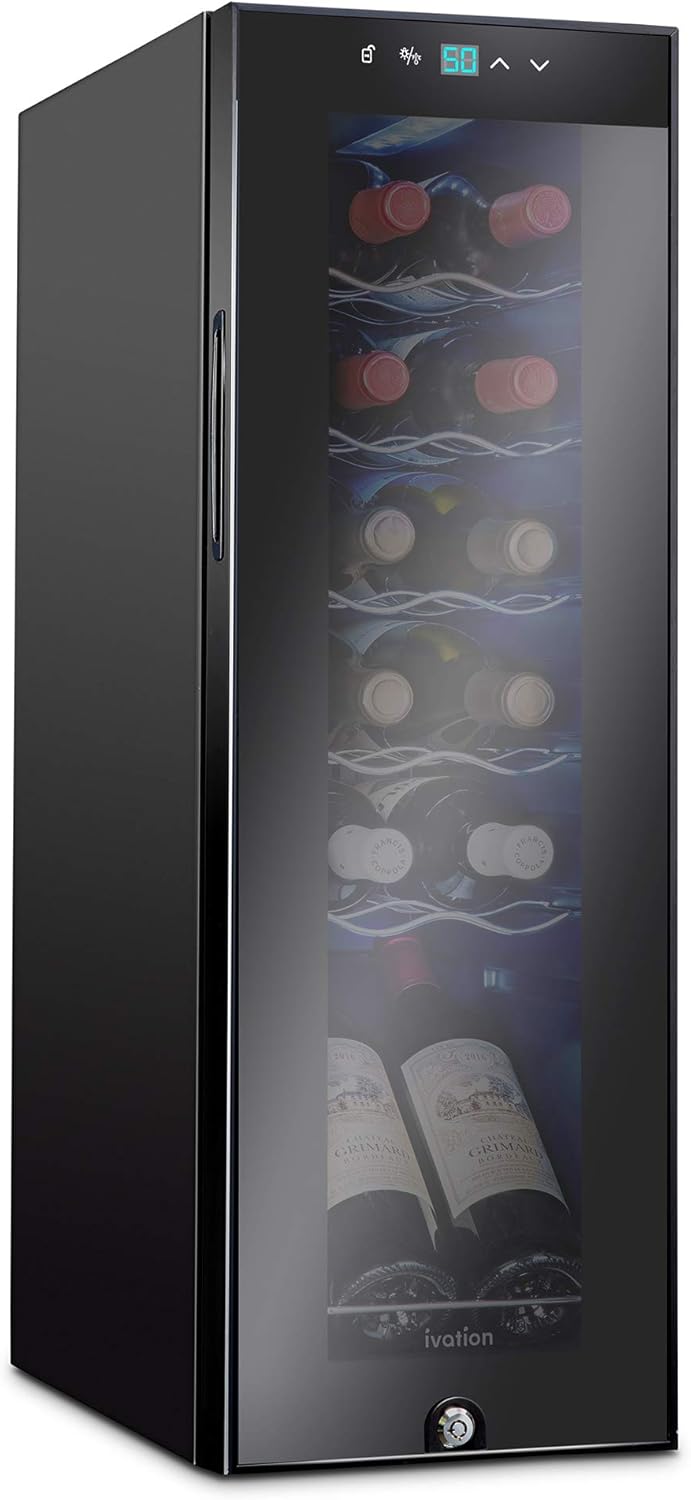
Ivation 12-Bottle Wine Cooler
| Capacity | 1.2 cubic feet |
|---|---|
| Temperature Range | 41-64°F |
| Power | 95W / 1.2 Amps |
| Cooling Method | Compressor |
| Refrigerant | R-600A |
This Ivation 12-bottle cooler uses a compressor cooling system and internal fan to hold a stable 41–64°F range, making it suitable for both chilling and longer-term storage. It installs freestanding and has six removable wire racks so you can fit standard 750 ml bottles or rearrange for larger formats. The digital touch display shows temperature in Fahrenheit or Celsius and can be locked to prevent accidental changes, while the double-paned UV-resistant glass and rubber gasket help keep light and air out. Vibration-reducing compressor operation preserves sediment and the interior LED provides soft illumination for inspections without harsh heat. As a compact unit it draws modest power (rated 95W) and includes a keyed lock for security. Limitations include a small 1.2 cu ft capacity that restricts larger fermentation batches and single-zone control that prevents separate temperature settings for multiple products. The unit is best when you need a reliable, quiet compressor fridge with precise temperature stability in a compact footprint rather than a higher-capacity or dual-zone system.
Best for: Buyers seeking a compact, performance-focused compressor fridge that holds steady temperatures for precise fermentation or small-batch aging and who prioritize stability and quiet operation.
Less Ideal for: Those who need higher capacity, multiple temperature zones, or to run several fermentations at different setpoints simultaneously should look at larger or dual-zone units.
- Compressor cooling with inverter ensures stable, low temperatures suitable for fermentation control.
- Wide adjustable temperature range (41–64°F) with digital touch controls and lock for set-and-forget operation.
- Double-paned UV-resistant glass and airtight gasket protect contents from light and external air.
- Removable wire racks allow flexible bottle arrangement and easier cleaning.
- Quiet, vibration-reducing operation that minimizes disturbance to sediments or sensitive contents.
- Small 1.2 cubic foot capacity limits the number and size of fermentation vessels you can fit.
- Single temperature zone cannot maintain different temperatures for multiple simultaneous projects.
Verdict: Choose this cooler when you want a compact, compressor-driven fridge that delivers stable, low-temperature control for small-batch fermentation and precision cooling.
EUHOMY Wine Cooler BR001-110

| Capacity | 3.2 cubic feet |
|---|---|
| Bottle capacity | Up to 25 standard 750ml bottles |
| Temperature range | 41°F to 64°F |
| Cooling method | Compressor |
| Door orientation | Reversible |
This EUHOMY wine cooler is a compact freestanding unit aimed at steady, long-term beverage storage. It uses a compressor cooling system with a 41 to 64°F temperature range controlled by a digital touchscreen, so you can keep reds, whites, and sparkling bottles at appropriate serving temperatures. The interior offers four chrome full-width racks, a flat shelf and a bottom compartment to fit up to 25 standard 750ml bottles and to reconfigure storage as needed. The double-layer thermopane glass door reduces temperature swings and blocks UV light, and soft LED lighting helps with visibility without harsh heat. Practical touches include adjustable leveling legs, a built-in handle and a reversible door for flexible placement under counters or freestanding in a bar or office. Expect manual defrosting and typical small-fridge energy use; for buyers prioritizing quiet, vibration-free operation the compressor is described as high-performance and low-vibration but compressor units can still be noisier than thermoelectric models. The unit is supported by a one-year warranty and arrives with a user manual for setup and operation.
Best for: Buyers who want a compact, reliable freestanding cooler for steady storage of a small to medium wine collection and value precise temperature control and flexible placement.
Less Ideal for: Those seeking a zero-maintenance built-in cellar replacement, ultra-low energy operation, or very large bottle capacity should consider larger or different-style units.
- Compressor cooling with a wide 41–64°F range for storing different wine styles
- Double-pane glass door that insulates and blocks UV to protect wine quality
- Adjustable shelves and mix of racks allow flexible storage up to 25 standard bottles
- Digital touchscreen control and internal LED lighting simplify temperature monitoring and viewing
- Reversible door and leveling legs make placement under counters or freestanding easier
- Manual defrost requires occasional user maintenance
- Annual energy consumption is relatively high compared with the smallest thermoelectric units
Verdict: A compact, compressor-cooled freestanding wine cooler that delivers precise temperature control and flexible storage for a small commercial or bar setting.
Ivation 18-Bottle Wine Cooler

| Capacity | 1.8 cubic feet |
|---|---|
| Bottle Capacity | 18 Bottle |
| Temperature Range | 41°F–64°F |
| Cooling Method | Compressor |
| Defrost System Type | Automatic |
The Ivation 18-Bottle Wine Cooler is a compact freestanding unit that uses a compressor and internal fan to keep temperatures steady between 41°F and 64°F, making it suitable for storing reds, whites, and sparkling wines. It typically sits on the floor or a countertop and is configured as a single-zone cooler with six wire racks that are removable to fit different bottle sizes. Notable features include a double-paned thermopane glass door that reduces UV exposure, a digital touch display with lock, soft LED interior lighting, and automatic defrost for low-maintenance operation. The compressor design and inverter help the cooler maintain set temperatures even when ambient room temperature fluctuates, which is valuable for long-term storage and reliability-focused buyers. Trade-offs are its single-zone layout, which does not allow separate temperatures for whites and reds, and modest capacity, which limits it to small collections or secondary storage. Energy consumption is moderate and the unit is intended as a dedicated wine fridge rather than a full-size cellar.
Best for: Buyers who prioritize a reliable, temperature-stable freestanding cooler for a small collection or secondary wine storage and want a low-maintenance unit with clear digital controls.
Less Ideal for: Collectors who need a large-capacity or dual-zone cellar for storing multiple wine types at different temperatures should consider larger or dual-zone models instead.
- Compressor cooling with internal fan for stable, consistent temperatures
- Double-paned thermopane glass door that helps block UV and insulates the interior
- Digital touch controls with lock and clear LCD for easy temperature management
- Removable wire racks accommodate different bottle sizes and simplify loading
- Single-zone design cannot maintain different temperatures for whites and reds
- Limited 18-bottle capacity may be too small for larger collections
Verdict: Choose this Ivation cooler when you want a compact, compressor-driven freestanding unit that keeps a small wine collection at stable, reliable temperatures.
Choosing the Right Quiet Single-Zone Wine Cooler: Key Factors to Consider
Noise Output and Acoustic Design
Quiet operation is the primary reason to choose a quiet single-zone wine cooler. Look for units with low-decibel ratings and design features that reduce sound transmission, such as insulated cabinets, rubberized compressor mounts, and variable-speed fans. Noise matters because continuous background hum or intermittent rattles can be irritating in open-plan homes and may indicate mechanical stress that shortens component life.
Consider where the cooler will live. A unit that is acceptably quiet in a garage might be disruptive in a living room. Also note that manufacturers often list noise at a single operating point; real-world noise can rise when the compressor cycles under heavy load or when the unit defrosts. Prioritizing acoustic design features will yield a cooler that blends into daily life and preserves the quiet environment needed for wine enjoyment.
Thermostat Accuracy and Temperature Stability
Temperature control is central to preserving wine. Single-zone coolers should maintain a steady setpoint within a narrow band to prevent repeated thermal expansion and contraction of the liquid, which stresses corks and ages wine prematurely. Look for models that report both set temperature and actual internal temperature, and that offer digital control with small increment adjustments.
Stability also means responding to door openings without long recovery times. A cooler that overshoots or takes hours to recover can expose bottles to harmful fluctuations. For buyers focused on longer-term storage, prioritize units with proven steady-state performance and clear calibration or offset settings.
Vibration Control and Shelving
Mechanical vibration can disturb sediment in older wines and accelerate chemical reactions. Effective vibration dampening comes from solid mounting of compressors, anti-vibration feet, and flexible shelving that isolates bottles from motor vibrations. Shelves matter because rigid or poorly supported racks transmit more vibration to bottles.
Also evaluate shelf layout: removeable or sliding shelves reduce handling and let you store different bottle shapes without forcing repeated shifting. For those storing a mix of standard and slightly wider bottles, look for adjustable shelving that keeps bottles secure while minimizing contact points that could transmit vibration.
Capacity and Interior Layout
Capacity should match how you actually collect and rotate wine. Single-zone units are often chosen for apartments or kitchens where space is limited, so usable capacity—how many standard 750 ml bottles fit comfortably—is more important than advertised gross liters. Consider whether capacity is optimized for horizontal storage with easy access, or if tall racks reduce effective count.
Interior layout affects organization and airflow. A cramped interior can block air movement and create hot or cold spots. Buyers should check shelf spacing and whether shelves slide out for easy loading. If you plan to store oversized bottles occasionally, ensure there is at least one adjustable shelf to accommodate them without compromising the rest of the load.
Ventilation and Installation Style
Single-zone wine coolers can be freestanding or built-in. Built-in models require front-facing ventilation so they can be enclosed in cabinetry without overheating. Freestanding units need a few inches of clearance along the sides and back for proper airflow. Poor ventilation increases compressor run time and noise and reduces temperature stability.
When installing in tight spaces, confirm manufacturer guidance for clearances and whether front-venting is available. Also think about electrical access and whether the unit will be placed on a level surface to prevent added vibration from uneven feet.
Energy Use and Continuous Operation Costs
Wine coolers run continuously, so energy efficiency affects long-term operating cost and household energy footprint. Look for units with efficient compressors, good insulation, and programmable standby or low-power modes. While energy labels and wattage give a snapshot, real-world consumption depends on ambient temperature, how often the door is opened, and how full the cooler is.
Efficient models often have better insulation and tighter seals, which also helps temperature stability and reduces compressor cycling. That means energy-conscious choices tend to support other buyer priorities like noise reduction and consistent cooling.
Where Quiet Single-Zone Coolers Work Best
Single-zone coolers excel when you need a dedicated, consistent environment for either whites or reds at a single serving temperature. They are ideal for small collections, secondary storage near a kitchen, or a compact cellar in an apartment. The simplicity of one temperature zone reduces complexity and the number of parts that can make noise or fail.
- Best for single-temperature storage where separate zones are unnecessary
- Good choice for open-plan living spaces because low noise keeps the area pleasant
- Works well as a serving cooler near dining areas or bars
Placement and Ventilation Tips
Correct placement makes a quiet cooler even quieter and extends component life. For built-in installations choose a front-venting model so the compressor does not have to pull air from inside the cabinet. For freestanding units leave the recommended clearance around the back and sides and avoid placing the cooler against a wall that can resonate sound.
If the cooler will sit on a hard floor, consider anti-vibration pads or a thin rubber mat to reduce transmitted noise. Avoid tight cupboards without ventilation. Regularly clean condenser coils and air intakes because dust buildup forces the compressor to run harder, raising noise and reducing temperature control.
- Use anti-vibration pads on hard surfaces
- Maintain recommended clearances for airflow
- Clean air intakes and coils every few months
How to Read Noise and Temperature Specs
Decibel ratings give a baseline but are measured in controlled conditions. A specification of 35 dB is relatively quiet; however real-world placement, floor materials, and ambient noise affect whether you notice it. When possible, prioritize anecdotal reports about steady low hum rather than intermittent clicking or rattling.
Temperature specs should include both setpoint range and reported accuracy. Look for models that specify stability over time or list degrees of variance at different ambient temperatures. Units that allow small incremental adjustments and show actual internal temperature are easier to calibrate to your preferred serving or storage point.
- Check both dB ratings and real-world user feedback
- Look for actual temperature readouts and fine control
- Beware of specs measured only under ideal test conditions
Maintenance to Keep a Cooler Quiet and Stable
Routine maintenance preserves quiet operation. Keep the condenser clean and dust-free, check door gaskets for tight seals, and ensure shelves are seated properly to avoid rattling. Periodically inspect anti-vibration mounts and the leveling feet to prevent new vibration paths that appear as the unit settles.
If a cooler develops new noises, trace loose panels, screws, or shelving first before assuming a compressor issue. Proper cleaning and basic upkeep will maintain both low noise and stable temperatures over years of use.
- Clean condenser coils twice a year
- Inspect door gaskets and replace if cracked
- Tighten loose shelving and check leveling feet
How We Chose the Best Quiet Single-Zone Wine Cooler
We focused on single-zone, low-noise wine coolers intended for household use and evaluated each model against measurable, buyer-relevant dimensions. Our process prioritized operational silence, temperature accuracy and stability, and vibration control because these directly affect wine preservation and tasting quality. We also considered usable storage capacity in standard 750 ml bottles, interior layout and shelving flexibility, and energy efficiency for continuous operation. Additional filters eliminated units that rely on noisy compressor designs without effective dampening, models with known temperature drift over time, and coolers with inadequate ventilation options for typical kitchen or built-in installation. We evaluated user-facing controls and display clarity, plus build quality and door sealing, because poor seals or flimsy racks can negate an otherwise quiet cooler. Units were excluded if they lacked clear temperature reporting, used multi-zone architectures, or were designed primarily for commercial usage rather than residential settings.
Our full evaluation process is outlined in our review methodology.
FAQ
Is a single-zone wine cooler good for both red and white wine?
Often a single-zone cooler is set to a compromise temperature or adjusted for the dominant style in your collection. It works well if you primarily drink one type or if you store bottles short-term. For long-term aging of both styles, separate dedicated storage at different temperatures is preferable.
How loud is too loud for a wine cooler in a living space?
It depends on the room, but continuous noise above roughly 40 dB may be noticeable in quiet living areas. Look for models rated in the mid-30s dB or lower and consider placement and anti-vibration measures to reduce perceived noise.
Do thermoelectric coolers run quieter than compressor units?
Thermoelectric units are often quieter under light loads, but they struggle with heat removal in warmer environments and with larger capacities. Compressor units typically provide stronger, more stable cooling and may still be quiet if they include effective vibration damping and insulation.
How should I position wine bottles to minimize temperature variation?
Store bottles horizontally and avoid crowding the interior. Leave some space around the door area for airflow, and place wines you access frequently near the front to reduce long open-door events that cause temperature swings.
Can vibration really affect wine quality?
Yes, persistent vibration can disturb sediment and accelerate chemical reactions in wine, subtly altering flavor and aging. For most everyday bottles the effect is small, but for older or bottled wines intended for long-term aging, minimizing vibration is more important.
Final Verdict
For small collections and household use, prioritize units that combine low operational noise, reliable temperature stability, and good vibration control. Match capacity and shelving layout to how you store bottles now and in the near future, and select an installation style that allows proper ventilation. Regular maintenance and correct placement further extend quiet performance and cooling reliability. Focus on these tradeoffs to choose the single-zone, quiet wine cooler that best preserves your bottles while fitting unobtrusively into your home.