
Note: This article contains affiliate links. If you click on these links and make a purchase, we may earn a small commission at no extra cost to you. This helps support our research and content. Read our full affiliate disclosure here.
If you want cleaning that happens without interrupting naps, conference calls, or evening relaxation, a quiet robot vacuum is the right tool. You need a machine that balances low operational noise with effective dirt removal and dependable navigation so you do not trade quiet for poor cleaning. This guide brings together the top shortlisted options in the quiet robot vacuum category and explains the practical tradeoffs involved. Below we cover how each model performs on noise, suction, mapping, and battery life so you can pick a unit that fits your living situation and tolerance for sound. Read on for quick takeaways and the evaluation criteria used to assemble this list.
Top Picks at a Glance
| Best Overall The best all-around choice for most situations | iRobot Roomba 105 Vac |  |
| Best Quality Built to a higher standard if you want something more solid | roborock Saros 20 |  |
| Best Budget The cheapest option that still gets the job done reliably | ILIFE V5s Plus Robot Vacuum |  |
| Top Rated A top-rated pick with lots of positive feedback | Shark AI Ultra AV2501AE |  |
| Most Popular A crowd favorite that many people choose with confidence | ROPVACNIC S1 Robot Vacuum |  |
| Best Seller A high-volume bestseller chosen again and again | eufy 11S Max Robot Vacuum |  |
iRobot Roomba 105 Vac

| Surface Recommendation | Carpet & Hard Floor |
|---|---|
| Other Special Features of the Product | Anti-Fall, Bagless, Dirt Detection Sensor, Eco Mode, LiDAR Navigation |
| Controller Type | App Control, Button Control, Voice Control |
| Battery Life | 200 minutes |
| Filter Type | Cartridge |
The Roomba 105 Vac is a straightforward robot vacuum that uses ClearView LiDAR to map rooms and navigate efficiently while avoiding obstacles and stairs. It applies a three-stage cleaning system with a multi-surface bristle brush and an edge-sweeping brush plus selectable suction levels so you can dial in stronger cleaning for high-traffic areas or quieter runs for daily maintenance. Setup and control are simple via the Roomba Home App or voice assistants, and the robot returns to its dock to recharge and resume cleaning when necessary. Practical benefits include reliable room-to-room coverage, customizable schedules and keep-out zones, and long battery life that supports extended cleaning sessions. The main limitations are its basic accessory set—no automatic bin emptying or mopping—and it lacks some advanced mapping features found on higher-end models, so users wanting the most granular room mapping or hands-free debris disposal may prefer an upgraded unit.
Best for: Buyers who want a balanced, easy-to-use robot vacuum that reliably cleans carpets and hard floors with smart mapping and app/voice controls without paying for premium extras.
Less Ideal for: Households that need hands-free bin emptying, integrated mopping, or the most advanced multi-floor mapping features should consider higher-tier models instead.
- ClearView LiDAR mapping for efficient navigation and obstacle avoidance
- Three-stage cleaning with multi-surface and edge-sweeping brushes
- App and voice control with scheduling and keep-out zone options
- Long battery life that allows extended cleaning and auto-recharge/resume
- No hands-free auto-empty dock included
- Does not include a mopping function
Verdict: A practical, well-rounded robot vacuum that balances strong mapping, customizable cleaning, and long runtime for everyday quiet cleaning needs.
roborock Saros 20

| Suction | 36,000 Pa |
|---|---|
| Battery Life | 180 minutes |
| Filter Type | Washable Filter |
| Noise Level | 55 db |
| Control | App, Remote, Voice |
The roborock Saros 20 is a performance-focused robot vacuum that pairs a very powerful 36,000 Pa digital motor with StarSight 3D navigation and an adaptable lift chassis to handle thresholds, carpets, and low-clearance furniture. In everyday use it maps rooms with RGB and ToF sensors to avoid more than 300 obstacles, follows learned cleaning schedules in the app, and can vacuum then mop with its FlexiArm side brush and extendable mop for edge-to-edge coverage. The included RockDock automates mop washing with hot-water cleaning, hot-air drying, and extended auto-dust emptying so routine maintenance is largely hands-free. Practical benefits include strong deep-cleaning suction for pet hair, the ability to cross high thresholds without getting stuck, and a slim profile to clean under sofas. Important trade-offs are size and noise: the unit is relatively heavy and listed noise is 55 dB in normal use, and the full RockDock system adds footprint and complexity compared with simpler docks. App and smart-home features require a network connection for the full experience.
Best for: Buyers who prioritize raw cleaning performance, reliable obstacle avoidance, and hands-free maintenance for homes with pets, stairs, or varied floor heights.
Less Ideal for: People who need the absolute quietest robot for small apartments or who lack space for a larger automated dock should consider smaller, lower-footprint models instead.
- Extremely strong 36,000 Pa suction for deep cleaning and pet hair removal
- Advanced 3D navigation and RGB camera that recognize and avoid many obstacles
- AdaptiLift chassis crosses high thresholds and lifts for carpet cleaning without manual intervention
- RockDock offers automated hot-water mop washing, hot-air drying, and long auto-empty intervals
- Slim 3.13 in profile reaches under low furniture to reduce missed dust
- Listed noise level around 55 dB means it is not the quietest model available
- Large dock and heavier robot increase the overall footprint compared with compact options
Verdict: Choose the Saros 20 if you want top-tier suction, advanced obstacle avoidance, and a heavily automated dock for low-maintenance, high-performance cleaning.
ILIFE V5s Plus Robot Vacuum

| Battery Life | 110 minutes |
|---|---|
| Capacity | 300 ml |
| Controller Type | App, Voice, Remote |
| Surface Recommendation | Hard Floor, Carpet |
The ILIFE V5s Plus is a budget-friendly robot vacuum that pairs basic vacuuming with a simple mop function for everyday floor maintenance. It offers five cleaning modes (auto, spot, edge, max and scheduled), runs up to about 110 minutes on a charge, and automatically returns to its charging base. Control options include the dedicated remote, the mobile app and voice commands through compatible smart speakers, which makes it easy to start or schedule cleaning without interacting directly with the unit. The low-profile design helps it slide under furniture and the 300 ml dustbin/water tank supports short cleaning sessions without frequent emptying. For quiet daily use it is a reasonable choice, though suction and navigation are modest compared with higher-end models and the combined vacuum/mop is better for light mopping than heavy scrubbing. Expect more manual maintenance for brushes and sensors and limited performance on high-pile carpet or deep pet-hair cleanup.
Best for: Buyers seeking a quiet, affordable robot that handles everyday dust, light pet hair and occasional mopping with easy app or voice control.
Less Ideal for: Households that need strong deep-clean suction, advanced mapping/navigation, or heavy-duty mopping should consider higher-tier models instead.
- Combined vacuum and mop for routine floor care
- Five cleaning modes and scheduling via app or remote
- Runs up to 110 minutes and auto-docks to recharge
- Works with voice assistants for hands-free control
- Slim profile for cleaning under low furniture
- Suction and navigation are basic compared with premium models
- 300 ml bin/tank means more frequent emptying on larger homes
- Mop function suited to light mopping rather than deep stains
Verdict: A budget-friendly, quiet robot that combines gentle vacuuming and light mopping for routine maintenance in small to medium homes.
Shark AI Ultra AV2501AE

| Filter Type | HEPA |
|---|---|
| Battery Life | 120 minutes |
| Other Special Features of the Product | Bagless, LiDAR Navigation |
| Control Method | Voice |
| Compatible Devices | Amazon Echo, Google Home |
The Shark AI Ultra AV2501AE is a lidar-guided robot vacuum that maps rooms and runs methodical, multi-pass cleaning cycles to remove dirt and pet hair from carpets and hard floors. It pairs with an app and voice assistants so you can schedule cleans or start jobs by voice, and its Matrix Clean Navigation uses LiDAR to build precise room maps and avoid obstacles day or night. The robot docks into an XL bagless self-empty base with true HEPA filtration rated for about 60 days of capacity, which keeps dust and allergens contained between emptying. Runtime is up to 120 minutes with recharge-and-resume for larger homes, and a self-cleaning brushroll helps reduce hair wrap. Trade-offs include a heavier base and robot footprint compared with compact models and likely higher operating noise than ultra-quiet designs due to strong suction needed for deep cleaning, so it prioritizes cleaning power and reliability over whisper-quiet operation.
Best for: Buyers who prioritize consistent, low-maintenance cleaning and want a dependable robot that handles pet hair and whole-home routines with minimal intervention.
Less Ideal for: Anyone whose top priority is the absolute quietest operation or who needs a very compact dock footprint for tight spaces.
- LiDAR-based precision mapping for methodical, repeatable cleaning paths
- XL bagless self-empty base with HEPA filtration holds ~60 days of debris
- Up to 120 minutes runtime with recharge-and-resume for whole-home coverage
- Self-cleaning brushroll reduces hair wrap, helpful for pet owners
- App and voice control for scheduled or hands-free operation
- Stronger suction and self-emptying mechanism make it louder than ultra-quiet models
- Larger robot and base take more floor and storage space than compact vacuums
Verdict: Choose this Shark if you want a reliable, self-emptying robot that delivers consistent deep cleaning and low-maintenance operation for pet-filled homes.
ROPVACNIC S1 Robot Vacuum
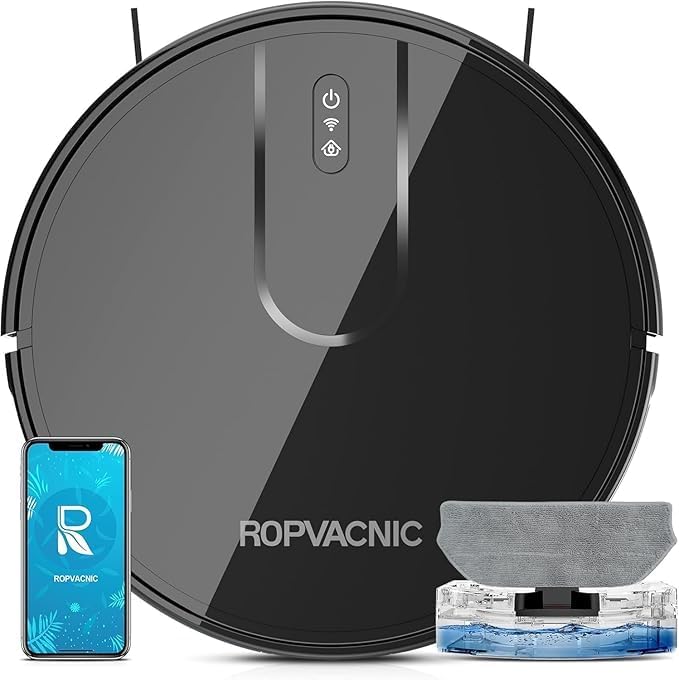
| Suction | 5200Pa |
|---|---|
| Battery life | 120 minutes |
| Filter type | Multi-layer high-efficiency filtration |
| Surface recommendation | Hardwood floors, low pile carpets |
| Form factor | Round |
The ROPVACNIC S1 is a 2-in-1 robot vacuum and mopping unit designed for daily floor maintenance on hard floors and low-pile carpets. It combines a 5200Pa suction system, dual rotating side brushes, and a no-entanglement design to pick up pet hair and debris while a controllable electric water tank supports light mopping with four water levels. You control cleaning via the app, remote, touchpad, or voice assistants, set schedules, and let the S1 return to its base automatically when battery drops below 20%. The low 2.99-inch profile helps it reach under furniture and the 4400mAh battery supports up to about two hours of runtime for larger areas. Practical benefits include hands-free scheduling, effective pet-hair pickup without frequent brush maintenance, and adjustable mopping intensity for different messes. Limitations to consider are that mopping is best for light stains rather than soaking or deep scrubbing, and advanced navigation may still struggle in very cluttered rooms where manual intervention is needed.
Best for: Buyers who prioritize an automated, low-maintenance robot that handles vacuuming plus light mopping and who value multiple control options and pet-hair performance.
Less Ideal for: Homes that need heavy wet mopping, deep stain removal, or extremely precise room-mapping navigation should consider a dedicated mop or higher-end mapping robot instead.
- Strong 5200Pa suction for better debris pickup
- Electric water tank with four adjustable mopping levels
- Multiple control options including app and voice assistants
- Low 2.99" profile fits under furniture and tight gaps
- Long 120-minute runtime for extended cleaning sessions
- Mopping function is for light maintenance rather than heavy stains
- Navigation can require occasional human intervention in very cluttered spaces
Verdict: Choose the ROPVACNIC S1 if you want a quiet, hands-off robot that reliably vacuums and provides adjustable light mopping with strong suction and solid pet-hair performance.
eufy 11S Max Robot Vacuum
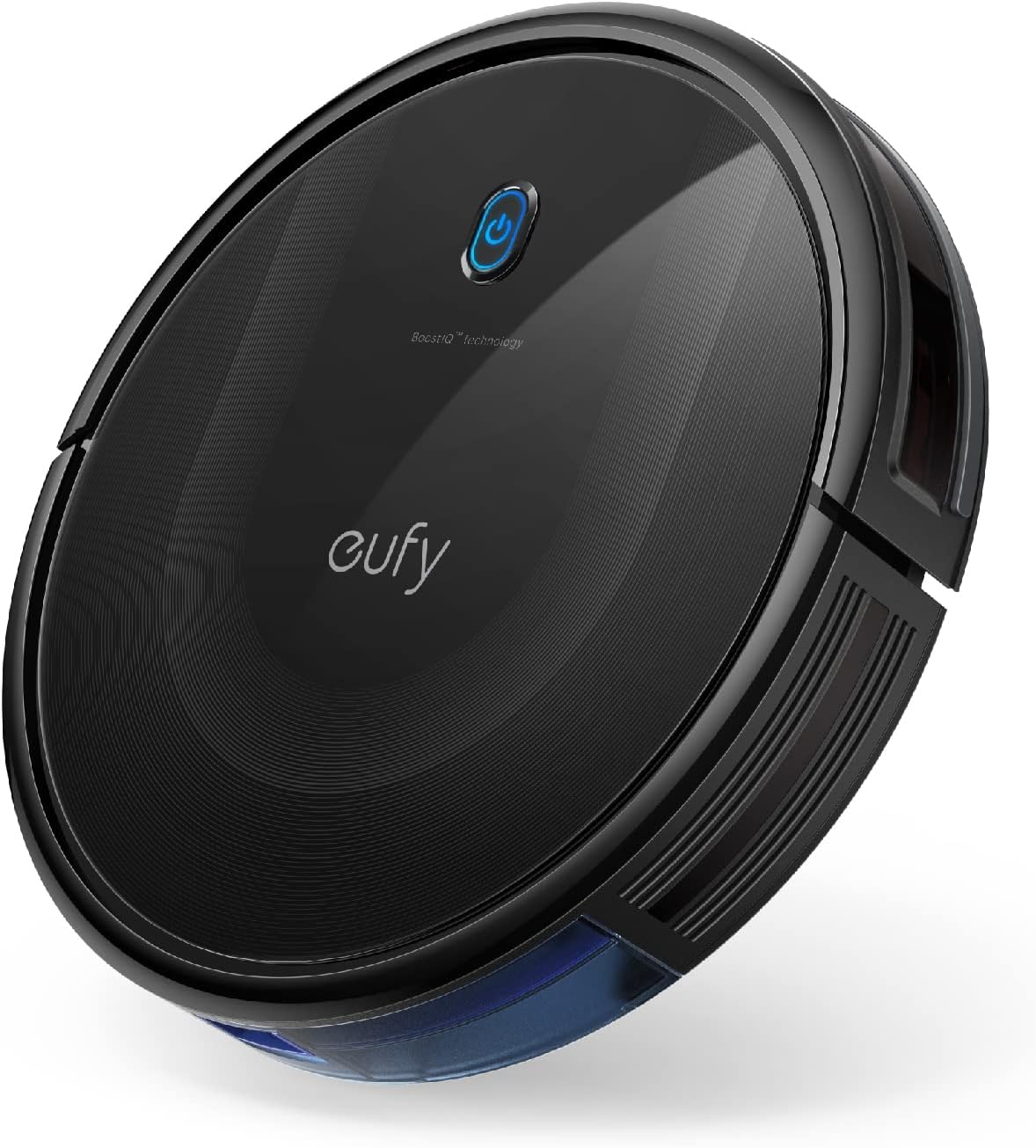
| Surface Recommendation | Hard Floor & Tile & Medium carpet |
|---|---|
| Battery Life | 100 minutes |
| Suction Power | 2000 Pa |
| Capacity | 600 ml |
| Noise Level | 55 db |
The eufy 11S Max is a low-profile robot vacuum built to clean hard floors and medium-pile carpets without drawing attention. Its 2.85-inch slim body lets it slide under low furniture while 2000Pa suction and a 12.8-inch cleaning path pick up dust, crumbs, and pet hair. It runs up to 100 minutes on hardwood at a reported low 55 dB, and automatic return-to-base means it tops off battery without user intervention. Controls are simple: the included remote and onboard buttons let you start, stop, and switch modes quickly, though there is no Wi-Fi or app control. Practical touches include washable filters, drop-sensing and anti-collision sensors, and a 600 ml dust capacity that reduces how often you empty the bin. The trade-offs are straightforward: navigation is basic rather than lidar or map-based, so room coverage is more random and may miss tight corners, and the single-side-brush design can be less thorough along edges compared with dual-brush models. For routine, quiet cleaning of hardwood, the 11S Max balances strong suction and a slim profile in a simple, reliable package.
Best for: Buyers who prioritize a quiet, no-frills robot that cleans hardwood reliably and fits under low furniture will appreciate this model for regular maintenance cleaning.
Less Ideal for: If you want mapped cleaning, smartphone scheduling, or the most thorough edge-cleaning for complex floorplans, choose a model with advanced navigation and app control instead.
- Slim 2.85" profile reaches under low furniture
- Up to 100 minutes runtime for extended cleaning sessions
- Powerful 2000Pa suction for effective pickup on hard floors
- Quiet operation at about 55 dB suitable for daytime or evening use
- Large 600 ml dust capacity and washable filter lower maintenance frequency
- Random navigation rather than mapping can lead to uneven coverage
- No Wi‑Fi or smartphone app means limited scheduling and remote control options
Verdict: A slim, quiet robot with strong suction made for routine hardwood maintenance when you want reliable, no-frills cleaning.
Choosing the Right Quiet Robot Vacuum: Key Factors to Consider
Operational Noise (Decibels and Perceived Loudness)
Noise specs matter because a low decibel rating usually means the vacuum will not interrupt conversations, sleep, or quiet hours. Look for both manufacturer decibel figures and independent noise tests when possible, since measured numbers give a baseline comparison. Remember that perceived loudness is affected by frequency as well as volume. A suction motor that emits higher-pitched whine can feel louder than a lower-frequency hum at the same dB level.
Consider the unit's noise at different power settings. Many quiet robot vacuums achieve acceptable cleaning on a low or eco mode that is significantly quieter than max power. If you plan to run the robot while home, prioritize models with a dedicated quiet or night mode and user controls to fine-tune suction versus sound.
Cleaning Performance at Low Power
How well the vacuum cleans when running quietly is the central tradeoff for this category. Effective low-power cleaning depends on brush design, airflow efficiency, and the ability to maintain suction over time. A model that only achieves silence by throttling suction too far will leave behind pet hair and settled debris.
Examine evidence of pickup across multiple floor types, including area rugs, bare floors, and threshold crossings. If you have pets or heavy soiling, require a machine that can still switch to higher power for spot cleaning while preserving quiet baseline cycles for regular maintenance.
Navigation and Route Efficiency
Navigation directly affects both cleaning quality and how long the robot runs. A well-mapped route means fewer repeated passes and shorter overall runtime, which reduces cumulative noise exposure. Look for mapping systems and sensors that create stable floor plans and avoid dithering behaviors like repeated backing up, bumping, or getting stuck.
Efficient navigation also helps in multi-room homes because the robot can prioritize rooms and return to base without prolonged searching. For quiet operation, fewer collisions and smoother turns translate into less abrupt impact noise and a more discreet cleaning cycle.
Battery Life and Runtime at Quiet Settings
Battery capacity matters differently for quiet-focused use. Running on lower power typically extends runtime, but not all batteries deliver consistent power long enough to finish typical cleaning jobs. Check expected runtime at the quieter modes rather than at maximum suction, since that is the mode you will use most often for silent cycles.
Also consider recharge behavior and whether the robot resumes and completes an interrupted cycle. A robot that needs multiple short charges to finish a home increases total cleaning time and produced noise over several sessions.
Maintenance and Filter/Brush Upkeep
Easier upkeep keeps performance high while reducing the need for louder spot-cleaning sessions. Tangle-resistant brush designs, washable filters, and accessible dustbins mean you can maintain suction efficiency without frequent aggressive cleaning that generates more noise. Poor maintenance accelerates clogging and forces the robot to run harder to achieve the same result.
Consider how often consumables need replacement and how straightforward routine tasks are, like clearing hair from the brush roll or emptying the bin. Lower-effort maintenance reduces the risk of performance drift that would otherwise push owners into higher, noisier cleaning modes.
How Quiet Modes Change Real-World Cleaning
Quiet modes typically reduce motor speed and suction, which lowers noise but can also reduce pickup efficiency on dense carpet. In practice, many units perform well for daily surface maintenance at lower settings and still permit targeted high-power passes when needed.
Use quiet mode for scheduled everyday cleaning and reserve boosted settings for weekly deep cleans or problem areas. This dual strategy gives you the benefit of discreet daily maintenance while preserving the ability to handle tougher messes.
- Quiet mode for daily surface maintenance
- Boosted power for targets or heavy soils
- Schedule quiet cycles during low-activity hours
Placement and Docking Tips to Reduce Disturbance
Where you place the charging base and route barriers influences how the unit moves and how often it triggers collision sounds. Put the dock on a solid, level surface away from high-traffic areas and soft furnishings that can amplify noise.
Use virtual barriers or no-go zones to avoid areas that cause frequent bumping and turning. This reduces abrupt impact noises and shortens the cleaning cycle by preventing the robot from wasting time in problematic spots.
- Dock on firm flooring, not squeaky wood
- Keep the area around the dock clear for smooth docking
- Use virtual walls to avoid repetitive collisions
Flooring Types and Expected Outcomes
Hard floors generally allow the quietest operation and the best pickup at lower suction levels. Brushes and suction interact differently with carpets, and thicker rugs will need higher power to lift embedded dirt. If your home is mainly hard surfaces, you can expect the quietest, most efficient cycles.
For mixed-floor homes, choose a model with adaptive suction or room-specific settings so it can raise power only where necessary. This targeted use keeps most of the cycle quiet while still addressing tougher areas when encountered.
- Hard floors: best quiet performance
- Low-pile rugs: decent pickup on quiet modes
- High-pile carpets: likely need boosted passes
Scheduling and Smart Home Integration
Program scheduled cleanings during times when ambient noise masks the robot, such as midday activity or early evening when family members are away from quiet tasks. Scheduling keeps floors maintained without manual intervention.
If you use voice assistants or home automation routines, integrate the robot so it runs only when occupants are less likely to be disturbed. Smart features that pause on command or switch modes remotely let you keep control without interrupting ongoing quiet cycles.
- Schedule quiet cycles during low-activity windows
- Use remote controls to switch modes without manual interaction
- Pair with routines that avoid running during sensitive hours
How We Chose the Best Quiet Robot Vacuum
We focused on models engineered for reduced operational noise without sacrificing core cleaning abilities. Our selection filters prioritized measurable sound output and features that lower perceived noise, then filtered for strong cleaning and navigation performance in typical home layouts. Evaluation criteria included laboratory and manufacturer-listed decibel ratings when available, suction and brush design that influence debris pickup at lower power settings, mapping and navigation stability to avoid repeated passes, and battery life that sustains full cleaning cycles at quieter power modes. We excluded units that relied solely on small form factors or marketing claims for quiet operation but lacked evidence of effective cleaning at low-power settings. We also set aside products with inconsistent navigation or frequent error reports, since repeated retries increase runtime noise. The final picks balance verified low-noise performance, cleaning effectiveness across floor types, smart mapping and obstacle avoidance, reasonable battery life for realistic home sizes, and user controls that let owners tune noise versus performance.
Our full evaluation process is outlined in our review methodology.
FAQ
How many decibels is considered 'quiet' for a robot vacuum?
Quiet robot vacuums often operate in the mid-50s decibel range on low settings. Perceived quietness depends on frequency content and duration, so a lower dB rating is helpful but not the only factor to consider.
Will a quiet robot vacuum clean carpets as well as hardwood floors?
Quiet modes generally perform best on hard floors. Low-pile rugs may clean acceptably, but thick carpets usually require higher suction to remove embedded dirt, which increases noise. Look for models with adaptive suction or a boost option for carpets.
Can I schedule quiet cleaning while I am working from home?
Yes, scheduling quiet cycles during predictable low-activity times can keep floors managed without frequent interruptions. Choose a model with customizable quiet modes and adjust the timing if you find certain hours still conflict with meetings or calls.
How often do I need to clean brushes and filters to keep noise down?
Regular maintenance every one to three weeks is common, depending on pet hair and debris levels. Clogged brushes and filters force the motor to work harder and can raise noise and reduce cleaning efficiency.
Do quieter vacuums have shorter battery life?
Not necessarily. Running at lower power usually extends runtime, but overall battery life depends on battery capacity and efficiency. Check runtime figures for quiet modes rather than only maximum suction runtime.
Final Verdict
Prioritize measured noise output and real-world quiet-mode cleaning when choosing a quiet robot vacuum. Balance your tolerance for low-level background noise against the need for effective pickup on the floor types in your home. Navigation reliability and maintenance ease matter as much as raw decibel figures because they influence how long and how often the robot runs. If you favor minimal disruption, select a unit with dedicated quiet settings, proven pickup at lower power, and stable mapping so the device finishes cycles without repeated retries. That combination delivers the most consistent, low-noise cleaning experience for everyday living.