
Note: This article contains affiliate links. If you click on these links and make a purchase, we may earn a small commission at no extra cost to you. This helps support our research and content. Read our full affiliate disclosure here.
If you store wine at home, noise and vibration can quietly undermine bottle aging and drinking quality. A quiet wine cooler reduces audible hum and mechanical vibration while keeping a steady temperature and humidity for long-term storage or daily chilling. This guide highlights the top shortlisted options across styles and capacities, focusing on low-decibel performance, temperature accuracy, and gentle handling of corked bottles. You will find models suited for a cellar-like environment, undercounter installation, or freestanding placement. Read on to see how we evaluated each cooler and which features matter most for whisper-quiet wine storage.
Top Picks at a Glance
| Best Overall The best all-around choice for most situations | Tylza 24" Dual Zone Wine Refrigerator |  |
| Best Quality Built to a higher standard if you want something more solid | Whynter 100-Bottle Wine Refrigerator BWR-1002SD |  |
| Best Value The sweet spot between price and what you get | Feelfunn 4.5 Cu Ft Wine Cooler |  |
| Top Rated A top-rated pick with lots of positive feedback | Ivation 12-Bottle Wine Cooler |  |
| Most Popular A crowd favorite that many people choose with confidence | Antarctic Star 3.2 Cu. Ft Wine Cooler |  |
| Best Seller A high-volume bestseller chosen again and again | EUHOMY 18L Wine Fridge |  |
Tylza 24" Dual Zone Wine Refrigerator

| Capacity | 4.2 cubic feet |
|---|---|
| Temperature range left zone | 35-50°F |
| Temperature range right zone | 41-64°F |
| Annual energy consumption | 163 kilowatt hours per year |
| Installation type | Under-Counter/Freestanding/Built-In |
This Tylza 24" dual-zone fridge is a focused beverage chiller for households or small bars that need separate temperature control for wine and drinks. It provides two independently controlled cooling zones with adjustable ranges (left 35–50°F, right 41–64°F) and a touch control panel with temperature memory to restore settings after power interruptions. The unit fits under counters or works freestanding and offers a mix of metal and wood shelving that can be rearranged to fit bottles or stacks of 12‑oz cans, with the manufacturer listing capacity for about 20 Bordeaux bottles and 88 cans. A rotary scroll inverter compressor and fan circulation aim for even cooling while running quietly under 38 dB, and the double-layered glass door plus a keyed lock help protect stored bottles. Practical limits include a moderate 4.2 cu ft capacity that will not suit large collections and a 24" footprint that requires planning for built-in installation; buyers should also expect typical compressor vibration and longer pull-down times compared with commercial blast chillers. For a performance-focused mini fridge that balances low noise, dual zones, and flexible shelving, this is a sensible option.
Best for: Buyers who prioritize precise temperature control and low-noise operation for mixed wine and beverage storage in a home bar or under-counter setup.
Less Ideal for: Those needing large-capacity cellars or professional rapid-cooling performance for high-volume commercial use should look elsewhere.
- Independent dual cooling zones with specific temperature ranges for wine and beverages
- Quiet inverter compressor design operating under 38 dB for low noise environments
- Touch control with temperature memory restores settings after power outages
- Flexible metal and wood shelving that can be removed or rearranged to fit bottles and cans
- Built-in or freestanding installation options for versatile placement
- 4.2 cubic foot capacity limits the number of bottles for serious collectors
- Not a rapid commercial-style cooler so pull-down times may be slower than specialty units
Verdict: Choose this fridge when you want a quiet, dual-zone under-counter cooler that keeps wine and cans at independently controlled serving temperatures.
Whynter 100-Bottle Wine Refrigerator BWR-1002SD

| Capacity | 9.7 cubic feet / 100 bottles |
|---|---|
| Temperature Range | 40F – 65F (5C – 18C) |
| Cooling Method | Compressor with fan-forced circulation |
| Shelves | 12 removable wooden flat slide out shelves |
| Voltage / Power | 115V / 120 watts |
The Whynter BWR-1002SD is a large-capacity single-zone wine refrigerator that holds up to 100 standard 750ml bottles (90 with the display shelf) and can be used built-in or freestanding. It uses a compressor-based cooling system with internal fan-forced circulation and an adjustable thermostat that covers roughly 40F to 65F, so it can maintain serving and storage temperatures for reds, whites, and sparkling wines. Notable features include tempered double-pane UV-protected glass, reversible stainless steel-trimmed door with a lock, interior LED lighting, and 12 removable wooden-faced slide-out shelves plus a display shelf for open bottles. In practice the unit delivers stable, even temperatures and the compressor cooling is robust for a large load, though compressor models usually run quieter than small fans but louder than high-end thermo-electric units. Installation is flexible thanks to front ventilation for flush mounting. Expect solid performance for collectors who prioritize capacity and reliable temperature control, but be aware it is a sizable, heavier appliance and it consumes mains power continuously.
Best for: Collectors who prioritize reliable compressor cooling and large single-zone storage for hundreds of bottles and want flexible built-in or freestanding installation.
Less Ideal for: People seeking the absolute quietest, vibration-free cellar or a compact unit for small spaces should consider smaller or specialist low-noise models instead.
- Very large 100-bottle capacity suitable for serious collections
- Compressor cooling with fan-forced circulation provides even, stable temperatures across the cabinet
- Tempered double-pane glass with UV protection helps shield wines from light exposure
- Front ventilation allows built-in or freestanding installation
- Includes lock, interior LED lighting, and removable slide-out shelves for easy organization
- Compressor-based systems can produce more audible noise and vibration than premium quiet models
- Physically large and heavy, requiring planning for placement and installation
Verdict: Choose the Whynter BWR-1002SD if you need a large, dependable compressor wine cooler that maintains even temperatures and fits flush for built-in or freestanding installation.
Feelfunn 4.5 Cu Ft Wine Cooler

| Capacity | 4.5 cubic feet |
|---|---|
| Temperature Range | 34–64°F |
| Cooling Method | Compressor |
| Defrost Type | Manual Defrost |
| Refrigerant | R-600A |
The Feelfunn 4.5 Cu Ft Wine Cooler is a freestanding beverage refrigerator built to store wine, beer, and soda at controlled temperatures. It uses a compressor cooling system and a 34–64°F range (listed as 34–64°F/40–61°F in places) with digital up/down controls and an LED display for simple adjustments. Six adjustable full-width shelves and a double-layer UV-protective glass door make it easy to organize bottles and cans while helping keep temperatures stable. Noise is a highlight here; the unit is rated below 38 dB in product copy which makes it suitable for bedroom or office placement where low hum matters. Practical touches include manual defrost, an interior LED light, and R-600A refrigerant. Important compromises are typical of compressor mini-fridges: it consumes moderate energy (the listing shows high annual kWh) and requires freestanding installation and space for ventilation, and manual defrost means occasional maintenance. For buyers prioritizing a quiet, compact cooler with straightforward temperature control and flexible shelving, this performs well in everyday home use.
Best for: Buyers who want a quiet, compact wine cooler with straightforward temperature controls and flexible shelving for everyday storage in shared living spaces.
Less Ideal for: People who need a completely maintenance-free or ultra-low-energy cooler for constant heavy-duty commercial use should consider other options.
- Quiet compressor operation rated under 38 dB, suitable for bedrooms and offices
- Adjustable full-width shelves that accommodate bottles and cans
- Double-layer glass door with sealing strip for improved temperature stability
- Simple digital ▲/▼ temperature control and interior LED light for visibility
- Manual defrost requires periodic maintenance
- Relatively high reported annual energy consumption compared with small thermoelectric units
Verdict: A quiet, practical freestanding wine cooler that balances low-noise operation and flexible shelving for home use.
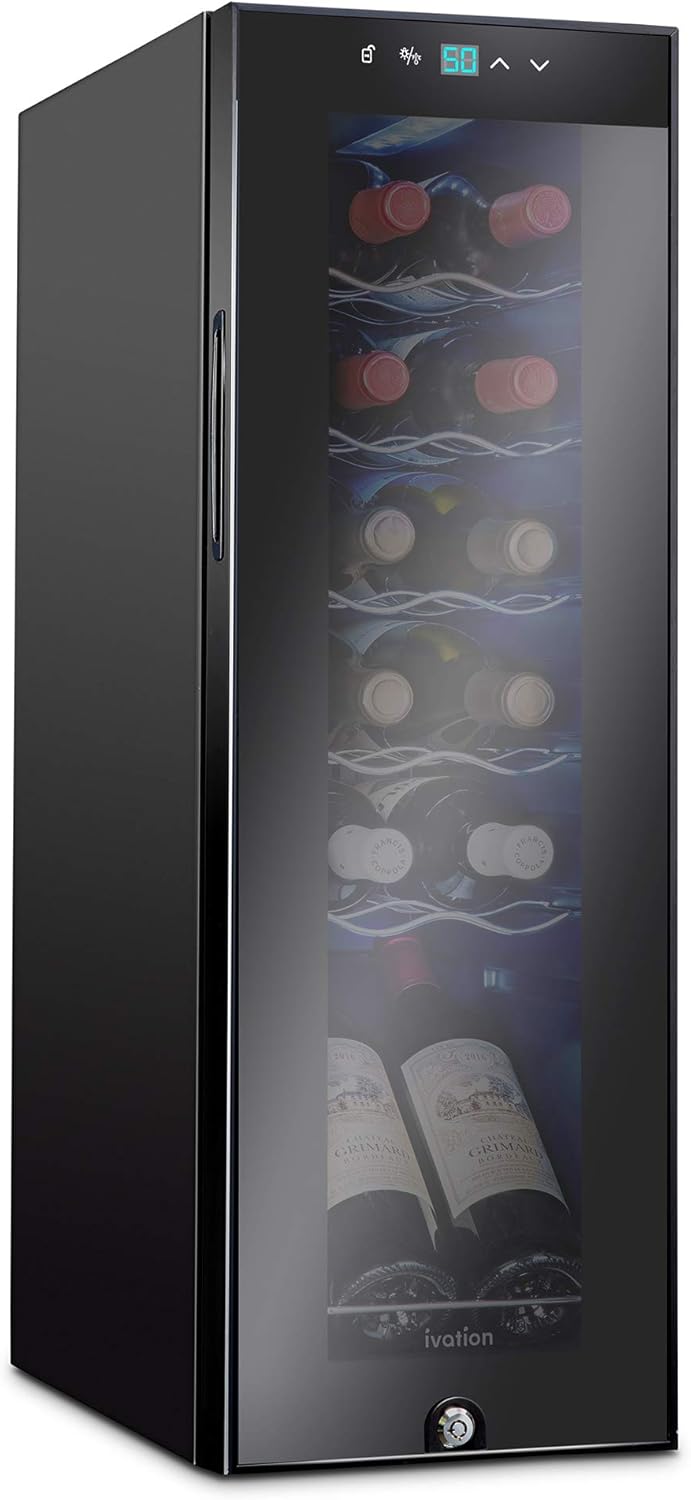
Ivation 12-Bottle Wine Cooler
| Capacity | 1.2 cubic feet |
|---|---|
| Temperature Range | 41-64°F |
| Power | 95W / 1.2 Amps |
| Cooling Method | Compressor |
| Refrigerant | R-600A |
This Ivation 12-bottle cooler uses a compressor cooling system and internal fan to hold a stable 41–64°F range, making it suitable for both chilling and longer-term storage. It installs freestanding and has six removable wire racks so you can fit standard 750 ml bottles or rearrange for larger formats. The digital touch display shows temperature in Fahrenheit or Celsius and can be locked to prevent accidental changes, while the double-paned UV-resistant glass and rubber gasket help keep light and air out. Vibration-reducing compressor operation preserves sediment and the interior LED provides soft illumination for inspections without harsh heat. As a compact unit it draws modest power (rated 95W) and includes a keyed lock for security. Limitations include a small 1.2 cu ft capacity that restricts larger fermentation batches and single-zone control that prevents separate temperature settings for multiple products. The unit is best when you need a reliable, quiet compressor fridge with precise temperature stability in a compact footprint rather than a higher-capacity or dual-zone system.
Best for: Buyers seeking a compact, performance-focused compressor fridge that holds steady temperatures for precise fermentation or small-batch aging and who prioritize stability and quiet operation.
Less Ideal for: Those who need higher capacity, multiple temperature zones, or to run several fermentations at different setpoints simultaneously should look at larger or dual-zone units.
- Compressor cooling with inverter ensures stable, low temperatures suitable for fermentation control.
- Wide adjustable temperature range (41–64°F) with digital touch controls and lock for set-and-forget operation.
- Double-paned UV-resistant glass and airtight gasket protect contents from light and external air.
- Removable wire racks allow flexible bottle arrangement and easier cleaning.
- Quiet, vibration-reducing operation that minimizes disturbance to sediments or sensitive contents.
- Small 1.2 cubic foot capacity limits the number and size of fermentation vessels you can fit.
- Single temperature zone cannot maintain different temperatures for multiple simultaneous projects.
Verdict: Choose this cooler when you want a compact, compressor-driven fridge that delivers stable, low-temperature control for small-batch fermentation and precision cooling.
Antarctic Star 3.2 Cu. Ft Wine Cooler

| Capacity | 3.2 cubic feet |
|---|---|
| Bottle capacity | 26 bottles |
| Cooling method | Compressor |
| Temperature range | 32°F-61°F |
| Number of shelves | 4 |
This Antarctic Star 3.2 cu ft wine cooler is a compact freestanding unit intended for home, office, or bar use where space is limited but you still want proper bottle storage. It uses a compressor cooling system with a 32°F to 61°F working range and horizontal wire racks to hold up to 26 standard wine bottles or about 130 cans. The glass door with an airtight seal and soft blue LED interior light help protect wine from excess heat and showcase bottles without adding damaging UV exposure. Adjustable shelving and leveling legs make it simple to fit different bottle sizes and to sit flat on uneven floors, and the key lock adds basic security. Practical drawbacks include a manual defrost system and the need to leave clearance around the unit for ventilation, and while the compressor design gives reliable cooling it may produce some noise compared with thermoelectric models labeled ultra-quiet. For buyers who prioritize a modest capacity, visible storage, and straightforward temperature control, this cooler performs as expected, but those needing whisper-quiet operation or automatic defrosting should compare quieter or higher-end alternatives.
Best for: Buyers who want a visible, compact wine cooler with reliable compressor cooling and modest capacity and who value product reviews and straightforward, proven features when choosing a quiet unit.
Less Ideal for: Those who need the absolute quietest operation for bedroom or media-room placement or who prefer a unit with automatic defrost and higher-end vibration control.
- Compressor cooling with 32°F–61°F range suitable for both wine and beverages
- Holds up to 26 standard wine bottles with horizontal wire racks
- Clear glass door with airtight seal and interior blue LED lighting for display
- Adjustable shelves and leveling legs let you fit different bottle sizes and sit the unit flat
- Manual defrost requires occasional maintenance
- Compressor design can be louder than some thermoelectric or specialty quiet models
Verdict: A reliable compact compressor wine cooler that balances visible display and proven cooling for buyers prioritizing a practical, well-reviewed small unit.
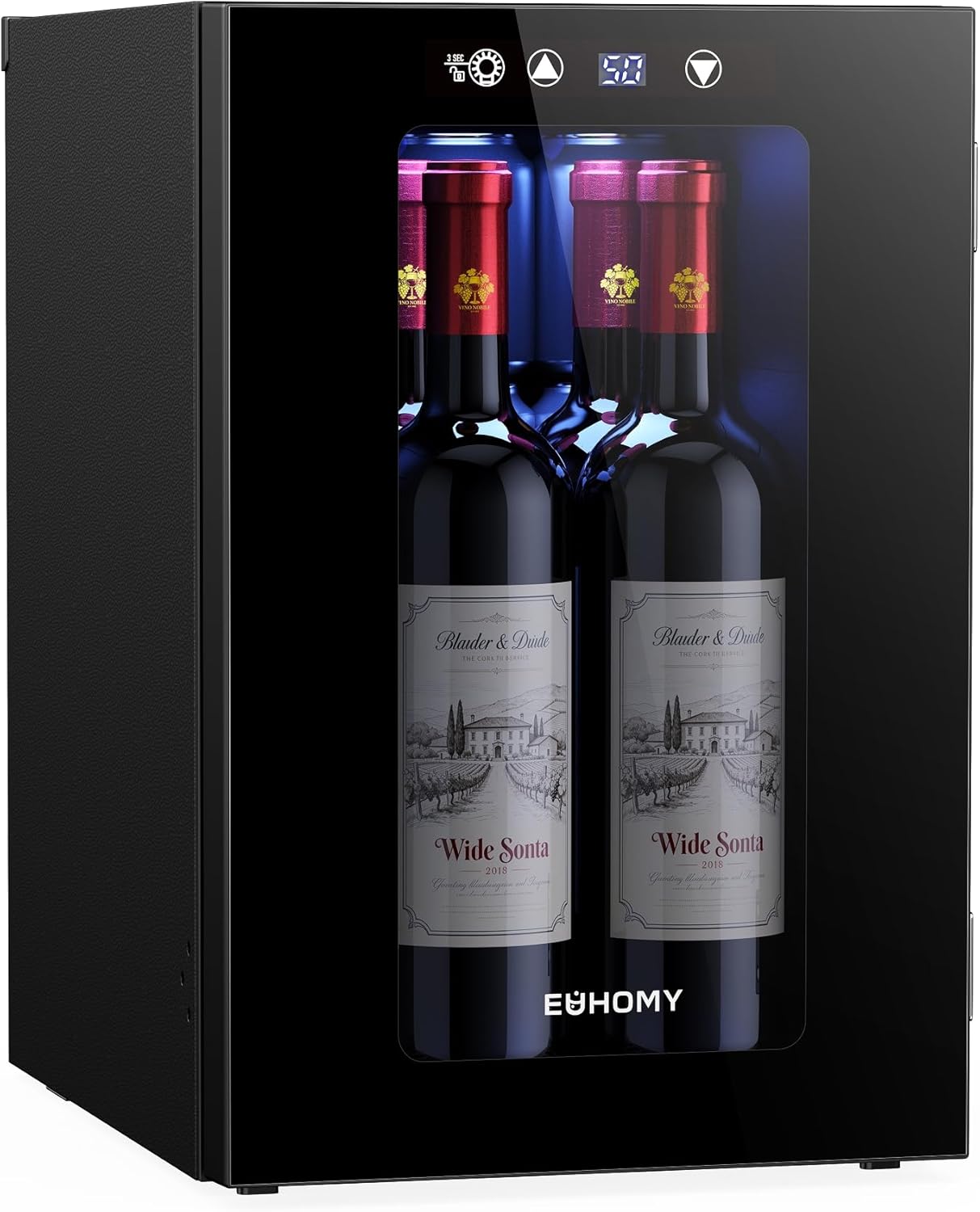
EUHOMY 18L Wine Fridge
| Capacity | 18 liters |
|---|---|
| Cooling Method | Compressor |
| Temperature Range | 40°F to 61°F |
| Number Of Shelves | 1 |
| Installation Type | Countertop |
The EUHOMY 18L Wine Fridge is a small compressor-cooled cooler designed for countertop or freestanding use to store a handful of bottles and cans. It offers a digital touchscreen that sets temperatures between 40°F and 61°F, a double-pane glass door with LED interior lighting, and one removable shelf so you can fit bottles or stacks of cans. The compressor system provides steady cooling and the manufacturer states quiet operation around 38 dB, which helps the unit sit beside a bar, office, or kitchen without creating a constant noise nuisance. Practical benefits include the ability to keep red, white, sparkling wine, or beer at ready-to-serve temperatures and the compact footprint that fits tight spaces. Limitations to expect are the very small 18 L capacity that only holds about four 750 ml bottles or up to two dozen cans when arranged differently, manual defrosting, and a single door orientation without reversible mounting, so placement options are somewhat constrained.
Best for: Buyers who want a reliable, compact cooler to keep a small selection of wines or beverages at controlled serving temperatures without complicated setup or large space requirements.
Less Ideal for: Those who need to store larger collections, organize many bottle sizes, or require a built-in undercounter installation should look at larger-capacity or different-format coolers.
- Digital touchscreen with adjustable 40°F–61°F temperature range for precise control
- Compressor cooling for consistent, dependable chilling compared with thermoelectric units
- Compact countertop form that fits small kitchens, dorms, or home bars
- Double-pane glass door with LED lighting showcases contents while blocking UV rays
- Very limited 18 L capacity suitable for only a few bottles or a small can stash
- Manual defrost requires occasional maintenance and can be inconvenient
Verdict: A compact, compressor-cooled countertop wine fridge that delivers quiet, accurate temperature control for buyers who need dependable short-term storage for a few bottles.
Choosing the Right Quiet Wine Cooler: Key Factors to Consider
Noise Output (Decibel Level)
How loud a cooler runs matters for placement and enjoyment. Decibel ratings give a baseline comparison, but perceived loudness depends on frequency and ambient noise in the room.
A cooler that lists 35 dB will be noticeably quieter than one at 45 dB in a quiet space. Consider where you will place the unit: a bedroom, kitchen, or living area demands lower noise output than a garage or dedicated cellar. Also look for night modes or variable fan speeds that reduce noise during idle periods.
Temperature Stability and Range
Wine benefits from a narrow, consistent temperature band more than rapid cooling. Evaluate how well a cooler holds a set temperature across days and under varying room conditions.
Look for models with accurate digital thermostats, even airflow, and minimal temperature variance from top to bottom shelves. A reliable low-end and high-end of the cooling range are important if you plan to store both red and white wines at their preferred serving or aging temperatures.
Vibration Dampening
Mechanical vibration can disturb sediments and accelerate chemical reactions in wine, affecting aroma and mouthfeel. For long-term storage, vibration control is a critical factor.
Check for features such as low-vibration compressors, rubber-mounted components, or thermoelectric systems that produce less mechanical movement. Shelving and rack mounts that cradle bottles also reduce the transmission of vibrations from the chassis to the bottles themselves.
Rack Design and Bottle Capacity
A cooler must hold the bottles you own without overcrowding while allowing gentle handling. Rack layout and depth determine whether standard Bordeaux, Burgundy, or magnum bottles fit easily.
Look at shelf materials and whether shelves slide for easy access. Proper spacing prevents bottles from knocking together and lets air circulate. Consider future needs so you do not outgrow the unit; some purchasers prefer modular shelves for mixed-size collections.
Humidity Management
Maintaining adequate humidity prevents corks from drying and air ingress, which can spoil wine. A cooler that is too dry shortens cork life, while excessive humidity can encourage mold.
Evaluate whether the unit has built-in humidity control, sealed construction to retain moisture, or guidance on simple measures like placing a shallow water tray. For long-term cellaring, consistent moderate humidity is preferable to fluctuating conditions.
Installation and Placement Options
Where and how you install a cooler affects both performance and noise perception. Undercounter, freestanding, and built-in installations have different ventilation requirements and acoustic impacts.
Check ventilation type and required clearance, front-venting options for built-in installations, and whether the unit has adjustable feet for level placement. Accessibility of controls and door swing direction influence how convenient daily use will be in your space.
Noise Measurement and What It Means
Decibel numbers are useful but not the whole story. How loud a cooler seems depends on frequency, duty cycle, and the room acoustics. A unit that cycles on briefly at a higher dB can be less intrusive than one that emits a steady mid-level hum.
When assessing noise claims, look for independent measurements or third-party tests. Pay attention to whether the quoted decibel level is measured at one meter and whether it captures sound spikes during compressor start-up.
- Continuous low-level noise is less annoying than intermittent loud starts
- Fan tone and vibration frequency can make similar dB readings feel different
- Room placement and surface materials change perceived loudness
Thermoelectric Versus Compressor Cooling
Thermoelectric coolers tend to run quieter since they have no compressor, but they have limits on cooling capacity and handle ambient heat less effectively. Compressor-based systems cool more robustly and can maintain lower temperatures in warm rooms, but they often produce more noise and vibration.
Decide which matters more for your situation: silent operation in a climate-controlled room or stronger cooling performance for variable ambient conditions.
- Thermoelectric: very low vibration, best for small to medium loads in cool rooms
- Compressor: better temperature range and control for larger or warm-location storage
Placement Tips to Minimize Perceived Noise
Placement and installation affect both actual and perceived noise. Position the cooler on a stable, level surface to prevent rattles. Leave recommended clearance for airflow so fans do not work harder and become louder.
Avoid placing the cooler directly against thin cabinetry panels or hollow surfaces that can amplify sound. If undercounter, choose front-venting designs that do not rely on cabinet voids for exhaust.
- Use an anti-vibration mat or rubber feet to decouple the unit from the floor
- Ensure good circulation space per the manufacturer's guidance
- Avoid overly tight cabinetry that traps heat and increases fan activity
Rack Options for Different Bottle Types
Shelving systems range from fixed wooden racks to wire or metal sliding shelves. Solid wood shelves typically cradle bottles gently and minimize clinking, while sliding metal racks improve access but can transfer more vibration if not cushioned.
Consider how often you rotate bottles. Frequent access favors sliding shelves and clear organization. For long-term storage, choose deeper, well-supported racks that keep bottles stationary and aligned.
- Look for cushioned or slatted shelves that prevent glass-on-glass contact
- Check labeled capacity versus practical capacity for mix-sized bottles
- Consider modular shelves if you have varied bottle formats
Maintaining Your Quiet Cooler
Routine maintenance keeps a cooler running quietly and efficiently. Clean condenser coils or filters if accessible, check door seals for tight closure, and level the unit if it shifts during use.
Replace worn gaskets and tighten any loose internal fittings that may cause rattling. Keep the interior organized so bottles do not move during compressor cycles.
- Inspect seals and hinges annually
- Remove dust from vents and coils per guidance
- Tighten shelf mounts and check feet for wear
How We Chose the Best Quiet Wine Cooler
We prioritized products designed specifically to minimize acoustic and mechanical disturbance while maintaining accurate temperature control suited to wine storage. Core evaluation criteria included measured noise output in decibels or manufacturer-stated sound levels, temperature stability across the usable range, and internal vibration control such as low-vibration compressors or thermoelectric cooling. We also weighted rack design and capacity for proper bottle support, humidity control features to protect corks, and ease of installation and placement for undercounter or freestanding setups. Excluded from consideration were coolers intended only for general beverage chilling without wine-specific temperature bands, units with unverified noise claims, and products lacking adequate rack or humidity management for long-term storage. We focused on models that provide consistent, wine-appropriate conditions and clearly documented acoustic performance or noise-reduction design elements. The result is a shortlist that balances quiet operation with the thermal and mechanical characteristics important for maintaining wine quality.
Our full evaluation process is outlined in our review methodology.
FAQ
What is an acceptable decibel level for a quiet wine cooler?
Acceptable levels vary by placement, but units under about 40 dB are generally perceived as quiet in living spaces. For bedrooms or very quiet rooms, aim for lower readings or thermoelectric models that run with minimal mechanical noise.
Do thermoelectric coolers damage wine over time?
Thermoelectric coolers produce less vibration, which is beneficial, but their cooling performance is limited in warm rooms. They are fine for short- to medium-term storage in temperature-controlled environments, but may not maintain ideal conditions for long-term aging in hotter locations.
How do I reduce vibration in my existing cooler?
Place the unit on a stable, level surface and use anti-vibration pads or rubber feet to decouple it from flooring. Ensure shelves are secure and avoid overcrowding bottles which can amplify movement during cycles.
Are built-in quiet wine coolers different from freestanding ones?
Built-in units typically use front ventilation and are designed to operate with less clearance, but they may need different airflow management. Freestanding units often have rear exhaust and can be placed in spots with better airflow, which can affect fan duty cycles and noise.
How important is humidity control in a quiet wine cooler?
Humidity control is important for cork preservation. Moderate, stable humidity helps prevent corks from drying and shrinking. If a unit lacks active humidity control, simple measures like a water tray can help maintain moisture levels.
Final Verdict
Prioritize consistent temperature stability and effective vibration dampening when choosing a quiet wine cooler. Noise output is a practical constraint tied closely to cooling method and installation, so balance expected room conditions against whether you need stronger cooling capacity or near-silent operation. Focus on well-supported racks, level installation, and maintenance to preserve wine quality. With those tradeoffs in mind, you can confidently select a cooler that keeps bottles rested and aromas intact while running unobtrusively.