
Note: This article contains affiliate links. If you click on these links and make a purchase, we may earn a small commission at no extra cost to you. This helps support our research and content. Read our full affiliate disclosure here.
When you need parts with fine surface detail at sizes beyond desktop minis, a resin 3D printer for large prints changes what you can make. Large-format resin machines let you produce tall prototypes, full-scale models, and multi-part cast masters while keeping the layer-level surface finish that resin printing delivers. This guide shortlists the top options for big resin builds and explains the practical tradeoffs you should expect. We evaluated machines for build volume, print consistency, and features that reduce failed prints and post-processing time. Read on for the picks and a breakdown of the criteria that matter for large-format resin printing.
Top Picks at a Glance
| Best Overall The best all-around choice for most situations | UniFormation GK3 Ultra 13.5" Resin 3D Printer |  |
| Best Quality Built to a higher standard if you want something more solid | phrozen Sonic Mega 8K S |  |
| Best Value The sweet spot between price and what you get | Creality HALOT-MAGE PRO |  |
| Top Rated A top-rated pick with lots of positive feedback | ANYCUBIC Photon P1 |  |
| Best Seller A high-volume bestseller chosen again and again | ANYCUBIC Photon Mono M7 Max |  |
UniFormation GK3 Ultra 13.5" Resin 3D Printer
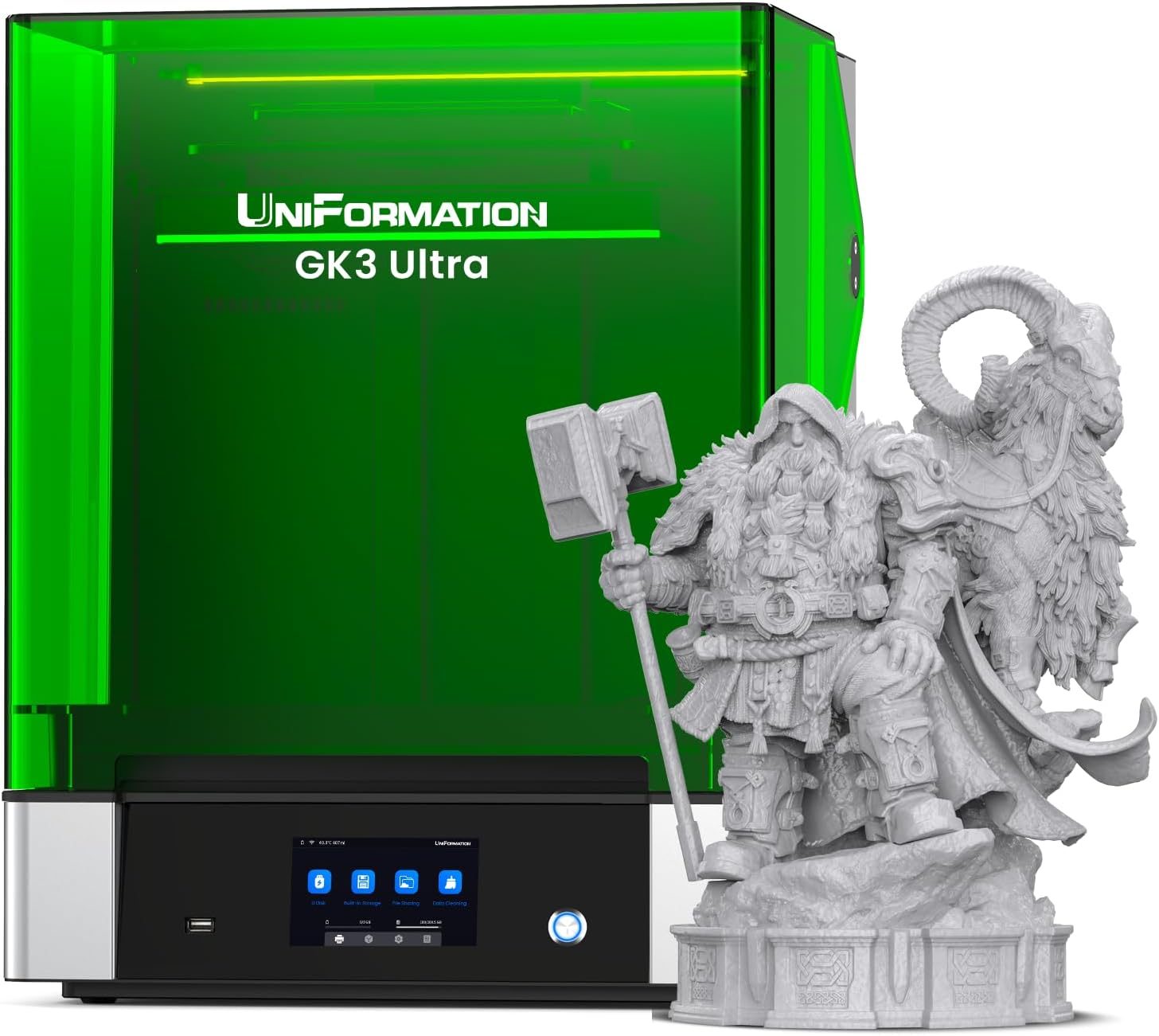
| Build volume | 300 × 160 × 300 mm |
|---|---|
| Screen resolution | 16K LCD |
| Pixel size | 20–26 μm |
| Repeat positioning accuracy | ±0.003 mm |
| Heating system | Auto heat to 25℃/30℃ |
The UniFormation GK3 Ultra is a large-volume resin printer aimed at higher-throughput hobbyists and small studios. It uses a 16K monochrome LCD with 20–26µm pixels to deliver fine detail across a 300 × 160 × 300mm build area, so you can print large models or several parts in a single run. The printer's KK60 Z-axis module and reinforced mechanics promise steady vertical motion and repeatable positioning for cleaner layer lines on big prints. Practical features include an automatic resin feeding system and a heated resin vat that brings resin to 25 or 30 °C before printing, which reduces failed prints in cold environments and supports uninterrupted long jobs. A quick-replace LCD module and quick-release resin vat simplify maintenance, while a built-in activated carbon filter and side-mounted drip hanger keep the workspace cleaner. Expect a heavy, studio-class machine that needs dedicated bench space and occasional maintenance of consumables, but for those focused on large, high-resolution resin parts it significantly reduces hands-on interruptions and environmental issues.
Best for: Buyers who want a reliable large-format resin printer for high-detail models, batch production, or studio prototyping and value features that reduce mid-print interruptions.
Less Ideal for: Casual hobbyists with limited bench space or those who only print small parts occasionally should consider smaller, lighter machines instead.
- Very large 300 × 160 × 300mm build volume for single big prints or batch runs
- 16K LCD with 20–26µm pixel size for high-detail prints across the full build area
- Automatic resin feeding plus heated vat to reduce failed prints and enable long continuous jobs
- Quick-replace LCD and quick-release vat make maintenance and screen/vat swaps faster
- Built-in activated carbon filter and drip management improve odor control and workspace cleanliness
- Heavy, bench‑focused machine that requires a dedicated workspace and handling
- Studio-class size and systems mean higher consumable use and occasional maintenance
Verdict: If you need a studio-capable resin printer that combines a true large build volume with automatic resin feed and heating to keep big, high-detail prints running reliably, the GK3 Ultra is a strong choice.
phrozen Sonic Mega 8K S

| XY Resolution | 43 µm |
|---|---|
| Screen Size | 15 inch mono LCD |
| Printing Volume | L12.99 x W7.28 x H11.81 inches |
| Connectivity | USB, Wifi |
The phrozen Sonic Mega 8K S is a production-focused MSLA resin printer that targets studios and pros who need fast, repeatable large prints. It uses a 15-inch 8K monochrome LCD and 43 µm XY resolution to capture fine detail across a roomy build volume (L12.99 x W7.28 x H11.81 inches), letting you print batches of small parts or sizeable single models with industrial-grade fidelity. Phrozen pairs that panel with speed-oriented hardware: ACF film and TR300 high-speed resin lower suction forces for reliable, faster layer cycles, and the lift-up lid plus a built-in metal drip hanger streamline post-print handling and resin recovery. Typical use is high-volume miniature runs, dental or jewelry masters, and larger prototypes where detail and throughput both matter. Expect a heavier, workshop-oriented machine that needs decent bench space and resin post-processing; it is not a plug-and-play toy and benefits from experience with MSLA workflows. For production shops the reduced failed layers, faster cure times, and thoughtful handling features add up to real time and material savings.
Best for: Buyers who prioritize production speed and high-detail large-format resin printing for commercial or serious prosumer work and are comfortable with MSLA workflows and post-processing.
Less Ideal for: Hobbyists who want a simple, compact starter printer or users who prefer filament/FDM printing for low-maintenance weekend use.
- Very high 8K XY resolution (43 µm) across a large 15-inch mono LCD for fine detail on big prints.
- Designed for high throughput with a build plate sized to batch-print dozens of miniatures or large single parts.
- ACF film and TR300 resin reduce suction and enable much faster layer speeds for production runs.
- Lift-up lid and built-in metal drip hanger make access and resin recovery cleaner and more efficient.
- Heavier, workshop-oriented unit that requires significant bench space and setup experience.
- Requires dedicated resin post-processing and handling; not aimed at casual or first-time hobbyists.
Verdict: Choose the Sonic Mega 8K S when you need large-format, high-resolution resin prints delivered quickly for production-focused work.
Creality HALOT-MAGE PRO
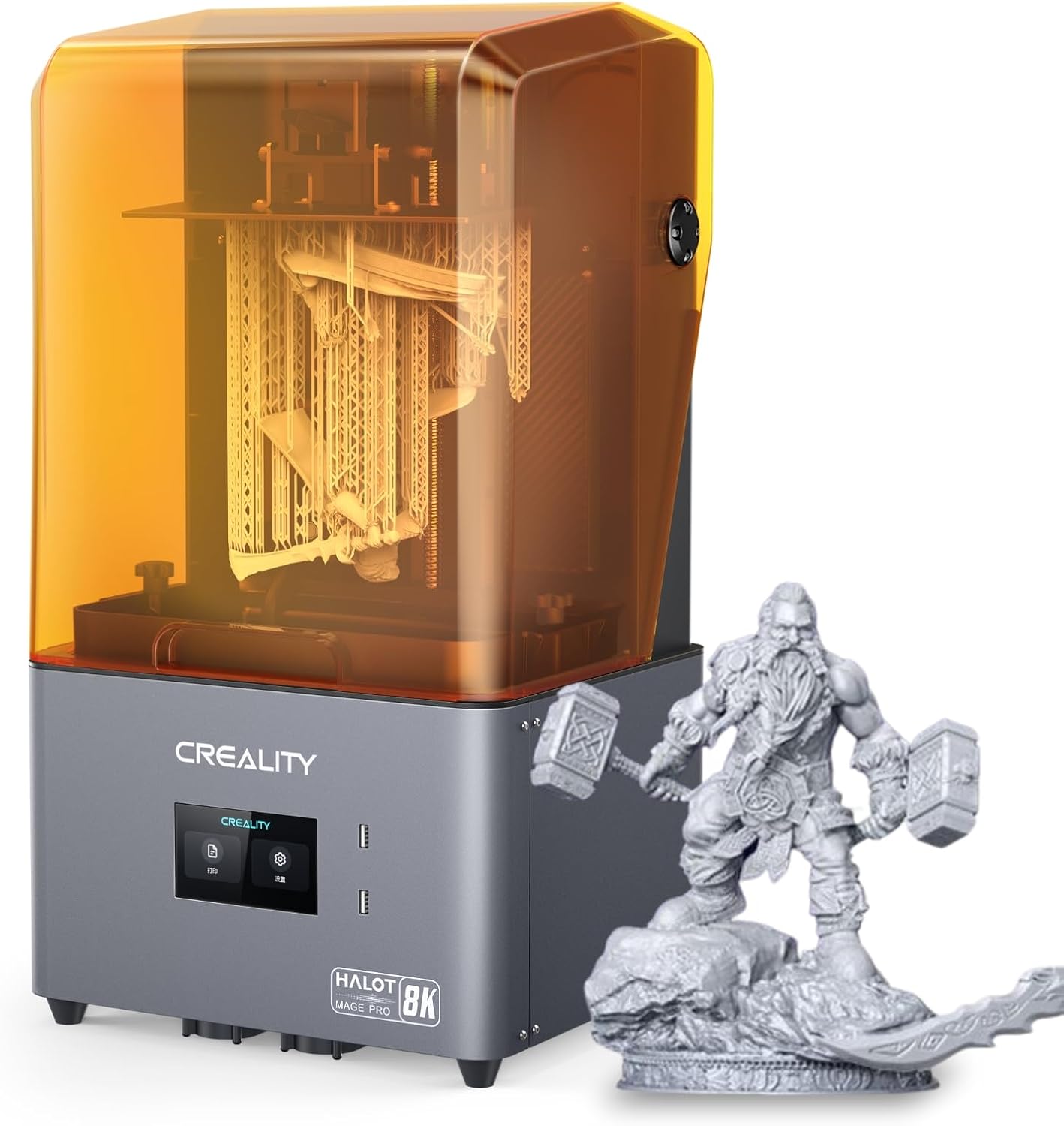
| Build Volume | 228×128×230mm (6712cm³) |
|---|---|
| Printing Speed | ≤170mm/h |
| LCD Screen | 10.3" monochrome |
| LCD Resolution | 8K (7680×4320) |
| XY Resolution | 29.7μm |
The HALOT-MAGE PRO is a large resin printer built for high-resolution, high-speed production of sizable models. Its 10.3" 8K monochrome LCD and 29.7μm XY resolution deliver fine detail across a generous 228×128×230mm build volume, and the Integral Light Source 3.0 with >90% uniformity and strong intensity speeds layer cure times so prints complete much faster than typical 4K machines. Practical touches like an auto resin pump for refill and recovery, a larger activated carbon filter to reduce fumes, and a flip lid that opens one-handed streamline repeated, larger print jobs. The printer supports USB, RJ45, Wi-Fi and Creality Cloud for file transfer and works with HALOT BOX, CHITUBOX and Lychee slicers, so it fits into common resin workflows. Downsides are the size and weight that demand a dedicated workspace and the need to use standard 405nm resins and compatible slicers, which is typical for resin systems; achieving flawless results still requires calibration and post-curing. For makers who print large, detailed resin parts, the HALOT-MAGE PRO balances speed and precision effectively.
Best for: Makers who prioritize fast, high-resolution resin output at a larger scale and want workflow features that cut manual steps when producing big, detailed prints.
Less Ideal for: Hobbyists with limited workspace, frequent casual printers who prefer low-maintenance FDM machines, or users who need a highly portable desktop printer.
- True 8K 10.3" monochrome LCD for very high XY detail across a large build area
- High curing intensity and >90% light uniformity for faster, more consistent layer cures
- Auto resin pump reduces manual resin handling and speeds refill/recovery
- Built-in air filter and larger activated carbon filter to cut resin odor during long prints
- Multiple file transfer options and compatibility with popular slicers for an intuitive workflow
- Physically large and heavy, requiring a dedicated, well-ventilated workspace
- Requires typical resin post-processing and calibration to reach best results
Verdict: If you need large, highly detailed resin prints and want dramatically faster curing with practical automation like auto resin handling, the HALOT-MAGE PRO is a top fit.
ANYCUBIC Photon P1

| LCD Type | 10.1'' Mono LCD |
|---|---|
| XY Resolution | 13312 x 5120 (14K) |
| Light Source | COB |
| Build Area | 8.78 x 4.96 x 9.05 in. |
The ANYCUBIC Photon P1 is a large-area resin LCD printer built for reliable, high-detail production work. It prints on a 10.1" mono LCD and pairs a stable ball-screw Z-axis and precision guide rails to reduce wobble and deliver consistent layer accuracy, which is helpful when running long prints. Notable features include dual-color/dual-material printing for two-resin or two-color parts, Wave Release film to lower peel forces and improve success rates, resin heating and support for very high-viscosity resins (up to 8,000 cps), and automated Smart Leveling 3.0 to reduce setup fiddling. The printer also offers AI monitoring for plate installation and resin-level/residue detection, plus Photon Workshop 4.0 software tools for slicing and remote control. Trade-offs to expect are the size and weight that make it less portable and likely require a dedicated workspace and ventilation, and higher upfront complexity compared with small hobby printers; users should plan for post-processing and resin handling. For large resin builds that need repeatable results and industrial resin compatibility, the Photon P1 is a strong, reliability-oriented choice.
Best for: Engineers, small shops, and serious hobbyists who need repeatable, large-area resin prints and want a machine rated for industrial-grade resins and long print runs.
Less Ideal for: Casual or first-time users who prefer compact, plug-and-play hobby printers or who do not want to manage resin handling and post-processing.
- Large build area with 10.1" mono LCD and 14K XY resolution for fine detail on big parts
- Stable ball screw and precision rails minimize Z wobble for consistent long prints
- Dual-color/dual-material printing enables two-resin or two-color parts in a single run
- Wave Release film and Smart Leveling 3.0 reduce failed prints and simplify setup
- Supports very high-viscosity resins (up to 8,000 cps) for engineering materials
- Size and weight require a dedicated, well-ventilated workspace
- Higher operational complexity and post-processing demands compared with small hobby printers
Verdict: Choose the Photon P1 if you need a large-format resin printer built for repeatable, high-detail production prints and compatibility with engineering resins.
ANYCUBIC Photon Mono M7 Max

| LCD Type | 13.6'' Mono LCD |
|---|---|
| XY Resolution | 6480 x 3600 (7K) |
| Light Source | COB (LighTurbo 3.0) |
| Max Printing Speed | 60mm/h |
| Resin Vat Capacity | 1300ml |
The Photon Mono M7 Max is a large-format resin LCD printer designed for printing big, detailed models without splitting parts. It uses a 13.6-inch 7K monochrome LCD and ANYCUBIC's LighTurbo 3.0 (COB light source plus Fresnel lens and factory calibration) to deliver more uniform exposure across the print area, which helps reduce layer inconsistencies and aliasing on wide prints. Intelligent Release 2.0 adjusts peel height dynamically to improve success rates on taller or complex pieces, and the printer claims up to 60mm/h max print speed for faster throughput. Practical touches for large-workflow users include a flip-open cover that holds at adjustable angles, a 1300ml resin vat with temperature control and auto-fill/one-key recycling, and a resin-management flow-back feature to keep excess resin out of printed parts. The machine is sizable and heavier than desktop hobby printers, and getting consistent high-quality results on very large prints still requires careful leveling, slicing, and suitable resins. Expect a steeper setup and maintenance curve compared with small hobby resin machines, plus the usual resin handling precautions.
Best for: Buyers who prioritize reliable, high-detail large-format resin prints and want a printer with built-in features to reduce failed prints and streamline resin handling.
Less Ideal for: If you need a compact, lightweight machine for occasional small models or want a plug-and-play desktop printer with minimal setup, this large resin printer is not a good fit.
- Very large 13.6-inch 7K mono LCD for high-detail large prints
- COB LighTurbo 3.0 with Fresnel lens and factory calibration for improved light uniformity
- Intelligent Release 2.0 peel control to raise large-print success rates
- Resin management features including temperature-controlled vat, 1300ml capacity, and auto-fill/recycle
- Flip-open cover with adjustable hold angles for easier access and post-print handling
- Large footprint and weight make it less suitable for small workspaces
- Requires more careful setup, slicing, and resin choice to realize top-quality large prints
Verdict: Choose the Photon Mono M7 Max when you need a purpose-built large-format resin printer that combines a 7K mono screen and advanced light and peel controls to improve success with big, detailed prints.
Choosing the Right Resin 3D Printer for Large Prints: Key Factors to Consider
Build Volume and Z Clearance
Large-format resin printing demands both a wide XY plane and tall Z clearance. The machine must provide enough XY area to fit your parts without awkward slicing, and sufficient Z height to print tall objects in a single run. Insufficient Z clearance forces you to split models or reorient them, which increases seams and post-processing.
Beyond raw dimensions, check usable build area after accounting for leveling offsets, gantry obstructions, and any recommended safety margins. For production-style runs consider how many parts fit per plate at a target layer height because build volume combined with throughput drives long-term productivity.
Exposure System and Light Uniformity
Consistent curing across a large XY area is harder to achieve than on small prints. The exposure system must deliver even intensity so dimensional accuracy and surface detail stay uniform from center to edge. Look for machines with well-characterized light engines, temperature-stable LEDs, or masked LCDs designed for larger panels.
Nonuniform exposure increases failed layers and warping, which is more costly on long-duration, large prints. Also consider whether the system supports tunable exposure or per-layer adjustments to optimize thick cross-sections and fine features within the same print.
Mechanical Rigidity and Motion Accuracy
Long prints magnify errors caused by frame flex, loose bearings, or imprecise lead screws. A rigid gantry and accurate Z drive reduce layer registration issues and maintain straight vertical walls over many hours. Printers with beefy frames, low-backlash screws, and robust bed mounts tend to deliver more repeatable large prints.
Also consider vibration isolation and motor drivers that support smooth microstepping. When printers run for many hours thermal drift and component wear become significant factors, so look for features that mitigate those risks and simplify recalibration.
Resin Compatibility and Material Handling
Large resin builds consume more material and increase exposure of uncured resin to the workspace. Machines that support a wide range of commercial resins, including higher-viscosity and tough formulations, give you flexibility for functional parts. Check whether the printer's vat and vat-surface materials are compatible with common resins and whether the manufacturer documents safe handling for large-volume pours.
Practical material-handling features matter too: removable vats, easy-pour palettes, and spill containment reduce cleanup time and risk. Also evaluate how the machine deals with resin heating, filtration, and off-gassing during extended prints.
Software Workflow and Slicing Controls
On large prints, orientation, support placement, and exposure tuning have outsized effects on success. Slicing software that offers advanced support editing, adaptive exposure, and reliable hollowing/splitting tools makes it easier to prepare big models. Good software reduces the need for trial-and-error and minimizes wasted hours.
Consider whether the workflow includes batch printing features, remote monitoring for long jobs, and clear logging for troubleshooting failures. The ability to fine-tune parameters per region of a model is especially useful for mixed-feature prints where thin details and thick sections coexist.
Post-Processing and Part Handling
Larger resin parts are harder to rinse, cure, and handle without damage. Evaluate how the machine's recommended post-processing procedures scale to bigger pieces, including recommended wash volume, solvent containment, and curing chamber size. Some systems have accessory ecosystems that support large-part rinsing and curing which speeds throughput and preserves surface quality.
Also consider handling ergonomics: how you remove the build plate, whether there are quick-release mechanisms, and what tools are recommended for safe part removal. Proper post-processing infrastructure reduces the likelihood of damage during demolding and improves final surface finish.
Preparing Models for Large-Format Resin Printing
Orientation and support strategy differs when a model scales up. Place delicate features to reduce unsupported overhangs and orient the model to minimize the resin-cured cross-section at each layer when possible.
Hollowing and drain holes are more important on large parts to reduce resin use and prevent suction-related failures during peeling. Use internal support lattices and consider adding escape channels for trapped resin.
- Orient to reduce unsupported areas and minimize required supports
- Hollow large volumes and add reliable drainage
- Use thicker anchors for large contact points to prevent lift-off
Managing Print Time and Queueing
Large resin prints can run for many hours or even days. Plan your print queue to minimize idle times on the printer and avoid starting long jobs right before leaving the workspace unattended.
Break big projects into scheduled runs, and stagger curing and washing so you are not bottlenecked at post-processing. Remote monitoring or camera supervision helps spot early failures.
- Estimate run times with conservative layer counts
- Schedule post-processing slots to keep parts moving
- Use remote alerts if available to catch early failures
Safety and Workspace Setup for Larger Resin Jobs
Printing big resin parts increases solvent use and uncured resin exposure. Ensure good ventilation, appropriate personal protective equipment, and dedicated spill containment near the printer.
Set aside curing and washing stations sized for larger parts and equip them with trays and racks that prevent contamination between jobs. Cleanliness and organization reduce accident risk and cross-contamination of resins.
- Use nitrile gloves and eye protection when handling uncured resin
- Provide local exhaust ventilation or an air purifier rated for VOCs
- Keep large dedicated containers for resin waste and used solvents
Scaling Prototypes to Functional Large Parts
Moving from scale models to full-size resin parts often requires reevaluating wall thickness, radii, and feature tolerances. Resin printed parts can be brittle, so design geometry to distribute loads and avoid thin cantilevers.
If the part will be used functionally, plan for reinforcement options such as embedded metal inserts, post-cure annealing, or resin blends designed for toughness. Mechanical testing of representative sections is advisable before committing to full-size runs.
- Increase fillets and add ribs for strength
- Consider hybrid builds with inserts or secondary bonding
- Test sample coupons to validate mechanical properties
Maintenance Tips for Reliable Long Prints
Regular checks and preventive maintenance reduce the chance of mid-print failures. Inspect the vat film, lead screws, and fasteners before long jobs and keep spares of wear items that commonly fail during extended use.
Record maintenance actions and environmental conditions to spot trends. Recalibrate Z endstops and leveling more often when running large-format prints because small deviations accumulate over long durations.
- Keep spare vat films and build-plate fasteners on hand
- Inspect and lubricate leadscrews per manufacturer guidance
- Log long-job parameters and outcomes to refine settings
How We Chose the Best Resin 3D Printer for Large Prints
We focused on machines that reliably handle large-format resin builds without excessive rework. Key evaluation dimensions included build volume and Z clearance to confirm the printer can accommodate the target part sizes; light source and masking uniformity to ensure consistent detail across wide XY areas; mechanical stability and frame rigidity to reduce layer shifts during long jobs; and material ecosystem support and resin handling features that affect print success and safety during larger runs. We also considered software workflow and slicing support because long, high-resolution prints magnify the impact of poor orientation, support generation, and exposure settings. Ease of maintenance and replacement part availability were factored in since larger prints increase run time and wear on consumables. Exclusions included small-format hobby machines unsuitable for tall or wide parts and experimental or prototype-only rigs lacking basic safety enclosures or repeatable calibration. In short, we filtered for machines with proven large-volume capabilities, dependable exposure systems, solid mechanical design, and practical serviceability for continuous, large-print workflows.
Our full evaluation process is outlined in our review methodology.
FAQ
What is a practical maximum Z height for consistent large resin prints?
Practical Z height depends on the machine build and support strategy, but many large-format resin setups aim for Z clearances that allow tall parts without reorientation. Above certain heights, mechanical drift and increased suction forces raise failure risk, so users often limit single-run height or add intermediate supports.
How does resin viscosity affect large-print success?
Higher-viscosity resins can slow resin flow and increase suction between layers, which is more pronounced on wide cross-sections. For large prints choose resins with workable viscosity or plan for longer recoating and pause times to let material settle.
Do I need a bigger curing station for large prints?
Yes. Curing chambers and UV cabinets sized for small parts will not accommodate larger prints, and inadequate curing can leave interiors under-cured. Evaluate curing capacity alongside printer build volume when planning large-format projects.
How do I prevent layer delamination on long resin prints?
Prevent delamination by ensuring good exposure uniformity, strong support anchors, and a rigid mechanical platform. Optimize exposure settings to fully cure layer interfaces and use thicker support bases for large contact areas.
Is post-processing more challenging with large resin parts?
Usually yes. Larger parts require more solvent for washing, bigger curing footprints, and careful handling to avoid flexing during demolding. Planning appropriate jigs, racks, and rinse/cure workflows reduces risk of damage.
Final Verdict
For large-format resin printing prioritize machines with adequate build volume, consistent exposure across the XY plane, and a mechanically sturdy design. Software that supports advanced slicing and robust material handling features will make long prints more predictable and reduce trial-and-error. Balance your need for size with workflow readiness: post-processing capacity, maintenance discipline, and safe material handling are as important as raw dimensions. Focus on the criteria outlined here to pick a machine that meets your part-size goals while keeping uptime and repeatability high.