
Note: This article contains affiliate links. If you click on these links and make a purchase, we may earn a small commission at no extra cost to you. This helps support our research and content. Read our full affiliate disclosure here.
When you are heading into remote terrain, clean drinking water is essential and the right Reverse Osmosis Water Filter for Backpacking can make the difference between a comfortable trip and avoidable risk. Backpacking filters must remove bacteria, protozoa, and chemical contaminants while staying compact and light enough to carry for miles. This guide presents seven shortlisted options that balance filtration effectiveness, weight, and ease of use for hikers, bikepackers, and thru-hikers. Below you will find evaluation notes on filtration performance, packability, and field usability that matter on overnight and multi-day trips, followed by buying considerations to help you choose the option that fits your route and style. Read on for practical tradeoffs and what to expect from each type of system.
Top Picks at a Glance
| Best Overall The best all-around choice for most situations | Premier 4-Stage Portable RO System |  |
| Best Quality Built to a higher standard if you want something more solid | APEC Water ROES-PH75LD |  |
| Best Value The sweet spot between price and what you get | Bluevua ROPOT-Travel RO Filter |  |
| Best Budget The cheapest option that still gets the job done reliably | CO-Z Countertop Reverse Osmosis WFS-R040-00 |  |
| Top Rated A top-rated pick with lots of positive feedback | AquaTru Carafe |  |
| Most Popular A crowd favorite that many people choose with confidence | DREO RO Water Filter WF112 | 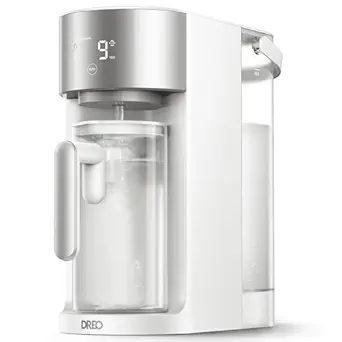 |
| Best Seller A high-volume bestseller chosen again and again | PHILIPS ADD5930 Countertop RO |  |
Premier 4-Stage Portable RO System

| Model Number | RO4251275M |
|---|---|
| Material Type | Polypropylene (PP) |
| External Testing Certification | NSF |
| Unit Count | 1 Count |
| Product Benefits | Reduces Chloramine |
This compact 4-stage reverse osmosis system is designed as a portable purifier for travel, RVs, boats, camping and similar off-grid situations. It uses a sediment prefilter, two coconut-shell activated carbon stages and a high-rejection RO membrane to strip chlorine, chloramine, VOCs and a wide range of dissolved solids; the product description lists membrane capacities up to 150 GPD with a practical output of roughly 5–6 gallons per hour. Filters are oversized 2.5 x 12 cartridges with quick-connect fittings and color-coded tubing for easier hookup, and a garden-hose adapter is included so you can get running without complex plumbing. The NSF external certification is a useful assurance of testing, but note this is a portable, inline-style system rather than a built-in countertop unit so it is best used where portability and simpler setup matter more than permanent installation. Because it relies on an RO membrane, expect wastewater and slower fill times compared with simple carbon filters, and plan filter changes according to local water quality and usage.
Best for: Buyers who want a robust, transportable purifier for camping, RVing, boating or temporary setups and prioritize thorough contaminant removal over ultralight, single-filter simplicity.
Less Ideal for: People seeking an ultralight backpacking filter or a permanent under-sink installation should look at lighter gravity or pump filters for weight savings or dedicated built-in RO systems for home use.
- Portable design with garden-hose adapter for quick hookup without permanent installation.
- Four-stage filtration including RO membrane for broad contaminant removal.
- XL 2.5 x 12 quick-connect filters extend service life versus smaller inline cartridges.
- Color-coded tubing and quick-connect fittings simplify setup in the field.
- NSF external testing certification listed.
- RO process produces wastewater and has slower output than basic carbon-only filters.
- System is intended as a portable unit and not optimized for built-in under-sink installation.
Verdict: Choose this portable 4-stage RO when you need a field-ready system that delivers near-lab-quality filtration and easy hose hookup for travel or RV use.
APEC Water ROES-PH75LD

| Purification Method | Alkaline, Reverse Osmosis |
|---|---|
| Operating Pressure Range | 40-85 psi |
| Upper Temperature Rating | 360 °F |
| Supported Water TDS Level Maximum (PPM) | 2000 |
| Capacity | 4 gallons |
The APEC ROES-PH75LD is a 6-stage under-sink reverse osmosis system built to deliver high-purity, remineralized drinking water at up to 75 gallons per day. It uses multiple carbon block filters, an RO membrane, and a premium calcium carbonate mineral cartridge to raise pH and improve taste, while the included tank, faucet, tubing, and drain saddle provide a complete installation kit. Notable practical features include a smart leak detector with optional WiFi alerts and robust components designed for long filter life and heavy-duty operation. In use the system produces clean, neutral-to-alkaline water suitable for everyday drinking and cooking, and the higher flow capacity keeps supply steady for a household. The system does require under-sink space and water pressure within the 40-85 psi operating range, and it is a stationary unit intended for home plumbing rather than portable or backpacking use, so it is best where continuous, high-quality output and mineral-enhanced taste are priorities.
Best for: Buyers who prioritize high-performance, consistent household water purification and want mineral-enhanced alkaline water with built-in leak protection.
Less Ideal for: People seeking a lightweight, portable filter for backpacking, camping, or short-term travel should look for compact gravity or pump filters instead.
- Six-stage filtration with RO membrane plus mineral cartridge for improved taste and alkalinity
- Rated 75 gallons per day for steady household output
- Includes complete installation kit: tank, faucet, tubing, drain saddle, feed adapter, and wrench
- Smart leak detector with optional WiFi alerts for added protection
- Designed for under-sink installation and not portable for backpacking or travel
- Requires adequate feed water pressure (40-85 psi) to operate properly
Verdict: Choose this system when you want a high-capacity, factory-quality under-sink RO that delivers remineralized, better-tasting alkaline water with leak protection.
Bluevua ROPOT-Travel RO Filter

| Purification Method | Reverse Osmosis |
|---|---|
| Power Source | Corded Electric |
| Capacity | 2000 liters |
| Material Type | Glass |
| Other Special Features of the Product | Portable |
The Bluevua ROPOT-Travel is a countertop reverse osmosis purifier designed for mobility and simple operation. It uses a 6-stage filtration system with a 0.0001μm RO membrane plus UV to cut TDS, heavy metals, fluoride, and other contaminants, and it dispenses a measured 18 oz into the included borosilicate glass bottle. Setup is plug-and-play with no plumbing required, and the unit includes a self-cleaning mode, a filter life alert, and a quick twist-and-lock filter swap that makes maintenance fast. Its compact footprint and stainless steel handle make it easy to carry for short trips, dorms, or small kitchens, and the manufacturer highlights a 3:1 filtered-to-waste ratio that reduces water waste compared with larger RO systems. Limitations for backpacking include its reliance on AC power and a included glass bottle that adds fragility; it is better suited to car camping or short stays where a power outlet and careful packing are available rather than multi-day pack-and-hike trips.
Best for: Buyers who prioritize clean, near-bottled-quality water in portable settings and want a low-maintenance, plug-and-play purifier for car camping, short trips, or small living spaces.
Less Ideal for: Long-distance backpackers or ultralight hikers who need battery-free, rugged, or fully off-grid filtration solutions should choose lighter, nonpowered options.
- Comprehensive 6-stage RO plus UV treatment for broad contaminant reduction
- No-plumbing plug-and-play design simplifies setup and use
- Durable borosilicate glass bottle reduces single-use plastic
- Self-cleaning and filter-life alert reduce routine maintenance overhead
- Compact, portable form with integrated handle for short trips and small spaces
- Requires corded AC power so not suitable for off-grid backpacking
- Glass bottle increases fragility compared with plastic alternatives
Verdict: Choose the ROPOT-Travel when you need near-bottled RO quality in a compact, plug-and-play unit for car camping or short trips where AC power and careful packing are available.
CO-Z Countertop Reverse Osmosis WFS-R040-00

| Purification Method | Reverse Osmosis |
|---|---|
| Stages | 5-stage |
| Capacity | 5 liters |
| Supported Water TDS Level Maximum (PPM) | 500 |
| Filter Life Cycle | 1 years |
The CO-Z countertop RO is a plug-in, 5-stage reverse osmosis purifier designed to sit on a counter and deliver low-TDS water without plumbing. It filters through five stages and meets NSF/ANSI 58 and 61 claims to remove common contaminants including heavy metals and fluoride, and it reports real-time TDS on a small control panel. Use is simple: fill the tank, plug the unit in, choose one of three preset dispense volumes or continuous flow, and collect water in the removable pitcher. Notable conveniences include a 1.3 gallon holding tank, a fast filter-change mechanism, an automatic self-clean cycle, and a filter life indicator. For everyday home or office use it provides abundant purified water with a 4:1 pure-to-drain ratio and a stated 75-gallon daily capacity. The unit is not designed for ultralight backpacking or off-grid use because it requires mains power, is relatively heavy, and is sized for countertop operation rather than field portability.
Best for: Buyers on a tight budget who want a straightforward, countertop RO system for home, office, or RV use where mains power is available and low-TDS water is a priority.
Less Ideal for: People seeking an ultralight, self-contained water purifier for backpacking, backcountry trips, or locations without reliable electricity should look at portable manual filters instead.
- 5-stage reverse osmosis filtration with NSF/ANSI 58 and 61 compliance
- Built-in TDS meter and filter life indicator for easy monitoring
- Three preset dispense volumes plus continuous dispensing for measured pours
- Large 1.3 gallon tank and removable 0.4 gallon pitcher reduce refill frequency
- Automatic self-cleaning cycle and quick filter replacement design
- Requires corded electric power so not suitable for remote or off-grid use
- Relatively heavy and bulky compared with backpacking-oriented filters
- Pure-to-drain ratio and daily capacity assume steady mains water supply and may not reflect field conditions
Verdict: Choose this unit if you want an affordable, countertop RO that delivers low-TDS water and easy monitoring for home or RV use where mains power is available.
AquaTru Carafe

| Purification Method | Reverse Osmosis |
|---|---|
| Power Source | Corded Electric |
| Filter Life Cycle | Pre-filter up to 6 months; RO up to 1–2 years; VOC carbon 1 year |
| Maximum Flow Rate | 0.5 gpm |
| Supported Water TDS Level Maximum (PPM) | 300 |
The AquaTru Carafe is a compact countertop reverse osmosis purifier designed to deliver very clean, great-tasting water without installation or plumbing. You fill the inlet tank, plug the unit into a standard outlet, and purified water pumps into the included borosilicate glass carafe; the control panel and built-in filter indicators make routine use and maintenance straightforward. Its four-stage system combines pre-filtration, RO membrane, and carbon stages to reduce 84 contaminants including lead, PFAS, and microplastics, and the manufacturer-rated filter lifecycles mean fewer replacements versus typical pitchers. Because it requires a 120V outlet and runs at low flow, it is best used on a kitchen counter for drinking, cooking, and beverage prep rather than high-volume tasks. The unit is heavier and larger than a simple pitcher and is not designed for mobile or off-grid use, but for someone who prioritizes reliable, certified contaminant removal without plumbing changes it delivers clear benefits and predictable upkeep.
Best for: Buyers who want a reliable, certified countertop RO purifier for everyday home use and who prioritize consistent contaminant reduction without changing plumbing.
Less Ideal for: People needing a lightweight, battery-free or field-ready water solution for backpacking, camping, or remote travel should choose a portable purifier instead.
- Removes a wide range of contaminants including lead, PFAS, and microplastics using reverse osmosis
- No plumbing or drilling required; simply plugs into a standard outlet and sits on the counter
- Long filter life ratings (pre-filter up to 6 months, RO up to 1–2 years) reduce replacement frequency
- Borosilicate glass carafe keeps purified water free of plastic taste and is dishwasher safe
- Requires mains power and is not portable for backpacking or off-grid situations
- Lower flow rate and small clean-water tank mean slower fill times compared with plumbed systems
Verdict: Choose the AquaTru Carafe when you need a dependable countertop RO purifier that reliably removes a broad set of contaminants without plumbing changes.
DREO RO Water Filter WF112

| Purification Method | Reverse Osmosis |
|---|---|
| Capacity | 3 liters |
| Included Components | WF112 body, 1 RO filter, 1 autofill pitcher |
| Pure to Drain Rate | 3:1 |
| Runtime | 265 gallons(1000L) |
The DREO WF112 is a compact countertop reverse osmosis system that uses a 7‑stage RO filter to produce low‑TDS drinking water and reports filter life and TDS readings on a touch control panel. It is designed for installation‑free use: fill the included pitcher or let the autofill sensor replenish the 1.1 L pitcher while the 3 L tank holds filtered water for short‑term use. The unit self‑flushes internal tubes to help reduce buildup and the replaceable RO cartridge twists in for quick swaps; the manufacturer rates the filter for about 265 gallons (1,000 L). Practical benefits include clear visual TDS monitoring, relatively low water waste with a 3:1 pure‑to‑drain ratio for an RO unit, and a compact footprint that sits on counters or in small kitchens. Important limitations for outdoor or backpacking scenarios are weight and need for a water source and power‑free manual filling—this is not a portable pump or inline filter for trail use, and its capacity and flow are aimed at home countertop use rather than on‑the‑go filtration.
Best for: Buyers who prioritize verified water quality and clear social proof from other users and want a compact, easy‑to‑use countertop RO system for home or office use where visible TDS and filter life monitoring reduce uncertainty.
Less Ideal for: People needing ultralight, pump‑or‑gravity portable filtration for multi‑day backpacking trips or on‑trail water treatment should choose a purpose‑built portable filter or purifier instead.
- 7‑stage RO filtration with built‑in TDS meter for visible water quality monitoring
- Autofill pitcher and 3 L storage tank reduce frequent refills for short household use
- Self‑cleaning auto‑flush helps limit internal contamination between uses
- Twist‑to‑install replaceable RO cartridge simplifies maintenance
- Compact counter footprint fits small kitchens, offices, or dorm rooms
- Not designed or convenient for backpacking due to size and need for a stable water source
- Requires periodic replacement RO cartridges with limited lifespan (about 265 gallons)
Verdict: If you want a compact countertop RO system with visible TDS monitoring and easy maintenance for home use, the DREO WF112 delivers trustworthy filtered water in a small footprint.
PHILIPS ADD5930 Countertop RO
| Purification Method | Activated Carbon + RO |
|---|---|
| Maximum Flow Rate | 266 milliliters_per_minute |
| Supported Water TDS Level Maximum (PPM) | 500 |
| Filter Life Cycle | 12 months |
| Capacity | 16.9 fluid ounces |
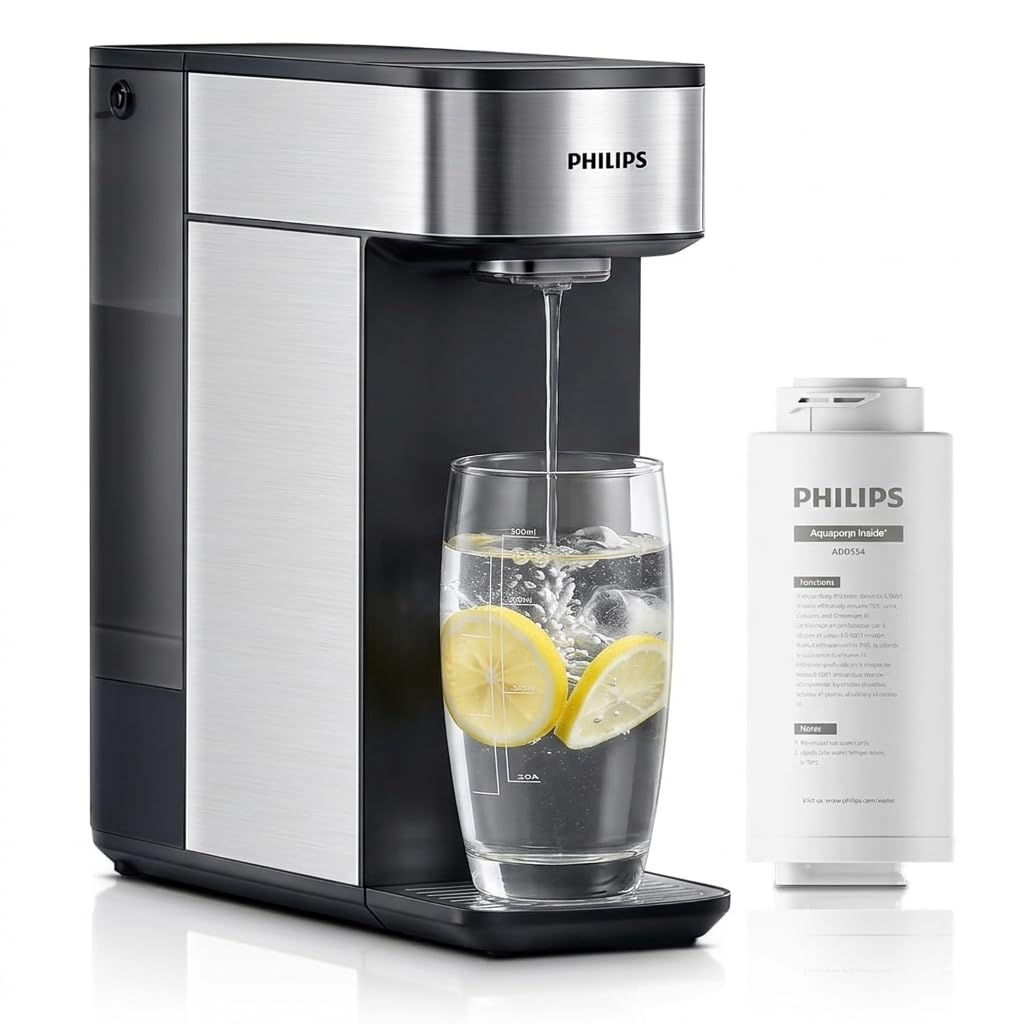
The PHILIPS ADD5930 is a tabletop reverse osmosis unit that provides five-stage filtration, including Aquaporin-enhanced membranes, to reduce TDS and remove contaminants like chlorine and lead. It is designed as a plug-and-play countertop dispenser with a built-in RO filter and a 16.9 oz glass bottle for filling and carrying water. Installation is minimal — you fill the source tank and run the unit from mains power — and the self-cleaning cycle and 12-month filter life make maintenance straightforward. Practical benefits include NSF/ANSI certifications for material and performance and a steady flow of about 266 ml per minute, which is good for producing small amounts of very high-quality drinking water. Important limitations for outdoor use are its reliance on corded electric power, relatively slow output compared with gravity or pump filters used while hiking, and the system size and fragility of the glass bottle; it is best as a basecamp or car-camping purifier rather than a lightweight on-trail device.
Best for: Buyers who prioritize verified contaminant removal and want a simple, low-effort purifier for basecamp, car camping, or RV use where safety and proven certifications matter more than weight.
Less Ideal for: Ultralight backpackers or day hikers who need a packable, nonpowered filter or pump for on-trail water treatment should choose a lightweight gravity, straw, or pump purifier instead.
- Five-stage reverse osmosis plus Aquaporin technology for thorough contaminant and TDS reduction.
- NSF/ANSI 58 and 372 certifications and SGS-certified filter core for verified material and performance safety.
- Plug-and-play countertop design with included 16.9 oz glass bottle for ready-to-use purified water.
- Built-in self-cleaning function and a 12-month filter life simplify maintenance and filter care.
- Compact footprint suited to small kitchens, RV counters, or a basecamp table.
- Requires corded electric power so it cannot be used independently on the trail.
- Small capacity and glass bottle make it fragile and impractical for extended backpacking trips.
Verdict: For backpacking-adjacent trips that use a basecamp, this countertop RO delivers certified, low-effort purification but is not a substitute for a lightweight on-trail filter.
Choosing the Right Reverse Osmosis Water Filter for Backpacking: Key Factors to Consider
Filtration Performance and Contaminant Removal
A backpacking reverse osmosis system must reduce a broad range of contaminants including bacteria, protozoa, and dissolved chemicals. Reverse osmosis membranes are rated by pore size and rejection percentage; smaller pores and higher rejection mean better removal of salts, heavy metals, and many organic compounds.
High filtration performance often requires pre-filters to remove sediment and larger particles to protect the membrane. Consider what contaminants are likely on your route—alpine streams often have sediment and microbial risks, whereas water near agricultural runoff may include nitrates and pesticides. Matching a filter's demonstrated removal capabilities to expected hazards is essential for safety and for avoiding premature membrane fouling.
Pack Weight and Footprint
Every ounce matters on long hikes, so evaluate the system's total carried weight including membranes, housings, and any required reservoirs or pumps. Some reverse osmosis systems designed for field use are engineered to be lightweight with compact housings and collapsible reservoirs.
Also consider packed volume: a lightweight unit that occupies a lot of space may disrupt gear organization. If you are section-hiking or doing unsupported treks, minimizing both weight and bulk extends range and reduces fatigue.
Flow Rate and Daily Throughput
Flow rate determines how quickly you can fill water bottles or hydration bladders. On the trail, slow systems can add significant time to your day. Reverse osmosis filtration typically reduces flow compared with simple microfilters, so check published throughput and realistic fill times.
Also consider how much water you need per day for drinking, cooking, and emergencies. Systems with higher throughput or the ability to process larger volumes between maintenance cycles are better for groups or longer stretches between water sources.
Field Maintenance and Ease of Use
Backpacking filters must be serviceable without specialized tools. Look for systems that allow simple backflushing, cartridge swaps, or membrane rinses with common trail tools. Filters that need precise assembly or delicate parts can be difficult to manage in cold, wet, or low-light conditions.
Maintenance frequency matters too. Membranes that require less frequent replacement reduce the number of spare parts you must carry. Clear instructions and intuitive connections save time at the campsite and reduce the risk of user error.
Durability and Weather Resistance
Trail conditions expose gear to impacts, abrasion, freezing temperatures, and UV. A backpacking reverse osmosis unit should use robust housings and fittings that tolerate being tossed in a pack. Materials that resist cracking in cold weather and connectors that remain watertight after repeated use will extend service life.
Consider whether the system can be partially disassembled for drying after wet trips and if critical components are protected from sand and grit. A ruggedly built unit reduces the chance of mission-ending failures away from resupply.
Replacement Parts and Field Repairability
Even well-built systems need replacement membranes, O-rings, and pre-filters. Check what spare parts are available and how easy they are to carry. Standardized filter sizes and common O-ring dimensions simplify field repairs and reduce the need to stock brand-specific spares.
Repairability also includes how straightforward it is to swap parts under poor lighting or in cold conditions. Systems designed for simple, tool-free maintenance minimize the time you spend troubleshooting on the trail and help you stay on schedule.
When Reverse Osmosis Makes Sense on the Trail
Reverse osmosis is most useful on routes where dissolved chemical contaminants, heavy metals, or very fine particulates are a real concern and where you can accept the tradeoff of slower flow and potentially higher weight. For day hikes or well-known, clean mountain streams, simpler microfilters or chemical treatments may suffice.
Consider RO systems for extended multi-day trips in areas with agricultural runoff, mining influence, or when you expect to camp near questionable water sources for long stretches. Also choose RO when you plan to fill for a group or need near-tablewater quality for sensitive users.
- RO systems remove dissolved contaminants that many mechanical filters cannot.
- RO is heavier and slower than many backpacking filters.
- Use RO selectively when chemical contamination risk is high or group needs justify the tradeoffs.
Types of Portable Reverse Osmosis Systems
Portable RO systems vary from hand-pump driven units to gravity-fed setups paired with manual pressure syringes. Hand-pump systems deliver higher pressures needed for RO membranes but add weight. Some designs use foot pumps or small battery-powered pumps to assist flow.
Other lightweight systems simplify the design by including compact pre-filters and high-efficiency membranes tuned for lower operating pressures, accepting lower throughput in exchange for packability.
- Hand-pump RO: Better throughput, heavier and more complex.
- Low-pressure RO: Lighter, slower, optimized for solo hikers.
- Hybrid units: Combine RO membranes with activated carbon for taste and chemical reduction.
Managing Wastewater and Efficiency
Reverse osmosis systems generate a reject stream that contains concentrated contaminants and must be disposed of properly. On the trail, efficient systems minimize waste volume but you will still need to plan for where to discard reject water away from camps and waterways. Carrying large volumes of feed water to process on site is often impractical, so consider sources close to camp.
Some portable RO designs use a recirculation loop to improve membrane efficiency and reduce total waste, though this can add complexity. Understanding expected feed-to-product ratios and planning fills accordingly will help you avoid excessive time and water loss.
- Expect some wastewater; plan disposal away from water sources.
- Recirculation systems improve efficiency but add parts.
- Prefer setups that clearly document expected product-to-waste ratios.
Packing and Integrating an RO System with Your Gear
Think about how the system will live in your pack. Rigid housings are easier to protect but take more space. Collapsible reservoirs and soft housings save space but may be vulnerable to puncture. Place delicate components in the core of your pack surrounded by softer items to prevent impacts.
Also plan for how you will carry spare filters and maintenance tools. Small parts like O-rings and fittings should be stored in labeled, waterproof bags. If you rely on a pump that uses batteries, include spare batteries and keep them dry and accessible.
- Store fragile parts in the pack core.
- Use labeled waterproof bags for spares and seals.
- Balance weight distribution to keep the pack stable on technical trails.
Field Tips for Longer Trips
Bring basic repair supplies such as spare O-rings, a small multi-tool, and a syringe or squeeze bottle for backflushing. Regularly pre-filtering turbid water using a bandana or coffee filter reduces membrane fouling and extends service intervals.
Practice assembly and flushing at home before you rely on the system in the backcountry. If your membrane is rated to tolerate freezing only when dry, be sure to dry it thoroughly before cold-weather legs or stow it inside your pack at night to prevent damage.
- Pre-filter heavily sedimented water before it reaches the membrane.
- Practice maintenance at home to speed campsite operations.
- Dry membranes before freezing conditions to avoid cracks.
How We Chose the Best Reverse Osmosis Water Filter for Backpacking
We prioritized features that matter on the trail, focusing on metrics that directly affect safety, carry burden, and field usability. Our selection filters emphasized filtration performance at the pore and contaminant level, the overall carry weight and packed volume, and user-facing factors like flow rate and maintenance needs. Durability and resistance to common trail hazards such as drops and freezing were also considered, along with supply-chain practicality like filter element availability and simple field serviceability. Concretely, we evaluated systems on contaminant removal certifications or stated membrane ratings, measured or reported flow rates with typical backpacking water sources, component weights and packed dimensions, and how easily the system can be backflushed or replaced in the field. We excluded bulky, gravity-only home systems and devices that require mains power or complex plumbing, because they are unsuitable for multi-day backpacking. Systems that used unproven or proprietary single-use components without replacement options were also removed from consideration.
Our full evaluation process is outlined in our review methodology.
FAQ
Can you use a reverse osmosis filter directly from a stream?
You can, but it is best to pre-filter turbid water to remove sand and silt. Raw stream water often contains large particles that will clog pre-filters and accelerate membrane fouling, so a simple cloth or sediment pre-filter is recommended before running water through an RO system.
How much extra weight does a backpacking RO system add?
Weight varies widely by design. Lightweight RO units optimized for single-person use are heavier than a simple microfilter but can still be carried for multi-day trips. Consider the total carried weight including membranes, reservoirs, and any pumps when planning your pack.
How often do membranes need replacement on the trail?
Membrane life depends on water quality and maintenance. With proper pre-filtration and backflushing, membranes can last many trips, but heavy sediment or chemical exposure will shorten life. Carrying a spare membrane or planning resupply that includes replacement parts is prudent for extended trips.
Is reverse osmosis better than chemical treatments for backpacking?
They serve different purposes. RO removes dissolved chemicals and fine particulates that chemical tablets do not, while chemical treatments are lighter and easier for microbial disinfection. Use RO when chemical contamination or dissolved pollutants are a concern and chemical tablets when weight and speed are primary constraints.
Can reverse osmosis systems handle freezing temperatures?
Some components can be damaged by freezing if water is left inside membranes or housings. If you expect freezing conditions, dry the system thoroughly or store membranes insulated inside your pack at night. Check manufacturer guidance for freeze tolerance before heading into cold climates.
Final Verdict
Choosing a reverse osmosis water filter for backpacking means balancing superior contaminant removal against added weight, slower fill times, and maintenance needs. Prioritize filtration efficiency and durability if you are concerned about dissolved pollutants or heavy metal exposure, but factor in pack weight and daily throughput for long-distance hiking. For most users, selecting a system with straightforward field maintenance, available replacement parts, and realistic product-to-waste ratios will provide the best mix of safety and practicality on extended trips.