
Note: This article contains affiliate links. If you click on these links and make a purchase, we may earn a small commission at no extra cost to you. This helps support our research and content. Read our full affiliate disclosure here.
If you want reliable, great-tasting drinking water at home, a dedicated reverse osmosis water filter for drinking water is one of the most effective options. These systems remove a wide range of dissolved solids and contaminants that standard carbon filters miss, and they can make a noticeable difference in flavor and perceived water quality. Choosing the right RO system matters because capacity, flow rate, and installation complexity affect daily convenience and ongoing maintenance. This guide presents seven shortlisted reverse osmosis water filters that represent the best balance of contaminant removal, flow performance, and ease of ownership. Below you will find our evaluation criteria, practical buying factors, and answers to common questions to help you pick the system that fits your plumbing layout and drinking needs.
Top Picks at a Glance
| Best Overall The best all-around choice for most situations | Express Water RO5DX Reverse Osmosis |  |
| Best Quality Built to a higher standard if you want something more solid | Waterdrop G3P600 Tankless RO |  |
| Best Value The sweet spot between price and what you get | APEC Water ROES-50 |  |
| Best Budget The cheapest option that still gets the job done reliably | FS-TFC 5-Stage RO System |  |
| Top Rated A top-rated pick with lots of positive feedback | iSpring RCC7-BN 5-Stage RO |  |
| Most Popular A crowd favorite that many people choose with confidence | iSpring RCC7AK-BN Reverse Osmosis System |  |
| Best Seller A high-volume bestseller chosen again and again | DREO RO Water Filter 113 |  |
Express Water RO5DX Reverse Osmosis

| Purification Method | Reverse Osmosis |
|---|---|
| Filtration Stages | 5-Stage |
| Gallons Per Day | 50 GPD |
| Maximum Flow Rate | 0.8 gpm |
| Supported Water TDS Level Maximum (PPM) | 300 |
The Express Water RO5DX is a compact five-stage under-sink reverse osmosis system designed to deliver very pure drinking water for a household. It uses a sediment stage, granular activated carbon and carbon block pre-filters, a reverse osmosis membrane, and a post activated carbon filter to reduce a wide range of contaminants including heavy metals, fluoride, chlorine, VOCs, and many pharmaceuticals, and it is independently tested to NSF/ANSI standards. Installation is aimed at DIY users with quick-connect fittings, included feed adapters for common pipe sizes, and a labeled color-matched layout that makes filter swaps straightforward; the kit includes an under-sink storage tank and a chrome faucet that delivers about 0.8 gpm. Practical benefits include high impurity reduction, a built-in leak stop valve and extra filter set for the first year, and a compact footprint that fits under most cabinets. Limitations to consider are the wastewater ratio inherent to RO systems, operating pressure requirements (40-80 psi) which may necessitate a booster pump in low-pressure homes, and the need to replace the membrane annually and pre/post filters on schedule to maintain performance.
Best for: Buyers who want a lab-tested, high-reduction under-sink RO system that delivers consistently very clean drinking water and can handle routine DIY installation and maintenance.
Less Ideal for: People with very low household water pressure, those who cannot accommodate RO wastewater, or users who prefer a zero-maintenance pitcher or faucet-mounted filter.
- Five-stage filtration validated by independent testing to reduce heavy metals, fluoride, VOCs and many pharmaceuticals
- Produces up to 50 gallons per day with a 4 gallon storage tank for steady household supply
- Quick-connect fittings, included adapters and labeled housings simplify DIY installation and filter changes
- Built-in leak stop valve and double-sealed filters add protection against leaks and contamination
- Requires adequate incoming water pressure (40-80 psi) and may need a booster pump in low-pressure situations
- Typical RO wastewater: discharges between one and three gallons per gallon produced
Verdict: Choose the RO5DX if you want a proven five-stage under-sink RO that delivers lab-tested high contaminant reduction and a steady household supply of drinking water.
Waterdrop G3P600 Tankless RO
| Filtration stages | 8-stage |
|---|---|
| Flow rate | 0.42 gpm |
| Capacity | 600 gallons |
| Pure to drain ratio | 2:1 |
| Installation type | Under Sink |
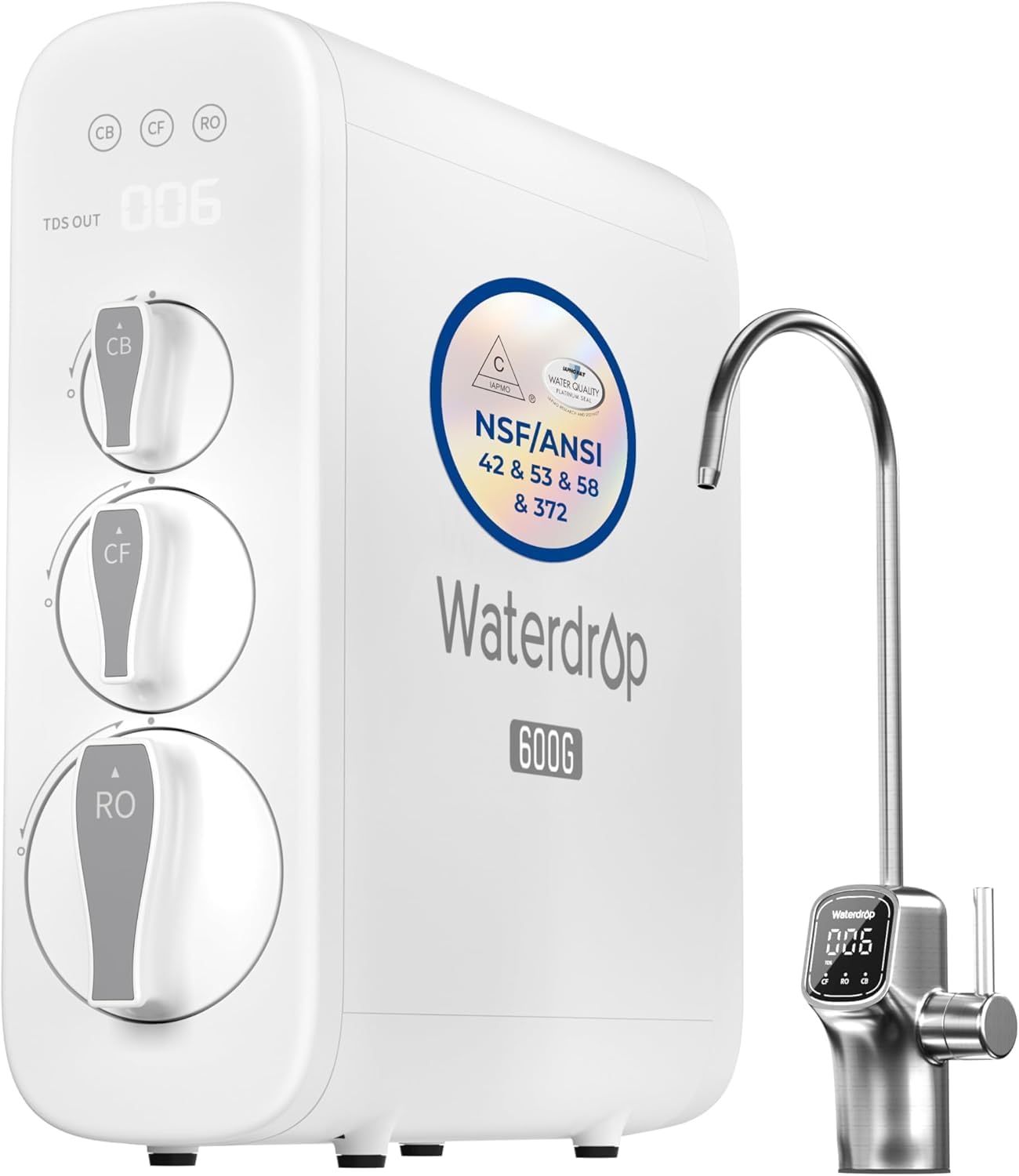
The Waterdrop G3P600 is a tankless reverse osmosis system designed for steady, high-volume drinking water at the kitchen sink. It uses an 8-stage filtration train including RO membrane and carbon block stages to cut TDS, chlorine, heavy metals, PFAS and other contaminants, and its tankless design frees up under-sink space while producing a cup of water in about eight seconds. A smart faucet provides real-time TDS readout and filter-life indicators so you can monitor water quality and replacement timing without guesswork. The unit runs on plug-in power and advertises a low 2:1 pure-to-drain ratio for reduced wastewater compared with many RO units, and the advertised 600 GPD capacity and 0.42 gpm flow rate mean fast filling for pitchers and cooking. Installation requires two drilled holes and under-sink clearance for the unit, and while filters are twist-and-replace, the system does need electricity and periodic membrane and carbon replacements; real-world performance will also depend on feed water TDS and pressure. For buyers prioritizing high throughput and measurable water quality, this is a strong fit.
Best for: Buyers who want a high-capacity under-sink RO focused on measurable water quality and fast dispensing for daily drinking and cooking needs.
Less Ideal for: People without an accessible under-sink outlet or those who prefer a passive, non-electric filter system.
- High daily throughput rated at 600 GPD for fast dispensing and heavy household use
- 8-stage filtration including RO membrane and carbon block to reduce TDS, chlorine, heavy metals and PFAS
- Smart display faucet with TDS monitoring and filter life indicators for easy water-quality checks
- Tankless design saves under-sink space and allows tool-free filter replacement
- Requires under-sink electrical connection which may complicate some installations
- Advertised low drain ratio will vary with household water pressure and TDS; some wastewater is still generated
Verdict: Choose the Waterdrop G3P600 if you need tankless, high-throughput RO water with an integrated TDS display for confident everyday drinking water.
APEC Water ROES-50

| Purification Method | Reverse Osmosis |
|---|---|
| Filtration Stages | 5-Stage |
| Daily Output (GPD) | 50 GPD |
| Operating Pressure Range | 40-85 psi |
| Filter Life Cycle | 6 months |
The APEC Water ROES-50 is a 5-stage under-sink reverse osmosis system designed to deliver very clean, great-tasting drinking water from a dedicated faucet. It uses prefilters, an RO membrane, and post-filtration to reduce contaminants including chlorine, lead, arsenic, fluoride, PFAs, and microplastics, and it is WQA/NSF certified for material safety. Typical use is straightforward: install the unit under the kitchen sink, connect the included tank and faucet, and the system produces up to 50 gallons per day while storing filtered water for steady flow. Notable features include quick-connect fittings and color-coded tubing for easier DIY installation, an included Filter-Max replacement set, and long filter lifespans that range from six to 24 months depending on which stage you replace. Practical benefits are high contaminant rejection and reduced reliance on bottled water, plus clear service intervals. Limitations are the low maximum flow rate to the drain and the need for periodic filter changes and a storage tank, which adds footprint under the sink compared with smaller countertop options.
Best for: Buyers who want a reliable, high-contaminant-rejection under-sink system they can install themselves and who prioritize water purity and low ongoing maintenance complexity.
Less Ideal for: People with extremely limited under-sink space, households that need very high daily output beyond 50 GPD, or users who want a no-install countertop solution.
- Five-stage RO filtration removes a broad range of contaminants for very pure drinking water
- 50 GPD production capacity suitable for most household drinking and cooking needs
- Quick-connect fittings and color-coded tubing simplify DIY installation and servicing
- Includes Filter-Max replacement set and brushed nickel faucet so system is ready to install
- Requires under-sink space for the system and storage tank
- Filters and membrane need periodic replacement to maintain performance
Verdict: Choose the ROES-50 if you want a DIY-friendly, certified under-sink RO system that reliably delivers very pure drinking water for most homes.
FS-TFC 5-Stage RO System

| Purification Method | Reverse Osmosis |
|---|---|
| Installation Type | Under Sink |
| Maximum Flow Rate | 18 liters per hour |
| Supported Water TDS Level Maximum (PPM) | 500 |
| Capacity | 100 gallons |
This FS-TFC 5-stage reverse osmosis system installs under a standard sink and delivers highly filtered drinking water without electricity. It uses a five-stage filtration train and a pressurized storage tank to remove chlorine, heavy metals, fluoride, VOCs and many other contaminants, and the manufacturer claims up to 99.999% reduction across 1000+ impurities. The unit is compact and rated for about 100 gallons with a tested flow of roughly 18 liters per hour, so it can supply daily drinking and cooking needs quickly. The package includes a faucet, tank, feedwater adapter and extra tools, plus four replacement filters up front to cover nearly a year of filter changes. Installation is marketed as tool-free and doable in about 10 minutes for typical sinks. Expect low ongoing operating cost because the system runs without electricity and reports a low 1:1 drain ratio, but note the stated filter life and capacity limits mean you will need periodic filter replacement and a match to your water pressure and TDS conditions for best performance.
Best for: Buyers seeking an affordable, compact under-sink RO that delivers high contaminant reduction and low operating cost for everyday drinking and cooking water.
Less Ideal for: Households needing very high daily purified volumes or those wanting a whole-house solution should consider larger-capacity systems instead.
- Five-stage RO filtration targets chlorine, heavy metals, fluoride, VOCs and other contaminants
- Compact under-sink design fits most standard sinks and saves counter space
- Includes faucet, tank and four extra replacement filters for about a year of service
- Runs without electricity and reports a low 1:1 drain ratio to reduce wasted water
- Filter life listed as one year requires periodic replacement and maintenance
- Capacity and flow are limited compared with larger or commercial RO systems
Verdict: A cost-conscious under-sink RO that delivers very high contaminant removal and low ongoing cost for everyday drinking water needs.
iSpring RCC7-BN 5-Stage RO

| Purification Method | Reverse Osmosis, Activated Carbon, Carbon block |
|---|---|
| Power Source | No Power Needed |
| Maximum Flow Rate | 3.4 liters per minute |
| Supported Water TDS Level Maximum (PPM) | 750 |
| Capacity | 75 gallons |
The iSpring RCC7-BN is a 5-stage under-sink reverse osmosis system designed to deliver bottled-quality drinking water at the tap. It uses three pre-filters (sediment, GAC, carbon block), a high-rejection RO membrane, and a final GAC polishing filter to reduce over 1,000 contaminants including chlorine, lead, fluoride, and PFAS while cutting TDS substantially. The system includes a pressurized storage tank and a lead-free designer brushed nickel faucet for standard kitchen installation and requires no electricity. Transparent first-stage housing makes visual inspections easy and push-to-connect fittings simplify plumbing and help prevent leaks. Practical strengths are its NSF/ANSI 58 certification, high daily capacity for typical household use, and extensive online support for DIY installation. Important limitations are that it is intended for municipal tap water rather than untreated well water and replacement filters and membrane must be changed on schedule to maintain performance; the unit also occupies under-sink space and has ongoing consumable costs. For buyers prioritizing reliable contaminant removal and factory-quality construction, this system delivers consistent, long-term drinking water improvement.
Best for: Buyers who want a dependable, lab-tested under-sink RO system that consistently delivers high-purity drinking water and who are comfortable with DIY installation or basic plumbing work.
Less Ideal for: People relying on raw well water without additional whole-house pre-treatment or buyers who need a zero-maintenance, filter-free water solution.
- Complete 5-stage filtration including RO membrane and final polishing filter for broad contaminant removal
- NSF/ANSI 58 certified for verified RO performance
- Transparent sediment housing and push-to-connect fittings simplify inspection and reduce leak risk
- Includes pressurized storage tank and lead-free brushed nickel faucet for ready-to-use installation
- No electricity required so it works during power outages
- Not designed for untreated well water without pre-treatment
- Requires periodic filter and membrane replacements and incurs ongoing consumable costs
Verdict: Choose the RCC7-BN when you want a proven, NSF-certified under-sink RO system that reliably produces high-quality drinking water for daily household use.
iSpring RCC7AK-BN Reverse Osmosis System

| Purification Method | Reverse Osmosis, Alkaline, Activated Carbon, Carbon block |
|---|---|
| Power Source | No Power Needed |
| Maximum Flow Rate | 284 liters_per_day |
| Supported Water TDS Level Maximum (PPM) | 750 |
| Filter Life Cycle | 6 months |
The iSpring RCC7AK-BN is a six-stage under-sink reverse osmosis system that produces remineralized drinking water without electricity. It combines sediment and carbon prefilters, a high-rejection RO membrane, and an alkaline postfilter that restores minerals and raises pH for a more pleasant taste. The clear first-stage housing and color-coded push-fit tubing make DIY installation and routine filter checks straightforward, and the top-mounted faucet fastener eases countertop faucet mounting. Because it is NSF/ANSI 58 certified for the entire system, the RCC7AK-BN addresses a wide range of contaminants including lead, fluoride, PFAS, and chlorine while offering a 75 gallon per day output rating and a storage tank for on-demand dispensing. Replacement filters are available in timed lifecycles and iSpring provides supporting videos and US-based technical support. The system requires under-sink space for the tank and housings and periodic filter and membrane changes, so plan for maintenance and clearance under your sink.
Best for: Buyers who prioritize verified performance and social proof and want a proven, certified under-sink RO that consistently reduces a wide range of contaminants while improving taste.
Less Ideal for: People who need an ultra-compact or portable filter for renters with no under-sink access or who prefer a zero-maintenance, filter-free solution.
- NSF/ANSI 58 certified for whole-system contaminant reduction
- Six-stage filtration with alkaline remineralization for improved taste and balanced pH
- Transparent first-stage housing for easy visual inspection
- DIY-friendly push-fit tubing and color-coded connections with installation videos
- Operates without electricity and delivers up to 75 gallons per day
- Requires under-sink space for the tank and filter housings
- Periodic filter and membrane replacements are needed on a scheduled basis
Verdict: Choose this NSF-certified six-stage RO if you want proven contaminant removal with a remineralizing stage and strong user support.
DREO RO Water Filter 113

| Purification Method | Reverse Osmosis |
|---|---|
| Capacity | 5 liters |
| Other Special Features of the Product | Built In TDS Meter, Change Filter Indicator, Reduce TDS, Touch Control |
| Pure to Drain Rate | 3:1 |
| Included Components | WF113 Body, RO Filter, 2 Autofill Water Pitchers |
The DREO RO Water Filter 113 is a plug-in countertop reverse osmosis system designed to deliver drinking-quality water without plumbing. It uses a 7-stage RO filter and a built-in TDS meter so you can watch raw and purified TDS in real time, and the unit notifies you when filters need replacing. The system includes a 5L internal tank plus two 1.1L autofill pitchers so one pitcher is always ready while the other refills automatically. Self-cleaning auto-flush cycles help reduce biofilm buildup in the tubing and the twist-to-install replacement filter makes maintenance straightforward. The purifier targets a 3:1 pure-to-drain ratio to limit water waste relative to some RO models, and the filter lifespan is given in gallons for easy planning. Limitations are typical of compact countertop RO units: it still produces waste water during filtration and the unit occupies counter space and weighs over 10 pounds, so it is less convenient for tiny kitchens or frequent moving. For buyers who want a tested RO stack with hands-free pitchers and visible TDS monitoring, this is a practical, low-hassle option.
Best for: Buyers who prioritize reliable, lab-tested RO purification and prefer visible TDS monitoring and low-maintenance operation for everyday drinking water.
Less Ideal for: People with extremely limited counter space, those who need a hard-plumbed under-sink solution, or users who want zero wastewater systems.
- Built-in TDS meter and filter-life indicator for visible water quality and maintenance reminders
- Auto-fill dual-pitcher system provides continuous access to filtered water without manual refilling
- Self-cleaning auto-flush reduces internal buildup and lowers routine maintenance effort
- 7-stage RO filtration tested to remove many impurities and deliver low-TDS water
- Twist-to-install replacement filter simplifies servicing
- Produces waste water as part of RO process despite a 3:1 pure-to-drain ratio
- Requires counter space and is relatively heavy for a portable countertop unit
Verdict: A tested, easy-to-maintain countertop RO system that gives visible TDS monitoring and hands-free pitchers for reliable everyday drinking water.
Choosing the Right Reverse Osmosis Water Filter for Drinking Water: Key Factors to Consider
Contaminant Removal Spectrum
Different reverse osmosis membranes and pre/post-filters target different contaminants. You should look for systems that list specific reductions for total dissolved solids, lead, chromium, nitrates, and common pesticides. Performance verified by independent lab testing or published reduction percentages gives the clearest indication of what the system will remove.
Consider the water quality issues you actually face. If your local supply has measurable arsenic or high hardness, ensure the system or an added prefilter addresses those. Keep in mind that RO membranes excel at dissolved solids but typically do not reintroduce minerals unless a remineralization stage is included.
Production Rate and Usable Flow
An RO system's rated production rate is usually measured in gallons per day, but the key practical metric is how quickly it can supply water at the drinking faucet. Systems with small storage tanks or low recovery rates can feel slow during meal prep or when filling pitchers. Look for a balance between membrane capacity and storage volume so the faucet delivers usable flow without long waits.
If your household consumes a lot of bottled or filtered water, choose a system with higher daily production or larger storage. Also consider whether a booster pump is needed if your incoming water pressure is low; pumps increase output but add complexity and electricity use.
Installation and Plumbing Compatibility
Some RO units mount under-sink with simple push-fit connections and a dedicated faucet, while others require more extensive plumbing work or professional installation. Verify the system's connection types and whether your sink and cabinet space can accommodate the tank and filters. Pay attention to drain connection requirements for the membrane rinse stream and the space needed for filter changes.
If you rent or prefer a simpler setup, prioritize models that offer tool-free fittings and clear installation guides. For complex plumbing configurations, plan for professional help to avoid leaks or code violations.
Waste Water and Recovery Efficiency
Reverse osmosis produces a stream of brine that carries away rejected contaminants. Recovery efficiency describes how much of the feed water becomes usable water versus waste. Higher-efficiency systems reduce water waste and can lower operating costs, but often at the expense of slower production without a tank or pump.
Consider local water costs and environmental impact when evaluating recovery rates. Some systems include permeate pumps or efficiency-enhancing features that improve recovery without sacrificing quality, which is worth considering if you want to minimize waste.
Maintenance Needs and Consumables
RO systems rely on a sequence of prefilters, the membrane, and postfilters. Replacement intervals vary widely: prefilters often change every 6 to 12 months, membranes every 2 to 5 years depending on feed water quality, and postfilters on a similar cadence to prefilters. Factor in the availability and cost of replacement cartridges as part of the long-term ownership picture.
Also check how easy it is to access and swap filters. Systems with quick-change housings and clear service indicators reduce the chance of neglected maintenance and extend membrane life.
Materials and Faucet Options
Materials that contact potable water should be certified for drinking use and resistant to corrosion. Look for NSF-certified housings, lead-free faucets, and food-grade tubing. The dedicated faucet style matters for kitchen ergonomics; some buyers prefer a matched stainless-steel faucet while others are satisfied with a compact chrome option.
If you want only filtered drinking water rather than whole-sink filtration, a separate faucet keeps treated water isolated from everyday sink use and helps maintain the system's lifespan.
How Reverse Osmosis Changes Drinking Water Taste and Safety
Reverse osmosis removes dissolved salts and many chemical contaminants that affect taste and odor. By stripping out these contributors, RO-treated water often tastes cleaner and less metallic compared with untreated tap water.
Beyond taste, RO systems reduce contaminant loads that can be a health concern at elevated concentrations. The degree of safety improvement depends on the specific contaminants in your source water and how well the system is maintained.
- RO is effective for dissolved inorganic compounds and many heavy metals.
- It does not selectively remineralize; some systems add a final stage to improve mouthfeel.
- Proper maintenance ensures the membrane and filters continue to perform as rated.
Sizing a System for Household Demand
Estimate your daily drinking and cooking water use when choosing system capacity. A typical adult uses a few liters daily for direct drinking, but pitcher refills, coffee makers, and meal prep increase demand. Multiply expected uses to get a realistic daily volume.
If multiple people or a high-consumption habit are present, opt for a higher production membrane or a larger storage tank. Conversely, single-person households can prioritize compact units with lower throughput and simpler maintenance.
- Check rated gallons per day and expected faucet flow from an empty tank.
- Account for recovery ratio and how often you want to wait for refills.
- Consider a tankless RO if you prefer continuous flow and have adequate inlet pressure.
Common Installation Configurations
Most household RO systems mount under the kitchen sink, with a small pressurized tank and a dedicated faucet on the countertop. This keeps treated water separate from general sink use and preserves the unit from grease and soap exposure.
In some installations, the system can feed a refrigerator water line or an auxiliary sink, but that requires careful planning of line routing and connection fittings. Always verify local plumbing codes and the system's specified connection points before attempting changes.
- Under-sink with a tank is the most common and space-efficient layout.
- Tankless units save under-sink space but often need higher inlet pressure or a booster pump.
- Drain connections must be secure to handle the membrane reject stream.
Remineralization and Post-Treatment Options
Because RO strips many minerals, some people notice a flat or slightly acidic taste. Optional remineralization cartridges reintroduce small amounts of calcium and magnesium to improve flavor and raise pH slightly. This is a personal preference rather than a safety requirement.
Other post-treatment options include UV disinfection for biological risk, alkaline filters for taste, and activated carbon polishing to reduce any residual taste and odor. Choose post-treatment based on your water test results and taste preferences.
- Remineralization can enhance mouthfeel for those sensitive to flat-tasting water.
- UV is useful only if microbial contamination is a concern.
- Carbon polishing improves flavor and removes chlorine traces left by municipal treatment.
Reducing Environmental Impact of RO Systems
Because RO systems produce a waste stream, minimizing waste is both an environmental and practical concern. Look for higher recovery ratios, built-in permeate pumps, or options that reduce reject flow while maintaining membrane performance.
Routine filter maintenance also helps keep the system efficient. Clogged prefilters increase backpressure and waste, so following replacement schedules reduces unnecessary waste water production.
- Compare recovery ratios when evaluating systems.
- Consider a permeate pump to boost recovery without extra energy use.
- Follow filter service intervals to keep the system running efficiently.
How We Chose the Best Reverse Osmosis Water Filter for Drinking Water
We focused on criteria that directly affect drinking water quality, user experience, and long-term ownership cost. Primary evaluation dimensions included contaminant removal capability, measured by the number and type of contaminants reduced; effective production rate and usable flow at the dedicated faucet; storage capacity and recovery efficiency for everyday availability; installation complexity and compatibility with typical kitchen plumbing; and ongoing maintenance needs including filter and membrane replacement intervals. We also considered build quality and materials in contact with potable water to reduce the risk of corrosion or leaching. Products were excluded if they lacked independent contaminant removal data or if they required nonstandard plumbing modifications for basic installation. We prioritized systems with documented membrane performance, clear service schedules, and straightforward user-replaceable filters. Systems aimed only at whole-house treatment without a dedicated drinking-water faucet were not included. The final shortlist balances laboratory-grade removal with practical household concerns like flow, waste brine rate, and ease of filter changes.
Our full evaluation process is outlined in our review methodology.
FAQ
How often should I change RO filters and the membrane?
Prefilters typically require replacement every 6 to 12 months, while the RO membrane usually lasts 2 to 5 years depending on feed water quality. Postfilters are often changed on the same schedule as prefilters. Regular monitoring of water taste and any capacity changes helps determine exact timing.
Will an RO system remove fluoride or lead from my drinking water?
Reverse osmosis membranes reduce many dissolved contaminants, including lead, and can significantly lower fluoride concentrations. Actual removal rates depend on the membrane and system design, so check independent reduction data for the specific contaminants you are concerned about.
Does an RO system waste a lot of water?
RO systems do generate a reject stream, and recovery ratios vary across models. Higher-efficiency systems and those with permeate pumps reduce waste, while low-pressure installations without a pump tend to have greater reject volumes. Consider recovery rate when evaluating systems if water waste is a priority.
Can I install an under-sink RO system myself?
Many under-sink RO systems are designed for homeowner installation with push-fit or threaded connections and clear instructions. However, if your plumbing layout is complex or you are uncomfortable with cutting into water lines, professional installation avoids leaks and ensures code compliance.
Do RO systems remove beneficial minerals from water?
Reverse osmosis removes a broad range of dissolved minerals, which can reduce the mineral content that contributes to taste. Some systems include a remineralization stage to restore small amounts of calcium and magnesium for improved flavor. This is a preference rather than a health necessity for most people.
Final Verdict
When choosing a reverse osmosis water filter for drinking water, prioritize verified contaminant removal, sufficient production rate, and a maintenance schedule you can realistically follow. Balance recovery efficiency and storage capacity against how often you use filtered water and how much under-sink space you have. Opt for a system with clear performance data and accessible consumables to minimize surprises. If you value faster flow and reduced water waste, focus on models with higher recovery or pumps; if simplicity and compactness matter more, choose a straightforward under-sink unit with an adequate tank. With those tradeoffs in mind, you can confidently select an RO system that delivers cleaner, better-tasting drinking water.