
Note: This article contains affiliate links. If you click on these links and make a purchase, we may earn a small commission at no extra cost to you. This helps support our research and content. Read our full affiliate disclosure here.
When you plan a multiday hike or backcountry excursion, the way you treat water determines comfort and safety on the trail. A reverse osmosis water filter for hiking promises near-complete contaminant removal, but not every system is practical to carry or use outside of basecamp. In this guide you will find seven shortlisted options that balance thorough filtration with field practicality. We evaluated each pick for filtration performance, portability, and ease of use so you can choose the right system for your itinerary. Read on to see what matters most when you need high-purity water on the trail.
Top Picks at a Glance
| Best Overall The best all-around choice for most situations | iSpring RCC7-BN 5-Stage RO |  |
| Best Quality Built to a higher standard if you want something more solid | Purewell K8680 Portable RO Purifier |  |
| Best Value The sweet spot between price and what you get | Waterdrop C2SL Countertop RO |  |
| Best Budget The cheapest option that still gets the job done reliably | joypur Portable RO Survival Pump |  |
| Top Rated A top-rated pick with lots of positive feedback | Bluevua ROPOT Countertop RO |  |
| Most Popular A crowd favorite that many people choose with confidence | DREO RO Countertop WF112 | 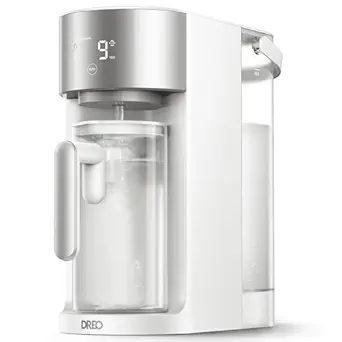 |
| Best Seller A high-volume bestseller chosen again and again | Bluevua ROPOT-UV Countertop RO |  |
iSpring RCC7-BN 5-Stage RO

| Purification Method | Reverse Osmosis, Activated Carbon, Carbon block |
|---|---|
| Power Source | No Power Needed |
| Maximum Flow Rate | 3.4 liters per minute |
| Supported Water TDS Level Maximum (PPM) | 750 |
| Capacity | 75 gallons |
The iSpring RCC7-BN is a traditional under-sink 5-stage reverse osmosis system designed to deliver bottled-quality drinking water at home. It installs under the sink with a dedicated brushed nickel faucet and uses three prefilters (sediment, GAC, carbon block), an RO membrane that filters to 0.0001 microns, and a final polishing GAC filter to remove tastes and odors. The system stores treated water in a tank and requires no electrical power, so it runs quietly and reliably while producing up to 75 gallons per day. Practical benefits include transparent first-stage housing for visual filter checks, push-to-connect fittings to reduce leaks, and clear guidance and videos for DIY installation. Limitations are its intended use with municipal tap water only (not for untreated well water) and the need for periodic filter and membrane replacements to maintain performance, plus the unit's under-sink footprint and tank make it unsuitable for ultralight or portable scenarios. For stationary kitchen use it provides consistent, high-quality water, but it is not a field or hiking filter.
Best for: Buyers who want a reliable, high-capacity under-sink system to supply consistently purified drinking water at home and value proven contaminant reduction and easy DIY installation.
Less Ideal for: People seeking lightweight, portable filtration for hiking, backpacking, or remote use should choose a purpose-built portable filter or purifier instead.
- Comprehensive 5-stage filtration including RO membrane for high contaminant removal
- Certified to NSF/ANSI 58 for performance credibility
- Transparent first-stage housing makes filter condition visible
- Push-to-connect fittings and included installation resources simplify DIY setup
- Produces up to 75 gallons per day without electricity
- Designed for municipal tap water and not rated for untreated well or raw surface water
- Requires periodic replacement filters and membrane to maintain effectiveness
Verdict: Choose the RCC7-BN when you need a proven, high-capacity under-sink RO system to deliver reliably pure drinking water at home.
Purewell K8680 Portable RO Purifier

| Purification Method | Reverse Osmosis, Ultraviolet |
|---|---|
| Filter Life Cycle | 12 months |
| Power Source | Battery Powered |
| RO Membrane Pore Size | 0.0001 micron |
The Purewell K8680 is a battery-powered portable RO system that brings full reverse osmosis filtration plus UV sterilization to camping, RVing, and emergency kits. It uses a 0.0001 micron RO membrane and dual UV lamps to remove dissolved solids, PFAS, heavy metals, chlorine, and many chemical contaminants, while an integrated TDS display shows filtered-water quality in real time. The unit charges via USB‑C, runs for several hours per charge, and can rapid-fill a 2.1 L bottle in about three minutes, making it usable for groups in the field. It performs an automatic 10‑second self-clean on startup, claims a high desalination rate and a 2:1 purified-to-waste ratio, and reports filter lifespans of roughly 12–36 months depending on water quality. Trade-offs are its focus on fresh or brackish water only (not seawater) and the need to replace RO cartridges on a schedule, so long trips require planning for spare filters and charging.
Best for: Buyers who prioritize the best possible contaminant removal when hiking or camping and want a portable system that delivers near-home RO performance with on-board water-quality feedback.
Less Ideal for: Minimalist day hikers looking for ultra-light, maintenance-free straw filters or users who need seawater desalination should look elsewhere.
- Full RO filtration with 0.0001 micron membrane for high contaminant removal
- Dual UV lamps for additional disinfection
- Built-in TDS display for on-the-spot water quality monitoring
- USB‑C fast charging and long runtime suitable for group use outdoors
- Automatic startup self-cleaning cycle and energy-saving standby
- Not designed for seawater desalination
- Requires periodic RO filter cartridge replacements
Verdict: If you want near‑home RO-level purification on the trail with UV backup and TDS readout, the Purewell K8680 is the best performance-focused portable choice.
Waterdrop C2SL Countertop RO

| Purification Method | Reverse Osmosis |
|---|---|
| Filter Life Cycle | 12 months |
| Power Source | Corded Electric |
| Capacity | 75 gallons |
| Pure to Drain Ratio | 3:1 |
The Waterdrop C2SL is a plug-in countertop RO system designed to produce high-purity drinking water without plumbing or installation. You fill the 108 oz feed tank, plug the unit in, and it uses a 0.0001 μm RO membrane and seven filtration stages to cut TDS, lead, microplastics, chlorine, and other contaminants while a mineral stage reintroduces calcium and magnesium for better taste. The system automatically refills a detachable 40 oz glass pitcher so you can refrigerate filtered water easily, and a smart display with voice alerts shows filter life and tank status to simplify upkeep. It is intended for one to two people and the 3:1 pure-to-drain ratio and 12-month filter life help limit maintenance and waste compared with many RO units. The countertop format and no-drill setup make it easy to move between kitchens, offices, or short-term stays, but its size and power requirement mean it is not a field or backpacking device; it is best used where you have countertop space and an outlet.
Best for: Buyers who want a plug-and-play countertop RO that produces better-tasting, remineralized drinking water with minimal installation and simple maintenance for small households or short-term stays.
Less Ideal for: People needing a portable filtration solution for hiking or remote backcountry trips or larger households that require higher daily filtered volume.
- Seven-stage RO with 0.0001 μm membrane removes a wide range of contaminants
- Mineral stage restores calcium and magnesium for improved taste
- Autofill detachable 40 oz glass pitcher for easy refrigeration and serving
- Smart display and voice alerts simplify filter monitoring and setup
- No-plumbing countertop design for quick setup and portability between locations
- Requires electrical power and countertop space so not suitable for true backcountry use
- Designed for 1–2 people so daily output may be limited for larger households
Verdict: If you need a no-install countertop RO that delivers remineralized, refrigerator-ready drinking water with low upkeep for a one- or two-person setup, the C2SL is a practical choice.
joypur Portable RO Survival Pump

| Purification Method | Reverse Osmosis |
|---|---|
| Power Source | Manual |
| Other Special Features of the Product | Multi Stage Filtrartion |
| Material Type | PP Cotton+Activated Carbon + RO Membrane |
This compact, hand-powered water purifier uses a three-stage system with PP cotton, activated carbon, and a 0.0001 micron RO membrane to remove contaminants in the field. It is intended for hikers and emergency use where you need reliable filtration without batteries or electricity: you pump manually to push water through prefilter stages and the RO membrane, producing potable water from uncertain sources. The build is freestanding and lightweight, making it easy to pack and set up at a campsite or riverbank, and the inclusion of activated carbon helps with taste and odor in addition to sediment removal. Because it is manual, flow rate depends on user pumping effort and it is better suited for small-group or individual use rather than producing large volumes quickly. The unit does not list electronic components or battery power so it is simple to maintain, but users should expect slower output compared with powered filters and factor in replacing membrane and filter elements over time.
Best for: Backpackers and emergency preppers who need a compact, electricity-free purifier that can produce highly filtered water in remote settings and prioritize contaminant removal over speed.
Less Ideal for: People who need to produce large volumes of water quickly, groups on extended trips that require high daily water throughput, or users who prefer electric or gravity-fed systems for speed.
- Three-stage filtration including RO membrane for high contaminant removal
- Manual power source works without batteries or electricity
- Activated carbon layer improves taste and reduces odors
- Compact freestanding design suitable for hiking and emergency kits
- Manual pumping yields limited flow rate and slower water production
- Not suitable for quickly supplying large groups due to output constraints
Verdict: A budget-friendly, hand-powered RO purifier that gives hikers and preppers high-level filtration without needing power.
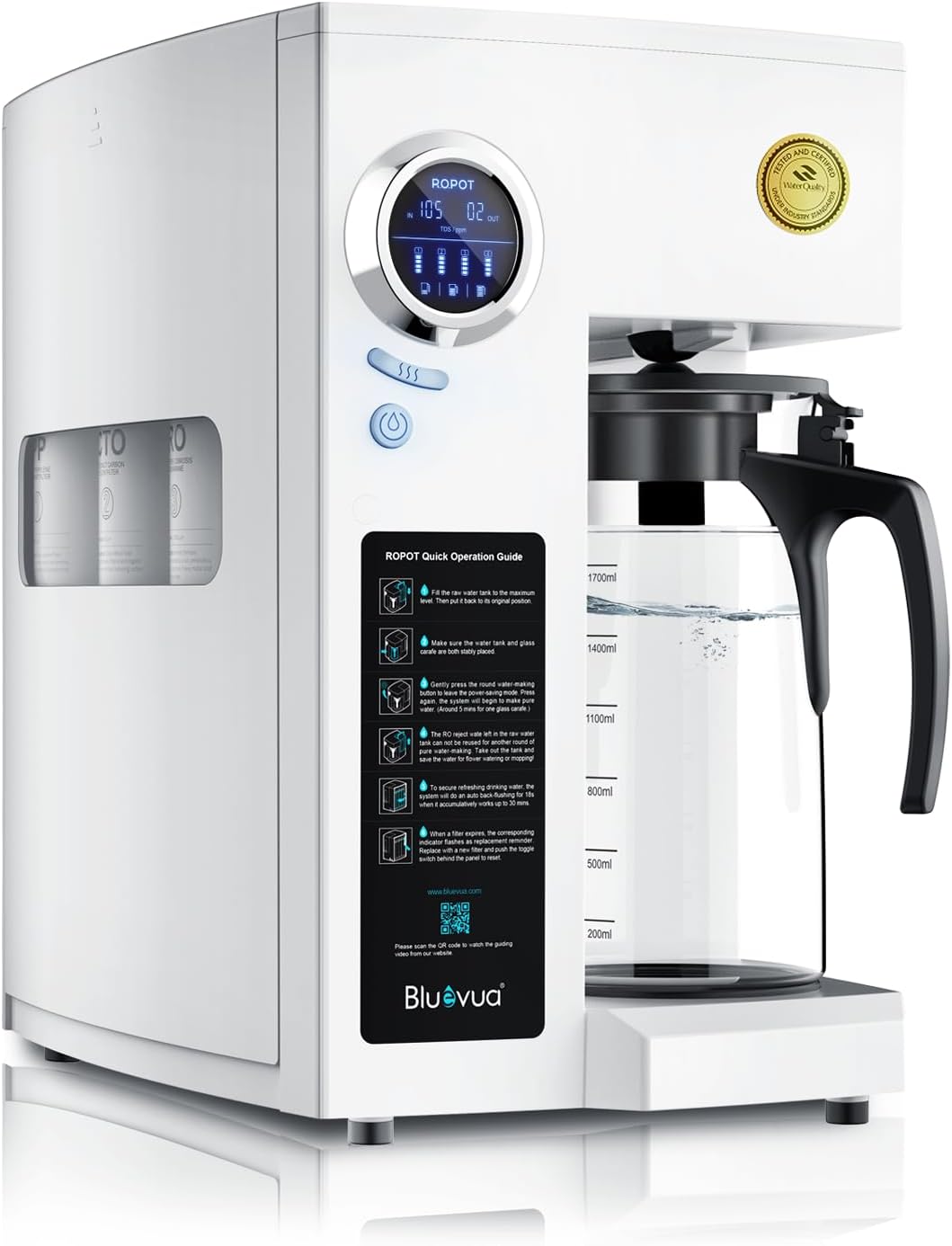
Bluevua ROPOT Countertop RO
| Purification Method | Reverse Osmosis |
|---|---|
| Maximum Flow Rate | 0.26 liters per minute |
| Supported Water TDS Level Maximum (PPM) | 1000 |
| Filter Life Cycle | 24 months |
| Capacity | 1700 ml |
The Bluevua ROPOT is a plug-in countertop RO purifier built around a high-borosilicate glass carafe and a five-stage filtration stack that includes remineralization. It is used by filling the unit, plugging it in, and letting the system produce low-TDS water at about 0.26 liters per minute while the smart display reports filter life and TDS readings. Notable features include the glass storage carafe that avoids plastic contact, a filter life monitor, and an energy-saving standby mode. The unit aims for strong contaminant reduction with a very fine RO membrane and claims a 2:1 pure-to-drain water ratio to reduce waste compared with larger RO setups. Limitations for outdoor use are clear: the ROPOT is countertop-sized, requires mains power, and produces water relatively slowly, so it is best for campsite bases or trailhead use where you have power rather than on-the-go hiking. Regular filter replacements and attention to the monitor are needed to keep performance consistent.
Best for: A buyer who prioritizes dependable, bottle-quality water at a campsite or basecamp with access to electricity and wants clear maintenance indicators and glass storage rather than plastic.
Less Ideal for: Not a fit for ultralight hikers or situations without reliable power where compact, manual, or pump-style filters are required.
- High-borosilicate glass carafe reduces plastic contact and secondary contamination risk
- Five-stage RO filtration with remineralization for low TDS and improved taste
- Built-in TDS/readout and filter life monitor for easy maintenance tracking
- Plug-in countertop design requires no plumbing and includes energy-saving standby mode
- Requires mains power and is not suitable for backpacking or on-the-go filtration
- Low flow rate means longer fill times compared with portable pumps or gravity filters
Verdict: Choose the Bluevua ROPOT when you need reliable, low-TDS, bottle-quality water at a powered campsite or basecamp with glass storage and clear filter-life monitoring.
DREO RO Countertop WF112

| Purification Method | Reverse Osmosis |
|---|---|
| Capacity | 3 liters |
| Pure to Drain Rate | 3:1 |
| Included Components | Body, RO filter, Autofill pitcher |
| Built-in Features | TDS meter, Change filter indicator, Touch control |
The DREO WF112 is a countertop reverse osmosis system designed to deliver thoroughly filtered water without permanent installation. It uses a 7-stage RO filter with a reported 3:1 pure-to-drain ratio and includes a 3 liter tank plus a 1.1 liter autofill pitcher, making it useful for kitchen, office, or small household use. Notable practical features include a built-in TDS meter and filter-life indicator so you can monitor water quality and know when to swap cartridges, plus a self-cleaning flush that reduces internal buildup and an autofill sensor that keeps the pitcher topped up. The filter lifetime is listed around 265 gallons (about 1000L) per cartridge, and replacement elements twist in for easy changes. Limitations for hiking-focused buyers are obvious: it is a countertop appliance that requires carrying filtered water rather than filtering on the trail, and it needs occasional cartridge replacements and periodic descaling. For those looking to ensure low-TDS, lab-tested RO purity at home or to fill bottles before a hike, it is a compact, hands-off option that simplifies monitoring and maintenance.
Best for: Buyers who want reliable, low-TDS reverse osmosis water at home to fill bottles before outdoor trips and value built-in monitoring and simple maintenance.
Less Ideal for: People who need a portable or pump-powered filter for treating water directly on the trail should choose a lightweight hiking filter instead.
- 7-stage RO filtration with SGS-tested impurity removal for very low TDS water quality
- Built-in TDS meter and filter-life indicator for real-time water-quality and maintenance feedback
- Auto-fill pitcher and self-cleaning auto-flush reduce manual refilling and internal contamination risk
- Compact, installation-free countertop design that is easy to set up and move
- Not portable for on-trail use since it is a countertop unit intended for pre-filtering and storage
- Filter capacity requires periodic replacement (approx 265 gallons) and occasional descaling
Verdict: If you want lab-grade RO water at home to reliably fill bottles before hikes, the DREO WF112 delivers compact, monitored purification with minimal setup.
Bluevua ROPOT-UV Countertop RO

| Purification Method | Reverse Osmosis |
|---|---|
| Power Source | Corded Electric |
| Maximum Flow Rate | 0.26 liters per minute |
| Supported Water TDS Level Maximum (PPM) | 500 |
| Filter Life Cycle | 12 months |
The Bluevua ROPOT-UV is a plug-in countertop RO system that delivers heavily filtered water into a borosilicate glass carafe without any plumbing. It uses a 6-stage process with a 0.0001μm RO membrane, UV sterilization and a remineralization stage, and the unit displays TDS and filter-life information on an LCD so you can see water quality and maintenance needs. Setup is simply filling the reservoir and plugging in the power adapter, and the glass carafe reduces plastic contact for a cleaner taste. Practical benefits include strong contaminant removal, onboard sterilization from the UV lamp, and filter-life monitoring that helps a cautious buyer know when to replace consumables. Important limitations for outdoor use are that it requires a corded power source, has a modest 0.26 L/min flow rate, and is sized as a countertop appliance rather than a truly lightweight hiking purifier, so it is best for basecamp or cabin use rather than multi-day trail carry.
Best for: Buyers who prioritize verified contaminant removal and measurable water quality and need a plug-in countertop purifier for basecamp, cabin, or travel locations where power is available.
Less Ideal for: Backpackers and ultralight hikers who need a compact, battery-free or pump-style purifier for use on the trail should look for purpose-built portable filters instead.
- Comprehensive 6-stage filtration with RO membrane and UV reduces a wide range of contaminants
- Built-in TDS meter and LCD display show pre/post water quality and filter life
- Borosilicate glass carafe minimizes plastic contact and improves taste
- No-plumbing countertop design for plug-and-play setup
- Requires corded power so not suited for remote trail use without electricity
- Relatively low output flow (0.26 L/min) compared with portable field purifiers
Verdict: If you want factory-quality RO filtration with UV sterilization and visible TDS readouts at a powered basecamp or cabin, this countertop unit delivers reliable, measurable purity.
Choosing the Right Reverse Osmosis Water Filter for Hiking: Key Factors to Consider
Filtration Performance and Contaminant Reduction
The primary reason to choose a reverse osmosis system while hiking is the level of contaminant removal. RO membranes remove dissolved salts, many heavy metals, and a portion of organic compounds that simple mechanical filters may miss. For hikers near mining runoff, agricultural areas, or uncertain water sources, higher rejection rates translate directly to safer water.
Look for clear membrane rejection specifications and evidence of multi-stage prefiltration. Prefilters protect the RO membrane from sediment and biological load, extending service life and preserving flow rate. Because RO reduces dissolved solids substantially, it can also improve taste and reduce odor, which matters on longer trips.
System Weight and Packability
On the trail every ounce counts, so system weight and how the unit packs are central to decisions. Some RO kits are modular: the membrane and pump can be carried separately and assembled at camp, which keeps daypack weight low while allowing a full clean-water setup when you stop.
Consider total packed volume and whether hard-case components add unnecessary bulk. Softer, collapsible reservoirs and hose segments pack flatter and can be stowed inside a pack to balance load. Also check whether the system needs extra accessories that add weight, such as external batteries, chargers, or heavy fittings.
Energy Needs and Flow Rate
Reverse osmosis is more demanding than simple gravity or pump filters because it forces water through a dense membrane. For hikers, the practical question is how much effort or power the system requires to produce a liter of water. Manual pump-assisted RO systems consume human energy and can be tiring to use frequently. Electric pumps need batteries or charging solutions, which add weight and logistical complexity.
Evaluate liter-per-minute flow rates in camping conditions and whether bursts of higher flow are possible for quicker fills. Also consider the ratio of purified water produced to wastewater generated; high rejection ratios that waste a lot of source water may be impractical where water is scarce.
Ease of Use and Field Maintenance
A system that is fiddly to set up or hard to clean will be frustrating after a long day on the trail. Look for quick-connect fittings, clear flushing procedures, and intuitive assembly that one person can handle. Systems that allow backflushing or include simple chemical sanitization steps are easier to maintain in the field and less likely to foul.
Also consider how often the membrane or prefilters need replacement and whether replacements are easy to carry. Durable housings and abrasion-resistant hoses reduce the chance of damage during transport, and straightforward troubleshooting steps can prevent a single issue from disabling your water supply.
Water Source Suitability
Not all natural sources are suitable inputs for RO without pre-treatment. Highly turbid water with lots of sediment will clog prefilters quickly and reduce membrane life. When you will be using glacial streams, silty rivers, or stagnant ponds, prioritize systems with robust sediment prefilters and simple field-cleaning steps.
Assess whether the system tolerates biologically loaded water; some RO setups are designed for clearer inputs and perform poorly when the source is contaminated with algae or heavy organic matter. Matching the system to the most common water sources on your planned hikes will reduce maintenance and keep flow rates acceptable.
Durability and Replacement Parts Availability
Backcountry gear must survive bumps, drops, and variable temperatures. Components like membranes, pumps, and connectors should be robust or easily replaceable. Consider how easy it is to source spare parts and consumables before a trip because carrying multiple full spares is rarely practical.
Materials that resist UV degradation and flexible tubing that resists kinks will extend usable life. Also think about warranty terms and manufacturer support for technical questions, since membrane questions can be technical for non-specialists.
Where Reverse Osmosis Fits in Backcountry Water Treatment
Reverse osmosis is at the high end of contaminant removal for portable treatment options. It removes dissolved salts and many chemical contaminants that standard mechanical filters and chemical treatments do not. That makes RO attractive for hikers concerned about heavy metals, prolonged exposure to low-level pollutants, or sources impacted by human activity.
RO systems are more complex and resource-intensive than gravity or pump filters, so they are most appropriate for multi-day trips or expeditions where water quality is a persistent concern. For short day hikes with reliable sources, lighter, simpler methods may still be preferable.
- High contaminant reduction including dissolved solids
- Best for multi-day or remote trips with uncertain water quality
- Requires more setup and potentially power than basic filters
Transporting and Storing RO Components on the Trail
Plan how you will carry membranes, pumps, hoses, and prefilters. Distribute weight across the pack and use protective sleeves for rigid components to avoid damage. Whenever possible, collapse reservoirs and stow hoses inside the pack to protect them and save space.
Use a checklist to verify all small fittings, O-rings, and clamps are stowed. A small repair kit with spare O-rings and a compression clamp can keep you going if a connection starts to leak.
- Protect rigid components with padding
- Use collapsible reservoirs to save space
- Carry spare O-rings and small repair items
Conserving Source Water and Managing Wastewater
RO systems generate waste brine which should be managed carefully in the backcountry. When water is plentiful this is less of an issue, but in arid regions wasting two to three liters to make one liter of potable water is not practical. Some systems are more efficient and produce less waste for comparable purity.
Collect wastewater when possible and disperse it away from campsites and water sources. Consider pre-filtering to reduce membrane reject rate and improve overall water yield.
- Some RO setups waste more water than others
- Pre-filtering improves system efficiency
- Dispose wastewater away from campsites and waterways
Field Hygiene and Preventing Biofouling
Keeping membranes free of biological growth extends life and preserves flow rate. After use, flush membranes with clean water and follow any recommended short-term storage steps such as a light sanitizing rinse. For extended storage, many systems recommend a preservative solution or thorough drying according to the manufacturer instructions.
Inspect prefilters regularly and replace or clean them when visibly soiled. In warm climates especially, biofouling can accelerate, so increased attention to hygiene will save weight in the long run by avoiding premature membrane replacement.
- Flush membranes after use
- Use preservative steps for long storage
- Monitor prefilters for clogging more often in warm weather
How We Chose the Best Reverse Osmosis Water Filter for Hiking
Our selection focused on systems suitable for hiking and lightweight backcountry use, not large household installations. We prioritized measurable filtration performance and real-world portability because hikers face tradeoffs between purity, weight, and set-up complexity. Key evaluation criteria included membrane rejection rate and multi-stage filtration, which indicate how effectively a system removes dissolved solids and microbiological hazards. We assessed packability through weight, packed volume, and component modularity to ensure options are realistic for backpacking. Flow rate and required energy or pumping effort were graded to reflect convenience at camp. Usability covered set-up time, maintenance in the field, and how easy it is to change or flush membranes. We excluded heavy countertop and municipal-scale systems that require continuous AC power or plumbing. Systems with unclear membrane specifications or no practical camp deployment method were removed. The final list emphasizes units that deliver strong contaminant reduction while remaining usable for hikers who need reliable drinking water away from trailheads.
Our full evaluation process is outlined in our review methodology.
FAQ
Is reverse osmosis necessary for all backcountry water sources?
Not usually. For clear mountain streams and well-protected sources, a high-quality mechanical filter or chemical treatment may suffice. RO is most useful when dissolved contaminants, heavy metals, or chemical pollutants are a concern, or when you need the highest possible purity.
How much extra weight does an RO system add to a pack?
It varies widely by system. Minimalist or modular RO kits can add a few pounds once you include pump and membrane, while more complete setups with batteries and cases are heavier. Consider the full kit weight rather than just the membrane when planning.
Can I run an RO system manually without batteries?
Some RO systems are designed for manual pump operation, though they require significant effort to produce liters of water. Manual systems eliminate battery logistics but increase physical work, so they are better suited to occasional use or group water duties rather than continuous daily production.
How often do RO membranes need replacing in the field?
Membrane life depends on source water quality and how well prefilters are maintained. In heavy sediment conditions membranes can foul in weeks, while cleaner sources and diligent prefiltering can extend life to many months. Carrying spare prefilters and following flushing routines helps maximize membrane life.
Will reverse osmosis remove viruses and bacteria encountered on the trail?
RO membranes have very fine pore structure and can remove many pathogens, but effectiveness depends on the system and prefiltration. For microbiological safety, some hikers combine RO with UV treatment or chemical disinfection as an added safeguard, particularly where viral contamination is a concern.
Final Verdict
Choose an RO system for hiking when dissolved contaminants or chemical pollutants are a primary concern and when you can accept the tradeoffs in weight and setup complexity. Prioritize systems with clear membrane performance specs, robust prefiltration, and efficient water yield. If portability and low effort are top priorities, favor modular, lower-weight RO kits or supplement a basic filter with additional treatments. Balance the need for purity against pack weight and daily water production when selecting the best option for your trip.