
Note: This article contains affiliate links. If you click on these links and make a purchase, we may earn a small commission at no extra cost to you. This helps support our research and content. Read our full affiliate disclosure here.
Installing the right reverse osmosis water filter under a sink can make a major difference in water taste, odor, and contaminant reduction at the tap. You want a system that fits your plumbing, reliably removes the contaminants you care about, and is practical to maintain over time. This guide shortlists the top options for sink installations and explains the evaluation criteria used to select them. We focus on real-world concerns like filtration performance, flow rate, installation complexity, filter life, and long-term maintenance. Read on to see which systems meet those standards and which features matter most for a successful under-sink setup.
Top Picks at a Glance
| Best Overall The best all-around choice for most situations | Waterdrop G2 Tankless RO System |  |
| Best Quality Built to a higher standard if you want something more solid | Waterdrop G3P600 Tankless RO |  |
| Best Value The sweet spot between price and what you get | Express Water RO5DX 5-Stage RO |  |
| Best Budget The cheapest option that still gets the job done reliably | Slevoo SJ-RO75R Reverse Osmosis |  |
| Top Rated A top-rated pick with lots of positive feedback | Home Master Artesian Full Contact TMAFC-ERP |  |
| Most Popular A crowd favorite that many people choose with confidence | APEC Water ROES-50 |  |
| Best Seller A high-volume bestseller chosen again and again | iSpring RCC7AK-BN Reverse Osmosis System |  |
Waterdrop G2 Tankless RO System

| Flow rate | 400 GPD |
|---|---|
| Filtration stages | 7 Stage |
| Pure to drain rate | 1:1 |
| Supported water TDS maximum | 300 ppm |
| Installation type | Under Sink |
The Waterdrop G2 is a tankless under-sink RO designed for steady, fast filtered water without a storage tank. It uses a 7-stage composite filtration arrangement including RO membrane and carbon/PP stages to cut TDS and common contaminants while offering NSF/ANSI 372 lead-free material certification. Because it is tankless and rated for 400 GPD with a 1:1 pure-to-drain ratio, it produces water quickly—about a cup in roughly 12 seconds—and reduces waste compared with many conventional RO units. The integrated electric and water circuits require an under-sink outlet but simplify installation and shrink the footprint so it saves cabinet space; filters use a twist-and-pull design for fast replacements. Practical limits: it needs power and a drilled faucet hole, and supported feed water TDS should be under 300 ppm. Also expect typical RO maintenance such as periodic filter and membrane replacements. If you want high flow, compact under-sink RO with lower water waste, the G2 delivers a useful balance of speed, filtration stages, and space savings.
Best for: Buyers who want a compact, fast under-sink RO that minimizes cabinet footprint and water waste while delivering steady filtered water for daily kitchen use.
Less Ideal for: Homes without an under-sink power outlet or users who need an RO solution for very high-TDS source water or off-grid installations.
- Tankless design saves under-sink space and avoids a storage tank.
- High output up to 400 GPD for fast dispensing.
- Low 1:1 pure-to-drain ratio reduces wastewater compared with many RO systems.
- Seven-stage composite filtration including RO membrane and carbon/PP stages for broad contaminant removal.
- Twist-and-pull filters make replacements quick and installation is relatively straightforward.
- Requires an under-sink electrical outlet and drilling a faucet hole to operate.
- Not intended for feed water with TDS above 300 ppm.
Verdict: Choose the Waterdrop G2 if you want a compact, tankless under-sink RO that delivers fast, high-output filtered water while cutting wastewater.
Waterdrop G3P600 Tankless RO
| Filtration stages | 8-stage |
|---|---|
| Capacity | 600 GPD |
| Pure to drain ratio | 2:1 |
| Power source | Corded Electric |
| Maximum flow rate | 0.42 gpm |
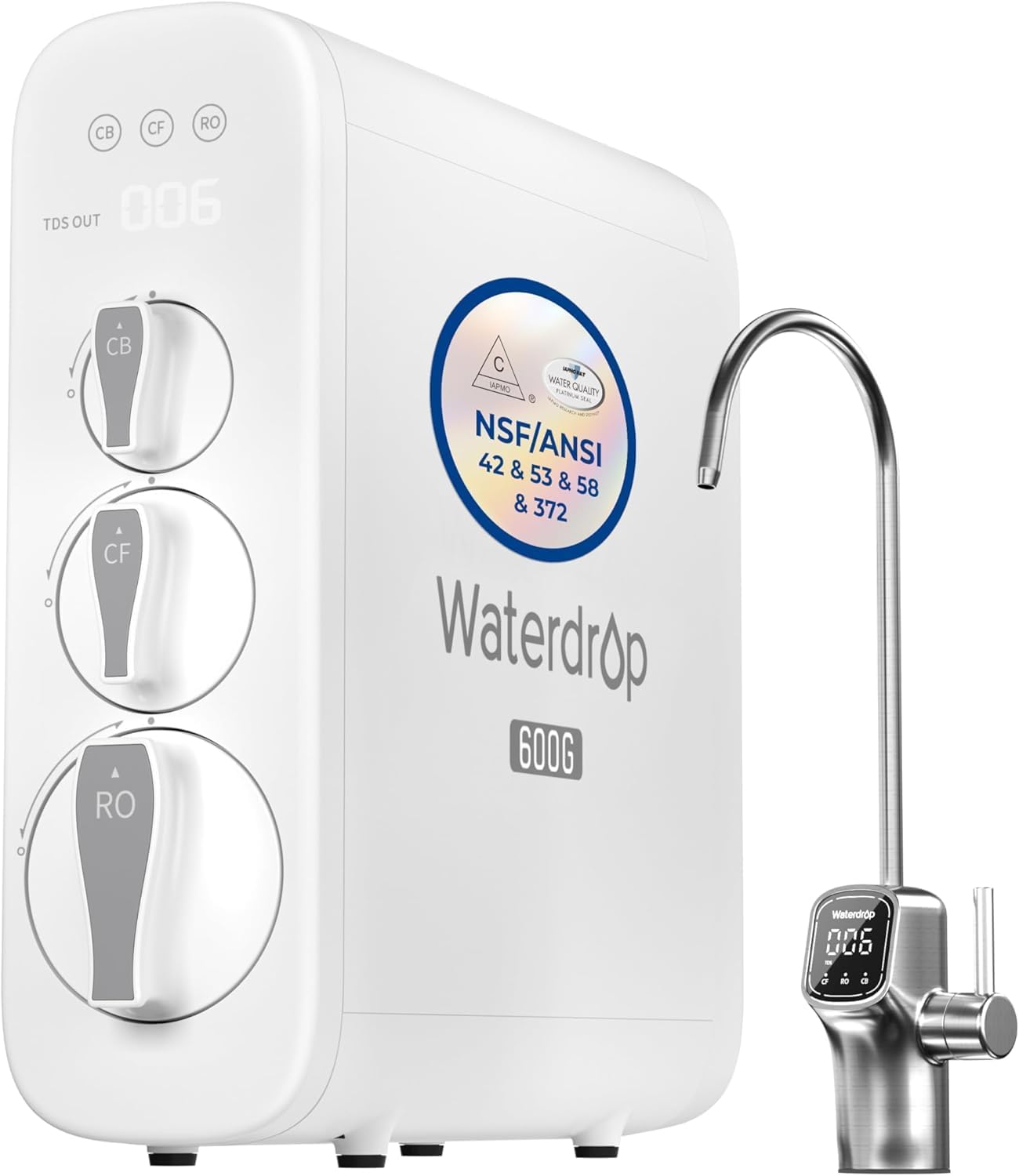
The Waterdrop G3P600 is a tankless under-sink reverse osmosis system built for high-flow households that want fast, low-waste purified water. It uses an 8-stage filtration train including carbon block and an RO membrane to reduce TDS, heavy metals, PFAS, chlorine, and other contaminants, and its 600 GPD capacity produces an 8 oz cup in about 8 seconds. The unit is plug-in powered and includes a smart LED faucet that monitors TDS and filter life for easy maintenance. Tankless construction saves significant under-sink space and the twist-to-replace cartridges simplify filter swaps without tools. The system advertises a 2:1 pure-to-drain ratio, which lowers wastewater compared with many traditional ROs, but it does require an electrical outlet under the sink and a small hole for the faucet plus a drain connection. Installation may be tighter in shallow cabinets and you should confirm clearance before buying. For buyers who prioritize delivery speed, contaminant reduction, and a compact footprint, this model packs strong performance into a user-friendly package.
Best for: Buyers who prioritize high throughput, strong contaminant reduction, and quick dispensing for everyday drinking and cooking will appreciate this system.
Less Ideal for: Those without an accessible under-sink outlet or with very shallow cabinets should consider non-powered or compact alternatives.
- High 600 gallons-per-day capacity for fast dispensing
- 8-stage filtration targeting TDS, heavy metals, PFAS, chlorine and taste/odor
- Smart LED faucet with TDS and filter-life display for maintenance visibility
- Tankless design saves under-sink space and allows quick tool-free filter replacement
- Requires under-sink electrical power and a drain/faucet hole for installation
- Cabinet clearance can be tight despite tankless layout
Verdict: If you want fast, high-capacity RO performance with low wastewater and a compact, tankless footprint, the G3P600 is a top choice.
Express Water RO5DX 5-Stage RO

| Purification Method | Reverse Osmosis |
|---|---|
| Maximum Flow Rate | 0.8 gpm |
| Gallons Per Day | 50 GPD |
| Capacity | 4 gallons |
| Supported Water TDS Level Maximum (PPM) | 300 |
The Express Water RO5DX is a compact under-sink reverse osmosis system built to deliver very high impurity reduction for household drinking water. It uses a five-stage setup — sediment, granular activated carbon, activated carbon block, RO membrane, and post-activated carbon — to cut dissolved solids, heavy metals, fluoride, pharmaceuticals, and chlorine, and it is independently tested to NSF/ANSI standards. Typical use is kitchen or remote indoor installation feeding a dedicated chrome faucet and a 4 gallon storage tank so you get fast flow at about 0.8 gpm. Installation is aimed at DIYers: quick-connect fittings, included feed adapters for 3/8 and 1/2 piping, a wrench, and an included extra filter set for the first year. Practical features include a leak stop valve and labelled housings for easy filter swaps; maintenance is predictable with annual membrane and twice-yearly pre/post filter changes. Expect the usual RO behavior: it discharges wastewater (approximately 1–3 gallons per produced gallon) and requires adequate incoming pressure or a booster pump for low-pressure situations.
Best for: Buyers who want a high-performing, tested under-sink RO that they can install themselves and who prioritize water purity and predictable maintenance schedules.
Less Ideal for: Homes with very low water pressure without the willingness to add a booster pump or users who prefer zero-waste or whole-house filtration solutions.
- Five-stage filtration including an RO membrane for extensive removal of heavy metals, fluoride, pharmaceuticals, and VOCs.
- NSF/ANSI tested and certified performance claims for impurity reduction.
- Includes 4 gallon storage tank and a brass/chrome faucet for immediate use out of the box.
- DIY-friendly quick-connect fittings, feed adapters, and labeled housings simplify installation and filter changes.
- Safety features like a leak stop valve and included spare filter set for first-year maintenance.
- Produces wastewater at a typical RO reject ratio of about 1–3 gallons per gallon produced.
- Needs sufficient incoming water pressure (40–80 psi) or a booster pump for proper operation.
Verdict: A tested, DIY-friendly five-stage RO that delivers highly purified tap water and clear maintenance intervals for buyers focused on practical, long-term water quality.
Slevoo SJ-RO75R Reverse Osmosis

| Purification Method | Activated Carbon |
|---|---|
| Power Source | Gravity/Faucet Pressure |
| Supported Water TDS Level Maximum (PPM) | 2000 |
| Capacity | 700 gallons |
The Slevoo SJ-RO75R is an under-sink reverse osmosis system designed to strip a wide range of contaminants from tap water using a 0.0001 micron RO membrane plus pre/post carbon stages. It installs under a standard sink and runs on faucet pressure, producing filtered water quickly — the listing claims 200 ml in about 8 seconds and a 700 gallon capacity before major service. Notable conveniences include a change filter indicator and a quick pull-and-twist filter design that makes replacements straightforward; three replacement filters are included with the unit. The system is certified to NSF/ANSI 58 for removal of heavy metals, fluoride, PFAS, chlorine and more, and its 3:1 pure-to-drain ratio is better than many traditional RO units. Expect a compact plastic housing that fits smaller cabinets and a gravity/faucet-powered installation that avoids added electrical work. Limitations are typical for RO: it produces wastewater at the stated ratio and requires periodic cartridge changes, and the plastic construction may feel less premium than metal-bodied systems.
Best for: Buyers seeking an affordable, certified under-sink RO that removes a wide range of contaminants and fits in smaller cabinets while keeping installation simple and maintenance straightforward.
Less Ideal for: People who want an electrically boosted system, zero wastewater solutions, or a premium metal-bodied unit for heavy commercial use should consider other options.
- NSF/ANSI 58 certified for broad contaminant removal including heavy metals and PFAS
- Relatively fast output with a claimed 200 ml in about 8 seconds
- 3:1 pure-to-drain ratio reduces wastewater compared with many RO systems
- Quick pull-and-twist filter cartridges and included filter life indicator simplify maintenance
- Compact footprint fits small under-sink cabinets
- Plastic housing may feel less durable than metal alternatives
- Still generates wastewater as part of the RO process
- Requires periodic filter and membrane replacements
Verdict: A space-saving, NSF-certified under-sink RO that delivers strong contaminant removal and easy filter changes at a budget-friendly level.
Home Master Artesian Full Contact TMAFC-ERP

| Installation Type | Under Sink |
|---|---|
| Purification Method | Alkaline, Reverse Osmosis |
| Maximum Flow Rate | 1 gpm |
| Operating Pressure Range | 40-95 psi |
| Supported Water TDS Level Maximum (PPM) | 500 |
The Home Master Artesian Full Contact TMAFC-ERP is an under-sink RO system designed to produce mineral-rich, great-tasting water while addressing common RO headaches like slow flow and high waste. It uses a seven-stage purification path that includes catalytic carbon and a patented 2-pass remineralization to add calcium and magnesium twice, and a non-electric permeate pump to boost production and slash wastewater. The system ships as a fully assembled unit with an RO membrane, storage tank, faucet, and installation fittings, and the modular filter housings are intended for easy annual service without tools. Notable practical benefits are fast 8-ounce fill times, improved removal of chloramines with catalytic carbon, and better water efficiency thanks to the permeate pump. Trade-offs include the physical footprint under the sink and the need to replace filters annually or after about 2000 gallons, and initial installation is more involved than simple cartridge filters. For buyers prioritizing consistent, high-quality tap water and long-term reliability, this model focuses on durable components and serviceability.
Best for: Buyers who want a reliable, serviceable under-sink RO that delivers mineralized, better-tasting water and reduced wastewater over time.
Less Ideal for: Renters or users who need a plug-and-play countertop unit or who cannot accommodate under-sink space for installation.
- Patented 2-pass remineralization adds beneficial minerals for improved taste
- Non-electric permeate pump increases water production and reduces wastewater
- Catalytic carbon stage improves removal of chloramines and chlorine
- Modular, easy-to-change filter design and fully assembled unit simplify maintenance
- Fast 4.5 second (8 oz) fill rate for quicker access to filtered water
- Requires under-sink space and has a larger physical footprint than simple filters
- Filters and membrane need scheduled replacement (about yearly or 2000 gallons)
Verdict: Choose this Home Master unit if you want a durable under-sink RO that boosts flow, reduces waste with a permeate pump, and delivers mineralized drinking water reliably.
APEC Water ROES-50

| Filtration stages | 5-Stage |
|---|---|
| Daily output | 50 GPD |
| Operating pressure range | 40-85 psi |
| Supported water TDS maximum | 2000 ppm |
| Filter life cycle | 6 months |
The APEC Water ROES-50 is a five-stage under-sink reverse osmosis system designed to deliver very low-TDS drinking water for a household kitchen. It uses sediment and carbon prefilters, an RO membrane, and a post-filter to reduce chlorine, lead, arsenic, fluoride, heavy metals, PFAs, microplastics and other common tap-water contaminants, and includes a storage tank and dedicated faucet for steady flow. Installation is DIY-friendly with quick-connect fittings and color-coded tubing, making it a reasonable weekend project for someone comfortable with basic plumbing. Filters are large-capacity and the manufacturer recommends changing prefilters every 6 to 12 months and the membrane/post-filter every 12 to 24 months depending on feed-water quality. The system runs on normal household water pressure and temperatures and is rated for a maximum supported TDS up to 2000 ppm, but output is limited by a roughly 50 GPD production rate and the small flow-to-drain ratio inherent to RO systems, so it is best for drinking and cooking rather than whole-house supply. Built with factory-quality components and backed by long market track record, it is a practical choice if you want proven contaminant removal and steady filtered water at the sink.
Best for: Buyers who prioritize proven contaminant removal and want a reliable, certified under-sink RO system with a track record and straightforward DIY installation for drinking and cooking water.
Less Ideal for: Homes that need high-volume or whole-house filtration or renters who cannot install an under-sink plumbing system.
- Five-stage filtration removes a wide range of contaminants including heavy metals, fluoride, and PFAs
- Produces up to 50 gallons per day with a pressurized storage tank for steady faucet flow
- WQA/NSF-certified components and long seller history provide social-proof reliability
- DIY-friendly quick-connect fittings and color-coded tubing simplify installation and service
- 50 GPD output and storage tank make it suitable only for point-of-use drinking/cooking, not whole-house needs
- Requires periodic filter and membrane replacements on a 6–24 month schedule depending on water quality
Verdict: Choose the ROES-50 if you want a proven, certified under-sink RO system that reliably delivers very low-TDS drinking water with simple DIY installation.
iSpring RCC7AK-BN Reverse Osmosis System

| Purification Method | Reverse Osmosis, Alkaline, Activated Carbon, Carbon block |
|---|---|
| Power Source | No Power Needed |
| Maximum Flow Rate | 284 liters_per_day |
| Supported Water TDS Level Maximum (PPM) | 750 |
| Filter Life Cycle | 6 months |
The iSpring RCC7AK-BN is a six-stage under-sink reverse osmosis system that combines sediment and carbon prefiltration, an RO membrane, and an alkaline remineralization stage to produce drinking water with reduced contaminants and a balanced pH. It installs under a kitchen sink and includes a brushed nickel faucet and storage tank, with color-coded push-to-connect fittings and clear first-stage housing to simplify monitoring and DIY maintenance. NSF/ANSI 58 certification for the full system and stated removal rates for common contaminants give added reassurance for cautious buyers, and the unit runs without electricity so it works during power outages. Filter replacement cadence is defined (6 months for some stages) and replacement part options are listed, but the system requires periodic maintenance and under-sink space for the tank and housings. The convertible feed adapter and fridge compatibility add flexibility, while the top-mounted faucet fastener eases countertop installation from above.
Best for: Buyers who prioritize verified contaminant removal and reliable, maintenance-friendly under-sink filtration with a focus on safety and predictable performance.
Less Ideal for: Those who need an ultra-compact countertop solution or want a completely maintenance-free purifier that requires no periodic filter replacements.
- NSF/ANSI 58 certification for the complete RO system provides verified contaminant reduction.
- Six-stage filtration including an alkaline remineralization stage restores minerals and raises pH for better-tasting water.
- No electricity required so it continues to provide filtered water during power outages.
- Transparent first-stage housing and color-coded push-fit tubing make visual inspection and DIY maintenance easier.
- Includes brushed nickel faucet, storage tank, and adapter options for fridge connection.
- Requires regular filter changes and under-sink space for the tank and housings.
- Flow rate and capacity depend on water pressure and the 75 GPD rating may be lower in practice.
Verdict: A fully certified, electricity-free under-sink RO system that delivers reliable contaminant reduction and remineralized drinking water for cautious, risk-averse buyers.
Choosing the Right Reverse Osmosis Water Filter for Sink: Key Factors to Consider
Filtration Effectiveness
This determines which contaminants the system removes and by how much. Check lab certifications or test data for reduction rates of common concerns such as lead, chlorine, cysts, and total dissolved solids. Higher removal percentages matter when your water source has specific contaminants you want reduced.
Also consider the membrane rejection rate and whether the system includes pre- and post-filters to protect the membrane and improve taste. Systems marketed for broad contaminant lists may still vary in real-world effectiveness, so prioritize documented reduction figures that match your local water quality needs.
Production Rate and Storage Capacity
Production rate, typically measured in gallons per day (GPD), affects how quickly the system can supply filtered water. For sink-mounted systems without a large storage tank, a higher production rate reduces wait times for drinking and cooking water.
Consider household usage patterns: a single person or couple will need far less daily output than a family. Where countertop pressure or low feed pressure exists, production can drop, so check rated GPD and whether the system maintains reasonable flow under typical home conditions.
Ease of Installation
Under-sink installations vary in complexity depending on existing plumbing and the system design. Some units require only straightforward tubing and a saddle valve, while others need a dedicated faucet hole or a separate drain connection. Assess whether you are comfortable with basic plumbing tasks or will need professional help.
Easy-to-follow instructions, color-coded tubing, and common-sized fittings reduce installation time and the chance of leaks. Also verify cabinet clearance and whether the system's tank or filter housings will fit alongside existing items under the sink.
Maintenance Frequency and Cost
Regular filter changes and occasional membrane replacement are inevitable. Look at recommended replacement intervals for pre-filters, post-filters, and the RO membrane. Shorter intervals can mean fresher tasting water but higher lifetime upkeep.
Factor in the availability and cost of replacement cartridges and whether the system uses proprietary parts. Systems with longer filter life or washable pre-filters can lower total maintenance burden. Clear maintenance indicators or simple cartridge swaps make upkeep less error-prone.
Waste Water Ratio and Efficiency
Reverse osmosis produces reject water while concentrating contaminants. The waste-to-purified-water ratio affects household water use and may be relevant in areas with water restrictions. More efficient systems or those that include permeate pumps can reduce waste without sacrificing production rate.
If environmental impact or municipal limits matter, compare manufacturer-stated waste ratios and consider whether additional components are needed to improve efficiency.
Fit, Size, and Plumbing Compatibility
Under-sink space can be tight, so physical dimensions matter. Measure cabinet height, depth, and available clearance before selecting a system. Some designs have compact filter stacks or tankless setups to save space, while others require a separate pressurized tank.
Plumbing compatibility includes the type of cold-water feed connection, drain hookup style, and faucet hole requirements. Systems that use standard 1/4-inch tubing and common fittings are easier to integrate with existing fixtures.
Common Under-Sink Installation Scenarios
Most sink installations fall into a few predictable scenarios. A simple changeover where a spare faucet hole exists is the easiest case. When no faucet hole is available, you may need to fit a dedicated filtered-water faucet in the sink or countertop, or choose a system that taps the existing sprayer or soap-dispensing hole.
For tight cabinets, compact filter stacks or tankless RO units reduce the footprint. If you plan to keep cleaning supplies or a garbage disposal under the sink, account for those items when measuring. In rental or temporarily occupied spaces, prioritize systems that can be returned to original plumbing with minimal alteration.
- Existing faucet hole available: fastest install
- No faucet hole: plan for drilling or alternate faucet
- Limited cabinet space: consider tankless or compact units
- Disposal or complex plumbing: check clearance and routing
How to Test Your Water Before Buying
Testing your tap water helps you choose the right system. Home test kits can identify general hardness, chlorine, nitrates, and lead ranges. For a more detailed profile, send a sample to a certified lab or request a report from your local water utility if you are on municipal supply.
Match test results to filtration capabilities. If lead is detected, verify the system has documented lead reduction claims. If total dissolved solids are high, prioritize high-rejection membranes and adequate post-filtration to improve taste.
- Start with a simple home test for common contaminants
- For precise results use a certified lab or utility report
- Choose a system with documented reductions for detected contaminants
Maintenance Tips to Keep Performance Consistent
Follow the recommended replacement schedule for pre-filters, carbon filters, and membranes to avoid reduced flow or poorer contaminant rejection. Pre-filters protect the membrane from sediment and chlorine damage; neglecting them shortens membrane life.
Flushing new membranes per instructions and keeping fittings tight prevents leaks and early failures. Keep replacement parts on hand if replacement windows are long for shipping or availability reasons. Regular checks of tank pressure and occasional sanitizing keep the system functioning well.
- Replace pre-filters more often if feed water is turbid
- Record filter change dates to maintain schedule
- Check tank pressure annually and sanitize as recommended
Space-Saving Options and When to Choose Them
If under-sink room is limited, consider tankless RO systems or models with horizontally stacked filters. Tankless designs eliminate the storage tank, freeing space for other items and reducing complexity.
Compact systems may trade off production rate or require more frequent membrane cycling. Balance the need for small size against the household demand for filtered water to avoid frustration from long waits.
- Tankless: smallest footprint, may need higher feed pressure
- Horizontal stacks: fit shallow cabinets
- Standard tank: larger but smoother peak demand handling
Improving Efficiency and Reducing Waste
To lower RO waste, look for systems with better waste-to-purified ratios or consider adding a permeate pump. Permeate pumps recover kinetic energy and can significantly reduce reject water without electrical power.
Another approach is routing reject water to a utility sink for non-potable uses like cleaning. Ensure routing complies with local plumbing codes and that connections do not contaminate potable lines.
- Permeate pumps cut waste without electricity
- Reuse reject water for non-potable tasks when allowed
- Check local regulations before rerouting drain lines
How We Chose the Best Reverse Osmosis Water Filter for Sink
To build this list we applied practical, buyer-focused filters so every recommended reverse osmosis sink system meets real in-kitchen needs. We prioritized measurable filtration performance, including percent-reduction claims for common contaminants such as lead, chlorine, and total dissolved solids. Flow rate and daily production were next, because a system that produces very low output can frustrate regular use. Ease of installation and compatibility with standard under-sink plumbing were key; systems requiring major cabinet modifications or uncommon fittings were excluded. We also evaluated ongoing maintenance factors: filter and membrane life, availability of replacement parts, and the clarity of maintenance instructions. Build quality and certification testing or third-party lab data were considered when available. Systems with unclear performance data, impractical maintenance demands, or designs that do not fit typical sink cavities were excluded. The final selections balance contaminant removal, usable flow, straightforward installation, and predictable upkeep.
Our full evaluation process is outlined in our review methodology.
FAQ
How often should I change RO system filters under the sink?
Pre-filters are usually changed every 6 to 12 months depending on feed water quality, while membranes typically last 2 to 5 years. Heavier sediment or chlorine exposure shortens filter life, so follow manufacturer intervals and monitor flow and taste for signs of replacement needs.
Will a reverse osmosis system lower my water pressure at the sink?
RO units themselves do not reduce your household line pressure, but production rate can be limited and cause slower dispensing from the dedicated faucet. Installing a system with an appropriate production rate or a pressurized storage tank helps maintain usable flow.
Can I install a reverse osmosis system myself under the sink?
Many homeowners can install under-sink RO systems with basic tools, especially when color-coded tubing and standard fittings are provided. More complex setups involving new faucet holes, nonstandard plumbing, or tankless units may require a plumber.
Is RO water safe to drink every day?
RO water is widely used for drinking and cooking and removes many contaminants. Because it reduces dissolved minerals, some people choose to remineralize or use a post-filter for taste. Daily safety depends on nutritional considerations and personal preference.
How much water is wasted with an under-sink RO system?
Waste varies by design and feed pressure but often ranges from one to four gallons rejected per gallon produced for conventional systems. More efficient units and permeate pumps can reduce this ratio, and routing reject water for nonpotable use can improve overall efficiency.
Final Verdict
When choosing a reverse osmosis water filter for a sink installation, prioritize the filtration performance you need, realistic production capacity, and an installation approach that fits your under-sink space. Expect routine maintenance for filters and membranes and factor those intervals into long-term ownership plans. Balance efficiency, installation complexity, and maintenance demands to pick a system that reliably delivers clean, great-tasting water without constant fuss. Focus on documented contaminant reduction, usable output for your household, and plumbing compatibility to make a confident selection.