
Note: This article contains affiliate links. If you click on these links and make a purchase, we may earn a small commission at no extra cost to you. This helps support our research and content. Read our full affiliate disclosure here.
If you have mostly carpeted floors, choosing the right robot vacuum makes a big difference in cleaning effectiveness and how often you need to pull out a traditional vacuum. A robot vacuum for carpet should do more than skim surface debris; it must lift dirt from carpet fibers, handle boundary transitions, and manage pet hair without frequent clogging. This guide shortlists the top options for carpeted homes and evaluates each on real-world factors like suction, brush design, and navigation. Below you will find the top picks for carpet use, plus clear buying criteria and practical tips to help you pick the right model for your layout and cleaning needs.
Top Picks at a Glance
| Best Overall The best all-around choice for most situations | iRobot Roomba 105 Vac |  |
| Best Quality Built to a higher standard if you want something more solid | roborock Saros 20 |  |
| Best Value The sweet spot between price and what you get | roborock Q7 L5 Robot Vacuum |  |
| Best Budget The cheapest option that still gets the job done reliably | Lefant M210 Robot Vacuum |  |
| Top Rated A top-rated pick with lots of positive feedback | WSUANE D15S Max Robot Vacuum |  |
| Most Popular A crowd favorite that many people choose with confidence | iRobot Roomba 105 Combo |  |
| Best Seller A high-volume bestseller chosen again and again | eufy 11S Max Robot Vacuum |  |
iRobot Roomba 105 Vac

| Surface Recommendation | Carpet & Hard Floor |
|---|---|
| Battery Life | 200 minutes |
| Other Special Features of the Product | Anti-Fall, Bagless, Dirt Detection Sensor, Eco Mode, LiDAR Navigation |
| Controller Type | App Control, Button Control, Voice Control |
| Filter Type | Cartridge |
The Roomba 105 Vac is a straightforward robot vacuum built to handle everyday dirt on carpets and hard floors using ClearView LiDAR for fast mapping and obstacle avoidance. It uses a 3-stage cleaning system with a multi-surface bristle brush and an edge-sweeping brush plus what the brand calls 70x power-lifting suction, and you can choose from four suction levels to match light touchups or deeper pickup runs. Setup and scheduling work through the Roomba Home App or voice assistants, and the robot returns to its dock to recharge automatically before resuming a job. Practical benefits include targeted room or spot cleans, keep-out zones via the app, and a long battery runtime noted in the specs. The machine is compact and easy to maintain with replaceable filters and included docking hardware, but it lacks hands-free emptying and some higher-end obstacle recognition features found on pricier models. For steady, no-fuss carpet maintenance it performs consistently, though buyers who want advanced mapping, automatic bin emptying, or wet-mopping will need to look higher in the lineup.
Best for: Buyers who want a reliable, easy-to-use robot that consistently maintains carpets and hard floors without extra frills and who prioritize straightforward mapping and app control.
Less Ideal for: People who want a fully hands-off maintenance solution with auto-emptying, integrated mopping, or the most advanced obstacle recognition should consider higher-tier models.
- ClearView LiDAR mapping for efficient room-by-room navigation and obstacle avoidance
- Four suction power levels for customizable cleaning intensity
- 3-stage cleaning system with multi-surface and edge brushes that improve carpet pickup
- App and voice control for easy scheduling, targeted cleans, and keep-out zones
- No hands-free auto-empty dock included
- Does not include mopping capability
Verdict: A solid, no-nonsense robot vacuum that uses LiDAR mapping and adjustable suction to keep carpets regularly clean without complicated setup or extra attachments.
roborock Saros 20

| Suction Power | 36,000 Pa |
|---|---|
| Battery Life | 180 minutes |
| Filter Type | Washable Filter |
| Power Source | Battery Powered |
| Noise Level | 55 db |
The roborock Saros 20 is built for heavy-duty carpet cleaning while still handling hard floors and low furniture. It pairs a 36,000 Pa digital motor and a dual anti-tangle system to pull embedded dirt and pet hair from deep pile, and AdaptiLift Chassis 3.0 raises the body to cross high thresholds and clean taller carpets without losing suction. StarSight AI Navigation with 3D ToF sensors and an RGB camera maps rooms in real time and recognizes common obstacles so the robot takes more efficient routes with fewer interruptions. The RockDock automated base adds practical hands-free upkeep with hot-water mop washing, hot-air drying, and days-long auto emptying, which reduces manual maintenance for busy homes. Useful app controls, SmartPlan learning, and voice commands make scheduling and zone control straightforward. Trade-offs are its relatively large physical footprint and a noise level around 55 dB, and tight spaces under very low furniture under 3.13 inches remain off-limits despite the slim profile.
Best for: Buyers focused on performance who need powerful carpet cleaning and hands-off maintenance for pet hair and deep-soil removal, and who prioritize advanced navigation and long runtime.
Less Ideal for: People who need an ultra-compact, whisper-quiet robot for very small apartments or users who prefer a minimal manual-maintenance dockless unit.
- Very high suction (36,000 Pa) for deep carpet and pet hair extraction
- Advanced 3D ToF navigation and RGB camera reduce missed spots and collisions
- AdaptiLift chassis crosses up to 3.46 in thresholds and handles thicker carpets
- Automated RockDock provides hot-water wash, hot-air dry, and extended auto-emptying
- App control with SmartPlan learning and voice control for easy scheduling
- Relatively large and heavy compared with compact robot vacuums
- Operates at around 55 dB which can be noticeable in quiet homes
Verdict: If deep carpet cleaning and hands-free maintenance are your priority, the Saros 20 delivers class-leading suction, advanced obstacle-aware navigation, and an automated dock that keeps it running with minimal intervention.
roborock Q7 L5 Robot Vacuum

| Suction | 8,000 Pa |
|---|---|
| Navigation | LiDAR |
| Battery life | 150 minutes |
| Water tank capacity | 270 ml |
| Filter type | Washable |
The roborock Q7 L5 is a LiDAR-guided robot vacuum that vacuums and mops in a single run, using an integrated 270 ml water tank and up to 8,000 Pa suction to handle dust and pet hair on hard floors and low‑pile carpet. It maps rooms with multi-floor support and quick mapping so you can set scheduled cleans, no-go zones, and targeted room runs from the Roborock app or with voice assistants. Practical features include a dual anti-tangle brush system that reduces hair wrap, carpet boost that increases suction where needed, washable filters, and a child lock. For hardwood floors the precise navigation and along-floor-direction cleaning reduce repeated passes and the electronic water control offers three water levels to avoid over-wetting. Limitations to note are the combined dustbin/water-tank design which means you cannot refill water without handling the combo unit, and the robot requires a 2.4 GHz Wi‑Fi connection for full app features.
Best for: Buyers who prioritize reliable, predictable cleaning on hardwood and want a robot that follows precise maps, runs on a schedule, and minimizes hair-related maintenance.
Less Ideal for: People who need separate, large-capacity water or dust tanks for long runs without handling the unit frequently or who cannot provide a 2.4 GHz Wi‑Fi network.
- LiDAR mapping and multi-floor mapping for accurate, efficient coverage
- Strong 8,000 Pa suction with carpet boost for better pickup of dust and pet hair
- Dual anti-tangle brushes minimize hair wrap and maintenance
- Electronic water tank with three water levels lets you control mop moisture
- App control plus Alexa and Google Home compatibility for scheduled, hands-free operation
- Integrated dustbin and water tank is a single combo part, which adds steps when refilling or emptying
- Requires 2.4 GHz Wi‑Fi for app connectivity, which may need router changes for some homes
Verdict: A strong‑suction, LiDAR‑mapped vacuum‑and‑mop that reliably cleans hardwood with low hair maintenance and smart app controls.
Lefant M210 Robot Vacuum

| Battery Life | 120 minutes |
|---|---|
| Capacity | 500 cubic centimeters |
| Filter Type | Cartridge |
| Compatible Devices | Amazon Echo, Google Home, Smartphones |
| Other Special Features of the Product | Anti-Fall, Auto-Docking, Obstacle Avoidance, Pet Hair Pick Up, Scheduling |
The Lefant M210 is a small, app-controlled robot vacuum aimed at regular upkeep on hardwood and other hard floors. Its low 3-inch profile slips under furniture, and a brushless suction port helps pick up pet hair without brush tangles. You can run scheduled cleans, pick from six modes including edge and spot, and control the unit via the Lefant app or Alexa/Google voice commands. The listed 120-minute runtime (quiet mode) covers mid-size rooms on a single charge, and the 500ml dustbin reduces how often you empty it. Navigation relies on infrared anti-collision and anti-drop sensors rather than LIDAR, so it follows zigzag or randomized patterns rather than tightly mapped routes; that makes coverage fine for open hardwood areas but less precise in cluttered rooms. Noise is moderate at about 52 dB and suction is tuned for surface dirt rather than deep carpet extraction. For buyers wanting a straightforward, affordable hardwood-focused cleaner, the M210 delivers solid basic performance, but expect simpler navigation and fewer advanced mapping features than higher-end models.
Best for: Buyers on a tight budget who need a dependable, easy-to-use robot for regular hardwood and low-pile cleaning and value app/voice scheduling over advanced mapping.
Less Ideal for: Homes that require precise room mapping, systematic multi-room navigation, or deep-cleaning on high-pile carpets should consider more advanced models.
- Slim profile fits under low furniture for hidden-dirt pickup
- Brushless suction port reduces hair tangles for pet owners
- App scheduling plus Alexa and Google voice control for hands-free operation
- 500ml dustbin and up to 120 minutes runtime support longer cleaning cycles
- Navigation uses infrared sensors and randomized or zigzag patterns rather than LIDAR mapping, so room coverage can be less efficient in cluttered spaces
- Suction and cleaning are optimized for hard floors and low-pile carpet, not deep-cleaning thick carpet
Verdict: If you want an affordable, compact robot that handles daily hardwood and pet hair cleaning with app and voice scheduling, the Lefant M210 is a practical pick.
WSUANE D15S Max Robot Vacuum

| Capacity | 3.5 liters |
|---|---|
| Suction power | 10000Pa (max) |
| Battery Type | Lithium Ion |
| Battery Life | 1000 hours |
| Filter Type | Three-layer high-efficiency (washable) + filter cotton (not washable) |
The WSUANE D15S Max is a LIDAR-guided robot vacuum and mop designed to run long and reduce maintenance. It uses dToF LiDAR mapping to build accurate multi-level maps, supports app control and Google Home, and offers four suction levels up to a claimed 10000Pa with automatic carpet boost for deeper cleaning. The included 3.5L self-emptying dock holds weeks of debris so the robot can operate hands-free for long stretches, and a hair-cutting anti-tangle roller plus side brushes help keep pet hair moving into the bin. Runtime ranges from about 70 to 160 minutes depending on mode, and washable three-layer filtration captures fine dust with replaceable filter cotton. Practical limitations include a relatively high noise figure listed at 70 dB at peak power and reliance on the app for advanced settings, which may add setup steps. For carpet use the automatic boost and high suction are useful, but peak suction will use more battery and produce more noise. Overall it aims to minimize hands-on upkeep while delivering strong carpet performance when higher suction is selected.
Best for: Buyers who prioritize a low-maintenance, dependable robot that can run long stretches without intervention and deliver stronger cleaning on carpets and pet hair.
Less Ideal for: Users who need whisper-quiet operation or who prefer a fully manual control experience without relying on a smartphone app.
- Large 3.5L self-emptying dustbin reduces manual emptying for weeks of use
- dToF LiDAR navigation creates precise maps and supports no-go zones and multi-level mapping
- High maximum suction plus automatic carpet boost for improved carpet cleaning
- Hair-cutting anti-tangle roller and side brushes that help prevent brush clogs from pet or human hair
- Long runtime options up to 160 minutes in quiet mode for extended cleaning sessions
- Peak suction modes are louder and shorten runtime compared with lower modes
- Some advanced controls require the app which adds setup and dependency on a smartphone
Verdict: Choose the D15S Max if you want a LIDAR-mapped, self-emptying robot that minimizes hands-on upkeep while delivering strong carpet suction.
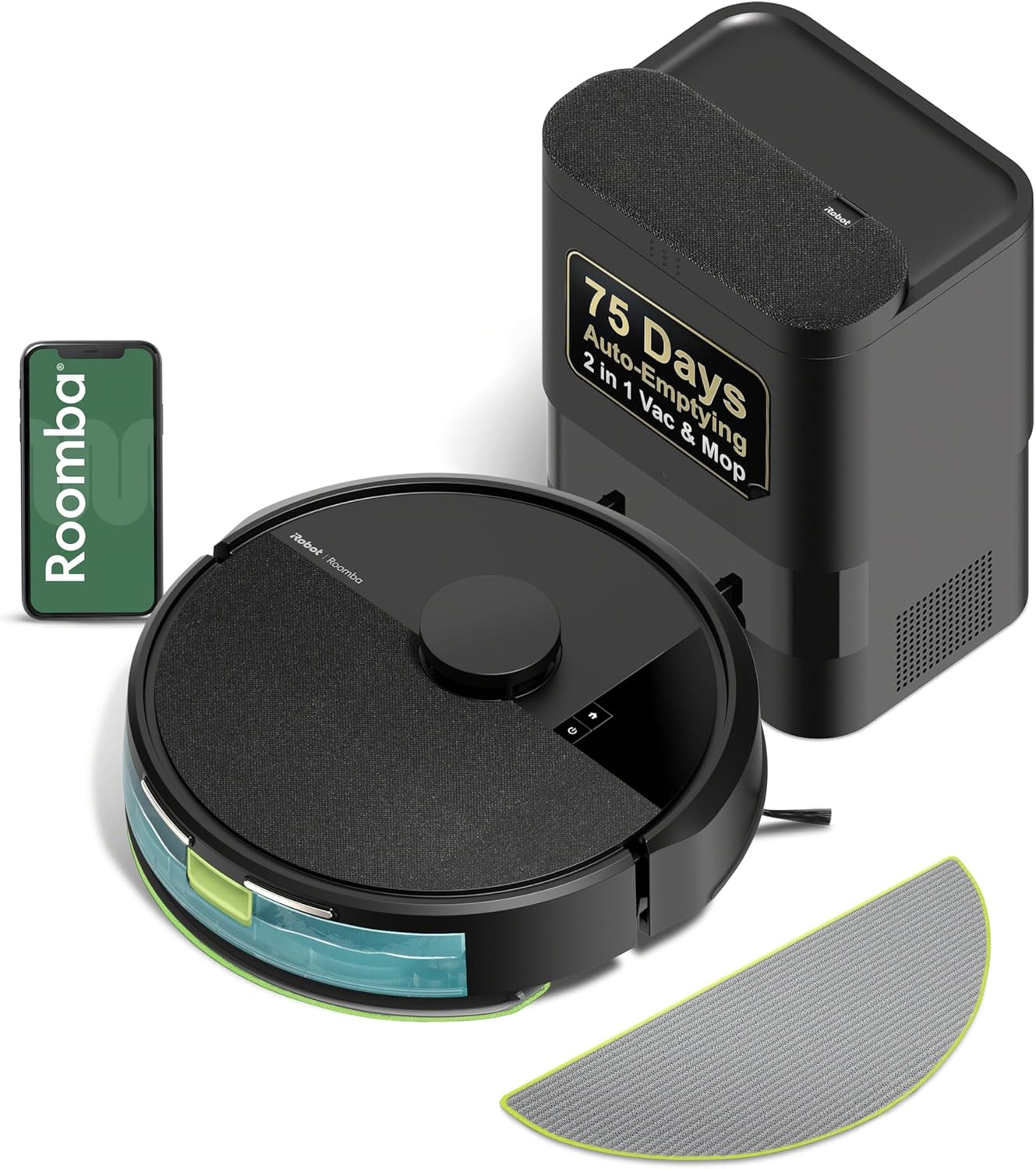
iRobot Roomba 105 Combo
| Battery Life | 100 minutes |
|---|---|
| Surface Recommendation | Carpet & Hard Floor |
| Special Features | LiDAR Navigation, Self-Emptying, Simultaneous Vacuuming & Mopping |
| Filter Type | Cartridge |
| Control Method | App, Touch, Voice |
The Roomba 105 Combo pairs vacuuming and mopping in a single disc-shaped robot designed for routine home cleaning and pet hair. It uses ClearView LiDAR to map rooms for efficient coverage and avoid obstacles, and offers three cleaning modes: vacuum, mop, or vacuum-and-mop together. The unit combines 70x stronger power-lifting suction with an edge-sweeping brush and a multi-surface brush to pull dirt from carpets and hard floors, while a microfiber mop pad and a micro-pump control water flow for consistent mopping and SmartScrub deep scrubbing on high-traffic areas. The included AutoEmpty dock captures debris in a bag for up to 75 days, reducing how often you handle dust. Controls are flexible via the iRobot Home app, onboard buttons, or voice assistants, and the robot supports scheduling and room targeting. Expect routine maintenance like wiping the bin, occasional brush cleaning, and periodic filter changes; the 100-minute battery life may require recharges on very large carpeted homes. Overall it balances hands-free convenience with practical cleaning power for mixed-floor households.
Best for: Buyers who want a mostly hands-off robot that reliably maps rooms, empties itself, and delivers strong suction for everyday carpet and mixed-floor cleaning supported by broad user feedback.
Less Ideal for: Homes that need very long continuous runtime for whole-house carpet cleaning in a single run or users who expect professional-level deep-cleaning performance on heavily soiled carpets.
- AutoEmpty dock holds up to 75 days of debris for low-maintenance operation
- ClearView LiDAR mapping and obstacle avoidance for systematic coverage
- 70x power-lifting suction plus multi-surface and edge brushes for stronger carpet pickup
- Vacuum-and-mop combo with micro-pump and SmartScrub for deeper mopping on hard floors
- App, button, and voice control with scheduling and room targeting
- 100-minute battery life may be short for very large homes or long carpeted runs
- Mop function requires compatible cleaning solution and occasional pad replacement
Verdict: If you want a low-fuss robot that maps reliably, self-empties for months, and delivers strong suction for everyday carpet care, this Roomba Combo is a practical choice.
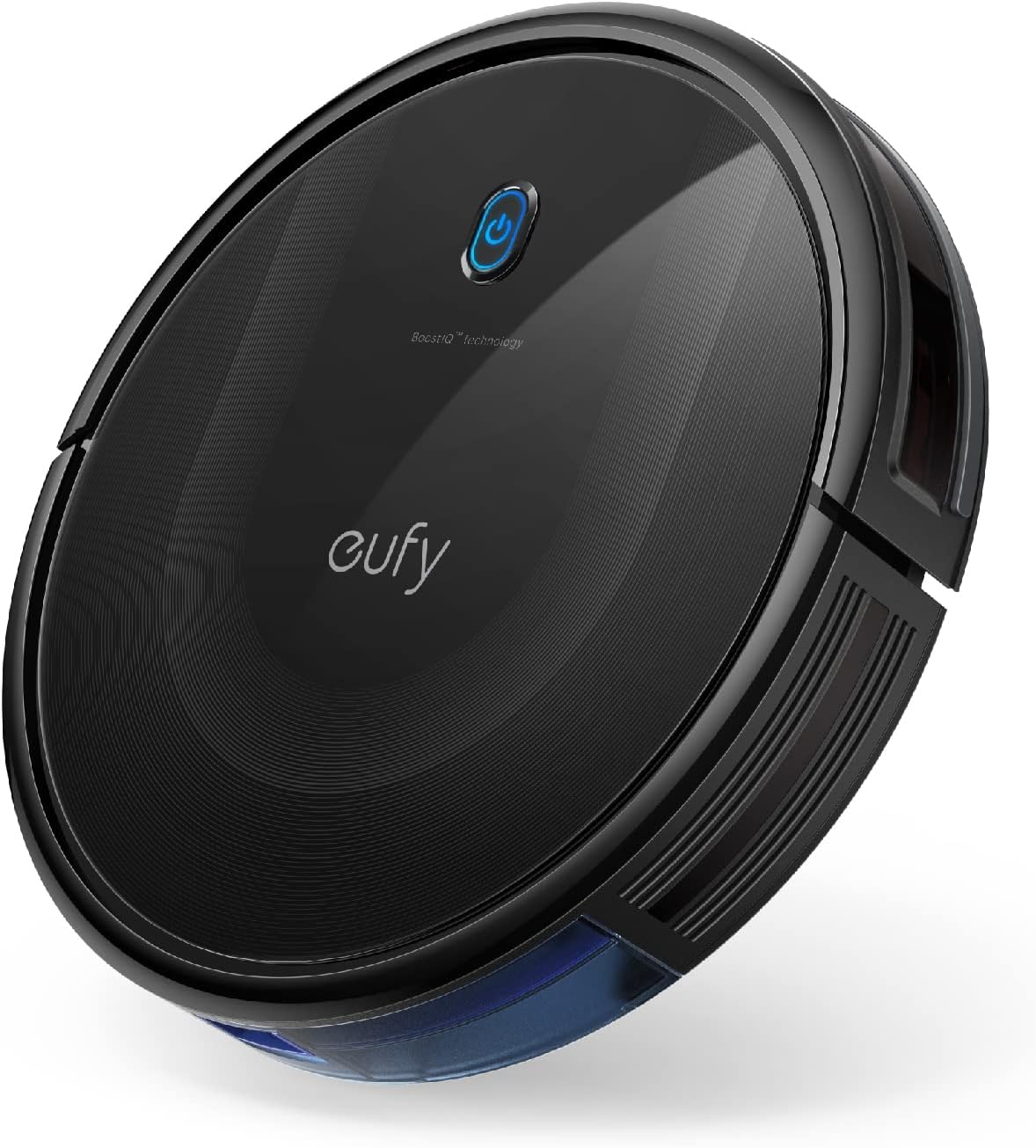
eufy 11S Max Robot Vacuum
| Surface Recommendation | Hard Floor & Tile & Medium carpet |
|---|---|
| Battery Life | 100 minutes |
| Suction Power | 2000 Pa |
| Capacity | 600 ml |
| Noise Level | 55 db |
The eufy 11S Max is a low-profile robot vacuum built to clean hard floors and medium-pile carpets without drawing attention. Its 2.85-inch slim body lets it slide under low furniture while 2000Pa suction and a 12.8-inch cleaning path pick up dust, crumbs, and pet hair. It runs up to 100 minutes on hardwood at a reported low 55 dB, and automatic return-to-base means it tops off battery without user intervention. Controls are simple: the included remote and onboard buttons let you start, stop, and switch modes quickly, though there is no Wi-Fi or app control. Practical touches include washable filters, drop-sensing and anti-collision sensors, and a 600 ml dust capacity that reduces how often you empty the bin. The trade-offs are straightforward: navigation is basic rather than lidar or map-based, so room coverage is more random and may miss tight corners, and the single-side-brush design can be less thorough along edges compared with dual-brush models. For routine, quiet cleaning of hardwood, the 11S Max balances strong suction and a slim profile in a simple, reliable package.
Best for: Buyers who prioritize a quiet, no-frills robot that cleans hardwood reliably and fits under low furniture will appreciate this model for regular maintenance cleaning.
Less Ideal for: If you want mapped cleaning, smartphone scheduling, or the most thorough edge-cleaning for complex floorplans, choose a model with advanced navigation and app control instead.
- Slim 2.85" profile reaches under low furniture
- Up to 100 minutes runtime for extended cleaning sessions
- Powerful 2000Pa suction for effective pickup on hard floors
- Quiet operation at about 55 dB suitable for daytime or evening use
- Large 600 ml dust capacity and washable filter lower maintenance frequency
- Random navigation rather than mapping can lead to uneven coverage
- No Wi‑Fi or smartphone app means limited scheduling and remote control options
Verdict: A slim, quiet robot with strong suction made for routine hardwood maintenance when you want reliable, no-frills cleaning.
Choosing the Right Robot Vacuum for Carpet: Key Factors to Consider
Suction and Airflow
Carpets trap dirt within fibers, so raw suction and the vacuum's ability to move air through the cleaning head determine how much debris gets pulled free. Higher airflow is especially important for medium- and high-pile carpets where debris sits deeper; manufacturers often quote suction in pascals or airflow in liters per minute, but real-world performance also depends on head sealing and brush geometry.
If you have pets or heavy foot traffic, prioritize models with stronger suction and adjustable power settings so the robot can step up suction on carpets and conserve battery on hard floors.
Brushroll Type and Anti-Tangle Features
The brushroll design controls how well fibers are agitated and how hair is channeled into the intake. Combination brushrolls with rubber fins plus bristles tend to work best across different pile heights because they both lift and sweep debris. Anti-tangle systems, quick-release brush modules, and rubberized paddles help reduce hair wrap and make maintenance faster.
For homes with long pet hair, choose a design that minimizes tangling and allows tool-free access for cleaning the brush. Frequent brush maintenance increases overall upkeep time, so better mechanical design pays off in daily use.
Navigation, Mapping, and Coverage
Effective navigation ensures the robot covers carpeted zones systematically instead of wandering randomly. Cameras, lidar, and visual inertial systems enable mapping that produces predictable, repeatable runs and makes it easier to set no-go lines or room schedules. Mapping also affects how the robot handles carpeted transitions, stairs, and area rugs.
Reliable obstacle detection and path planning reduce the chance of the robot getting stuck on furniture legs or edges, which is especially important when carpet height varies across your home.
Battery Life and Recharge Behavior
Longer runtime lets the robot finish larger carpeted areas in a single cycle, which improves cleaning consistency. For carpets, higher suction settings drain battery faster, so balance runtime against suction needs. Models with automatic recharge and resume will return to base when low, recharge, and then finish the job; this behavior is useful for very large homes or multi-room carpet zones.
Also consider how quickly the battery recharges and whether the robot can estimate remaining coverage time. Faster recharge cycles and smart resume cut total cleaning time across multi-pass sessions.
Dustbin Capacity and Filtration
Carpeted homes generally produce more lint and pet hair, filling dustbins faster. Larger dustbins reduce emptying frequency and are helpful if you run frequent clean cycles. Fine dust and allergen containment depend on filtration quality; HEPA or high-efficiency filters trap smaller particles and reduce airborne dust when the bin is emptied.
Consider how easy the bin is to remove and empty without scattering dust. Some models include washable pre-filters or sealed pathways that keep dust contained during disposal.
Choosing the Right Suction Profile for Your Carpet
Different carpets need different suction strategies. Low-pile, looped carpets often do well with moderate suction and aggressive brush action, while thick, plush carpets require higher airflow and deeper suction to reach trapped particles. Adjustable power settings let you tailor cleaning intensity to specific rooms, conserving battery on low-pile rugs and kicking into high power on deep pile areas.
If your home mixes carpet types, look for a robot that senses surface changes and adjusts cleaning mode automatically. Otherwise plan to use scheduled runs with manual mode selection for rooms that demand deeper cleaning.
- Use lower power on thin rugs to save battery
- Select high-suction mode for thick pile or heavy soiling
- Prefer automatic surface detection when available
Managing Pet Hair and Long Fibers
Pet hair can tangle brushrolls and clog intakes quickly. Robots with rubberized, tangle-resistant brushrolls and accessible maintenance panels reduce downtime. Also check for wide intakes that accept hair without immediate clogging.
For multiple-pet households, schedule more frequent cleans and choose models with larger bins and strong suction to prevent repeated partial pickups that leave hair behind.
- Look for tool-free brush removal
- Empty bin after high-hair runs to maintain suction
- Consider brushless or rubber-only rollers if tangles are persistent
Layout Planning and Mapping Tips for Carpeted Homes
Carpeted floor plans often include mixed thresholds, runners, and furniture groupings. Use the robot's mapping tools to create room boundaries and no-go zones around delicate edges or places where the robot commonly stalls. Place the charging base in an open area so the robot can reliably return during long carpeted cleans.
If your home has multiple carpeted rooms, assign scheduled runs by room to prevent long battery-draining continuous runs and to ensure high-traffic areas get prioritized cleaning.
- Create room-based schedules to manage battery load
- Set no-go lines for loose rugs or cabling
- Place base station on hard, level surface near an open carpet edge
Maintenance Routines That Keep Carpet Performance High
Routine maintenance keeps suction and brush efficiency high on carpets. Clean the brushroll weekly in homes with pets, clear the intake path, and replace filters per the manufacturer's interval or sooner if you notice dust escape. Check side brushes and wheels for hair wrap, which can impair navigation and cleaning effectiveness.
Periodic deep maintenance, such as washing washable filters and inspecting brush bearings, extends component life and keeps carpet cleaning consistent over months.
- Inspect brush and intake after heavy hair pickups
- Wash or replace filters on a regular schedule
- Keep wheels and sensors free of lint buildup
When to Use Boost Modes and Spot Cleans
Boost or carpet-specific modes increase suction to pull dirt from fibers more effectively. Use these modes for spots of concentrated soil or before guests arrive. Because boost modes shorten runtime, reserve them for targeted cleaning or schedule them room-by-room to avoid mid-run battery depletion.
Spot clean functions are useful for localized spills on carpets; they concentrate cleaning in one area without demanding a full-floor power run.
- Use boost mode for heavy soiling only
- Schedule spot cleans for high-traffic entryways
- Combine spot cleaning with regular whole-room cycles for best results
How We Chose the Best Robot Vacuum for Carpet
We prioritized features that directly affect carpet cleaning performance and everyday usability. Key evaluation criteria included suction power and airflow for extracting dirt from pile, brushroll design and anti-tangle features for dealing with pet hair, navigation and mapping accuracy to ensure full coverage of carpeted rooms, battery life and recharge behavior for sustained cleanings, and dustbin capacity plus filter quality to limit emptying frequency and contain fine dust. We excluded models that lack sufficiently strong suction or that rely solely on side brushes for dirt pickup, since those designs underperform on medium-to-high pile carpets. We also filtered out units with poor mapping capability that repeatedly miss zones or get stuck on common thresholds. Each shortlisted vacuum had to demonstrate clear engineering for carpeted surfaces, practical runtime for typical home sizes, and user-friendly maintenance access. The scoring emphasized measurable specs and user-facing design that reduce maintenance time and improve deep-clean results.
Our full evaluation process is outlined in our review methodology.
FAQ
Will a robot vacuum for carpet damage my plush carpet fibers?
Most robot vacuums are designed to be safe on residential carpets. However, aggressive brushrolls on high-suction settings can slightly disturb very loose or delicate fibers. If you have specialty or delicate carpeting, use lower power modes and test in an inconspicuous area first.
How often should I run a robot vacuum on carpeted floors?
Frequency depends on traffic and pets. For high-traffic or pet homes, daily or every-other-day runs keep visible hair and crumbs down. Lower-traffic homes can run three times a week. Regular runs prevent deep buildup and reduce the need for manual vacuuming.
Can robot vacuums pick up embedded dirt from high-pile carpets?
Robots can remove loose and some embedded debris, especially when equipped with strong suction and suitable brushrolls. For very deeply embedded dirt, periodic manual deep-cleaning with an upright or canister vacuum may still be necessary.
How do I prevent my robot from getting stuck on area rug edges?
Use mapping and no-go lines to restrict risky areas, and check threshold heights during a test run. Many robots handle small transitions, but high fringes or loose rug corners may still cause snags. Anchoring edges and running slow-speed passes can reduce incidents.
Does running a robot on carpet wear out the carpet faster?
Normal robot operation should not accelerate wear beyond typical foot traffic. Avoid using aggressive scrub settings repeatedly on delicate carpets. Properly sized, moderate-suction cleaning cycles are less likely to stress fibers than heavy manual scrubbing.
Final Verdict
Prioritize suction and brush design when choosing a robot vacuum for carpet, and match those features to your carpet pile and household habits. Strong navigation, sufficient battery runtime, and easy maintenance reduce downtime and improve actual clean results in carpeted rooms. Balance deeper cleaning needs against battery life and maintenance time. If you focus on the criteria outlined above, you can confidently select a robot that maintains carpet appearance with minimal hands-on effort.