
Note: This article contains affiliate links. If you click on these links and make a purchase, we may earn a small commission at no extra cost to you. This helps support our research and content. Read our full affiliate disclosure here.
If you want to reduce the time you spend vacuuming without sacrificing cleanliness, a smart robot vacuum can be a game changer. These devices handle daily debris, adapt to different floor types, and automate routine cleaning so you can focus on other tasks. Choosing the right model matters because suction power, navigation accuracy, and app or voice integration determine how much real-world work the robot will save you. This guide covers our shortlisted top picks across common home setups and highlights the evaluation criteria we used to select them, including suction performance, mapping and navigation, battery life, and maintenance needs. Read on to find the smart robot vacuum features that match your floors and expectations.
Top Picks at a Glance
| Best Overall The best all-around choice for most situations | roborock Q10 S5+ |  |
| Best Quality Built to a higher standard if you want something more solid | roborock Saros 10R |  |
| Best Value The sweet spot between price and what you get | ROPVACNIC S1 Robot Vacuum |  |
| Best Budget The cheapest option that still gets the job done reliably | ILIFE V5s Plus Robot Vacuum |  |
| Top Rated A top-rated pick with lots of positive feedback | WSUANE D15S Max Robot Vacuum |  |
| Most Popular A crowd favorite that many people choose with confidence | Shark Matrix Clean AV2511AE |  |
roborock Q10 S5+

| Maximum Suction | 10,000 Pa |
|---|---|
| Capacity | 2.7 liters |
| Battery Life | 150 minutes |
| Filter Type | Washable |
| Noise Level | 65 db |
The roborock Q10 S5+ is a feature-packed robot vacuum and mop that focuses on low-maintenance, whole-home cleaning. It uses 360° LiDAR mapping and ReactiveTech obstacle avoidance to create precise multi-level maps and navigate cluttered rooms, while the 10,000 Pa suction and ultrasonic carpet detection boost power on carpets and protect rugs during mopping. The VibraRise 2.0 mopping module delivers high-frequency scrubbing for tougher stains and automatically lifts for carpet transitions. A 2.7 L auto-empty dock stores dirt for up to about 70 days, cutting down routine upkeep, and washable filters and dual anti-tangle brush design reduce hair snags for pet owners. App and voice control let you schedule cleanings, set no-go zones, and choose emptying modes, and a long runtime supports larger areas. Trade-offs include noticeable noise at higher power levels and a relatively large robot footprint that may struggle in very tight spaces, and it only supports 2.4 GHz Wi‑Fi. For buyers seeking a smart, hands-off machine that balances powerful vacuuming with capable mopping, the Q10 S5+ is a compelling option.
Best for: Buyers who want a smart, low-maintenance cleaning solution for mixed floors and pet hair and value advanced mapping, strong suction, and an effective mopping option.
Less Ideal for: People who need an ultra-quiet robot for noise-sensitive environments or who require compatibility with 5 GHz Wi‑Fi networks.
- 10,000 Pa suction with automatic carpet boost for strong debris and pet hair pickup
- LiDAR 360° mapping and multi-level maps enable precise navigation and no-go zones
- 2.7 L self-emptying dock supports up to about 70 days of hands-free debris collection
- VibraRise 2.0 sonic mopping system with auto-lift prevents carpets from getting wet
- Dual anti-tangle brush design reduces hair wrap and maintenance
- Higher suction and mopping modes can be noticeably loud
- Only supports 2.4 GHz Wi‑Fi, which limits modern network flexibility
- Larger footprint may have trouble accessing very tight or low-clearance areas
Verdict: If you want a powerful, smart robot that minimizes hands-on maintenance while handling vacuuming and sonic mopping across multiple floors, the Q10 S5+ is a strong all-around pick.
roborock Saros 10R

| Suction | 22,000 Pa |
|---|---|
| Battery Life | 180 minutes |
| Filter Type | Washable |
| Noise Level | 65 db |
| Power Source | Battery Powered |
The roborock Saros 10R is a performance-focused robot vacuum and mop built to handle everyday dirt and pet hair on hard floors and low-pile carpets. It pairs powerful 22,000 Pa HyperForce suction with a Zero-Tangling DuoDivide brush and FlexiArm side brush to pick up hair without frequent brush cleaning, while the ultra-slim 3.14-inch body slips under low furniture to reach hidden dust. The multifunctional dock 4.0 automates maintenance with hot-water mop washing, hot-air drying, 60-day dust collection and auto refill features that greatly reduce hands-on upkeep. Navigation relies on the StarSight 2.0 system with 3D sensing and obstacle avoidance, which improves edge and cord handling and supports auto re-wash for high-traffic spots. For hardwood floors the mop functions and automatic mop lift when carpets are detected help avoid over-wetting. Trade-offs are the relatively loud 65 dB reported noise level during operation and a large, heavier docked system footprint, which may be more than needed for small homes.
Best for: Buyers who prioritize strong cleaning performance and low-maintenance operation on hard floors and have pets or long hair that require frequent deep pickup.
Less Ideal for: People living in very small apartments or who need a whisper-quiet machine for nighttime cleaning should consider smaller or quieter alternatives.
- Very strong 22,000 Pa suction for deep pickup on hardwood and low-pile carpets
- Zero-tangling main brush and omnidirectional wheels reduce hair maintenance
- Ultra-slim 3.14-inch profile reaches under low furniture and into tight spots
- Multifunctional dock automates mop washing, drying, and up to 60 days of dust collection
- 3D obstacle detection and advanced mapping improve edge cleaning and cord avoidance
- Noise level around 65 dB may be noticeable during cleaning
- Large multifunctional dock increases system footprint and setup complexity
Verdict: Choose the Saros 10R if you want top-tier suction and a hands-free docked system that keeps hardwood floors and pet hair under control with minimal daily effort.
ROPVACNIC S1 Robot Vacuum
| Suction power | 5200Pa |
|---|---|
| Battery life | 120 minutes |
| Filter type | Multi-layer Optimized High-Efficiency Filtration |
| Control methods | App, Remote, Voice |
| Surface recommendation | Hardwood Floors, Low Pile Carpets |
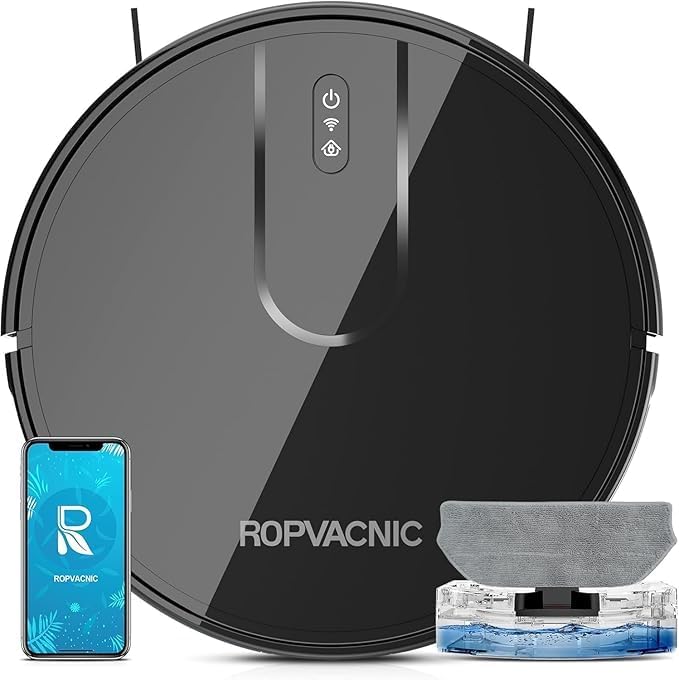
The ROPVACNIC S1 is a compact robot vacuum and electric mop designed for hands-off floor maintenance in homes with hard floors and low-pile carpets. It combines a 5200Pa suction motor, dual rotating side brushes, and a no-entanglement cleaning head to capture dust, crumbs, and pet hair, while an electronically controlled water tank offers four levels of mopping intensity for different stains. You control cleaning schedules and modes from the app, a remote, or via Alexa/Google voice commands, and the unit returns to its charging dock automatically when battery gets low. Practical touches include a multi-layer HEPA-style filter, a long 120-minute runtime for larger areas, and a low-profile 2.99-inch height that slips under furniture. Expect solid cleaning on hard floors and light rugs, with the mop useful for daily maintenance rather than heavy scrubbing; performance on thicker carpets will be limited and the electronic water tank requires occasional refills and pad changes. For buyers who prioritize automated, pet-friendly upkeep, the S1 offers a well-rounded feature set at this performance level.
Best for: Buyers who want an automated, low-effort floor care solution that handles daily vacuuming and light mopping—especially those with pets and mostly hard floors.
Less Ideal for: People needing a deep-cleaning machine for thick carpets, heavy soiling, or professional-grade wet mopping should look elsewhere.
- Strong 5200Pa suction for effective pickup on hard floors and low-pile rugs
- Integrated electric mopping with four adjustable water levels for tailored floor maintenance
- Long 120-minute battery life supports cleaning larger areas between charges
- App, remote, and voice control let you schedule and start cleaning hands-free
- Low-profile design reaches under furniture and a no-entanglement head reduces hair clogs
- Mopping is best for light maintenance and not heavy stain removal
- Not intended for deep-cleaning on high-pile carpets or rugs
Verdict: A practical, pet-friendly robot that combines strong suction and adjustable electric mopping for hands-off daily cleaning on hard floors and low-pile rugs.
ILIFE V5s Plus Robot Vacuum

| Battery Life | 110 minutes |
|---|---|
| Capacity | 300 ml |
| Controller Type | App, Voice, Remote |
| Compatible Devices | Amazon Echo, Google Home |
| Other Special Features | 5 cleaning modes, vacuuming and mopping |
The ILIFE V5s Plus is an entry-level robot vacuum that combines vacuuming and mopping with app, remote and voice control for hands-off floor maintenance. It offers five cleaning modes — auto, spot, edge, max and scheduled — so you can run quick spot cleans or set a regular schedule from the app or remote, and it works with Alexa and Google Home for simple voice commands. A 2600mAh battery delivers up to 110 minutes of runtime and the unit automatically returns to its charging base when the job is done or the battery runs low. The 2-in-1 water tank and dustbin make switching between vacuum and mop straightforward, and the slim profile helps it reach under low furniture. Practical limitations are modest suction compared with higher-end models and basic navigation rather than lidar mapping, so it performs best in simpler floor plans and on hard floors or low-pile carpet rather than complex homes with many obstacles.
Best for: Buyers wanting an affordable, smart robot that handles routine vacuuming and light mopping on hard floors and simple floorplans while offering app and voice controls for convenience.
Less Ideal for: Homes with lots of furniture, stairs, or high-pile carpets that need strong, advanced navigation and maximum suction power.
- Vacuum and mop combo simplifies daily maintenance on hard floors
- App, remote, and voice control (Alexa and Google) for convenient scheduling and operation
- Long runtime up to 110 minutes with automatic return to charging base
- Multiple cleaning modes including spot and edge for targeted cleaning
- Slim, low-profile design fits under low furniture
- Basic navigation system without lidar mapping can struggle in cluttered or complex layouts
- Moderate suction compared with higher-end models may require occasional manual touch-ups
Verdict: A cost-conscious choice for buyers who want basic smart scheduling, voice control, and a combined vacuum-and-mop that handles everyday debris on hard floors.
WSUANE D15S Max Robot Vacuum

| Suction power | 10000Pa (max) with additional modes |
|---|---|
| Dustbin capacity | 3.5 liters |
| Navigation | dToF LiDAR with multi-level mapping and no-go zones |
| Battery runtime | Up to 160 minutes (quiet mode) |
The WSUANE D15S Max is a smart robot vacuum and mop designed to minimize hands-on maintenance while covering large areas. It uses dToF LiDAR navigation and multi-sensor detection to build accurate maps, let you set no-go zones, and avoid obstacles, while app control and Google Home compatibility let you schedule and manage runs remotely. The standout convenience is the 3.5L self-emptying station touted to hold many weeks of debris, and a brushless motor with up to 10000Pa peak suction plus auto-boost on carpets for stronger pickup. Pet owners get an anti-tangle, blade-equipped roller that cuts hair during or after runs to reduce clogs. Runtime varies by mode with up to 160 minutes on the quiet setting and a 3200mAh battery that auto-charges between jobs. Practical limits include a reported 70 dB noise level at higher power and a mix of washable and non-washable filters that require occasional replacement; very small or irregularly shaped rooms may still need manual spot checks despite mapping. For buyers prioritizing low-maintenance, automated cleaning over ultra-quiet operation, this is a capable option.
Best for: Buyers who want a mostly hands-off, map-driven robot that reliably cleans larger homes and cuts down routine maintenance chores.
Less Ideal for: People who need the quietest possible machine for noise-sensitive households or those who prefer fully washable filter systems.
- Large 3.5L self-emptying dustbin reduces how often you touch dirt
- dToF LiDAR mapping with no-go zones enables reliable, repeatable cleaning of multi-room homes
- High peak suction (up to 10000Pa) with auto-boost for better carpet pickup
- Anti-tangle blade-equipped roller and strong side brushes for pet hair and debris
- App control plus Google Home compatibility for remote scheduling and map editing
- Higher noise at strong suction settings (listed around 70 dB)
- Filter system mixes washable and non-washable components that need replacement over time
Verdict: If you want extended hands-free cleaning and accurate LiDAR mapping for larger homes, the D15S Max delivers dependable, low-maintenance performance.
Shark Matrix Clean AV2511AE

| Battery Life | 120 minutes |
|---|---|
| Capacity | 0.27 gallons |
| Control Method | Voice |
| Compatible Devices | Amazon Alexa, Google Assistant |
The Shark Matrix Clean AV2511AE is a LIDAR-guided robot vacuum and mop designed for homes that need frequent, automated cleaning. It maps your home for targeted runs, follows a Matrix Clean grid pattern to take multiple passes over dirty areas, and combines vacuuming with sonic mopping for hard floors while keeping strong suction on carpets. Notable conveniences include a self-emptying, bagless HEPA base that holds up to 60 days of debris and an app plus voice control for scheduling and room-specific cleanings. The self-cleaning brushroll and pet-focused airflow help pick up embedded pet hair, and recharge-and-resume reduces the need to babysit long runs. Trade-offs are typical for a high-tech robot: it is a larger, heavier unit with a significant base footprint and relies on the app ecosystem for advanced controls, and sonic mopping is best for surface refresh rather than deep grout cleaning. For busy households that want a low-maintenance, smart cleaning routine, this unit reduces daily chores effectively.
Best for: Buyers who prioritize proven performance and social proof and want a smart, low-intervention cleaning solution for pet hair and mixed flooring that minimizes daily upkeep.
Less Ideal for: Those who need a compact travelable robot or require heavy-duty wet scrubbing for grout and deeply soiled floors should look elsewhere.
- Self-emptying bagless HEPA base holds up to 60 days of debris for reduced maintenance
- LIDAR home mapping with Matrix Clean grid pattern provides thorough, repeat-pass coverage
- Combined vacuuming and sonic mopping for multi-surface cleaning
- Self-cleaning brushroll and pet-focused design improve hair pickup
- App control plus voice compatibility with Alexa and Google Assistant
- Large base and heavier unit require more floor and storage space
- Sonic mopping refreshes surfaces but is not a deep grout or heavy-soil solution
Verdict: Choose the Shark Matrix Clean AV2511AE if you want a smart, self-emptying robot that reliably handles pet hair and mixed floors with minimal hands-on maintenance.
Choosing the Right Smart Robot Vacuum: Key Factors to Consider
Suction Power and Brush Design
Suction power determines how effectively a robot vacuum pulls debris from carpet fibers and bare floors. Look for models that provide adjustable suction modes so the machine can boost power on rugs and dial back on hard floors to preserve battery life.
Brush design matters because a single-roll brush struggles with long hair while combo roller systems and side brushes help collect edge and corner dirt. Consider whether the unit offers tangle-resistant rollers or easy-to-remove brush assemblies to reduce time spent detangling and cleaning.
Navigation, Mapping, and Room Coverage
Reliable navigation ensures the vacuum visits all accessible areas without repeatedly re-cleaning the same spots or missing corners. Mapping-capable units build a floorplan you can use to set no-go zones, room schedules, and targeted spot cleaning. Laser-based or visual SLAM systems typically give more accurate maps than random-bump navigators.
Also evaluate how the robot handles thresholds, rugs, and multi-room layouts. A unit that can resume after recharging or perform multi-pass cleaning will cover larger homes more efficiently.
Battery Life Relative to Home Size
Battery capacity should match your living space. Short runtimes are fine for small apartments but not for multi-room houses. Consider not just claimed runtime but the effective coverage you can expect under normal suction settings and navigation patterns.
Check whether the vacuum automatically returns to its dock to recharge and resume where it left off. That feature lets the device finish larger jobs without manual intervention.
App Control, Scheduling, and Integrations
A good companion app simplifies scheduling, lets you start or pause cleaning from anywhere, and exposes useful features like room naming, cleaning history, and firmware updates. Integration with voice assistants can be convenient for hands-free control, while cloud-based services may enable advanced mapping features.
Prioritize models with clear, responsive apps and straightforward setup. Also consider privacy and how mapping and usage data are stored and managed by the manufacturer.
Maintenance Needs and Consumables
Long-term ownership costs depend on how often you must replace filters, brushes, and batteries. Models with easily accessible dustbins, washable filters, and tool-free brush removal reduce maintenance time. Pay attention to dustbin capacity too; larger bins mean fewer interruptions when you have pets or heavy traffic areas.
Assess how intuitive the routine cleaning tasks are—emptying the bin, untangling hair from brushes, and replacing filters—and whether spare parts are commonly available.
Noise, Scheduling Flexibility, and Practical Usability
Noise levels affect whether you can run the robot while you are home, working, or sleeping. Some models offer quiet modes that are less disruptive but may trade off suction power. Scheduling flexibility matters for households with varied routines; the ability to create room-by-room schedules and set quiet hours improves the daily experience.
Also consider physical usability: how easy it is to move the robot, view its status lights, and access the dock location. Small practical details influence whether you will actually use the device regularly.
Which Floor Types Need Special Attention
Different floor surfaces pose distinct challenges. Thick-pile carpets require stronger suction and robust brush rolls to dislodge embedded dirt, while bare floors benefit from softer brushes that prevent scattering debris. Area rugs with fringe or tassels can snag brushes, so a model with tangle-resistant features or the ability to disable main brushes is useful.
If your home mixes hardwood, vinyl, and carpet, choose a robot that can detect floor types and adjust suction automatically. That capability conserves battery on easy surfaces and increases cleaning power where it is needed.
- Hardwood and tile: gentle brushes to avoid scratches
- Low-pile carpet: standard suction usually sufficient
- High-pile carpet: higher suction and deeper brush engagement
- Rugs with tassels: consider tangle-resistant rollers or the option to skip brush use
Setting Up Maps and No-Go Zones
Spend some time training the robot to build accurate maps before relying on automated schedules. Walk through the initial mapping runs to confirm important areas are included and that furniture or temporary obstacles are not treated as permanent no-go zones.
Use virtual boundaries to protect fragile areas, keep the vacuum out of pet bowls, or prevent it from attempting stairs. If your layout changes seasonally, check how easy it is to edit or re-learn maps in the app.
- Start with a full mapping run in an uncluttered state
- Create no-go zones for delicate furniture or pet areas
- Rename rooms in the app for targeted cleaning schedules
- Re-map after major furniture moves
Managing Pet Hair and High-Traffic Areas
Homes with shedding pets benefit from models with higher suction, larger dustbins, and brush designs that resist hair wrap. Frequent emptying is part of owning a robot in this environment, so either choose a larger onboard bin or plan for more regular maintenance.
Schedule cleaning during low-activity times so the robot can complete multi-pass cleaning without interference. Some robots offer high-power pet modes that you can trigger for rooms with concentrated hair buildup.
- Empty bins more often in multi-pet homes
- Use boosted suction modes for concentrated hair removal
- Inspect brushes weekly for tangles on long-haired pets
When Auto-Empty Stations Matter
Auto-empty docking stations reduce how often you manually empty the robot by transferring debris into a larger bag or chamber at the dock. This is especially useful if you have allergies or pets and prefer fewer touchpoints with dust.
However, auto-empty stations add size and require their own consumables in many designs. Evaluate the trade-off between convenience and ongoing upkeep based on how often you want to interact with the system.
- Auto-empty reduces manual bin handling frequency
- Dock stations increase footprint and may use replaceable bags
- Decide if the reduced interaction outweighs added maintenance costs
Privacy and Data Management Expectations
Smart robot vacuums that build maps and connect to cloud services can raise privacy questions. Check the manufacturer's policies on how map data is stored, whether it is anonymized, and what controls you have over sharing or deleting maps.
If you prefer local-only control, look for devices that offer on-device mapping and local network operation without mandatory cloud features. Clear privacy settings in the app make it easier to manage what data is retained.
- Confirm where maps and usage data are stored
- Look for options to delete or export maps from the app
- Prefer local control if cloud storage is a concern
How We Chose the Best Smart Robot Vacuum
We focused on factors that directly affect how well a smart robot vacuum performs in everyday home use. Our selection criteria prioritized suction performance on multiple floor types, navigation and mapping accuracy for reliable coverage, battery life relative to typical home sizes, and the ease and frequency of routine maintenance. We also weighed software and smart features, such as app control, scheduling, and integration with voice assistants, because they determine how convenient the device is to operate long-term. We excluded models that lack robust obstacle avoidance or that provide only minimal mapping capabilities, since these deficiencies materially reduce real-world usefulness. We also filtered out machines with insufficient support for washable or replaceable filters and brushes, because high upkeep costs and poor hygiene are common dealbreakers. The final list balances cleaning capability, autonomy, and user experience so buyers can choose a model that fits their floorplan and cleaning expectations.
Our full evaluation process is outlined in our review methodology.
FAQ
How often should I empty the dustbin?
It depends on your home. For single-person households with light debris, emptying weekly may suffice. For pet owners or high-traffic homes, emptying after every or every-other run keeps suction optimal and reduces odors.
Do smart robot vacuums scratch hardwood floors?
Most models are safe on finished hardwood when used with the appropriate brush and suction settings. Avoid robots with coarse bristles and ensure wheels are clean to minimize the risk of surface marks.
Can a robot vacuum handle scattered cords and clutter?
Robots do not reliably manage loose cords or dense clutter. It is best to tidy cables, toys, and small objects before a run to prevent tangles or blockages and to protect the robot from damage.
Will the robot vacuum work on multiple floors?
Many models can operate across multiple floors by creating separate maps, but workflow requires manually moving the dock or unit between levels unless the system supports multi-floor mapping with dock relocation. Battery life and recharge behavior affect how well it handles larger floorplans.
How long do brushes and filters typically last?
Lifespan varies with usage and the environment. Expect filters and brushes to need replacement every few months in heavy-use or pet homes, and less frequently in light-use situations. Regular cleaning extends service life.
Final Verdict
Choosing the right smart robot vacuum comes down to matching core capabilities to your home: strong suction and the right brush setup for carpeted areas, reliable mapping for multi-room layouts, and battery life that suits your floor plan. Weigh convenience features like auto-empty docks and advanced app controls against the ongoing maintenance they require. Prioritize navigation accuracy and maintenance accessibility if you want a hands-off experience, and focus on suction and brush design if pet hair or deep-pile carpets are your main concern. Selecting with those priorities in mind will help you pick a robot that consistently keeps your home cleaner with minimal effort.