
Note: This article contains affiliate links. If you click on these links and make a purchase, we may earn a small commission at no extra cost to you. This helps support our research and content. Read our full affiliate disclosure here.
If you want consistently clean hard floors with minimal effort, a robot vacuum that also mops can be a game changer. These hybrid units can sweep up dust and debris, then apply a damp cleaning pass to remove spots and light scuffs so floors stay presentable between deep cleans. Choosing the right robot vacuum for mopping matters because mop system design, water delivery, and navigation determine how well it removes stains without damaging flooring. This guide covers seven shortlisted robot vacuums for mopping that meet practical performance and reliability standards. We evaluated each option on mop effectiveness, navigation and mapping, battery life, and ease of maintenance so you can match a unit to your home and cleaning habits. Read on to find the features and tradeoffs that matter most for mop-capable robot vacuums.
Top Picks at a Glance
| Best Overall The best all-around choice for most situations | iRobot Roomba Plus 405 Combo |  |
| Best Quality Built to a higher standard if you want something more solid | roborock Saros 10R |  |
| Best Value The sweet spot between price and what you get | roborock Q7 L5 Robot Vacuum |  |
| Best Budget The cheapest option that still gets the job done reliably | ILIFE V5s Plus Robot Vacuum & Mop |  |
| Top Rated A top-rated pick with lots of positive feedback | iRobot Roomba 105 Combo |  |
| Most Popular A crowd favorite that many people choose with confidence | ROPVACNIC S1 Robot Vacuum Mop |  |
| Best Seller A high-volume bestseller chosen again and again | eufy C28 Robot Vacuum & Mop |  |
iRobot Roomba Plus 405 Combo
| Battery Life | 120 minutes |
|---|---|
| Capacity | 0.5 liters |
| Controller Type | App, Button, Voice Control |
| Surface Recommendation | Carpet & Hard Floor |
| Number of Power Levels | 4 |
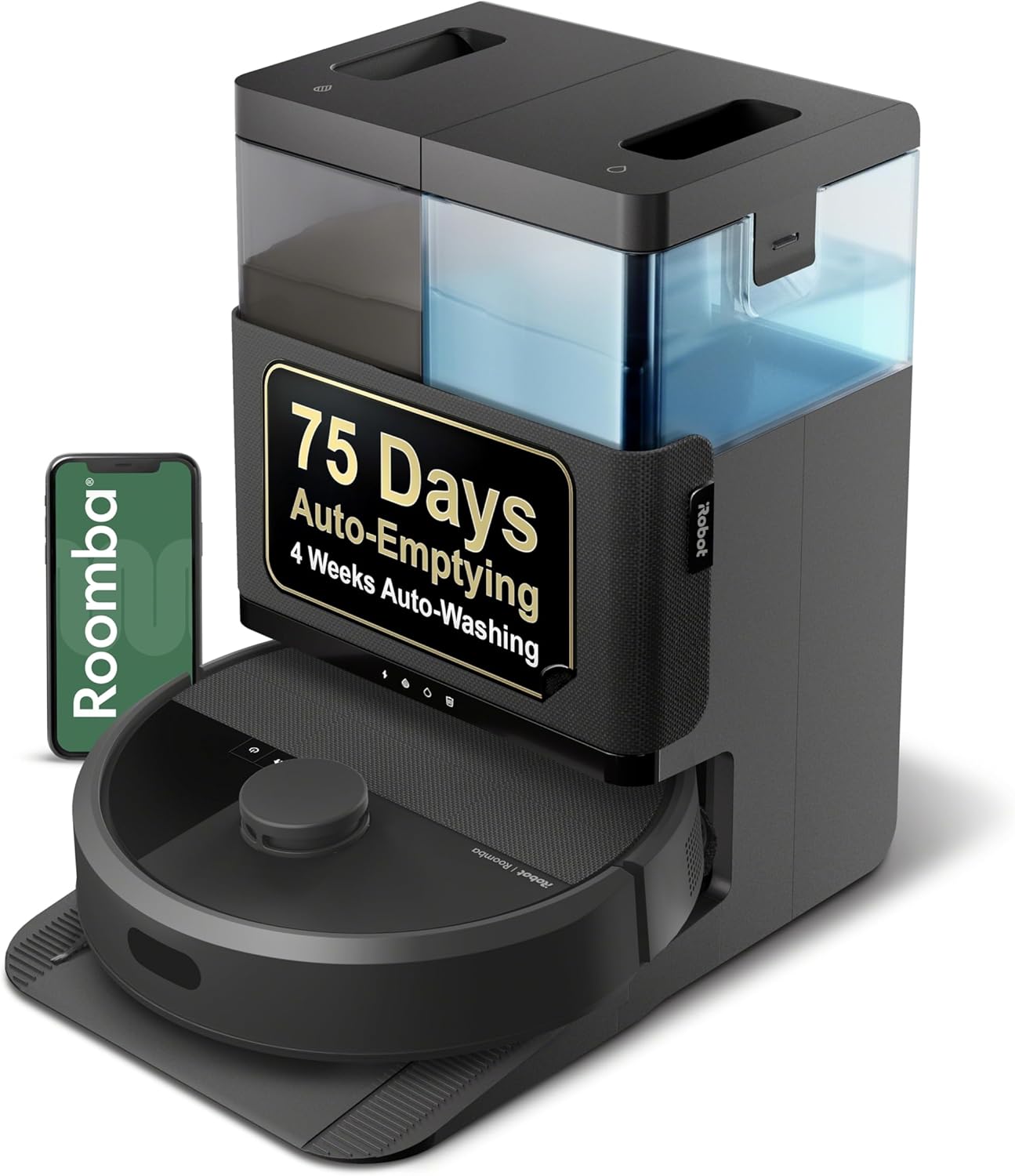
The Roomba Plus 405 Combo is a self-contained robot that vacuums and mops floors while handling dock-side maintenance for you. It uses ClearView LiDAR to map rooms and navigate around furniture, offers four suction levels for tailored cleaning, and switches between vacuum, mop, combo, or vacuum-then-mop modes; the mop pads spin and use SmartScrub for extra scrubbing on stuck-on messes. The AutoWash dock auto-empties debris for up to 75 days and rinses and dries mop pads after runs, which cuts down on manual upkeep. Battery runtime is listed at 120 minutes and the system detects carpets to lift pads and avoid wetting rugs. Practical limitations include the need for occasional filter and brush maintenance and periodic dock tank cleaning, and its performance depends on initial mapping and app setup for best results. For homes with mixed hard floors and carpet, the 405 Combo reduces hands-on mopping while keeping floors relatively fresh between deeper cleanings.
Best for: Buyers who want a single robot that can both vacuum and mop with minimal daily intervention and who value mapped navigation and automated pad care.
Less Ideal for: Those who need industrial‑level wet cleaning or have very uneven floors and thresholds where a robot cannot reliably travel.
- AutoWash dock that auto-empties debris and washes and dries mop pads
- ClearView LiDAR mapping for efficient navigation and room maps
- Dual spinning mop pads with SmartScrub for deeper scrubbing on hard floors
- Multiple cleaning modes and carpet-detecting pad lift to protect rugs
- Requires routine maintenance like filter changes, occasional dock tank rinsing, and brush cleaning
- Performance and mapping can be affected by complex layouts or clutter
Verdict: If you want a capable all‑in‑one robot that vacuums and mops and largely handles pad washing and emptying for you, the Roomba Plus 405 Combo is an easy, low‑effort choice.
roborock Saros 10R

| Suction | 22,000 Pa |
|---|---|
| Battery Life | 180 minutes |
| Filter Type | Washable |
| Noise Level | 65 db |
| Power Source | Battery Powered |
The roborock Saros 10R is a performance-focused robot vacuum and mop built to handle everyday dirt and pet hair on hard floors and low-pile carpets. It pairs powerful 22,000 Pa HyperForce suction with a Zero-Tangling DuoDivide brush and FlexiArm side brush to pick up hair without frequent brush cleaning, while the ultra-slim 3.14-inch body slips under low furniture to reach hidden dust. The multifunctional dock 4.0 automates maintenance with hot-water mop washing, hot-air drying, 60-day dust collection and auto refill features that greatly reduce hands-on upkeep. Navigation relies on the StarSight 2.0 system with 3D sensing and obstacle avoidance, which improves edge and cord handling and supports auto re-wash for high-traffic spots. For hardwood floors the mop functions and automatic mop lift when carpets are detected help avoid over-wetting. Trade-offs are the relatively loud 65 dB reported noise level during operation and a large, heavier docked system footprint, which may be more than needed for small homes.
Best for: Buyers who prioritize strong cleaning performance and low-maintenance operation on hard floors and have pets or long hair that require frequent deep pickup.
Less Ideal for: People living in very small apartments or who need a whisper-quiet machine for nighttime cleaning should consider smaller or quieter alternatives.
- Very strong 22,000 Pa suction for deep pickup on hardwood and low-pile carpets
- Zero-tangling main brush and omnidirectional wheels reduce hair maintenance
- Ultra-slim 3.14-inch profile reaches under low furniture and into tight spots
- Multifunctional dock automates mop washing, drying, and up to 60 days of dust collection
- 3D obstacle detection and advanced mapping improve edge cleaning and cord avoidance
- Noise level around 65 dB may be noticeable during cleaning
- Large multifunctional dock increases system footprint and setup complexity
Verdict: Choose the Saros 10R if you want top-tier suction and a hands-free docked system that keeps hardwood floors and pet hair under control with minimal daily effort.
roborock Q7 L5 Robot Vacuum

| Suction | 8,000 Pa |
|---|---|
| Navigation | LiDAR |
| Battery life | 150 minutes |
| Water tank capacity | 270 ml |
| Filter type | Washable |
The roborock Q7 L5 is a LiDAR-guided robot vacuum that vacuums and mops in a single run, using an integrated 270 ml water tank and up to 8,000 Pa suction to handle dust and pet hair on hard floors and low‑pile carpet. It maps rooms with multi-floor support and quick mapping so you can set scheduled cleans, no-go zones, and targeted room runs from the Roborock app or with voice assistants. Practical features include a dual anti-tangle brush system that reduces hair wrap, carpet boost that increases suction where needed, washable filters, and a child lock. For hardwood floors the precise navigation and along-floor-direction cleaning reduce repeated passes and the electronic water control offers three water levels to avoid over-wetting. Limitations to note are the combined dustbin/water-tank design which means you cannot refill water without handling the combo unit, and the robot requires a 2.4 GHz Wi‑Fi connection for full app features.
Best for: Buyers who prioritize reliable, predictable cleaning on hardwood and want a robot that follows precise maps, runs on a schedule, and minimizes hair-related maintenance.
Less Ideal for: People who need separate, large-capacity water or dust tanks for long runs without handling the unit frequently or who cannot provide a 2.4 GHz Wi‑Fi network.
- LiDAR mapping and multi-floor mapping for accurate, efficient coverage
- Strong 8,000 Pa suction with carpet boost for better pickup of dust and pet hair
- Dual anti-tangle brushes minimize hair wrap and maintenance
- Electronic water tank with three water levels lets you control mop moisture
- App control plus Alexa and Google Home compatibility for scheduled, hands-free operation
- Integrated dustbin and water tank is a single combo part, which adds steps when refilling or emptying
- Requires 2.4 GHz Wi‑Fi for app connectivity, which may need router changes for some homes
Verdict: A strong‑suction, LiDAR‑mapped vacuum‑and‑mop that reliably cleans hardwood with low hair maintenance and smart app controls.
ILIFE V5s Plus Robot Vacuum & Mop

| Battery Life | 110 minutes |
|---|---|
| Capacity | 300 ml |
| Controller Type | App, Voice, Remote |
| Filter Type | Cartridge |
| Surface Recommendation | Hard Floor, Carpet |
The ILIFE V5s Plus is a budget-friendly 2-in-1 robot that vacuums and mops hard floors while handling light low-pile carpet cleanups. It offers five cleaning modes (auto, spot, edge, max and scheduled) and can be controlled via the included remote, the ILIFE app, or voice assistants, which makes day-to-day operation simple. The 300 ml water tank and mop bracket allow it to damp-mop spills and light stains as it vacuums, while a 2600 mAh battery provides roughly 110 minutes of runtime and automatic return-to-base charging. Intelligent sensors help prevent falls and reduce head-on collisions, and the slim 3.19-inch profile lets it reach under low furniture. Limitations include modest suction compared with higher-end models and a relatively small tank that requires frequent refilling for larger homes, so it is better for maintenance cleaning than deep scrubbing. Expect straightforward setup and maintenance, making this a practical choice for basic mopping needs on a tight budget.
Best for: Buyers seeking an affordable robot that can maintain hard floors with occasional mopping and hands-off scheduling, prioritizing simple smart controls and practical runtime over high-end suction.
Less Ideal for: Those who need powerful deep-clean suction, large water capacity for extended mopping sessions, or advanced navigation for complex multiroom layouts should consider higher-tier models instead.
- Combined vacuum and mop function for simultaneous cleaning of hard floors
- Multiple control options: app, remote, and voice assistant compatibility
- Long runtime (about 110 minutes) with automatic self-charging
- Slim profile to access under low furniture
- Five cleaning modes including scheduled cleaning for hands-off maintenance
- 300 ml water tank and dustbin are relatively small for large or multiple-room homes
- Suction and deep-clean performance are modest compared with premium models
Verdict: A wallet-friendly vacuum-and-mop that delivers reliable maintenance cleaning and smart controls for households that want basic mopping without a premium price.
iRobot Roomba 105 Combo
| Surface Recommendation | Carpet & Hard Floor |
|---|---|
| Battery Life | 100 minutes |
| Other Special Features of the Product | Self-Emptying, LiDAR Navigation, Simultaneous Vacuuming & Mopping, Smart Mapping |
| Controller Type | App Control, Button Control, Voice Control |
| Filter Type | Cartridge |
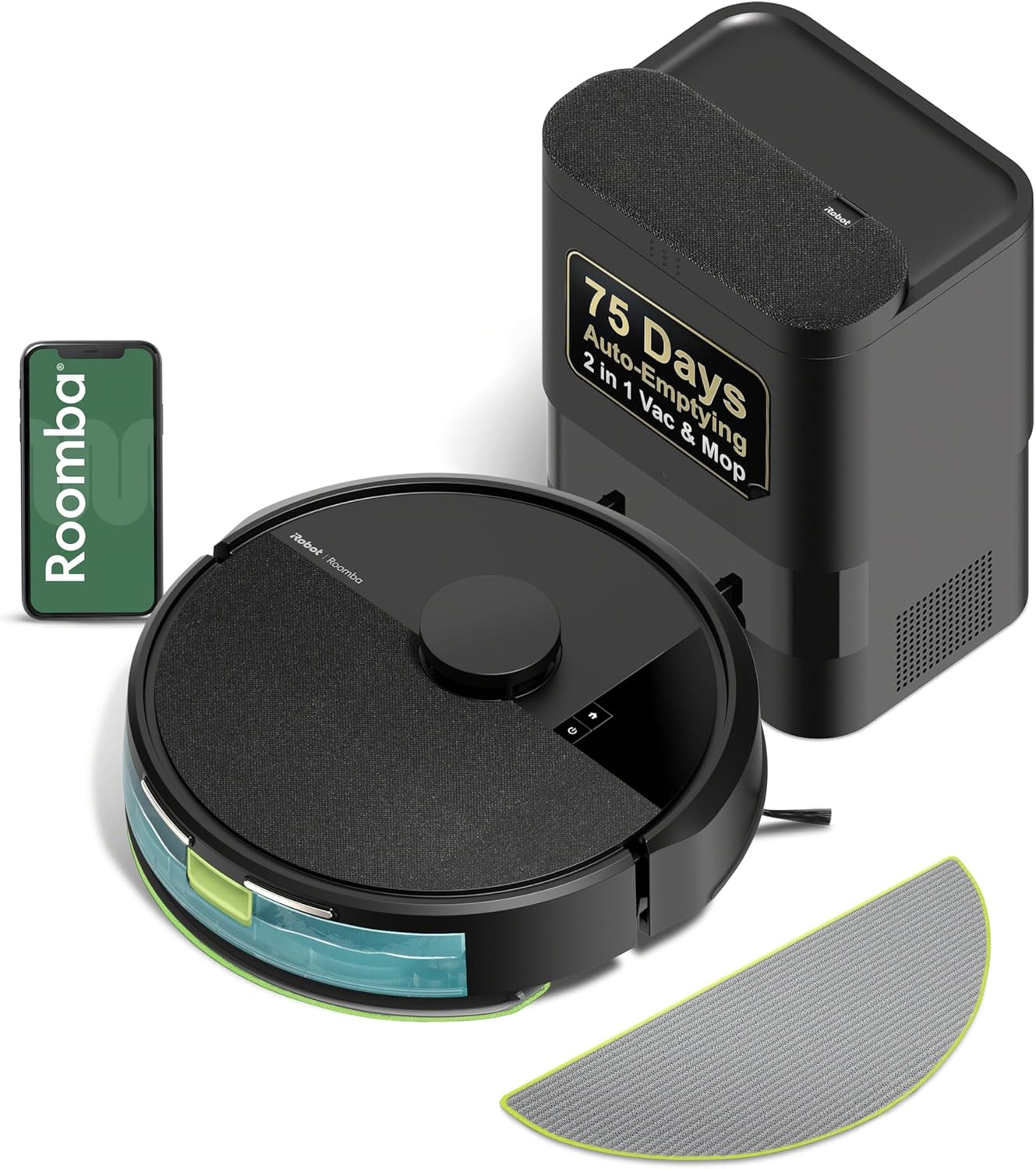
The Roomba 105 Combo is a wet-and-dry robot that combines vacuuming and microfiber mopping into one routine, backed by ClearView LiDAR mapping and a self-emptying AutoEmpty dock. It runs on lithium-ion power for roughly 100 minutes per charge and offers three cleaning modes: mop only, vacuum only, or vacuum-and-mop together. The robot uses a four-stage cleaning system with intense power-lifting suction, an edge-sweeping brush and a multi-surface brush to pull debris from carpets and hard floors, while a micro-pump supplies consistent moisture to the reusable microfiber pad and a SmartScrub setting doubles scrubbing on high-traffic areas. LiDAR mapping creates up to three maps you can edit in the app, and built-in carpet detection avoids wetting rugs while mopping. Practical benefits include hands-off dirt removal thanks to the 75-day bagged dock and easy scheduling and voice control via the app. Important limitations are a 100-minute runtime that may need recharge on very large homes and modest manual maintenance like filter and brush cleaning on a regular schedule.
Best for: Buyers who prioritize a reliable, low-touch floor cleaner that can both vacuum and mop daily with strong navigation and automatic emptying.
Less Ideal for: Users who need very long continuous runtime for extensive multi-level homes or those who prefer disposable single-use mop systems.
- Self-emptying AutoEmpty dock holds up to 75 days of debris for low-maintenance operation
- ClearView LiDAR mapping creates editable maps and enables precise navigation and obstacle avoidance
- Combined vacuum and microfiber mopping with a micro-pump and SmartScrub for deeper scrubbing
- Carpet detection prevents the mop from wetting rugs while mopping
- App, voice, and onboard controls plus scheduling for convenient, on-demand cleaning
- Approximate 100-minute battery life may require recharges on very large floor plans
- Mopping uses a reusable microfiber pad that needs manual washing and occasional replacement
Verdict: Choose the Roomba 105 Combo if you want a dependable robot that reliably vacuums and mops with LiDAR mapping and a hands-free 75-day auto-empty dock.
ROPVACNIC S1 Robot Vacuum Mop
| Suction power | 5200Pa |
|---|---|
| Battery life | 120 minutes |
| Filter type | Multi-layer optimized high-efficiency filtration |
| Surface recommendation | Hardwood floors, low pile carpets |
| Control methods | App, Remote, Voice |
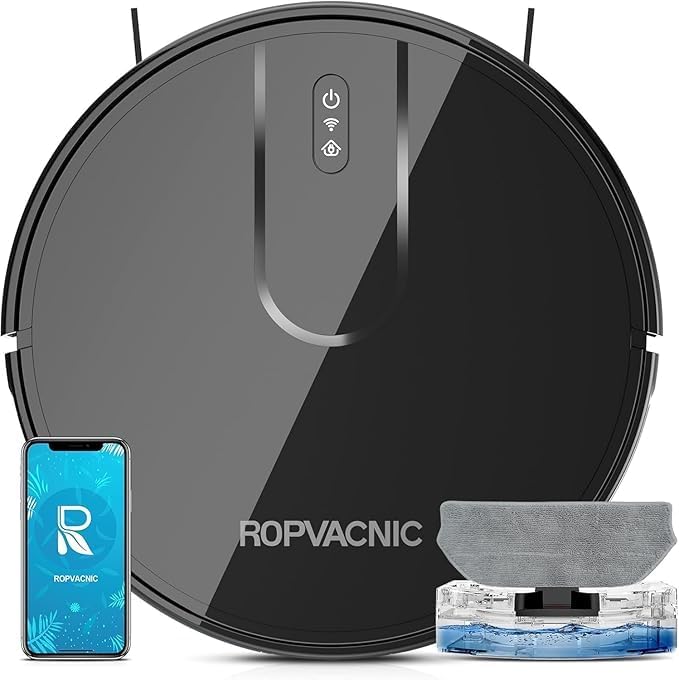
The ROPVACNIC S1 is a self-charging robot that vacuums and electrically mops floors in one pass, aimed at keeping hardwood and low-pile carpeted spaces tidy with minimal intervention. In daily use you can schedule cleanings from the app, start or stop with a voice assistant, or use the included remote; the robot returns to its base automatically when battery runs low. The unit pairs a 5200Pa motor and three-point cleaning system with a dedicated electrically controlled water tank and four-stage water adjustment, so you can tune mop output for light dampening up to stronger moisture for tougher spots. Navigation uses an advanced sensing system to avoid obstacles and slip under low furniture at about 3 inches tall, and a HEPA-style multi-layer filter helps capture fine dust and pet dander. Practical trade-offs include a compact 12-inch diameter that may require more passes in wide-open rooms and reliance on app setup for full features, but the long 120-minute runtime and pet-oriented brush design make it a solid mopping-capable option for routine floor maintenance.
Best for: Buyers who prioritize proven cleaning performance and hands-off mopping in homes with pets or mainly hard floors and who value social proof when choosing a reliable, feature-rich robot.
Less Ideal for: Users wanting the simplest, no-app setup or those who need maximum single-pass coverage for very large open-plan homes should consider different models.
- Combined vacuum and electronically controlled mop with four-stage water adjustment for tailored damp mopping.
- Strong 5200Pa suction and three-point cleaning system for picking up debris and pet hair.
- 120-minute battery life and auto-return charging for uninterrupted cleaning of larger areas.
- Multiple control options including app, remote, and voice assistants for hands-free scheduling and commands.
- Includes spare HEPA filter and multiple brushes in the box for maintenance and pet hair handling.
- 12-inch diameter and low-profile design can increase runtime on large open floors compared with wider-coverage robots.
- Full feature set requires app and smart home setup which may be inconvenient for users who prefer simple plug-and-play.
Verdict: If you want a well-reviewed robot that combines strong suction with adjustable electric mopping and smart controls for pet-friendly homes, the ROPVACNIC S1 is a practical pick.
eufy C28 Robot Vacuum & Mop

| Suction | 15,000 Pa |
|---|---|
| Battery Life | 140 minutes |
| Dust capacity (station) | 3 liters |
| Navigation | LiDAR |
| Filter Type | Washable |
The eufy C28 combines vacuuming and active mopping in a single robot designed for low-effort floor care. It uses a 28cm HydroJet roller mop that self-washes and scrapes away trapped debris while an automated Omni station empties dust, refills and collects wastewater, and dries the mop with warm air so the system can run for up to about 75 days without routine maintenance. LiDAR navigation maps rooms and avoids small obstacles without using cameras, and the DuoSpiral roller claims to prevent hair tangles for pet households. Suction is rated at 15,000 Pa and the unit supports app and voice control plus auto-lift of the mop over short carpets. Practical benefits include true hands-free mopping cycles, strong suction for carpets and hard floors, and a large 3L dust capacity in the station that reduces trips to the trash. Trade-offs are the product footprint and weight of the combined robot plus station, and the reliance on the proprietary station for full hands-free operation if you want the long maintenance interval.
Best for: Buyers who prioritize minimal maintenance and reliable mop+vacuum cleaning cycles for mixed hard-floor and short-carpet homes and want a privacy-friendly navigation system.
Less Ideal for: People with very small homes or tight storage who cannot accommodate the Omni station, or users who only need a simple standalone robot without automated station features.
- HydroJet roller mop with self-washing and scraping keeps mop cleaner during use
- All-in-One Omni station auto-empties, refills, dries, and stores waste for extended hands-free periods
- LiDAR navigation maps rooms and avoids small obstacles while protecting privacy by not using cameras
- Zero-tangle DuoSpiral roller design handles long pet hair without frequent brush cleaning
- App and voice control plus auto-lift mop make transitions between floor types easier
- Large station and robot add bulk and take up floor space
- Full hands-free features depend on using the Omni station rather than standalone robot use
Verdict: Choose the C28 if you want a privacy-focused robot that combines strong suction and a true self-washing mop with an Omni station that minimizes hands-on maintenance.
Choosing the Right Robot Vacuum for Mopping: Key Factors to Consider
Mop System Design and Water Control
The way a robot delivers water to the mop pad determines cleaning effectiveness and floor safety. Systems that offer adjustable water flow or electronically controlled reservoirs let you dial moisture for different floor types, from sealed hardwood to tile grouts. Single-use damp pads are simple but can over-wet, while electronic pumps or regulated tanks provide a more consistent, conservative dampness.
Also consider whether the mop is a passive cloth, a vibrating pad, or a rotating assembly. Vibration or agitation adds mechanical cleaning power and helps remove dried residues that a passive cloth might smear. A removable, washable pad and a clear water tank window simplify upkeep and reduce the chance of odors or mold.
Navigation, Mapping, and Area Control
Accurate mapping matters for mopping because you want repeatable, complete coverage without redundant damp passes. Laser or camera-based navigation typically gives better repeatability than random bounce patterns and supports features like no-mop zones and room-by-room scheduling. Reliable mapping reduces the risk of the robot missing spots or repeatedly soaking the same area.
Look for virtual boundaries and map-editing tools that let you exclude rugs, delicate floor zones, or areas with cables. Also evaluate how well the robot returns to finish an interrupted cycle and whether it remembers multiple floor plans for multilevel homes. Ease of mapping and recovery behavior directly affects how much supervision the robot needs during mop cycles.
Vacuum Suction and Dry Pickup on Hard Floors
A robot that mops still needs to pick up dust, hair, and debris before laying down moisture. Effective dry pickup prevents particles from being smeared into the floor during wet passes. Consider suction strength, brush roll design, and whether the unit separates hard-floor modes from carpet modes to avoid over-spinning the mop while crossing thresholds.
Brush designs that minimize hair wrap and use soft roller elements often perform better on hard floors. Check whether the robot has a pre-mop vacuum pass or an auto-adjust feature that raises the mop module over carpets and thresholds to prevent wetting unintended surfaces.
Battery Life and Recharge Behavior
Mopping uses power both for movement and potentially for water pumps or vibrating pads, so run time affects how large an area the robot can handle in one session. Longer battery life reduces the need for mid-cycle recharges, which can interrupt mop continuity and leave streaks if a job is split awkwardly.
Assess both runtime and whether the robot can resume a mid-clean after recharging. Fast recharge rates and intelligent return-to-dock behavior help for larger homes. If you have an open-plan or multi-room layout, choose a unit with enough runtime to cover your typical cleaning zone in one go.
Ease of Maintenance and Consumables
Maintenance frequency and complexity influence long-term ownership cost and convenience. Check how easy it is to remove and wash mop pads, refill and access water tanks, and replace filters. Machines that use readily washable pads and have simple tank designs reduce ongoing work.
Also consider how the robot signals maintenance needs, such as when pads require washing or filters need replacement. Readability of the controls and the availability of spare pads and filters matter because small parts wear out with regular wet cleaning.
Floor Compatibility and Surface Safety
Not all hard floors respond the same to damp mopping. Unfinished or older hardwood can be sensitive to moisture, while tile and sealed laminate tolerate more aggressive wetting. Understanding floor finish and manufacturer care recommendations helps prevent damage when using a robot vacuum for mopping.
Look for units that let you reduce water output or disable mopping for specific rooms. Some robots include fabric-safe modes or gentle settings designed to minimize exposure on moisture-sensitive surfaces. Confirm your floor type pairs well with robotic damp mopping before relying on it as a primary cleaning method.
How Robot Mopping Works
Robot mops generally use one of three approaches: passive damp cloths, actively dispensed water onto a pad, or motorized pads that vibrate or rotate. Each method balances complexity and cleaning effectiveness differently. Passive systems are the simplest and cheapest to run but depend on manual watering or pre-dampening; active systems control moisture and reduce operator intervention.
Understanding the underlying approach helps set expectations for stain removal, streaking, and maintenance. Active water control with a regulated pump reduces puddling and makes it easier to leave rugs and thresholds dry, while vibrating pads can tackle stubborn spots better than passive cloths.
- Passive pads: low complexity, risk of uneven dampness
- Regulated water tanks: consistent moisture, lower flood risk
- Vibrating or rotating pads: better agitation for dried residue
Setting Up Mopping Zones and No-Go Areas
Good mapping features let you exclude rugs, delicate wood zones, or areas with many cords. During setup, walk the robot's map and draw exclusion boxes around anything you do not want the mop to touch. Name rooms clearly so you can schedule mopping for the right spaces.
If the robot supports multi-floor maps, store separate plans so the device does not try to mop an upstairs carpeted area with a wet pad. Test boundaries on a short run to confirm the robot respects virtual walls and physical obstacles before running a full mop cycle.
- Use virtual no-mop zones for rugs and carpeted areas
- Create room-specific schedules to avoid wetting sensitive spaces
- Verify boundary behavior on a short test run
Daily Use Tips to Prevent Streaks and Residue
Vacuum or sweep first to remove loose dirt that would otherwise smear. For routine maintenance, run mop cycles on low to medium moisture and increase only for visible spots. Regularly clean or replace mop pads to prevent redepositing grime.
Use distilled or filtered water if your tap water is very hard to reduce mineral buildup in tanks and on pads. Wring or machine-wash reusable pads per manufacturer guidance and let tanks dry between uses to avoid odors.
- Always remove debris before wet mopping
- Run on conservative moisture settings for daily maintenance
- Wash pads and dry tanks to minimize odors and mineral deposits
Dealing with High-Traffic and Sticky Messes
For sticky spills or high-traffic soil, a robot mop is best used as a maintenance tool rather than a replacement for manual spot cleaning. Pre-treat heavy deposits with a quick manual wipe or a targeted spray to loosen residue, then let the robot follow to maintain overall cleanliness.
Plan periodic deeper cleans where you run a slower, higher-moisture pass with either the robot on a dedicated spot-clean mode or a manual mop. This combination keeps the robot from being overburdened and preserves pad life.
- Pre-treat sticky spills before running a mop cycle
- Schedule periodic deeper clean passes for heavy soils
- Use a manual touch-up for stubborn stains
Maintenance Schedule and Common Troubleshooting
Establish a simple maintenance routine: empty and rinse tanks after several runs, wash mop pads weekly or as needed, and check brushes and filters for hair buildup. Replace consumables on the interval recommended by the manufacturer or sooner if performance drops.
If the robot leaves streaks, inspect the pad condition and water setting, then run a short diagnostic area at a lower moisture level. If navigation errors occur, rebuild the map or reset localization and clear the area of low obstacles that confuse sensors.
- Weekly: wash pads and inspect brushes
- After several runs: rinse tanks and dry thoroughly
- Troubleshoot streaks by lowering moisture and using clean pads
How We Chose the Best Robot Vacuum for Mopping
We selected models that combine effective wet cleaning with dependable vacuum performance and realistic day-to-day usability. Our filters prioritized mop delivery systems that allow controlled moisture application, navigation systems capable of repeatable room mapping, and battery runtimes sufficient for typical single-level homes. Concrete evaluation criteria included mop system design and control, navigation and mapping accuracy, suction and debris pickup on hard floors, battery life and recharge behavior, and ease of maintenance for pads and tanks. We excluded niche or single-function devices that only offer dry mopping cloths without active water management, and we did not consider units that lack basic mapping or scheduled-clean features. The resulting shortlist favors solutions that reduce the risk of over-wetting, maintain suction performance while carrying a mop module, and make routine upkeep straightforward. We also considered build quality and how intuitive the app or on-robot controls are, because those dimensions affect long-term satisfaction. Models with unclear replacement-part availability or ambiguous tank designs were deprioritized.
Our full evaluation process is outlined in our review methodology.
FAQ
Can a robot vacuum for mopping damage hardwood floors?
It can if the unit over-wets the surface or if your floors are sensitive to moisture. Choose a robot with adjustable water control and use conservative settings on older or unfinished hardwood. Always verify floor finish compatibility before routine robotic mopping.
How often should I wash or replace mop pads?
Wash reusable pads weekly or after heavy use and replace them according to wear signs, such as thinning fabric or persistent odors. Frequency depends on how often you run mop cycles and the amount of dirt the robot picks up.
Will the robot mop cross carpets and ruin them?
Most mop-capable robots include virtual no-mop zones or will lift the mop module automatically to avoid carpets. Use mapping tools to exclude rugs and verify the robot's carpet-detection behavior during a test run.
Is it better to use tap water or a cleaning solution in the tank?
Many manufacturers recommend plain or diluted water and caution against using undiluted detergents that can damage pumps and seals. If you use a cleaning solution, confirm it is approved by the robot's manufacturer and follow dilution instructions.
How does the robot handle multi-room mopping on larger homes?
Run time and mapping determine multi-room performance. Choose a robot with sufficient battery life and resume-after-charge capability for larger homes. Use room-based scheduling to break jobs into manageable segments if needed.
Final Verdict
A good robot vacuum for mopping balances consistent moisture control, reliable navigation, and solid dry pickup to keep hard floors looking their best without constant supervision. Prioritize mop systems that let you adjust water delivery, mapping that prevents accidental wetting of rugs, and maintenance workflows that fit your routine. Weigh tradeoffs between mechanical agitation and simplicity, and match runtime to your home layout. With the right combination of features you can minimize manual mopping while protecting sensitive flooring and keeping high-traffic areas tidy.