
Note: This article contains affiliate links. If you click on these links and make a purchase, we may earn a small commission at no extra cost to you. This helps support our research and content. Read our full affiliate disclosure here.
If you want a robot vacuum that remembers rooms and cleans efficiently, choosing one with reliable mapping makes a huge difference. Mapping-capable robot vacuums reduce overlap, avoid missed zones, and let you set room-specific schedules so cleaning matches your home layout. This guide shortlists the top mapping robot vacuums across practical use cases and evaluates them on navigation, suction, battery life, and smart-home controls. Read on to see which models fit different home layouts and cleaning habits.
Top Picks at a Glance
| Best Overall The best all-around choice for most situations | Shark AI Ultra Robot Vacuum AV2501AE |  |
| Best Quality Built to a higher standard if you want something more solid | roborock Qrevo Edge 2 |  |
| Best Value The sweet spot between price and what you get | ILIFE A30s Robot Vacuum |  |
| Best Budget The cheapest option that still gets the job done reliably | Lefant M330 Pro Robot Vacuum |  |
| Top Rated A top-rated pick with lots of positive feedback | Bagotte G6 Robot Vacuum |  |
| Most Popular A crowd favorite that many people choose with confidence | iRobot Roomba 105 Combo |  |
| Best Seller A high-volume bestseller chosen again and again | roborock Q7 L5 Robot Vacuum |  |
Shark AI Ultra Robot Vacuum AV2501AE

| Battery Life | 120 minutes |
|---|---|
| Filter Type | HEPA |
| Navigation | LiDAR (360°) |
| Capacity | 60 days |
The Shark AI Ultra Robot Vacuum AV2501AE is a mapping-capable robot that combines LiDAR navigation with a 60-day capacity XL HEPA self-empty base to reduce maintenance. It uses 360° LiDAR to create precise home maps and Matrix Clean Navigation to run methodical grid passes, which helps the robot cover rooms thoroughly and avoid obstacles both day and night. The self-emptying, bagless base captures debris and traps allergens with HEPA filtration, and the self-cleaning brushroll is designed to handle pet hair without frequent tangles. App and voice controls let you schedule cleans, start on-demand runs, and integrate with Alexa or Google Assistant, while Recharge and Resume plus a reported 120-minute runtime support larger homes. Trade-offs include a relatively large docked footprint and a heavier unit compared with some slim models, and the system relies on the app for advanced customization rather than extensive onboard controls. For buyers who want mapped, low-maintenance cleaning across mixed floors, this model delivers practical convenience and strong suction for pet households.
Best for: Buyers who want mapped, low-maintenance whole-home cleaning with strong allergen control and minimal daily intervention, especially in homes with pets.
Less Ideal for: People who need an ultra-compact robot for tight spaces or who prefer simple, no-app-only controls and minimal setup.
- 360° LiDAR mapping for accurate, room-level navigation and object avoidance
- XL HEPA self-empty base holds up to 60 days of debris and traps allergens
- Matrix Clean Navigation performs multi-pass grid cleaning for more thorough coverage
- Self-cleaning brushroll helps reduce hair tangles from pets
- App and voice control with scheduling and Recharge and Resume for larger homes
- Base and robot are relatively large and add to overall footprint
- Advanced cleaning customization mainly handled in the app rather than on the robot
Verdict: This Shark delivers mapped, low-maintenance cleaning with a HEPA self-empty base that keeps pet hair and allergens contained for weeks.
roborock Qrevo Edge 2

| Suction | 25,000 Pa |
|---|---|
| Battery Life | 188 minutes |
| Navigation | RetractSense LDS, Reactive AI (280+ objects) |
| Dock Features | 176°F hot-water washing, 131°F warm-air drying, auto dust emptying |
The roborock Qrevo Edge 2 is a performance-focused robot vacuum and mop built to handle multi-surface cleaning with minimal intervention. It combines a 25,000 Pa suction motor and an upgraded mopping system to pick up embedded dirt and tackle dried stains, while the FlexiArm side brush and retractable LDS let the unit clean edges and slip under low furniture. Reactive AI obstacle recognition and RetractSense navigation produce reliable mapped routes and fewer collisions, and SmartPlan 3.0 adapts cleaning patterns for different rooms and dirt levels. The dock adds true hands-free maintenance with hot-water mop washing, warm-air drying, auto dust emptying, and water refilling so the robot can run long cycles without owner involvement. Practical limits include a relatively loud measured noise level and the unit's overall complexity, which means occasional dock maintenance and app setup are required to get the best results. For anyone prioritizing mapping accuracy, suction strength, and automated dock care, this unit delivers a strong, low-supervision cleaning experience.
Best for: Buyers who want top-tier cleaning performance and reliable mapped navigation with minimal daily intervention, especially in homes with varied floor types and pets.
Less Ideal for: People who need a very quiet night-time cleaner or who prefer a simpler, plug-and-play robot without an advanced dock and app setup.
- Very high suction power for deep cleaning across surfaces
- Ultra-slim profile and retractable sensors let it reach under low furniture
- Advanced AI obstacle recognition reduces collisions and improves routing
- Multifunction dock provides hot-water mop washing, warm-air drying, and auto emptying for hands-free maintenance
- Measured noise around 64 dB can be noticeable during high-power runs
- Complex dock and app features require occasional maintenance and initial setup
Verdict: Choose the Qrevo Edge 2 if you want a mapping-first robot that pairs powerful suction with an automated dock for largely hands-free, deep cleaning.
ILIFE A30s Robot Vacuum

| Max Suction | 10000 Pa |
|---|---|
| Navigation | LiDAR |
| Runtime | 150 minutes |
| Dustbin Capacity | 450 ml |
| Compatible Devices | Amazon Echo, Google Home, Smartphones |
The ILIFE A30s is a mapping-focused robot vacuum that uses LiDAR navigation and SLAM to build a home map, let you set no-go zones, and plan efficient cleaning paths via the ILIFE Clean app. It is designed as a vacuum-only unit with up to 10,000Pa max suction and a dual anti-tangle brush to handle pet hair on both hard floors and carpets. Users can control it with the app, voice assistants, or the included remote, schedule cleanings, and toggle carpet boost or suction levels. The 150-minute runtime and automatic recharge mean it can cover larger areas before returning to dock, while a 450 ml dustbin reduces how often you need to empty it. Limitations to note are the lack of a mopping function and a fairly loud reported noise level, so it is best for users prioritizing mapped navigation and suction rather than multi-surface cleaning or quiet operation.
Best for: Buyers who want a mapping-capable robot vacuum that prioritizes reliable navigation and strong suction to reduce manual vacuuming time, especially in homes with pets.
Less Ideal for: People who need a hybrid vacuum-and-mop solution or who require an especially quiet robot for noise-sensitive environments.
- LiDAR navigation with SLAM mapping enables accurate home maps and no-go zones
- High max suction (up to 10,000Pa) for lifting dirt and pet hair
- App control plus voice and physical remote for flexible operation
- Long runtime (150 minutes) and auto-recharge for larger area cleaning
- Dual anti-tangle brush reduces hair wrap from pets
- Vacuum-only design — no mopping capability
- Reported noise level around 72 dB may be loud for some households
Verdict: Choose the ILIFE A30s when you want accurate LiDAR mapping plus strong suction to keep pet-friendly homes cleaner with minimal oversight.
Lefant M330 Pro Robot Vacuum

| Battery Life | 150 minutes |
|---|---|
| Capacity | 450 ml |
| Controller Type | App Control, Voice Control |
| Other Special Features of the Product | Cordless, LiDAR Navigation, No-Go Zone, Scheduling, Wet/Dry |
| Filter Type | Sponge |
The Lefant M330 Pro is an affordable LiDAR robot vacuum and mop that maps multi-floor layouts and uses PSD obstacle detection to avoid furniture and cords. In typical use you set no-go zones and schedules in the Lefant app or via voice assistants, then let the robot run up to 150 minutes per charge to vacuum and mop hard floors while automatically boosting suction on carpets. Notable features include dual-band Wi-Fi, carpet detection, a visible 450 ml dustbin, and a slim 95 mm profile that reaches under low furniture. The mop function has a refillable water tank and washable pad, though mopping requires emptying the tank afterwards to avoid leaks. Practical limits to expect are basic sponge filtration rather than HEPA-level filtering and a modest 450 ml dust capacity that needs regular emptying in heavy-shedding homes. For mapping and room-by-room cleaning on a budget, the M330 Pro delivers strong navigation and useful app controls, but buyers who need hospital-grade filtration or very large dust capacity should consider higher-end models.
Best for: Budget-minded buyers who want reliable mapping and obstacle avoidance for routine vacuuming and occasional mopping in apartments or medium homes.
Less Ideal for: Users who require medical-grade air filtration or those who want very large dust capacity and extended run between emptying.
- LiDAR navigation with multi-floor mapping enables efficient, systematic cleaning
- PSD obstacle detection reduces collisions with furniture, cords, and small objects
- App and voice control with no-go zone scheduling for room-by-room cleaning
- Slim 95 mm profile reaches under low furniture and cleans tight spaces
- Visible 450 ml dustbin and anti-tangle suction port help with pet hair management
- Sponge filter instead of a higher-grade HEPA filter
- 450 ml dustbin may require frequent emptying in homes with heavy pet hair
Verdict: If you want mapped cleaning and reliable obstacle avoidance without a big price tag, the Lefant M330 Pro is a practical, budget-friendly choice.
Bagotte G6 Robot Vacuum

| Filter Type | H13 |
|---|---|
| Battery Life | 120 minutes |
| Capacity | 300 ml |
| Control Method | App, Remote, Voice |
| Compatible Devices | Amazon Echo, Google Home, Smartphones |
The Bagotte G6 is a mapping-capable robot vacuum that uses 360° LiDAR to build precise home maps, create no-go zones, and plan efficient cleaning paths while offering vacuuming, sweeping and mopping in one run. In normal use you set up the 2.4 GHz Wi-Fi connection and the app (or use Alexa/Google Home) to save maps, schedule cleanings, and mark restricted areas so the robot avoids delicate spaces and pet bowls. The unit claims up to 6000Pa suction for deeper pickup on hard floors and low-pile carpet and includes an H13 HEPA filter and dual side brushes to help collect pet hair. Battery runtime is listed at 120 minutes and the robot will auto-recharge between jobs. Practical benefits include accurate room mapping from LiDAR, multiple control options (app, remote, voice) and a 2-in-1 dust and water tank for combined vacuuming and mopping. Limitations to note are that heavy carpets or very deep pile may still need a second pass, and effective mapping requires an initial setup run in uncluttered conditions; the 300 ml tank also means more frequent emptying if you mop large areas.
Best for: Buyers who prioritize reliable, repeatable mapping and hands-off scheduling to keep floors maintained with minimal intervention, especially in homes with pets or mixed hard-floor and low-pile carpet areas.
Less Ideal for: Those who need deep cleaning on high-pile carpets or very large homes where a larger dust/water tank and commercial-grade suction would be necessary.
- 360° LiDAR mapping creates accurate maps and supports virtual no-go zones
- High stated suction (up to 6000Pa) for stronger pickup on hard floors and low-pile carpet
- App, remote, and voice control plus smart home compatibility for flexible scheduling and control
- H13 filter and side brushes help capture fine dust and pet hair
- 2-in-1 dust and water tank lets the robot vacuum and mop in one pass
- 300 ml tank requires frequent refills or emptying for large mop jobs
- Performance may be reduced on very deep-pile carpets or thick area rugs
Verdict: Choose the Bagotte G6 if you want reliable LiDAR mapping with app-based no-go zones and strong suction for hands-off daily maintenance.
iRobot Roomba 105 Combo
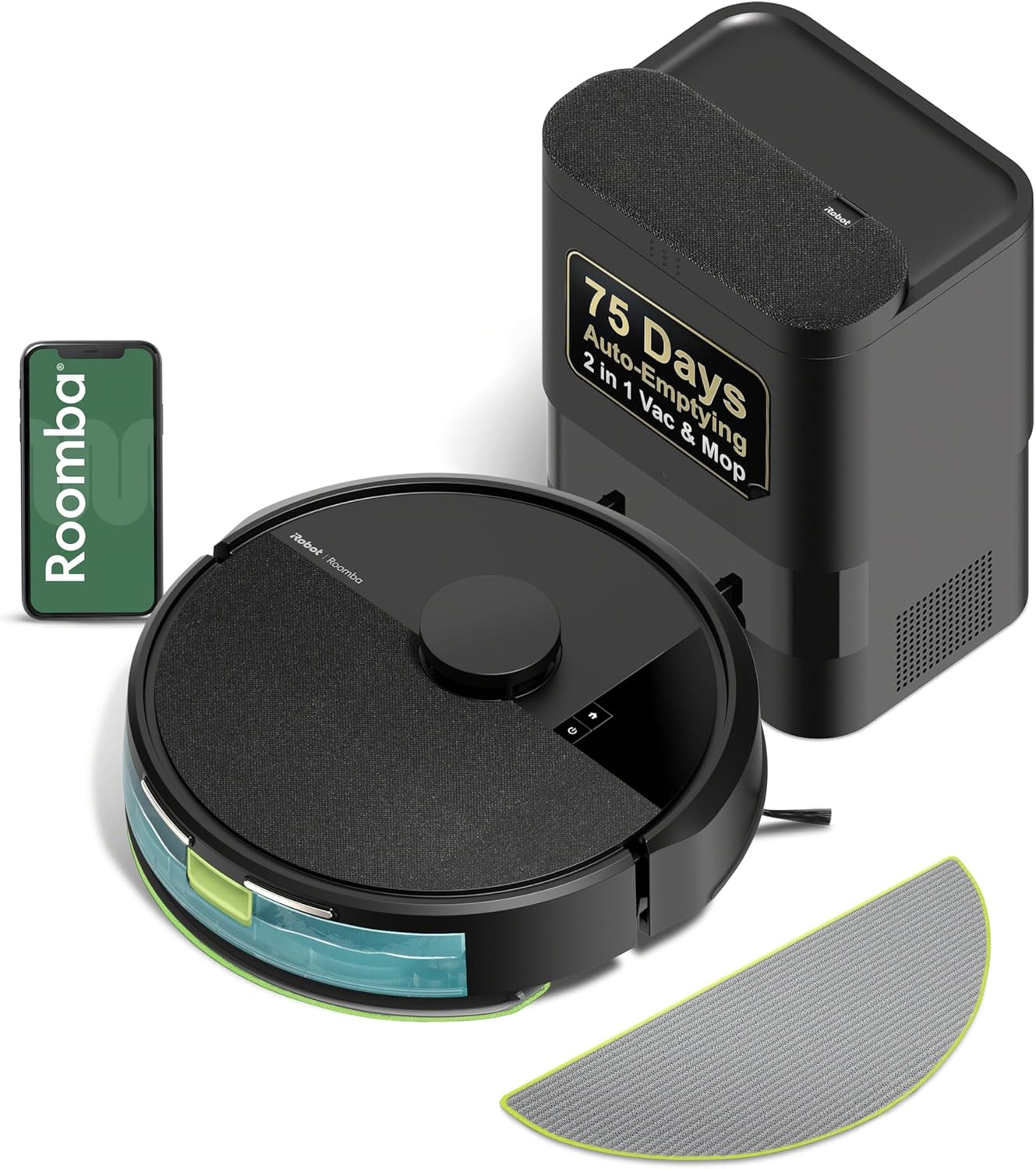
| Battery Life | 100 minutes |
|---|---|
| Navigation | ClearView LiDAR |
| Filter Type | Cartridge |
| Control | App, Touch, Voice |
| Surface Recommendation | Carpet & Hard Floor |
The Roomba 105 Combo pairs a disc-shaped robot vacuum-mop with a self-emptying AutoEmpty dock to reduce hands-on maintenance. It uses ClearView LiDAR to map spaces and navigate around obstacles, and offers three cleaning modes: vacuum, mop, or vacuum-and-mop simultaneously. The 4-stage cleaning system combines intense suction, an edge-sweeping brush and a multi-surface brush for better pickup, plus a reusable microfiber pad and a micro-pump that meters water for consistent mopping and a SmartScrub setting for deeper scrubbing. Setup and daily control work through the Roomba Home app, onboard buttons, or voice assistants, and the dock's bag keeps debris contained for up to 75 days. Expect routine upkeep like wiping the bin, cleaning brushes, and changing the cartridge filter every few months. Battery run time is listed at about 100 minutes, which is fine for small to medium homes but may require recharges on larger properties. The unit avoids carpets while mopping and supports scheduled room-targeted cleans, making it practical for mixed hard-floor and carpeted homes.
Best for: Buyers who want a mapped robot that largely removes the need to empty debris and that can handle routine vacuuming and light mopping across mixed floors with simple app or voice control.
Less Ideal for: Homes that require very long runtime between charges, professional-grade wet scrubbing, or heavy-duty carpet shampooing should consider more powerful or specialized systems.
- Self-emptying AutoEmpty dock holds up to 75 days of debris for low-maintenance operation
- ClearView LiDAR mapping provides precise navigation and room mapping
- Combined vacuum and mop modes with water metering and SmartScrub for deeper cleaning
- Multiple control options: app, onboard buttons, and voice assistants
- Battery life around 100 minutes may be short for very large homes
- Mopping uses a microfiber pad and is not a full wet-system so very heavy grime may need manual cleaning
Verdict: Choose the Roomba 105 Combo if you want mapped LiDAR navigation plus a hands-off AutoEmpty dock for routine vacuuming and light mopping with minimal daily maintenance.
roborock Q7 L5 Robot Vacuum

| Suction | 8,000 Pa |
|---|---|
| Navigation | LiDAR |
| Battery life | 150 minutes |
| Water tank capacity | 270 ml |
| Filter type | Washable |
The roborock Q7 L5 is a LiDAR-guided robot vacuum that vacuums and mops in a single run, using an integrated 270 ml water tank and up to 8,000 Pa suction to handle dust and pet hair on hard floors and low‑pile carpet. It maps rooms with multi-floor support and quick mapping so you can set scheduled cleans, no-go zones, and targeted room runs from the Roborock app or with voice assistants. Practical features include a dual anti-tangle brush system that reduces hair wrap, carpet boost that increases suction where needed, washable filters, and a child lock. For hardwood floors the precise navigation and along-floor-direction cleaning reduce repeated passes and the electronic water control offers three water levels to avoid over-wetting. Limitations to note are the combined dustbin/water-tank design which means you cannot refill water without handling the combo unit, and the robot requires a 2.4 GHz Wi‑Fi connection for full app features.
Best for: Buyers who prioritize reliable, predictable cleaning on hardwood and want a robot that follows precise maps, runs on a schedule, and minimizes hair-related maintenance.
Less Ideal for: People who need separate, large-capacity water or dust tanks for long runs without handling the unit frequently or who cannot provide a 2.4 GHz Wi‑Fi network.
- LiDAR mapping and multi-floor mapping for accurate, efficient coverage
- Strong 8,000 Pa suction with carpet boost for better pickup of dust and pet hair
- Dual anti-tangle brushes minimize hair wrap and maintenance
- Electronic water tank with three water levels lets you control mop moisture
- App control plus Alexa and Google Home compatibility for scheduled, hands-free operation
- Integrated dustbin and water tank is a single combo part, which adds steps when refilling or emptying
- Requires 2.4 GHz Wi‑Fi for app connectivity, which may need router changes for some homes
Verdict: A strong‑suction, LiDAR‑mapped vacuum‑and‑mop that reliably cleans hardwood with low hair maintenance and smart app controls.
Choosing the Right Robot Vacuum with Mapping: Key Factors to Consider
Navigation & Mapping Accuracy
How precisely a robot maps and localizes affects coverage and repeatability. A robot that builds accurate floor plans makes scheduled and spot cleaning more reliable because it can target rooms and remember no-go zones.
Mapping quality impacts whether the robot follows efficient routes or repeats areas. For multi-room homes, look for persistent maps, multi-floor support, and easy map correction tools so you can merge or split rooms and place virtual boundaries without reinventing the map each time.
Suction Power and Brush System
Suction strength and the design of main brushes determine how much dust and hair the robot actually lifts from carpets and hard floors. Stronger suction helps with deep-pile carpets, while an effective brushroll and side brushes capture edges and corners more consistently.
Consider how the brush system handles hair wrapping and whether the design is user-serviceable. A robot with a tangle-resistant brush or simple brush removal makes upkeep faster and keeps performance consistent over time.
Battery Capacity and Coverage Per Charge
Battery endurance dictates how much area a robot can cover before returning to dock. For larger homes, look for long run times and reliable recharge-and-resume behavior so the robot can finish cleaning across multiple sessions without losing its map position.
Also factor in how quickly the robot returns to docking and whether it resumes where it left off. Devices that estimate remaining runtime and adapt cleaning plans help avoid incomplete cleans in bigger spaces.
App Functionality and Map Editing
A capable app turns mapping into a practical feature. Useful apps let you visualize maps, name rooms, create no-go zones, schedule room-specific cleans, and run targeted spot cleans. Intuitive map editing saves time when your furniture layout changes.
Examine whether the app supports multiple saved floor maps, integrates with voice assistants, and provides clear status updates. Secure, responsive app controls reduce frustration and make advanced mapping worth the cost.
Obstacle Handling and Reliability
How a robot senses and negotiates furniture, thresholds, and clutter affects daily reliability. Good obstacle handling reduces the chance of the robot getting stuck or knocking over small items, and helps preserve both the robot and household objects.
Look for robust sensor suites and recovery behaviors like backing up and re-routing. Reliable edge detection and low-profile designs improve access under couches and beds without frequent human intervention.
Maintenance and Consumables
Routine maintenance determines long-term ownership hassle. Consider how easy it is to empty the dustbin, access the filter, and clean or replace brushes. Readily available consumables and straightforward filter or brush replacement reduce downtime.
Also check whether the robot supports self-emptying bases or larger dustbins if you prefer less frequent maintenance. The simpler the maintenance steps, the more consistent the cleaning performance will remain over time.
How Mapping Changes Daily Cleaning
Persistent mapping shifts a robot vacuum from random area coverage to goal-oriented cleaning. Instead of roaming until its battery runs out, a mapping robot can plan efficient routes that reduce overlap and target high-traffic rooms more often.
Mapping also enables targeted actions such as cleaning only the kitchen after dinner or excluding a play area during nap time. For households with multiple rooms, these capabilities translate to fewer missed spots and a more predictable cleaning cadence.
- Saves time by reducing redundant passes
- Enables room-by-room scheduling
- Supports no-go zones and virtual barriers
- Improves repeatability across cleaning cycles
Mapping Limitations to Watch For
Maps are only as useful as the robot's sensors and software. Low-light areas, reflective floors, or cluttered rooms can confuse mapping systems and create imperfect floor plans. Expect to spend a short amount of time editing maps after initial setup.
Be aware that steep thresholds and very dark rugs may still cause navigation hiccups. If your home has many levels, ensure the robot supports multiple saved maps so it can operate reliably on each floor.
- Cluttered floors reduce mapping accuracy
- Some sensors struggle with shiny surfaces
- Multi-floor homes need separate map support
Setting Up Maps and Virtual Boundaries
Initial mapping usually involves a full run of the robot through open rooms while you monitor the app. After the robot completes its first map, use the app to label rooms, draw exclusion zones, and split or merge spaces as needed.
Virtual boundaries are particularly useful for protecting fragile areas or keeping the robot out of pet bowls and cables. Test boundary placements during daytime and refine them after a couple of cleaning cycles to ensure the robot respects them consistently.
- Run initial mapping with doors open between rooms
- Label rooms for targeted scheduling
- Use exclusion zones for fragile or cluttered areas
Integrating Mapping with Home Automation
Most mapping-capable robots offer some level of smart-home integration. You can often trigger room cleans with voice commands, link cleaning schedules to home routines, or pause cleaning when certain sensors detect activity.
If you already use a voice assistant or smart-home hub, verify the level of integration before purchasing. A seamless connection lets you include cleaning tasks in daily routines and reduces the need to open the app for simple commands.
- Voice-triggered room cleaning
- Inclusion in morning or away routines
- Alerts and status updates sent to your devices
Practical Tips to Improve Mapping Performance
Keep floors relatively clear during the initial mapping run and for the first few cleans. Removing small obstacles, cords, and toys allows the robot to build a more accurate floor plan and reduces the chance of it getting stuck.
Regularly update the map if you move furniture or add rugs. Small adjustments in the app maintain high navigation reliability and prevent the robot from misclassifying areas or creating redundant cleaning paths.
- Clear clutter before initial mapping
- Mark temporary no-go zones for frequent changes
- Re-run mapping after significant furniture rearrangements
How We Chose the Best Robot Vacuum with Mapping
We focused on features and real-world usability that matter for mapping robot vacuums. Primary filters required accurate multi-room mapping, user-editable maps, and consistent navigation in typical home environments. We excluded devices that only offer basic random or zoned cleaning without persistent maps. Evaluation emphasized navigation accuracy and mapping features, cleaning performance on hard floors and carpets, battery life and recharge behavior, and app or voice control responsiveness. We also considered obstacle handling, boundary options like virtual walls, and ease of maintenance for brushes and filters. Practical adoption factors—such as how well a robot resumes cleaning after docking, map editing tools, and how it handles door thresholds—were weighed heavily. Products that lacked persistent mapping, had limited app controls, or demonstrated frequent navigation errors were not included. The resulting shortlist represents units that balance intelligent mapping with real-world cleaning results and usable software controls.
Our full evaluation process is outlined in our review methodology.
FAQ
Do mapping robot vacuums work in homes with multiple floors?
Often they do, but it depends on whether the robot supports saving multiple floor maps. If multi-floor support is included, the robot can store separate maps and let you switch between them or automatically detect the correct map in some setups.
How much interaction does a mapping robot need after setup?
Typically only occasional map edits and routine maintenance. After initial mapping and labeling, you will mainly empty the dustbin, clear brush tangles, and update maps if you change furniture layout or add rugs.
Are mapping features worth it for small apartments?
It depends on your priorities. In compact spaces, mapping still offers benefits like room scheduling and virtual boundaries, but simpler navigation systems may suffice if you prefer lower-cost or more basic models.
Can mapping robots avoid pet bowls and cables reliably?
They can often avoid such obstacles when you use exclusion zones and keep floors relatively tidy. However, lightweight or low-profile items may still be nudged, so occasional monitoring and boundary placement are recommended.
Will mapping functions work with voice assistants?
Many mapping-capable robots integrate with voice assistants for basic commands and room-specific cleans. Integration level varies, so check whether the robot supports the specific voice actions you need, such as starting a named room clean.
Final Verdict
Choosing a robot vacuum with mapping is a practical step if you want predictable, room-focused cleaning and fewer missed zones. Prioritize navigation accuracy and app map controls if you value targeted schedules and virtual boundaries, and choose stronger suction if carpets are a priority. Weigh the tradeoffs between runtime and coverage for your floor plan, and consider maintenance ease so performance stays consistent. With those factors in mind, you can confidently select a mapping robot that matches your home layout and cleaning habits.