
Note: This article contains affiliate links. If you click on these links and make a purchase, we may earn a small commission at no extra cost to you. This helps support our research and content. Read our full affiliate disclosure here.
When you need supplemental heat without altering your home's HVAC, a safe portable heater gives targeted warmth where and when you need it. Picking the right unit matters for comfort, running cost, and, most importantly, household safety. This guide covers seven shortlisted safe portable heaters that prioritize tip-over protection, overheat cutoff, and predictable heat output for indoor use. We evaluate units based on safety systems, energy efficiency, noise, and ease of use so you can find a heater that fits your room size and daily routine. Read on for the practical criteria we used and guidance to match a heater to your space.
Top Picks at a Glance
| Best Overall The best all-around choice for most situations | Lasko Ceramic Tower Heater 751320 |  |
| Best Quality Built to a higher standard if you want something more solid | Dr. Infrared Heater DR-968 |  |
| Best Value The sweet spot between price and what you get | Amazon Basics Ceramic Space Heater |  |
| Best Budget The cheapest option that still gets the job done reliably | Amazon Basics Ceramic Mini Heater |  |
| Top Rated A top-rated pick with lots of positive feedback | DREO Space Heater HSH006 |  |
| Most Popular A crowd favorite that many people choose with confidence | GiveBest Portable Space Heater PTC-905 |  |
| Best Seller A high-volume bestseller chosen again and again | Mr. Heater Portable Buddy F232000 |  |
Lasko Ceramic Tower Heater 751320

| Heat Output | 1500 watts |
|---|---|
| Heating Element | Ceramic |
| Indoor Usage | Indoor |
| Power Source | Corded Electric |
| Heating Coverage | 150 |
The Lasko Ceramic Tower Heater 751320 is a slim, portable electric heater designed to warm small to medium rooms. It uses a 1500-watt ceramic element and widespread oscillation to circulate heat, and offers two heat settings plus an automatic thermostat mode for steady temperature control. Electronic controls and a multi-function remote make it easy to change settings from across the room, and the seven-hour timer lets you schedule runtime without babysitting the unit. Safety features include a self-regulating ceramic element, overheat protection and a cool-touch housing, which together make this a sensible option for bedrooms and living spaces. The unit is lightweight and has a built-in handle for moving between rooms, but it lacks child-lock and tip-over switch features found on some other models. Noise is low on the comfort settings, though the heater is best suited to targeted room heating rather than whole-house use.
Best for: Buyers who want a safe, easy-to-use portable heater for nightly use or spot-warming in bedrooms and living rooms and who value simple electronic controls and remote operation.
Less Ideal for: People seeking features like a child lock, tip-over protection, or more granular heat settings should consider other models with those safety or control options.
- Powerful 1500W ceramic element for fast, effective warmth
- Widespread oscillation for more even room coverage
- Electronic thermostat and 7-hour timer for convenient temperature control
- Includes remote control with onboard storage for easy adjustments
- Built-in safety features like overheat protection and cool-touch housing
- No child-lock or tip-over switch on this specific model
- Limited to two manual heat settings which reduces fine-grain control
Verdict: A practical, safety-minded tower heater that delivers quick, even warmth with convenient remote and timer controls for everyday room heating.
Dr. Infrared Heater DR-968

| Wattage | 1500 Watts |
|---|---|
| Heating Coverage | 576 square feet |
| Number of Speeds | 3 |
| Voltage | 120 |
| Amperage | 12.5 A |
The Dr. Infrared Heater DR-968 combines a quartz infrared tube and PTC element with a high-velocity, low-noise blower to warm rooms quickly and evenly. It is typically used as a primary supplemental heater in bedrooms, living rooms, home offices, or similar indoor spaces where fast, object-focused warmth is preferred over forced hot-air circulation. The unit offers Auto, Low (1000W) and High (1500W) modes with an electronic thermostat (50 to 85°F) and an energy-saving auto mode that cycles between settings to hold the set temperature. Practical touches include caster wheels for repositioning, a 12-hour timer, and an IR remote for convenient control. Safety is a strong point: UL certification, tip-over protection, and overheat auto-shutoff reduce fire risk and make it suitable around households with kids or pets. Expect a 39 dB blower that is relatively quiet, but note the heater is 19 pounds and requires a grounded 120V outlet drawing 12.5 amps, so placement and circuit load matter in tighter spaces.
Best for: Buyers who prioritize strong, fast room heating and reliable safety features will appreciate this heater for supplementing home heat in bedrooms, living rooms, or home offices.
Less Ideal for: People who need an ultra-lightweight, ultra-portable travel heater or who must run heaters from low-capacity circuits should consider other options.
- Dual heating system (quartz infrared + PTC) for faster, more even heat delivery
- Energy-saving Auto mode that cycles between high and low to maintain set temperature
- Built-in safety features including UL certification, tip-over protection, and overheat shutoff
- Remote control, electronic thermostat, timer, and caster wheels for easy use and positioning
- Relatively heavy at 19 pounds which makes it less convenient to carry long distances
- Draws 12.5 amps so it should not share an overloaded circuit
Verdict: A safety-focused, performance-oriented 1500W infrared heater that delivers fast, even warmth for medium to large indoor rooms.
Amazon Basics Ceramic Space Heater

| Heat Output | 1500 watts |
|---|---|
| Heating Method | Convection |
| Number of Speeds | 3 |
| Voltage | 120 volts |
| Max Temperature Setting | 130 °F |
This Amazon Basics ceramic space heater delivers quick, localized warmth for small rooms or home offices using a 1500W ceramic heating element and convection airflow. It offers three settings—high (1500W), low (900W), and fan-only—so you can balance heating speed with energy use, and an adjustable thermostat helps maintain a steady temperature. The unit is lightweight and portable for moving between desks, bedside tables, and workspaces, and includes tip-over and overheat protection plus a power indicator light for safer everyday use. Noise is modest at about 43 dB on heat, making it unobtrusive for office or bedroom use. It is not intended for humid environments like bathrooms, and because it is a single-room, non-oscillating heater it works best as a spot heater rather than warming large open areas. Controls are simple and straightforward, which suits pragmatic users who want reliable performance without extra bells and whistles.
Best for: Buyers who want an affordable, no-frills personal heater to quickly warm a single room or workspace and prioritize simple, reliable safety features.
Less Ideal for: People seeking whole-room heating for large or open-plan spaces or those who need a heater rated for bathrooms or damp environments should look elsewhere.
- Powerful 1500W output for fast spot heating
- Three operating modes including a 900W low setting to save energy
- Built-in tip-over and overheat protection for safer unattended use
- Lightweight, compact design makes it easy to move between rooms
- Quiet operation (~43 dB) suitable for bedrooms and offices
- Non-oscillating design limits coverage to a focused area
- Not safe for use in high-moisture rooms such as bathrooms
Verdict: A compact, safety-focused personal heater that gives fast, quiet spot heating with simple controls for practical everyday use.
Amazon Basics Ceramic Mini Heater
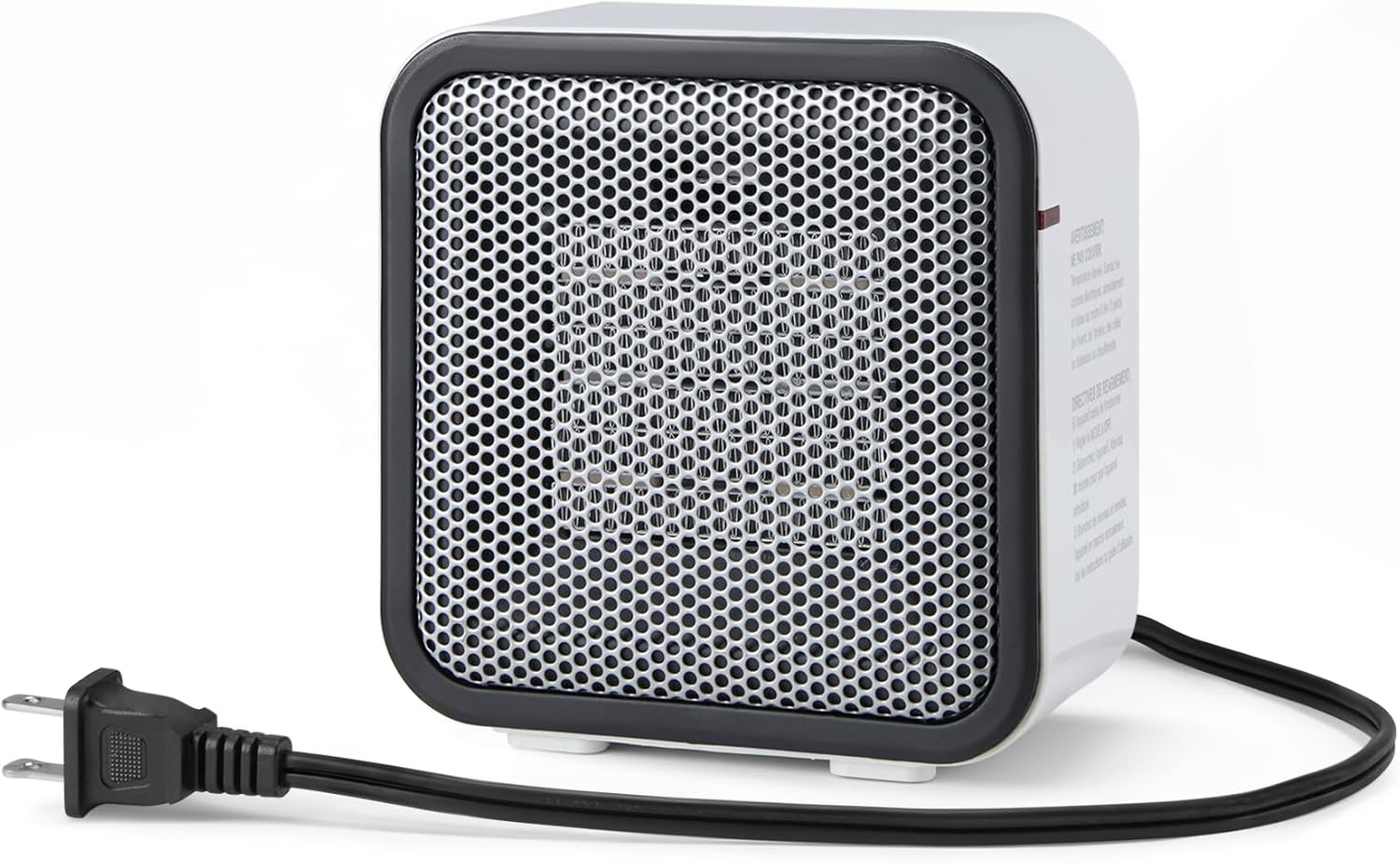
| Heat Output | 500 watts |
|---|---|
| Heating Method | Convection |
| Heating Coverage | 107.6 square feet |
| Power Source | Corded Electric |
| Special Features | Tip-Over Protection |
This compact Amazon Basics ceramic mini heater delivers targeted, personal heat for small spaces like desks, bedside tables, or home offices. It uses a 500-watt ceramic heating element to produce warm air quickly while remaining quiet enough for close-range use, and the small footprint makes it easy to move and tuck onto a tabletop. Safety features include tip-over protection that cuts power if the unit is knocked over, which is reassuring for homes with pets or cluttered workspaces. The heater has a single heat setting and simple plug-in operation, so it is straightforward but lacks thermostat control or multiple power levels for fine tuning. Its 500W output is enough to warm an individual but not to heat large rooms, so you should expect limited coverage. For buyers who need a cheap, portable, and safe personal heater, this model is an efficient no-frills choice; if you want adjustable heat or whole-room heating, consider a higher-powered or multi-setting unit instead.
Best for: Buyers looking for an inexpensive, portable heater to warm a single person or a small workspace who prioritize simplicity and safety over adjustable settings.
Less Ideal for: Anyone who needs whole-room heating, precise temperature control, or multiple power levels should look at larger or multi-setting heaters instead.
- Very compact and lightweight for easy tabletop use and transport
- 500W ceramic element provides quick, quiet personal heat
- Built-in tip-over protection for added safety
- Simple plug-and-play operation with minimal controls
- Single heat output with no thermostat or multiple power settings
- Not suitable for heating medium to large rooms
Verdict: A safe, budget-friendly personal heater that delivers quick tabletop warmth for one person.
DREO Space Heater HSH006

| Heat Output | 1500 watts |
|---|---|
| Heating Element | PTC Ceramic |
| Heating Coverage | 200 sq.ft |
| Number of Speeds | 4 |
| Min–Max Temp | 41–95 °F |
The DREO HSH006 is a compact tower space heater designed to deliver quick, focused warmth for small rooms and offices. It uses a 1500W PTC ceramic element and a forced-air design to heat up within seconds, with an adjustable thermostat that ranges from 41 to 95°F in 1°F increments so you can dial in a steady temperature. Controls include multiple heat modes (Power, ECO, Fan), four fan speeds, a 12-hour timer and a remote for convenient operation. The heater emphasizes safety with tip-over detection, overheat protection, a safety plug and flame‑resistant materials, and it is ETL-listed. DREO also highlights a brushless DC motor and winglet fan geometry that cuts noise to about 34 dB, making it suitable for bedrooms. Trade-offs are typical of compact 1500W heaters: effective coverage is limited to roughly 200 sq ft and continuous high-power use will draw the expected electrical load. The unit is portable and easy to move, and the precise thermostat plus safety systems make it a sensible choice where quiet, reliable supplemental heat is needed.
Best for: Buyers who prioritize dependable, safety-minded supplemental heating for bedrooms, home offices, or small living spaces and want precise thermostat control and quiet operation.
Less Ideal for: Not a good fit for heating large rooms, open-plan areas, or situations that need whole-house heat where a higher-capacity system is required.
- Fast PTC ceramic heating for quick warm-up
- Precise adjustable thermostat with 1°F increments for stable temperature control
- Multiple modes, 4 speeds and 12-hour timer for flexible use
- Several built-in safety features including tip-over and overheat protection and ETL listing
- Brushless DC motor and fan design that keeps noise low (~34 dB)
- Rated coverage limited to about 200 sq ft so not suitable for large open spaces
- As a 1500W electric heater it requires normal household circuit capacity and will draw significant power at full output
Verdict: Choose the DREO HSH006 when you want a compact, safety-focused heater that delivers quick, quiet, and precisely controlled warmth for small indoor spaces.
GiveBest Portable Space Heater PTC-905

| Heat Output | 1500 watts |
|---|---|
| Power Modes | 1500W / 750W |
| Thermostat | Electronic, adjustable |
| Number of Speeds | 2 |
| Heating Coverage | 200 sq.ft |
The GiveBest PTC-905 is a compact ceramic space heater designed for personal and small-room heating. It offers two power modes (1500W and 750W) plus a cool-fan setting, and an electronic thermostat that cycles the unit on and off to maintain a set temperature. Safety features include overheat shutoff, tip-over protection with audible alert, flame-retardant housing, and a long cord for flexible placement. In practice the heater warms small bedrooms, home offices, and bathrooms quickly and runs quietly enough for sleeping or focused work. Controls are straightforward and the built-in carry handle makes it easy to move where you need spot heat instead of warming the whole house. Limitations are typical for a compact room heater: it is best for small to medium rooms and will not substitute for whole-home heating, and it has a basic control set without advanced scheduling or app connectivity. For buyers focused on straightforward, safety-minded portable warmth, this is a practical, no-frills option.
Best for: Buyers who prioritize a safe, compact heater for single rooms and want reliable, quiet spot heating with clear safety protections and simple controls.
Less Ideal for: People who need to heat large open areas or want smart/home-automation features and programmable schedules.
- Dual heat modes (1500W and 750W) plus a cool fan for year-round use
- Electronic adjustable thermostat that maintains preset temperature automatically
- Multiple safety features including overheat shutoff, tip-over protection, and flame-retardant housing
- Quiet operation suitable for bedrooms and home offices
- Portable, lightweight design with built-in carry handle and long power cord
- Designed for small to medium rooms only and not suitable for whole-house heating
- Controls are basic with no smart features or advanced scheduling
Verdict: Pick this heater if you want a compact, safety-focused portable heater that quietly delivers reliable spot warmth for bedrooms and home offices.
Mr. Heater Portable Buddy F232000

| Heat Output | 9000 BTU (max) |
|---|---|
| Heating Coverage | 225 |
| Fuel Type | Propane |
| Number of Speeds | 2 |
| Included Components | Piezo Igniter, Portable Buddy Heater |
The Mr. Heater Portable Buddy is a compact radiant propane heater designed for quick warmth on patios, in garages, or at campsites. It produces 4,000 or 9,000 BTU and has low and high settings to tailor output, running on a 1 lb propane cylinder or, with accessories, a 20 lb tank. Practical touches include an easy-grip handle, a swivel regulator for simple cylinder attachment, and a piezo igniter for match-free starts. Safety features aimed at risk-averse users include an oxygen depletion sensor, thermal shut-off, and tip-over switch, and the unit is constructed with self-extinguishing materials. Runtime is about 5.4 hours on low or 2.4 hours on high from a 1 lb cylinder, which makes it convenient for short outdoor events but means you will need spare fuel for longer use. It is not electric, so it is portable without cord constraints but requires propane management and ventilation when used indoors. For someone who values a compact, safety-focused portable heater that delivers strong radiant heat, this is a practical choice with straightforward operation.
Best for: Buyers who prioritize a compact, safety-minded portable heater for occasional indoor or outdoor use and want a simple, reliable flame-based heat source rather than electric options.
Less Ideal for: People who need continuous, long-duration indoor heating or who prefer plug-in electric heaters with no fuel handling or ventilation concerns.
- Two heat settings (4,000 and 9,000 BTU) for adjustable warmth
- Built-in safety systems including oxygen depletion sensor, thermal shut-off, and tip-over switch
- Runs on common 1 lb propane cylinders and can be adapted for a 20 lb tank
- Piezo igniter and swivel regulator make setup and ignition simple
- Short runtime on a 1 lb cylinder, requiring spare fuel for extended use
- Uses propane so indoor use requires attention to ventilation and fuel handling
Verdict: A compact, safety-focused portable propane heater that reliably delivers radiant heat for short-term indoor or outdoor use.
Choosing the Right Safe Portable Heater: Key Factors to Consider
Safety Systems and Certifications
A heater's active and passive safety systems determine how well it prevents accidents in a busy home. Look for features such as tip-over shutoff, automatic overheat cutoff, cool‑touch housings, and guarded heating elements. Third-party certifications or safety listings indicate the unit has been evaluated to a baseline standard.
These systems matter because portable heaters are moved and located in varying floor plans where pets, children, or clutter can create hazards. A certified product with multiple redundant protections reduces the chance of a fire or burns and gives you confidence to run the heater for extended periods.
Heat Output Relative to Room Size
Matching a heater's output to the room size ensures efficient, comfortable warming without excessive energy use. Manufacturers typically rate output in watts; choose a unit sized for the square footage and ceiling height of the space you intend to heat.
Undersized heaters will run continuously and struggle to maintain set temperatures. Oversized units may cycle frequently, which can be noisy and wear controls faster. Consider how well the heater distributes heat across a room rather than focusing heat in one spot.
Energy Efficiency and Operating Cost
Energy efficiency affects how much it costs to run a heater regularly and how environmentally friendly it is. Compare wattage settings, available power modes, and thermostat accuracy to estimate runtime consumption.
Features like adjustable thermostats, eco or low-power modes, and programmable timers let you maintain comfort while minimizing wasted energy. Efficient heaters that reach and hold a set temperature will spend less time at peak draw and reduce your overall electricity use.
Noise and Day-to-Day Comfort
Noise level affects where you can comfortably use a portable heater. Living rooms and kitchens can tolerate louder operation than bedrooms or home offices. Consider fan-driven models that move air and often produce steady white noise versus radiant designs that are nearly silent.
Look for measured decibel ratings or user reports about sound. A quieter heater is easier to run overnight or while working, while louder units may be better suited to intermittent use in open areas.
Controls, Thermostat Accuracy, and Usability
The quality of controls determines how precisely you can manage indoor temperature and how easy the heater is to operate. Digital thermostats, fine-grain temperature settings, and clear interfaces make it simpler to set and maintain comfort levels.
Good usability includes reachable buttons, remote control or app support where offered, and an understandable indicator for active safety events. A precise thermostat that keeps temperature within a narrow band will be more comfortable and more energy efficient over time.
Physical Design and Surface Temperatures
A heater's enclosure, grille design, and handle placement affect safety and placement options. Cool-touch exteriors and recessed heating elements lower burn risk. Consider footprint and stability to avoid accidental tipping in high-traffic areas.
Surface temperature matters when units are left near furniture or fabrics. Lower external temperatures reduce the need to create buffer zones around the heater and make it safer in homes with children or pets.
Choosing Between Fan-Forced and Radiant Styles
Fan-forced heaters use an internal fan to move warmed air into the room and typically heat a space more quickly and evenly. They are well suited to living areas where you want faster temperature changes, but fans add audible noise and moving parts that can require occasional cleaning.
Radiant heaters warm objects and people directly without forcing air movement, which makes them quieter and often more efficient for spot heating. They are a good fit when you need a quiet heater for a bedroom or desk area but may not distribute warmth as evenly across a larger room.
- Fan-forced: faster distribution, higher noise, better for open rooms
- Radiant: quieter, great for targeted warmth, less effective for large areas
Placement Best Practices for Safety and Performance
Place a portable heater on a stable, level surface away from high-traffic paths and combustible materials. Maintain the manufacturer's recommended clearance on all sides and avoid putting the heater on soft surfaces that can block airflow.
Keep heaters away from curtains, bedding, and furniture and do not run extension cords unless the heater documentation explicitly allows it. Positioning near a thermostat or cold drafts can cause short cycling; instead locate the unit where it senses representative room temperature.
- Keep recommended clearances free of flammable materials
- Avoid elevated soft surfaces and high-traffic paths
- Do not cover or obstruct vents and grilles
Maintenance and Simple Safety Checks
Routine maintenance helps heaters operate safely and efficiently. Regularly dust intake and output grilles, check that fans spin freely, and inspect power cords for damage. A clogged grille or worn cord can reduce performance and increase risk.
Test automatic shutoffs periodically by gently tipping a unit to ensure tip-over protection still functions and listen for unusual noises that could indicate internal wear. Replace or retire any heater with persistent electrical smell, sparking, or irregular cycling.
- Dust grilles and clean fans to maintain airflow
- Inspect power cords and plugs before seasonal use
- Periodically verify tip-over and overheat protections
How Thermostats and Programmable Timers Save Energy
Accurate thermostats reduce runtime by turning heaters off when the set temperature is reached and restarting only when needed. Programmable timers let you match heating to occupancy patterns so you are not heating an empty room.
Look for units with a clear temperature readout and small setpoint increments for tighter control. Combining timers with eco modes can significantly lower energy use without sacrificing comfort.
- Use timers to avoid unnecessary run hours
- Prefer accurate thermostats with fine-grain control
- Eco modes help limit peak power draw
Special Considerations for Bedrooms and Childcare Areas
In bedrooms and spaces with children, prioritize heaters with multiple redundant safety features, low external surface temperatures, and quiet operation. Models that include a child lock or recessed controls reduce the risk of accidental changes.
Consider placement that keeps the heater out of reach, and avoid any unit that requires frequent manual adjustments at night. A heater that can run quietly and maintain a steady, moderate temperature is the safest choice for these spaces.
- Choose low-surface-temperature designs for child safety
- Prefer quiet operation for overnight use
- Use child-lock features when available
How We Chose the Best Safe Portable Heater
We focused on objective safety and usability characteristics relevant to in-home portable heaters. Key evaluation criteria included certified safety systems such as tip-over shutoff and thermal cutouts, documented insulation and surface temperatures, and any third-party certifications or safety listings where available. We also measured heat delivery versus power draw to estimate operating efficiency and looked at thermostat accuracy and control granularity for steady comfort. Noise level was assessed for typical living-room distances to determine suitability for bedrooms and home offices. Additional filters removed units intended only for outdoor use, unshielded high-surface-temperature models, and heaters lacking basic automatic shutoffs. Excluded from consideration were products that rely solely on open heating elements without protective guards, units designed only for industrial or workshop environments, and models with poor or no consumer safety documentation. The final shortlist balances strong passive and active safety features with reliable temperature control, reasonable runtime cost, and low operational noise. These dimensions directly informed the scorecard metrics used in each product summary.
Our full evaluation process is outlined in our review methodology.
FAQ
Are portable heaters safe to run overnight?
They can be, when the unit includes automatic overheat cutoffs, tip-over shutoffs, and cool-touch surfaces, and when you follow placement guidelines. Avoid running heaters unattended if they lack multiple safety systems or clear safety documentation.
Can a portable heater significantly raise my electricity bill?
It depends on wattage and run time. Higher-output heaters consume more power, but accurate thermostats and eco modes can reduce total runtime. Use timers and lower setpoints to manage operating cost.
Is it safe to use a portable heater in a small bathroom?
Bathrooms present moisture and close clearances, so only use models rated for damp or bathroom use and keep them away from water sources. Ensure the unit has appropriate ingress protection and manufacturer guidance for bathroom placement.
Do tip-over shutoffs always work?
Tip-over shutoffs are reliable when well designed, but they should be tested periodically. They may not trigger if the heater is only slightly tilted or if placed on an uneven surface, so maintain stable placement.
How close can a heater be to furniture?
Follow the manufacturer's specified clearance distances. As a general rule, keep at least the recommended clearance on all sides and avoid placing heaters within a foot of combustible materials or fabrics.
Final Verdict
When selecting a safe portable heater, prioritize proven safety systems, a match between heat output and room size, and controls that let you maintain temperature efficiently. Expect tradeoffs between speed of warming and quiet operation; fan models warm faster while radiant units tend to be quieter and better for spot heating. Focus on units with accurate thermostats, cool-touch exteriors, and automatic shutoffs to minimize risk and operating cost. With those priorities in mind, you can choose a heater that provides dependable, safe warmth for your home.