
Note: This article contains affiliate links. If you click on these links and make a purchase, we may earn a small commission at no extra cost to you. This helps support our research and content. Read our full affiliate disclosure here.
If you rely on a top-loading water dispenser for daily drinking and cooking, safety and sanitation matter as much as dispensing performance. A Safe Top-Loading Water Dispenser reduces contamination risk, keeps hot and cold outputs secure, and makes cleaning straightforward so you spend less time maintaining it and more time using clean water. This guide shortlists seven top picks that emphasize child protection, hygienic water flow, and easy maintenance. We evaluated each option on measurable safety and upkeep criteria to help you choose the right dispenser for a kitchen, office, or common area.
Top Picks at a Glance
| Best Overall The best all-around choice for most situations | COSTWAY Top-Loading Water Cooler |  |
| Best Quality Built to a higher standard if you want something more solid | Brio Top Loading Water Cooler CLTL520 |  |
| Best Value The sweet spot between price and what you get | Avalon Top Loading Water Cooler |  |
| Best Budget The cheapest option that still gets the job done reliably | Kreiaoer Top-Loading Water Dispenser |  |
| Top Rated A top-rated pick with lots of positive feedback | Primo Top Loading Pro Water Dispenser |  |
| Most Popular A crowd favorite that many people choose with confidence | Frigidaire Top-Load Water Dispenser EFWC498 |  |
| Best Seller A high-volume bestseller chosen again and again | Brio 130 Series Top-Load Water Cooler |  |
COSTWAY Top-Loading Water Cooler

| Wattage | 500 watts |
|---|---|
| Installation Type | Freestanding |
| Access Location | Top |
| Number of settings | 2 |
| Capacity | 5 gallons |
This COSTWAY top-loading water cooler delivers hot and cold water using an internal compressor and separate switches for heating and cooling so you can shut off one function to save energy. It accepts standard 3–5 gallon bottles and uses mechanical push-button faucets with a child-lock on the hot tap for safety, which makes it straightforward to use in homes or small offices. The unit has a removable drip tray and a detachable barrel seat for easier cleaning, plus a bottom storage cabinet for cups or small supplies. Setup is simple since it is freestanding and top-accessible for bottle changes, and indicator lights show the operating status. Limitations include basic mechanical controls rather than digital precision and a modest 500-watt power draw, so it is not the most energy-efficient model available and may be noisier than reservoir-based coolers during active cooling.
Best for: Buyers who want a simple, safe top-loading dispenser for family or small office use that prioritizes straightforward operation, easy cleaning, and hot-water safety features.
Less Ideal for: If you need ultra-quiet operation, precise digital temperature control, or the lowest possible energy use, consider other cooler types with thermoelectric or advanced inverter compressors.
- Provides both hot and cold water with independent on/off switches for energy saving
- Top-loading design fits standard 3–5 gallon bottles for easy replacement
- Child-lock on hot tap and mechanical push-button faucets improve safety and ease of use
- Removable drip tray and detachable barrel seat simplify cleaning and maintenance
- Bottom storage cabinet offers convenient space for cups or accessories
- Controls are mechanical and lack digital temperature settings or displays
- Compressor cooling can be louder and draw more power than thermoelectric or reservoir models
Verdict: A straightforward, safety-minded top-loading dispenser that fits standard 3–5 gallon bottles and is ideal for families or small offices needing reliable hot and cold water.
Brio Top Loading Water Cooler CLTL520

| Wattage | 90 watts |
|---|---|
| Installation Type | Freestanding |
| Access Location | Top |
| Number of settings | 3 |
| Upper Temperature Rating | 180 °F |
The Brio CLTL520 is a top-loading water cooler designed for everyday home or small office use, delivering three temperature options—hot, cold and room temperature—via simple push-button controls. It is built with a stainless steel cabinet and a BPA-free removable drip tray for easier cleaning, and a child-safety lock on the hot tap adds protection where children are present. The unit supports standard 3 to 5 gallon bottles and its non-spill top makes bottle changes straightforward. With an upper temperature rating up to 180°F and a lower rating of 47°F it provides reliably hot and chilled water without complicated settings, and the corded electric design keeps operation hands-off once installed. Limitations include its top-loading format, which requires lifting bottles into place, and a relatively heavy cabinet that can be less convenient to move. The cooler does not appear to include built-in UV or advanced self-cleaning beyond an ozone-cleaning claim, so users seeking automated sterile maintenance should plan for periodic manual care.
Best for: Buyers who prioritize straightforward, reliable hot and cold dispensing in a durable, safety-conscious cooler for home or small office use.
Less Ideal for: People who need a bottom-load design for easier bottle changes, a lightweight portable unit, or an integrated automated sterilization system should consider other options.
- Three temperature settings for hot, cold, and room-temperature water
- Stainless steel exterior for a durable, modern finish
- Child-safety lock on the hot spout for added protection
- Removable BPA-free drip tray simplifies cleaning
- Non-spill top-loading design makes bottle changes easier to align and fill
- Top-loading requires lifting heavy bottles into place rather than bottom-load convenience
- No clearly documented advanced self-cleaning system or UV sterilization included
Verdict: Choose the Brio CLTL520 when you want a sturdy, no-nonsense top-loading cooler that reliably delivers hot, cold, and room-temperature water with built-in hot-water safety features.
Avalon Top Loading Water Cooler

| Wattage | 420 watts |
|---|---|
| Installation Type | Freestanding |
| Access Location | Top |
| Upper Temperature Rating | 185 °F |
| Capacity | 5 gallons |
This Avalon top-loading dispenser delivers both cold and hot water from easy-to-use paddle spouts, making it convenient for drinks, instant soups, and quick tea or coffee without a kettle. Cold water is chilled by a compressor to about 47°F while the hot tap reaches roughly 185°F and includes a child safety lock to prevent accidental dispensing. The slim freestanding cabinet is designed to fit in small corners and accepts standard 3 or 5 gallon bottles placed on top so you can visually check supply. Practical touches include UL listing, Energy Star compliance for efficiency, and a simple two-setting control layout, though the unit is fairly basic with no digital controls or filtration built in. Installation is plug-in and straightforward, but its weight and top-loading design mean two people are helpful when moving or swapping heavy bottles. For everyday office or home use where safety, reliability, and space savings matter, it performs as a dependable, no-frills dispenser.
Best for: Buyers who want a straightforward, space-saving dispenser that reliably delivers very hot and chilled water with family-friendly safety features for home or small office use.
Less Ideal for: Those who need built-in filtration, programmable temperature control, or a bottom-load/no-lift solution should consider other models.
- Provides both hot (approx. 185°F) and cold (approx. 47°F) water from paddle spouts for quick drinks
- Child safety lock on the hot spout reduces burn risk around families or offices
- Slim freestanding top-loading design fits small spaces and shows bottle level
- UL listed and Energy Star compliant for electrical safety and efficiency
- No built-in water filtration or advanced temperature controls
- Top-loading bottle changes can be heavy and awkward without help
- Basic control set lacks digital indicators or customization
Verdict: A compact, safety-focused top-loading dispenser that reliably supplies hot and cold water for homes and small offices.
Kreiaoer Top-Loading Water Dispenser

| Wattage | 575 watts |
|---|---|
| Installation Type | Countertop |
| Number of settings | 3 |
| Hot Water | >90℃/194℉ |
| Cold Water | <15℃/59℉ |
This compact top-loading dispenser heats and cools bottled water for small spaces, using a one-button start and a front/rear switch to select hot, cold, or room-temperature water. It is designed for countertop use and accepts 3–5 gallon bottles with an internal stainless steel liner that resists rust and scaling. Typical use is simple: load a bottle on top, press the button to heat or cool, and dispense via the push-cup outlet; the removable drip tray and bucket seat make occasional cleaning straightforward. Notable features include a high heating power for near-boiling water, a cooling cycle with indicator lights, and a polypropylene shell meant to resist drops and pressure. Practical benefits are low daily energy consumption and small footprint, which fits desks or small kitchens while reducing bottled-water purchases. Important limitations are slow cooling cycles (about 45 minutes to reach cold) and modest cooling power that yields only small cold servings per cycle, so it is better for occasional cold water than continuous heavy use.
Best for: Buyers on a tight budget who need a compact, no-frills dispenser for occasional hot and cold water in a small office, dorm, or home kitchenette and prioritize simplicity and low running costs.
Less Ideal for: Large households or high-traffic offices that need continuous cold water or fast refill capacity should look at higher-capacity or direct-plumbed dispensers instead.
- Heats water quickly to near-boiling for tea or hot drinks
- Stainless steel inner tank reduces rust and scaling for safer water
- Compact countertop design fits small offices, dorms, or kitchens
- One-button operation and push-cup dispenser make single-handed use easy
- Removable drip tray and bucket seat simplify cleaning and maintenance
- Cooling is relatively slow and delivers small cold volumes per cycle
- Top-loading design requires lifting bottles onto the unit which may be awkward for some users
Verdict: A budget-friendly, compact top-loading dispenser that reliably produces hot water and occasional cold servings while keeping energy use low.
Primo Top Loading Pro Water Dispenser
| Installation Type | Freestanding |
|---|---|
| Access Location | Top |
| Number of settings | 3 |
| Power Source | AC |
| Capacity | 5 gallons |
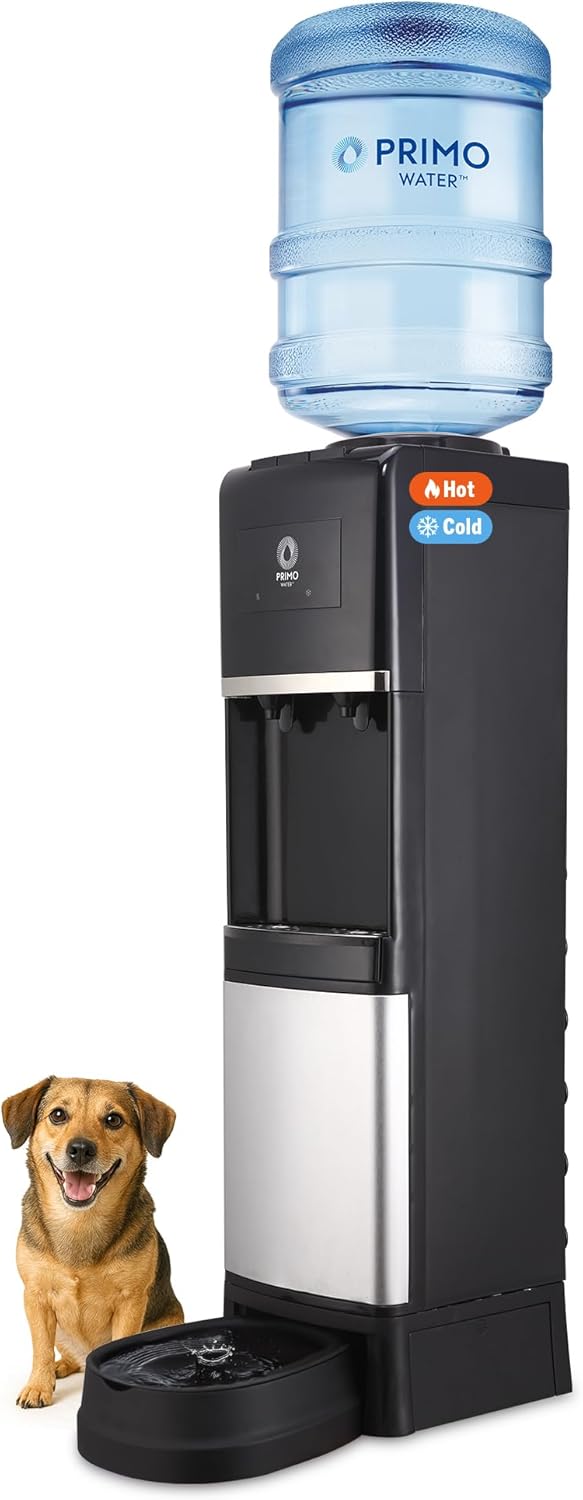
The Primo Top Loading Pro is a tool-free, top-loading water dispenser meant for home or small office use that fits 3- and 5-gallon bottles and supplies both cold and hot water. Setup is simple—plug in, load the bottle into the spill-proof holder, and use the push-button controls to fill cups or the included pet bowl; the stainless steel reservoirs and fast-flow spout keep pours quick and resistant to corrosion. Practical touches such as a two-step child-safety hot tap, LED night light, refill indicator, and a removable dishwasher-safe pet bowl make daily use safer and lower-maintenance. It runs quietly and is Energy Star and UL rated, which helps with efficiency and peace of mind. The main limitations are its top-loading format, which keeps the bottle visible and requires lifting into place, and the unit's height and footprint that may not suit very tight spaces or users who prefer bottom-load convenience. For reliability-minded buyers, the Primo focuses on straightforward, durable components rather than smart integrations.
Best for: Buyers who prioritize a dependable, no-frills dispenser with built-in safety features and a pet-friendly station for daily household use.
Less Ideal for: People who need bottom-loading convenience, built-in smart controls, or integrated advanced filtration should consider other styles.
- Supplies both hot and cold water with fast-flow dispensing.
- Top-loading spill-proof bottle holder simplifies bottle changes and prevents leaks.
- Stainless steel reservoirs resist corrosion and help maintain temperatures.
- Includes removable, dishwasher-safe pet bowl with dedicated push-button dispensing.
- Safety and convenience features including two-step hot-lock, LED night light, and refill indicator.
- Top-loading design requires lifting bottles into place, which can be difficult for some users.
- No smart connectivity or advanced filtration options built into the unit.
Verdict: A reliable, safety-focused top-loading dispenser that delivers hot and cold water and a built-in pet station for households that want straightforward, durable performance.
Frigidaire Top-Load Water Dispenser EFWC498

| Wattage | 420 watts (heater) / 100W cooling |
|---|---|
| Installation Type | Freestanding |
| Number of settings | 2 |
| Power Source | Corded Electric |
| Capacity | 5 gallons |
The Frigidaire EFWC498 is a compact top-loading dispenser that supplies instant hot and cold water for kitchens, offices, or dorms. It uses a compressor cooling system with 100W cooling and a 420W heater to produce noticeably cold or steaming hot water via two push-button spigots, and it accepts both 3- and 5-gallon bottles. The unit includes a stainless steel welded tank for durability and to reduce overheating, a removable drip tray for easy cleanup, and a child-safety lock on the hot spigot for accidental-use protection. Its slim freestanding profile takes up little floor space and the top-loading design makes bottle changes straightforward and lets you see water level. Expect basic two-temperature operation rather than adjustable thermostats, and the top-load layout requires lifting bottles onto the unit instead of bottom-load convenience. For buyers focused on safety and proven functionality, this model delivers straightforward performance without advanced controls or premium features.
Best for: Buyers who prioritize a reliable, safety-minded top-loading dispenser with proven cooling and a child lock for family or shared spaces. They want straightforward operation and durable construction rather than advanced controls.
Less Ideal for: Those who need precise temperature control, bottom-load convenience, or a premium feature set should consider other dispenser styles.
- Provides both hot and cold water on demand with separate push-button spigots
- Compressor-based cooling for stronger cold performance than thermo-electric units
- Stainless steel welded tank designed to reduce overheating and improve longevity
- Child-safety lock on the hot dispenser for added household safety
- Slim freestanding design fits small spaces and accepts 3- and 5-gallon bottles
- Only two fixed temperature settings with no fine temperature control
- Top-loading requires lifting full bottles onto the unit, which can be awkward for some users
Verdict: A dependable, safety-focused top-loading dispenser that delivers hot and cold water with durable stainless steel internals and child-lock protection.
Brio 130 Series Top-Load Water Cooler

| Installation Type | Freestanding |
|---|---|
| Capacity | 5 gallons |
| Material Type | Stainless Steel |
The Brio 130 Series is a simple, no-plumbing top-load water cooler built for everyday use in kitchens, offices, and common areas. It accepts 3- and 5-gallon bottles and uses a no-spill collar so bottle changes are tidy and you can see remaining water at a glance. The unit provides both hot and cold dispensing with a reported 1.5 L/min flow rate and bright LED lights that indicate when temperatures are ready. A two-step child safety lock and automatic relock on the hot tap add a clear safety layer for households with kids. The cooler is freestanding and made with a stainless steel reservoir and rugged polymer body, which helps it stand up to regular use without installation or plumbing. Expect straightforward operation and quick access to beverages, though top-load models require lifting bottles into place and a separate bottle purchase. For buyers focused on a reliable, factory-quality dispenser that minimizes spills and prioritizes safety, the Brio 130 hits the mark.
Best for: Buyers who want a straightforward, safe top-loading dispenser that is easy to set up and uses standard bottled water without plumbing.
Less Ideal for: People who prefer a hands-free or built-in plumbed solution or who need a unit with a room-temperature dispense setting.
- Top-load no-spill collar makes bottle changes cleaner and lets you see remaining water
- Delivers both hot and cold water with a fast 1.5 L/min flow rate
- Two-step child safety lock with automatic relock for hot water
- Stainless steel reservoir and durable polymer body for everyday durability
- Bright LED indicators show when hot and cold are ready
- Requires lifting and replacing separate 3- or 5-gallon bottles
- No room-temperature dispense option
Verdict: A dependable, safety-minded top-load cooler that provides quick hot and cold water with a spill-proof bottle system and child lock.
Choosing the Right Safe Top-Loading Water Dispenser: Key Factors to Consider
Child and Hot-Water Safety
A top-loading dispenser that will be used in households or busy shared spaces should include physical safety measures. Child locks and separate activation steps for hot water prevent accidental dispensing and scalding, which is a primary safety concern. When evaluating a model, confirm how the lock engages and whether it is intuitively located so caregivers can use it reliably.
Beyond locks, consider whether the hot-water actuator requires a deliberate action or two-step press to operate. Designs that force a user to hold a button while dispensing are often safer than single-press mechanisms because they reduce unintended activation.
Sanitary Delivery and Contamination Control
The way water leaves the dispenser affects contamination risk. Covered spigots, nozzle guards, recessed outlets, and drip trays that isolate returned water all reduce chances for airborne particles or direct contact to reach the water stream. Models with sealed reservoirs or one-way valves further limit exposure when you change bottles.
Also check how exposed the spout is during bottle changes. Systems that protect the fill port or use a sealed cap reduce the potential for dirt or hands to touch internal surfaces. For frequent public or high-traffic use, prioritize designs that minimize exposed wet surfaces.
Ease of Cleaning and Sanitizing
Regular cleaning is essential to keep a dispenser safe and tasting fresh. Look for units with removable drip trays, accessible nozzles, and service panels that let you reach interior surfaces without special tools. Clear, step-by-step cleaning instructions and labeled parts speed maintenance and reduce the chance of missed areas.
Materials that tolerate common disinfectants and warm soapy water allow more aggressive cleaning when needed. Models that make disassembly quick encourage more frequent sanitation, which matters in kitchens, offices, and childcare settings.
Materials, Finishes, and Water-Contact Parts
The materials used in the water path influence both safety and longevity. Food-grade plastics and stainless steel are preferable where they contact water. Matte or textured finishes can hide buildup, while smooth, nonporous surfaces are easier to wipe and disinfect.
Also consider whether replacement parts like nozzles and gaskets are standard or proprietary. Readily available, simple parts reduce downtime and make it easier to restore sanitary function after wear or accidental damage.
Maintenance Accessibility and Serviceability
How simple it is to perform routine maintenance determines whether the unit will stay sanitary over time. Designs with clearly labeled access panels, tool-free removable components, and straightforward filter or gasket replacement procedures lower the barrier to proper upkeep.
If a dispenser will be used in an environment with limited technical support, prioritize models that allow nontechnical users to complete routine tasks such as draining the reservoir, replacing a gasket, or cleaning the nozzle without specialized tools.
Thermal Performance and Insulation
Consistent cold and hot temperature delivery matters when users depend on the dispenser for beverages and food prep. Good thermal insulation reduces energy load on the heating and cooling elements and helps the unit maintain set temperatures between uses. For hot-water safety, stable temperature controls prevent overheating that could increase scald risk.
Also consider recovery time for hot and cold taps when the dispenser services multiple users in sequence. Faster thermal recovery reduces long waits and discourages unsafe user behavior like repeated rapid taps to coax temperature changes.
How Top-Loading Designs Affect Hygiene
Top-loading dispensers place the bottle or reservoir above the cabinet, which makes gravity feed straightforward but can introduce points of contact during bottle changes. That interaction is the most common opportunity for contamination, so models that minimize exposed filling surfaces or use a sealed bottle interface reduce risk.
Think about how often bottles will be changed and who will perform those changes. In shared spaces, a design that isolates the fill port reduces the chance that multiple hands or airborne debris will compromise cleanliness.
- Sealed bottle adapters reduce exposure during swaps
- Recessed fill ports limit direct contact with nozzle area
- Top-mounted reservoirs are easier to inspect visually for buildup
Sanitizing Routines That Work
A simple, repeatable cleaning routine keeps a dispenser safe without requiring specialized products. Weekly wipe-downs of exterior surfaces, daily attention to drip trays, and monthly sanitizing of the water path are common practices for home and light commercial use.
Use mild detergent and warm water for routine cleaning and a diluted bleach or food-safe sanitizer for periodic deep cleans when the manufacturer permits. Always follow the unit-specific instructions for contact time and rinsing to avoid residual disinfectant.
- Daily: empty and clean drip tray
- Weekly: wipe spouts and external surfaces
- Monthly: sanitize interior reservoir and nozzles per instructions
Placement and Installation Tips
Location affects both safety and usability. Place the dispenser on a stable, level surface away from direct sunlight and heat sources to avoid temperature fluctuations that can encourage bacterial growth. Ensure there is sufficient clearance to change bottles safely without awkward lifting.
When installing near children, position controls and hot-water locks out of easy reach or install the unit against a wall so the control panel faces away from passing traffic. Verify that the electrical outlet meets the unit's requirements and that any drain lines are routed so spills do not contact electrical components.
- Keep unit level and on a sturdy surface
- Allow clearance for bottle swaps and ventilation
- Locate away from heat and direct sunlight
Common Missteps to Avoid
Skipping regular sanitation because the unit appears clean is a frequent mistake. Mineral deposits and biofilm can form out of sight and compromise water quality. Set a calendar reminder to perform monthly cleanings and inspect seals and gaskets for wear.
Another common error is assuming a child lock is foolproof. Test safety features periodically and combine mechanical locks with safe placement to reduce risk. Finally, using harsh chemicals not approved for water-contact parts can damage materials and create new contamination risks.
- Do not neglect unseen interior surfaces
- Do not assume safety features are permanent without periodic checks
- Avoid unapproved cleaning chemicals on water-contact parts
When to Call a Technician
Call a service professional if you detect persistent leaks, unexplained temperature failure, or mechanical issues affecting the hot-water lock. Problems that require internal repairs or involve sealed refrigeration or heating systems are best handled by trained technicians to maintain safety.
Also engage support if you notice persistent odors or tastes after multiple proper sanitizing cycles, as that can indicate failing components or buildup in areas you cannot access safely.
- Persistent leaks or drips after cleaning
- Hot or cold temperature instability
- Lingering off-flavors or odors after sanitation
How We Chose the Best Safe Top-Loading Water Dispenser
We focused on features that directly affect user safety, hygiene, and long-term maintenance when selecting these top-loading water dispensers. Our editorial filters prioritized: built-in child or hot-water locks to prevent accidental scalding; sanitary delivery designs such as drip trays, covered nozzles, or sealed spigots that limit airborne and contact contamination; materials and finishes that resist bacteria buildup and are easy to wipe and disinfect; straightforward disassembly or accessible service panels to enable periodic deep cleaning; and clear manufacturer instructions for sanitizing and filter maintenance. We excluded units with unclear safety documentation, dispensers lacking any child-protection mechanism, and products with designs that make routine cleaning impractical. We also favored units with durable water-contact materials and replaceable parts to extend usable life. The criteria we applied align with the scoring metrics used across each product entry so you can compare safety, sanitation, and maintenance performance at a glance.
Our full evaluation process is outlined in our review methodology.
FAQ
How often should I sanitize a top-loading water dispenser?
Sanitize the water path monthly for typical home use, with more frequent attention to external touchpoints like drip trays and spouts. Increase frequency in high-traffic or childcare settings.
Are child locks necessary on a home dispenser?
Child locks significantly reduce scald risk from hot water and are recommended in homes with young children. Combine a lock with safe placement and supervision for best protection.
Can I use household bleach to clean the dispenser?
Diluted household bleach is commonly used for deep sanitizing when allowed by the manufacturer. Follow the unit's instructions for concentration, contact time, and rinsing to avoid chemical residue in the water.
What if my dispenser develops an odor that cleaning does not remove?
If odors persist after following the recommended sanitizing steps, a technician should inspect the unit. Persistent smells can indicate trapped debris, failing gaskets, or interior areas that need professional cleaning or part replacement.
Is stainless steel better than plastic for water-contact parts?
Stainless steel offers excellent corrosion resistance and is generally easier to disinfect, while high-quality food-grade plastics can be hygienic if they tolerate cleaning agents. Material choice should balance durability, cleanability, and the specific maintenance routine you are willing to follow.
Final Verdict
Prioritize safety features and maintenance accessibility when choosing a Safe Top-Loading Water Dispenser. Child and hot-water locks, sealed or protected spouts, and materials that tolerate regular sanitizing will keep water safer and reduce long-term upkeep. Weigh the tradeoff between more complex safety systems and how likely you are to follow recommended cleaning schedules. Focus on models that make routine sanitation straightforward and provide clear instructions so you can maintain safe operation with minimal hassle.