
Note: This article contains affiliate links. If you click on these links and make a purchase, we may earn a small commission at no extra cost to you. This helps support our research and content. Read our full affiliate disclosure here.
If you use hot water every day for beverages, cooking, or quick meal prep, a self-cleaning hot water dispenser cuts routine maintenance and keeps water tasting fresh. The right dispenser saves time by automating descaling and sanitizing steps you would otherwise perform manually. This guide covers the top shortlisted self-cleaning hot water dispensers across common household needs and highlights the features that matter for reliability, safety, and ease of upkeep. Below you will find concise buying guidance and clear evaluation criteria used to select these top options, followed by notes on installation, care, and typical tradeoffs to consider.
Top Picks at a Glance
| Best Quality Built to a higher standard if you want something more solid | Brio 800 Countertop Water Cooler |  |
| Best Value The sweet spot between price and what you get | Avalon Bottleless Water Cooler A5 |  |
| Best Budget The cheapest option that still gets the job done reliably | YSHUSTGY Bottom Loading Water Dispenser |  |
| Top Rated A top-rated pick with lots of positive feedback | SOOPYK Bottom Loading Water Cooler |  |
| Most Popular A crowd favorite that many people choose with confidence | Avalon A3 Bottom-Loading Water Cooler |  |
| Best Seller A high-volume bestseller chosen again and again | Brio Bottom Loading Water Cooler | 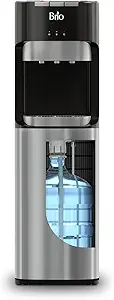 |
Brio 800 Countertop Water Cooler

| Installation Type | Countertop |
|---|---|
| Number of settings | 3 |
| Power Source | Corded Electric |
| Capacity | 800 ml |
| Upper Temperature Rating | 200 °F |
The Brio 800 is a countertop bottleless dispenser designed for frequent use in kitchens or small offices, offering tri-temperature dispensing (hot, cold, room) from a compact cabinet-friendly footprint. It uses a two-stage filter setup to reduce sediment, chlorine, PFAS, and microplastics, and the side-access twist-in filters make replacements straightforward. The unit includes a digital display and night light for easy access and presettable temperature control so you can customize hot and cold set points. Practical features for performance-minded users include a larger solenoid valve for faster fill rates and a hot-clean cycle that circulates hot water to sanitize internal reservoirs on demand. Trade-offs are its 800 ml listed capacity and countertop installation only, which limit throughput for very large households or heavy communal use, and its stainless steel body and electronics add weight compared with simpler dispensers. For someone who prioritizes quick fills, on-demand temps, and built-in sanitizing, this unit performs reliably and keeps maintenance user-friendly.
Best for: Someone who wants fast, on-demand hot and cold filtered water with built-in sanitizing and easy filter access for frequent daily use.
Less Ideal for: Large households or busy communal settings that need greater reservoir capacity or under-counter integration should consider higher-capacity or plumbed-in alternatives.
- Tri-temperature dispensing with presettable hot and cold set points
- Two-stage filtration that targets sediment, chlorine, PFAS, and microplastics
- Hot-clean cycle that circulates hot water to sanitize internal reservoirs
- Larger solenoid valve for faster dispensing and quicker fill times
- Side-access, twist-in filters for straightforward replacements
- 800 ml capacity may be small for high-volume or shared-use environments
- Countertop installation only, so not suitable for under-counter setups
Verdict: Choose the Brio 800 if you want a countertop dispenser that combines fast fills, tri-temperature control, and a built-in hot-clean sanitizing cycle for hands-off maintenance.
Avalon Bottleless Water Cooler A5

| Wattage | 420 watts |
|---|---|
| Installation Type | Freestanding |
| Number of settings | 3 |
| Upper Temperature Rating | 185 °F |
| Power Source | Corded Electric |
The Avalon A5 bottleless water cooler is a freestanding dispenser designed for offices, break rooms, or home use where on-demand filtered water is preferred over bottled deliveries. It hooks into a water line using the included installation kit and runs water through a sediment plus carbon block dual-filter system rated for about six months or 1,500 gallons, then offers cold, cool, and hot outputs via push-button dispensing. A UV self-cleaning cycle and a replace-filter indicator aim to reduce manual sanitizing and maintenance, and a child safety lock on the hot spout helps prevent accidental burns. The stainless steel cabinet and bottom-access filter installation make it sturdy and relatively easy to service. Important drawbacks are the unit's size and weight for tight spaces and the need to replace filters periodically; it also requires a nearby power outlet and plumbing hookup so it is not truly plug-and-play. For buyers who want steady, filtered water without bottle logistics, the A5 is a practical, low-friction option with built-in sanitation features.
Best for: Buyers who want to avoid bottled-water logistics and prefer a plumbed, low-maintenance dispenser that delivers hot, cold, and room-temperature filtered water for office or shared-space use.
Less Ideal for: People who need a simple portable or countertop solution without plumbing, or users who cannot accommodate the unit's footprint or weight in their space.
- Bottleless hookup eliminates bottled water deliveries and ongoing bottle storage.
- Dual sediment and carbon block filters provide basic particulate and taste/odor reduction and are rated for up to 1,500 gallons.
- UV self-cleaning helps reduce manual sanitizing and keeps internal surfaces cleaner between service intervals.
- Three temperature settings (hot, cold, room) cover common drinking and beverage needs.
- Includes installation kit with tubing and fittings for under-sink connection to a water line.
- Requires hard plumbing connection and a nearby outlet, so installation is more involved than countertop units.
- Filters must be replaced every six months or so, adding recurring maintenance cost.
- At 44 pounds and with a tall footprint, it may be bulky for small kitchens or tight utility spaces.
Verdict: Choose the Avalon A5 if you want a plumbed, self-sanitizing bottleless dispenser that delivers consistent hot, cold, and room-temperature filtered water without bottled deliveries.
YSHUSTGY Bottom Loading Water Dispenser

| Voltage | 110V |
|---|---|
| Water Heating Power | 500W |
| Water Cooling Power | 90W |
| Cold Water Temperature | 10-15℃/50-59℉ |
| Hot Water Temperature | 85-95℃/185-203℉ |
This bottom-loading water dispenser provides hot, cold, and room-temperature water from a 5-gallon bottle using a 500W heater and a 90W cooling system, and it includes a self-cleaning function and a detachable drip tray for maintenance. Typical use is simple: load a bottle into the lower compartment, select the desired tap, and the dispenser delivers water at the listed temperature ranges while indicator lights show heating, cooling, and water shortage status. Practical benefits include easier bottle changes because of the lower loading design, built-in safety protections such as over-temperature and anti-dry burn cutoffs, and modest heating and cooling throughput for steady household or small-office demand. The exterior is polypropylene with electrostatic spraying to resist rust and wear, and ventilation holes plus an anti-slip base help longevity and stability. Limitations to expect are relatively modest cooling capacity (about 0.53 gal/hour) and basic thermostat control rather than precise digital temperature settings, so it fits routine daily dispensing more than heavy commercial use or exact-temperature applications.
Best for: Buyers seeking a budget-friendly, easy-to-use dispenser for home or small office where simple hot and cold water delivery and easy bottle changes are priorities.
Less Ideal for: Not a good choice for high-volume commercial settings or users who need fast chilling rates and exact digital temperature control.
- Bottom-load design makes bottle replacement easier for users with limited strength
- Separate hot, cold, and room-temperature taps cover typical drinking needs
- Safety protections include over-temperature, overload, and anti-dry burn cutoffs
- Detachable water collection box for easy cleaning and spill management
- Polypropylene body with electrostatic coating resists corrosion and wear
- Cooling output is modest and may be slow during heavy use
- No precise digital temperature control or advanced display
Verdict: A no-frills, budget-friendly bottom-load dispenser that delivers reliable hot, cold, and room-temperature water with easy bottle changes and basic safety features.
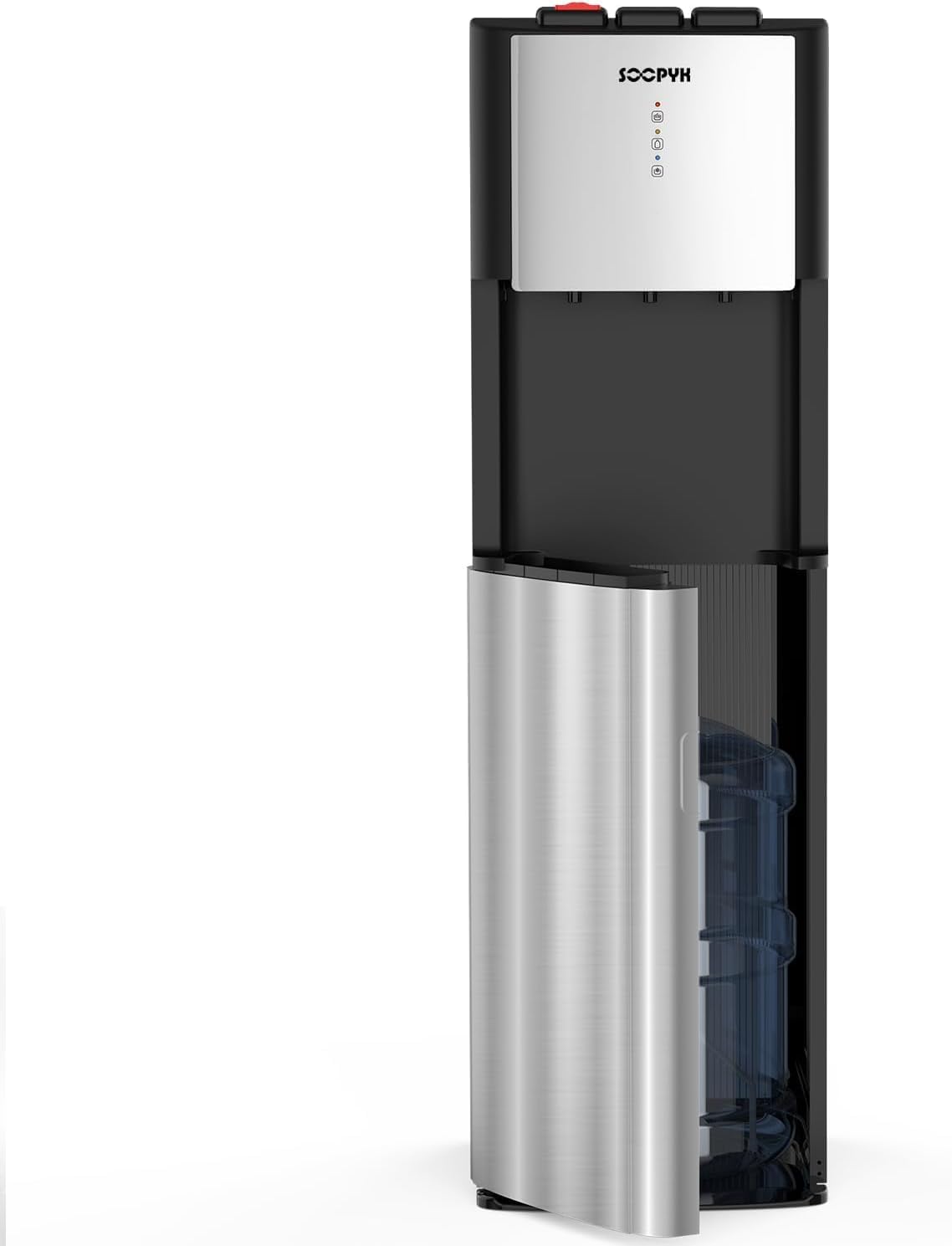
SOOPYK Bottom Loading Water Cooler
| Installation Type | Freestanding |
|---|---|
| Power Source | Corded Electric |
| Upper Temperature Rating | 200 °F |
| Lower Temperature Rating | 45 °F |
| Capacity | 18.93 liters |
This SOOPYK bottom-load water cooler delivers hot, cold, and room-temperature water from a freestanding stainless steel dispenser designed for 5-gallon bottles. It is typically used in kitchens, small offices, or break rooms where easy bottle replacement and basic temperature flexibility matter. Notable features include a stainless steel hot tank with overheat protection, an empty-bottle indicator, a removable drip tray for cleaning, and an internal UV lamp for the cold reservoir; the listing also describes an automatic self-cleaning function that runs while the unit is plugged in. In practice the unit offers straightforward push-button dispensing and a child safety lock on the hot spigot, and the bottom-load design keeps bottles out of sight for a neater appearance. Limitations to be aware of are that the self-cleaning process has no dedicated button or visible indicator and the empty-bottle alert can lag depending on residual tank water, so monitoring is still needed during heavy use.
Best for: Buyers who prioritize a dependable, low-maintenance water dispenser with simple controls and a durable hot tank for steady everyday use in homes or small offices.
Less Ideal for: People who need visible controls and status indicators for cleaning cycles or immediate empty-bottle alerts, or buyers who require advanced filtration features.
- Three temperature settings include hot, cold, and room water for versatile use
- Stainless steel hot tank with built-in overheat protection for durability
- Bottom-load design keeps the bottle hidden and makes replacement easier
- Removable drip tray and internal UV lamp support easier maintenance and cleaner water
- Self-cleaning runs automatically with no dedicated button or status indicator
- Empty-bottle indicator can be delayed depending on cold tank water level
Verdict: Choose this unit if you want a straightforward bottom-loading dispenser with a stainless steel hot tank and automatic self-cleaning for reliable everyday hot and cold water.
Avalon A3 Bottom-Loading Water Cooler

| Wattage | 150 watts |
|---|---|
| Access Location | Bottom |
| Number of settings | 3 |
| Upper Temperature Rating | 185 °F |
| Lower Temperature Rating | 47 °F |
The Avalon A3 is a bottom-loading water cooler designed for shared spaces that need simple hot and cold dispensing plus a sanitary cleaning option. It offers three temperature settings—cold (around 47°F), hot (up to 185°F), and room temp—delivered from push-button spouts with a child safety lock on the hot tap. The unit pumps water from 3–5 gallon bottles stored in the lower cabinet, includes an empty-bottle indicator and a removable drip tray, and has a nightlight for easy nighttime use. A built-in ozone self-cleaning cycle helps reduce microbial buildup without manual disassembly, which is useful in offices or break rooms where hygiene and low maintenance matter. The stainless steel exterior gives a durable, professional look, and the compressor-based cooling provides reliably cold water without ice. Expect typical trade-offs for a bottom-loader of this size: it occupies floor space and requires occasional bottle changes and ozone cycles, and very tall containers may be limited by the dispensing clearance. For buyers who prioritize easy maintenance and hygienic dispensing, the Avalon A3 is a practical, no-frills option.
Best for: Buyers who want a low-maintenance dispenser for offices, break rooms, or small businesses where visible hygiene features and reliable hot and cold water matter most.
Less Ideal for: Those who need an undercounter or countertop point-of-use system or who prefer bottled-free filtration systems should consider other options.
- Three temperature outputs including very hot water suitable for tea or coffee
- Ozone self-cleaning function reduces the need for manual sanitizing
- Bottom-loading design avoids lifting heavy bottles and includes empty-bottle indicator
- Child safety lock on hot spout and nightlight for safer, convenient use
- Requires floor space and regular bottle replacement since it uses external 3–5 gallon bottles
- Ozone cleaning is not a substitute for all cleaning tasks and may not replace periodic manual maintenance
Verdict: Choose the Avalon A3 if you want a sturdy bottom-loading dispenser with hot, cold, and ozone self-cleaning for cleaner, low-effort shared use.
Brio Bottom Loading Water Cooler

| Wattage | 500 watts |
|---|---|
| Installation Type | Freestanding |
| Access Location | Bottom |
| Number of settings | 3 |
| Upper Temperature Rating | 198 °F |
The Brio bottom-loading water cooler is a freestanding dispenser designed for 3- or 5-gallon bottles that makes hot, cold, and room-temperature water available on demand. It is typically used in kitchens, offices, or small break rooms where users want easy access to multiple temperatures without heavy lifting thanks to the bottom-load cabinet. Key features include a stainless steel reservoir, an LED display with an empty-bottle alert, and a child-safety lock on the hot spout for safer use around children. The unit runs on a corded electric supply and offers straightforward three-setting control with a maximum listed upper temperature of 198 F for hot water. Practical benefits include reduced strain when changing bottles, a durable food-grade reservoir that helps preserve water taste, and the convenience of instant hot water for beverages or meals. Important limitations are that self-cleaning features are not listed for this exact model and maintenance still requires periodic cleaning and filter changes where applicable, and the unit is relatively heavy for repositioning once installed.
Best for: Buyers who prioritize safety and reliable, no-lift dispensing for a household or small office and want a straightforward hot-and-cold dispenser that reduces bottle-handling strain.
Less Ideal for: People seeking a dispenser with built-in self-cleaning or touchless dispensing features should consider other models that explicitly include UV, ozone, or automated sanitizing functions.
- Bottom-load design eliminates heavy lifting and simplifies bottle changes
- Stainless steel reservoirs help maintain water purity and flavor
- Three temperature settings provide hot, cold, and room-temperature water on demand
- LED display with empty-bottle alert helps avoid unexpected runouts
- Child-safety lock on hot spout reduces risk of accidental hot water dispensing
- No explicit self-cleaning (UV or ozone) feature listed for this model
- Unit is fairly heavy, making it awkward to move once positioned
Verdict: Choose this bottom-load Brio cooler if you want a durable, no-lift dispenser that reliably delivers hot, cold, and room-temperature water with simple safety features.
Choosing the Right Self-Cleaning Hot Water Dispenser: Key Factors to Consider
Self-Cleaning Mechanism
Not all self-clean systems work the same way. Some dispensers run a short hot-water flush through internal pathways to rinse deposits, while others use scheduled higher-temperature cycles to break down scale and microbes. Understanding the mechanism matters because it determines how often a manual descaling is needed and how effectively the unit maintains water taste.
Also consider whether the cleaning cycle requires any user-supplied chemicals or special cartridges. True automated cycles that use only hot water are simpler to maintain. Units that combine internal heating cycles with accessible drain points make it easier to remove loosened scale and residue during scheduled maintenance.
Temperature Range and Stability
Different uses call for different temperature targets. For tea and instant beverages, near-boiling temperatures are useful. For baby formula or delicate tasks, cooler preset options or adjustable temperature control are important. A good dispenser holds a set temperature without wide fluctuations when multiple pours are taken in sequence.
Stability also affects safety and energy use. Units that over-cycle the heater to maintain an exact temperature may consume more power. Look for dispensers with clear, repeatable temperature settings and a rapid recovery rate so you do not wait long between pours.
Safety and User Controls
Hot water appliances present burn risk, so safety features are essential. Child-lock mechanisms, push-and-hold dispensing, drip trays that detect jugs, and automatic shutoff for dry boil or low-water conditions reduce accidental scalds and damage.
Controls should be intuitive and placed so accidental activation is unlikely. Indicator lights or alerts that show when a cleaning cycle is running or when water level is low help prevent misuse and make maintenance predictable.
Filter Compatibility and Water Quality
If your dispenser uses a replaceable sediment or carbon filter, factor filter life and ease of replacement into your decision. Good filtration reduces scale formation and improves flavor, but replacement frequency and cost affect lifetime upkeep.
Also think about whether the unit supports a variety of filter types or requires proprietary cartridges. Non-proprietary filter compatibility can lower ongoing costs and make sourcing replacements easier. Consider local water hardness when evaluating needed filtration and descaling intervals.
Installation and Footprint
Installation needs vary from simple countertop plug-in units to models that require a direct cold-water line. Count the space on your counter, access to a grounded outlet, and whether you want a permanent plumbed installation.
A compact footprint is preferable for small kitchens but may trade off tank capacity and recovery speed. Also check for ease of moving the unit for cleaning or winter storage and whether the dispenser includes a removable reservoir for simpler maintenance.
How Self-Clean Cycles Work
Self-clean cycles typically use one of three approaches: automated hot-water flushing, elevated-temperature sterilization cycles, or timed rinses combined with replaceable filter media. The simplest systems flush hot water through internal passages to dislodge loose deposits. More advanced systems periodically raise internal temperatures to limits that help reduce microbial contamination and break down mineral scale.
Knowing which method a dispenser uses tells you what to expect for maintenance. Flushing-only systems still benefit from occasional manual descaling in hard-water areas, while high-temperature sanitizing cycles can extend the interval between manual cleanings.
- Flushing cycles: frequent, low-effort rinses to keep pathways clear
- High-temp cycles: less frequent, more effective against microbes and scale
- Timed rinses plus filters: continuous protection with periodic cartridge swaps
Installation Options: Countertop Vs Plumbed
Countertop plug-in dispensers are easiest to set up. They usually have a refillable reservoir and require only a power outlet. These are flexible for renters or anyone who wants a nonpermanent solution.
Plumbed-in models connect directly to the cold-water supply and offer continuous refill without manual topping up. They often need professional installation and may have additional filtration requirements. Consider the tradeoff between convenience and the complexity of installation when choosing a setup.
- Countertop: simple setup, portable, limited tank size
- Plumbed: continuous water, larger capacity, installation overhead
Maintenance Best Practices
Even self-cleaning units need scheduled attention. Keep drip trays and exterior surfaces wiped to avoid residue buildup. Follow the manufacturer's guidance for how often to run the cleaning cycle and when to empty and rinse tanks or reservoirs.
In hard-water areas, supplement automated cycles with periodic manual descaling using a manufacturer-approved descaler or a mild vinegar solution if recommended. Replace filters on schedule and inspect seals and dispensing valves for mineral buildup to maintain performance and prevent leaks.
- Wipe external surfaces weekly
- Run or schedule self-clean cycles at recommended intervals
- Inspect and replace filters and seals per service schedule
Energy Use and Heat Loss Considerations
A dispenser that keeps water hot continuously uses standby energy. Some units use insulated tanks and smart thermostats to reduce cycling and energy draw. If energy use is a concern, compare insulation, standby power ratings, and the presence of eco modes that lower maintenance temperature during idle periods.
Also consider heat loss through external surfaces. Well-insulated units limit unwanted warming of nearby counters and reduce the frequency of heater activation, which improves efficiency over time.
- Look for insulated tanks and eco or sleep modes
- Check energy specifications when available to compare standby use
- Smaller tanks recover faster but may cycle more often
Common Problems and How to Avoid Them
Common issues include mineral scale buildup, weakened seals that cause slow leaks, and inconsistent temperature after heavy use. Preventive steps include using appropriate water filtration, running self-clean cycles on schedule, and replacing wear items such as gaskets or filters as soon as performance drops.
If you notice reduced flow or a change in water taste, prioritize an inspection of the filter and a cleaning cycle before assuming hardware failure. Regular maintenance extends service life and preserves safety features like dry-boil protection.
- Scale buildup: use filtration and scheduled descaling
- Leaky seals: inspect and replace gaskets when required
- Temperature dips: check recovery rate and heating element condition
How We Chose the Best Self-Cleaning Hot Water Dispenser
We focused on features and performance that reduce hands-on maintenance while delivering dependable hot water distribution. Key evaluation criteria included the effectiveness of the self-cleaning or automatic descaling mechanism, the dispenser's thermal control and temperature consistency, safety features such as child locks and dry-boil protection, long-term reliability and build quality, and ease of routine cleaning for surfaces and internal reservoirs. We also prioritized clear maintenance workflows and availability of replaceable service parts like filters or sealing components. Excluded from consideration were units that rely solely on manual cleaning without an automated sanitizing cycle, dispensers meant only for office use with commercial plumbing requirements, and models lacking basic safety interlocks. Our shortlist emphasizes real-world use: how well a unit minimizes limescale buildup, how simple scheduled maintenance is, and whether the design supports straightforward winterization or infrequent use. The scoring criteria below reflect these practical filters and the performance dimensions we weighed when picking the finalists.
Our full evaluation process is outlined in our review methodology.
FAQ
How often should I run a self-clean cycle?
Frequency depends on the unit and local water hardness. Many manufacturers recommend weekly or monthly cycles; in hard-water areas more frequent cycles or supplemental manual descaling may be necessary.
Can I use vinegar to descale a self-cleaning dispenser?
Some manufacturers allow diluted vinegar for manual descaling, but others require approved descalers. Check the unit's instructions because harsh chemicals can damage internal components or invalidate warranties.
Is a plumbed-in model better than a countertop unit?
Plumbed-in units provide continuous refill and are convenient for heavy users, but they require installation and may add complexity for maintenance. Countertop models are easier to install and move but need manual refilling.
What safety features should I expect on a hot water dispenser?
Expect child locks, push-and-hold dispense controls, low-water auto-shutdown, and indicator lights for active cleaning cycles. These features reduce burn risk and prevent damage from dry heating.
Do self-cleaning dispensers eliminate the need for filters?
No. Self-cleaning cycles address internal scale and microbial control but do not replace filtration. Filters improve taste and reduce sediment and scale formation; many units combine both approaches for best results.
Final Verdict
Prioritize dispensers with an effective automated cleaning approach, dependable temperature control, and robust safety features. Balance installation preferences and ongoing maintenance needs against tank size and recovery rate to match your household's daily hot-water habits. Choosing a unit that minimizes manual descaling and makes filter replacement straightforward will reduce long-term upkeep. Focus on the functional tradeoffs described here and pick the dispenser that best fits your routine and installation constraints for reliable, low-maintenance hot water delivery.