
Note: This article contains affiliate links. If you click on these links and make a purchase, we may earn a small commission at no extra cost to you. This helps support our research and content. Read our full affiliate disclosure here.
Working with knits and other stretch fabrics changes how you approach sewing. You need a serger that can manage fabric feed, maintain balanced stitch tension, and produce seams that stretch without popping. Choosing the right serger sewing machine for stretch fabrics means prioritizing stitch quality, differential feed, and a reliable loopers system so your garments hold up in wear and wash. This guide shortlists the top options and explains the features and tradeoffs that matter most for sewing stretch fabrics. Below are our top picks for serger sewing machines for stretch fabrics, followed by the factors we weighed and practical guidance to help you pick the best machine for your workflow.
Top Picks at a Glance
| Best Overall The best all-around choice for most situations | JUKI MO-50E Serger |  |
| Best Quality Built to a higher standard if you want something more solid | Bernette Funlock B44 Serger |  |
| Best Value The sweet spot between price and what you get | VEVOR Serger Overlock Machine 336 |  |
| Best Budget The cheapest option that still gets the job done reliably | JAYGOVAN Serger Overlock Machine |  |
| Top Rated A top-rated pick with lots of positive feedback | Brother 1034D Serger |  |
| Most Popular A crowd favorite that many people choose with confidence | SINGER S0230 Serger |  |
| Best Seller A high-volume bestseller chosen again and again | SINGER S0100 Serger |  |
JUKI MO-50E Serger

| Power Source | Corded Electric |
|---|---|
| Material | Aluminum |
| Number of Threads | 3 or 4 |
The JUKI MO-50E is a straightforward, home-focused serger that borrows durability and feeding features from JUKI's industrial line to handle everyday seaming and edge finishes. It runs with three or four threads, uses lay-in tensions for simple adjustments, and includes an automatic lower looper threader that saves time when rethreading. The adjustable differential feed and calibrated knife let you control stretch and edge trimming, which is useful when working with knits and other stretch fabrics. Built-in rolled hem capability adds convenience for lightweight hems, and the corded electric motor provides reliable, consistent power. The machine is relatively compact and solidly built from aluminum, but it lacks some high-end convenience features like an integrated air or electronic threading system or extra presser feet found on pricier models. For balanced sewers who want a dependable, no-frills serger that can manage stretch fabrics with careful adjustment, the MO-50E offers a durable, practical solution.
Best for: Sewers who want a durable, practical serger that handles everyday knits and stretch fabrics without needing premium electronic features and who prefer straightforward mechanical controls.
Less Ideal for: Users who need the fastest, automatic threading systems, a wide assortment of included presser feet, or extensive built-in automation should consider higher-end models instead.
- Automatic lower looper threader reduces rethreading time
- Adjustable differential feed helps control stretching and puckering on knits
- Calibrated, adjustable knife for precise edge trimming
- Built-in rolled hem for quick lightweight hemming
- Durable, industrial-derived construction for reliable home use
- No advanced electronic or air-threading system for faster threading
- Limited accessory set compared with higher-end sergers
Verdict: Choose the MO-50E if you want a reliable, mechanically simple serger that gives good control over stretch fabrics through differential feed and a calibrated knife.
Bernette Funlock B44 Serger

| Built-in stitches | 15 |
|---|---|
| Thread options | 2/3/4-thread |
| Max stitch speed | 1,300 stitches per minute |
| Differential feed | 0.6–2.0 |
| Power source | AC |
The Bernette Funlock B44 is a robust serger built for fast, professional finishes on a wide range of fabrics including stretch knits. It delivers 2-, 3-, and 4-thread overlock stitches plus specialized options such as rolled hem and flatlock, and the differential feed (0.6 to 2.0) helps prevent stretching and puckering when working with elastic or lightweight materials. The machine reaches up to 1,300 stitches per minute, so it speeds through long seams and production runs, and the bright LED and LCD make thread changes and adjustments easier. An extension table and adjustable presser foot improve control on larger or thicker projects, and included accessories like bobbins, needles, and a threader make setup straightforward. Practical limits are a moderately heavy weight and the usual learning curve for serging tensions and threading, so beginners will need time to master optimal settings for tricky stretch fabrics. For sewists who need a fast, versatile machine for finishing garments and stretchy material, the B44 offers factory-quality results.
Best for: Sewists who prioritize speed and professional finishes on stretch fabrics and need a machine that handles a wide range of materials reliably.
Less Ideal for: Casual hobbyists who rarely work with knits or those wanting an ultra-light portable serger for occasional mending.
- Supports 2-, 3-, and 4-thread overlock stitches for versatile seam finishes
- Differential feed (0.6–2.0) reduces stretching and puckering on knit and stretch fabrics
- High speed up to 1,300 stitches per minute for fast production
- Includes useful accessories (bobbins, needles, threader) and an extension table for larger projects
- LED light and LCD improve visibility and adjustment accuracy
- Heavier, bulkier machine that is less portable
- Steeper learning curve for tensioning and threading compared with basic sergers
Verdict: Choose the Bernette Funlock B44 when you need a fast, durable serger that reliably handles stretch fabrics and delivers professional overlock finishes.
VEVOR Serger Overlock Machine 336
| Thread capability | 2/3/4-thread |
|---|---|
| Stitching speed | Up to 1,250 SPM |
| Differential feed | 0.7–2.0 adjustable |
| Power source | hand_powered |
| Input voltage | 120 volts |
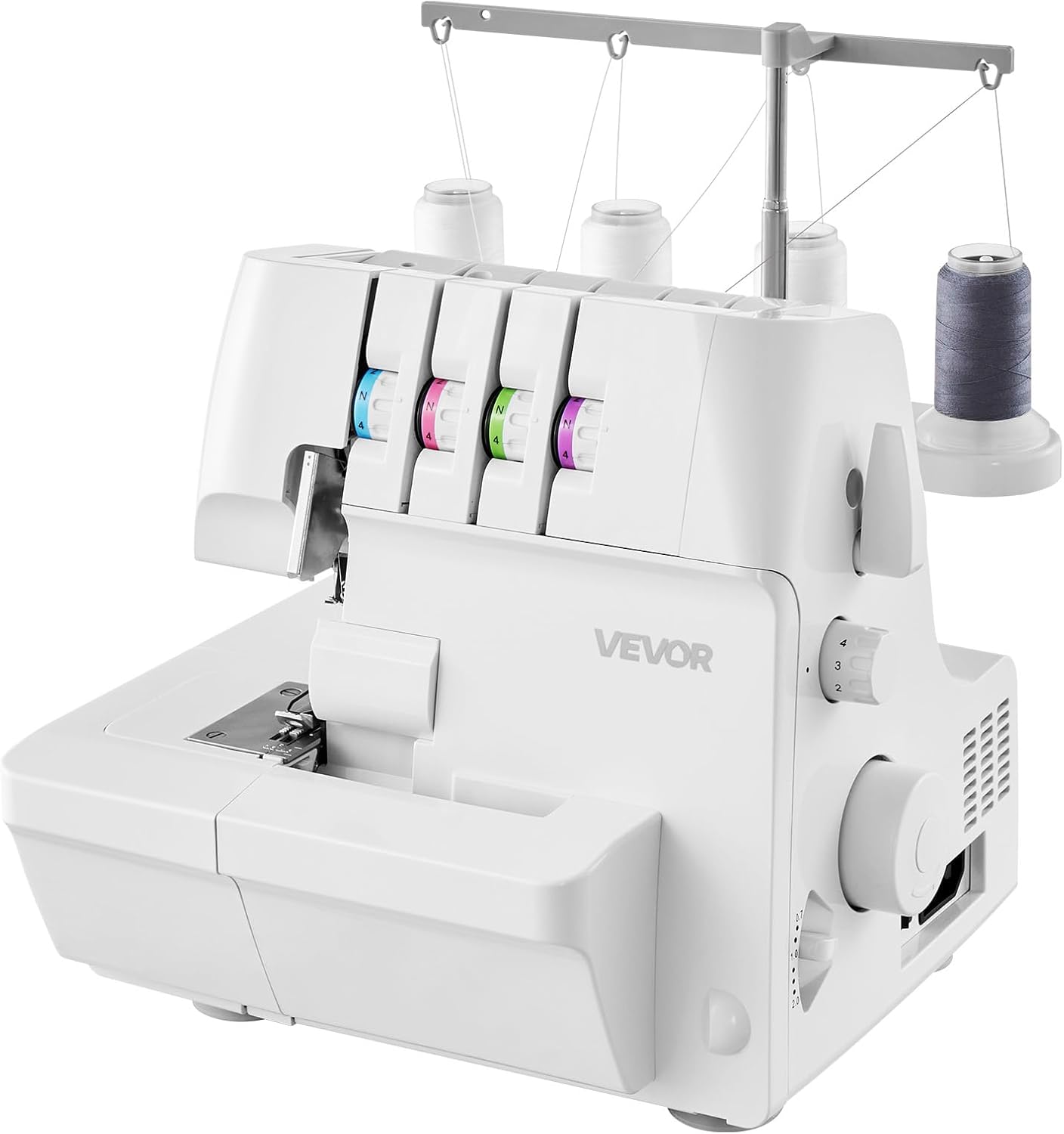
This VEVOR serger is built to handle a wide range of fabrics, with 2-, 3- and 4-thread options and an adjustable stitch length for different finishes. The 0.7–2.0 differential feed is the standout feature for stretch fabrics, reducing puckering and keeping seams flat when working with knits and stretchy blends. It reaches up to 1,250 stitches per minute, so larger projects move quickly, and the trim trap plus onboard tool compartment help keep your workspace tidy. Color-coded threading and a free arm make setup and narrow-work like cuffs and sleeves easier, while the LED light improves visibility when sewing darker or layered materials. On the downside the unit is a heavier, metal-and-plastic desktop machine that may be bulkier than some hobbyist models and it does not list high-wattage industrial motor specs, so extremely heavy continuous commercial use could be limited. For home sewers and small businesses focused on stretch fabrics, it balances speed, useful features, and tidy organization.
Best for: Sewers who prioritize tidy, professional-looking finishes on knits and other stretch fabrics and want an affordable machine that handles repairs, hems, and small production runs efficiently.
Less Ideal for: Those needing a lightweight portable serger for occasional travel or users requiring a heavy-duty industrial machine for continuous high-volume manufacturing should look elsewhere.
- Adjustable 0.7–2.0 differential feed smooths stretchy and lightweight fabrics
- Switchable 2/3/4-thread capability for a range of seam finishes
- Up to 1,250 stitches per minute for faster project completion
- Color-coded threading, free arm, and LED light simplify setup and detail work
- Relatively heavy desktop unit that may be less portable for occasional users
- Not specified as an industrial-grade motor for continuous heavy commercial use
Verdict: Choose this serger if you want a capable, feature-forward machine that tames stretch fabrics and speeds up hemming and finishing for home or small-business projects.
JAYGOVAN Serger Overlock Machine

| Power Source | ac |
|---|---|
| Input Voltage | 110 volts |
| Material | Cast Iron |
| Thread Capability | 4-Thread |
This JAYGOVAN serger is a budget-friendly 4-thread overlock machine aimed at speeding up seam finishing and working with stretch fabrics. It runs up to 1200 stitches per minute and includes automatic fabric trimming, an adjustable stitch length, and tension controls so you can fine-tune seams for different knits. The cast-iron frame and LED work light help keep stitching steady and visible, while the foot controller gives hands-free speed control for longer seams. Practical benefits include quicker seam finishes, stronger 4-thread overlocks that resist unraveling, and the ability to trim while sewing to save time. Limitations to expect at this price are a smaller, more compact footprint that may feel cramped for bulky projects and a basic accessory bundle with only a foot controller and manual included. Some users may need to spend time learning threading and tension adjustments to get smooth results on very lightweight or very heavy stretch fabrics.
Best for: Buyers looking for an affordable serger to finish seams and handle everyday stretch fabrics who are comfortable learning machine threading and tension adjustments.
Less Ideal for: Sewers who need a heavy-duty, feature-rich professional serger for high-volume industrial work or large bulky projects should consider higher-end models.
- 4-thread overlock produces durable, compact seams that resist unraveling
- High top speed (up to 1200 stitches/min) for faster sewing and production
- Built-in knife trims fabric while overlocking to save time
- Adjustable stitch length and tension controls let you dial settings for different stretch fabrics
- Compact design may be tight for bulky or multi-layer projects
- Basic included accessories; extra feet or tools may be required for specialized work
Verdict: A cost-conscious 4-thread serger that speeds seam finishing and trims edges while giving enough adjustability for most stretch-fabric projects.
Brother 1034D Serger

| Thread functions | 3/4 thread |
|---|---|
| Max stitch speed | 1,300 stitches per minute |
| Power source | Corded Electric |
| Input voltage | 120 volts |
The Brother 1034D is a compact, entry-to-mid-level serger that handles 3- and 4-thread overlock stitches plus rolled hem and narrow hem options, making it useful for finishing garment seams and edge treatments. It runs up to 1,300 stitches per minute and includes a foot pedal for speed control, so it moves quickly through seams on both lightweight and medium-weight fabrics. Notable features for stretchy materials include a differential feed to reduce stretching or puckering and a color-coded lay-in threading system with a F.A.S.T. lower looper to simplify thread changes. The metal interior frame adds rigidity for consistent stitch quality when working with multiple layers or heavier knits. The machine ships with three snap-on presser feet and a removable trim trap for clean edge trimming. Limitations are typical for its class: it is mechanical rather than computerized so stitch selection is manual, and advanced decorative or cover-stitch functions require optional attachments or a different machine. For sewers prioritizing dependable, factory-quality finishing on stretch fabrics, this model focuses on solid basics rather than advanced automation.
Best for: Sewers who want a reliable, workhorse serger that consistently finishes stretch fabrics and knits without fuss and favors mechanical simplicity over advanced electronics.
Less Ideal for: Users seeking built-in cover-stitch functions, extensive decorative stitches, or computerized automation should consider a different model with those specific features.
- Differential feed improves stitch quality on stretchy and thin fabrics.
- Durable metal frame provides stable performance and consistent stitch tension.
- Color-coded lay-in threading and F.A.S.T. lower looper simplify threading and reduce setup time.
- Runs up to 1,300 stitches per minute for faster seaming and finishing.
- Includes three snap-on presser feet and a removable trim trap for common serging tasks.
- Manual dial-based controls limit fine tuning compared with computerized sergers.
- Does not include built-in cover-stitch capability; extra attachments are needed for some stitch types.
Verdict: Choose the Brother 1034D when you need a sturdy, fast serger that reliably produces clean finishes on stretch fabrics without electronic complexity.
SINGER S0230 Serger

| Power Source | Electric |
|---|---|
| Stitch Speed | 1300 stitches/min |
| Thread Options | 2, 3, or 4 threads |
The SINGER S0230 is a straightforward mechanical serger built to deliver professional-looking seam finishes on garments and stretch materials. It handles 2, 3, or 4 thread stitches and runs up to 1,300 stitches per minute, trimming and overlocking in one pass to speed garment construction and hemming. The differential feed is the key feature for this article goal: it prevents stretching on knits and reduces puckering on lightweight fabrics so cuffs and seams lay flat. Color-coded threading and onboard accessory storage make setup and routine tasks easier for sewers who are newer to serging. The machine includes a free arm for small tubes like sleeves and comes with basic tools such as tweezers and extra needles. Expect the S0230 to be compact and reasonably portable, but remember it is a mechanical model so you will not get advanced computerized stitch programming or automated tension features found on higher-end machines. For sewers focused on stretch fabrics, it is a practical, capable option that balances speed and usability without extra complexity.
Best for: Buyers who want a reliable, easy-to-use serger that improves finishes on stretch fabrics and speeds garment sewing while preferring proven, straightforward mechanics over feature-heavy models.
Less Ideal for: If you need computerized features, industrial power for very thick materials, or advanced automated tensioning, look at higher-end or heavy-duty sergers instead.
- Differential feed prevents stretching and puckering on knits and lightweight fabrics.
- Color-coded threading simplifies setup for beginners and reduces threading errors.
- High sewing speed (up to 1,300 spm) for faster project completion.
- Supports 2-, 3-, and 4-thread stitches for rolled hems, overlock seams, and decorative edges.
- Onboard accessory storage keeps tweezers, needles, and tools handy.
- Mechanical controls lack advanced automated tension or stitch programming found on premium models.
- Not a heavy-duty industrial frame, so very thick layers may be challenging.
Verdict: A user-friendly mechanical serger with differential feed and color-coded threading that makes professional finishes on stretch fabrics faster and more consistent.
SINGER S0100 Serger

| Stitch speed | 1300 stitches/min |
|---|---|
| Thread options | 2, 3, or 4 threads |
| Built-in stitches | 6 |
| Power source | Electric |
The SINGER S0100 is a straightforward overlock machine aimed at finishing seams and trimming excess fabric in one pass, with options for 2-, 3- and 4-thread stitches. It excels on stretch fabrics thanks to a differential feed that reduces wavy or puckered seams and a built-in free arm for cuffs and sleeves. At 1,300 stitches per minute it moves quickly through larger projects, and the color-coded threading plus pre-threaded delivery make initial setup easier for cautious or inexperienced users. The unit includes basic accessories stored in a front compartment and an adjustable tension system for dialing in stitch balance. Limitations include a relatively small set of built-in stitches (six) and a lighter-duty construction compared with heavier industrial models, so users who need advanced decorative stitches or heavy continuous production may find it constrained. For home sewers working with knits, sheers, and everyday garments, it provides efficient, professional-looking seam finishes with an approachable setup.
Best for: Sewists who prioritize reliable, easy-to-use finishing for stretch fabrics and want a risk-averse, low-friction machine for home garment sewing and small projects.
Less Ideal for: Professional sewshops or users who require a wide range of decorative stitches or continuous heavy-duty production should consider more robust, feature-rich models.
- 2/3/4-thread capability for rolled hems and overlock seams
- Differential feed to prevent stretching or puckering on knits and sheers
- Color-coded threading and pre-threaded setup reduce beginner setup frustration
- High speed (1,300 stitches/min) for faster project completion
- Only six built-in stitches limits decorative and specialty options
- Lightweight consumer construction not suited for heavy industrial use
Verdict: A user-friendly serger that makes professional seam finishes on stretch fabrics accessible to cautious home sewists.
Choosing the Right Serger Sewing Machine for Stretch Fabrics: Key Factors to Consider
Stitch Elasticity and Formation
How a serger forms stitches determines whether seams will stretch with the fabric instead of breaking. For stretch fabrics, look for consistent overlock and cover stitches that allow give without loosening or puckering. Machines that deliver balanced stitch formation across different thread tensions reduce the need for constant readjustment when you switch between lightweight and medium-weight knits.
Beyond raw appearance, test results such as recovery after stretching and the absence of skipped stitches are the practical measures that matter. This influences seam durability and garment comfort, especially on high-stretch areas like cuffs and waistbands.
Differential Feed Range and Stability
A reliable differential feed prevents wavy hems on lightweight knits and prevents stretching on heavy knits during sewing. Wider adjustment allows you to fine-tune how the feed dogs move layers of fabric relative to each other, which is critical when handling very stretchy or very thin materials.
Stability of the differential feed under varied stitch lengths and fabric thicknesses reduces fabric distortion and helps maintain consistent seam allowances. Machines with positive detents or clearly marked settings make repeatable setups easier when working across several projects.
Looper Threading and Tension Control
Stretch-friendly seams depend on accurate looper tension and smooth thread paths. Clear, color-coded looper threading and easy-to-access tension dials let you dial in balanced stitches quickly. Precise tension control prevents loops from pulling through or forming loose, snag-prone edges.
For frequent knit work, consider machines with fine tension increments and visible tension markings so you can replicate settings between fabrics. Accessibility of the looper area also affects how easily you can clear jams and perform routine maintenance.
Presser Foot Pressure and Needle Options
Adjustable presser foot pressure helps control fabric feed without compressing or stretching the material. Being able to reduce pressure slightly for thin jersey or increase it for heavier stretch fabrics preserves fabric shape while delivering even stitches.
Compatibility with stretch-specific needles and multiple presser feet expands the range of finishes you can achieve, from narrow rolled hems to secure multi-thread overlocks. Consider how easy it is to change feet and swap to a different needle type when switching fabric types.
Ease of Setup and Daily Use
Sewing stretch fabrics often requires frequent changes to stitch length, differential feed, and tension. Machines that make those adjustments quick and intuitive save time and reduce frustration. Features such as color-coded guides, front-mounted controls, and a straightforward foot-lift mechanism speed up workflow and encourage experimentation.
Also think about the learning curve. A machine with helpful documentation and clear markings will let you reach consistent results faster, which matters for hobbyists balancing limited sewing time and multiple projects.
Serviceability and Long-Term Reliability
Regular maintenance, such as cleaning lint from loopers and occasional oiling, keeps stitch behavior steady over time. Choose machines constructed with robust loopers and feed systems that tolerate frequent use with textured or fuzzy knits.
Consider access to simple adjustments and replaceable parts. Durable construction reduces the chance of alignment drift and the need for professional servicing, which keeps operating costs lower and makes the machine more dependable for recurring stretch-sewing projects.
Common Stitch Types for Stretch Fabrics
Understanding stitch types helps you pick the right serger functions for stretch fabrics. Two- and three-thread overlocks create flexible seam allowances and clean edges, while four-thread overlocks add safety stitch strength for high-stress seams like side seams on fitted garments. Some sergers also offer cover or chain stitches that mimic knit factory finishes and permit vertical stretch without seam failure.
Choose stitch types based on the garment area and desired finish. Narrow rolled hems and lettuce-edge finishes are excellent for lightweight knits, while stronger multi-thread overlocks are better for seams that will bear repeated stress.
- Two-thread overlock: Good for lightweight hems and decorative edges.
- Three-thread overlock: Common for stretchy seams and clean edge finishes.
- Four-thread overlock: Adds a safety stitch for more durable seams.
- Cover/chain stitch: Useful for hemming with vertical stretch.
Thread and Needle Choices That Improve Stretch Performance
Thread and needle selection directly affect seam elasticity and durability. Polyester thread offers good strength with some give, while specialized stretch thread or woolly nylon provide extra recovery for seams that need to expand and return. Use thread weights that match fabric thickness to avoid bulky seams or weak joins.
Needles labeled for stretch or ballpoint tips are designed to pass between knit fibers rather than cutting them. Using the correct needle type reduces runs, skipped stitches, and fabric damage, producing neater, longer-lasting finishes.
- Use ballpoint or stretch-specific needles for knits.
- Match thread weight to fabric; consider woolly nylon for highly elastic seams.
- Test on fabric scraps to find the best thread and needle combo.
Hemming and Edge Finishes That Stretch With the Fabric
Hemming knits often requires approaches that preserve stretch. Narrow rolled hems offer a tidy edge on lightweight fabrics without restricting give. For heavier knits, a twin-needle cover stitch or a folded hem secured with a stretch stitch keeps the edge flexible. Consider decorative finishes that also stabilize edges, such as lettuce hems created with slight differential feed adjustments.
Adjust stitch length and tension when switching hemming techniques. Small changes can transform a puckering edge into a smooth, elastic finish, so always run a test strip before committing to the garment.
- Narrow rolled hem for lightweight fabrics.
- Cover stitch or twin needle for stable, stretchable hems.
- Use differential feed to fine-tune lettuce or ruffled edges.
Troubleshooting Common Stretch-Fabric Issues
Many stitch problems with knits trace back to tension or needle mismatches. If stitches look looped or loose, reduce looper tension or check that threads are seated correctly. Puckering usually indicates too much presser pressure or an incorrect stitch length for the fabric weight.
Another frequent issue is fabric feeding inconsistently. Verify that the differential feed setting is appropriate and that the feed dogs are clean. If skipped stitches occur, swap to a fresher stretch needle and rethread the machine, following color guides if available.
- Loose loops: Adjust looper tension and check threading.
- Puckering: Reduce presser foot pressure and try a longer stitch length.
- Skipped stitches: Replace needle and rethread following guides.
- Uneven feed: Clean feed dogs and experiment with differential feed.
Workspace and Accessories That Make Knit Sewing Easier
A well-lit, organized workspace speeds sewing and reduces mistakes when working with stretch fabrics. Keep a small table or extension to support wider garments and prevent fabric from pulling away from the machine. Good lighting helps spot tension issues before they become problems.
Accessories such as clear presser feet, specialized hem feet, and seam guides improve control and finish. A small stash of different needle sizes, extra loopers or blades where compatible, and a set of test scraps in common fabrics will save time and help you reproduce reliable stitch settings.
- Use a worktable extension to support large pieces.
- Keep spare stretch needles and a variety of presser feet on hand.
- Store labeled fabric scraps for quick testing of settings.
How We Chose the Best Serger Sewing Machine for Stretch Fabrics
We narrowed the list by focusing on features and performance traits that directly affect working with stretch fabrics. Key evaluation criteria included stitch quality and elasticity, differential feed range and stability, looper threading and tension control, presser foot and needle system compatibility, and build reliability for sustained home sewing use. We also considered ease-of-use features such as color-coded threading, clear tension indicators, and accessible adjustments that reduce setup time for varied knit weights. Machines that showed inconsistent stitch formation on common knits, lacked a usable differential feed range, or had fragile loopers or threads guides were excluded. We prioritized machines that balance robust stitch performance with practical usability for hobbyists and home sewing enthusiasts. Threading convenience and serviceability were also factored into selections, since consistent tension and maintenance behavior matter more over time than a single impressive spec. The final picks reflect a blend of reliable stitch mechanics, user-focused controls, and adaptability across lightweight to medium-weight stretch fabrics.
Our full evaluation process is outlined in our review methodology.
FAQ
Can any serger sew stretch fabrics?
Many sergers can handle stretch fabrics, but not all perform equally. Machines with differential feed, adjustable presser pressure, and the ability to fine-tune looper tension are better suited to knits and other stretchy materials.
What stitch should I use for a knit garment seam?
A three- or four-thread overlock is common for knit garment seams because these stitches combine flexibility with seam strength. Use a cover or chain stitch for hems when vertical stretch and a factory-like finish are desired.
Why is my knit seam puckering after serging?
Puckering often results from too much presser foot pressure, incorrect stitch length, or overly tight tension. Try easing the presser pressure, increasing stitch length slightly, or loosening looper tension and retesting on a scrap.
How often should I change needles when sewing knits?
Needles should be changed regularly if you sew often. A fresh stretch or ballpoint needle prevents skipped stitches and fabric damage, so replace needles after several projects or at the first sign of skipped stitches or pull-throughs.
Do I need special thread for stretch fabrics?
Standard polyester thread works for many knits, but for seams that must recover a lot, consider using specialty stretch threads like woolly nylon in the looper position. Always test thread combinations on scrap fabric to confirm recovery and appearance.
Final Verdict
Focus on machines that offer predictable stitch formation, a usable differential feed, and easy tension adjustments when choosing a serger for stretch fabrics. Pay attention to presser foot pressure and needle compatibility because those settings directly affect seam elasticity and fabric handling. Ultimately prioritize a machine that balances reliable mechanics with accessible controls so you can achieve professional, durable seams on a range of knit projects.