
Note: This article contains affiliate links. If you click on these links and make a purchase, we may earn a small commission at no extra cost to you. This helps support our research and content. Read our full affiliate disclosure here.
If you sew garments, home décor, or knits regularly, a serger sewing machine dramatically speeds finishing and produces professional seams. Choosing the right serger under $500 matters because budget models vary in stitch options, threading complexity, and how well they handle knits and bulky seams. This guide covers the top shortlisted serger sewing machines in this price band and explains the practical differences that affect everyday sewing. You will find clear notes on stitch capabilities, ease of setup, and durability so you can pick a machine that fits your workflow and skill level. Read on for the evaluation criteria and concise buying guidance before the product list.
Top Picks at a Glance
| Best Overall The best all-around choice for most situations | Juki MO-50E Serger |  |
| Best Quality Built to a higher standard if you want something more solid | Janome 8002D Overlock Machine |  |
| Best Value The sweet spot between price and what you get | MILLEPUNTI MLD42 Serger |  |
| Best Budget The cheapest option that still gets the job done reliably | FEIYUE FY505 Serger |  |
| Top Rated A top-rated pick with lots of positive feedback | JUKI MO644D Serger |  |
| Most Popular A crowd favorite that many people choose with confidence | SINGER S0230 Serger |  |
| Best Seller A high-volume bestseller chosen again and again | Brother 1034D Serger |  |
Juki MO-50E Serger

| Threads | 3 or 4 |
|---|---|
| Power Source | Corded Electric |
| Material | Aluminum |
The Juki MO-50E is a straightforward, reliable home serger that handles 3- or 4-thread overlocking and rolled hems with industrial-derived durability. It is typically used for finishing garment edges, producing professional seams, and adding decorative rolled hems; threading is simplified by the automatic lower looper threader and lay-in tensions reduce setup fuss. Adjustable differential feed and a calibrated knife let you control fabric feeding and seam finish across lightweight to medium-weight fabrics, and the compact footprint makes it easy to fit on a sewing table. Practical benefits include a built-in rolled-hem setting for quick finishing, robust metal construction that feels factory-quality, and corded power for consistent performance. The machine is focused on fundamental serging tasks rather than advanced computerized functions, so you should not expect electronic stitch programming or extensive decorative stitch libraries. For sewists who want a durable, no-frills serger that produces clean professional edges, the MO-50E is a solid choice under $500, though those seeking high-tech bells and whistles will want to look elsewhere.
Best for: Sewists who want a dependable, workhorse serger that produces professional edge finishes without needing computerized features and prefer simple, reliable mechanics.
Less Ideal for: Quilters or hobbyists who want extensive decorative stitches, touchscreen controls, or computerized automation should consider feature-rich models instead.
- Automatic lower looper threader simplifies threading and saves setup time
- Adjustable differential feed for better control on stretchy and delicate fabrics
- Built-in rolled hem and adjustable calibrated knife for neat edge finishes
- Durable metal/aluminum construction derived from industrial Juki designs
- No computerized controls or advanced stitch programming
- Limited to basic serging functions compared with higher-end models
Verdict: Choose the MO-50E if you want a compact, factory-quality serger that reliably delivers clean professional edges without extra computerized complexity.
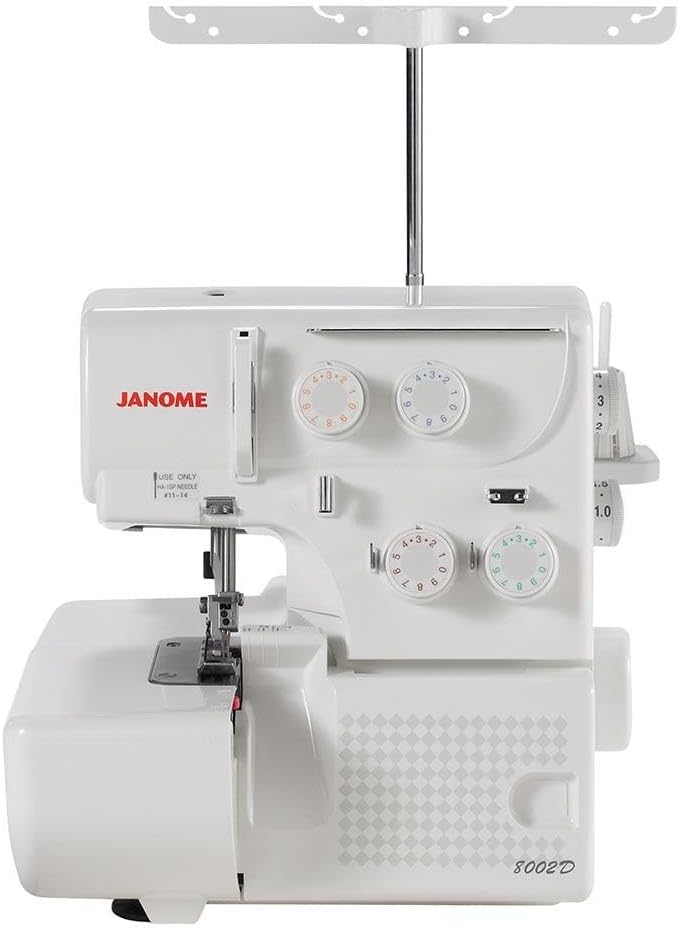
Janome 8002D Overlock Machine
| Power Source | ac |
|---|---|
| Material | Metal, Plastic |
| Included Components | Screwdrivers, Tweezers, Needle Pack, Power Cord, Foot Controller, Manual |
| Stitch Speed | Up to 1,300 stitches per minute |
The Janome 8002D is a straightforward 3/4-thread overlock machine built to give home sewists professional seam finishes without a steep learning curve. It trims and sews edges in one pass, offers rolled hems, and switches between 3- and 4-thread stitches so you can make lightweight finishes or strong garment seams. The adjustable differential feed helps control knits and lightweight fabrics to reduce stretching and puckering, and color-coded threading plus marked tension dials simplify setup. At speeds up to 1,300 spm the 8002D moves through projects quickly while its mostly mechanical construction feels durable for regular use. The machine is manual rather than computerized, so it lacks automated stitch programming or fancy stitch memory, and heavier or technical specialty work may need a more feature-rich serger. Still, for garments and everyday knit work it delivers consistent, factory-quality edge finishes at a performance-minded price point.
Best for: Buyers who prioritize fast, reliable seam finishing and want a durable, performance-focused serger for garment sewing and knit projects.
Less Ideal for: Sewers seeking computerized controls, advanced decorative stitches, or industrial-level features should consider higher-end models.
- Converts between 3- and 4-thread overlock for versatility
- Adjustable differential feed reduces puckering on lightweight fabrics and stretch on knits
- Up to 1,300 stitches per minute for fast seam completion
- Color-coded threading and marked tension controls simplify setup and threading
- Manual machine without computerized stitch programming or memory
- Not suited for specialized decorative stitches or highly technical serging features
Verdict: Choose the Janome 8002D if you want a fast, no-nonsense serger that delivers professional edge finishes and reliable performance for garment and knit sewing.
MILLEPUNTI MLD42 Serger

| Stitches | 12 |
|---|---|
| Thread capability | 2/3/4 thread |
| Max speed | 1,300 stitches per minute |
| Power source | AC 120V |
The MILLEPUNTI MLD42 is a straightforward serger that handles edge finishing, rolled hems, and stretch seams with a focus on speed and practicality. It supports 2, 3 or 4 thread configurations and includes a built‑in rolled hem and differential feed, so you can tidy raw edges, finish lightweight knits without puckering, and create decorative lettuce edges. Color‑coded threading, a waste catcher, and onboard accessory storage make setup and day‑to‑day use less fussy, while the free arm helps with cuffs and narrow tubes. The machine's top speed of 1,300 spm moves projects quickly, which is useful for small production runs or frequent mending. The accessory kit is comprehensive for getting started, but the unit is a mechanical/basic serger so advanced electronic controls and an automatic needle threader are not present. Weight and metal construction give it a stable feel but make it less portable than very small tabletop models. For practical home use under $500 it covers the essentials without extra complexity.
Best for: Buyers who want a no‑frills, reliable serger that speeds up hemming and finishing tasks and prioritizes straightforward setup and durable construction.
Less Ideal for: Users seeking advanced computerized features, automatic threading, or an ultra‑light portable machine for frequent travel should consider other options.
- 2/3/4‑thread capability for versatile finishing styles
- Built‑in rolled hem and differential feed for clean edges on knits and delicate fabrics
- Color‑coded threading guide and included accessory kit simplify setup
- High top speed (1,300 spm) for faster project completion
- Onboard waste catcher and accessory storage keep the workspace tidy
- No computerized controls or automatic needle threader, so setup requires manual threading and adjustments
- Relatively heavy compared with ultra‑portable models, reducing ease of transport
Verdict: A practical, fast serger that delivers essential overlock finishes and high throughput for home sewists looking for reliable performance under $500.
FEIYUE FY505 Serger

| Model Number | FY505 |
|---|---|
| Power Source | Corded Electric |
| Thread Capability | 2/3/4-thread |
| Max Sewing Speed | 1,100 stitches per minute |
The FEIYUE FY505 is a straightforward serger aimed at home sewers who need professional edge finishes without a large investment. It accepts 2, 3 or 4 threads and includes a built-in rolled hem option, differential feed dial, and cutting-width adjustment so you can finish knits and woven edges cleanly. Color-coded thread guides and numbered loopers simplify threading, and the heavy-duty metal frame plus an extra-hard carbon-steel blade give more durable cutting and stable feeding for heavier fabrics. The FY505 runs up to about 1,100 stitches per minute, which is fast enough to speed through small to medium projects. You will still need some practice to master tension and seam trimming, and advanced features like automatic tension adjustment or an air-threading system are not present, so expect a learning curve for perfect results. For its price range it offers solid build quality and the core features most hobbyists and small-scale makers need.
Best for: Buyers wanting a budget-friendly, workmanlike serger to add professional edge finishes to home sewing projects and small production runs.
Less Ideal for: Those who need fully automated threading, advanced electronic controls, or professional production-level throughput should consider higher-end models.
- Supports 2/3/4-thread overlocking for flexible stitch options
- Durable metal frame and carbon-steel blade for precise cutting
- Color-coded threading and numbered loopers ease setup
- Differential feed and cutting-width adjustment for handling different fabrics
- Max sewing speed up to 1,100 stitches per minute to speed projects
- No automatic tension or advanced automatic threading features
- Learning curve required to get consistent seams and trim on first uses
Verdict: A well-built, budget-friendly serger that delivers the essential 2–4 thread functions and strong cutting performance for home sewers under $500.
JUKI MO644D Serger

| Model Number | MO-644D |
|---|---|
| Power Source | Treadle Powered |
| Threads | 2/3/4 thread convertible |
| Max Sewing Speed | 1500 spm |
| Warranty Description | 5 year limited warranty. |
The JUKI MO644D is a dependable home serger built from the companys industrial know-how, offering convertible 2/3/4-thread serging with an automatic rolled hem for finishing edges and lightweight garment construction. It is typically used for seam finishing, narrow hems, and sewing knits where a stretch-capable edge is required; color-coded threading and a breakaway looper simplify setup while the upper knife retracts to make threading and maintenance safer. Adjustable stitch length and differential feed let you control stretch and fabric feeding for cleaner seams on light to medium-weight materials, and the dedicated-drive knife system supports consistent cutting and stitch formation at up to 1500 spm. Practical benefits include a robust cutting mechanism and factory-style stitch quality in a compact footprint, plus compatibility with a variety of optional presser feet for specialized tasks. Limitations are that it is aimed at light to medium fabrics rather than heavy materials, and it lacks electronic conveniences like speed control presets or digital displays, so users should expect a mechanical, hands-on operation.
Best for: Buyers who prioritize a mechanically robust, factory-quality stitch and want a reliable, no-frills serger for finishing garments and working with knits.
Less Ideal for: If you need a machine for heavy fabrics like leather or very bulky upholstery or prefer digital speed controls and touchscreen settings, this is not the best choice.
- Convertible 2/3/4-thread serging with automatic rolled hem for versatile finishes
- Color-coded threading and breakaway looper for easier, more reliable threading
- Dedicated drive knife system for consistent cutting and stitch formation
- Adjustable stitch length and differential feed to manage stretch and fabric feeding
- Designed for light to medium-weight fabrics so not ideal for heavy-duty materials
- No digital controls or advanced electronic features
Verdict: Choose the JUKI MO644D when you want a compact, mechanically solid serger that delivers factory-quality finishing and dependable performance for light to medium fabrics.
SINGER S0230 Serger

| Power Source | Electric |
|---|---|
| Thread Capability | 2–4 threads |
| Sewing Speed | Up to 1300 stitches/min |
| Included Components | Serger and Accessories |
The SINGER S0230 is a straightforward mechanical serger aimed at hobbyists and home sewists who want professional seam finishes without a steep learning curve. It handles 2-, 3-, or 4-thread stitches for overlocking, rolled hems, and decorative edges while trimming excess fabric as it sews, and the color-coded threading helps speed setup for beginners. The adjustable differential feed reduces stretching on knits and puckering on lightweight fabrics, and the free arm makes finishing sleeves and cuffs easier. At up to 1300 stitches per minute it runs fast enough to cut project time, and the unit includes basic accessories stored in the machine for convenient setup. Trade-offs include a mostly plastic exterior and the limitations of a mechanical (non-computerized) machine if you want advanced stitch programming or extremely heavy industrial use, but for garment sewing, stretch fabrics, and home projects it delivers consistent, store-like finishes at an accessible price point.
Best for: Buyers who want a reliable, easy-to-use serger for garment sewing and stretch fabrics and who value clear setup cues and dependable seam finishes backed by lots of customer experience.
Less Ideal for: Sewists needing industrial-strength metal-frame machines for constant heavy-duty production or users who require computerized stitch customization and advanced automation.
- Supports 2-, 3-, and 4-thread stitches for versatile seam finishes
- Color-coded threading simplifies setup for beginners
- Differential feed prevents stretching and puckering on knits and sheers
- Operates up to 1300 stitches per minute to speed project completion
- Includes basic accessories stored onboard for easy access
- Predominantly plastic construction rather than a heavy-duty metal frame
- Mechanical controls limit advanced stitch programming and automation
Verdict: A beginner-friendly, fast serger that delivers professional-looking seam finishes and reliable performance for home sewing projects under $500.
Brother 1034D Serger

| Stitches per minute | 1,300 |
|---|---|
| Thread functions | 3/4 thread |
| Power source | Corded Electric |
| Input voltage | 120 volts |
The Brother 1034D is a straightforward, durable serger intended for hobbyists and small sewing projects that need professional-looking seams and fast finishing. It handles 3- and 4-thread overlock stitches plus rolled hems, narrow hems and ribbon lock, and the machine reaches speeds up to 1,300 stitches per minute for quick seaming. Practical touches include a metal interior frame for stability, a color-coded lay-in threading path and a F.A.S.T. lower looper system to simplify rethreading, plus snap-on presser feet (standard, gathering and blind hem) and a removable trim trap for cleaner workspaces. The differential feed helps manage knits and lightweight fabrics so seams stay even. Limitations to note are that advanced specialty stitches require optional presser feet and the machine is mechanical rather than computerized, so users who want automated tension or digital stitch selection will need a higher-end model. For everyday garment construction, hemming and edge finishing, the 1034D is a reliable, user-friendly choice.
Best for: Buyers who want a dependable, easy-to-learn serger that delivers professional seams and fast performance for regular home sewing and garment finishing without steep technical complexity.
Less Ideal for: If you need computerized features, automated tensioning, or built-in stitch programming for heavy production work, look at higher-end models instead.
- Durable metal interior frame for long-term stability
- Color-coded lay-in threading and F.A.S.T. lower looper for easier threading
- Up to 1,300 stitches per minute for faster finishing
- Differential feed improves results on stretch and thin fabrics
- Includes useful snap-on presser feet and a removable trim trap
- Mechanical controls lack computerized automation or digital stitch memory
- Some specialty stitches require optional presser feet purchases
Verdict: A sturdy, user-friendly serger that delivers fast, professional-looking overlock stitches for risk-averse buyers seeking reliable home sewing performance under $500.
Choosing the Right Serger Sewing Machine: Key Factors to Consider
Stitch Types and Configurations
Different serger stitches handle distinct finishing tasks. A machine that offers 3-thread and 4-thread overlock options covers most garment seams and seam finishes. Specialized stitches such as rolled hems, flatlock, and cover-style stitches expand utility for lightweight fabrics and decorative finishes.
Choosing a machine with easy switching between stitch configurations matters because it affects how many finishing techniques you can do without switching machines. If you plan to work with knits or produce professional ready-to-wear seams, prioritize machines that include a stable 4-thread overlock and a reliable rolled hem setting.
Threading Complexity and Looper Access
Threading is the most frequent setup task on a serger, and complex or unclear looper paths slow down workflow. Color-coded threading guides, numbered paths, and front-facing looper access reduce setup time and make thread changes less error-prone.
Machines with easier looper access and clear diagrams save time during routine thread changes and maintenance. If you are new to serging, favor machines with intuitive threading aids and a tension system that is simple to adjust so you spend less time troubleshooting tension issues.
Differential Feed and Fabric Control
Differential feed prevents wavy seams on knits and controls stretching on delicate fabrics. A responsive differential feed lets you adjust for fabric stretch, thickness, and gathering effects when doing hems or finishing edges.
For sewers who work with a mix of knits and woven fabrics, differential feed performance is critical. Better units let you fine-tune the feed to avoid puckering on fine knits and to feed multiple layers evenly for bulky seams.
Speed and Motor Responsiveness
Serger speed influences how quickly you can finish projects, but raw top speed is only part of the story. Motor responsiveness, smooth acceleration, and consistent stitch formation under different speeds affect stitch quality and operator control.
Look for machines with a balance between comfortable top speed and steady stitch consistency. If you frequently finish long seams or work in production-style bursts, a stable motor that maintains tension at higher speeds is especially important.
Build Quality and Serviceability
Durable internal components, solid presser-foot construction, and quality knives contribute to long-term reliability. Machines with accessible components for cleaning and simple parts replacement reduce downtime and extend useful life.
Even at lower price points, prefer designs that offer metal-critical parts and straightforward maintenance access. Consider the availability of replacement needles, blades, and routine maintenance parts when estimating long-term ownership costs.
Which Stitch Configurations Matter Most
For home sewing, the most useful serger stitch configurations are 3-thread overlock for narrow seam finishing, 4-thread overlock for strong structural seams, and a rolled hem for neat lightweight edges. Machines that let you switch between these quickly increase your finishing options without changing equipment.
Also consider whether the machine offers a wide or narrow overlock width and an adjustable stitch length. These controls let you tailor the seam appearance and strength across fabric types.
- 3-thread overlock for edge finishing and seam allowance trimming
- 4-thread overlock for durable, stretchable seams on garments
- Rolled hem and narrow hem options for lightweight fabrics
- Adjustable stitch length and cutting width for customized finishes
Threading Tips to Reduce Setup Time
Use the color-coded threading guides and wind a small test on scrap fabric after rethreading to verify tension and stitch formation. When changing threads, work methodically: upper looper, lower looper, then needles to minimize backtracking.
Keep a small brush and tweezers handy to clear lint from the looper area after each project. Regular light cleaning and occasional oiling at recommended points maintain smooth operation and reduce repeated rethreading due to jammed loops.
- Thread in the order suggested by the diagram to avoid tangles
- Test stitch on scraps before cutting into the project fabric
- Clean lint and fabric debris from looper and knife areas after each session
Handling Knits and Stretchy Fabrics
Differential feed is the main control for preventing stretching and puckering on knits. When set above neutral it can stretch slightly to prevent tightness; when below neutral it can gather fabrics for decorative effects. Practice on scraps to find the sweet spot for each fabric.
Needle selection and appropriate thread tension also impact how a serger handles knits. Use ballpoint needles designed for knits and adjust tensions incrementally until seams lie flat without rippling.
- Increase differential feed to combat wavy edges on lightweight knits
- Use ballpoint needles for knit fabrics to prevent skipped stitches
- Adjust tension in small increments and test before sewing the final seam
Maintaining Your Serger for Longevity
Routine maintenance keeps stitch quality steady. Remove lint from the looper and feed areas after each project, change or clean the knife as needed, and follow recommended lubrication points. Replace needles frequently to avoid skipped stitches and fabric damage.
Store the machine covered and in a dry place. When not in use, disengage the rotary cutter if the model allows it and double-check that thread ends are clipped to prevent tangles during storage.
- Clean lint after every sewing session
- Replace needles regularly and inspect blades for nicks
- Follow the manufacturer maintenance schedule for oiling and servicing
Accessories That Improve Workflow
A few thoughtful accessories can make serging faster and more pleasant. A large waste tray or lint catcher helps keep the workspace tidy. Extra presser feet for piping or gathering expand what you can do without switching machines.
Stocking extra sets of needles, replacement blades, and high-quality polyester thread reduces downtime. A dedicated machine brush, tweezers, and a small screwdriver set for adjustments are also helpful.
- Waste tray or lint catcher to keep workspace clean
- Spare needles and replacement blades for quick swaps
- Specialty presser feet for piping, gathering, or narrow hems
How We Chose the Best Serger Sewing Machine
We selected serger sewing machines that balance practical home-sewing needs with reliable performance within the under $500 price limit. Each candidate had to offer at least basic differential feed and multiple stitch options, including 3- or 4-thread overlock, so the machine can handle common garment and knit finishes. Ease of threading and a clear tension system were weighted heavily because setup time and frustration are common pain points for new serger owners. We also prioritized stitch stability under varied fabrics, looking for machines that maintain even stitch length and tension across lightweight knits, medium-weight woven fabrics, and layered seams. Durability and build quality were evaluated by checking construction features like metal internal components and robust presser-foot assemblies. User-friendly features such as a clear threading path, color-coded guides, and accessible looper access influenced inclusion. We excluded machines that lacked key finishing stitches or had consistently poor user feedback on threading or seam reliability. Final selections reflect a balance of stitch capability, usability, and expected longevity for home sewists working within the stated budget.
Our full evaluation process is outlined in our review methodology.
FAQ
Can a serger replace a sewing machine for garment construction?
A serger complements but does not replace a sewing machine. Sergers excel at finishing seams and handling knits, but they cannot perform tasks like buttonholes, zippers, or long straight-topstitching that require a standard sewing machine.
Is a 3-thread serger good enough for beginners?
A 3-thread serger can handle many basic finishing tasks and is often simpler to thread, making it suitable for beginners. However, a 4-thread option provides stronger, stretchable seams if you plan to sew knit garments regularly.
How often should I change needles on a serger?
Change needles after approximately 8 to 10 hours of regular sewing or sooner if you notice skipped stitches or fabric snags. Frequent needle changes protect fabric and maintain stitch consistency.
What maintenance does a serger require?
Basic maintenance includes brushing out lint after each use, periodic oiling at recommended points, checking and replacing the knife blade when dull, and keeping the looper area clean. Regular care prevents tension issues and prolongs machine life.
Will a lower-cost serger handle thick seams and layered fabrics?
Many budget sergers can handle moderate layers, but very thick or tightly layered seams may strain lower-end feed systems. Test on similar fabric stacks and look for models with robust feed dogs and adjustable presser-foot pressure if you plan heavy seam work.
Final Verdict
When choosing a serger sewing machine under $500, prioritize the stitch types you will use most, ease of threading, and differential feed performance. Tradeoffs at this price point usually involve how many specialized stitches are offered and the convenience of setup and maintenance features. Focus on a machine that delivers reliable 3- and 4-thread finishes if you sew knits, or one with an intuitive threading system if simplicity matters more. Balance stitch capability, user-friendly features, and build durability to match your sewing routine. With the right priorities, you can find a serger in this budget range that speeds finishing and produces professional-looking seams for everyday projects.