
Note: This article contains affiliate links. If you click on these links and make a purchase, we may earn a small commission at no extra cost to you. This helps support our research and content. Read our full affiliate disclosure here.
If you rely on kitchen knives for heavy prep or professional service, a dependable Service Knife Sharpener keeps blades working safely and efficiently. The right sharpener restores a keen edge quickly without removing excess metal or shortening blade life. This guide highlights seven shortlisted options that suit busy home cooks and small-scale foodservice environments. We evaluated candidates across practical metrics like sharpening speed, edge retention, ease of use, and durability. Below are the top picks followed by detailed buying factors to help you match a sharpener to your workflow and knives.
Top Picks at a Glance
| Best Overall The best all-around choice for most situations | Chef'sChoice Trizor 15XV |  |
| Best Quality Built to a higher standard if you want something more solid | Work Sharp Professional Precision Adjust |  |
| Best Value The sweet spot between price and what you get | Intelitopia Knife Sharpening Stone Set |  |
| Best Budget The cheapest option that still gets the job done reliably | Smith's 2-Step Knife Sharpener CCKS |  |
| Top Rated A top-rated pick with lots of positive feedback | WORK SHARP Guided Field Sharpener |  |
| Most Popular A crowd favorite that many people choose with confidence | AnySharp Hands-Free Knife Sharpener |  |
| Best Seller A high-volume bestseller chosen again and again | KITCHELLENCE 3-Stage Knife Sharpener |  |
Chef'sChoice Trizor 15XV

| Material Type | Diamond |
|---|---|
| Grit Type | Fine |
| Stages | Three |
The Chef'sChoice Trizor 15XV is a countertop electric sharpener built for home cooks who want a fast, repeatable edge without mastering stones. It uses three stages: two diamond-plated stages to form and hone the bevel and a final stropping/polishing stage that yields a razor-sharp 15-degree Trizor edge suited for precise slicing. The unit's angled guides and spring-loaded slots make it easy to run a blade through consistently, and the manufacturer quotes roughly a minute for an initial sharpening and seconds for touch-ups. It handles both straight-edge and serrated knives and can convert typical 20-degree factory edges to the narrower 15-degree geometry for improved cutting performance. The trade-off is that it is an electric, fixed-angle system so you cannot vary angles manually or use it for specialty blade geometries, and it takes counter space. For buyers seeking reliable, repeatable sharpening with minimal skill, the Trizor delivers fast, professional-feeling results that noticeably restore cutting performance.
Best for: Home cooks who want quick, repeatable professional-style sharpening without learning whetstone technique and who value consistent results with minimal effort.
Less Ideal for: Users who need custom or variable bevel angles, who prefer manual sharpening methods, or who require a fully portable, non-electric solution.
- Three-stage system with 100% diamond abrasives for fast shaping and honing
- Final stropping disks provide a polished, razor-sharp finish
- Precision angle guides and spring-loaded slots ensure consistent results with minimal skill
- Works on both straight-edge and serrated knives and can convert 20° edges to 15°
- Fixed electric-angle system does not allow manual angle variation for specialty blades
- Requires countertop space and electricity
Verdict: Choose the Trizor 15XV when you want fast, consistent, professional 15-degree sharpening for everyday knives with minimal skill required.
Work Sharp Professional Precision Adjust

| Included components | Ceramic, Coarse Diamond, Fine Diamond, Leather Strop, Medium Diamond |
|---|---|
| Sharpening angles | 15°–30° |
| Abrasive grits | 220, 320, 400, 600, 800 diamond + fine ceramic + strop |
The Work Sharp Professional Precision Adjust is a benchtop sharpening system built for precise, repeatable sharpening of kitchen, pocket, hunting, and small pen knives. It uses a metal housing and an adjustable guide with a digital inclinometer to set sharpening angles from 15 to 30 degrees, and the kit includes seven abrasives — multiple diamond grits, a fine ceramic stone, and a leather strop — so you can move from coarse re-profiling to a fine, polished edge. Typical use is clamping the blade in the guide, selecting an abrasive to remove or refine material, and dialing in the exact angle for consistent passes. The practical benefits are clear: quick material removal when needed, repeatable factory-style angles, and an all-in-one workflow from coarse to stropping without switching systems. Trade-offs are the unit's bench footprint and weight compared with handheld options and the learning curve to get comfortable with angle selection and abrasive progression for different steels.
Best for: Buyers who want a performance-oriented, bench-style sharpener that delivers precise, repeatable edges and a complete abrasive progression for restoring and finishing knives.
Less Ideal for: Those who need a lightweight, travel-friendly or purely handheld solution for quick touch-ups on the go should consider compact sharpeners instead.
- Angle guidance with a digital inclinometer for precise, repeatable bevels
- Includes seven abrasives covering coarse to fine plus leather strop for a complete sharpening progression
- Metal benchtop construction for stability during sharpening passes
- Suitable for a wide range of knives including kitchen, pocket, fillet, and hunting blades
- Bulkier and heavier than portable or handheld sharpeners
- Requires some learning to choose angles and grit progression for different knife steels
Verdict: Choose this if you want a stable, professional benchtop system that delivers accurate, repeatable angles and a full abrasive progression for high-performance edge work.
Intelitopia Knife Sharpening Stone Set

| Included components | Sharpening Stones |
|---|---|
| Number of Packs | 7 |
| Material Type | Stone |
| Grit Type | Coarse |
This Intelitopia kit packs everything a home cook or hobbyist needs to restore and polish knives. It includes two dual-sided whetstones (400/1000 and 3000/8000 grit) for initial reshaping through fine polishing, a coarse flattening stone to keep the stones true, a bamboo non-slip base, angle guide, leather strop for burr removal, and a simple instruction sheet. In practice the 400 grit quickly repairs dull or nicked edges and the 1000 grit refines the bevel; the 3000/8000 side brings a smooth mirror polish suitable for kitchen and pocket knives. The bamboo base and three rubber feet help stabilize the stone during use, and the leather strop removes the last burr for a keen cutting edge. Expect a learning curve if you have never used whetstones since consistent angle control and stone flattening are required for best results. The kit covers a wide range of blades but does not include water or honing guides beyond the simple angle tool, so beginners should budget time to practice.
Best for: Buyers who want a complete, workmanlike sharpening setup to restore and polish a range of knives and who are willing to learn whetstone technique for better results.
Less Ideal for: People who need a fully guided, tool-free sharpening solution or who prefer an electric sharpener that requires no skill to use.
- Dual grit whetstones (400/1000 and 3000/8000) for coarse sharpening through fine polishing
- Includes practical accessories: flattening stone, leather strop, angle guide, and non-slip bamboo base
- Strop and high-grit stone enable a polished edge suitable for kitchen and pocket knives
- Non-slip base and rubber feet improve stability during sharpening sessions
- No detailed guided jig or advanced angle-control system included, so consistent technique is required
- Beginners must learn stone maintenance and flattening to avoid uneven wear
Verdict: A complete, practical whetstone kit that gives skilled home users the stones and accessories needed to sharpen and polish a wide variety of blades.
Smith's 2-Step Knife Sharpener CCKS

| Included Components | 1 sharpener |
|---|---|
| Material Type | Synthetic |
| Grit Type | Coarse, Fine |
The Smith's CCKS 2-Step Knife Sharpener is a pocketable pull-through tool aimed at quick edge restoration for outdoor and home knives. It has preset tungsten carbide coarse slots that take three to four strokes to reprofile a very dull blade, and crossed ceramic rods that refine the edge for a smoother, sharper finish. In use it is fast and simple: stabilize the unit on a flat surface or hold it steady by the non-slip rubber feet and pull the blade through the coarse then fine stage a few times. The plastic body includes a lanyard hole and is light enough to carry on a keychain or in a tackle box, and the unit even floats for fishing trips. Practical limitations are its preset angles and compact size, which make it best for field touch-ups rather than precision kitchen re-profiling or restoring severely damaged blades, and the synthetic housing is less robust than all-metal sharpeners.
Best for: Buyers who want an inexpensive, easy-to-use sharpener for field and everyday touch-ups when camping, fishing, hunting, or handling pocket and fillet knives.
Less Ideal for: Users who need professional-level reprofiling, exact bevel control, or a heavy-duty bench sharpener for frequent kitchen use.
- Two-stage system with carbide coarse and ceramic fine elements for quick edge restoration
- Very compact and lightweight with a lanyard hole so it is easy to carry on outdoor trips
- Non-slip rubber feet for safer use and floats in water for fishing/hunting environments
- Restores a very dull blade in only a few passes using preset angles
- Preset sharpening angles limit ability to customize bevels or perform precision reprofiling
- Small plastic body is less durable than larger metal or bench-mounted sharpeners
Verdict: A low-cost, portable two-stage sharpener that delivers fast, reliable edge touch-ups for outdoor and casual users.
WORK SHARP Guided Field Sharpener

| Material Type | Diamond and Ceramic Sharpener |
|---|---|
| Grit Type | Coarse, Fine |
| Included Components | WSGFS221 |
The WORK SHARP Guided Field Sharpener is a portable guided sharpening system built for field use and home touch-ups, with removable diamond plates, a rotating ceramic honing rod and a leather strop. You set the guide for 20 or 25 degrees and run the blade across the diamond or ceramic surfaces for quick re-profiling, then refine the edge on the strop; the ceramic rod also has a grooved section for fish hooks and a coarse/fine face for varied honing. Its self-contained layout needs no tools or assembly, which makes it convenient to carry while hunting, camping, or storing in a kitchen drawer for occasional maintenance. The included abrasives and guides produce consistent bevel angles and usable edges without having to freehand with stones, but it is not a substitute for a full bench stone or powered sharpening system when you need mirror-polished razors or major reprofiling. For reliability-focused users this unit shines because its components are durable, easy to replace, and designed to work without fiddly setup in the field.
Best for: Buyers who prioritize a dependable, no-fuss sharpening kit for outdoor use or quick at-home touch-ups and want components that last and perform consistently under field conditions.
Less Ideal for: People who need precision mirror finishes, extensive reprofiling, or a high-speed electric system for large volumes of knives should choose a bench or powered sharpener instead.
- Complete kit with diamond plates, rotating ceramic rod, and leather strop for edge finishing
- Guided angles (20° and 25°) give repeatable, consistent bevels for knives in the field
- Self-contained, tool-free design is compact and easy to carry
- Ceramic rod includes grooved surface for fish hooks and coarse/fine faces for versatility
- Not intended to produce mirror-polished razor edges or perform heavy reprofiling
- Smaller abrasive surfaces require more passes than larger bench stones for major sharpening
Verdict: A rugged, self-contained guided sharpener ideal for dependable field use and reliable everyday edge maintenance.
AnySharp Hands-Free Knife Sharpener

| Material Type | Plastic, Tungsten Carbide |
|---|---|
| Grit Type | Fine |
| Included Components | 1 x Knife Sharpener |
| Pre-set Angle | 20 degrees |
The AnySharp hands-free sharpener is a simple countertop tool that restores dull kitchen and utility knives with a few guided pulls. You secure the unit to a smooth surface with the PowerGrip suction base, then draw blades through the tungsten carbide sharpening slots set at a 20-degree angle, which makes the process fast and repeatable without skill or electricity. Its small plastic body and fine-grit carbide edges are aimed at routine home maintenance rather than full reprofiling, so it removes minimal metal while leaving knives functional for slicing and prep. The suction mount improves safety and stability compared with freehand pull sharpeners, and the compact footprint stores easily in a drawer. Limitations include a single preset angle and basic abrasive media, so it will not replace a professional stone or multi-angle system for custom edges or heavily damaged blades, and it is less suitable for specialized blades that need different bevels.
Best for: Buyers who want a low-effort, repeatable way to keep everyday kitchen knives sharp and value stability and safety over custom sharpening control.
Less Ideal for: People who need professional-level sharpening, custom edge angles, or want to repair chipped or badly rolled edges should look at stones or multi-angle systems instead.
- Hands-free PowerGrip suction base for stable, safer sharpening
- Tungsten carbide edges deliver quick edge restoration with a few pulls
- Pre-set 20-degree angle provides consistent results without skill
- Compact, cord-free design stores easily and requires no power
- Single pre-set angle limits use on blades that require other bevels
- Fine tungsten carbide is not suited for heavy damage or full regrinds
Verdict: A safe, easy, no-power tool for quickly restoring everyday knives to usable sharpness with consistent, repeatable results.
KITCHELLENCE 3-Stage Knife Sharpener
| Material Type | Plastic |
|---|---|
| Included Components | Cut-resistant glove |
| Unit Count | 1 Count |
| Model Number | KS37 P |
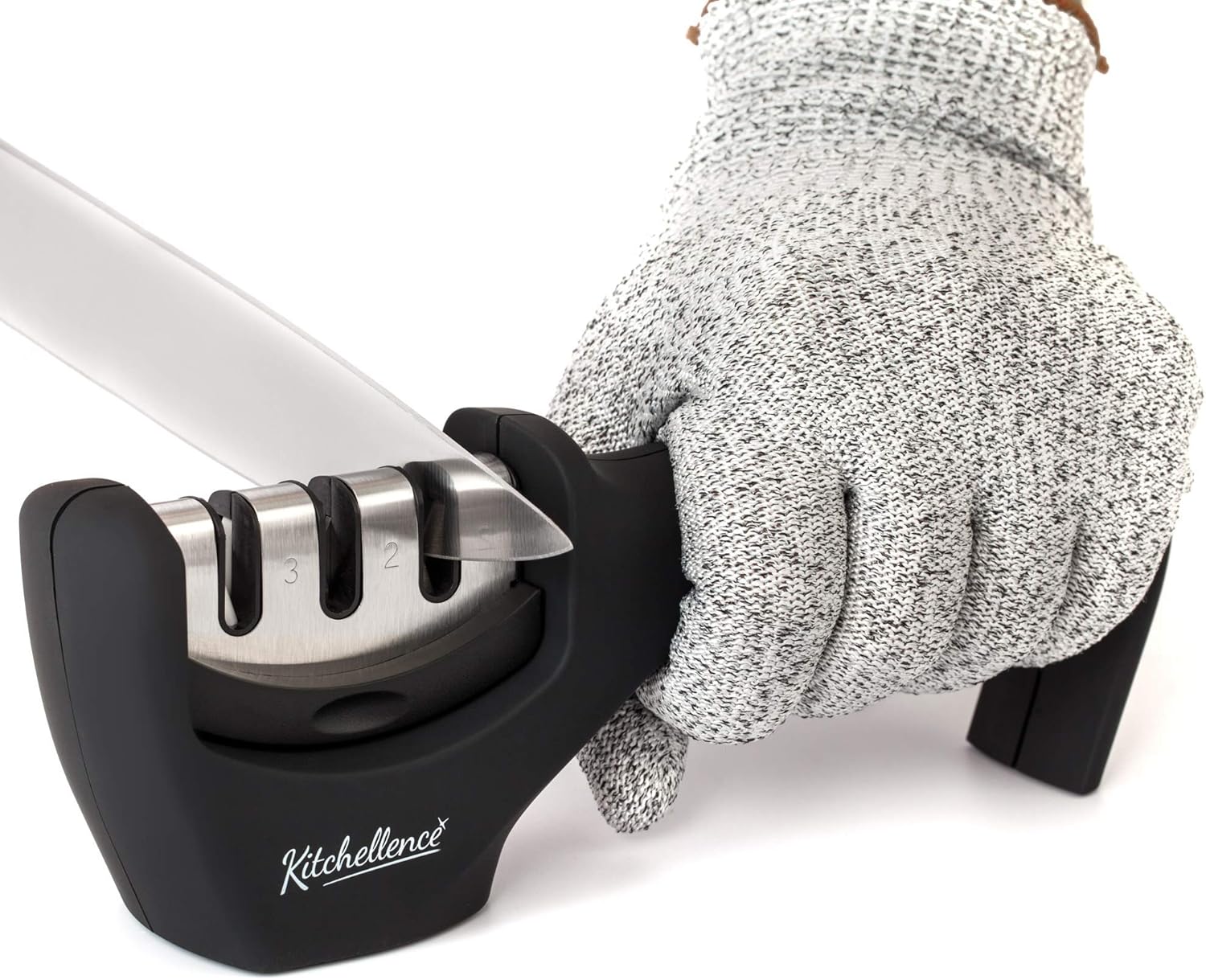
This kit provides a simple, three-stage sharpening process that repairs damaged edges, restores the V-shape, and polishes blades for a cleaner edge. It is used by placing the blade in each slot and pulling it through a few times; the first diamond rod realigns nicks, the second sharpens the bevel, and the third hones and polishes. The plastic body includes an ergonomic, non-slip base and handle so both right- and left-handed users can steady the tool during use, and the included cut-resistant glove adds safety while working. For everyday kitchen knives this delivers quick visible improvement without requiring technique or maintenance of stones or electric sharpeners. Limitations are its manual, slot-style design which offers less control than whetstones and is not suited for specialty blades like serrated knives or very high-end Japanese steels that need precise angles.
Best for: Buyers who want a low-risk, easy-to-use sharpening solution for everyday kitchen knives and prioritize safety and predictable results over expert-level edge control.
Less Ideal for: Users who need precision angle control, service for serrated or specialty knives, or professional sharpening for high-end blade steels should look at stone or guided sharpening systems instead.
- Three distinct sharpening stages for repair, sharpening, and polishing
- Ergonomic non-slip base and handle for stable, ambidextrous use
- Includes cut-resistant glove to improve user safety
- Diamond sharpening rod in the first stage for effective edge repair
- Slot-style manual system provides less angle control than whetstones or guided systems
- Not suitable for serrated blades or specialized steels
Verdict: A straightforward, safe three-stage sharpener that reliably renews everyday kitchen knives with minimal skill required.
Choosing the Right Service Knife Sharpener: Key Factors to Consider
Sharpening Method and Abrasive Type
Different sharpeners use stones, ceramic rods, diamond abrasives, or guided mechanical systems. Each method affects how quickly metal is removed and the kind of bevel produced. Diamond abrasives cut aggressively and work well on hard steels, while ceramic finishes can refine a keen edge but remove metal more slowly.
For busy service use, choose an abrasive system that balances speed and control. A progression of grits lets you move from repairing a dull edge to polishing a fine edge without switching tools. Also consider whether replacement abrasive elements are readily available and affordable because heavy use wears consumables faster.
Angle Control and Consistency
Maintaining a consistent angle across the blade is crucial for reliable cutting performance. Guided sharpeners, angled jigs, or preset slots help less experienced users repeat the same bevel, which is important when multiple knives must be returned to service quickly.
If you work with different knife styles, look for units that support multiple angle settings or can be adjusted to match the blade's original geometry. Consistent angles reduce the need for frequent touch-ups and improve edge longevity.
Speed Versus Metal Removal
High-speed sharpening is appealing in a service environment, but faster is usually achieved by more aggressive metal removal. Excessive removal shortens blade life and can alter blade profile. Assess how quickly the sharpener restores a working edge and whether it does so with controlled, minimal stock removal.
For frequent maintenance, prefer systems that repair nicks and roll without heavy grinding. For very dull or damaged blades, a more aggressive mode or coarse abrasive can be useful, but plan for subsequent honing or fine polishing to restore cutting performance without wasting material.
Ease of Use and Safety
In busy kitchens, a sharpener that is quick to set up and intuitive to operate reduces downtime and operator error. Look for clear guides, comfortable handles, and secure bases that prevent slippage. Safety features such as finger guards, non-slip feet, and enclosed mechanisms lower the risk when sharpening under time pressure.
Training requirements matter. A straightforward guided system can be used by multiple staff with minimal instruction. If a device requires manual angle holding or complex motions, factor in the time needed to build technique and the margin for inconsistent results.
Maintenance and Consumables
Routine maintenance affects long-term cost and reliability. Consider whether abrasives, belts, or wheels are user-replaceable, how often they need replacement under typical workloads, and whether cleaning the unit is straightforward. Some systems need lubrication or stone flattening; others are virtually maintenance-free.
Devices with easy-to-source consumables will have lower operating disruptions. Also check how simple it is to access wear parts and whether the manufacturer provides clear guidance for upkeep to maximize service life.
Durability and Construction
A tool intended for service use should withstand frequent cycles and occasional hard use. Metal housings, reinforced mounts, and quality bearings extend useful life compared with lightweight plastic designs. Durable construction also contributes to consistent sharpening performance because components remain aligned longer.
Evaluate the expected lifecycle under regular use. Durable machines may cost more upfront but reduce downtime and replacement frequency in high-use settings.
When to Resharpen Versus Hone
Resharpening restores the blade bevel when the edge is visibly dull, chipped, or when a steel hone no longer brings the blade back to cutting performance. Honing realigns a rolled edge and is a lighter maintenance step you can do frequently between resharpening.
For service knives that see heavy use, develop a schedule based on cutting tasks and how quickly blades lose bite. Frequent honing preserves the edge and delays more aggressive material removal required by resharpening.
- Hone daily or before service shifts if the knife sees continuous use
- Resharpen when the knife fails a paper-cut or tomato-slice test
- Track individual knife performance to optimize maintenance intervals
Matching Sharpeners to Knife Steel and Edge Angle
Different steels and edge angles respond differently to abrasive types. Harder, modern steels benefit from sharper, harder abrasives like diamond, while traditional softer steels take well to whetstones and ceramic finishes.
Consider the common edge angles you use. Thinner angles are better for slicing tasks but require more frequent maintenance. Sharpeners that allow angle adjustment make it easier to preserve the intended geometry for each knife.
- Use coarser abrasives to correct chips and very dull edges
- Use finer grits for finishing and polishing to maximize cutting performance
- Adjust angles based on task: thinner for slicing, slightly thicker for heavy chopping
Setting Up a Sharpening Station
A dedicated sharpening station keeps abrasives, guides, and safety gear accessible and reduces setup time. Ensure the work surface is stable, well-lit, and clear of contaminants that can scratch abrasives or blades.
Organize consumables and a maintenance kit to flatten stones or replace worn belts. Good ergonomics reduces fatigue and improves consistency when sharpening multiple knives.
- Keep a small container for water or lubricant if using water stones
- Store replacement abrasives and a flattening stone nearby
- Use a non-slip mat to secure the sharpener during use
Troubleshooting Common Sharpening Issues
Uneven bevels often stem from angle inconsistency or uneven pressure during strokes. Use angle guides or a mechanical jig to correct this and work carefully through grit progression to even out the edge.
If the edge feels scratchy after finishing, it usually needs a finer polishing step or deburring with a strop. Persistent dullness can indicate worn abrasives or an incorrectly set angle that fails to contact the cutting bevel properly.
- Check for loose components if grit progression does not improve the edge
- Replace or dress abrasives that glaze or load with metal particles
- Finish with a strop or ultra-fine ceramic to remove burr and polish the edge
Portable Versus Stationary Units
Portable sharpeners are useful for on-the-go touch-ups and small kitchens where space is limited. They tend to be lighter and simpler but may offer fewer angle options and shorter abrasive life under heavy use.
Stationary units are better for consistent, repeatable results in a dedicated sharpening area. They typically offer more robust angle control, faster material removal, and longer-lasting consumables suited to service workloads.
- Choose portable for occasional touch-ups and on-site service
- Choose stationary for repeated resharpening of many knives
- Factor bench space and storage into your decision
How We Chose the Best Service Knife Sharpener
We focused on tools that reliably restore and maintain service-knife edges while limiting unnecessary metal loss. Selection prioritized sharpening systems and devices proven to produce consistent bevel geometry across a range of blade steels and edge angles. We tested specifications for abrasive types and grit progression, mechanical guidance or angle control, and claims about edge longevity. Key filters excluded hobbyist-only gadgets that lack durable abrasives, single-purpose tools that only touch serrations, and devices with poor safety features for frequent use. We also excluded sharpeners that require extensive setup or consumables that are hard to replace. The final selection reflects a balance of sharpening speed, ease of use for repeated service, durability of parts and abrasives, and the ability to produce a repeatable bevel suitable for common kitchen and chef knives. Our evaluation emphasized measurable dimensions: how quickly a unit can bring a blunt edge back to cutting condition, how well the edge holds up under normal use, how intuitive and safe the device is for repeated cycles, and how long consumable components last under typical workloads. These criteria guided inclusion and ranking.
Our full evaluation process is outlined in our review methodology.
FAQ
How often should I resharpen service knives?
It depends on usage. Heavy daily use may require resharpening every few weeks, while honing can be done daily. Monitor cutting performance and resharpen when honing no longer restores the edge.
Can any sharpener handle all kitchen knives?
Not always. Some sharpeners are optimized for specific edge angles or steel hardness. Choose a system that supports the angles and abrasives appropriate for your knives.
Is a guided sharpener better for staff with limited experience?
Often yes. Guided systems provide consistent angle control and reduce the learning curve, which helps multiple staff members produce similar results safely.
Will frequent sharpening shorten blade life?
Excessive coarse sharpening removes metal and can shorten blade life. Regular light honing with occasional controlled resharpening preserves geometry and prolongs overall blade lifespan.
What maintenance do sharpeners need?
Maintenance varies by type but commonly includes replacing worn abrasives, cleaning debris, and flattening stones. Follow the device's maintenance schedule to maintain performance.
Final Verdict
Choose a Service Knife Sharpener that matches the workload and knife construction in your kitchen. Prioritize angle control and a sensible grit progression if you need fast, repeatable results with minimal blade loss. Balance sharpening speed against long-term blade preservation and pick a durable unit with accessible consumables to keep knives in regular service. Ultimately, focus on systems that make consistent, safe sharpening straightforward for whoever will be using the tool; that approach yields the best mix of performance, safety, and lifecycle cost for service environments.