
Note: This article contains affiliate links. If you click on these links and make a purchase, we may earn a small commission at no extra cost to you. This helps support our research and content. Read our full affiliate disclosure here.
When your kitchen knives start to drag or tear food, a reliable home sharpening system makes the difference between safe, precise cuts and frustrating prep work. A dedicated sharpening system produces repeatable bevel angles and controlled abrasiveness so you can restore a clean edge without risking metal removal mistakes. This guide presents seven shortlisted sharpening system home knife sharpeners chosen for home cooks and hobbyists. We tested for ease of use, setup stability, edge retention potential, and maintenance burden to help you pick a tool that fits your skill level and how often you sharpen. Read on to see the evaluation criteria used and practical tips for getting the best results from any system.
Top Picks at a Glance
| Best Overall The best all-around choice for most situations | Chef'sChoice Trizor 15XV Sharpener |  |
| Best Quality Built to a higher standard if you want something more solid | KME Precision Knife Sharpener Kit |  |
| Best Value The sweet spot between price and what you get | Lansky Standard 3-Stone Sharpening System |  |
| Best Budget The cheapest option that still gets the job done reliably | KITCHELLENCE 3‑Stage Knife Sharpener |  |
| Top Rated A top-rated pick with lots of positive feedback | Work Sharp Precision Adjust Elite |  |
| Most Popular A crowd favorite that many people choose with confidence | Sharp Pebble 1000/6000 Whetstone |  |
| Best Seller A high-volume bestseller chosen again and again | Work Sharp MK2 Knife Sharpener |  |
Chef'sChoice Trizor 15XV Sharpener

| Material Type | Diamond |
|---|---|
| Grit Type | Fine |
| Stages | Three |
The Chef'sChoice 15XV Trizor is a countertop electric sharpener built for homeowners who want restaurant-style slicing without complicated setup. It runs a three-stage process: coarse diamond abrasives to form the primary bevel, finer diamond abrasives to hone the edge, and patented stropping disks that polish and finish both straight and serrated blades into a 15-degree Trizor XV profile. Precision angle guides and spring-loaded slots make sharpening consistent and nearly foolproof, and first-time sharpening typically takes about a minute with quick touch-ups in seconds. The unit is optimized for 15-degree class knives but can convert 20-degree factory edges to the finer 15-degree profile. Practical benefits include fast, repeatable results and a long-lasting edge thanks to diamond abrasives and a polishing stage. Limitations are that it is designed around a specific bevel angle and electric slots only, so it does not offer customizable bevel angles beyond its intended settings and requires space on the counter for a roughly 10-inch unit.
Best for: Home cooks who want a fast, reliable way to get professional 15-degree edges without mastering manual sharpening and who value consistent, repeatable results.
Less Ideal for: People who need fully adjustable bevel angles, travel-friendly manual tools, or a compact, no-power sharpening solution.
- Three-stage system (sharpen, hone, stropping) for a polished, long-lasting edge
- 100% diamond abrasives for fast material removal and durable sharpening surfaces
- Precision angle guides and spring-loaded slots provide consistent, repeatable results
- Works with both straight-edge and serrated knives and can convert 20-degree edges to 15-degree Trizor profile
- Fixed angle system centered on a 15-degree edge limits bevel customization
- Requires countertop space and electric power to operate
Verdict: Choose the Chef'sChoice 15XV if you want a simple, three-stage electric system that consistently delivers a razor-sharp 15-degree Trizor edge on straight and serrated kitchen knives.
KME Precision Knife Sharpener Kit

| Grit Type | Extra Fine, Extra-coarse, Coarse, Fine |
|---|---|
| Included Stones | 1×4 inch diamond hones (XC140, C300, F600, XF1500 |
| Angle Range | 17 to 30 degrees continuous |
| Material Type | Wood |
| Case | Hard carry case included |
The KME Precision Knife Sharpener Kit is a controlled-angle, rod-guided system designed to take knives from dull to razor-sharp with repeatable results. It uses a spherical bearing rod guide and a rotating blade clamp to keep the edge angle steady while you work, and the angle is continuously adjustable from 17 to 30 degrees in single-degree increments for precise bevel setup. The kit includes four 1×4" gold-series diamond hones (XC 140, C 300, F 600, XF 1500) so you can remove material quickly with the coarse stones and refine to a fine, polished edge with the extra-fine. Practical touches like the neoprene-lined low-profile clamp, quick-change stone holder, water bottle, cleaning cloth, and a hard hardshell carrying case make it convenient for both home and field use. The system is compact and portable, but it is manual and requires some practice to move stones smoothly and consistently; sharpening larger or very thick blades takes more time than powered systems. For someone focused on edge performance and repeatable angles, this kit delivers professional-level control in a compact package.
Best for: Buyers who prioritize edge performance and repeatable, controllable sharpening for kitchen or field knives and are willing to learn a manual system.
Less Ideal for: Users who want a fast, tool-free restoration with minimal learning or who prefer an electric sharpener for high-volume sharpening jobs.
- Precise angle control from 17 to 30 degrees in 1-degree increments for repeatable edges
- Four gold-series diamond hones (140, 300, 600, 1500) cover aggressive sharpening through fine polishing
- Spherical rod guide and rotating clamp reduce angle deviation and speed the process
- Portable hard carry case and included accessories make it field-ready and easy to store
- Manual operation requires practice to get completely smooth, consistent passes
- Sharpening large or very thick blades is slower compared with motorized systems
Verdict: Choose this kit if you want a portable, highly controllable manual sharpening system that delivers professional-level edges.
Lansky Standard 3-Stone Sharpening System

| Hone grits | Coarse 120; Medium 280; Fine 600 |
|---|---|
| Included components | Standard System with clamp and guide rods |
| Material type | Synthetic |
The Lansky Standard 3-Stone Controlled-Angle Sharpening System is a handheld kit that helps hobbyists and home cooks restore and maintain knife edges with repeatable angles. It uses a clamp that holds the blade and a set of guide rods so you can run the three hones — coarse (120), medium (280) and fine (600) — across the same angle every pass. In practice it is used by securing a knife in the clamp, selecting the desired angle, and moving the hone diagonally across the edge in controlled strokes; the system works well for kitchen, outdoor and workshop knives and is compact enough for drawer storage. The main benefits are the precise, repeatable angle control and the progression of grits for reconditioning through finishing. Limitations are that setup and zone-by-zone sharpening take more time than a pull-through sharpener, and very large or heavily damaged blades may need additional coarse work before using the 120-grit hone. The kit is durable and forgiving for beginners who follow the included technique guidance.
Best for: Buyers who prioritize precise, repeatable sharpening and want a system that lets them maintain blades themselves rather than rely on professional services.
Less Ideal for: If you need ultra-fast doorstep sharpening for many knives or have mostly oversized blades, a simpler pull-through machine or professional service may suit you better.
- Controlled-angle clamp and guide rods give consistent bevels across the blade
- Three progressively finer hones (120, 280, 600 grit) cover reconditioning through regular touch-ups
- Compact, handheld design stores easily and works on kitchen, outdoor, and workshop knives
- Includes clamp and full instructions that make it approachable for beginners
- Sharpening takes more time and staging than pull-through or electric sharpeners
- Not ideal for very large blades without repositioning the clamp or pre-grinding severely damaged edges
Verdict: Choose this system if you want a compact, controlled-angle setup that delivers repeatable, pro-quality edges at home.
KITCHELLENCE 3‑Stage Knife Sharpener
| Material Type | Plastic |
|---|---|
| Included Components | Yes |
| Model Number | KS37 P |
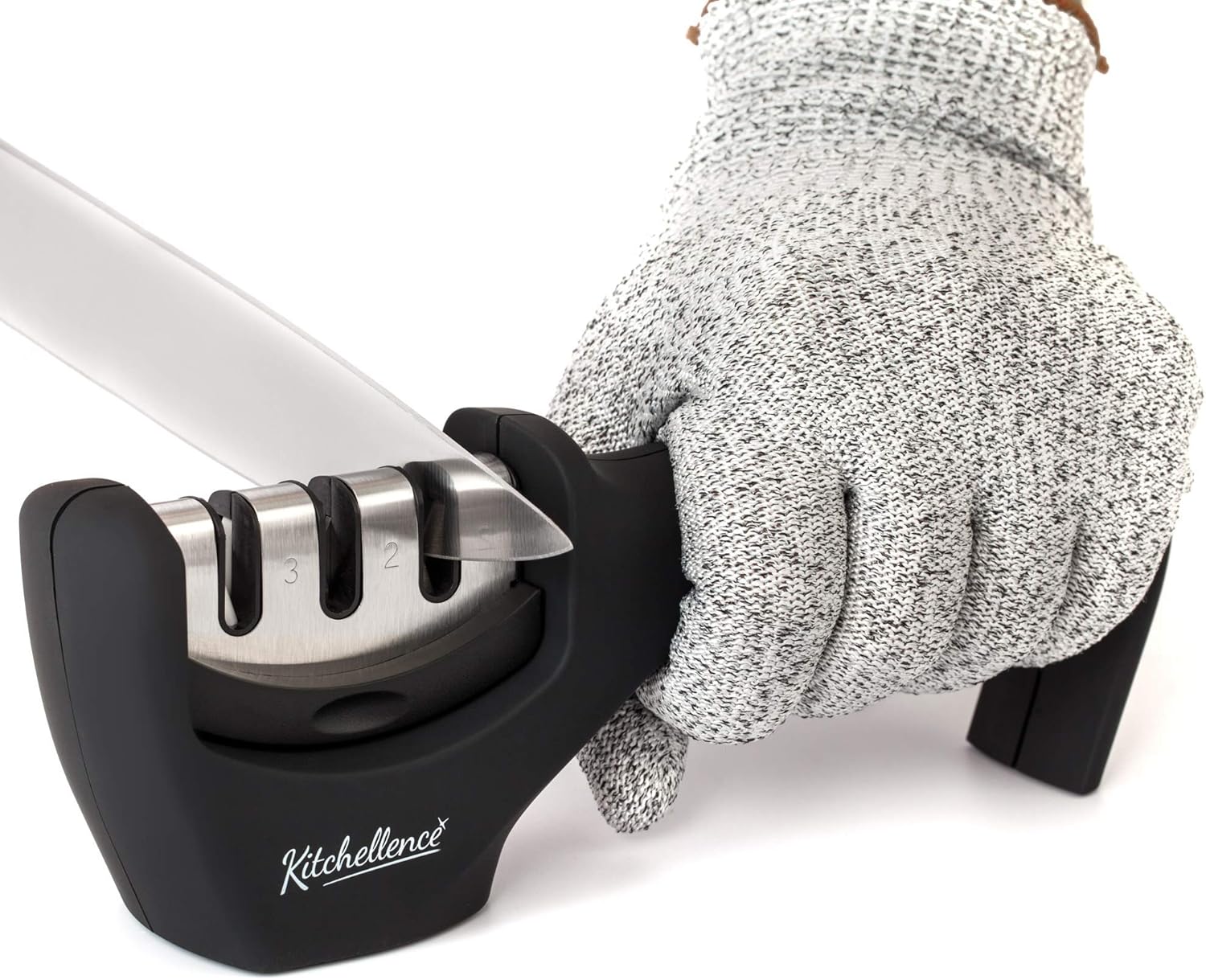
This compact 3-stage sharpener is built for quick home use: the first diamond rod straightens damaged edges, the second slot restores the blade geometry, and the third polishes to a fine edge. It is held by an ergonomic non-slip base and handle so you can pull blades through each stage with control, and the included cut-resistant glove adds a safety margin while you work. Constructed from ABS plastic, it is lightweight and easy to store on a countertop or drawer. The unit is aimed at routine maintenance of kitchen knives rather than professional reprofiling, so it works best for dull or slightly chipped household blades and fast touch-ups. Because the design is manual it requires some consistent strokes to get an even edge and will not replace a whetstone for advanced sharpening tasks. For buyers wanting an inexpensive, user-friendly way to keep everyday knives sharper between deeper services, this kit is a practical choice.
Best for: Cost-conscious home cooks who want a safe, easy tool to restore and maintain everyday kitchen knives between professional sharpenings.
Less Ideal for: Professional chefs or hobbyists who need fine-grit control or to reshape blade geometry should choose a whetstone or professional sharpening service instead.
- Three-stage system (diamond rod, sharpening slot, polishing slot) for a complete edge refresh
- Ergonomic handle and non-slip base provide stable, one-handed sharpening
- Includes a cut-resistant glove for safer handling during use
- Lightweight ABS construction makes it easy to store and transport
- Manual pull-through design is not suitable for precision reprofiling or professional sharpening
Verdict: An affordable, user-friendly 3-stage sharpener that safely refreshes home kitchen knives between deeper sharpening sessions.
Work Sharp Precision Adjust Elite

| Included components | Leather strop, ceramic rod for serrations |
|---|---|
| Material Type | Plastic, Stainless Steel |
| Model Number | WSBCHPAJ-ELT-ATL |
| UPC | 662949040976 |
The Work Sharp Precision Adjust Elite is a benchtop guided sharpening system designed to produce consistent, professional edges at home. You clamp the blade, set one of the preset angles between 15° and 30°, and work through the included coarse and fine diamond plates followed by a ceramic finishing rod or the serrated-knife conical rod. The kit includes a tri-abrasive attachment for curved blades and a leather strop for final polishing, so it covers straight, serrated, and curved profiles without sending knives out for service. It is straightforward enough for beginners thanks to the guided angle mechanism, yet the range of abrasives gives experienced users control over edge geometry and refinement. The unit is built from sturdy materials and comes with industrial-grade plates, which contributes to long-term reliability, though it does take some bench space and has a learning curve for perfectly even passes. For buyers who want repeatable factory-quality edges at home, this is a practical, durable system.
Best for: Buyers who prioritize a reliable, repeatable sharpening setup that produces professional-quality edges at home and want a system that handles straight and serrated knives.
Less Ideal for: Casual users who want a pocket-sized or fully motorized automatic sharpener for occasional touch-ups should consider simpler or portable options instead.
- Adjustable guided angles from 15° to 30° for consistent edge geometry
- Includes coarse and fine diamond plates plus ceramic finishing rod and leather strop for complete sharpening workflow
- Dedicated conical ceramic rod for restoring serrated blades
- Industrial-quality abrasives and robust construction aimed at long-term reliability
- Requires dedicated bench space and a bit of practice to get perfectly even strokes
Verdict: Choose this system if you want a durable, guided sharpening setup that reliably produces professional edges on straight and serrated knives at home.
Sharp Pebble 1000/6000 Whetstone

| Grit | 1000/6000 |
|---|---|
| Material Type | Corundum |
| No Oil Required | Yes |
| Included Components | Angle guide, bamboo base, instruction manual |
The Sharp Pebble 1000/6000 whetstone is a wet sharpening kit designed to restore and polish kitchen knives at home. It combines a 1000-grit side for repairing and re-profiling dull edges and a 6000-grit side for polishing to a razor finish, and it ships with a bamboo non-slip base, an angle guide to hold consistent bevels, and beginner instructions. You use it by soaking or wetting the stone, securing it in the bamboo base, locking the blade angle with the guide, and stroking the blade across the stone until the desired edge is reached. The included angle guide and base make the process accessible to novices and reduce guesswork, while the corundum abrasive claims good durability and flatter wear than cheaper stones. This kit does not require oil, so cleanup is simple, and the dual grit covers most household sharpening needs without extra stones. Expect a short learning curve for technique and pace; users who want fully professional flattening or very coarse re-profiling may need additional accessories like a flattening stone or coarser grit stones.
Best for: Buyers who want a reliable, user-friendly whetstone kit that produces pro-level polish without outsourcing sharpening and who value straightforward, proven tools backed by many positive reviews.
Less Ideal for: People who need heavy material removal, very coarse re-profiling, or a fully professional bench setup should choose a dedicated coarse stone or shop-grade system instead.
- Two-sided 1000/6000 grits cover edge repair and high-polish finishing for most home knives.
- Angle guide and non-slip bamboo base simplify maintaining a consistent bevel for beginners.
- No oil required so setup and cleanup are straightforward.
- Corundum composition is marketed to cut consistently and resist rapid dishing compared with cheap stones.
- Not supplied with a flattening stone, so periodic lapping is required to keep the stone perfectly flat.
- Beginners still need to learn correct stroke technique and pressure despite the guide.
Verdict: A beginner-friendly dual-grit wet whetstone kit that reliably restores and polishes home knives to near-professional sharpness.
Work Sharp MK2 Knife Sharpener

| Included Components | Abrasive Belts, Knife Sharpener |
|---|---|
| Model Number | WSKTS2 |
| Grit Type | Medium |
| Brand Name | WORK SHARP |
The Work Sharp MK2 is a benchtop electric sharpening system that uses flexible abrasive belts to sharpen a wide range of edges from fine kitchen knives to axes and lawnmower blades. You position the blade in the edge guide and run the belt against the bevel; the belts conform to the blade profile so you can sharpen tips and serrations better than rigid wheels. Two motor speeds give you a gentler setting for routine kitchen knives and a higher-power mode for heavier tool grinding. Included abrasive belts make it ready to use and belt replacements are straightforward when worn. Practical benefits include fast, repeatable results without manual whetstone skill and the ability to handle nonstandard edges like serrations and scissors. Trade-offs are that it requires bench space and an electrical outlet, it is more aggressive than some hand stones so inexperienced users should follow the angle guide to avoid over-thinning, and it is a powered tool that produces noise and debris during use.
Best for: Someone who prefers a reliable, low-fuss powered system to restore and maintain a variety of household blades without learning whetstone technique and who values repeatable results.
Less Ideal for: If you want a quiet, pocketable handheld sharpener or you plan to use only occasional fine-tuning on premium chef knives by hand, a manual stone or compact handheld tool may be a better match.
- Flexible abrasive belts conform to blade profiles for consistent tip-to-heel sharpening
- Two-speed motor for lighter knife touch or heavier tool grinding
- Works on a wide range of items including serrated blades, scissors, axes and mower blades
- Includes abrasive belts so it is usable out of the box
- Requires bench space and an electrical outlet for operation
- Can remove material quickly if used without following the guide and proper technique
Verdict: Buy this if you want a fast, repeatable powered sharpener that can handle kitchen knives and heavier tools with minimal skill required.
Choosing the Right Sharpening System Home Knife Sharpener: Key Factors to Consider
Angle Control And Repeatability
Consistent bevel angles are critical because they determine how the knife cuts and how long the edge lasts. A sharpening system that locks the knife and positions abrasives at a fixed, repeatable angle reduces guesswork and delivers predictable results over multiple sessions.
Look for clear angle markings, adjustable guides, or indexed jigs that hold geometry steady. Systems that allow micro-adjustment let you tune between a very acute edge for slicing and a more obtuse angle for heavy-duty chopping.
Abrasive Types And Grit Progression
Different abrasives polish and reshape the edge in distinct ways. Coarse grits remove material fast and correct damaged edges, while medium and fine grits refine and polish the bevel for a sharper, longer-lasting edge. Some systems use stones, others use ceramic rods or diamond plates, and each material affects how quickly steel is cut and how the edge finishes.
A good home system includes a sensible progression of grits or offers compatible accessories for stepping from repair to polish. Consider how often you will resurface metal versus simply honing, because more aggressive abrasives shorten the time to restore badly dulled knives but also remove more steel.
Clamping Method And Knife Compatibility
How the system holds the knife affects safety and accuracy. Fixed jigs, magnetic clamps, and V-block style holders all have tradeoffs in how they fit different blade shapes and thicknesses.
Ensure the chosen system supports the blade lengths and profiles you own. Some clamps are better for straight-edged Western knives, while others adapt to narrower or recurved blades. A secure clamp prevents slipping and reduces the chance of accidental nicks during sharpening.
Stability And Work Surface Requirements
Stable setup keeps the blade and abrasive aligned through each stroke. Systems that mount to a workbench, include non-slip bases, or have robust guide rods maintain consistent contact and reduce wobble. Stability influences how much pressure you need to apply and how even the resulting edge will be.
If you have limited countertop space, look for compact systems that still offer solid anchoring or include bench mounts. Portable or travel-friendly systems should still provide a reliable way to secure the knife for safe operation.
Maintenance, Consumables, And Long-Term Cost
Sharpening systems are only as useful as their consumables and serviceability. Stones and diamond plates eventually wear, and some systems require periodic replacement of guides or clamps. Assess whether replacement abrasives are available and how easy they are to install.
Also factor in cleaning: open designs that shed metal swarf are easier to rinse, while sealed or precision fixtures may need careful care. Long-term ownership costs include replacement grits and any sharpening jigs or accessories you might add as your skills progress.
Learning Curve And Safety Features
Some systems are nearly foolproof for beginners, with fixed angles and limited adjustment, while others reward practice and skill. Consider whether you want a system that teaches good technique or one that demands steady hands and patience.
Safety features like finger guards, easy-to-read angle markings, and secure clamps matter for home use. A short learning curve reduces the chance of damaging blades during the first few sessions and makes regular maintenance more likely.
How To Choose The Right Sharpening Angle
The sharpening angle determines edge geometry, cutting performance, and durability. Narrow angles around 15 degrees per side make exceptionally sharp edges for slicing, but they are more fragile. Wider angles around 20 to 25 degrees per side create a tougher edge that stands up to chopping and heavier use.
- For delicate slicing and fine prep, choose a lower angle and finish with finer grits.
- For general kitchen work, a mid-range angle balances sharpness and durability.
- If you frequently use the tip for prying or the knife for heavy chopping, pick a wider angle to resist chipping.
Setting Up And Using A Sharpening System Safely
Start by reading the system's instructions and practice on a low-cost blade if you are new. Secure the clamp and verify the knife is straight in the jig, then set the angle before applying abrasive. Use steady, even strokes with consistent pressure and follow the prescribed grit progression from coarse to fine.
Keep the work area clean and remove metal filings between stages. Wear cut-resistant gloves or use a finger guard when appropriate, and never rush the stone-to-blade contact process. Rinse or wipe abrasives according to manufacturer care instructions to maintain cutting efficiency.
- Check clamp alignment before every run.
- Count strokes per side to build a repeatable routine.
- Inspect the edge under good light or with a magnifier to confirm burr removal.
Maintaining Stones, Plates, And Rods
Stones and plates perform best when flat and free of embedded particles. Flatten waterstones periodically with a lapping plate or flattening stone to preserve an even surface. Diamond plates rarely need flattening but should be rinsed to remove metal dust.
Store abrasives dry and protected to avoid contamination. Replace worn or heavily grooved stones to avoid inconsistent edges. A light honing or strop after the final grit will polish the apex and remove any lingering burr for a cleaner, keener edge.
- Flatness checks help detect uneven wear.
- Clean abrasives after use to keep abrasive action consistent.
- Rotate or use the full stone surface to distribute wear.
When To Reprofile Or Just Hone
Minor dulling is often fixed by honing or using a fine grit to refresh the edge. Reprofiling with coarse abrasives is only necessary when the bevel is damaged, has a large burr, or the edge geometry needs a significant change. Frequent re-profiling shortens blade life by removing material faster.
If you notice visible chips, a rounded bevel, or the knife requires excessive force to cut, plan a reprofile session. Otherwise, maintain the edge with regular touch-ups and strops to minimize steel removal.
- Hone or strop weekly for regular home use.
- Reprofile after major damage or after many sharpening cycles.
- Track how much metal you remove to avoid over-thinning the blade.
How We Chose the Best Sharpening System Home Knife Sharpener
Our selection focused on sharpening systems designed for home kitchens that deliver consistent, controllable results across common kitchen steels. We prioritized systems that let users set and hold clear edge angles, offer a graduated range of abrasive grits, and provide safe, stable mounting or jigs for repeatable strokes. Ease of use and learning curve were key: we favored systems with straightforward setup, clear angle guides, and components that are durable and easy to clean. Performance criteria included how well each system can remove burrs and produce a usable, long-lasting edge without excessive material removal. We also evaluated accessory breadth, such as included abrasive stones, rods, or clamps, and whether consumables are readily available. Safety and ergonomics were assessed by looking at handle comfort, clamp stability, and guard design. Systems that required specialized skills or extensive tuning were excluded unless they offered clear beginner-friendly modes. The result is a field of sharpeners appropriate for home cooks who want predictable maintenance and good edge retention.
Our full evaluation process is outlined in our review methodology.
FAQ
How often should I sharpen kitchen knives with a system?
It depends on use. For regular home cooking, a light hone or stropping weekly and a full sharpen every few months is common. Heavy, daily use may require more frequent attention.
Can I use the same angle for all my knives?
Not always. Thin, slicer-style blades benefit from a lower angle, while heavier chef's knives may perform better at a wider angle. Match the angle to each knife's intended tasks.
Are diamond plates better than waterstones?
Each has pros and cons. Diamond plates cut fast and are durable, while waterstones can produce a finer polish but require flattening and more maintenance. Choose based on how much material removal versus finish you need.
Will a sharpening system damage my knives?
When used correctly, a system reduces the risk of uneven edges and bad geometry. Damage typically results from incorrect angles, excessive pressure, or skipping grit stages. Start with practice and protect the blade profile.
Do I need special tools to flatten stones?
A lapping plate or flattening stone is the standard tool to re-level waterstones. Coarser diamond flatteners also work. Regular flattening keeps stones effective and prevents inconsistent sharpening.
Final Verdict
Pick a sharpening system that matches how you use your knives and how much hands-on setup you want to do. Prioritize angle control, a sensible abrasive progression, and a secure clamping method to achieve repeatable results and extend blade life. For most home cooks, systems that simplify angle setting and offer a medium-to-fine grit path will provide the best balance of sharpening speed and edge longevity. If you need heavy repair work, choose a system with coarse options, but plan to move through progressively finer abrasives to finish the edge properly.