
Note: This article contains affiliate links. If you click on these links and make a purchase, we may earn a small commission at no extra cost to you. This helps support our research and content. Read our full affiliate disclosure here.
If you make bags regularly, the machine you choose determines how durable and professional your finished pieces will be. A sewing machine for bag making needs to handle thick fabrics, multiple layers, and heavy thread without bogging down or skipping stitches. This guide presents seven carefully shortlisted sewing machines that suit bag construction, from small totes to reinforced messenger bags. We assess machines for stitch strength, presser foot versatility, and reliable fabric feed so you can pick a tool that matches your workflow and materials. Below you will find our top picks followed by practical criteria and advice to help you match a machine to the kinds of bags you want to sew.
Top Picks at a Glance
| Best Overall The best all-around choice for most situations | SINGER Heavy Duty 4423 |  |
| Best Quality Built to a higher standard if you want something more solid | Janome JW8100 Sewing Machine |  |
| Best Value The sweet spot between price and what you get | BEAMNOVA Leather Cobbler Sewing Machine |  |
| Best Budget The cheapest option that still gets the job done reliably | Ninonly FHSM-520 Sewing Machine |  |
| Top Rated A top-rated pick with lots of positive feedback | SINGER Heavy Duty 4411 |  |
| Most Popular A crowd favorite that many people choose with confidence | Brother XM2701 Sewing Machine |  |
| Best Seller A high-volume bestseller chosen again and again | Brother SE700 Sewing & Embroidery |  |
SINGER Heavy Duty 4423

| Built-in stitches | 23 |
|---|---|
| Stitch applications | 97 |
| Max sewing speed | 1,100 stitches/min |
| Power source | Corded Electric |
| Input voltage | 120 volts |
The SINGER Heavy Duty 4423 is built around a powerful motor and metal interior frame that make it suited to heavier materials like canvas and denim while still working fine on lighter fabrics. It offers 23 built-in stitches that translate to 97 stitch applications for basic seams, stretch fabrics, and decorative work, and a top drop-in bobbin plus an automatic needle threader reduce fiddly setup time. The machine runs at up to 1,100 stitches per minute so larger pieces get stitched quickly, and the stainless steel bedplate helps fabric feed smoothly. Included presser feet and accessories (zipper foot, buttonhole foot, quilting guide, bobbins and needles) cover most bag-making tasks out of the box. Trade-offs are its mechanical control layout, which lacks computerized stitch customization, and a mostly plastic exterior that keeps weight down but is less refined than premium metal-body models. For makers who want raw power and reliable, fast stitching for bags and heavy fabrics, this is a practical, workhorse choice.
Best for: Crafters who need a robust, fast machine that handles heavy fabrics and multi-layer seams for making bags and durable soft goods without fuss.
Less Ideal for: Users who want touchscreen controls, advanced programmable stitch options, or a full metal exterior for a premium finish should consider other models.
- Powerful motor and heavy-duty metal interior frame suitable for thick fabrics and multiple layers
- High sewing speed up to 1,100 stitches per minute speeds up large projects
- Top drop-in bobbin and automatic needle threader make setup and maintenance easier
- Includes essential presser feet and accessories useful for bag construction
- Mechanical controls limit stitch customization compared with computerized machines
- Exterior housing is largely plastic rather than full metal
Verdict: A fast, no-nonsense heavy-duty machine that gives bag makers the power and accessories to sew thick fabrics and multi-layer seams reliably.
Janome JW8100 Sewing Machine

| Stitch count | 100 built-in stitches |
|---|---|
| Buttonholes | 7 one-step buttonholes |
| Power source | Corded Electric |
| Feed system | 7-piece feed dog system |
The Janome JW8100 is a full-featured computerized machine aimed at sewists who want power and versatility for garment and quilting work. It offers 100 stitches and seven one-step buttonholes selectable via a backlit LCD with convenient start/stop, speed control slider, and needle up/down controls, which makes it easy to sew without the foot pedal and to control stitch pace on thicker materials. Practical conveniences like a built-in needle threader, jam-proof drop-in bobbin, auto-declutch bobbin winder, and a 7-piece feed dog system help maintain smooth, balanced fabric feeding—useful when stitching multiple layers for bags. The included extra-wide extension table, even feed foot, and quarter-inch foot are helpful for managing bulky seams and accurate piecing. Limitations include its home-machine weight and size that make it less portable, and the feature set is presented in consumer-friendly terms rather than pro-grade industrial capabilities. For makers focused on performance for structured bags, it delivers reliable stitch quality and useful accessories but is not a heavy-duty industrial machine.
Best for: Buyers who prioritize reliable stitch performance and versatile stitch options for home production of structured bags and quilting-style panels, and who value helpful conveniences that speed up repetitive work.
Less Ideal for: People who need continuous high-volume, industrial-grade sewing for thick canvas or leather that require a commercial walking-foot or cylinder-bed machine.
- Wide stitch selection with 100 built-in stitches for decorative and utility seams
- Backlit LCD, start/stop button, and speed control for precise stitch management
- 7-piece feed dog system and even feed foot improve fabric feeding for layered materials
- Bonus extra-wide extension table and quilting feet help handle large panels and bulky bag sections
- Not designed as an industrial or commercial heavy-duty machine
- Relatively heavy and bulky for frequent transport
Verdict: A feature-rich, performance-minded home sewing machine that reliably handles layered and structured bag projects with useful quilting accessories.
BEAMNOVA Leather Cobbler Sewing Machine
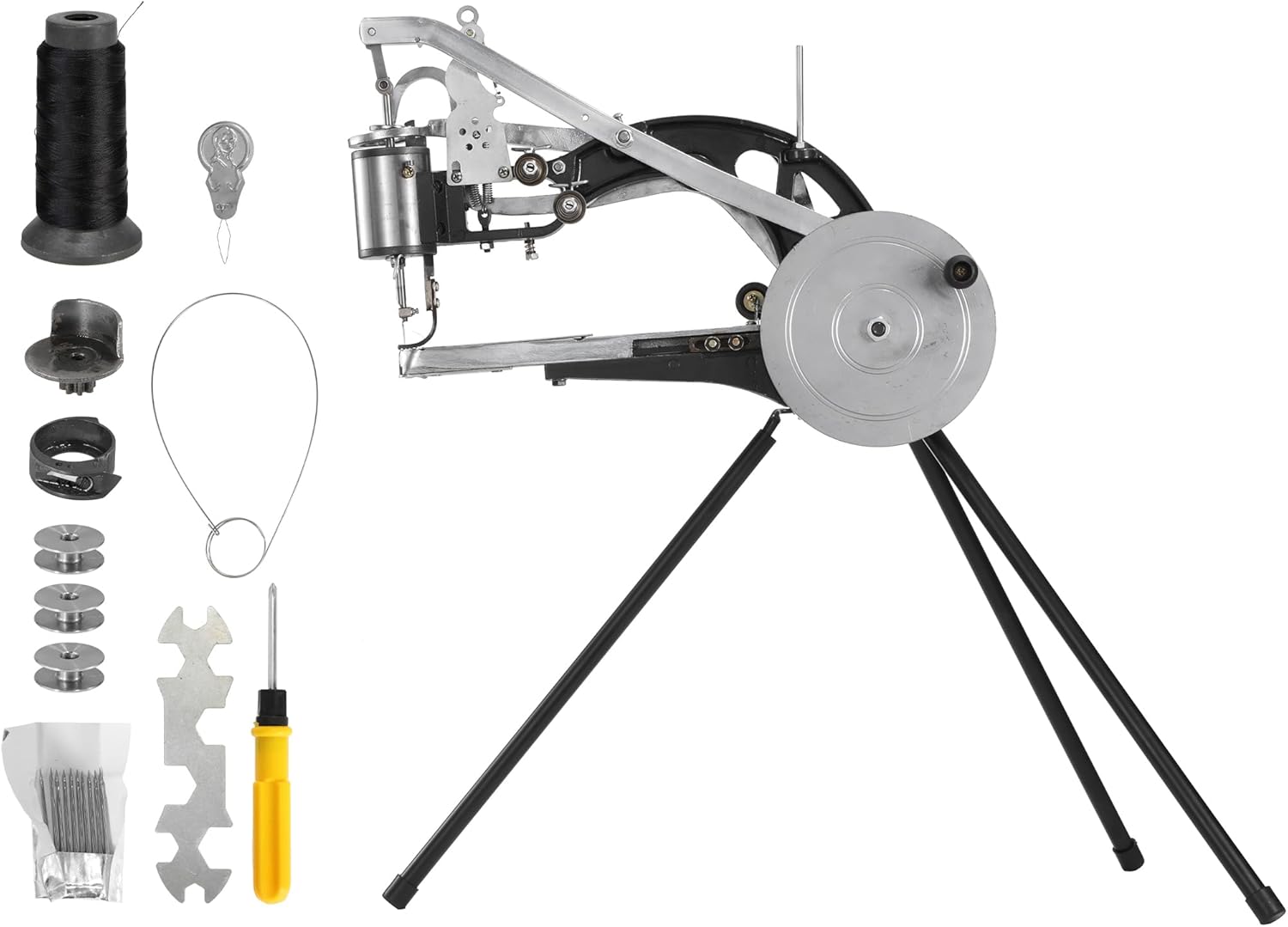
| Power Source | Hand Powered |
|---|---|
| Included Components | 10 needles, nylon coil |
| Material | Alloy Steel |
This BEAMNOVA cobbler sewing machine is a heavy-duty, hand-powered unit aimed at leather repair and small workshop use. It sews leather, canvas, denim, rubber, and similar thick materials using nylon, silk, or cotton thread and includes needles and a nylon coil to get started. The open arm and rotating turntable let you reach narrow or curved areas like bag corners and shoe uppers, while the precision bobbin and upgraded metal frame improve stitch consistency and durability. The tripod stand makes it freestanding so you can place it on the floor rather than mounting to a bench, and the aluminum alloy column reduces weight compared with all-iron builds. Because it is manually operated, speed depends on user technique and it is best for detailed repair work or low-volume production rather than continuous high-speed manufacturing. Some buyers may need to experiment with needle size and thread tension to handle very thick multilayer seams common in heavy bag construction.
Best for: Practical makers and small-scale bag makers who prioritize a durable, no-frills machine for occasional repairs and low-volume construction and who prefer a manually controlled tool over a powered production press.
Less Ideal for: High-volume bag manufacturers or users who need fast, continuous powered stitching for thick multi-layer seams should consider motorized industrial machines instead.
- Built for thick materials like leather and canvas, suitable for bag panels and straps
- Open-arm design and 360-degree turntable for sewing curved and tight areas
- Includes needles and nylon coil so you can start right away
- Freestanding tripod stand removes the need for bench installation
- Hand powered so production speed is limited compared with motorized machines
- Requires tuning of needle size and tension for very thick multilayer seams
Verdict: A rugged, manual cobbler machine that gives small-scale bag makers a durable, freestanding option for sewing leather and heavy fabrics when they value control and build quality over speed.
Ninonly FHSM-520 Sewing Machine

| Power Source | AC adapter |
|---|---|
| Material | Acrylonitrile Butadiene Styrene (ABS) |
The Ninonly FHSM-520 is a lightweight, beginner-focused sewing machine that covers common mending and small craft tasks. It offers 16 stitch patterns selectable by a dial, a reverse stitch for securing seam ends, and an LED work light to aid visibility. The unique switchable single- and double-needle modes let you sew parallel seams for added strength, which is handy when reinforcing straps or decorative topstitching on small fabric bags. It runs from an AC adapter and includes both foot-pedal and hands-on button control, plus a starter accessory kit and clear threading guides for quick setup. The motor handles thin cotton, linen, polyester and light denim up to a few layers, making it suitable for tote bags, pouches, and small shopper bags made from medium-weight fabric. It is not designed for heavy canvas, multi-layer thick denim, or industrial bag projects, so larger or load-bearing bags will need a heavier-duty machine. For hobbyists on a tight budget who make small to medium fabric bags, this machine delivers practical features in a compact package.
Best for: Budget-minded hobbyists and beginners who make small to medium fabric bags, pouches, and tote-style projects and want an easy-to-use, portable machine to sew and reinforce seams.
Less Ideal for: Crafters building heavy-duty, load-bearing bags or repeatedly sewing thick multi-layer materials should choose a more powerful, commercial-grade machine.
- 16 built-in stitches including decorative and zigzag for versatile sewing options
- Switchable single- and double-needle modes for stronger parallel seams
- Includes foot pedal and direct button control plus a starter accessory kit
- Compact and lightweight for easy storage and use in small workspaces
- Motor cannot handle heavy canvas or multi-layer thick denim for heavy-duty bags
- Limited to lighter fabrics and a few stacked layers which restricts larger bag projects
Verdict: A compact, affordable starter machine that gives budget-focused bag makers enough stitch variety and double-needle strength for small to medium fabric bags.
SINGER Heavy Duty 4411

| Power Source | Corded Electric |
|---|---|
| Built-In Stitches | 11 (69 stitch applications) |
| Top Drop-In Bobbin | Yes |
| Buttonhole | 4-step |
The SINGER Heavy Duty 4411 is a workhorse mechanical sewing machine built to tackle both heavy fabrics and everyday sewing tasks. Its reinforced metal frame and more powerful motor deliver faster, skip-free stitching that makes short work of denim, canvas, and layered projects, while adjustable presser-foot pressure lets you also sew lightweight fabrics without puckering. You get a top drop-in bobbin with a transparent cover for easy thread monitoring, LED work light to brighten the needle area, and four essential presser feet useful for common jobs like zippers and buttonholes. The machine offers 69 stitch applications and a simple 4-step buttonhole that are handy for bag making details and decorative finishes. Limitations include its mechanical controls, which lack computerized stitch programming and automatic thread trimming, so advanced patterning requires more manual setup, and the accessory set is basic compared with pro kits. For makers who need a reliable, durable machine for heavy materials and high-speed work, the 4411 delivers practical performance without extras.
Best for: Someone who prioritizes a durable, reliable machine that consistently sews through thick fabrics and frequent projects, especially makers focused on sturdy bags and heavy-duty sewing tasks.
Less Ideal for: If you want computerized stitch patterns, automatic trimming, or a wide specialized accessory bundle out of the box, a feature-rich electronic machine would be a better fit.
- Heavy-duty interior metal frame for stable, skip-free stitching on thick materials
- Powerful motor with high-speed stitching suitable for dense fabrics and multiple layers
- Top drop-in bobbin with transparent cover for easy thread monitoring
- Included presser feet and adjustable presser-foot pressure for versatility across fabric weights
- Mechanical controls lack computerized stitch customization and automatic conveniences
- Accessory set is basic and may require purchasing additional feet or tools for specialized bag features
Verdict: Buy this if you need a dependable, heavy-duty mechanical machine that consistently handles thick materials and high-volume bag-making work.
Brother XM2701 Sewing Machine

| Built-in stitches | 27 |
|---|---|
| Included presser feet | 6 |
| Power source | Corded Electric |
| Input voltage | 120 volts |
The Brother XM2701 is a compact mechanical sewing machine aimed at beginners and hobbyists who need a reliable machine for everyday sewing. It offers 27 built-in stitches including utility, decorative, and stretch options plus a one-step auto-size buttonholer, making it straightforward to handle tasks like seams, hems, and basic decorative work. Key user-friendly touches include an automatic needle threader, jam-resistant drop-in bobbin, automatic bobbin winding, and a built-in LED light that keep setup and small-project work simple. The free arm and six included presser feet (zipper, buttonhole, zigzag, narrow hemmer, blind stitch, button sewing) expand what you can do without extra purchases. Because it is a mechanical, dial-controlled machine it is durable and easy to repair but lacks computerized stitch programming and advanced speed controls that pros might want. For heavier industrial bag materials you will need the appropriate needles and slow, careful feeding; the XM2701 is best suited to light- and mid-weight fabrics and domestic bag projects rather than heavy canvas or leather without modification.
Best for: Practical home sewers who value an easy-to-use, dependable machine for making and finishing small to medium-weight bags, alterations, and craft projects backed by strong user feedback.
Less Ideal for: People who regularly sew heavy-duty materials like thick canvas, leather, or multiple-layer upholstery should consider a heavy-duty or industrial machine instead.
- Beginner-friendly features: automatic needle threader and drop-in bobbin simplify threading and setup.
- Versatile stitch set: 27 built-in stitches plus one-step buttonholer cover common sewing and decorative needs.
- Includes useful accessories: six quick-change presser feet and multiple bobbins let you start sewing right away.
- Portable, lightweight design with a bright LED work light makes it easy to move and sew in small spaces.
- Not designed for heavy industrial materials out of the box and may require specialty needles or a more powerful machine for thick canvas or leather.
- Mechanical controls lack the precision and extra stitch programming found on computerized models.
Verdict: A straightforward, well-regarded mechanical sewing machine that gives beginners and hobbyists the features needed to make everyday and small-to-medium bag projects reliably.
Brother SE700 Sewing & Embroidery

| Built-in embroidery designs | 135 |
|---|---|
| Built-in sewing stitches | 103 |
| Embroidery field | 4" x 4" |
| Screen | 3.7" touchscreen |
| Connectivity | Wireless LAN, USB |
The Brother SE700 combines a full-featured sewing machine and a 4" x 4" embroidery unit in one compact, user-friendly package. It is typically used for garment construction, repairs, and adding embroidered logos or monograms to small projects like bags, pouches, and fabric accessories. Notable features include 103 built-in sewing stitches with 10 one-step auto-size buttonholes, 135 built-in embroidery designs plus 10 fonts, a 3.7" color touchscreen for on-screen editing, wireless LAN and USB connectivity for design transfer, and an automatic needle threader and thread cutter to speed setup. For bag makers the machine's reliable top-drop bobbin, jam-resistant feeding, and included embroidery hoop make it straightforward to add custom patches or monograms. Limitations to consider are the modest 4" x 4" embroidery field that restricts large panels and the machine's overall size and weight if you need a highly portable unit; advanced commercial users may want larger embroidery areas or higher industrial speeds. The SE700 is practical for makers who value dependable everyday performance and easy design transfer for consistent embroidered details on small- to medium-sized bag projects.
Best for: Practical home sewers and small-batch bag makers who want a reliable, easy-to-use combo machine for sewing construction and adding small embroidered logos or monograms with minimal setup fuss.
Less Ideal for: Commercial businesses or makers who need large-format embroidery, very high throughput, or a highly portable travel machine.
- Combo sewing and embroidery functions let you stitch seams and add embroidered personalization without switching machines.
- Wireless LAN and USB support make it easy to transfer designs from the Artspira app or PC.
- Automatic needle threader, automatic thread cutter, and jam-resistant top-drop bobbin speed setup and reduce fiddly adjustments.
- Large selection of built-in stitches and embroidery designs plus 10 fonts for monogramming and decorative work.
- 3.7" touchscreen enables on-screen editing and previewing of designs before stitching.
- 4" x 4" embroidery field limits the size of single embroidery motifs you can apply to bags.
- At 15.6 pounds it is less convenient to move frequently between workspaces.
- Not designed for high-volume industrial production or very large embroidery projects.
Verdict: Choose the SE700 if you want a dependable home combo machine that makes sewing and small-format embroidery straightforward for custom bag details.
Choosing the Right Sewing Machine for Bag Making: Key Factors to Consider
Needle and Thread Compatibility
Bag projects routinely use heavier fabrics and thicker thread than typical apparel sewing. Confirm that a machine accepts heavy-duty needle sizes and a range of thread weights, including topstitching and upholstery threads. Machines that restrict needle size or tension range will struggle to form reliable stitches in dense seams.
Also consider whether the machine offers a robust tensioning system and accessible bobbin types that accommodate heavier bottom threads. The ability to swap to larger needles and adjust tension without complicated workarounds reduces skipped stitches and broken needles when sewing multiple layers and reinforced seams.
Feed System and Layer Management
Even, reliable feeding is essential when you handle canvas, leatherette, or multiple layers of interfacing. Look for machines with improved feed dogs, walking foot or even-feed attachments, and adjustable presser-foot pressure. These features reduce fabric shifting and puckering, keeping seams straight and aligned across complex assemblies.
A machine that can swap to a walking foot or that includes an even-feed accessory will save time and rework on bulky seams, topstitching, and edgework. Also check whether the feed dog height and presser-foot pressure are user-adjustable for fine-tuning when moving between light and heavy materials.
Motor Power and Consistent Torque
Strong, consistent motor torque matters more than top speed for bag making. The motor must push a needle and heavier thread through stacked layers without stalling or losing speed under load. Machines with weak motors may bog down on corners, produce skipped stitches, or overheat during long sessions.
If you plan to sew thick seams or add hardware and reinforcements, prioritize models with higher torque ratings or commercial-grade drive systems. Consider duty-cycle expectations and whether the machine is rated for extended runs if you sew many pieces in a day.
Presser Foot Options and Specialized Accessories
Different bag components require specific feet and accessories: zipper feet for pockets and closures, edge-stitch feet for neat topstitching, and roller or Teflon feet for sticky or coated fabrics. Verify what presser feet are included and whether the machine accepts additional specialized feet, such as walking feet or binder attachments.
A versatile accessory ecosystem reduces the need for workarounds and improves finish quality. Machines with easy foot change systems and a range of included accessories give you more control over seam appearance and construction techniques used in bag making.
Throat Space and Workspace Clearance
Working with bag panels, boxed corners, and long strap assemblies benefits from larger throat space and a roomy work area. A deeper throat allows you to maneuver large pieces and reduces the need to constantly reposition the project during assembly.
Also consider whether the machine has detachable tables or accessory extension tables for flatbed support. Adequate lighting and an open workspace contribute to more accurate sewing and reduce strain when handling bulky or unwieldy bag structures.
Durability and Maintenance
Because bag making can be demanding, the machine should have durable internal components and straightforward maintenance access. Metal internal frames, quality gearing, and user-serviceable parts extend a machine's useful life and keep it running smoothly through repeated heavy-duty use.
Regular maintenance routines, such as cleaning lint build-up, timely oiling where specified, and easy access to the bobbin area, prevent performance degradation. Consider machines with good parts availability and clear maintenance instructions to minimize downtime.
Best Machines for Heavy Fabrics and Multiple Layers
When your projects use canvas, waxed canvas, or dense interfacing stacks, prioritize machines designed to take heavy-duty needles and sustain stitch integrity through thick assemblies. These machines typically pair stronger feed systems with higher torque motors so seams remain even even when turning corners and stitching over reinforcements.
Look for models that offer walking-foot compatibility and adjustable presser-foot pressure to keep layers moving together without bunching.
- Walking foot or even-feed compatibility improves layer tracking
- Higher presser-foot pressure helps penetrate thick fabrics
- Accessible tension adjustments reduce skipped stitches
What to Expect When Sewing Coated or Sticky Materials
Coated fabrics and faux leathers can stick to standard presser feet and feed dogs. A roller foot or Teflon-coated presser foot reduces friction and prevents fabric feeding issues. You may also need specialized needles designed for coated materials to avoid tearing or marking.
Use longer stitch lengths for topstitching on coated materials to avoid perforation lines that weaken the fabric. Test stitch settings on scraps before committing to a full panel to dial in tension and stitch length.
- Roller or non-stick feet reduce surface drag
- Use appropriate needle types to prevent snagging
- Longer stitch lengths can be stronger on coated surfaces
Zippers, Hardware, and Heavy Topstitching Techniques
Installing zippers and attaching hardware are common bag-making tasks that place local stress on seams. A sturdy zipper foot and the ability to lower feed dogs or use a topstitching foot help you get close to bulky elements and produce clean, flat seams around hardware.
For heavy topstitching, choose a machine that accepts heavier threads and offers a consistent stitch formation at slower sewing speeds to avoid skipped stitches when passing over thick seams.
- Zipper foot access for close-edge stitching
- Topstitching foot and heavy-thread compatibility
- Switch to slower speeds when crossing hardware-heavy areas
Managing Long Runs and Production Sewing
If you plan to produce bags in batches, durability and cooling behavior become more important than raw stitch speed. Machines designed for longer duty cycles will tolerate repeated passes through thick seams without overheating.
Consider accessories that speed up repetitive tasks, such as edge guides, seam guides, and dedicated presser feet that reduce setup time between steps.
- Duty-cycle expectations over maximum speed
- Accessories that streamline repetitive operations
- Routine maintenance prevents downtime during runs
Workspace Setup and Ergonomics for Bag Construction
An organized workstation makes sewing large items easier. Use an extension table or a flatbed insert to support bag panels as you stitch. Proper lighting and an ergonomic chair reduce fatigue during longer sessions.
Arrange frequently used tools such as clips, heavy needles, and thread cones within reach. A stable, level surface prevents the machine from walking and helps maintain consistent seam allowances.
- Extension tables support larger panels
- Good lighting and seating reduce errors
- Keep heavy needles and clips within arm's reach
How We Chose the Best Sewing Machine for Bag Making
We prioritized features and performance that matter specifically for bag making rather than general home sewing. First, stitch strength and needle compatibility were key: machines had to accept heavy-duty needles and maintain consistent stitch formation through multiple layers and thick interfacing. Second, fabric handling and feed mechanisms were evaluated to ensure even, tracked seams on canvas, denim, faux leather, and laminated fabrics. Third, motor torque and workspace clearance were considered so a machine can drive thicker seams and accommodate larger bag panels comfortably. Fourth, presser feet options and walking-foot or even-feed compatibility were vetted for smooth topstitching and matched-layer feeding. Finally, build durability and user-serviceability were part of the selection filters because bag making is often repetitive and demanding on a machine. We excluded machines intended solely for lightweight garments or decorative home sewing where motor torque and needle options are insufficient for bag substrates. Items that lacked basic heavy-thread capability, limited presser foot options, or poor feed systems were not shortlisted. Our final list balances reliable construction, practical shop-ready features, and the specific specs that influence long-term bag-making success.
Our full evaluation process is outlined in our review methodology.
FAQ
Can a domestic sewing machine handle thick bag seams?
Often a domestic machine can handle thick seams if it accepts heavy needles, has adjustable presser-foot pressure, and offers consistent motor torque. However, performance depends on the specific model's build and the thickness of the materials you use.
What stitch length is best for topstitching on bags?
A slightly longer stitch length, typically in the medium to long range, works well for topstitching because it reduces perforation and looks cleaner on heavy fabrics. Test on a scrap to match thread weight and material.
Do I need special needles to sew faux leather or coated fabrics?
Yes. Needles designed for coated or synthetic materials and topstitch needles reduce marking and tearing. Using a roller foot or non-stick foot also helps the fabric glide smoothly under the foot.
Is a walking foot necessary for bag making?
A walking foot is often very helpful when sewing multiple layers or matched seams because it feeds the top and bottom layers evenly. It is not always required, but it reduces shifting and improves seam alignment on bulky assemblies.
How do I prevent skipped stitches when sewing through hardware areas?
Slow the machine speed, use a heavier needle and thread, and stitch with consistent pressure. Approaching hardware at a reduced pace and keeping the needle aligned with previous stitch holes prevents skipping and minimizes needle stresses.
Final Verdict
When choosing a sewing machine for bag making, focus on stitch strength, a reliable fabric feed system, and motor torque rather than top speed alone. Prioritize machines that accept heavy needles and threads, offer walking-foot or even-feed compatibility, and provide enough throat space for large panels. Balance workspace ergonomics and maintenance needs against duty-cycle expectations to match the machine to your production volume. Ultimately, pick the machine that best fits the materials and techniques you use most often. Prioritizing the factors discussed above will lead to more consistent results and fewer frustrating interruptions while constructing durable, well-finished bags.