
Note: This article contains affiliate links. If you click on these links and make a purchase, we may earn a small commission at no extra cost to you. This helps support our research and content. Read our full affiliate disclosure here.
Choosing the right sharpening system kitchen knife sharpener matters because a consistent edge changes how your knives perform in daily cooking. The wrong approach can remove too much metal, damage bevel geometry, or make blades inconsistent. This guide focuses on shortlisted sharpening systems that suit most home kitchens, emphasizing durability, repeatable angles, and safety. We evaluated models that make it straightforward to restore edges, refine bevels, and maintain edge geometry. Below you will find our top picks and clear evaluation points so you can choose a system that matches your skill level and the knives you own.
Top Picks at a Glance
| Best Overall The best all-around choice for most situations | Chef'sChoice 15XV Trizor |  |
| Best Quality Built to a higher standard if you want something more solid | Edge Pro Apex 4 |  |
| Best Value The sweet spot between price and what you get | Work Sharp Precision Adjust Knife Sharpener |  |
| Best Budget The cheapest option that still gets the job done reliably | Secura 2-Stage Electric Knife Sharpener |  |
| Top Rated A top-rated pick with lots of positive feedback | Work Sharp MK2 Knife Sharpener |  |
| Most Popular A crowd favorite that many people choose with confidence | KITCHELLENCE 3-Stage Knife Sharpener |  |
| Best Seller A high-volume bestseller chosen again and again | Intelitopia Knife Sharpening Set |  |
Chef'sChoice 15XV Trizor

| Material Type | Diamond |
|---|---|
| Grit Type | Fine |
| Stages | Three |
| Included Components | Knife Sharpener |
| Model Number | 0101500 |
The Chef'sChoice 15XV Trizor is a three-stage electric sharpener designed to convert and maintain 15-degree class edges for kitchen knives. You run straight-edge and most serrated blades through three guided stages: coarse diamond abrasives to form the primary bevel, finer diamond abrasives to hone the edge, and patented stropping disks to polish and finish. The built-in precision angle guides and spring-loaded slots remove guesswork and let even casual users get a consistent, very sharp edge quickly—first-time sharpening takes about a minute and touch-ups only seconds. Because the sharpening elements are 100 percent diamond, the unit sharpens quickly and retains effectiveness over many cycles. It also offers the ability to convert standard 20-degree factory edges to a keener 15-degree profile for improved slicing. Trade-offs are typical of electric systems: it is a countertop appliance that takes up some space and is focused on 15-degree edges rather than adjustable multi-angle profiling, so users who need very specialized angles or wet-stone control may prefer manual methods.
Best for: Home cooks who want a reliable, low-effort way to achieve restaurant-style 15-degree edges for everyday kitchen knives and value fast, consistent results over manual stropping control.
Less Ideal for: People who need fully adjustable angle control, prefer wet-stone technique, or want a compact, travel-friendly sharpening tool.
- Three-stage system with 100% diamond abrasives for fast, repeatable sharpening
- Precision angle guides and spring-loaded slots ensure consistent results without skill
- Final stropping disks deliver a polished, razor-like edge suitable for slicing
- Can convert 20-degree factory edges to a sharper 15-degree Trizor edge
- Designed primarily for 15-degree edges and not for users needing many angle choices
- Takes up countertop space and is less portable than handheld sharpeners
Verdict: Choose the Chef'sChoice 15XV if you want a countertop electric sharpener that delivers fast, consistently sharp 15-degree edges with minimal skill required.
Edge Pro Apex 4

| Angle range | 10°–24° (up to 27°) |
|---|---|
| Included stones | 120–1000 grit waterstones |
| Polish options | 2000 & 3000 grit polish tapes |
| Hone | 8" 1200 grit ceramic hone |
| Max blade width | Up to 3.5" |
The Edge Pro Apex 4 is a guided, hands-on sharpening system built to deliver consistent, repeatable edges without power or clamping. It uses a continuous angle control (10°–24°, up to 27°) and a set of waterstones plus polish tapes and a ceramic hone to take blades from coarse sharpening through fine polishing. Typical use is bench-top sharpening of kitchen, hunting, pocket, and even serrated knives up to 3.5" wide; stones mount quickly and the safety lip reduces slippage while you work. The kit's range of grits (120–1000 grit stones, 2000 and 3000 polish tapes, plus a 1200 ceramic hone) means you can reprofile, sharpen, and polish without switching systems. Because it is a guided manual system, results depend on technique and time invested, and it is slower than powered sharpeners for large batches of knives. The Apex 4's durable metal construction and included Cordura case make it a tool that holds calibration and is serviceable for pro use, but it requires some learning to exploit its full precision potential.
Best for: Buyers who prioritize edge performance and repeatable precision, such as serious home cooks, chefs, or custom knife owners who are willing to learn a manual guided system to get pro-level results.
Less Ideal for: Casual users who want a fast, turn-key solution for many knives or who prefer fully automated electric sharpeners with minimal technique required.
- Continuously adjustable angle control for precise, repeatable bevels
- Comprehensive grit progression and polish tapes for sharpening through polishing
- Nonpowered guided system preserves temper and removes less metal than aggressive grinders
- Patented safety lip and hands-on design reduce blade slippage during sharpening
- Robust metal construction and included Cordura case support professional use and transport
- Requires practice and time to achieve peak results compared with automated systems
- Slower for processing large numbers of knives since it is manual
Verdict: If you want professional, repeatable edges and are willing to invest time learning a manual guided system, the Apex 4 delivers the precision and stone progression to achieve them.
Work Sharp Precision Adjust Knife Sharpener

| Included components | 320 & 600 grit tri-brasive, diamond, fine ceramic, angle adjustable chassis, benchtop base, v-block clamp, slide rod |
|---|---|
| Adjustable angle range | 15–30 degrees in 1-degree increments |
| Manufacturer | Work Sharp |
| Model number | WSBCHPAJ |
The Work Sharp Precision Adjust is a benchtop guided sharpening system built to give consistent, repeatable edges across a wide range of knives. It secures the blade in a v-block clamp and uses a three-sided abrasive assembly with coarse and fine diamond plus fine ceramic stones, letting you switch grits quickly as you refine an edge. The chassis lets you set angles from 15 to 30 degrees in one-degree increments so you can reprofile worn blades or polish a keen edge for slicing tasks. Setup and use are straightforward: clamp the knife, set the angle, and draw the abrasive across the edge on the guided slide rod for uniform bevels. The included benchtop base makes it stable for kitchen use and the components are durable plastics and steel that stand up to repeated sharpening. It is not an electric sharpener so it requires deliberate, manual passes rather than a powered belt, and very coarse regrinding tasks can be slower than motorized machines. For cooks who value control and repeatability, this system speeds up getting a professional edge without advanced skill work.
Best for: Buyers who want a reliable, repeatable sharpening method to keep kitchen and pocket knives performing well and who prefer hands-on control over automated sharpening.
Less Ideal for: Users who need rapid regrinding of heavily damaged blades, or who prefer a fully motorized, pull-through sharpening experience with minimal manual technique.
- Adjustable angle from 15 to 30 degrees in 1-degree increments for precise, repeatable bevels
- Three abrasives (coarse and fine diamond plus fine ceramic) let you transition from reprofiling to polishing
- V-block clamp and guided slide deliver consistent edge geometry across knives
- Benchtop base provides stability during sharpening and straightforward setup
- Includes multiple abrasive stones and user guide to cover most kitchen and pocket knife needs
- Manual operation is slower than powered belt or motorized sharpeners for heavy regrinding
- Not ideal for very large or unusually shaped blades that do not fit the clamp
Verdict: Choose this guided benchtop system if you want precise, repeatable manual sharpening with adjustable angles and multiple stones for professional-quality edges.
Secura 2-Stage Electric Knife Sharpener

| Grit Type | Medium |
|---|---|
| Material Type | Acrylonitrile Butadiene Styrene |
| Included Components | Electric Knife Sharpener |
| Model Number | WT-28D-1 |
The Secura 2-Stage Electric Knife Sharpener is a simple plug-in tool for restoring dull straight-edge kitchen knives. You run a blade through Stage 1 to reshape and re-establish the edge, then through Stage 2 to refine and polish it; built-in angle guides help convert a standard 20-degree edge toward a finer 15-degree angle. The unit uses diamond abrasive wheels so sharpening is quick and effective on a variety of stainless and carbon-steel blades, and non-slip suction feet keep the sharpener stable on the counter during use. It is not designed for serrated knives, and the two-stage design gives less control than a whetstone for advanced users, but for everyday home cooks it delivers a fast, repeatable edge with minimal learning curve. The compact ABS housing stores easily and the sharpening slots are clearly labeled, making routine maintenance straightforward for busy kitchens.
Best for: Buyers who want an affordable, no-fuss way to keep everyday kitchen knives sharp with minimal skill and time investment.
Less Ideal for: Users seeking professional-level edge control or those who need to sharpen serrated blades should look at manual stones or specialty tools instead.
- Two-stage system separates edge re-profiling and polishing for predictable results
- Diamond abrasive wheels sharpen quickly and work on common kitchen steels
- Precision angle guides help achieve a consistently finer edge
- Non-slip suction feet improve stability during use
- Compact footprint stores easily in most kitchens
- Not suitable for serrated knives
- Provides less fine control than manual stones for custom bevels
Verdict: A budget-friendly, easy-to-use electric sharpener that quickly restores and polishes straight-edge kitchen knives for everyday home cooks.
Work Sharp MK2 Knife Sharpener

| Included Components | Abrasive Belts, Knife Sharpener |
|---|---|
| Material Type | Plastic |
| Grit Type | Medium |
| Model Number | WSKTS2 |
The Work Sharp MK2 is an electric bench sharpener built around flexible abrasive belts that conform to a blade edge for consistent results across many tool types. It is typically used on kitchen knives but is also set up for pocket knives, serrated edges, scissors, axes and garden tools thanks to its belt design and included edge guide. Two motor speeds let you step up power for heavier grinding jobs or choose a gentler speed for daily knife maintenance, and the compact footprint makes it easy to keep on a workbench or counter. Notable features include replaceable 3/4 x 12 inch abrasive belts, an adjustable edge guide that supports the blade to the tip, and a design focused on repeatable angles. Practical benefits are fast material removal when you need to reshape edges and the ability to service a wide range of blades without complex jigs. Limitations are that it is a motorized system that removes metal rather than a honing-only solution, so aggressive use will thin blades over time, and it requires replacement belts and a bit of setup to dial in angles for different knives.
Best for: Buyers who prioritize a dependable, repeatable sharpening solution to keep a wide range of knives and tools ready for use will appreciate this unit's robust motor and belt system.
Less Ideal for: If you only want a quick honing touch-up for fine kitchen knives or prefer a purely manual, ultra-compact sharpener for travel, this electric belt system is more capability than you need.
- Flexible abrasive belts conform to varied blade shapes for consistent sharpening
- Two-speed motor provides extra power for heavier grinding tasks
- Adjustable edge guide supports the blade to the tip for repeatable angles
- Compact, bench-friendly footprint suitable for kitchen or workshop storage
- Removes metal—more aggressive than honing and requires occasional belt replacement
- Not a slip-it-in-drawer tool; needs a stable surface and basic setup to use effectively
Verdict: Choose the MK2 when you want a reliable, repeatable electric sharpening system that handles kitchen knives and a wide range of edged tools.
KITCHELLENCE 3-Stage Knife Sharpener
| Material Type | Plastic |
|---|---|
| Included Components | Yes |
| Number of Items | 1 |
| Unit Count | 1 Count |
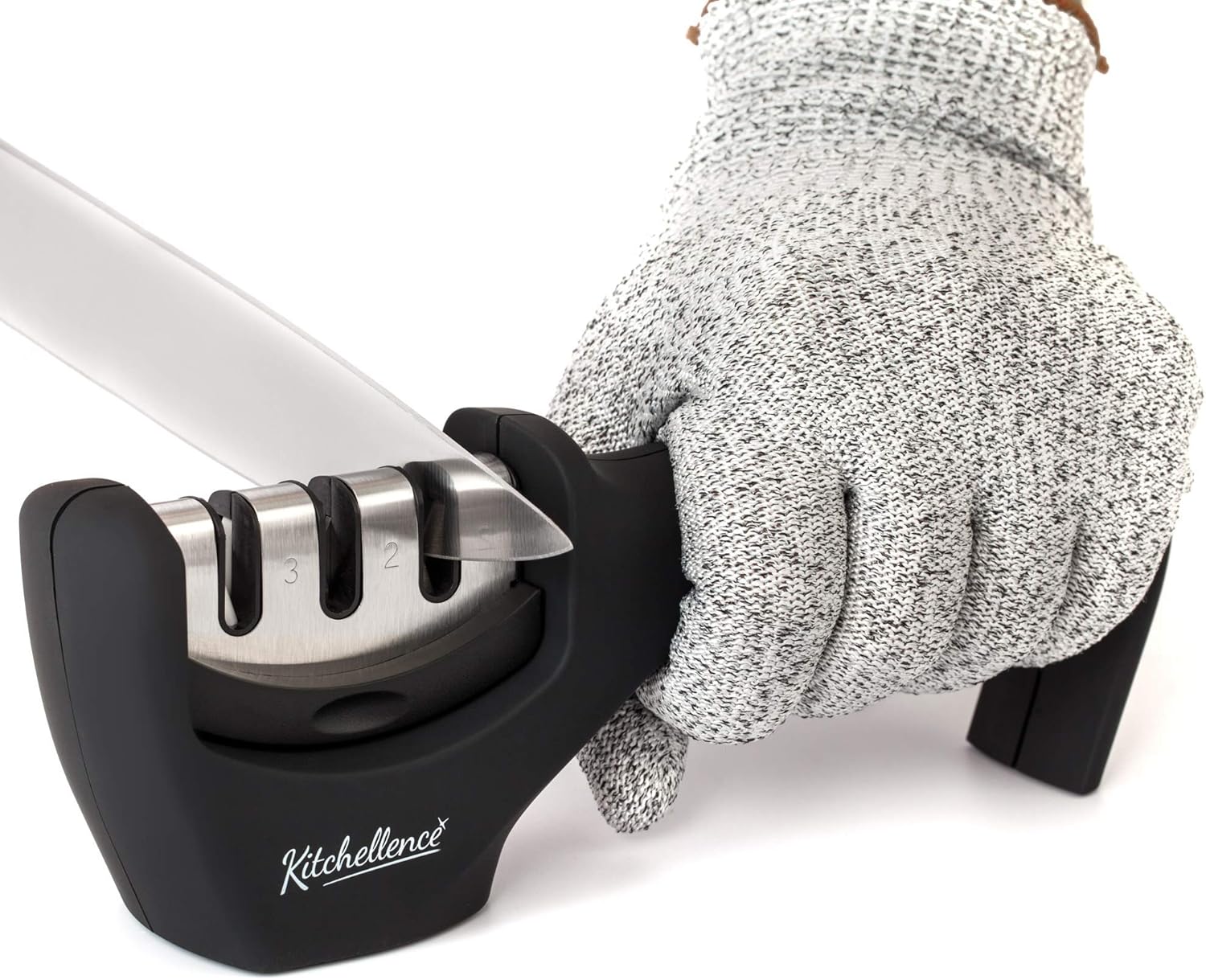
This three-stage manual sharpener is a straightforward, safety-minded kit for everyday kitchen knives. The first diamond rod repairs and realigns damaged edges, the second slot re-establishes the V-angle, and the third polishes and refines the edge for a smoother cut. It is hand-held with an ergonomic handle and a non-slip base to make single-handed pulls stable for both right- and left-handed users. The included cut-resistant glove is a helpful safety add-on when learning to sharpen. Built from ABS plastic, the unit is lightweight and durable for countertop storage or drawer use, and it works quickly for routine touch-ups. It is not a replacement for professional sharpening on high-end or specialty blades, and aggressive damage or very hard steels may need professional attention, but for most home cooks this kit restores slicing performance with minimal setup and skill required.
Best for: Buyers who prioritize clear user guidance and safety and want a simple home sharpening system that quickly restores everyday kitchen knives without technical setup.
Less Ideal for: Professional chefs, knife collectors, or anyone needing precision reprofiling of premium or very hard-steel blades should seek a professional or specialized sharpening system.
- Three distinct stages (diamond repair, angle sharpening, final polish) cover common edge restoration steps
- Ergonomic handle and non-slip base make sharpening quick and stable for right- and left-handed users
- Includes a cut-resistant glove for added user safety
- Lightweight ABS construction is durable and easy to store
- Manual pull-through design is not suited for precision restoration of high-end or specialty steels
- Plastic body may feel less robust than metal-bodied alternatives
Verdict: A safe, easy three-stage sharpener that gives most home kitchen knives a fast, reliable edge refresh with minimal skill required.
Intelitopia Knife Sharpening Set

| Included components | Sharpening Stones, flattening stone, leather strop, angle guide, bamboo base |
|---|---|
| Grits | 400/1000 and 3000/8000 |
| Material Type | Stone |
| Number of Packs | 7 |
This kit supplies everything a home cook needs to keep kitchen blades sharp without professional service. It pairs a 400/1000 grit stone for repairing and sharpening with a 3000/8000 grit stone for refining and polishing, plus a coarse flattening stone to restore the whetstone surface. The bamboo base and three non-slip rubber feet hold stones steady during use and an included angle guide helps maintain consistent bevels while you learn. After sharpening you can remove burrs and finish edges on the genuine leather strop. For routine home sharpening the stones cover the full progression from dull to razor edge and the instruction sheet helps novices get started. Expect some time learning the correct angle and consistent strokes, and you will need to soak or wet the stones and periodically flatten them for best performance. The kit is a practical, full-featured choice for someone who wants factory-quality sharpening results at home without buying separate components.
Best for: A cautious home cook who prefers a complete, factory-quality sharpening system to maintain and restore kitchen knives at home without buying separate tools.
Less Ideal for: People who want an instant, no-skill mechanical sharpener or who prefer sending knives to a professional sharpening service.
- Includes dual-grit whetstones (400/1000 and 3000/8000) for full sharpening progression
- Coarse flattening stone helps maintain a flat working surface
- Non-slip bamboo base and rubber feet improve stability during sharpening
- Leather strop for deburring and polishing edges
- Angle guide and instruction manual help beginners maintain consistent bevels
- Requires time and practice to master consistent angles and strokes
- Stones must be soaked or wetted and periodically flattened to perform optimally
Verdict: A full kit that delivers pro-level sharpening steps at home, making it the safe choice for buyers who want a complete, proven system.
Choosing the Right Sharpening System Kitchen Knife Sharpener: Key Factors to Consider
Angle Control
Maintaining a consistent bevel angle is critical because it determines cutting performance and edge life. A sharpening system that offers precise, repeatable angle settings lets you restore factory bevels or change geometry for a specific task with confidence. Inconsistent angles produce edges that cut unevenly and dull faster, so look for clear markings, detents, or indexed guides.
Angle control matters differently depending on blade type. Thinner Japanese-style blades often require lower angles, while Western blades commonly use higher angles for durability. Systems that allow fine angle adjustments give you flexibility across multiple knife types.
Abrasive Type and Grit Progression
The abrasive materials included and the available grit progression determine how quickly you can repair a chipped edge and how fine you can polish it. Coarse abrasives remove metal fast and are useful for reshaping, while medium and fine grits refine and polish the edge.
Ceramic stones, diamond plates, and water stones each behave differently. Diamond abrasives cut fast and stay flat but can remove more material, while water stones give a smoother finish but require flattening and care. A good system offers a logical progression of grits and allows swapping or upgrading stones.
Workholding and Stability
A stable clamp or jig keeps the blade secure during sharpening so the abrasive can contact the edge consistently. Movement during strokes leads to inconsistent bevels and increases the risk of injury. Evaluate how the system grips different blade shapes and thicknesses, and whether it requires a separate clamp or has an integrated fixture.
Systems that include non-slip bases or secure mounting options reduce vibration and let you focus on controlled strokes. Consider how easy it is to install and remove the knife, and whether the clamp holds a full tang or thin specialty blades reliably.
Ease of Use and Learning Curve
Some sharpening systems are beginner-friendly and guide each stroke, while others are designed for experienced users who want maximum control. Ease of use affects how quickly you can get a clean edge without frustration. Look for clear setup instructions, intuitive angle indexing, and ergonomic handles on guide rods or stones.
Also check whether the system needs extensive maintenance such as stone flattening or regular lubrication. Systems that simplify routine maintenance help users keep edges consistent without a steep time investment.
Long-Term Durability and Replaceable Parts
A sharpening system is an investment, and durability matters because worn components degrade results. Metal guide rods, corrosion-resistant clamps, and replaceable abrasives extend service life. Determine whether replacement stones, straps, or clamps are available and how easy they are to install.
Consider the warranty or support options with the system you choose. Systems with modular parts let you upgrade grits or swap worn pieces rather than replacing the entire unit, which is important for long-term value.
Who Benefits Most From a Sharpening System
Sharpening systems suit cooks who want consistent edges without mastering freehand whetstone technique. They are especially useful for people who own multiple knives with varied bevels and want repeatable results quickly.
Hobbyist chefs and home cooks who prefer predictable outcomes will appreciate systems that lock angle and control each stroke. People who frequently resurface dull blades or repair minor chips will also benefit from the coarse-to-fine progression these systems provide.
- Good for maintaining a matched set of knives
- Helps standardize edges across different blade geometries
- Reduces time spent relearning freehand sharpening
Setting Up and Using a Sharpening System
Start by reading the system instructions and securing the knife according to the clamp guidelines. Set the initial coarse grit and angle to remove damage or re-establish the bevel, using controlled, even strokes. Progress through grits to refine and polish the edge.
Keep the abrasive surface clean and follow any recommended lubrication or soaking procedures. For water stones, maintain proper flattening; for diamond stones, remove metal buildup with a cleaning stick. Frequent small passes are better than aggressive pressure, which can overheat or remove excess metal.
- Confirm clamp grips the spine and not just the tip
- Use light, consistent pressure and full-length strokes
- Rinse or wipe stones between grit changes
Maintaining Your Sharpening System
Regular maintenance preserves performance. Clean abrasive surfaces after each use to avoid glazing and metal buildup. Inspect guide rods and clamps for wear and tighten fasteners periodically.
If the system uses water stones, flatten them as recommended to maintain a true surface. For diamond plates, use a diamond hone or cleaning spray to restore cutting action when particles accumulate.
- Store stones flat and dry to prevent warping
- Replace worn straps or clamps before they loosen
- Keep a small maintenance kit with a flattening tool and cleaning supplies
Safety Tips for Home Sharpening
Treat the sharpening process with the same caution as cutting tasks. Secure work surfaces, keep fingers clear of the edge path, and wear cut-resistant gloves if you are unsure about hand positioning. Never rush or use excessive force.
Make sure the clamp is secure and the knife is stable before beginning. After sharpening, clean the blade thoroughly to remove abrasive particles and test the edge carefully using safe techniques such as slicing paper.
- Avoid stabilizing the blade with your free hand near the edge
- Work slowly when transitioning between grits
- Keep children and pets away from the sharpening area
When to Reshape Versus Hone
Reshaping or re-profiling the bevel is necessary when a blade has chips, a rolled edge, or when you want to change the cutting geometry. This requires coarser abrasives and removes more material. Reserve reshaping for occasional maintenance rather than frequent use.
Honing and polishing with medium to fine grits should be your regular routine to maintain a sharp edge. Light, periodic honing preserves the bevel and extends the interval between heavier resurface sessions.
- Use coarse grits sparingly for major repairs
- Polish with fine grits for daily upkeep
- Track how many coarse sessions you perform to avoid excessive metal loss
How We Chose the Best Sharpening System Kitchen Knife Sharpener
We shortlisted systems that deliver consistent, repeatable edges while minimizing unnecessary material removal. Practical criteria guided selection: angle control precision, abrasive quality and range, build stability, and user safety features. We favored systems that work across common kitchen blade steels and thicknesses, and that allow progression from coarse shaping to fine honing without awkward setup. We excluded one-off pull-through sharpeners and purely electronic gadgets that do not provide user-adjustable angles or progressive abrasives. We also filtered out devices that lack stable clamping or clear abrasive specifications. Key evaluation dimensions included how accurately a system holds angle under pressure, the grit progression and abrasive type, the rigidity of the clamp or guide, and how easy the system is to set up and use for home cooks. Editorially, we prioritized systems that balance beginner-friendly operation with features a more technical user will appreciate. Durability of components and availability of replacement stones or guides were factored in because they affect long-term ownership. Ease of cleaning and safe handling rounded out the evaluation so the final list reflects practical choices for everyday kitchen use.
Our full evaluation process is outlined in our review methodology.
FAQ
How often should I use a sharpening system on kitchen knives?
Frequency depends on use, but many home cooks need a full sharpening session a few times per year and light honing every few weeks. Heavy use or cutting abrasive materials may require more frequent attention.
Can a sharpening system damage my knives?
It can if used incorrectly. Excessive pressure, overly frequent coarse sharpening, or improper angle choices can remove too much metal. Follow angle guidelines and progress through grits to avoid unnecessary material loss.
Are diamond stones better than water stones for home users?
Diamond stones cut faster and stay flat, which is convenient for quick repairs. Water stones often give a smoother finish but require flattening and more care. The best choice depends on how much maintenance you want to perform.
Will a sharpening system work on serrated knives?
Most general sharpening systems are designed for plain edges. Serrated knives require specialized tools or techniques to sharpen each scallop, so check whether the system supports serrations before attempting to use it.
Do I need special clamps for thin or fragile blades?
Thin or specialty blades can be more difficult to secure. Some systems include adjustable clamps or pads to protect thin steel. If your knives are delicate, look for a system with fine clamping adjustment and soft contact points.
Final Verdict
Choose a sharpening system that matches how much work you plan to do and the types of knives you own. Prioritize accurate angle control and a sensible abrasive progression if you want repeatable, durable edges. If ease of use matters most, favor systems with clear indexing and stable clamping; if you value a refined finish, make sure fine-grit options are available. Think in terms of tradeoffs between rapid metal removal and long-term edge life. With the right system and routine maintenance, you can keep kitchen knives performing consistently and reduce the need for professional sharpening services.