
Note: This article contains affiliate links. If you click on these links and make a purchase, we may earn a small commission at no extra cost to you. This helps support our research and content. Read our full affiliate disclosure here.
If you plan to make fresh juice regularly, choosing the right slow juicer for home use makes a big difference in taste, nutrient retention, and cleanup time. A slow or cold-press juicer extracts juice more gently than high-speed machines, which often means less foam, more usable juice from produce, and longer fridge life for batches you store. This guide covers seven carefully shortlisted slow juicers for home use and explains the features that matter most for everyday home kitchens, including extraction efficiency, noise, and how easy each unit is to maintain. Read on for the evaluation criteria and practical tips to help you pick the best option for your routine.
Top Picks at a Glance
| Best Overall The best all-around choice for most situations | Omega Cold Press Juicer J8006HDBLK |  |
| Best Quality Built to a higher standard if you want something more solid | Hurom H400 Slow Juicer |  |
| Best Value The sweet spot between price and what you get | AMZCHEF Masticating Juicer 1902B |  |
| Best Budget The cheapest option that still gets the job done reliably | Elite Gourmet EJX600 Masticating Juicer |  |
| Top Rated A top-rated pick with lots of positive feedback | anybear Cold Press Juicer SJ054C |  |
| Most Popular A crowd favorite that many people choose with confidence | Ninja NeverClog Cold Press Juicer JC151 |  |
| Best Seller A high-volume bestseller chosen again and again | EanOruus 3-in-1 Masticating Juicer E-18 |  |
Omega Cold Press Juicer J8006HDBLK

| Wattage | 200 watts |
|---|---|
| Maximum Power | 200 watts |
| Power Source | Corded Electric |
| Number of Speeds | 1 |
The Omega J8006HDBLK is a slow masticating cold-press juicer built around a triple-stage auger that maximizes yield from fruits, vegetables, leafy greens and wheatgrass while running quietly at 80 RPM. It is typically used for batch juicing and also doubles as a small nutrition system for nut butters, baby food, pasta and sorbets thanks to included homogenizing and pasta nozzles. The 200-watt motor and adjustable end cap let you optimize extraction for different produce, and most removable parts are sink-rinseable or top-rack dishwasher safe which makes cleanup straightforward. Practical benefits include high juice yield with less oxidation, quiet operation that is family-friendly, and a long motor warranty that reflects durability. Important limitations are its single low speed which reduces flexibility for very soft or very hard ingredients and the unit is relatively heavy and takes noticeable counter space compared with compact models.
Best for: Home cooks who want a reliable, multi-use cold-press juicer that prioritizes juice yield, nutrient preservation and quiet batch juicing, plus occasional nut butters or baby food.
Less Ideal for: Buyers who need a lightweight, ultra-compact or variable-speed juicer for rapid single-serving use or specialized high-speed tasks.
- Triple-stage masticating auger extracts high juice yield from small amounts of produce
- Low 80 RPM speed minimizes heat and oxidation for fresher tasting juice
- Includes attachments for nut butters, baby food, pasta and sorbets for multi-purpose use
- Most removable parts are top-rack dishwasher safe for easier cleanup
- Backed by a long 15-year motor warranty
- Single speed limits control for very soft or very hard ingredients
- Relatively heavy and larger footprint for smaller kitchens
Verdict: Choose this Omega if you want a quiet, high-yield cold-press juicer that doubles as a compact nutrition system for versatile home use.
Hurom H400 Slow Juicer

| Wattage | 150 watts |
|---|---|
| Power Source | Corded Electric |
| Voltage | 230 volts_of_alternating_current |
| Capacity | 550 ml |
| Number of Speeds | 1 |
The Hurom H400 is a single-auger, cold-press juicer built to extract juice with low pulp and minimal cleanup. It uses a slow-turning auger and a strainer-free chamber so you can feed whole or large pieces through the wide self-feeding hopper while the machine quietly extracts high-yield juice. The two-part auger and easy-clean chamber detach for faster washing and the front juice gauge lets you monitor fill level without stopping. With a 150 watt motor and one speed, it is straightforward to operate via a single button and handles fruits and vegetables as well as softer items when you use the coarse strainer. Practical benefits include quieter operation than centrifugal models, better juice preservation for storage, and less visible pulp in the finished juice. Limitations are the single speed—which reduces control for specialty processing—and a relatively compact 550 ml capacity that may require more frequent emptying for families making multiple servings.
Best for: Buyers focused on maximum juice extraction and low-maintenance cleanup who want a quiet, reliable machine for daily fruit and vegetable juicing.
Less Ideal for: People who need variable speeds for delicate processing or who routinely make large batches for many people should consider larger-capacity or multi-speed models.
- High juice yield from slow masticating extraction
- Easy to clean chamber with detachable two-part auger
- Large self-feeding hopper accepts whole or large produce pieces
- Quiet 150 W motor for low-noise operation
- Single speed limits processing control for different ingredients
- 550 ml capacity may need frequent emptying for multiple servings
Verdict: Choose the H400 if you prioritize high-yield, low-pulp juice and minimal cleanup in a quiet, user-friendly slow juicer.
AMZCHEF Masticating Juicer 1902B

| Wattage | 300 watts |
|---|---|
| Maximum Power | 350 watts |
| Power Source | Electric |
| Voltage | 120 volts |
| Capacity | 5 pounds |
The AMZCHEF 1902B is a single-auger cold press juicer built for regular home use where you want high yield with minimal prep. It handles whole fruits and vegetables through a 5.4-inch feed chute so you can juice apples, oranges, carrots, and celery with little or no chopping, and the enlarged spiral auger plus triple strainers aim to separate dry pulp for smoother juice. The unit uses a quiet heavy-duty motor with auto-reverse and overheat protection to reduce jamming and extend run time, and the stainless steel blade and body give it a durable, kitchen-ready feel. Detachable parts make rinsing and reassembly straightforward, and the included shaker cup is handy for serving. Expect slower throughput than a centrifugal model, and hand-wash care is required for parts, but for anyone prioritizing nutrient retention, less foam, and better juice yield, this model delivers consistent results in a practical, easy-to-use package.
Best for: Buyers who want efficient, everyday cold-pressed juice at home with minimal prep and a focus on yield and juice quality.
Less Ideal for: Those who need very fast single-cup juicing or fully dishwasher-cleanable parts should look at faster centrifugal models or units with dishwasher-safe components.
- 5.4-inch oversized feed chute reduces chopping and speeds prep
- Upgraded spiral auger and triple strainers produce higher juice yield and drier pulp
- Quiet heavy-duty motor with auto-reverse and overheat protection prevents clogs and extends run time
- Durable stainless steel blade and body designed for frequent home use
- Parts require hand washing rather than dishwasher-safe cleaning
- Slower processing speed compared with centrifugal juicers
Verdict: Choose this masticating juicer if you want a quiet, high-yield home cold press that handles whole fruits with minimal prep.
Elite Gourmet EJX600 Masticating Juicer

| Capacity | 16 ounces |
|---|---|
| Wattage | 100 watts |
| Power Source | Corded Electric |
| Number of Speeds | 1 |
The Elite Gourmet EJX600 is a mini masticating juicer built for one to two servings at a time. It uses a low-speed single-auger design (about 70 RPM) to extract juice with less foam and oxidation than high-speed centrifugal machines, and it ships with a 16 oz Tritan juice cup and a small 3/4" feed chute that encourages chopping produce into smaller pieces. The unit is lightweight and space-saving, with only three removable parts and a supplied cleaning brush to make cleanup quick; removable parts are top-rack dishwasher safe (motor base must be hand-washed). It runs on a 100-watt motor and includes overload/overheat protection to reduce the chance of motor damage during tougher loads. Limits are clear: the small feed chute and single speed mean more prep for hard produce and slower throughput, so it is not suited for large batches or continuous juicing. For someone who wants fresh cold-pressed juice without a big countertop appliance, this is a practical, easy-to-store option with straightforward maintenance.
Best for: Buyers who want a low-cost, space-saving cold-press juicer for occasional single-serve fresh juice and value easy cleanup and simple operation.
Less Ideal for: Those who need to juice large volumes, make bottles for a family, or want a faster feed chute and multi-speed control should look at larger or more powerful models.
- Cold-press masticating extraction reduces foam and oxidation for smoother juice
- Compact single-serve footprint saves counter space and is easy to store
- Only three removable parts and included brush speed up cleaning
- BPA-free and Tritan parts with stainless steel blade materials
- Built-in overload and overheat protection helps prevent motor damage
- Small 3/4" feed chute requires more chopping and slows prep for larger produce
- Single speed and 100-watt motor limit throughput for heavy or frequent juicing
Verdict: If you want an affordable, compact slow juicer for occasional single-serve cold-pressed juice, this model delivers simple operation and easy cleanup.
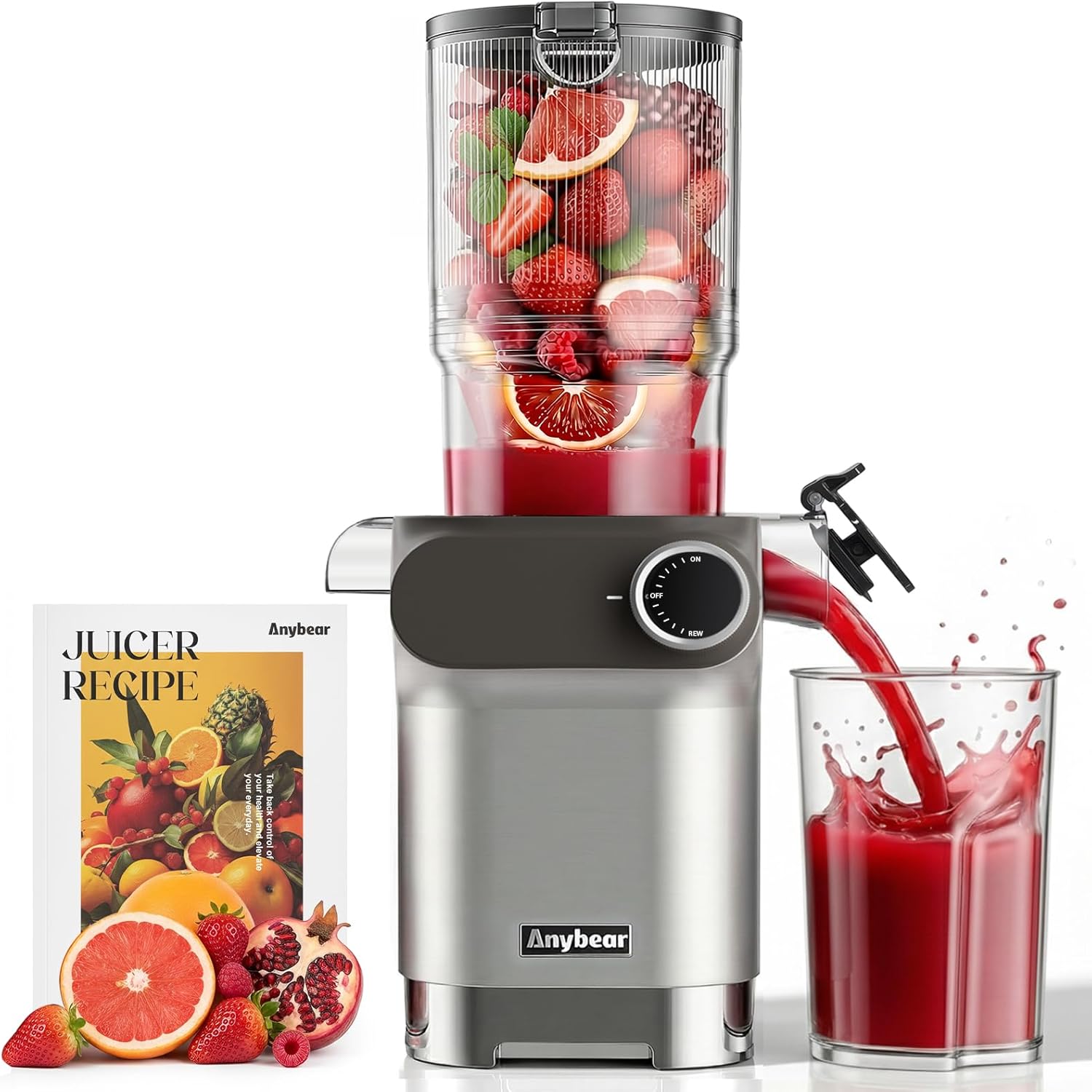
anybear Cold Press Juicer SJ054C
| Maximum Power | 200 watts |
|---|---|
| Wattage | 200 watts |
| Voltage | 110 volts |
The anybear Cold Press Juicer is a slow, single-auger masticating machine intended to extract juice from whole fruits and vegetables with minimal oxidation. It uses a 200W, high-torque motor to drive a heavy-duty auger at low speed, which increases yield and preserves flavor; the wide 4.3-inch feed chute reduces prep by accepting larger pieces. Key design touches include a Tritan feed chute that is marketed as baby food-grade and a one-piece stainless steel filter that simplifies cleaning; the unit ships with a cleaning brush and disassembles in a few steps for rinsing. In practice this model is useful for daily fresh juice, leafy greens, and soft produce where slow extraction improves texture and shelf life. Limits include hand-wash-only care and the typical slower throughput of masticating juicers compared with centrifugal machines, so it requires more time for large batches. The overall build and straightforward cleanup make it a dependable choice for home users who prioritize juice quality and long-term reliability over rapid juicing cycles.
Best for: Home cooks who want reliable, high-yield cold-pressed juice and care more about juice quality and longevity than speed.
Less Ideal for: People who need very fast throughput, frequent large-batch juicing for groups, or dishwasher-cleanable convenience.
- High-torque 200W motor for efficient cold-press extraction
- Wide 4.3-inch feed chute accepts larger pieces and reduces prep time
- Tritan feed-chute material marketed as baby food-grade for food safety
- One-piece stainless steel filter and simple disassembly make cleaning faster
- Requires hand washing and cannot be cleaned in a dishwasher
- Slower juicing speed compared with centrifugal models, so larger batches take more time
Verdict: Choose this slow juicer if you want a dependable, high-torque home masticating machine that prioritizes juice quality and easy cleaning.
Ninja NeverClog Cold Press Juicer JC151

| Maximum Power | 150 watts |
|---|---|
| Power Source | Corded Electric |
| Number of Speeds | 2 |
| Capacity | 24 fluid ounces |
The Ninja NeverClog JC151 is a slow masticating juicer built to handle fibrous fruits and vegetables without frequent clogging. Its 150-watt high-torque auger runs at low speed to extract juice from apples, carrots, celery, leafy greens and ginger while minimizing foam and preserving nutrients. Use it with the two included pulp filters to choose a smoother juice or a thicker, more fiber-rich pour, and the larger 24 oz juice jug plus 36 oz pulp container let you make multiple servings or prep ahead. One-touch controls with a reverse function help clear jams and improve yield, and the anti-drip lever reduces mess when you pause to pour. Most juice-contact parts are dishwasher safe and the design is straightforward to assemble, which eases cleanup compared with many centrifugal models. The JC151 is compact enough for typical countertops, but its single-speed motor and modest power mean it is optimized for regular home batches rather than heavy commercial use.
Best for: Buyers who want a reliable home cold-press juicer that handles fibrous produce, offers easy cleanup, and produces larger batches for family or weekly prep with minimal fuss.
Less Ideal for: People who need a commercial-grade machine for continuous heavy use or those who want multiple speed settings and advanced control over extraction.
- High-torque 150W auger extracts juice from tough, fibrous produce with less clogging
- Two interchangeable pulp filters let you control juice texture from smoother to pulpy
- Larger 24 oz juice jug and 36 oz pulp container support batch juicing for multiple servings
- Dishwasher-safe juice-contact parts and simple assembly make cleanup easier
- Single basic speed and simple button controls limit fine-tuned extraction adjustments
- Not intended for heavy commercial use or continuous high-volume juicing
Verdict: Choose the Ninja JC151 if you want an easy-to-clean, countertop cold-press juicer that handles tough produce and makes larger home batches with minimal clogging.
EanOruus 3-in-1 Masticating Juicer E-18

| Maximum Power | 250 watts |
|---|---|
| Power Source | ac |
| Voltage | 110 volts |
| Capacity | 100 fluid ounces |
The EanOruus E-18 is a single-auger cold press juicer designed for home use that handles whole fruits and produces juice, nut milk, and sorbet. It uses a 250 W AC motor with auto-reverse and overheat protection to process fibrous ingredients steadily and quietly, while the 6.5-inch wide chute and 100 oz hopper reduce prep time and let you run larger batches for families or meal prep. Two strainers and included accessories make switching between juice and sorbet straightforward, and most removable parts are hand-washable for manageable cleanup. The motor and construction aim for higher yield and nutrient retention compared with centrifugal models, but the unit is relatively heavy and requires more cleaning attention than simple centrifugal juicers. The plastic/polycarbonate parts keep cost down but may not feel as premium as metal alternatives. For buyers who prioritize consistent cold-press performance, large batch capacity, and safety features, this model delivers a reliable, quiet daily juicing experience.
Best for: Someone who wants dependable cold-press juice and the ability to make larger batches or nut milk with minimal prep and values quiet, protected motor operation.
Less Ideal for: Buyers who need a very lightweight, compact, or fully dishwasher-safe juicer or those who want a premium all-metal construction should consider other options.
- Extra-wide 6.5-inch chute accepts whole fruits to cut prep time
- 100 oz hopper allows larger, single-run batches for families or meal prep
- Auto-reverse and overheat protection help prevent jams and protect the motor
- Comes with interchangeable strainers for juice and sorbet to increase versatility
- Most parts are plastic and require hand washing rather than dishwasher-safe cleaning
- At 250 W and with a heavy build, it is bulkier than compact centrifugal juicers
Verdict: Choose the EanOruus E-18 if you want a quiet, high-capacity cold-press juicer that handles whole fruits and makes juice, nut milk, or sorbet with built-in protections for everyday home use.
Choosing the Right Slow Juicer for Home Use: Key Factors to Consider
Juice Yield And Pulp Dryness
A slow juicer's efficiency determines how much extract you get from the same amount of produce and how dry the leftover pulp is. Higher yield reduces per-glass cost and means fewer trips to the store. Pulp dryness also indicates how well the auger compresses fibers; wetter pulp suggests wasted juice that could have been extracted.
When evaluating home models, consider the types of produce you plan to use most. Leafy greens and wheatgrass need different force and mesh configurations than hard root vegetables. Machines that deliver consistently dry pulp across a range of produce save time and make batch juicing more economical.
Noise Level And Vibration
Noise and vibration matter for daily use in a home setting where quiet mornings or small apartments are common. Low-RPM, slow juicers typically run quieter than high-speed alternatives, but design choices such as motor housing and anti-vibration feet can make a noticeable difference.
If you often juice early or have thin walls, prioritize models that specify decibel levels or emphasize quiet operation. Reduced vibration also reduces the chance of the unit walking on the countertop and improves perceived build quality.
Ease Of Cleaning And Maintenance
Frequent cleaning is the single biggest factor that affects whether you will stick with a juicing habit. Machines with fewer parts, wide feed chutes, and dishwasher-safe components lower the time cost of cleanup. Mesh screens and augers that are easy to brush free of trapped fibers speed up turnaround between uses.
Consider whether replacement brushes or spare screens are readily available and how easy it is to inspect and clean internal crevices. For home use, a model that you can disassemble and rinse in a few minutes is generally preferable to one that requires lengthy scrubbing.
Durability And Materials
Materials and construction affect long-term reliability. Look for food-safe plastics or stainless steel components where they contact produce, and note whether the auger is reinforced or made from wear-resistant materials. Motor specifications and cooling design influence longevity under regular home use.
Warranty terms and access to replacement parts are also indicators of a unit built for the long run. Durability reduces total ownership hassle and ensures consistent performance across months or years of occasional to daily juicing.
Versatility Across Produce Types
Home cooks often rotate through a variety of fruits and vegetables, from leafy greens to hard roots and soft berries. A versatile slow juicer handles this range without frequent clogging or loss of yield. Some designs perform better with leafy material, while others excel with firm produce.
Consider whether the model supports additional attachments or alternate screens for specific tasks like nut milk or sorbet. Versatility means less need for multiple appliances and more flexibility in your weekly juicing routine.
Countertop Footprint And Usability
Space and user interaction are practical concerns for home kitchens. Measure the available counter space and consider the unit's footprint and height, especially if you plan to store it on top of cabinets. A compact design that still offers adequate feed chute size can be ideal for smaller kitchens.
Usability also covers control interface and spout orientation. Simple, durable controls and a drip-free spout improve the daily experience and reduce post-juicing cleanup on surfaces.
Why Slow Juicing Preserves Nutrients
Cold-press or slow juicing uses low rotational speed to minimize heat and oxidation during extraction. Heat and aeration from high-speed machines can degrade some sensitive vitamins and enzymes, so a slow process helps retain more of those compounds in the finished juice.
For home users who juice frequently and want to store juice for a day or two, the lower oxygen exposure in cold-pressed juice helps maintain color and flavor longer. This makes slow juicing a practical choice for meal-prep style juicing and batch production.
- Reduced heat during extraction
- Lower oxidation and foam
- Longer fridge stability for fresh juice
Best Practices For Preparing Produce
Trim large items and remove thick peels or pits when recommended by the juicer's manual to avoid undue stress on the auger. For leafy greens, rolling or compacting them into a small bundle helps feed them through the chute more consistently.
Cut hard vegetables and fruits into pieces sized for the feed chute. While some slow juicers accept whole apples or carrots, pre-cutting speeds setup and reduces the chance of jamming. Remove large seeds and very tough cores before juicing.
- Remove pits and thick peels where advised
- Cut firm produce to appropriate sizes
- Bundle leafy greens for more even extraction
Cleaning Routines That Save Time
Rinse parts immediately after use to prevent fibers and sugars from drying on screens and augers. Keep a designated brush near the sink so you can scrub mesh screens before pulp hardens. For daily users, a quick rinse followed by a more thorough weekly deep clean balances effort and hygiene.
Consider a short post-juice habit such as running water through the unit for a few seconds while disassembled. This small routine reduces the need for heavy scrubbing and keeps seals and gaskets functioning properly.
- Rinse immediately to prevent drying
- Use a dedicated cleaning brush for screens
- Schedule a weekly deep clean for seals and housings
Storing Juice Safely At Home
Store fresh cold-pressed juice in airtight glass bottles in the fridge to slow oxidation. Fill containers as fully as possible to reduce headspace and keep flavorful compounds intact. Consume within 48 to 72 hours for best taste and nutrient retention, depending on the produce mix.
Label bottles with the date and primary ingredients so you can rotate older batches first. If you plan to freeze juice, leave some room for expansion and use freezer-grade containers.
- Use airtight glass bottles
- Fill containers to minimize air space
- Label with date and ingredients
Common Troubleshooting Tips
If the juicer clogs, stop and reverse or clear the feed chamber according to the manual. Overloading the chute or feeding too much soft produce at once often causes blockages. Feeding produce in smaller increments helps maintain steady operation.
If you notice excessive noise or vibration, check that the unit sits level and that anti-vibration feet are engaged. Regularly inspect seals and over-time-wear components for signs of fatigue, and replace them as recommended to maintain smooth performance.
- Feed produce in small increments to avoid clogging
- Ensure the unit is level to reduce vibration
- Replace worn seals and parts per manufacturer guidance
How We Chose the Best Slow Juicer for Home Use
We shortlisted slow juicers that consistently deliver efficient cold-press extraction and solid build quality suitable for everyday home use. Our selection focused on measurable, practical criteria buyers care about: juice yield and pulp dryness, quiet operation and vibration control, ease of assembly and cleaning, durability of wear parts and motor longevity, and versatility across common fruits and vegetables. We prioritized units with straightforward maintenance and safe construction materials appropriate for food contact. We excluded machines designed solely for commercial kitchens, high-volume models intended for frequent heavy use, and hybrid machines that primarily function as centrifugal juicers. We also filtered out units with limited home-kitchen support options or unclear materials information. The resulting list contains slow juicers that balance extraction performance, convenience, and durability for typical home routines.
Our full evaluation process is outlined in our review methodology.
FAQ
How often should I clean a slow juicer?
Rinse and clean removable parts after every use to prevent residue buildup. Perform a deeper clean of mesh screens and seals weekly if you juice daily.
Can I juice leafy greens with a slow juicer?
Yes. Slow juicers handle leafy greens well when fed properly, often yielding more juice and less foam than high-speed models. Bundle leaves and alternate with firmer items for best extraction.
How long will cold-pressed juice last in the fridge?
Cold-pressed juice typically keeps best for 48 to 72 hours when stored in airtight glass containers and refrigerated. Shelf life varies with ingredients and how well the juice was extracted and handled.
Is a wider feed chute worth it for home use?
A wider feed chute reduces prep time because you can insert larger pieces, but it can increase cleaning complexity. For many home users, a balance between chute size and ease of cleaning is ideal.
Do slow juicers require special maintenance?
Routine maintenance is minimal: regular cleaning, checking seals and screens for wear, and replacing consumable parts when needed. Avoid forcing large, unprepared items into the chute to preserve the auger and motor.
Final Verdict
For most home kitchens, prioritize a slow juicer that balances juice yield, quiet operation, and straightforward cleaning. Think about the kinds of produce you use most and pick a unit with proven extraction across those items, plus easy access to spare parts and simple maintenance. Tradeoffs are inevitable: the most efficient extractors can be a little slower to clean, while the easiest-to-clean units may sacrifice some yield. Focus on the few criteria that will affect your daily routine most, and choose the model that fits your counter space and maintenance preferences for confident long-term use.