
Note: This article contains affiliate links. If you click on these links and make a purchase, we may earn a small commission at no extra cost to you. This helps support our research and content. Read our full affiliate disclosure here.
Picking the right small commercial coffee roaster shapes the flavor, consistency, and capacity of the coffee you serve. Whether you operate a micro-roastery, café, or specialty coffee shop, a roaster must deliver repeatable profiles, enough throughput for your schedule, and the operational features that fit your workflow. This guide presents five shortlisted small commercial coffee roasters that excel for different shop sizes and production goals. We evaluated machines across roast consistency, batch throughput, thermal control, build quality, and serviceability to help you match a roaster to your roasting volume and product goals. Read on to compare the top picks and decide which features matter most for your operation.
Top Picks at a Glance
| Best Overall The best all-around choice for most situations | Chef Prosentials B500 Coffee Roaster |  |
| Best Quality Built to a higher standard if you want something more solid | precision coffee roaster 1kg |  |
| Best Value The sweet spot between price and what you get | HNZXIB Commercial Coffee Roaster 4.4LBS |  |
| Best Budget The cheapest option that still gets the job done reliably | Kllkmmws Coffee Roaster Machine |  |
| Best Seller A high-volume bestseller chosen again and again | JIAWANSHUN Home Coffee Roaster FBA066 |  |
Chef Prosentials B500 Coffee Roaster

| Item model number | B500 |
|---|---|
| Maximum roasted beans capacity | 500 g |
| Item Weight | 22 pounds |
The B500 is a compact electric drum roaster aimed at small commercial shops and serious home roasters who need repeatable, hands-on batches. It roasts up to 500 g of green beans per batch using a smokeless drum system and direct-fire style heating with PID temperature control and roast curve recording for precise profiling. Typical use is batch roasting fresh beans, monitoring the PID readout, and saving profiles so you can reproduce preferred roast levels. The drum design and PID control make it straightforward to develop consistent roasts, and the unit's compact footprint fits behind a coffee bar or on a dedicated counter. Expect practical benefits like quicker cycle times than air roasters and the ability to capture roast curves for quality control. Important limitations are the 500 g max capacity, which is suitable for small-volume commercial use but not high-throughput production, and the likely need for separate ventilation for heavier smoke during development roasts despite the smokeless claim in normal operation.
Best for: Buyers who want a compact, profile-capable drum roaster for small-batch commercial service or serious home roasting and who prioritize reproducible roast control over high throughput.
Less Ideal for: Shops that need large daily output or roasters who require turnkey, high-capacity production should choose larger commercial machines instead.
- 500 g batch capacity fits small commercial or enthusiast use
- PID temperature control and roast curve recording for repeatable profiles
- Drum roasting method that produces traditional roast development and quicker cycle times than many air roasters
- Compact footprint suitable for counters or small shop spaces
- 500 g capacity limits output for higher-volume commercial needs
- May require external ventilation for heavy-smoking development roasts
Verdict: The B500 is the practical choice for small shops or dedicated home roasters who need a compact drum roaster with PID control and roast profiling for consistent small-batch results.
precision coffee roaster 1kg

| Capacity | 1 kg |
|---|---|
| Wattage | 2000 watts |
| Voltage | 240 volts |
| Human Interface Input | Touchscreen |
| Operation Mode | Semi-Automatic |
This 1 kg electric coffee roaster brings commercial-grade construction and control into a small-shop footprint. It uses a 2000W, 240V hot-air drum system with an upgraded bearing motor and siphon exhaust fan to support heavier daily throughput and more consistent agitation than hobby models. A 10.1-inch touchscreen shows real-time temperatures and curves and the unit includes 10 automatic profiles plus the ability to save manual profiles and connect to Artisan software for precise curve editing. The stainless steel body and full-metal front panel are built for repeated use in a cafe environment, and the included stainless bowl and microfilter make cleanup straightforward. Trade-offs are its 240V requirement and 70 lb heft, which make it best for a fixed counter in a shop or dedicated home roasting corner rather than casual or portable use. For buyers who need repeatable, profile-driven roasts at small commercial volumes, this model delivers strong control and durability.
Best for: Serious small-roastery owners or dedicated home roasters who prioritize repeatable, profile-driven results and durable, commercial-style hardware.
Less Ideal for: Casual hobbyists who need a lightweight, portable roaster or users who only have standard 120V household outlets.
- Commercial-grade stainless steel construction and full-metal front panel for durability
- 10.1-inch touchscreen with real-time temperature and roast curve visualization
- Supports auto profiles and Artisan software for precise profile import/export
- Upgraded bearing motor and siphon exhaust fan for higher daily capacity and consistent roasting
- Requires 240V power and is heavy, limiting placement options
- Lacks portability and is best suited to a fixed shop or dedicated home setup
Verdict: Buy this roaster if you need a durable, profile-capable 1 kg machine that brings small commercial performance and Artisan compatibility to a shop or serious home setup.
HNZXIB Commercial Coffee Roaster 4.4LBS

| Capacity | 4.4 pounds |
|---|---|
| Temperature range | 86–572°F |
| Power source | electric |
| Material | Stainless Steel |
This compact commercial roaster is built for small cafes and roasting studios that need reliable, repeatable batches. It uses a rotating stainless steel drum and PID temperature control across an 86–572°F range to deliver even 360° heating and consistent roast profiles from light to dark. The removable inner drum and all-stainless construction make cleanup straightforward and help avoid flavor carryover when switching beans or roasting nuts and grains. Controls include a long-duration timer up to 999 minutes which supports slow low-temperature roasts for nuts as well as typical coffee cycles. Practical limitations are its single 4.4 lb capacity variant here and 110V design, which suit small commercial or high-quality home setups but not high-volume shop throughput. Users should also expect a learning curve to dial in roast curves and to provide proper ventilation in a commercial space. For operators prioritizing reproducible small-batch output and durable construction, this roaster covers the essentials without excessive complexity.
Best for: Buyers who want a compact, durable roaster to produce consistent small-batch coffee or specialty roasted nuts and who value repeatable temperature control over maximum throughput.
Less Ideal for: Large coffee shops or operations that need high hourly output or turnkey, fully automated industrial roasting solutions should look at larger capacity equipment.
- Rotating drum design for even 360° roasting and consistent flavor development
- PID temperature control with a wide 86–572°F range for precise roast profiling
- Food-grade stainless steel construction and removable inner drum for easier cleaning and durability
- Long timer up to 999 minutes supports both typical coffee roasts and slow low-temperature nut roasting
- 4.4 lb capacity is intended for small-batch commercial use and may be too small for high-volume shops
- Requires proper ventilation and a learning period to master roast profiles
Verdict: A durable, small-batch commercial roaster that delivers precise, repeatable results for cafes and roasting studios focused on consistent quality.
Kllkmmws Coffee Roaster Machine

| Power | 800 watts |
|---|---|
| Voltage | 110 volts |
| Capacity | 500g/1.1lbs (raw beans) |
| Temperature range | 0-240°C/32-464°F |
This tabletop coffee roaster is a straightforward, budget-friendly machine for small-batch roasting of raw coffee beans and other seeds. You load up to 500 g (about 1.1 lb), set the temperature with the front knob and monitor progress through the glass cover with ventilation holes while the internal stir bar helps tumble beans for more even roast. The honeycomb bottom and 800W heater aim to distribute heat more uniformly, and the plastic and glass construction keeps the unit lightweight and portable for cafe counters or home use. Practical benefits include a wide adjustable temperature range that supports different roast profiles and side handles for easy movement. Limitations are the basic controls with no digital timing or profiles, and polypropylene materials that may not feel as durable as heavier commercial units; for very large volumes or strict consistency across many daily batches, a larger or more industrial roaster would be a better fit.
Best for: Small shop owners or hobbyist roasters who need an inexpensive, portable machine to produce modest daily batches and experiment with roast settings without a big upfront investment.
Less Ideal for: High-volume commercial roasteries or shops that require consistent, repeatable production across many batches per day should choose a larger, more robust machine with digital controls.
- 500 g (1.1 lb) capacity suitable for small commercial or batch use
- Wide adjustable temperature range (0–240°C) for flexible roast profiles
- Glass cover with vents lets you observe roast color and aroma development
- Built-in stir mechanism and honeycomb bottom promote more even heating
- Compact and portable with side handles for easy placement and movement
- No digital controls, timers, or programmable roast profiles
- Construction uses polypropylene which may not match longevity of heavier commercial materials
Verdict: An inexpensive, small-batch roaster that gives shops and enthusiasts a flexible, portable way to roast up to 500 g per cycle.
JIAWANSHUN Home Coffee Roaster FBA066
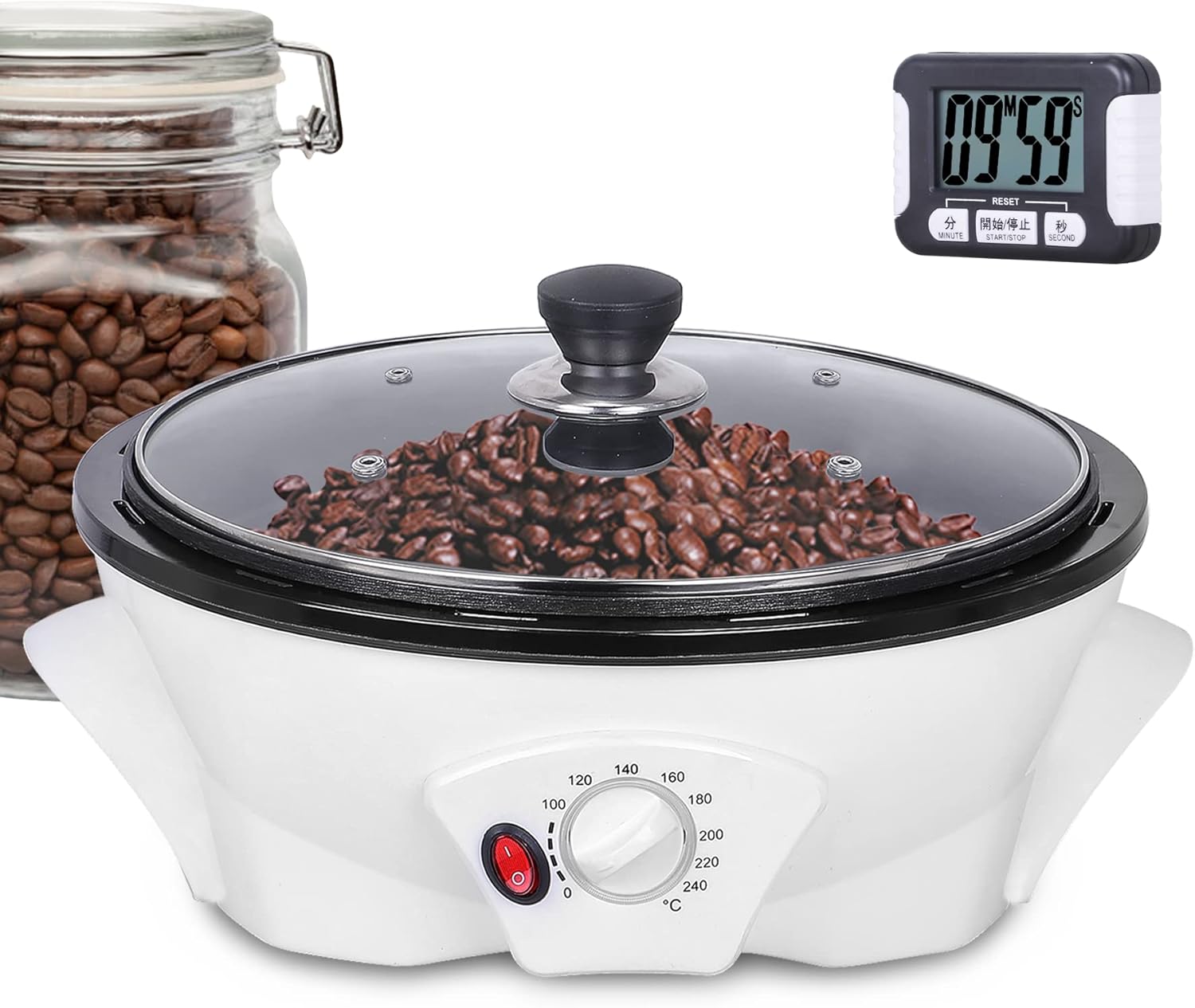
| Wattage | 1200 |
|---|---|
| Voltage | 120 volts |
| Capacity | 500g/1.1lb |
| Special Features | Temperature Adjustment, with Timer, Easy to Clean |
This JIAWANSHUN roaster is a compact countertop machine for small-batch home roasting that handles roughly 300–500g per cycle for the most even results. It uses a 1200W heater with adjustable temperature up to 240°C and an automatic stirring rod to keep beans moving for consistent color development, while a clear glass lid with ventilation ports lets you watch progress. The included timer makes repeatable roasts simpler for beginners and the honeycomb nonstick interior wipes clean easily. Practical extras include a cooler/catcher design to separate chaff and the ability to roast other small foods such as nuts or popcorn. Limitations to note for a small commercial context are capacity and throughput: recommended batch sizes and a single small chamber mean this is best suited to sampling, pilot batches, or very low-volume microproduction rather than continuous shop-level roasting, and the plastic and glass construction is less heavy-duty than commercial units.
Best for: Buyers who want a low-risk way to experiment with home or pilot coffee roasting and who prioritize repeatability and ease of use over high throughput.
Less Ideal for: Shops or producers needing continuous, high-volume roasting or heavy-duty factory-grade equipment should consider larger commercial roasters instead.
- Adjustable temperature up to 240°C for light to dark roast profiles
- 1200W power and automatic stirring rod provide even heating and rotation
- Built-in timer simplifies repeatable small-batch roasts for beginners
- Transparent glass lid with ventilation lets you monitor roasting visually
- Nonstick honeycomb interior is easy to clean after roasting
- Limited batch capacity suited to 300–500g recommended loads, not continuous commercial throughput
- Plastic and glass construction is less durable than professional commercial roasters
Verdict: A user-friendly small-batch roaster that makes repeatable home and pilot roasting simple for cautious buyers who want control over roast degree.
Choosing the Right Small Commercial Coffee Roaster: Key Factors to Consider
Roast Control and Profiling Capability
Precise control over heat input, airflow, and drum speed determines how well you can reproduce roast curves and develop flavors. Look for machines that offer programmable profiles, accurate temperature probes, and reliable controls that respond predictably across the roast. That capability affects consistency across batches and reduces guesswork when dialing in single-origin or blended coffees.
For a small commercial setup, the control interface should be usable in a busy environment and ideally allow saving multiple profiles. The better the profiling tools, the easier it is to train staff and scale a roast from test batches to full production.
Batch Size and Throughput
Batch capacity and cycle time determine how much green coffee you can roast per day. Smaller roasters that run very short cycles can still match larger throughput if they deliver quick, reliable turns, but frequent manual handling can increase labor. Estimate your daily cups sold or wholesale weight to choose a machine with appropriate batch capacity and realistic cycles per day.
Consider how scalable the machine is for busy periods and whether it supports continuous or near-continuous roasting workflows. Throughput also affects cooling capacity needs and post-roast handling logistics in a small shop.
Thermal Efficiency and Fuel Type
How a roaster generates and retains heat impacts fuel costs, roast stability, and environmental control. Electric and gas-fired units behave differently in ramp rates and heat recovery. Thermal insulation, efficient burners or heaters, and responsive input adjustments make it easier to hit target curves without excessive energy waste.
Thermal efficiency also influences how quickly the machine responds to setpoint changes and how much residual heat remains between batches, which matters when you roast several batches back-to-back.
Build Quality and Maintainability
Durable construction materials, quality bearings, and serviceable components reduce downtime and long-term operating cost. For small commercial use, frequent daily cycles demand robust parts and easy access to wear items like drive belts, bearings, and probes.
Check that maintenance tasks such as cleaning chaff, replacing seals, and calibrating sensors are straightforward. Machines that require specialized tools or long service waits can interrupt production at critical times.
Emission Control and Venting
Proper exhaust and chaff management protect indoor air quality and comply with local regulations. Look for options that integrate cyclones, afterburners, or staged filtration to control smoke and odor, and evaluate how easily the machine can tie into your existing ventilation system.
Venting complexity affects installation cost and usable placement within a commercial space. Consider noise levels, access for ductwork, and how emissions are handled during different roast stages.
Operator Ergonomics and Safety
Good ergonomics reduce fatigue and mistakes during busy shifts. Controls, loader height, and cooling tray access should suit your staff and kitchen layout. Safety features like guarded moving parts, emergency stops, and clear heat shields protect operators and simplify training.
A roaster that is uncomfortable to use or poses recurring safety hassles will slow production and increase the risk of errors during manual stages such as sample pulling and cooling.
Sizing a Roaster to Your Production Needs
Estimate daily roasted weight rather than relying solely on batch size. Factor in peak days, special orders, and sample/quality-check roasts when choosing capacity. A roaster with slightly more capacity than your typical daily need gives headroom for growth without forcing excessive small batches.
Also consider logistics around cooling and storage. A higher throughput roaster requires larger cooling trays and space to rest and degas roasted coffee before packaging or sale.
- Calculate weekly workload to account for variability
- Plan floor space for roaster, cooling, and green bean storage
- Consider staff time required per batch when estimating throughput
Installation, Venting, and Local Codes
Small commercial roasters often need dedicated exhaust and possibly an electrical or gas upgrade. Verify local ventilation codes and whether an external flue, indoor filtration, or an afterburner is required. Early coordination with an HVAC or local inspector avoids costly retrofits.
Noise and heat output are also installation factors in tight retail spaces. Evaluate exhaust routes and neighboring tenant impacts if you are in a multi-tenant building.
- Check clearance and roof-venting options before purchase
- Confirm fuel connections and electrical service compatibility
- Factor in costs for ductwork and emission controls
Training, Workflow, and Profile Reproducibility
Operator training is essential to realize the machine's profiling capabilities. Standardize roast procedures and logging so different operators can reproduce profiles consistently. The best small commercial roasters provide tools that simplify this, like programmable profiles and clear data readouts.
Integrate the roaster's timing and cooling steps into your shop workflow. Consistent sample pulls, quick cooling, and accurate record keeping reduce batch variation and speed troubleshooting when a roast drifts.
- Create written roast logs and profile templates
- Plan staff schedules around roast cycles to avoid rushed handling
- Use probe calibration and consistent sample timing for reproducibility
Maintenance Routines That Keep You Roasting
A simple, regular maintenance plan prevents unexpected downtime. Daily chaff removal, periodic lubrication, and scheduled probe checks protect roast consistency and mechanical health. Build a checklist that fits into closing or prep routines so maintenance becomes habitual.
Keep an inventory of commonly replaced wear parts that match your machine. That minimizes service interruption when parts wear out or fail during peak periods.
- Daily chaff and foreign object checks
- Weekly probe and sensor inspections
- Stock spare belts, gaskets, and common fasteners
Quality Control and Consistency Checks
Implement simple QC steps such as color evaluation, sample cupping, and weight loss tracking to confirm roast consistency. Recording roast curves and correlating them with sensory results helps maintain standards over time.
Routine lab-style checks can reveal subtle shifts in airflow, heat transfer, or sensor drift that affect cup quality even when the machine appears to operate normally.
- Track weight loss and target end-temperature per profile
- Use visual roast color guides and periodic cupping
- Log environmental conditions like ambient temperature for troubleshooting
How We Chose the Best Small Commercial Coffee Roaster
We selected roasters that meet professional-level expectations for consistent, repeatable roasting while remaining sized for small commercial operations. Priority went to machines that offer precise thermal control and profiling capability, because the ability to reproduce roast curves is essential for quality and single-origin clarity. Throughput and batch size were the next major filters, ensuring each candidate can handle typical daily volumes without long cycle times. We also considered mechanical robustness and serviceability, favoring designs with accessible components and spare-part availability to minimize downtime. Energy efficiency and emission control features were included because ventilation and operating cost matter in small commercial spaces. Units lacking stable temperature control, inadequate exhaust handling, or poor maintenance access were excluded. Our final list balances roast control, practical throughput, build quality, and shop-fit considerations that matter most to small-scale professional roasters.
Our full evaluation process is outlined in our review methodology.
FAQ
What batch size should I choose for a small commercial roaster?
Choose a batch size that matches your average daily roasted weight plus margin for growth. Consider how many cycles per day you are willing to run and the labor needed per batch when making this decision.
Do small commercial roasters need special ventilation?
Yes. Proper exhaust and filtration are usually required to control smoke, odor, and heat. Installation needs depend on fuel type and local code, so verify requirements before purchasing.
How important are programmable roast profiles?
Programmable profiles are valuable for repeatability and for training staff. They reduce variability between operators and make it easier to scale a roast from test batches to production.
How often should I service a small commercial roaster?
Daily cleaning and chaff removal are standard. More in-depth maintenance such as probe calibration, lubrication, and belt checks should occur on a weekly to monthly schedule depending on usage.
Can I use electric or gas roasters in any small shop?
Both fuel types are used in small commercial settings, but compatibility depends on available utilities and local regulations. Electric units simplify exhaust needs but may require higher electrical service; gas models need safe fuel hookups and proper ventilation.
Final Verdict
Choosing a small commercial coffee roaster comes down to balancing roast control, throughput, and practical shop considerations like venting and maintenance. Prioritize machines that offer stable profiling tools and serviceable components if consistency and uptime are important for your operation. Accept tradeoffs between batch size and flexibility: a slightly larger roaster gives production headroom, while a smaller, faster-cycling unit can be suitable if your workflow and staffing support it. Focus on the scoring criteria above to match a roaster to your daily volumes and quality goals and you will make a confident, long-term choice.