
Note: This article contains affiliate links. If you click on these links and make a purchase, we may earn a small commission at no extra cost to you. This helps support our research and content. Read our full affiliate disclosure here.
If you want cafe-style beans without the commercial clutter, a home drum coffee roaster can transform green coffee into consistent, even roasts. The right drum roaster gives you control over airflow, drum speed, and temperature so you can develop clear flavor profiles from light to dark. This guide shortlists the top home drum coffee roasters available, focusing on real-world usability, roast consistency, and maintenance needs. Below you will find our top picks, followed by detailed buying factors and practical guidance to help you pick the best roaster for your kitchen and roasting goals.
Top Picks at a Glance
| Best Overall The best all-around choice for most situations | DYVEE Coffee Roaster 400g |  |
| Best Quality Built to a higher standard if you want something more solid | Kaldi Fortis 600g Coffee Roaster |  |
| Best Value The sweet spot between price and what you get | Bokknppo Coffee Bean Drum Roaster |  |
| Best Budget The cheapest option that still gets the job done reliably | BANLICALI Coffee Bean Roaster |  |
| Top Rated A top-rated pick with lots of positive feedback | MISLOOPY Drum Coffee Roaster 3.8L |  |
DYVEE Coffee Roaster 400g
| Wattage | 400 watts |
|---|---|
| Voltage | 12 volts |
| Power Source | gas, electricity |
| Capacity | 300 g |
| Coffee Input Type | whole beans |
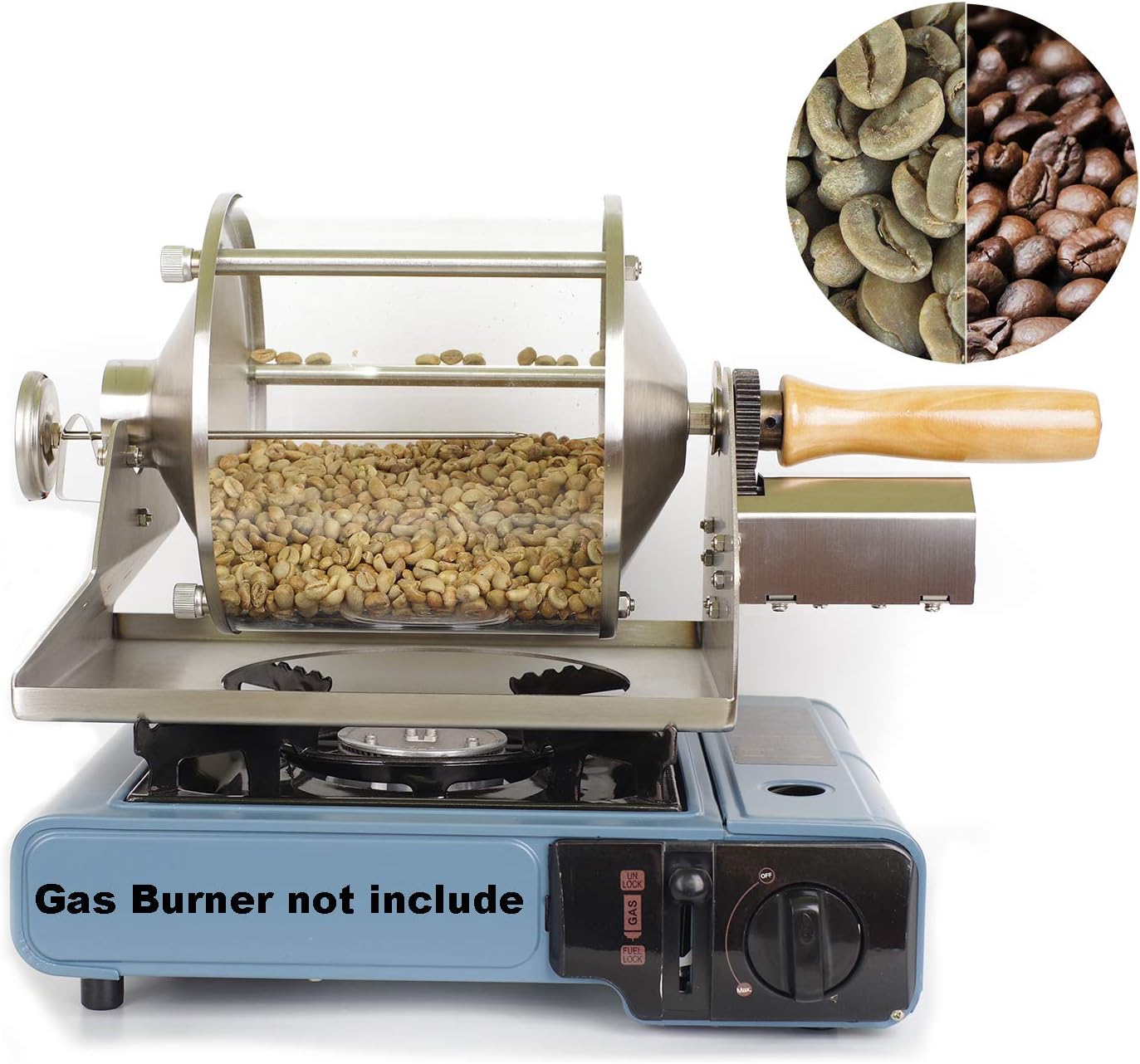
This DYVEE drum roaster is built for home enthusiasts who want visible, hands-on roasting. The quartz glass drum and direct gas-burner heating let you watch beans darken in real time, while a low-voltage 12V motor turns the drum for even exposure. It is typically used for small batches—manufacturer capacity is 400 g with recommended batches of 200–300 g—and includes a funnel, power adapter, and simple controls for manual four-step roasting. The stainless steel frame and wooden handle give a sturdy, heat-resistant feel, and the reusable filter and dual gas/electric power source add flexibility for where you operate it. Expect precise visual feedback and control over roast development, though you will need to manage temperature and stirring manually and accept a learning curve to hit consistent first and second-crack targets. The unit is compact but not silent, and the glass drum demands careful handling during and after use.
Best for: Home coffee enthusiasts who want a hands-on drum roaster to visually control roast development and are willing to learn manual temperature and timing techniques.
Less Ideal for: People seeking fully automatic, set-and-forget roasters or those who need large commercial batch capacity should look elsewhere.
- Quartz glass drum lets you monitor color changes during roasting
- Suitable for small home batches with up to 300–400 g capacity
- Low-voltage 12V motor enhances safety compared with higher-voltage units
- Stainless steel frame and wooden handle improve durability and heat resistance
- Includes necessary accessories: funnel and power adapter
- Manual operation requires practice to achieve consistent roasts
- Glass drum is fragile and needs careful handling
Verdict: Buy this if you want a compact, visually transparent drum roaster for small home batches and manual control over roast development.
Kaldi Fortis 600g Coffee Roaster

| Batch capacity | 600 g |
|---|---|
| Heater type | Gas burner required |
| Roaster type | Semi-convective drum |
| Thermometry | Dual data-logger thermometers |
The Kaldi Fortis is a compact drum roaster aimed at home baristas and small cafés who want hands-on, repeatable roasting. It accepts up to 600 g per batch and uses a semi-convective design with a gas burner required for heat, which gives fast warm-up and direct flame control for profile shaping. Visible features include a viewing window, dual data-logger thermometers for bean and exhaust monitoring, and options for solid or perforated drums to change airflow and roast character. Practical add-ons and accessories like a chaff collector, cooling fan, and artisan software compatibility make it suitable for iterative recipe development. Because it is a gas-heated, manual-style unit, expect more active attention during roasts rather than push-button automation, and you will need appropriate ventilation and a gas source. Finished batches can be cooled quickly with the included cooling airflow options, but installation and safe operation require space and basic technical setup. For roasters focused on control and consistent small-batch output, the Fortis delivers the core tools experienced users need.
Best for: Buyers who prioritize roast control and repeatable small-batch production and are comfortable with hands-on, gas-heated equipment and basic ventilation setup.
Less Ideal for: Users wanting fully automated, low-effort countertop roasters or those who cannot accommodate a gas heat source and ventilation requirements.
- 600 g batch capacity suitable for small-batch, repeatable runs
- Semi-convective drum design with gas flame gives responsive heat control for profile tuning
- Dual data-logger thermometers provide separate bean and exhaust temperature monitoring
- Includes or supports practical accessories such as chaff collector and cooling fan for cleaner, faster post-roast handling
- Requires a gas burner and proper ventilation which adds setup complexity and location constraints
- Manual operation with limited automation increases learning curve for new roasters
Verdict: Choose the Kaldi Fortis if you want a small drum roaster that gives responsive, gas-fired heat control and the instrumentation needed to dial in consistent artisan small-batch roasts.
Bokknppo Coffee Bean Drum Roaster

| Capacity | 3.8 liters (0.3-0.5 kg) |
|---|---|
| Voltage | 110-120V |
| Power | 18W |
| Motor Speed | 5-60 rpm |
| Material | Stainless Steel |
This Bokknppo drum-style coffee roaster is a compact stainless-steel machine aimed at hobbyists and small shops who want hands-on control over small batches. You load whole beans into the lockable drum, set the motor speed (5–60 rpm) and monitor roast temperature with the included thermometer while the adjustable heater and drum agitation promote even roasting. It includes a speed controller, built-in cooler, two sieves and a clear viewing window so you can follow color development and cool beans quickly after the roast. The unit runs from standard US power (110–120V) and is rated at low power, so it is suitable for countertop use without industrial electrical needs. Expect straightforward manual operation rather than automated roast profiles, and be prepared to experiment with times and temperatures to dial in results. Assembly is required and the 0.3–0.5 kg capacity means multiple small batches if you need larger quantities, but the stainless construction and included accessories make it a practical, durable option for people learning drum roasting techniques.
Best for: A practical home roaster or small coffee business owner who prioritizes durable, hands-on equipment and wants to learn drum roasting without industrial investment.
Less Ideal for: People who need large-volume, plug-and-play roasting with automated profiles or those who prefer fully automated countertop appliances.
- Sturdy stainless-steel construction for durability and heat resistance.
- Adjustable drum speed (5–60 rpm) and thermometer for real-time roast control.
- Includes cooler, sieves, speed controller and thermometer so you can roast and cool without buying extras.
- Compact footprint and standard US power make it usable on a kitchen countertop.
- Drum agitation and double guide baffles help produce more even roasts than simple pan methods.
- Manual operation with no automated roast profiles requires learning and repeat testing.
- Batch size is limited to about 0.3–0.5 kg, so not suited for high-volume roasting.
- Assembly required and some setup may be needed before first use.
Verdict: Buy this roaster if you want a compact, factory-quality stainless-steel drum machine that gives manual control and all-included accessories for learning small-batch drum roasting.
BANLICALI Coffee Bean Roaster

| Capacity | 0.66-2.65 lb (300-1200 g) |
|---|---|
| Motor power | 25 watts |
| Adjustable speed | 5-59 RPM |
| Temperature range | -50°C to +300°C (-58°F to 572°F) |
This compact drum roaster is built for small-batch home roasting using a gas burner rather than an internal heat source. You load up to about 0.66–2.65 pounds of green beans in the stainless steel drum, set the geared DC motor speed (5–59 RPM) and roast while observing color change through the glass window and the included thermometer port. The design emphasizes even rotation and airflow with V-shaped baffles and exterior vents, and the side thermometer lets you control the flame to avoid scorching. Because it requires an external gas stove and has a 25W motor for rotation only, it is simple to operate and easier to maintain than electric drum roasters. Expect a learning curve dialing in flame, time, and speed to hit desired roast levels, and the unit lacks an internal heating element or active cooling system so batches must be managed manually. For home users who want control and capacity for multiple cups per roast, this offers good value in a portable, stainless steel package.
Best for: Home roasters on a budget who want bigger single-batch capacity and hands-on control using a stovetop setup and are willing to learn flame-based roasting technique.
Less Ideal for: Buyers who need an electric, plug-and-play roaster with built-in heating, automated profiles, or integrated smoke extraction should look elsewhere.
- Large single-batch capacity up to 2.65 lb suitable for multiple cups or sharing
- Stainless steel construction and glass window for durability and visual monitoring
- Adjustable drum speed (5–59 RPM) for more precise roast agitation
- Side thermometer port with accurate temperature range for real-time monitoring
- Compact, countertop-friendly footprint and portable design
- Requires a gas stove as the heat source because it has no built-in heating element
- No active cooling system or smoke management, so roast control and cooling are manual
Verdict: If you want an affordable, high-capacity stovetop drum roaster for hands-on home batches, this stainless steel model delivers strong value and control.
MISLOOPY Drum Coffee Roaster 3.8L

| Voltage | 110-120V |
|---|---|
| Power | 18W |
| Motor | 12V DC Motor |
| Capacity | 3.8L (0.66-1.1 lbs/time) |
This compact drum roaster is built for steady, repeatable small-batch roasting at home or for a small café. The stainless steel drum and adjustable motor (5–60 rpm) let you control bean agitation for more even heating, and the included thermometer plus clear viewing window make it practical to monitor roast progress. You heat the drum on a household gas or small ceramic electric stove and use the speed controller and latchable drum door to load and unload beans; an anti-scald handle and separate bean cooler simplify handling post-roast. The 3.8L capacity handles roughly 0.66–1.1 pounds per run, so you can do daily small batches without constant refills. Assembly is required and the unit draws minimal electrical power for the motor while relying on an external heat source, so precise temperature control depends on your stove and technique rather than built-in heating. For those who want an affordable, durable drum roaster with practical accessories, this model delivers predictable, hands-on roasting with modest limits on automation and temperature precision.
Best for: A buyer who values a reliable, hands-on small-batch drum roaster for consistent home or small-cafe roasting and who prefers durable, serviceable equipment over fully automated machines.
Less Ideal for: If you need precise, built-in temperature control or fully automated one-button roasting for high-throughput commercial production, this manual stove-heated roaster is not a good fit.
- Stainless steel construction for durability and heat resistance
- Adjustable drum speed (5–60 rpm) for more even bean agitation
- Includes thermometer, bean cooler, and two sieves for practical post-roast handling
- Clear window and latchable drum door for easy monitoring and loading/unloading
- Relies on an external stove for heat so temperature control depends on user skill and stove consistency
- Assembly required and some setup needed before first use
Verdict: A sturdy, small-batch drum roaster that gives reliable, hands-on control and useful accessories for home or small commercial roasting.
Choosing the Right Home Drum Coffee Roaster: Key Factors to Consider
Roast Consistency
Consistent heat delivery and even bean agitation are essential because they determine how uniformly beans develop during a roast.
Irregular contact with heated surfaces or uneven airflow can create mixed flavor profiles within a single batch. Look for drum designs that provide gentle but continuous tumbles and heating systems that maintain steady temperatures to reduce batch-to-batch variability.
Temperature Control & Feedback
Precise temperature control and clear feedback let you reproduce roast curves and make deliberate adjustments. Digital readouts, reliable thermocouples, and gradual ramping capability matter more than a single high-power heat input.
If the roaster allows manual or programmable profiles, you can refine development time and first-crack behavior. For beginners, intuitive knobs and visible temperature readouts shorten the learning curve and minimize wasted beans.
Airflow And Smoke Management
Airflow affects heat transfer, chaff removal, and the final clarity of flavors. Adjustable airflow helps control roast speed and the balance between convection and conduction heating.
Good smoke management is also critical for home use. Look for roasters with integrated cyclone collectors, accessible chaff trays, and options to vent outdoors or filter smoke in small kitchens. Poor smoke control limits where you can roast and increases cleanup.
Capacity And Batch Size
Capacity determines how many roasts you can do in a session and how long beans sit between roasts. Smaller batches heat up and cool down faster, which can be ideal for experimenting, while larger batches are more efficient if you roast weekly for several people.
Choose a capacity that matches your coffee consumption and storage habits. Overloading a roaster reduces airflow and consistency, so a slightly larger capacity than your usual batch size helps maintain even results.
Ease Of Cleaning And Maintenance
Drum roasters produce chaff and oils, so tool-free access to the drum, a removable chaff tray, and easy-to-clean surfaces reduce maintenance time.
Regular cleaning keeps heating elements and sensors accurate and prevents smoke buildup. Consider how easily wear parts can be reached or serviced and whether common maintenance tasks require special tools or expertise.
User Controls And Learning Features
The best home drum coffee roasters balance manual controls for experienced roasters and guided features for newcomers. Variable drum speed, adjustable heat and airflow, plus the ability to log or follow roast curves can accelerate learning.
Look for clear controls, readable displays, and simple feedback on milestones such as first crack. Machines with a steeper learning curve can be rewarding, but intuitive interfaces let you focus on flavor development rather than machine operation.
Understanding Drum Roasting Basics
Drum roasters roast beans by tumbling them inside a rotating drum while applying heat and controlled airflow. This mechanical agitation promotes even contact between beans and the heated drum surface, combining conduction with convection for predictable development. For home users, the drum approach tends to produce smooth roast profiles and a forgiving roasting window compared with some air roasters.
- Drum rotation ensures even exposure to heat
- Airflow controls help manage roast speed and chaff removal
- Thermal mass of the drum affects how quickly roast temperatures change
Setting Up A Safe Home Roasting Station
Plan for ventilation and smoke control before you roast. Even small home roasters generate smoke, chaff, and aromatic compounds that can set off detectors or linger in a poorly ventilated kitchen. Position the roaster near a window, range hood, or a dedicated vent line and keep a fire-safe surface beneath the unit.
- Ensure a clear path for exhaust or use an inline filter if needed
- Keep a removable chaff tray accessible for quick emptying
- Avoid roasting near combustible materials or heat-sensitive surfaces
How Roast Profiles Affect Flavor
Roast profiles are a combination of initial heat application, development through first crack, and post-crack finishing time. Slower, controlled ramps highlight acidity and origin characteristics, while higher final heat produces darker, sweeter, or more caramelized notes. Drum roasters give fine-grained control over these stages via heat and airflow adjustments.
- Short dry phases and rapid ramps emphasize brightness
- Extended development after first crack increases body and sweetness
- Airflow tweaks can thin or thicken cup clarity
Maintenance Routines That Keep Results Consistent
Establish a cleaning routine after each roast session. Empty chaff, wipe oil residues from accessible surfaces, and inspect sensors and vents for buildup. Periodic deeper maintenance should include checking drum bearings, belts, and electrical connections according to the machine's guide.
- Empty the chaff collector after every roast
- Wipe interior surfaces when cool to remove oils
- Schedule a detailed inspection monthly with regular use
Common Troubleshooting Tips
If roasts are uneven, check for overloaded batches, inconsistent drum rotation, or blocked airflow. Inaccurate temperature readings can come from displaced probes or dirty sensors. If smoke becomes excessive, reduce roast power or improve exhaust flow and ensure chaff is not accumulating near heat sources.
- Reduce batch size to improve evenness
- Verify temperature probe placement and cleanliness
- Increase exhaust or lower heat to control excessive smoke
How We Chose the Best Home Drum Coffee Roaster
We started by focusing on machines designed for home users that use a rotating drum to tumble beans while applying controlled heat. Our editorial filters emphasized roast consistency, user controls, and day-to-day practicality rather than industrial throughput. We prioritized roasters that provide predictable heat and airflow adjustments so home roasters can reproduce profiles across multiple batches. Concretely, we evaluated: thermal stability and temperature control, drum design and agitation, airflow and smoke management, user controls and profiling capability, build quality and serviceability, and ease of cleaning. We excluded commercial-only machines with industrial power or capacity that exceed typical home ventilation and electrical limits. Units lacking clear temperature feedback, limited airflow control, or that are difficult to clean were removed from consideration. The final picks balance roast repeatability with usability and maintenance demands for home coffee enthusiasts.
Our full evaluation process is outlined in our review methodology.
FAQ
How much green coffee should I roast per batch?
Typical home drum roaster batches range from 100 g to 1 kg depending on the machine. Roast close to the machine's recommended capacity—slightly under capacity usually yields more even results.
Do home drum roasters need special ventilation?
Yes, you should provide a clear exhaust path or use a filtered setup. Even small units produce smoke and chaff that can trigger detectors or create lingering odors without adequate ventilation.
How long does a typical home drum roast take?
Roast times commonly fall between 8 and 18 minutes depending on batch size and desired roast level. Lighter roasts take longer to develop acidity and origin notes, while darker roasts use higher heat and shorter development relative to the total roast time.
Can I use any green coffee in a drum roaster?
Most green coffees can be roasted in a drum roaster, but bean size and density affect heat absorption. You may need to adjust temperature ramps and airflow to accommodate dense or oily varieties for even development.
How often should I clean the roaster?
Empty the chaff tray after every roast and wipe accessible surfaces when cool. Perform a more thorough cleaning and inspection of bearings, belts, and sensors on a monthly schedule with regular use.
Final Verdict
A home drum coffee roaster gives you the most control over roast development and the clearest pathway to repeatable, cafe-style beans at home. Prioritize machines that offer stable temperature control, adjustable airflow, and easy access for cleaning to keep results consistent and maintenance manageable. Balance capacity against how often you roast and choose a unit that matches your willingness to learn roast profiling. With the right setup and routine maintenance, a drum roaster can be the cornerstone of a home coffee program, delivering predictable flavor and room for experimentation.