
Note: This article contains affiliate links. If you click on these links and make a purchase, we may earn a small commission at no extra cost to you. This helps support our research and content. Read our full affiliate disclosure here.
Choosing the right small wine cooler for home use matters when you want properly chilled bottles without a bulky appliance taking up space. A compact cooler must balance consistent temperature control, vibration reduction, and storage capacity so your wines age or chill as intended while fitting a kitchen island, small apartment, or entertainment area. This guide presents six shortlisted small wine coolers that represent sensible options for home use. We evaluated units for temperature accuracy, usable bottle capacity, installation flexibility, and noise so you can find a compact cooler that meets your storage and lifestyle needs. Read on for the key tradeoffs and practical guidance before the product list.
Top Picks at a Glance
| Best Overall The best all-around choice for most situations | Wine Enthusiast 6-Bottle Countertop Cooler |  |
| Best Quality Built to a higher standard if you want something more solid | Tylza 18-Bottle Wine Fridge |  |
| Best Value The sweet spot between price and what you get | ROVSUN 18-Bottle Wine Fridge |  |
| Best Budget The cheapest option that still gets the job done reliably | EUHOMY 18L Wine Fridge |  |
| Top Rated A top-rated pick with lots of positive feedback | Cuisinart 8-Bottle Wine Cellar CWC-800CEN |  |
| Most Popular A crowd favorite that many people choose with confidence | Ivation 18-Bottle Wine Cooler |  |
Wine Enthusiast 6-Bottle Countertop Cooler

| Capacity | 6-Bottle |
|---|---|
| Cooling Method | Thermoelectric |
| Shelves | 3 wood shelves |
| Installation Type | Countertop |
| Energy Rating | Energy Star |
This Wine Enthusiast 6-bottle countertop cooler is built for small collections that need consistent, quiet temperature control. It uses thermoelectric (solid-state) cooling and a digital touchscreen with LED readout to set and monitor storage temperatures for reds, whites, or rosés, and is designed to sit on a counter or bar. The unit has three wood shelves and three door shelves that keep bottles organized while the glass door and metallic finish give it a clean, modern look. Because it is thermoelectric rather than compressor-driven it runs quietly and is more energy-efficient, but it works best in moderate ambient conditions and may struggle to reach the lowest setpoints if the room is warmer than recommended. The cooler is freestanding only and needs clearance for airflow, so it is not suitable for built-in installation. For someone who wants a compact, low-noise cooler to protect a handful of bottles, this is a practical, space-saving option; buyers who need heavy-duty cellar temperatures or built-in undercounter fitment should look elsewhere.
Best for: Buyers who prioritize quiet, energy-efficient countertop cooling for a small, curated wine selection and want straightforward digital temperature control.
Less Ideal for: Not a good fit for collectors needing built-in or undercounter installation or for users who require very low cellar temperatures in warm environments.
- Compact footprint fits on counters or small bars
- Digital touchscreen and LED display for precise temperature setting
- Thermoelectric solid-state cooling provides quiet, vibration-free operation
- Three wood shelves plus door shelves keep bottles organized and accessible
- Energy Star rated for efficient everyday use
- Thermoelectric cooling is less effective than a compressor in hot ambient rooms
Verdict: A compact, quiet, and energy-efficient countertop cooler that reliably stores a small wine collection with precise digital temperature control.
Tylza 18-Bottle Wine Fridge

| Capacity | 45 liters (18 bottles) |
|---|---|
| Temperature Range | 41–65°F |
| Cooling Method | Compressor |
| Power Source | Corded Electric |
| Installation Type | Built-In/Freestanding/Undercounter |
The Tylza 18-Bottle Wine Fridge is a compact compressor-equipped cellar meant to store and chill a modest wine collection at cellar-like temperatures. It offers a 41–65°F range controlled by an LED touchscreen and smart chip for 1°F adjustments, and the rotary scroll compressor plus 360° air circulation keep temperatures stable and frost free. Five removable metal shelves and adjustable feet let you fit different bottle shapes and install the unit as freestanding or undercounter. The low-E double-layer tempered glass door and tight seal improve insulation while the internal LED light illuminates bottles without strong heat or label fading. Practical touches include a keyed lock, child-lockable controls, and low noise operation under 35 dB ideal for kitchens or small home bars. Expect higher energy use than the smallest thermoelectric fridges and the unit is relatively heavy, so plan for installation help if undercounter mounting is intended. For buyers who need precise temperature control and reliable compressor cooling in a small footprint, this fridge covers the essentials well.
Best for: Buyers who want a reliable, cellar-like cooler that prioritizes temperature accuracy and quiet compressor performance in a small, installable unit.
Less Ideal for: If you need an ultra-lightweight, ultra-low-energy cooler or only occasional short-term chilling, a simpler thermoelectric model or portable cooler may be a better fit.
- Compressor cooling with 360° air circulation for stable, fast chilling
- LED touchscreen and smart chip for 1°F temperature control
- Low-E double-layer tempered glass door improves insulation and UV blocking
- Removable shelves and adjustable feet allow flexible bottle arrangement and placement
- Quiet operation under 35 dB suitable for kitchen or office locations
- Higher annual energy consumption compared with small thermoelectric coolers
- Relatively heavy for a compact unit which can complicate installation
Verdict: A compact, compressor-driven 18-bottle fridge that delivers precise, quiet temperature control for buyers who want dependable cellar-style chilling in a small footprint.
ROVSUN 18-Bottle Wine Fridge

| Capacity | 1.8 cubic feet |
|---|---|
| Size | 18 Bottle |
| Temperature range | 41-64°F |
| Cooling Method | Compressor refrigeration |
| Power | 115 volts |
This ROVSUN 18-bottle wine fridge uses a compressor refrigeration system to cool bottles faster and across a wider temperature range than thermoelectric units, making it suitable for storing reds, whites, champagne, or beer between 41 and 64°F. It is designed as a freestanding unit with removable chrome-plated metal shelves, a soft LED interior light, and an exterior touch control panel so you can adjust temperature without opening the door. The compressor is described as whisper quiet and the double-layer glass door plus good sealing help maintain steady internal temperatures. Practical features include an automatic defrost system, a keyed lock, and ETL specification compliance. Expect typical small-fridge trade-offs such as limited internal capacity for oversized bottles and the footprint of a 30-inch-tall cabinet, but the compressor cooling and touch controls deliver reliable, consistent performance for everyday home use.
Best for: Buyers who want a compact, budget-friendly wine cooler that prioritizes reliable compressor cooling and easy temperature control for everyday home use.
Less Ideal for: Collectors needing storage for large-format or long-term cellaring should look at larger or dedicated wine cellar options instead.
- Compressor refrigeration provides faster, more stable cooling than thermoelectric designs
- External touch control panel lets you change temperature without opening the door
- Removable chrome-plated metal shelves for flexible bottle arrangement
- Double-layer glass door with LED light and good sealing helps keep temperature steady
- 18-bottle capacity may not fit oversized or international-format bottles
- Freestanding footprint requires planning in tight spaces
Verdict: A compact, budget-conscious compressor wine fridge that delivers faster, steadier cooling and simple touch controls for everyday home wine storage.
EUHOMY 18L Wine Fridge
| Capacity | 18 liters |
|---|---|
| Cooling Method | Compressor |
| Temperature Range | 40°F to 61°F |
| Number Of Shelves | 1 |
| Installation Type | Countertop |
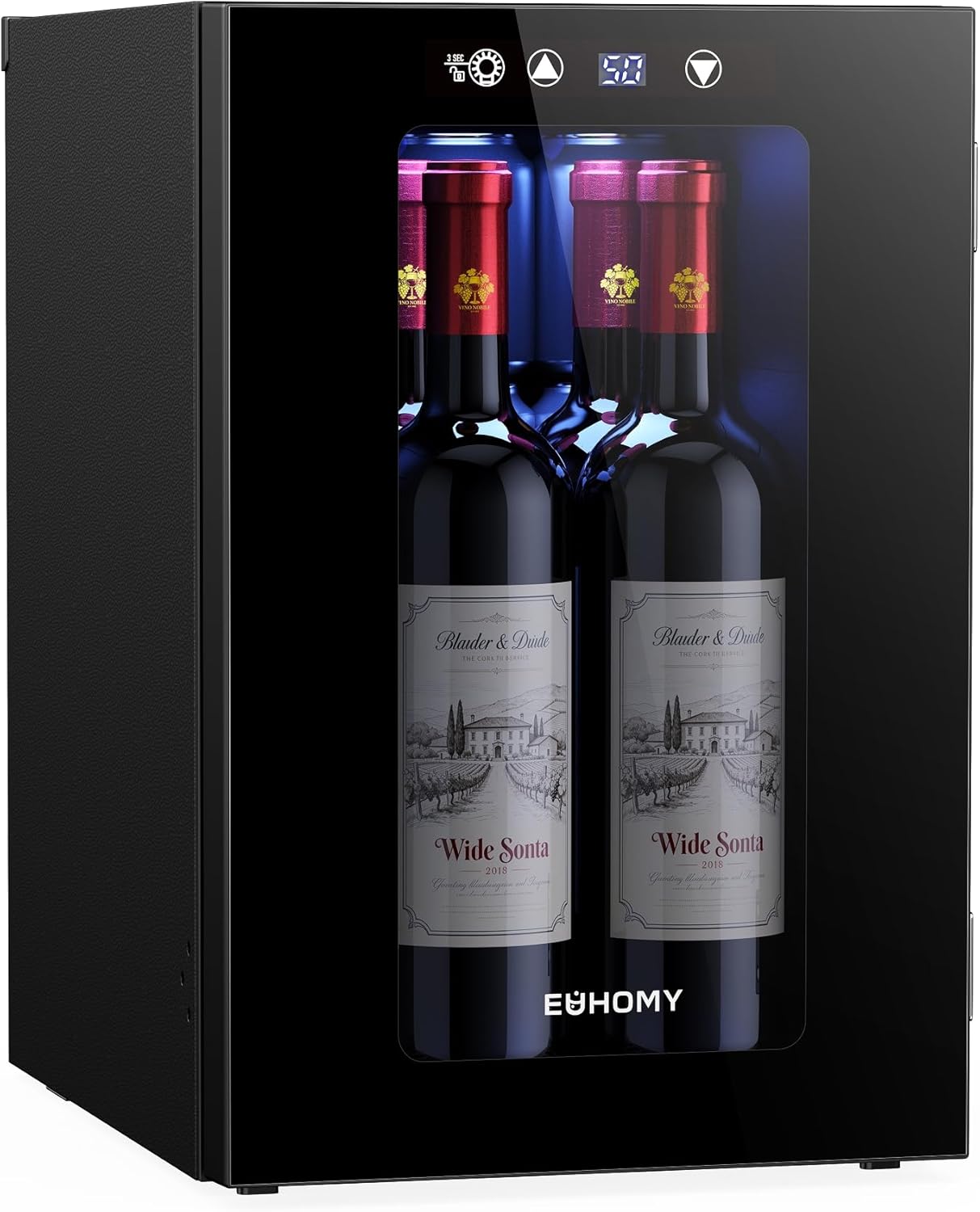
The EUHOMY 18L Wine Fridge is a small compressor-cooled cooler designed for countertop or freestanding use to store a handful of bottles and cans. It offers a digital touchscreen that sets temperatures between 40°F and 61°F, a double-pane glass door with LED interior lighting, and one removable shelf so you can fit bottles or stacks of cans. The compressor system provides steady cooling and the manufacturer states quiet operation around 38 dB, which helps the unit sit beside a bar, office, or kitchen without creating a constant noise nuisance. Practical benefits include the ability to keep red, white, sparkling wine, or beer at ready-to-serve temperatures and the compact footprint that fits tight spaces. Limitations to expect are the very small 18 L capacity that only holds about four 750 ml bottles or up to two dozen cans when arranged differently, manual defrosting, and a single door orientation without reversible mounting, so placement options are somewhat constrained.
Best for: Buyers who want a reliable, compact cooler to keep a small selection of wines or beverages at controlled serving temperatures without complicated setup or large space requirements.
Less Ideal for: Those who need to store larger collections, organize many bottle sizes, or require a built-in undercounter installation should look at larger-capacity or different-format coolers.
- Digital touchscreen with adjustable 40°F–61°F temperature range for precise control
- Compressor cooling for consistent, dependable chilling compared with thermoelectric units
- Compact countertop form that fits small kitchens, dorms, or home bars
- Double-pane glass door with LED lighting showcases contents while blocking UV rays
- Very limited 18 L capacity suitable for only a few bottles or a small can stash
- Manual defrost requires occasional maintenance and can be inconvenient
Verdict: A compact, compressor-cooled countertop wine fridge that delivers quiet, accurate temperature control for buyers who need dependable short-term storage for a few bottles.
Cuisinart 8-Bottle Wine Cellar CWC-800CEN
| Cooling Method | Thermoelectric |
|---|---|
| Number Of Shelves | 8 |
| Capacity | 6 liters |
| Power Source | Electric |
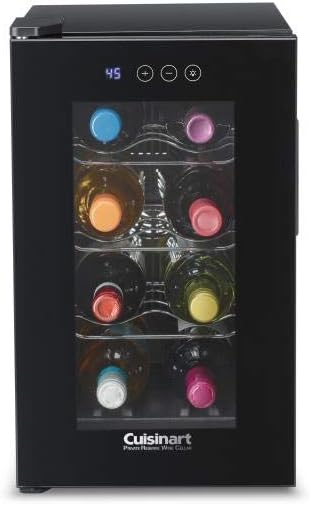
The Cuisinart 8-Bottle Private Reserve Wine Cellar is a small freestanding cooler designed to keep a selection of reds, whites, or sparkling wines at controlled serving temperatures. It uses a thermoelectric cooling system, which runs quietly and is more energy efficient than compressor units, and a touchscreen control with LED readout lets you set temperatures from 39°F to 68°F. Inside, contoured chrome racks and soft interior lighting make bottle access and display simple, and the unit ships with three removable racks to organize various bottle shapes. Typical use is for short- to medium-term storage and serving in an apartment, kitchen, or home bar where vibration-free, quiet operation matters. Limitations include the small 8-bottle capacity and thermoelectric cooling, which performs best in moderate ambient temperatures and is not suited for long-term cellar aging or very warm rooms. For buyers prioritizing quiet performance and a compact footprint, this is a practical countertop or freestanding option; buyers needing larger capacity or cooler performance for hot spaces should look at compressor-based models instead.
Best for: Buyers who want a quiet, energy-conscious small wine cooler to keep a few bottles at serving temperature and prefer a compact freestanding unit for a kitchen, office, or home bar.
Less Ideal for: Collectors who need long-term proper cellar conditions, those with larger collections, or people who will place the cooler in consistently hot rooms.
- Quiet thermoelectric cooling with low vibration suitable for delicate wines
- Touchscreen controls and LED display for easy temperature setting
- Soft interior lighting and contoured chrome racks for neat presentation and access
- Compact freestanding design fits small kitchens, apartments, or bars
- Only holds up to eight bottles, limiting larger collections
- Thermoelectric cooling is less effective than compressor units in very warm ambient temperatures
Verdict: Choose this Cuisinart if you want a quiet, compact 8-bottle cooler that maintains serving temperatures with energy-efficient thermoelectric performance.
Ivation 18-Bottle Wine Cooler

| Capacity | 18 Bottle |
|---|---|
| Temperature Range | 41-64°F |
| Cooling Method | Compressor |
| Power | 120 volts |
| Lock Type | Key |
This Ivation 18-bottle wine cooler is a compact freestanding cellar that uses a compressor and internal fan to keep temperatures steady between 41 and 64 F, making it suitable for storing reds, whites, and sparkling wines. It is typically used in kitchens, small apartments, or entertainment areas where space is limited and a dedicated wine environment is desired. Notable features include a double-paned UV-resistant glass door with airtight seal, removable wire racks for different bottle sizes, a keyed lock for security, and an LED interior light with a touch digital display for easy temperature control. The compressor cooling and inverter help deliver temperature stability and low vibration so sediment is not disturbed, and the unit supports Fahrenheit or Celsius readouts. Trade-offs are its single-zone design so you cannot store widely different temperatures simultaneously, and the stainless steel finish and glass door mean it benefits from placement out of direct sunlight to avoid extra workload. For a compact standalone cellar that balances capacity, temperature control, and a clean exterior, it is a practical choice.
Best for: Buyers who want a compact, freestanding cooler that reliably holds a modest collection and appreciate visible social proof of performance through consistent features like compressor cooling and a sealed glass door.
Less Ideal for: Collectors who need dual-zone cooling for wines at different temperatures or users wanting a built-in cabinet-style unit for full integration.
- Compressor cooling with internal fan for stable, low-vibration temperature control
- Holds up to 18 standard 750 ml bottles in removable wire racks to fit different bottle sizes
- Double-paned UV-resistant glass door and airtight seal protect wine from light and help insulation
- Digital touch display with selectable Fahrenheit/Celsius and soft LED interior lighting
- Built-in keyed lock and two keys provide added security for a collection
- Single temperature zone prevents storing wines that require different serving temperatures
- Annual energy consumption is moderate, so continuous operation will add to power use
Verdict: A reliable, space-saving compressor wine cooler that stabilizes temperature for an 18-bottle home collection.
Choosing the Right Small Wine Cooler for Home Use: Key Factors to Consider
Temperature Range and Stability
A cooler's temperature range determines the types of wine you can store and whether it will serve chilled bottles or provide long-term aging conditions. Look for a unit that can hit target setpoints reliably and hold them with minimal fluctuation.
Stability matters more than maximum advertised low or high numbers. Frequent swings or uneven zones inside the cabinet can stress wine and alter flavor development. Also consider how the cooler performs under typical home conditions, like being placed near heat sources or in a warm room, since inexact control in those scenarios can lead to warmer-than-expected interiors.
Capacity Versus Usable Space
Manufacturers often quote bottle counts based on idealized layouts that assume standard Bordeaux bottles. Real-world collections include different bottle shapes and occasional larger formats, so review how shelves accommodate these variations and whether racks are removable or adjustable.
Usable capacity also depends on shelving design and how densely you plan to store bottles. If you rotate bottles frequently for parties, flexible shelving that allows quick access and partial loading is more practical than a rigid, high-count layout that is hard to manage in daily use.
Noise Level and Vibration Control
Small coolers are often placed near living areas, so operational noise is a key comfort factor. Look for units rated for quiet operation and that use vibration-reducing shelving or mounting systems to protect fine wines.
Vibration can disturb sediment in aged bottles and subtly affect development over time. Even modest vibrations from compressors or fans can be noticeable in quiet spaces. Evaluate whether the cooler's operation would be acceptable in your intended placement, such as next to a sofa, bedroom, or open-plan kitchen.
Installation Flexibility
Consider whether you need a freestanding unit, an under-counter model, or something that can be built into cabinetry. Compact coolers vary in ventilation requirements; some need front-venting to sit under a counter, while others require rear clearance.
Measure the intended space and check door swing, reversible hinges, and the ability to install on slightly uneven floors. If you plan to retrofit the cooler into existing cabinetry, confirm the ventilation path and whether the unit supports flush or inset installations to avoid heat buildup or premature compressor cycling.
Control Interface and Lighting
Controls should be intuitive and sufficiently precise for your needs. Digital thermostats with clear displays let you set and monitor temperatures without guesswork. Consider whether the control is inside or outside the cabinet, and if a child lock or password is important for your household.
Interior lighting helps identify labels without opening the door, but light color and heat output matter. LED lighting is preferred because it emits little heat and offers neutral color rendering. Adjustable brightness or a dusk-to-dawn sensor reduces unnecessary light exposure to stored bottles.
Where to Place a Small Wine Cooler at Home
Placement affects both performance and convenience. Ideal locations are cool, dry, and away from direct sunlight and heat-producing appliances. Avoid spots with wide temperature swings, such as above ovens or near HVAC vents.
If you plan to store the cooler in an entertaining area, ensure the model's noise level matches the space. For under-counter installations, confirm the cooler's ventilation requirements and leave the recommended clearance to maintain compressor efficiency.
- Keep the cooler out of direct sunlight and away from ovens or dishwashers
- Ensure proper ventilation for under-counter models; check front-venting options
- Allow space for door swing and shelving access
- Prefer stable floor surfaces to minimize vibration
Organizing Bottles for Easy Access
Arrange bottles by style or drinking timeframe to simplify retrieval. Store frequently accessed bottles on middle shelves and long-keep bottles toward the back or on higher shelves if the unit is dedicated to aging.
Rotate inventory gently and track what you have to avoid forgotten bottles. Removable shelves or slide-out racks make partial loads easier to manage and reduce the need to rearrange the entire cooler when you remove a single bottle.
- Group by type, region, or drink-by date
- Use adjustable racks to accommodate larger bottles
- Store bottles horizontally if the unit is designed for it to keep corks moist
Maintenance and Energy Considerations
Regular cleaning and occasional defrosting extend the cooler's useful life. Wipe spills promptly and check door seals for a tight fit. Replace interior bulbs with low-heat LEDs as needed to avoid warming the cabinet.
Energy use varies with insulation quality, compressor efficiency, and how often the door is opened. A cooler with good insulation and accurate controls will cycle less and use less electricity over time. Consider energy labels and look for models designed for steady home use rather than commercial duty cycles.
- Clean shelves and interior surfaces periodically
- Inspect and replace door gaskets if they become loose or cracked
- Limit door openings to reduce temperature swings
- Choose LED lighting to minimize interior heat
Single-Zone Versus Dual-Zone Options
Single-zone coolers maintain one temperature across the entire interior and are suitable if you primarily store one style of wine, typically either reds or whites that share similar serving or aging targets.
Dual-zone models let you set two distinct temperatures for storing different wine types simultaneously. For small home coolers, dual-zone systems provide flexibility but may reduce usable capacity due to a divider and slightly increase complexity and cost of controls.
- Choose single-zone for simplicity and maximum usable space
- Select dual-zone if you regularly store both reds and whites at different temperatures
- Verify the size of each zone and shelving layouts before deciding
Dealing with Small Collections and Partial Loads
Small coolers are often used for rotating collections and entertaining. Partial loads change airflow and can affect stability, so consider models with adjustable shelving and efficient circulation to maintain consistent temperatures even when not full.
If you frequently store only a few bottles, look for units that use passive insulation and reliable electronic controls to reduce cycles. Thin-profile models with smaller interior volumes can reach setpoints faster and use less energy for small collections.
- Use bottle spacers or modular racks to prevent bottles from shifting
- Consider smaller-capacity models if you rarely fill a larger unit
- Avoid leaving gaps at the top where cold air can stratify
How We Chose the Best Small Wine Cooler for Home Use
We shortlisted small wine coolers for home use by focusing on the features and performance attributes that most influence real-world storage and convenience. Our evaluation prioritized temperature consistency across the usable interior, since steady cooling is critical to preserving wine character. Noise and vibration control were next: quiet operation and minimal vibration reduce disturbance and protect delicate sediment. We also assessed true usable capacity based on common bottle shapes and shelving flexibility rather than headline counts. Installation and footprint were considered to ensure each cooler fits common small-space scenarios, including freestanding and under-counter situations. Energy efficiency and interior lighting were factored as they affect operating cost and bottle handling. Finally, control accuracy and ease of use—digital controls, clear readouts, and reliable setpoints—rounded out the criteria. Units that lacked clear temperature control, had excessive vibration or noise, or offered misleading capacity claims were excluded. We did not consider specialty commercial chillers or full-size wine refrigerators, keeping the list strictly to compact models suitable for typical home use.
Our full evaluation process is outlined in our review methodology.
FAQ
Can a small wine cooler for home use age wine long term?
Small coolers can age wine for the medium term if they provide stable temperatures and minimal vibration. For decades-long aging, purpose-designed cellar conditions are preferable, but a compact cooler with consistent settings can handle several years for many bottles.
Is a dual-zone cooler worth it for a small home collection?
Dual-zone can be worth it if you regularly store both reds and whites at different temperatures. If you primarily keep one style or serve bottles at the same temperature, a single-zone unit is simpler and typically offers more usable space.
How much ventilation clearance does an under-counter small wine cooler need?
Clearance varies by model, but many compact under-counter units require front ventilation and minimal rear clearance. Check installation guidance for specific clearance needs and ensure cabinetry allows airflow to prevent overheating and shortened compressor life.
Will LED interior lights affect wine quality?
LED lights emit very little heat and minimal UV compared with traditional bulbs, so they are generally safe for short-term viewing. Avoid prolonged exposure to bright light and choose warm-tone LEDs to reduce any potential impact on labels and corks.
How should I clean and maintain a small wine cooler?
Unplug the cooler before cleaning and use a mild detergent and soft cloth for shelves and interior surfaces. Inspect and wipe door gaskets, and check drainage paths if the unit has an automatic defrost feature. Perform routine checks for unusual noise or vibration.
Final Verdict
Prioritize temperature stability, appropriate usable capacity, and quiet operation when choosing a small wine cooler for home use. Think about where you will place the unit and whether you need single- or dual-zone control based on the types of wine you store. Smaller models with flexible shelving suit rotating collections and limited counter or cabinet space, while units with better insulation and precise controls are preferable for longer-term storage. Balance the tradeoffs between footprint, noise, and temperature control to match your routines. Focus on practical features that make daily use easy and protect your bottles, and you will end up with a compact cooler that supports both enjoyment and proper storage of your wine.