
Note: This article contains affiliate links. If you click on these links and make a purchase, we may earn a small commission at no extra cost to you. This helps support our research and content. Read our full affiliate disclosure here.
If you own oversized-format wine bottles—magnums, double magnums, or tall-format imports—finding a refrigerator that stores them without tilting or crowding matters for preservation and convenience. A Small Wine Cooler for Large Bottles balances compact footprint with taller shelving, wider spacing, and reliable temperature control so your larger bottles sit upright or lie flat without stress. This guide covers our top shortlisted coolers designed to handle large formats while delivering steady temperatures, appropriate humidity, and vibration control. Below you will find the five best options we shortlisted and the criteria used to evaluate them, plus practical buying guidance to help you match a cooler to the bottles you plan to store.
Top Picks at a Glance
| Best Quality Built to a higher standard if you want something more solid | Wine Enthusiast 6-Bottle Countertop Cooler |  |
| Best Value The sweet spot between price and what you get | ORYMUSE 18-Bottle Wine Fridge HXYH-18 |  |
| Best Budget The cheapest option that still gets the job done reliably | ROVSUN 16-Bottle Wine Fridge |  |
| Top Rated A top-rated pick with lots of positive feedback | Cuisinart 8-Bottle Wine Cellar CWC-800CEN |  |
| Most Popular A crowd favorite that many people choose with confidence | BLACK+DECKER 8-Bottle Wine Cellar BD60026 |  |
Wine Enthusiast 6-Bottle Countertop Cooler

| Capacity | 6-Bottle |
|---|---|
| Cooling Method | Thermoelectric |
| Shelves | 3 wood shelves |
| Installation Type | Countertop |
| Energy Rating | Energy Star |
This Wine Enthusiast 6-bottle countertop cooler is built for small collections that need consistent, quiet temperature control. It uses thermoelectric (solid-state) cooling and a digital touchscreen with LED readout to set and monitor storage temperatures for reds, whites, or rosés, and is designed to sit on a counter or bar. The unit has three wood shelves and three door shelves that keep bottles organized while the glass door and metallic finish give it a clean, modern look. Because it is thermoelectric rather than compressor-driven it runs quietly and is more energy-efficient, but it works best in moderate ambient conditions and may struggle to reach the lowest setpoints if the room is warmer than recommended. The cooler is freestanding only and needs clearance for airflow, so it is not suitable for built-in installation. For someone who wants a compact, low-noise cooler to protect a handful of bottles, this is a practical, space-saving option; buyers who need heavy-duty cellar temperatures or built-in undercounter fitment should look elsewhere.
Best for: Buyers who prioritize quiet, energy-efficient countertop cooling for a small, curated wine selection and want straightforward digital temperature control.
Less Ideal for: Not a good fit for collectors needing built-in or undercounter installation or for users who require very low cellar temperatures in warm environments.
- Compact footprint fits on counters or small bars
- Digital touchscreen and LED display for precise temperature setting
- Thermoelectric solid-state cooling provides quiet, vibration-free operation
- Three wood shelves plus door shelves keep bottles organized and accessible
- Energy Star rated for efficient everyday use
- Thermoelectric cooling is less effective than a compressor in hot ambient rooms
Verdict: A compact, quiet, and energy-efficient countertop cooler that reliably stores a small wine collection with precise digital temperature control.
ORYMUSE 18-Bottle Wine Fridge HXYH-18

| Cooling Method | Compressor |
|---|---|
| Temperature Range | 41°F–64°F |
| Capacity | 1.6 cubic feet |
| Number of Shelves | 5 |
| Defrost System Type | Automatic |
The ORYMUSE HXYH-18 is a compact compressor wine fridge designed to keep up to 18 bottles at stable serving temperatures. It uses a compressor cooling system and an LCD digital control to set and monitor temperatures between 41°F and 64°F, which makes it suitable for reds, whites, and sparkling wines. Removable wire shelves let you rearrange space for larger or odd-shaped bottles, while the tempered glass door and stainless-steel exterior give it a polished look for a kitchen or home bar. The unit includes a keyed lock for security, runs quietly, and meets DOE and ETL specifications. Practical buyers will appreciate the energy-conscious design and straightforward automatic defrost. The trade-offs are its compact 1.6 cubic-foot capacity and single-zone layout, so you cannot store distinct wine types at separate temperatures simultaneously, and taller bottle arrangements may reduce usable shelf count.
Best for: Buyers who prioritize reliable, energy-conscious temperature control and a compact, presentable fridge for a kitchen, bar, or small cellar.
Less Ideal for: Collectors who need dual-zone cooling or larger-capacity storage for frequent entertaining or long-term cellaring.
- Compressor cooling for faster, more stable temperature control than thermoelectric units
- Digital LCD temperature control with 41°F–64°F range for precise setpoints
- Removable wire shelves let you reconfigure storage for different bottle sizes
- Tempered glass door and stainless-steel exterior provide a sleek display and decent insulation
- Includes keyed lock and operates quietly with energy-efficient design
- Single temperature zone limits storing reds and whites at different setpoints
- Small internal capacity may not suit collectors who rotate larger quantities
Verdict: Pick this ORYMUSE 18-bottle compressor fridge if you want a compact, energy-efficient unit that reliably holds serving temperatures and looks at home in a kitchen or home bar.
ROVSUN 16-Bottle Wine Fridge

| Capacity | 1.7 cubic feet |
|---|---|
| Bottle Count | 16 Bottle【Single Zone】 |
| Temperature Range | 41-64°F |
| Cooling Method | Compressor |
| Certification | ETL |
The ROVSUN 16-bottle wine fridge is a budget-focused, compact freestanding cooler that uses a compressor to reach and hold cellar-like temperatures from 41 to 64°F. It is typically used to store and chill standard wine bottles or taller cans on its three removable chrome-plated shelves, and the touch-panel control with large digital readout makes temperature changes straightforward. Because it is a compressor unit it cools steadily and recovers temperature quickly after the door is opened, and the single-zone design keeps all bottles at the same setpoint. Practical benefits include a matte stainless-steel framed glass door for visibility, a keyed lock for security, and an ETL safety listing. Limitations are its small internal volume—best for short-term storage or small collections—and the single-zone layout, which means you cannot hold red and white at separate ideal temperatures at the same time. Noise is described as low but compressor models can be perceptible in very quiet rooms.
Best for: Buyers seeking an affordable, space-saving wine cooler to chill a modest number of bottles for immediate use or display and who prioritize straightforward controls and steady compressor cooling.
Less Ideal for: Collectors wanting long-term aging capacity or the ability to store red and white wines at separate temperatures should consider larger dual-zone models or dedicated cellar options.
- Compact footprint fits tight spaces or countertops
- Compressor cooling for consistent, faster recovery temps
- Touch-panel digital control for simple temperature adjustments
- Removable sliding chrome-plated shelves accommodate taller bottles
- Keyed lock and glass door combine security with on-display storage
- Single temperature zone cannot store reds and whites at different temps
- Limited 16-bottle capacity is small for larger collections
Verdict: An affordable, compact compressor wine fridge that delivers reliable chilling and simple controls for small, ready-to-drink collections.
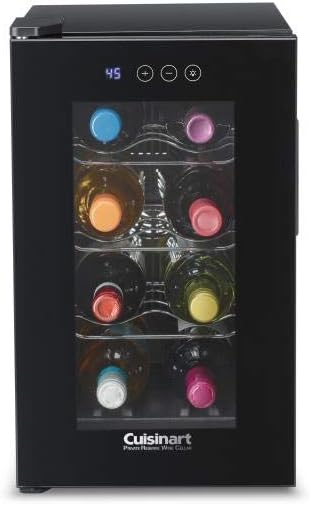
Cuisinart 8-Bottle Wine Cellar CWC-800CEN
| Cooling Method | Thermoelectric |
|---|---|
| Number Of Shelves | 8 |
| Capacity | 6 liters |
| Power Source | Electric |
The Cuisinart 8-Bottle Private Reserve Wine Cellar is a small freestanding cooler designed to keep a selection of reds, whites, or sparkling wines at controlled serving temperatures. It uses a thermoelectric cooling system, which runs quietly and is more energy efficient than compressor units, and a touchscreen control with LED readout lets you set temperatures from 39°F to 68°F. Inside, contoured chrome racks and soft interior lighting make bottle access and display simple, and the unit ships with three removable racks to organize various bottle shapes. Typical use is for short- to medium-term storage and serving in an apartment, kitchen, or home bar where vibration-free, quiet operation matters. Limitations include the small 8-bottle capacity and thermoelectric cooling, which performs best in moderate ambient temperatures and is not suited for long-term cellar aging or very warm rooms. For buyers prioritizing quiet performance and a compact footprint, this is a practical countertop or freestanding option; buyers needing larger capacity or cooler performance for hot spaces should look at compressor-based models instead.
Best for: Buyers who want a quiet, energy-conscious small wine cooler to keep a few bottles at serving temperature and prefer a compact freestanding unit for a kitchen, office, or home bar.
Less Ideal for: Collectors who need long-term proper cellar conditions, those with larger collections, or people who will place the cooler in consistently hot rooms.
- Quiet thermoelectric cooling with low vibration suitable for delicate wines
- Touchscreen controls and LED display for easy temperature setting
- Soft interior lighting and contoured chrome racks for neat presentation and access
- Compact freestanding design fits small kitchens, apartments, or bars
- Only holds up to eight bottles, limiting larger collections
- Thermoelectric cooling is less effective than compressor units in very warm ambient temperatures
Verdict: Choose this Cuisinart if you want a quiet, compact 8-bottle cooler that maintains serving temperatures with energy-efficient thermoelectric performance.
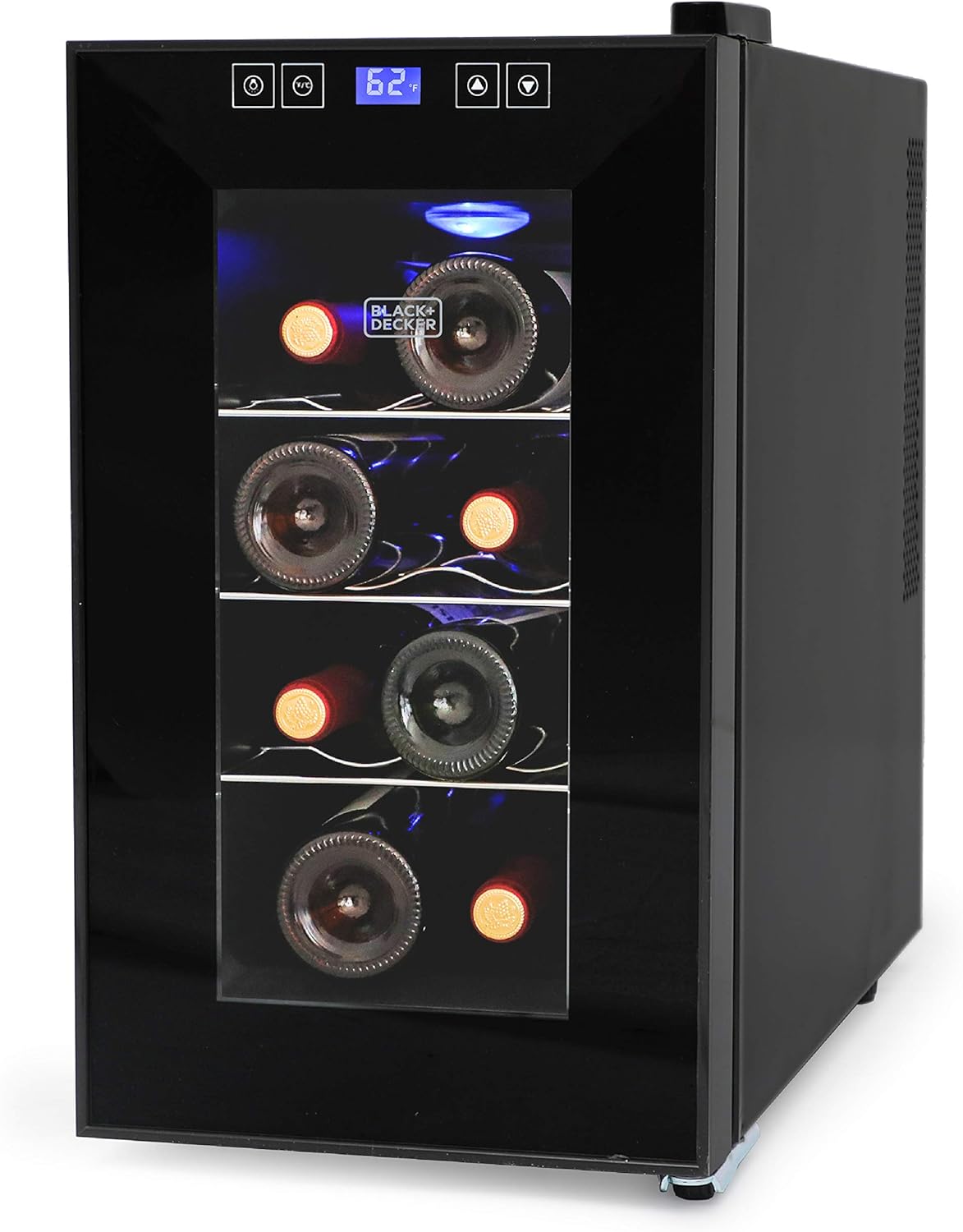
BLACK+DECKER 8-Bottle Wine Cellar BD60026
| Capacity | 0.88 cubic feet / 8 Bottles |
|---|---|
| Cooling Method | Thermoelectric |
| Temperature Range | 46°F – 65°F |
| Number of Racks | 3 |
| Power | 120 volts |
The BLACK+DECKER 8-Bottle Wine Cellar is a countertop thermoelectric cooler designed to keep wine at stable serving or short-term storage temperatures between 46 and 65°F. It uses a quiet thermoelectric system with low vibration and an electronic LED readout so you can set and monitor temperature easily, and the triple-pane clear glass door helps preserve the internal climate. The unit includes three removable chrome slide-out racks and an interior light for display, plus adjustable leveling legs and a recessed handle for a tidy countertop fit. Practical benefits include energy-efficient operation, minimal vibration that is kinder to wine sediment, and a small footprint that works in offices, bars, or kitchens. Limitations are inherent to its cooling method and size: thermoelectric units do not chill as aggressively as compressor fridges, so it is best for short- to medium-term storage and serving rather than long-term cellar aging, and the eight-bottle capacity restricts how many bottles you can store at once.
Best for: Buyers who want a compact, low-noise wine cooler for everyday serving and short-term storage and who prioritize a small footprint and simple digital controls.
Less Ideal for: Collectors needing long-term aging at very specific low temperatures or anyone who wants to store large numbers of bottles should consider larger compressor-based wine fridges.
- Compact footprint fits on counters or in small entertainment spaces
- Quiet thermoelectric cooling with low vibration preserves wine sediment
- Triple-pane glass door helps maintain stable internal temperature
- Electronic temperature control with LED display for simple monitoring
- Thermoelectric cooling is less powerful than compressor systems for rapid or very low-temperature chilling
- Only three slide-out racks limit capacity to standard bottle sizes
Verdict: A compact, quiet countertop cooler that is ideal for everyday serving and short-term storage of up to eight bottles.
Choosing the Right Small Wine Cooler for Large Bottles: Key Factors to Consider
Bottle Dimensions and Orientation
Large-format bottles vary widely in height, diameter, and neck length. Before choosing a small wine cooler, measure the tallest and widest bottles you plan to store and compare those measurements to the cooler's internal clearances. Some units allow bottles to lie flat while others are designed for upright storage; make sure the cooler supports the preferred orientation.
Orientation affects both capacity and long-term cork condition. Lying bottles flat keeps corks moist and airtight, but only if the shelves and spacing can safely accommodate the length. Upright storage saves horizontal space but concentrates pressure on the base and can lead to wine contact with the cork less frequently. Confirm how many of your large bottles will fit in either orientation so you do not end up modifying racks or stacking bottles unsafely.
Usable Capacity Versus Advertised Capacity
Manufacturers often list bottle counts based on standard 750 ml bottles, which overstates how many large bottles will actually fit. Look for usable internal volume, effective shelf spacing, and the number of racks rated for oversized bottles. A cooler that claims a certain bottle count may only hold a fraction of that number when you add magnums or tall formats.
Check whether racks are removable, sliding, or adjustable. A single removable shelf can turn multiple standard slots into a row that fits long bottles. Also consider door swing clearance and how packed the interior will be in practice; tight fits reduce airflow and may impair temperature uniformity.
Temperature Range and Stability
Wine benefits from stable temperatures rather than large daily swings. Look for coolers that can hit and hold cellar temperatures suitable for the styles you store. For red and larger-format aging, consistent mid-50s Fahrenheit is common, while serving whites requires lower setpoints. The precision of the thermostat, the presence of digital controls, and reported steady-state variation are important.
Insulation and door design affect stability as well. Thick walls, quality seals, and double-pane or UV-filtering glass doors help maintain set temperatures when the room temperature fluctuates. Avoid models with wide temperature drift or unclear calibration unless you plan to add a separate thermometer or controller.
Shelving and Rack Design
Shelves determine how bottles are organized, accessed, and supported. Look for sturdy shelves that slide or pull out to make loading long bottles easier. Some racks are designed with channels that hold bottles securely, while open shelves may allow taller bottles but provide less support.
Consider rack materials and finish. Wood slats are gentle on labels and reduce vibration transmission, while metal racks often allow denser packing but may require felt liners to avoid label scuffing. The ability to mix fixed and adjustable shelves gives you flexibility between storing larger bottles and maintaining overall capacity.
Vibration Dampening and Noise
Vibration accelerates sediment disturbance, which can be a concern for wines intended for long-term aging. Compressors, fans, and loose components can introduce micro-vibrations that affect bottle stability. Seek coolers with isolated compressors, soft-mounting, or design features that minimize vibration inside the cabinet.
Noise matters when a cooler sits in a living area or open kitchen. Check reported operating noise levels and whether the unit has quiet modes or fan-speed control. A low-noise, low-vibration design protects wine and reduces household disturbance.
Humidity and Light Protection
Relative humidity inside a cooler influences cork condition. Very dry interiors can cause corks to shrink, allowing oxygen ingress; overly humid environments can encourage mold on labels. Many small coolers do not offer active humidity control, so passive protection via stable temperatures and minimal door openings becomes important.
UV light exposure can degrade wine. Look for models with UV-filtering glass or solid doors if long-term storage is planned. If the cooler will sit in bright rooms, prioritize doors and seals that minimize light and air exchange to protect wine integrity.
Measuring Your Bottles Before You Buy
Take a tape measure to the tallest and widest bottles you own and note both the height with cork and the base diameter. Don't forget travel cork protectors or wax seals which can add height. Measuring ensures the cooler you choose has the internal clearance and rack spacing to accept your bottles without forcing them in.
If you plan to store a mix of standard and large bottles, plan for flexible shelving. Determine the number of large bottles you want to keep at once and reserve those slots when visualizing internal layouts.
- Measure bottle height, base diameter, and neck length
- Account for protective caps, wax, or seals
- Decide between upright and flat storage for your collection
Placement and Ventilation Considerations
Small wine coolers need adequate airflow around the cabinet to dissipate heat. Built-in or integrated installations have specific ventilation requirements. If you plan to place the cooler in a tight cabinet or under-counter, verify whether the unit is rated for built-in use and follow clearances to avoid overheating.
Room temperature affects performance. Avoid placing the cooler near heat sources like ovens, direct sunlight, or heating vents. A stable, temperate location reduces stress on the compressor and helps maintain consistent internal temperatures.
- Allow manufacturer-recommended clearance for ventilation
- Avoid direct sunlight and nearby heat sources
- Consider built-in rated units for under-counter installations
Maintaining Temperature Consistency
Minimize frequent door opening and avoid overpacking the interior, both of which hamper airflow and cause temperature swings. Use a small digital thermometer placed on an interior shelf to monitor variance across the cooler. If you notice hot or cold spots, reposition bottles or add a small circulation fan if the unit supports it.
Regular maintenance, such as cleaning door seals and checking condensate drains, keeps the cooling system efficient. Replace or reseal drawers and racks that no longer seat properly to preserve an even environment.
- Monitor with an internal thermometer
- Avoid overpacking; leave space for airflow
- Keep seals and drips clean for efficient cooling
Adapting Shelving for Oddball Formats
If your cooler does not natively accept a particular tall or wide bottle, removable shelves often provide a solution. Plan shelf removal so other bottles remain supported and do not shift. Some owners install custom inserts or foam supports to cradle irregular shapes without scratching labels.
When modifying racks, keep in mind load limits and balance. Do not create overhangs or cantilevers that place stress on the cabinet floor or door hinges. Balanced placement helps maintain efficient cooling and prevents tipping when the door is opened.
- Remove shelves strategically to create long-bottle rows
- Use padded supports to protect labels and prevent rolling
- Respect shelf load limits and door hinge weight
Energy Use and Long-Term Ownership
Small wine coolers vary in efficiency depending on insulation, compressor quality, and how often doors are opened. A well-insulated unit with tight seals will cycle less frequently. Consider energy use if the cooler will run continuously in a living area or basement.
Plan for long-term upkeep. Parts like door gaskets and fan motors can wear over time. Choose a cooler with accessible components and clear instructions for routine maintenance to extend usable life and reliability.
- Insulation quality reduces compressor runtime
- Regular maintenance prolongs component life
- Factor continuous running energy use into placement decisions
How We Chose the Best Small Wine Cooler for Large Bottles
We prioritized features that directly affect how well a small cooler stores oversized wine bottles. Key evaluation criteria included usable capacity for large formats, adjustable shelving and rack spacing so tall or wide bottles can fit without modification, and temperature control range and stability to maintain ideal cellar conditions. We also measured thermal insulation and door design to limit temperature swings, plus vibration damping and compressor noise because excessive movement can disturb sediment and high noise can be disruptive in living spaces. We excluded units that only advertise compact dimensions but lack clear guidance on shelf spacing or that rely solely on thin, single-pane doors with poor insulation. We also excluded coolers without any temperature calibration or with narrow control ranges that cannot hit typical red and white serving or storage setpoints. Our selection focused on models that combine thoughtful internal layouts with dependable temperature regulation and build features that support long-term wine storage for large bottles.
Our full evaluation process is outlined in our review methodology.
FAQ
Can a small wine cooler safely store magnum bottles?
Often yes, if the cooler has removable or adjustable shelves and sufficient internal height or length for a magnum. Check the usable internal dimensions rather than the standard 750 ml bottle count. Some small coolers are designed with longer shelves to accommodate magnums.
Is it better to store large bottles upright or lying flat?
Lying flat keeps corks moist and helps preserve long-term aging, while upright storage can be practical for space-saving short-term storage. The best choice depends on how long you plan to keep the bottle and the cooler's rack design.
How important is vibration control in a wine cooler?
Vibration control is important, especially for wines intended for aging, because continuous movement can disturb sediment and accelerate chemical reactions. Look for isolated compressors, solid shelving, and low-noise operation to minimize vibration exposure.
Do small coolers need humidity control for large bottles?
Active humidity control is uncommon in small units, but stable temperatures and limited door openings help maintain adequate humidity passively. If cork dryness is a concern, monitor cork condition and consider periodic inspection or a dedicated humidifier in longer-term storage situations.
Will a glass door harm my wine collection?
Glass doors that include UV protection can be fine for short- to medium-term storage, but for long-term aging it is better to minimize light exposure. Choose a cooler with UV-filtering glass or a solid door if your storage plan spans several years.
Final Verdict
Choosing a small wine cooler for large bottles requires balancing internal layout with reliable temperature control and low vibration. Prioritize usable internal dimensions and adjustable shelving so your oversized formats fit without modification, and select a unit with stable temperature regulation and good insulation to reduce daily swings. Decide whether you need more horizontal space for lying bottles or vertical clearance for upright storage, factor in noise and placement, and plan for routine maintenance. Focusing on these tradeoffs will help you pick a compact cooler that protects large bottles and supports the storage goals for your collection.