
Note: This article contains affiliate links. If you click on these links and make a purchase, we may earn a small commission at no extra cost to you. This helps support our research and content. Read our full affiliate disclosure here.
If you plan to age a handful of bottles rather than store a whole cellar, a small wine cooler designed for long-term storage makes a big difference. The right unit holds steady temperatures, controls humidity, and limits vibration so delicate wines can develop as intended. This guide shortlists the top small wine coolers suited specifically for long-term storage and explains the factors that matter for aging bottles rather than just chilling them. Below you will find our curated picks, followed by practical buying advice and the criteria we used to evaluate each cooler.
Top Picks at a Glance
| Best Overall The best all-around choice for most situations | Ivation 12-Bottle Wine Cooler |  |
| Best Quality Built to a higher standard if you want something more solid | Wine Enthusiast 24-Bottle Freezerless |  |
| Best Value The sweet spot between price and what you get | ROVSUN 18-Bottle Wine Fridge |  |
| Best Budget The cheapest option that still gets the job done reliably | EUHOMY 18L Wine Fridge |  |
| Top Rated A top-rated pick with lots of positive feedback | Vushine 12" Wine Cooler JCS-58QE |  |
| Most Popular A crowd favorite that many people choose with confidence | Ivation 18-Bottle Wine Cooler |  |
| Best Seller A high-volume bestseller chosen again and again | Icyglee 25-Bottle Wine Cooler |  |
Ivation 12-Bottle Wine Cooler
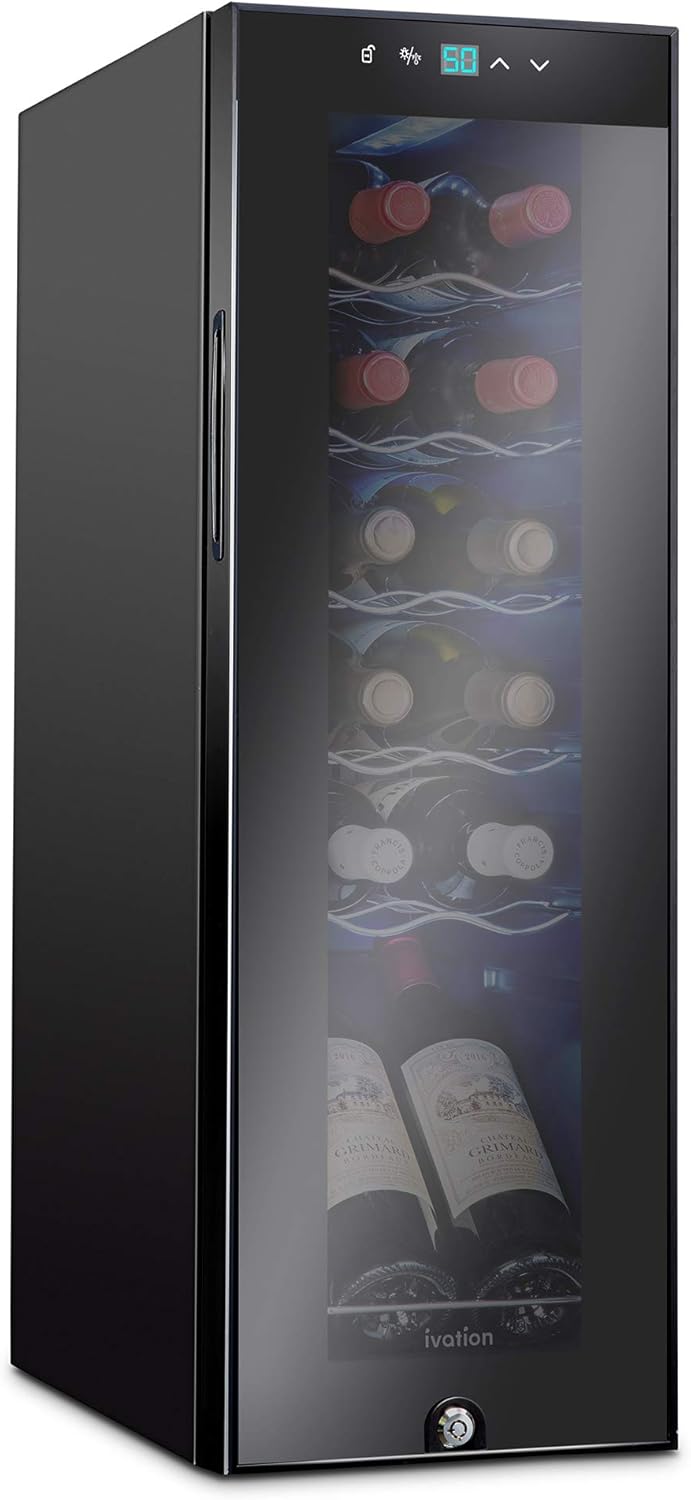
| Capacity | 1.2 cubic feet |
|---|---|
| Temperature Range | 41-64°F |
| Power | 95W / 1.2 Amps |
| Cooling Method | Compressor |
| Refrigerant | R-600A |
This Ivation 12-bottle cooler uses a compressor cooling system and internal fan to hold a stable 41–64°F range, making it suitable for both chilling and longer-term storage. It installs freestanding and has six removable wire racks so you can fit standard 750 ml bottles or rearrange for larger formats. The digital touch display shows temperature in Fahrenheit or Celsius and can be locked to prevent accidental changes, while the double-paned UV-resistant glass and rubber gasket help keep light and air out. Vibration-reducing compressor operation preserves sediment and the interior LED provides soft illumination for inspections without harsh heat. As a compact unit it draws modest power (rated 95W) and includes a keyed lock for security. Limitations include a small 1.2 cu ft capacity that restricts larger fermentation batches and single-zone control that prevents separate temperature settings for multiple products. The unit is best when you need a reliable, quiet compressor fridge with precise temperature stability in a compact footprint rather than a higher-capacity or dual-zone system.
Best for: Buyers seeking a compact, performance-focused compressor fridge that holds steady temperatures for precise fermentation or small-batch aging and who prioritize stability and quiet operation.
Less Ideal for: Those who need higher capacity, multiple temperature zones, or to run several fermentations at different setpoints simultaneously should look at larger or dual-zone units.
- Compressor cooling with inverter ensures stable, low temperatures suitable for fermentation control.
- Wide adjustable temperature range (41–64°F) with digital touch controls and lock for set-and-forget operation.
- Double-paned UV-resistant glass and airtight gasket protect contents from light and external air.
- Removable wire racks allow flexible bottle arrangement and easier cleaning.
- Quiet, vibration-reducing operation that minimizes disturbance to sediments or sensitive contents.
- Small 1.2 cubic foot capacity limits the number and size of fermentation vessels you can fit.
- Single temperature zone cannot maintain different temperatures for multiple simultaneous projects.
Verdict: Choose this cooler when you want a compact, compressor-driven fridge that delivers stable, low-temperature control for small-batch fermentation and precision cooling.
Wine Enthusiast 24-Bottle Freezerless

| Capacity | 2.4 cubic feet |
|---|---|
| Size | 24-Bottle |
| Cooling Method | Compressor |
| Defrost System Type | Manual Defrost |
| Power Plug Type | Type A – 2 pin (North American) |
This Wine Enthusiast 24-bottle cooler uses compressor-based cooling to provide steadier, more energy-efficient temperatures than thermoelectric units, which helps when storing a medium collection in variable environments like a garage. It has four chrome wire shelves plus an upright holder for up to four open bottles, and a front digital touchscreen with LED readout for setting and monitoring the single temperature zone. The unit runs quietly around 40 dB with only occasional cycling or auto-defrost sounds, and the glass door and metal racks make it easy to see and access bottles. Practical limitations include a non-reversible door and a compressor that can produce on/off cycle noise and temperature variance of about plus or minus 5 degrees when it cycles; the shelves are removable but not adjustable, which limits arrangement for odd-size bottles. For a buyer seeking stable, compressor cooling in a compact freestanding cabinet, this cooler balances performance and usable capacity for a garage setting.
Best for: Buyers who want a compact, reliable compressor cooler to preserve a modest wine collection in a variable environment like a garage and prioritize steady temperatures over adjustable shelving flexibility.
Less Ideal for: Not the best choice for collectors needing flexible shelf layouts, reversible door placement, or strictly vibration-free thermoelectric operation for extremely delicate aging setups.
- Compressor cooling delivers more stable temperatures and better performance in warmer or variable ambient conditions.
- Digital touchscreen and LED display make temperature control and monitoring straightforward.
- Sturdy chrome wire shelves and upright holder keep bottles secure and visible.
- Runs relatively quietly at about 40 dB for low-noise locations.
- Shelves are removable but not adjustable, limiting storage flexibility for oversized bottles.
- Door is not reversible which may constrain placement in tight garage layouts.
Verdict: A compact compressor wine cooler that offers stable, garage-friendly temperature control for a balanced, medium-sized collection.
ROVSUN 18-Bottle Wine Fridge

| Capacity | 1.8 cubic feet |
|---|---|
| Size | 18 Bottle |
| Temperature range | 41-64°F |
| Cooling Method | Compressor refrigeration |
| Power | 115 volts |
This ROVSUN 18-bottle wine fridge uses a compressor refrigeration system to cool bottles faster and across a wider temperature range than thermoelectric units, making it suitable for storing reds, whites, champagne, or beer between 41 and 64°F. It is designed as a freestanding unit with removable chrome-plated metal shelves, a soft LED interior light, and an exterior touch control panel so you can adjust temperature without opening the door. The compressor is described as whisper quiet and the double-layer glass door plus good sealing help maintain steady internal temperatures. Practical features include an automatic defrost system, a keyed lock, and ETL specification compliance. Expect typical small-fridge trade-offs such as limited internal capacity for oversized bottles and the footprint of a 30-inch-tall cabinet, but the compressor cooling and touch controls deliver reliable, consistent performance for everyday home use.
Best for: Buyers who want a compact, budget-friendly wine cooler that prioritizes reliable compressor cooling and easy temperature control for everyday home use.
Less Ideal for: Collectors needing storage for large-format or long-term cellaring should look at larger or dedicated wine cellar options instead.
- Compressor refrigeration provides faster, more stable cooling than thermoelectric designs
- External touch control panel lets you change temperature without opening the door
- Removable chrome-plated metal shelves for flexible bottle arrangement
- Double-layer glass door with LED light and good sealing helps keep temperature steady
- 18-bottle capacity may not fit oversized or international-format bottles
- Freestanding footprint requires planning in tight spaces
Verdict: A compact, budget-conscious compressor wine fridge that delivers faster, steadier cooling and simple touch controls for everyday home wine storage.
EUHOMY 18L Wine Fridge
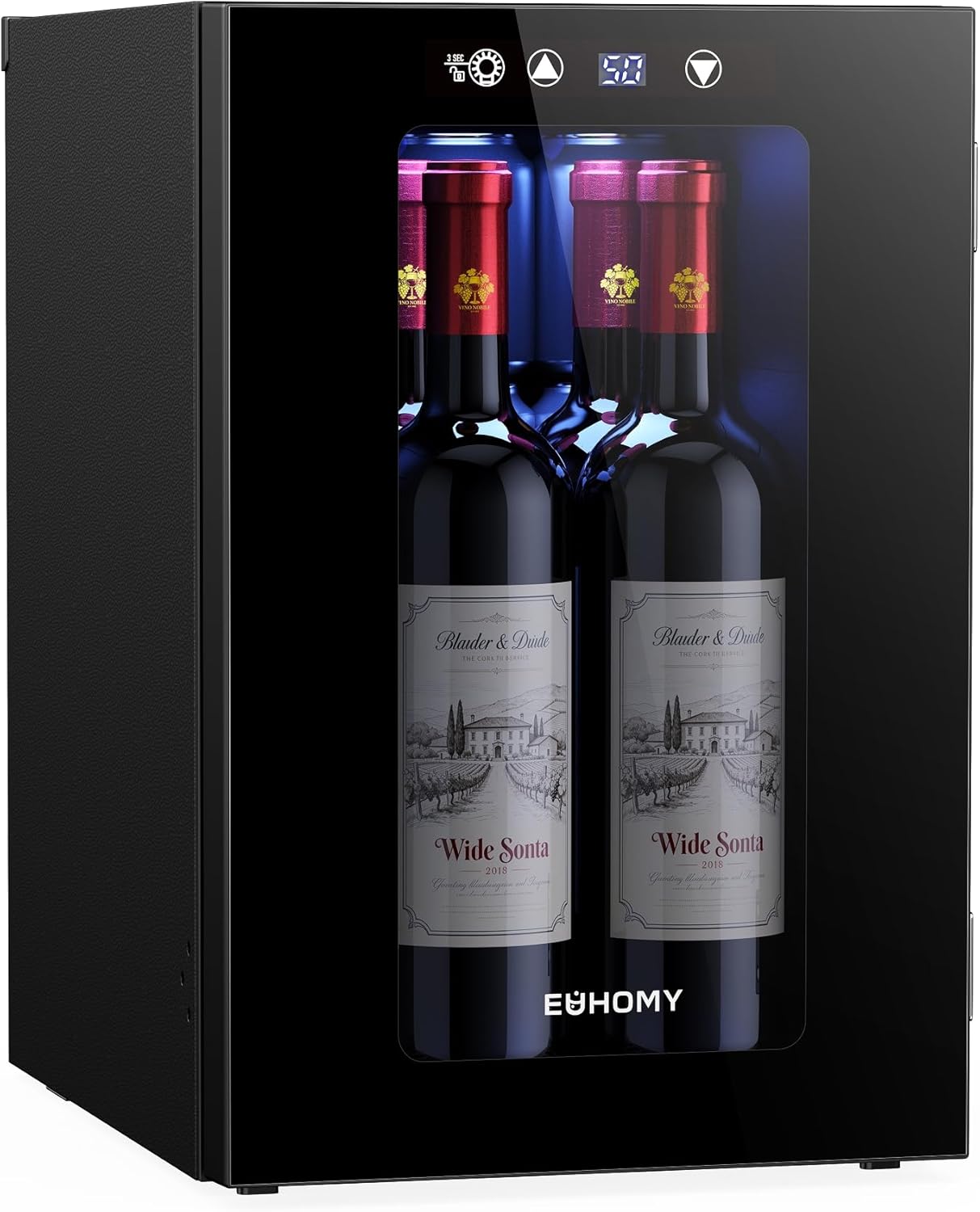
| Capacity | 18 liters |
|---|---|
| Cooling Method | Compressor |
| Temperature Range | 40°F to 61°F |
| Number Of Shelves | 1 |
| Installation Type | Countertop |
The EUHOMY 18L Wine Fridge is a small compressor-cooled cooler designed for countertop or freestanding use to store a handful of bottles and cans. It offers a digital touchscreen that sets temperatures between 40°F and 61°F, a double-pane glass door with LED interior lighting, and one removable shelf so you can fit bottles or stacks of cans. The compressor system provides steady cooling and the manufacturer states quiet operation around 38 dB, which helps the unit sit beside a bar, office, or kitchen without creating a constant noise nuisance. Practical benefits include the ability to keep red, white, sparkling wine, or beer at ready-to-serve temperatures and the compact footprint that fits tight spaces. Limitations to expect are the very small 18 L capacity that only holds about four 750 ml bottles or up to two dozen cans when arranged differently, manual defrosting, and a single door orientation without reversible mounting, so placement options are somewhat constrained.
Best for: Buyers who want a reliable, compact cooler to keep a small selection of wines or beverages at controlled serving temperatures without complicated setup or large space requirements.
Less Ideal for: Those who need to store larger collections, organize many bottle sizes, or require a built-in undercounter installation should look at larger-capacity or different-format coolers.
- Digital touchscreen with adjustable 40°F–61°F temperature range for precise control
- Compressor cooling for consistent, dependable chilling compared with thermoelectric units
- Compact countertop form that fits small kitchens, dorms, or home bars
- Double-pane glass door with LED lighting showcases contents while blocking UV rays
- Very limited 18 L capacity suitable for only a few bottles or a small can stash
- Manual defrost requires occasional maintenance and can be inconvenient
Verdict: A compact, compressor-cooled countertop wine fridge that delivers quiet, accurate temperature control for buyers who need dependable short-term storage for a few bottles.
Vushine 12" Wine Cooler JCS-58QE

| Capacity | 2.1 cubic feet |
|---|---|
| Bottle capacity | 21 bottles |
| Temperature range | 41-64°F (5-18°C) |
| Cooling method | Compressor |
| Installation type | Built-In or Freestanding |
This Vushine 12" wine cooler is a small compressor-driven cellar intended for undercounter installation or standalone use in a kitchen, bar, or office. It provides precise temperature control via a touch digital display with a 41–64°F range and a circulation fan to keep temperature uniform across its removable wooden shelves. The unit is rated for low noise and automatic defrost, and the double-pane UV-blocking glass door plus interior LED lighting help protect and present bottles. In daily use it handles chilling and short-term storage well and the compressor system cools faster and holds steady compared with thermoelectric designs. Expect straightforward setup: adjustable feet and multiple shelves let you fit different bottle sizes, but the unit is compact so capacity is limited to about 18–21 bottles. Buyers should also note the left-hinged door orientation and that it requires the usual 24-hour upright sit time before first use. For someone who wants a solid, small wine fridge that focuses on stable temperatures and build-in flexibility, this delivers sensible performance without extra bells.
Best for: Buyers who prioritize steady, reliable temperature control and a compact, installable wine fridge for everyday storage or entertaining will appreciate this unit.
Less Ideal for: Collectors who need high capacity, long-term aging storage or those who require a right-hinged door or larger footprint should consider larger models.
- Compressor cooling for faster, more stable chilling than thermoelectric units
- Digital touch temperature control with 41–64°F range for precise settings
- UV-blocking double-pane glass and interior LED protect and display bottles
- Adjustable wooden shelves and feet allow flexible storage and installation
- Automatic defrost and low-noise design suit frequent household use
- Small internal capacity limits long-term collections to roughly 18–21 bottles
- Door is left-hinged only, which may restrict placement options
Verdict: A compact, compressor-cooled wine fridge that delivers dependable, precise temperature control for everyday home use under $500.
Ivation 18-Bottle Wine Cooler

| Capacity | 1.8 cubic feet |
|---|---|
| Bottle Capacity | 18 Bottle |
| Temperature Range | 41°F–64°F |
| Cooling Method | Compressor |
| Defrost System Type | Automatic |
The Ivation 18-Bottle Wine Cooler is a compact freestanding unit that uses a compressor and internal fan to keep temperatures steady between 41°F and 64°F, making it suitable for storing reds, whites, and sparkling wines. It typically sits on the floor or a countertop and is configured as a single-zone cooler with six wire racks that are removable to fit different bottle sizes. Notable features include a double-paned thermopane glass door that reduces UV exposure, a digital touch display with lock, soft LED interior lighting, and automatic defrost for low-maintenance operation. The compressor design and inverter help the cooler maintain set temperatures even when ambient room temperature fluctuates, which is valuable for long-term storage and reliability-focused buyers. Trade-offs are its single-zone layout, which does not allow separate temperatures for whites and reds, and modest capacity, which limits it to small collections or secondary storage. Energy consumption is moderate and the unit is intended as a dedicated wine fridge rather than a full-size cellar.
Best for: Buyers who prioritize a reliable, temperature-stable freestanding cooler for a small collection or secondary wine storage and want a low-maintenance unit with clear digital controls.
Less Ideal for: Collectors who need a large-capacity or dual-zone cellar for storing multiple wine types at different temperatures should consider larger or dual-zone models instead.
- Compressor cooling with internal fan for stable, consistent temperatures
- Double-paned thermopane glass door that helps block UV and insulates the interior
- Digital touch controls with lock and clear LCD for easy temperature management
- Removable wire racks accommodate different bottle sizes and simplify loading
- Single-zone design cannot maintain different temperatures for whites and reds
- Limited 18-bottle capacity may be too small for larger collections
Verdict: Choose this Ivation cooler when you want a compact, compressor-driven freestanding unit that keeps a small wine collection at stable, reliable temperatures.
Icyglee 25-Bottle Wine Cooler

| Capacity | 3.2 cubic feet / 25 bottles |
|---|---|
| Cooling Method | Compressor (R600A) |
| Temperature Range | 41–64°F |
| Number of Shelves | 5 adjustable shelves |
| Defrost System Type | Manual |
The Icyglee 25-bottle wine cooler is a compact freestanding unit that uses a compressor to hold wine at a selectable temperature between about 41°F and 64°F, making it suitable for both red and white bottles. It has five adjustable shelves and a reversible double-layer glass door that offers UV protection while an internal LED light makes labels visible without overheating the interior. The digital temperature control and manual defrost let you dial in storage conditions, and the R600A compressor is designed for low vibration and quiet operation, which helps protect sediment and flavor. Practical benefits include a relatively high bottle capacity for a compact footprint and adjustable shelving for mixed bottle sizes, plus ETL certification and available customer support. Important limitations are its manual defrost requirement and a moderate annual energy draw, so it is best for small commercial settings or office bars where cost and space matter rather than heavy continuous-duty use.
Best for: Small businesses, office kitchens, or budget-minded bar operators who need a compact, quiet wine storage solution that balances bottle capacity and cost.
Less Ideal for: High-volume restaurants or large wine-storage operations that require larger capacity, dual-zone control, or continuous heavy-duty commercial performance.
- Compressor cooling for stable, low-vibration temperature control
- Digital temperature control across a 41–64°F range for both reds and whites
- Five adjustable shelves to accommodate mixed bottle sizes
- Double-layer glass door with UV protection and internal LED lighting
- Reversible door and compact freestanding form factor fit tight commercial spots
- Manual defrost requires occasional maintenance
- Annual energy consumption is relatively high for a compact unit
Verdict: A compact, budget-friendly compressor wine cooler that delivers quiet, stable temperature control and flexible shelving for small commercial or office use.
Choosing the Right Small Wine Cooler for Long-Term Storage: Key Factors to Consider
Temperature Stability
Long-term storage depends on keeping wine within a narrow temperature band. Small coolers that drift or cycle widely can accelerate chemical reactions and age wine unevenly.
Look for coolers with precise thermostatic control and documented stability over extended periods. Units that advertise adjustable setpoints across the standard cellar range make it easier to match storage conditions to the wine type and your local climate.
Humidity Management
Appropriate humidity helps keep corks from drying and air ingress at bay. A small cooler with poor humidity will allow corks to shrink or rot, both of which can compromise an aging bottle.
Some small units include built-in humidity systems or use passive methods like water trays and tighter door seals. Consider how the cooler maintains interior moisture across seasons and whether you can top up humidity without disturbing stored bottles.
Vibration and Motion Control
Vibrations disturb sediment and can speed undesirable reactions in aging wine. Compressors, fans, and even nearby household appliances can introduce micro-vibrations that affect long-term outcomes.
Choose models with vibration-dampening features, low-vibration compressors, or designs that isolate mechanics from shelving. Noise ratings and compressor placement are useful proxies when explicit dampening claims are absent.
Interior Layout and Bottle Fit
Small coolers vary in how many and which bottle shapes they accept. Long-term storage favors horizontal placement and secure shelving so corks remain moist and labels are protected.
Look for shallow shelving that holds standard Bordeaux and Burgundy bottles without crowding, flexible layouts that can accept a few larger formats, and finished surfaces that resist mold and odor transfer over years.
Door and Seal Quality
A well-sealed door prevents moisture loss and temperature ingress, both critical for stable long-term conditions. Cheap seals or frequently used clear glass doors with weak frames will let the environment fluctuate.
Consider tempered, UV-resistant glass or solid-door options, magnetic gaskets that maintain consistent pressure, and door locks or features that limit unnecessary opening. Frequent access will still degrade conditions, so plan placement accordingly.
Energy Use and Continuous Operation
Long-term storage means the cooler will run continuously, so energy efficiency affects operating cost and unit longevity. Inefficient units cycle more and place greater wear on compressors.
Choose systems designed for continuous use with adequate insulation, efficient compressors, and thermostats that avoid excessive cycling. Also consider serviceability and ease of filter or gasket replacement to extend useful life.
Ideal Temperature Ranges for Aging Different Wines
Different wine styles benefit from slightly different cellar temperatures. A stable range near 55 Fahrenheit is commonly cited as a general-purpose target for long-term aging, but adjusting within a few degrees can better suit specific varietals or personal preferences.
The important part is consistency. A small cooler that allows you to set and hold a target temperature within one to two degrees will produce more reliable aging results than a unit that drifts widely even if that drift stays inside nominal ranges.
- Sparkling wines often age at slightly cooler settings.
- Full-bodied red wines may be stored a few degrees warmer within the cellar range.
- Sweet and fortified wines can tolerate a wider range but still need steady conditions.
Managing Humidity in a Small Footprint
Small coolers have less internal volume to buffer humidity swings, so passive measures become important. Using a humidity tray or reservoir, positioning bottles off the back wall, and minimizing door openings help maintain moisture levels.
If a cooler provides active humidity control, verify how the system replenishes moisture and whether it requires frequent maintenance. In drier climates, plan for occasional monitoring and supplemental measures to protect corks.
- Keep a small container of water on a lower shelf to passively raise humidity.
- Avoid storing bottles with compromised or synthetic corks if humidity control is limited.
Placement and Environmental Considerations
Where you install the cooler affects how hard it must work. Avoid direct sunlight, heat sources, or areas with large temperature swings. A closet or interior wall often provides a stable ambient environment.
Provide clearance for ventilation and avoid placing the unit near washers, dryers, or high-traffic areas that introduce vibration. Good placement reduces energy use and improves temperature stability, both important for long-term storage.
- Leave recommended clearance on all sides to ensure proper airflow.
- Choose a level surface to prevent undue stress on internal shelving and the compressor.
Shelving Options and Organizing Small Collections
Organizing a small long-term collection is about protecting each bottle while keeping access to those you open. Consider models with removable or staggered shelves so you can accommodate different bottle sizes without compromising horizontal storage.
Labeling systems and a simple inventory method help you track age and cellaring goals. For bottles you plan to open soon, keep them separate from the core aging set to minimize disturbance.
- Use soft separators or shelf liners to prevent label abrasion.
- Reserve a dedicated shelf for bottles in active rotation to limit unnecessary handling of long-term stock.
Maintenance and Longevity for Continuous Use
Routine maintenance keeps a long-term cooler functioning as intended. Clean gaskets, check door seals, and vacuum condenser coils where accessible. Replace worn seals promptly to prevent humidity loss.
Plan for periodic checks of temperature performance and listen for unusual sounds that indicate beginning wear. A small cooler that receives basic upkeep will preserve conditions more reliably over years than one neglected after installation.
- Inspect seals and hinges every six months.
- Keep condenser and ventilation areas dust free.
How We Chose the Best Small Wine Cooler for Long-Term Storage
We focused on features that directly affect how well a small wine cooler supports long-term bottle aging. Key evaluation criteria included temperature stability across the recommended aging range, humidity control or passive humidity retention, vibration reduction to protect sediment and cork integrity, interior layout and shelving that safely hold standard aged bottles, and build quality and insulation to maintain conditions over months and years. We also considered energy efficiency for continuous operation and compressor type for noise and longevity. Units were excluded if they were marketed solely for short-term serving, lacked any means of humidity or vibration mitigation, or had inconsistent temperature regulation in the typical cellaring range. We prioritized coolers with documented continuous-running capability and thoughtful interiors that make long-term storage practical for small collections. The listed scoring metrics reflect these priorities and guided editorial judgment without relying on brand or price alone.
Our full evaluation process is outlined in our review methodology.
FAQ
What temperature should I set a small cooler for long-term storage?
Aim for a stable temperature around 50 to 58 Fahrenheit depending on the wine style, with roughly 55 Fahrenheit as a common all-purpose target. Consistency within a degree or two is more important than the exact setpoint.
How important is humidity for long-term wine storage in a small unit?
Humidity matters because it keeps natural corks from drying. Ideally maintain moderate humidity; if a cooler lacks active control, use passive measures like a water tray and minimize door openings to preserve moisture.
Can I store sparkling or fortified wines in the same small cooler as reds?
You can, but consider slight temperature adjustments if you plan to age both types long term. If the unit supports different setpoints or you segregate bottles spatially, you can achieve better conditions for each style.
How often should I check the bottles in long-term storage?
Frequent handling is not recommended. Check on the collection periodically to confirm temperature and humidity, perhaps every few months, and only open bottles when necessary to avoid disturbing the environment.
Is vibration a real concern for a small wine cooler?
Yes. Continuous low-level vibration can disturb sediments and affect aging. Choose a unit with vibration damping or a low-vibration compressor and place it away from household sources of motion.
Final Verdict
For long-term bottle aging in a small format, prioritize stable temperature control, humidity management, and vibration mitigation above all else. Interior shelving that supports horizontal storage and a tight door seal are practical next-level considerations. Balance those technical needs against available space and maintenance willingness so you choose a cooler that can hold conditions for months and years without frequent intervention. Focus on consistent environmental control rather than features designed for quick serving. That approach will help you preserve and develop wines reliably in a small wine cooler built for long-term storage.