
Note: This article contains affiliate links. If you click on these links and make a purchase, we may earn a small commission at no extra cost to you. This helps support our research and content. Read our full affiliate disclosure here.
Choosing the right small wine cooler matters when you want both reds and whites at their best without dedicating a full cabinet. The wrong storage can flatten aromas, speed oxidation, or make serving inconvenient. This guide focuses on compact coolers designed to hold and chill red and white bottles at their ideal ranges while fitting into kitchens, apartments, or entertaining nooks. We shortlisted top small wine coolers that pair temperature precision with flexible shelving and quiet operation. Below you will find our top picks and the evaluation criteria we used, plus practical buying guidance to help you match capacity, layout, and performance to how you drink and store wine.
Top Picks at a Glance
| Best Overall The best all-around choice for most situations | Icyglee 25-Bottle Wine Cooler |  |
| Best Quality Built to a higher standard if you want something more solid | Cuisinart 8-Bottle Wine Cellar CWC-800CEN |  |
| Best Value The sweet spot between price and what you get | Feelfunn 12-Bottle Wine Cooler |  |
| Best Budget The cheapest option that still gets the job done reliably | Icyglee Beverage Refrigerator WC-6B |  |
| Top Rated A top-rated pick with lots of positive feedback | Ivation 18-Bottle Wine Cooler |  |
| Most Popular A crowd favorite that many people choose with confidence | EUHOMY Wine Cooler BR001-110 |  |
| Best Seller A high-volume bestseller chosen again and again | EUHOMY 18L Wine Fridge |  |
Icyglee 25-Bottle Wine Cooler

| Capacity | 3.2 cubic feet / 25 bottles |
|---|---|
| Cooling Method | Compressor (R600A) |
| Temperature Range | 41–64°F |
| Number of Shelves | 5 adjustable shelves |
| Defrost System Type | Manual |
The Icyglee 25-bottle wine cooler is a compact freestanding unit that uses a compressor to hold wine at a selectable temperature between about 41°F and 64°F, making it suitable for both red and white bottles. It has five adjustable shelves and a reversible double-layer glass door that offers UV protection while an internal LED light makes labels visible without overheating the interior. The digital temperature control and manual defrost let you dial in storage conditions, and the R600A compressor is designed for low vibration and quiet operation, which helps protect sediment and flavor. Practical benefits include a relatively high bottle capacity for a compact footprint and adjustable shelving for mixed bottle sizes, plus ETL certification and available customer support. Important limitations are its manual defrost requirement and a moderate annual energy draw, so it is best for small commercial settings or office bars where cost and space matter rather than heavy continuous-duty use.
Best for: Small businesses, office kitchens, or budget-minded bar operators who need a compact, quiet wine storage solution that balances bottle capacity and cost.
Less Ideal for: High-volume restaurants or large wine-storage operations that require larger capacity, dual-zone control, or continuous heavy-duty commercial performance.
- Compressor cooling for stable, low-vibration temperature control
- Digital temperature control across a 41–64°F range for both reds and whites
- Five adjustable shelves to accommodate mixed bottle sizes
- Double-layer glass door with UV protection and internal LED lighting
- Reversible door and compact freestanding form factor fit tight commercial spots
- Manual defrost requires occasional maintenance
- Annual energy consumption is relatively high for a compact unit
Verdict: A compact, budget-friendly compressor wine cooler that delivers quiet, stable temperature control and flexible shelving for small commercial or office use.
Cuisinart 8-Bottle Wine Cellar CWC-800CEN
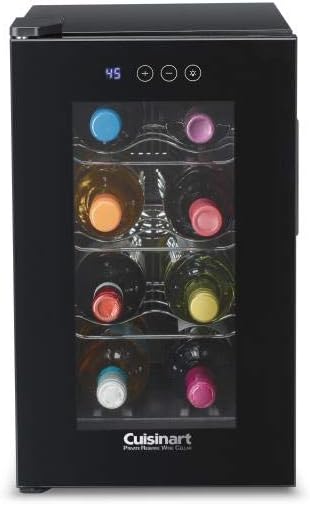
| Cooling Method | Thermoelectric |
|---|---|
| Number Of Shelves | 8 |
| Capacity | 6 liters |
| Power Source | Electric |
The Cuisinart 8-Bottle Private Reserve Wine Cellar is a small freestanding cooler designed to keep a selection of reds, whites, or sparkling wines at controlled serving temperatures. It uses a thermoelectric cooling system, which runs quietly and is more energy efficient than compressor units, and a touchscreen control with LED readout lets you set temperatures from 39°F to 68°F. Inside, contoured chrome racks and soft interior lighting make bottle access and display simple, and the unit ships with three removable racks to organize various bottle shapes. Typical use is for short- to medium-term storage and serving in an apartment, kitchen, or home bar where vibration-free, quiet operation matters. Limitations include the small 8-bottle capacity and thermoelectric cooling, which performs best in moderate ambient temperatures and is not suited for long-term cellar aging or very warm rooms. For buyers prioritizing quiet performance and a compact footprint, this is a practical countertop or freestanding option; buyers needing larger capacity or cooler performance for hot spaces should look at compressor-based models instead.
Best for: Buyers who want a quiet, energy-conscious small wine cooler to keep a few bottles at serving temperature and prefer a compact freestanding unit for a kitchen, office, or home bar.
Less Ideal for: Collectors who need long-term proper cellar conditions, those with larger collections, or people who will place the cooler in consistently hot rooms.
- Quiet thermoelectric cooling with low vibration suitable for delicate wines
- Touchscreen controls and LED display for easy temperature setting
- Soft interior lighting and contoured chrome racks for neat presentation and access
- Compact freestanding design fits small kitchens, apartments, or bars
- Only holds up to eight bottles, limiting larger collections
- Thermoelectric cooling is less effective than compressor units in very warm ambient temperatures
Verdict: Choose this Cuisinart if you want a quiet, compact 8-bottle cooler that maintains serving temperatures with energy-efficient thermoelectric performance.
Feelfunn 12-Bottle Wine Cooler

| Capacity | 1.41 cubic feet / 12 Bottle |
|---|---|
| Temperature Range | 41-64°F (5-17°C) |
| Cooling Method | Compressor |
| Defrost System Type | Frost Free |
| Installation Type | Freestanding |
The Feelfunn 12-bottle wine cooler is a compact freestanding fridge designed to store and chill up to a dozen standard wine bottles. It uses a compressor cooling system with a digital touch panel to set temperatures between 41 and 64°F, and five removable wire shelves let you arrange bottles or fit a few larger formats. Double-glazed glass doors provide UV protection and a built-in soft LED light makes it easy to see contents without warming the interior. The unit is rated to run quietly (under 35 dB) so it can sit in a living room or home bar without drawing attention, and frost-free operation reduces maintenance. Practical limitations are its modest 1.41 cu ft capacity and narrow footprint, so it is best for small collections rather than long-term cellaring or large-format bottles, and the compressor-based cooler will produce some vibration compared with thermoelectric models. For someone who wants simple digital controls, adjustable shelving, and a compact, quiet fridge for everyday chilled wine, this covers the essentials well.
Best for: Buyers who want a reliable, low-maintenance cooler for everyday chilled wine in a small space and prioritize simple digital controls and quiet operation.
Less Ideal for: Collectors who need long-term aging capacity, storage for many bottles, or frequent accommodation of very large-format bottles should look at larger or dedicated cellar units.
- Digital temperature control with 41–64°F range for flexible chilling of reds, whites and sparkling
- Compact freestanding design fits kitchens, home bars or offices
- Double-glazed glass door with UV protection helps preserve wine
- Adjustable removable shelves allow flexible bottle arrangement
- Quiet compressor operation (listed under 35 dB) suitable for living spaces
- Only a 12-bottle capacity, too small for larger collections
- Compressor operation can introduce slight vibration compared with thermoelectric units
Verdict: A compact, quiet 12-bottle cooler with simple digital controls and adjustable shelving for everyday chilled wine in small spaces.
Icyglee Beverage Refrigerator WC-6B

| Capacity | 0.6 cubic feet |
|---|---|
| Cooling Method | Compressor |
| Temperature Range | 40–61°F |
| Defrost Type | Manual Defrost |
The Icyglee WC-6B is a small compressor beverage fridge designed to chill cans and a few bottles in tight spaces. It offers one removable wire shelf so you can stack cans or lay a couple of wine bottles flat, and a temperature dial that ranges roughly from 40 to 61°F for basic beverage and wine chilling. Because it uses an R600 compressor it cools faster and more consistently than thermoelectric units, and the manual defrost and tight door seals help keep internal temps steady. The compact freestanding design and mirrored black door make it easy to tuck under a counter, in an office, or next to a home bar, and the claimed noise level under 40 dB keeps operation unobtrusive. Limitations include very small capacity — listed as 18 liters or 0.6 cu ft — so it is best for singles, couples, or very light entertaining, and there are no advanced controls like a digital thermostat or dual zones. For buyers wanting an affordable, space-saving compressor cooler for a handful of drinks, this covers the basics well.
Best for: Buyers looking for an inexpensive, space-saving beverage cooler to hold a small rotation of drinks in a dorm, office, or compact home bar.
Less Ideal for: Anyone who needs larger capacity, multi-zone temperature control, or a dedicated wine cellar solution for long-term bottle storage.
- Compressor cooling (R600) for faster, more consistent chills than thermoelectric units
- Removable shelf lets you switch between cans and a few bottles
- Very compact freestanding footprint fits tight spaces and under counters
- Quiet operation reported under 40 dB for low-noise placement
- Very small internal capacity (0.6 cu ft) limits storage to about a dozen cans or a few bottles
- No digital thermostat or dual-zone control for precise wine storage
Verdict: A budget-friendly, compressor-cooled mini beverage fridge that saves space while reliably chilling a small number of drinks.
Ivation 18-Bottle Wine Cooler

| Capacity | 1.8 cubic feet |
|---|---|
| Bottle Capacity | 18 Bottle |
| Temperature Range | 41°F–64°F |
| Cooling Method | Compressor |
| Defrost System Type | Automatic |
The Ivation 18-Bottle Wine Cooler is a compact freestanding unit that uses a compressor and internal fan to keep temperatures steady between 41°F and 64°F, making it suitable for storing reds, whites, and sparkling wines. It typically sits on the floor or a countertop and is configured as a single-zone cooler with six wire racks that are removable to fit different bottle sizes. Notable features include a double-paned thermopane glass door that reduces UV exposure, a digital touch display with lock, soft LED interior lighting, and automatic defrost for low-maintenance operation. The compressor design and inverter help the cooler maintain set temperatures even when ambient room temperature fluctuates, which is valuable for long-term storage and reliability-focused buyers. Trade-offs are its single-zone layout, which does not allow separate temperatures for whites and reds, and modest capacity, which limits it to small collections or secondary storage. Energy consumption is moderate and the unit is intended as a dedicated wine fridge rather than a full-size cellar.
Best for: Buyers who prioritize a reliable, temperature-stable freestanding cooler for a small collection or secondary wine storage and want a low-maintenance unit with clear digital controls.
Less Ideal for: Collectors who need a large-capacity or dual-zone cellar for storing multiple wine types at different temperatures should consider larger or dual-zone models instead.
- Compressor cooling with internal fan for stable, consistent temperatures
- Double-paned thermopane glass door that helps block UV and insulates the interior
- Digital touch controls with lock and clear LCD for easy temperature management
- Removable wire racks accommodate different bottle sizes and simplify loading
- Single-zone design cannot maintain different temperatures for whites and reds
- Limited 18-bottle capacity may be too small for larger collections
Verdict: Choose this Ivation cooler when you want a compact, compressor-driven freestanding unit that keeps a small wine collection at stable, reliable temperatures.
EUHOMY Wine Cooler BR001-110

| Capacity | 3.2 cubic feet |
|---|---|
| Bottle capacity | Up to 25 standard 750ml bottles |
| Temperature range | 41°F to 64°F |
| Cooling method | Compressor |
| Door orientation | Reversible |
This EUHOMY wine cooler is a compact freestanding unit aimed at steady, long-term beverage storage. It uses a compressor cooling system with a 41 to 64°F temperature range controlled by a digital touchscreen, so you can keep reds, whites, and sparkling bottles at appropriate serving temperatures. The interior offers four chrome full-width racks, a flat shelf and a bottom compartment to fit up to 25 standard 750ml bottles and to reconfigure storage as needed. The double-layer thermopane glass door reduces temperature swings and blocks UV light, and soft LED lighting helps with visibility without harsh heat. Practical touches include adjustable leveling legs, a built-in handle and a reversible door for flexible placement under counters or freestanding in a bar or office. Expect manual defrosting and typical small-fridge energy use; for buyers prioritizing quiet, vibration-free operation the compressor is described as high-performance and low-vibration but compressor units can still be noisier than thermoelectric models. The unit is supported by a one-year warranty and arrives with a user manual for setup and operation.
Best for: Buyers who want a compact, reliable freestanding cooler for steady storage of a small to medium wine collection and value precise temperature control and flexible placement.
Less Ideal for: Those seeking a zero-maintenance built-in cellar replacement, ultra-low energy operation, or very large bottle capacity should consider larger or different-style units.
- Compressor cooling with a wide 41–64°F range for storing different wine styles
- Double-pane glass door that insulates and blocks UV to protect wine quality
- Adjustable shelves and mix of racks allow flexible storage up to 25 standard bottles
- Digital touchscreen control and internal LED lighting simplify temperature monitoring and viewing
- Reversible door and leveling legs make placement under counters or freestanding easier
- Manual defrost requires occasional user maintenance
- Annual energy consumption is relatively high compared with the smallest thermoelectric units
Verdict: A compact, compressor-cooled freestanding wine cooler that delivers precise temperature control and flexible storage for a small commercial or bar setting.
EUHOMY 18L Wine Fridge
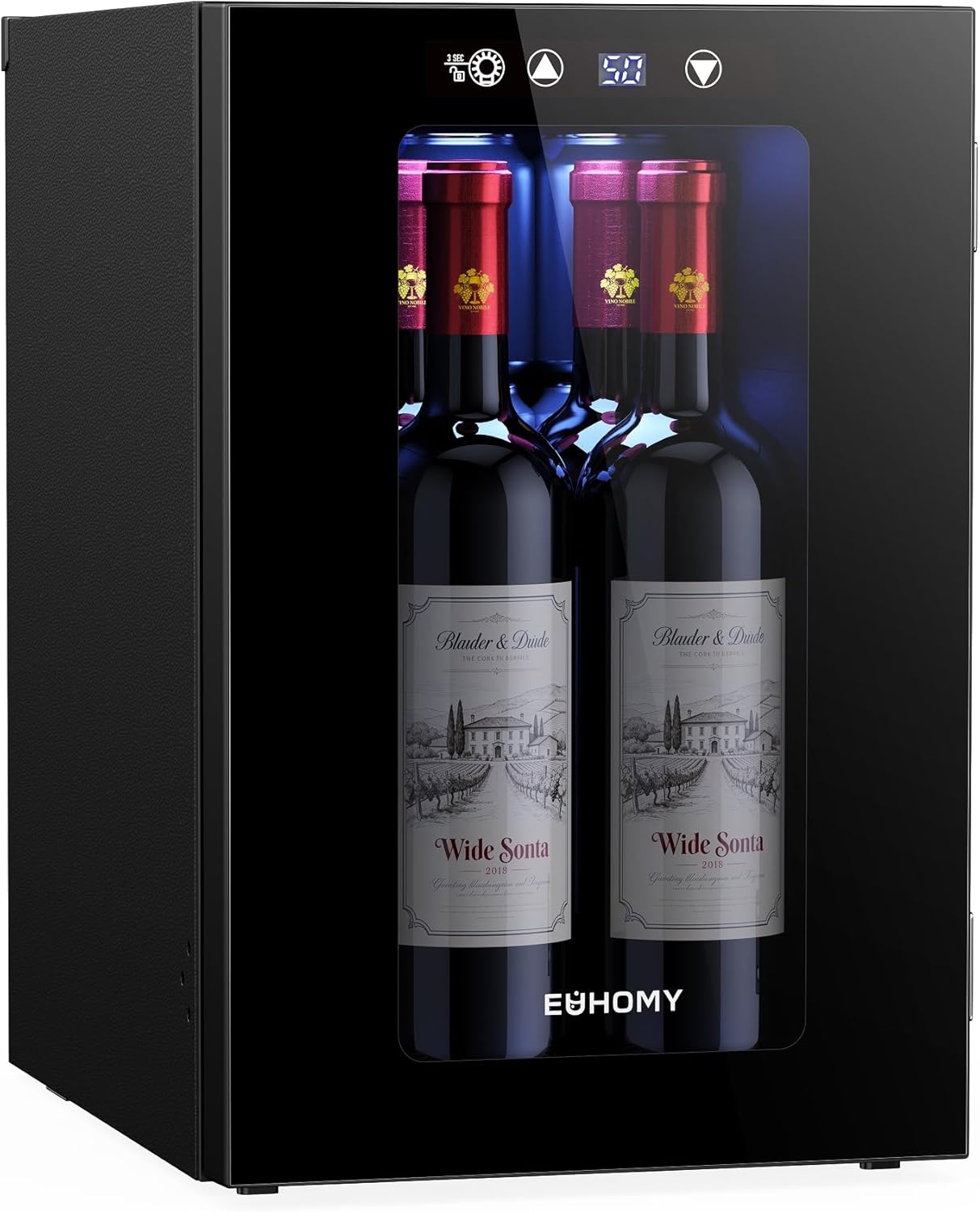
| Capacity | 18 liters |
|---|---|
| Cooling Method | Compressor |
| Temperature Range | 40°F to 61°F |
| Number Of Shelves | 1 |
| Installation Type | Countertop |
The EUHOMY 18L Wine Fridge is a small compressor-cooled cooler designed for countertop or freestanding use to store a handful of bottles and cans. It offers a digital touchscreen that sets temperatures between 40°F and 61°F, a double-pane glass door with LED interior lighting, and one removable shelf so you can fit bottles or stacks of cans. The compressor system provides steady cooling and the manufacturer states quiet operation around 38 dB, which helps the unit sit beside a bar, office, or kitchen without creating a constant noise nuisance. Practical benefits include the ability to keep red, white, sparkling wine, or beer at ready-to-serve temperatures and the compact footprint that fits tight spaces. Limitations to expect are the very small 18 L capacity that only holds about four 750 ml bottles or up to two dozen cans when arranged differently, manual defrosting, and a single door orientation without reversible mounting, so placement options are somewhat constrained.
Best for: Buyers who want a reliable, compact cooler to keep a small selection of wines or beverages at controlled serving temperatures without complicated setup or large space requirements.
Less Ideal for: Those who need to store larger collections, organize many bottle sizes, or require a built-in undercounter installation should look at larger-capacity or different-format coolers.
- Digital touchscreen with adjustable 40°F–61°F temperature range for precise control
- Compressor cooling for consistent, dependable chilling compared with thermoelectric units
- Compact countertop form that fits small kitchens, dorms, or home bars
- Double-pane glass door with LED lighting showcases contents while blocking UV rays
- Very limited 18 L capacity suitable for only a few bottles or a small can stash
- Manual defrost requires occasional maintenance and can be inconvenient
Verdict: A compact, compressor-cooled countertop wine fridge that delivers quiet, accurate temperature control for buyers who need dependable short-term storage for a few bottles.
Choosing the Right Small Wine Cooler for Red and White Wine: Key Factors to Consider
Temperature Range and Accuracy
Small wine coolers must reach and maintain temperatures appropriate for both red and white wine. Whites are typically best between about 45 and 55°F, while reds are often served from about 55 to 65°F depending on style. A cooler that cannot reliably hold those setpoints or that swings widely with compressor cycles will degrade aromas and accelerate aging.
When a unit advertises tight variance or digital set controls, that usually correlates to better bottle-to-bottle consistency. For buyers storing both types at once, dual-zone control is ideal; if only single-zone cooling is available, confirm the range includes both target temperatures and that the unit can sustain the lower end without excessive runtime.
Capacity and Bottle Orientation
Rated bottle counts for small coolers often assume standard 750 ml Bordeaux-style bottles. If you collect wider Burgundy bottles, magnums, or bottles with heavy punt shapes, effective capacity will be lower. Also consider whether you want to store bottles on their sides for cork hydration or upright for short-term chilling and grab-and-go service.
Shelving that slides or removes increases usable space and lets you mix reds and whites across shelves. Pay attention to the usable shelf depth and whether racks cradle bottles securely; poor rack design can reduce capacity and make retrieval awkward in a compact unit.
Dual-Zone Vs Single-Zone Design
Dual-zone designs let you set two different temperatures and are the simplest way to store reds and whites together. In a small cabinet, however, dual-zone units must be engineered to avoid thermal bleed between compartments. Check how the manufacturer separates zones and whether each zone has its own thermostat and airflow management.
Single-zone coolers can still work if you plan to dedicate the cooler to one style at a time or if you set a compromise temperature and use quick chilling for whites before serving. Consider how you actually drink wine: if you frequently host both styles simultaneously, dual-zone is usually worth the space and cost tradeoffs.
Noise, Vibration, and Location
Noise matters because small wine coolers are often placed in living spaces or open kitchens. Look for low-decibel operation and compressor designs advertised for quiet running. Vibration is a separate concern; sustained vibration can disturb sediment in older red bottles and may affect delicate aromatics over time.
How you plan to site the cooler affects acceptable noise levels. A unit that is fine in a basement might be distracting in a small apartment. Also consider ventilation needs and whether the cooler requires rear or top clearance; inadequate airflow will increase noise and shorten component life.
Energy Use and Daily Operation
Energy draw is more noticeable with a small cooler because compressors cycle frequently in tight cabinets. Look at rated power consumption and any energy-saving modes. Better insulation and well-sealed doors reduce cycling and maintain stable temperatures with less runtime.
Also consider door usage patterns. Frequent openings cause temperature recovery events that increase energy use and can momentarily raise compartment temperatures, which matters if you store both reds and whites at tight setpoints.
Finish, Venting, and Installation
Small wine coolers come in built-in or freestanding-ready finishes. Built-in designs often allow front ventilation, which is essential if you plan to tuck the unit under counters. Freestanding units may need rear clearance for airflow.
Consider door style and finish in your space because a reflective or glass door affects UV exposure. If you place the cooler near heat sources or in direct sunlight, insulation and cooling capacity become more critical to maintain set temperatures.
Why Dual-Zone Matters for Mixed Cellars
Dual-zone coolers provide separate temperature control for two compartments, which simplifies keeping whites and reds at their preferred serving or storage temperatures. In compact units, the design and airflow management between zones determine how independently each side holds its setpoint.
If you frequently serve both styles at the same gathering, dual-zone gives you ready-to-serve bottles without juggling a separate portable cooler or repeatedly changing set temperatures.
- Look for independent thermostats and sealed partitioning between zones
- Check recovery time when the door is opened on a busy night
- Confirm usable capacity of each zone for the types of bottles you own
Placement and Ventilation Tips for Small Units
Proper placement preserves performance and longevity. Built-in models often vent from the front and can be installed under counters, while freestanding coolers typically need clearances at the back and sides. Tight cabinets without ventilation will force the compressor to run harder and may shorten life.
Also plan for door swing clearance and whether the cooler will be near heat sources like ovens or direct sun. A small cooler positioned near a heat source can struggle to maintain low temperatures and will cycle more frequently.
- Allow recommended clearances and avoid enclosed spaces without ventilation
- Keep the unit away from direct sunlight and heat-generating appliances
- Measure door swing and nearby obstacles before final placement
Shelving Types and Organization Strategies
Shelving options—wire racks, slide-out wood shelves, or fixed metal trays—affect both capacity and ease of access. Slide-out shelves make it easier to rotate bottles and see labels in small spaces, while fixed racks may offer slightly higher rated capacity.
Organize with intent: reserve one shelf for ready-to-serve whites and another for short-term chilled reds, or use the top zone for whites and the bottom for reds if the unit is single-zone and you want a rough temperature gradient.
- Choose adjustable or removable shelves for flexibility
- Use shallow baskets for odd-shaped bottles
- Label shelves or use stickers to track ideal serving temps
Managing Humidity and Light Exposure
Humidity control is less critical in a small wine cooler than in a cellar, but adequate humidity helps preserve corks in long-term storage. Many small units have moderate humidity by virtue of sealed compartments, but extremely dry room environments can still dry corks over time.
Glass doors offer attractive display but allow UV and visible light that can degrade wine. Look for tinted glass or UV-blocking doors if you plan to place the cooler where it will get light exposure.
- Tuck humidifiers or moisture trays only when long-term cork preservation is a concern
- Prefer tinted or UV-resistant glass doors for display units
- Avoid placing coolers under bright lighting or in direct sun
Quick Chilling and Serving Workflow
If you host, build a workflow for quick chilling whites and refreshing reds. Fast-chill techniques or a small portable rapid cooler handle last-minute needs without disturbing stored inventory. Plan shelf space so you can move bottles temporarily to a lower-traffic area of the cooler to speed cooling.
Consider how often you need bottles at serving temperature versus long-term storage; that balance informs whether to prioritize rapid recovery time or slightly higher steady-state insulation.
- Reserve a bottom shelf or a front-access zone for bottles you will serve soon
- Allow at least a half hour for chilled whites pulled from room temperature
- Use pre-chilling in a fridge or ice bucket for last-minute needs
How We Chose the Best Small Wine Cooler for Red and White Wine
We evaluated small wine coolers using criteria that matter for storing both red and white wine in limited spaces. Temperature accuracy and stability were top priorities because reds and whites need different setpoints and consistent control to protect flavor and prevent premature aging. Storage layout and shelving flexibility were next, since small coolers must accommodate both standard Bordeaux bottles and slightly wider formats without wasting space. Noise and vibration were considered because vibration and loud compressors can disturb sediment and interfere with enjoyment in living spaces. Energy efficiency and run-time behavior were included to reflect real-world household costs and the ability to maintain set temperatures during frequent door openings. Finish, fit, and installation options were checked to ensure models work in typical kitchen or apartment locations and that ventilation needs fit confined spots. We excluded products intended solely for bulk commercial storage or non-wine beverage use. We focused on small, residential wine coolers whose specifications explicitly support dual-zone or precise single-zone control suitable for both red and white bottles. The resulting selection prioritizes measurable temperature performance, usable capacity, and everyday usability over marketing claims or aesthetic-only features.
Our full evaluation process is outlined in our review methodology.
FAQ
Can a small single-zone cooler store both reds and whites?
Often, but with tradeoffs. A single-zone cooler can store both if you set a compromise temperature or cycle bottles between the cooler and a quick-chill method. For simultaneous ready-to-serve bottles at different temperatures, dual-zone is more convenient.
How much ventilation clearance does a small wine cooler need?
Clearance depends on design. Built-in units usually vent from the front and need minimal side and rear space, while freestanding models commonly require several inches at the back for airflow. Always follow the manufacturer's clearance recommendations to avoid overheating and extra noise.
Will vibration from a small cooler damage wine?
Moderate vibration over long periods can disturb sediment and potentially affect delicate aromas. Look for models marketed with low-vibration or anti-vibration compressor systems if long-term aging or many older reds are in your collection.
Is a glass door safe for long-term wine storage?
Glass doors are acceptable for short- to medium-term storage if they have UV protection and the cooler is kept away from direct sunlight. For long-term aging, a solid door in a consistently dark environment is preferable.
How do I decide capacity needs for a small cooler?
Estimate how many bottles you want on hand plus space for rotation. Account for wider bottles and whether you will store upright. Rated capacities assume standard bottles, so plan for fewer bottles if you collect larger formats or want easy access.
Final Verdict
When selecting a small wine cooler for both red and white wine, prioritize temperature control and storage flexibility. If you frequently serve both styles at the same time, dual-zone control delivers the most convenience, while single-zone units can work for dedicated short-term storage or if you are willing to manage serving temperatures. Balance capacity and shelving against the space you have available, and consider noise, ventilation, and door type for the intended location. Focus on models that offer tight temperature accuracy and usable storage rather than headline capacity figures to confidently preserve and present your bottles.