
Note: This article contains affiliate links. If you click on these links and make a purchase, we may earn a small commission at no extra cost to you. This helps support our research and content. Read our full affiliate disclosure here.
Choosing the right smart smoke detector for home matters because early, reliable alerts can make the difference between a minor incident and a major emergency. A connected detector adds remote notifications, coordinated alarms, and easier maintenance, but not all units are equal in detection performance, app reliability, or installation type. This guide covers the top shortlisted smart smoke detectors for home use, each selected for practical household needs. We evaluate detection accuracy, connectivity and notification behavior, installation and power options, and long-term upkeep. Read on to find a model that fits your home's layout and monitoring preferences.
Top Picks at a Glance
| Best Overall The best all-around choice for most situations | YoLink Photoelectric Smoke Alarm YS7A12-UC |  |
| Best Value The sweet spot between price and what you get | eufy Security Smoke Alarm E10 |  |
| Best Budget The cheapest option that still gets the job done reliably | Kidde Smart Smoke Detector RGSDR-RW |  |
| Top Rated A top-rated pick with lots of positive feedback | HEIMAN Smart Smoke Detector S1-R Kit |  |
| Most Popular A crowd favorite that many people choose with confidence | Kidde Smart Smoke & CO Detector RGCUDR-RW |  |
YoLink Photoelectric Smoke Alarm YS7A12-UC

| Power Source | Battery Powered |
|---|---|
| Built-In Media | Photoelectric Smoke Alarm |
| Alarm | Audible |
The YoLink Photoelectric Smoke Alarm is a compact, battery-powered detector designed to spot smoldering fires and deliver remote alerts through the YoLink ecosystem. It installs quickly on ceilings or walls and uses a photoelectric sensor to reduce nuisance triggers from cooking while providing reliable early detection in bedrooms, hallways, and utility spaces. When paired with the YoLink Hub the alarm sends multi-channel notifications to your phone, email, or SMS and supports remote silence and automated or manual test schedules. The unit is UL217 10th Edition and CAN/ULC S531 certified and advertises up to five years of battery life, which lowers maintenance frequency. Because the device depends on the YoLink Hub for full smart functionality, buyers should plan for that extra component and the associated setup. The alarm is practical for homeowners who want a quieter photoelectric sensor with long battery life and broader wireless range than typical Wi-Fi sensors, but it is not a standalone smart detector without the hub.
Best for: Homeowners who want a reliable photoelectric alarm with long battery life and remote alerting as part of a broader smart-home ecosystem.
Less Ideal for: Users who need a standalone Wi‑Fi smart detector or who do not want to add a separate hub to their home network.
- Photoelectric sensor reduces false alarms from cooking and steam
- Certified to UL217 10th Edition and CAN/ULC S531 for recognized safety standards
- Long battery life rated up to five years lowers maintenance
- Sends remote alerts and supports remote silence when used with the YoLink Hub
- Small, easy-to-install form factor suitable for high ceilings and tight spaces
- Requires a YoLink Hub for smart alerts and remote features
- Fewer on-device smart features when used without the hub
Verdict: Choose this photoelectric alarm if you want a low-maintenance, certified smoke detector that delivers remote alerts and advanced range when paired with the YoLink Hub.
eufy Security Smoke Alarm E10

| Power Source | Battery Powered |
|---|---|
| Alarm | Audible |
| Compatible Devices | HomeBase 2, 3, Mini, and Pro |
The eufy Security Smoke Alarm E10 is an ultra-compact photoelectric smoke detector intended to integrate with a compatible eufy HomeBase for app notifications and centralized monitoring. It delivers UL 217 compliant smoke detection and a loud audible alarm while minimizing false alerts, and connects to HomeBase over a claimed long-range wireless link for flexible placement. The sealed built-in battery is rated for five years, removing yearly battery changes and low-battery chirps, and a one-tap mute plus a two-second test button simplify routine checks and silencing nuisance alerts. Practical buyers will appreciate the small 70 mm design that blends into rooms and the requirement to use a HomeBase, which centralizes alerts and remote notifications but means the detector cannot function standalone. Its focus is on reliable, low-maintenance smoke detection rather than DIY standalone operation or multi-vendor smart-home integrations.
Best for: Homeowners looking to optimize safety with low-maintenance, centralized smart detection and who already use or plan to install a eufy HomeBase for remote alerts.
Less Ideal for: People who want a standalone battery smoke alarm or who prefer devices that integrate directly with third-party smart-home hubs without a proprietary base station.
- UL 217 10th edition compliant for standard fire detection
- Sealed 5-year built-in battery removes regular battery replacement
- Ultra-compact 70 mm design blends discreetly into rooms
- App alerts and remote notifications when paired with eufy HomeBase
- One-tap mute and easy 2-second test make maintenance simple
- Requires a compatible eufy HomeBase to operate and cannot run standalone
- Limited to eufy HomeBase ecosystem for remote features and alerts
Verdict: Buy this if you want a low-profile, hands-off smoke detector that delivers UL-compliant alerts and five years of sealed battery service when tied into a eufy HomeBase system.
Kidde Smart Smoke Detector RGSDR-RW
| Power source | 2 AA alkaline batteries (included) |
|---|---|
| App notifications | Ring app real-time alerts |
| Interconnectivity | Wire-free interconnect with other Kidde alarms |
| Standards | UL 217 and FCC certified |
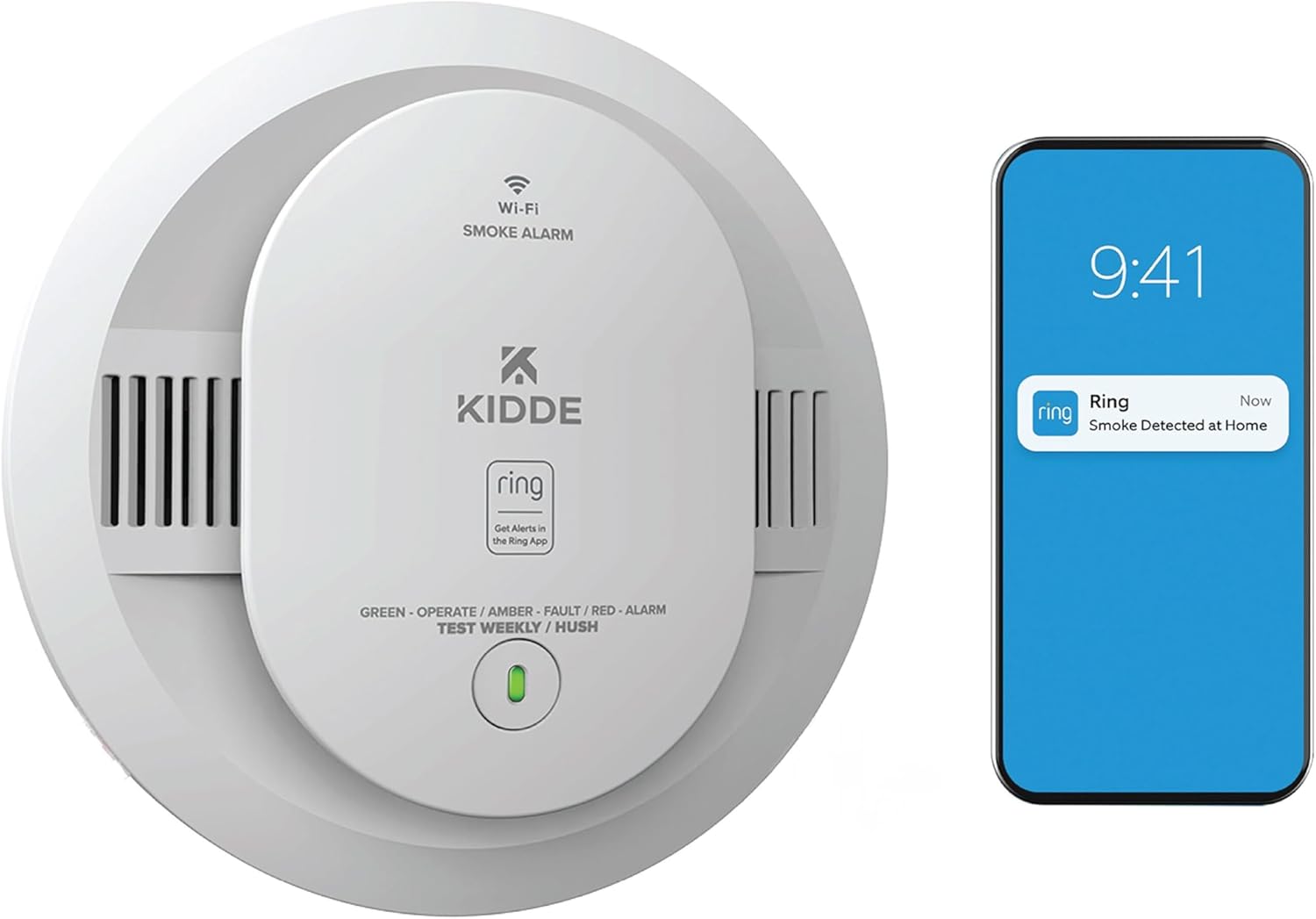
This Kidde Smart Smoke Detector pairs with the Ring app to deliver real-time smoke and low-battery alerts to your phone without a subscription, and it runs on two AA batteries so no wiring is required. It uses enhanced sensing to cut down on nuisance alarms compared with older Kidde models and claims faster smoke detection versus a leading competitor, making it practical for kitchens and living areas. The detector also supports wire-free interconnectivity so every Kidde alarm in the home can sound together, and it can relay notifications through Alexa-enabled devices. Setup is straightforward for renters or homeowners who do not want to modify wiring, but you can opt into Ring's optional 24/7 monitoring subscription for remote alarm response. The main limitations are reliance on AA batteries for power and optional paid monitoring for professional response, but for basic smart alerts and easy installation this unit hits the essentials.
Best for: Buyers looking for an inexpensive, easy-to-install smart smoke alarm that provides mobile alerts and simple interconnectivity without changing home wiring.
Less Ideal for: Homes that need hardwired, battery-backup professional monitoring out of the box or those who prefer built-in home automation hubs instead of Ring integration.
- Real-time smoke and low-battery notifications via the Ring app without a subscription
- Battery-powered, no hardwiring required for easy installation and use in rentals
- Wire-free interconnectivity lets multiple Kidde alarms sound together
- Enhanced sensing reduces false alarms compared with prior Kidde models
- Runs on AA batteries which require periodic replacement
- Optional 24/7 professional monitoring requires a paid Ring subscription
Verdict: A budget-friendly, battery-operated smart smoke detector that delivers real-time mobile alerts and easy wire-free installation for renters and cost-conscious homeowners.
HEIMAN Smart Smoke Detector S1-R Kit

| Power Source | 10-Year Battery Powered |
|---|---|
| Sensor Type | Photoelectric |
| Compatible Devices | Google Home, Heiman APP, Home Assistant, IFTTT, SmartThings |
| Alarm | Audible (85 dB) |
This HEIMAN kit pairs three photoelectric smoke alarms with a dedicated gateway to provide both local wireless interconnect and remote smartphone alerts when linked to a 2.4 GHz network. Installation is straightforward with magnetic or screw mounting and the units run on sealed 10-year CR123A batteries so you avoid annual battery changes and midnight chirps. The photoelectric dual-beam sensor is tuned to detect slow-smoldering fires while reducing cooking false alarms, and the 85 dB siren plus flashing LEDs and one-touch test/silence button make daily use and checks easy. Adding the gateway enables app notifications and integrations with Home Assistant, Google Home, IFTTT, and SmartThings for automation and broader monitoring. Limitations to note are the gateway requirement for remote alerts, the 2.4 GHz-only Wi-Fi setup, and that advanced features require configuring the app and compatible smart platforms, which may add setup time for less technical users.
Best for: Buyers who prioritize dependable, low-maintenance home fire protection and want the option to add remote monitoring and smart-home automations for whole-house alerts.
Less Ideal for: People who need a simple, standalone alarm with no hub or app dependence or households that only use 5 GHz Wi-Fi and cannot provide a 2.4 GHz connection.
- 10-year sealed battery power eliminates regular battery replacements and low-battery chirps
- Wireless interconnect lets one triggered alarm sound all linked units for whole-home notification
- Included gateway enables remote smartphone alerts and integrations with common smart home platforms
- Photoelectric dual-beam sensor reduces false alarms from cooking and detects slow-smoldering fires
- Gateway and 2.4 GHz Wi-Fi are required for remote notifications and smart integrations
- Setup and smart platform integration can take extra time and may require technical steps
Verdict: A low-maintenance, UL‑certified kit that combines 10‑year sealed batteries, wireless interconnect, and a gateway for reliable whole-home alerts and smart monitoring.
Kidde Smart Smoke & CO Detector RGCUDR-RW

| Detection type | Smoke and carbon monoxide |
|---|---|
| Power source | 2 AA batteries (included) |
| App integration | Ring app notifications |
| Certifications | UL 217, FCC |
This Kidde Smart Smoke & CO detector combines smoke and carbon monoxide sensing with Ring app notifications and battery-powered convenience. It mounts like a standard alarm and runs on two AA batteries, so you can install it anywhere without wiring; when it detects smoke or CO it sounds the local alarm and can send mobile alerts through the Ring app whether you are home or away. The unit supports Kidde wire-free interconnect so all compatible Kidde alarms in a house can sound together, and it includes enhanced sensing to cut down on nuisance alarms from cooking compared with prior Kidde models. It also offers low-level CO mobile alerts and works with Alexa for basic voice notifications. Important limitations are that advanced 24/7 monitoring requires an optional Ring subscription and it relies on AA batteries so you need to keep track of battery life; it is not a hardwired replacement for systems that require AC power and sealed-backup batteries.
Best for: Buyers who prioritize verified safety features and want a smart, easy-to-install alarm that provides app notifications and can interconnect with other Kidde devices for whole-home alerts.
Less Ideal for: Homes that require hardwired, AC-powered alarms with permanent backup power or users who need included professional monitoring without a subscription.
- Detects both smoke and carbon monoxide in one unit
- Real-time mobile alerts through the Ring app without a subscription
- Wire-free interconnect lets all Kidde alarms sound together
- Battery operation allows installation without wiring
- Reduced nuisance alarms compared with prior Kidde models
- Optional 24/7 professional monitoring requires a paid Ring subscription
- Runs on AA batteries rather than hardwired power with battery backup
Verdict: A straightforward, battery-powered combined smoke and CO alarm that delivers app alerts and wire-free interconnect for buyers who want trusted, smart home notifications.
Choosing the Right Smart Smoke Detector for Home: Key Factors to Consider
Detection Method and Accuracy
Different sensing technologies respond better to different kinds of fires. Photoelectric sensors excel at detecting slow, smoldering fires that produce a lot of smoke, while ionization sensors are typically faster at sensing fast-flaming fires. Some smart detectors combine sensing types or add heat sensors to improve overall responsiveness.
Detection accuracy affects both safety and nuisance alarms. A detector that is too sensitive may produce frequent false alarms from cooking or steam, while one that under-detects can delay alerts. Look for detectors with documented sensitivity ranges and certification to local safety standards to ensure dependable performance in home environments.
Connectivity and Alerting Options
How a smart detector connects determines how and when you receive alerts. Devices that use Wi-Fi can send push notifications directly to your phone, but rely on a stable home network. Detectors that use a mesh protocol or a separate hub can offer more reliable local propagation between units even if the internet goes out.
Consider whether the system supports local siren coordination, delayed notification for false-alarm reduction, and multiple user alerts. Also check whether the detector can communicate with other smart home systems for automation, such as pausing HVAC or triggering lights during an alarm.
Power Source and Installation
Smart smoke detectors come in battery-powered, hardwired, and rechargeable configurations. Battery models are easiest to install but require periodic battery replacement or recharge. Hardwired detectors provide continuous power and are often required in some homes, but installation can require access to ceiling wiring and possibly a neutral wire.
Installation type impacts placement flexibility. If you have high ceilings, vaulted areas, or older wiring, make sure the detector's mounting hardware and power requirements match the locations you intend to protect. Some designs offer convenient mounting plates for tool-free removal during testing and maintenance.
Maintenance, Testing, and Longevity
Regular testing and timely battery replacement are essential for ongoing protection. Smart detectors that include remote test and status reporting reduce the need for manual checks and can remind you when batteries are low or sensors need attention. Replaceable batteries and clear battery-access designs simplify upkeep.
Also consider the expected service life of the sensing element and whether the manufacturer provides firmware updates and diagnostics. Detectors that offer self-tests, sensor health logs, and audible or app-based warnings for failures will reduce the chance of unnoticed faults over years of use.
False Alarm Prevention and Smart Features
False alarms are common pain points in households. Features such as hush or silence modes, adaptive sensitivity for cooking areas, and multi-sensor verification can reduce nuisance alerts. Look for detectors with intelligent logic that differentiates between harmless cooking smoke and genuine fire conditions.
Smart features like staged alerts, geofenced arming, and integration with other home sensors can improve how alarms are handled. For example, automatic silencing based on a nearby occupancy sensor or temporarily reduced sensitivity during scheduled cooking times can prevent unnecessary disturbances while keeping safety a priority.
Placement Strategy for Whole-Home Coverage
Proper placement ensures timely detection and coordinated alarms. Install detectors on every level of the home, inside each bedroom, and in hallways that connect sleeping areas. Ceiling mounting is preferable because smoke rises; if ceiling installation is not possible, place units high on walls, at least 4 inches below the ceiling.
Avoid installing detectors too close to bathrooms, kitchens, or HVAC vents where steam, cooking fumes, or drafts can cause false alarms. Instead, place them at a distance that balances early detection with nuisance-minimization. For open-concept spaces, a centrally located unit can cover larger areas but consider multiple detectors for faster detection in sprawling floor plans.
- Mount on or near the ceiling in the center of rooms when possible.
- Keep at least 10 feet from cooking appliances to reduce false alarms.
- Add units in attics, basements, and stairwells for comprehensive coverage.
Coordinating Multiple Units and Alarm Behavior
Smart detectors should coordinate to ensure all occupants hear an alarm no matter where it starts. Local interconnectivity means that if one unit senses smoke, neighboring units will also sound, providing quicker household-wide notification. Check whether the detector supports local propagation independent of internet connectivity.
Consider how the system handles simultaneous events, such as multiple alarms or cascading notifications. Look for devices that prioritize local audible alerts first, followed by remote notifications, to ensure that on-site occupants are warned even if network connectivity is degraded.
- Confirm multi-unit alarm synchronization works without the cloud.
- Verify how long coordinated alarms persist and whether they reset automatically.
App Functionality and Remote Monitoring
A clear and reliable app can make the difference between timely action and missed alerts. Key app features include immediate push notifications, battery and sensor health indicators, event history logs, and remote hush or test functions. Look for straightforward setup flows and readable status screens that show which specific unit triggered an alert.
Apps vary in how they show alerts and diagnostics. Prefer apps that separate critical alarm notifications from routine maintenance messages and that allow multiple household members to receive alerts. Also check for firmware update processes that can be initiated from the app to keep devices secure and current.
- Look for apps with per-unit status and event logs.
- Choose detectors that allow multiple user accounts and reliable push alerts.
Dealing with Common False Alarm Sources
Cooking, steam from showers, dust, and aerosols are frequent causes of false alarms. Address these by careful placement and by choosing detectors with adaptive thresholds or hush features. In kitchens, consider using a heat-sensing complement or installing the smoke detector slightly further from the stove.
Regular cleaning and periodic testing reduce the chance of dust-triggered alarms. Use the detector's test function after any cleaning or battery change to confirm correct operation. If your detector provides event logs, review them to identify recurring false-trigger patterns and adjust placement if necessary.
- Use hush modes for temporary false-alarm sources when safe to do so.
- Clean units according to manufacturer guidance to prevent dust-related triggers.
Integration With Home Safety Systems
Integration lets smoke detectors work with other safety systems, such as carbon monoxide detectors, smart locks, lighting, and HVAC controls. Properly configured interactions can automatically unlock doors, flash lights, or shut down HVAC to slow fire spread. Verify that the detector supports local automation or can expose triggers to a separate smart home controller.
When integrating, ensure that automated actions do not create new hazards. For instance, shutting off HVAC can reduce smoke spread but may also affect ventilation. Test automation routines under safe conditions to confirm they behave as expected.
- Prefer detectors that provide clear, documented integration options.
- Test automation flows to confirm they trigger only under intended alarm conditions.
How We Chose the Best Smart Smoke Detector for Home
We focused on the features that actually matter for a smart smoke detector for home and applied strict editorial filters to keep the list practical. First, we prioritized detection reliability by considering units with proven photoelectric or ionization sensing approaches and clear signal thresholds for slow-smoldering and fast-flaming fires. Second, connectivity and notification behavior were central: we favored detectors that support consistent local alarm propagation and reliable remote alerts over Wi-Fi or dedicated hubs. Third, installation flexibility and power source options were weighed, including battery, hardwired, and rechargeable designs, because mounting and wiring constraints vary across homes. Fourth, we assessed maintenance and lifecycle factors, including battery life, ease of testing and silencing false alarms, and firmware update support. Finally, we took usability into account, such as companion app clarity, multi-unit coordination, and diagnostic alerts. We excluded devices that lack remote alert capability or that rely solely on proprietary, hard-to-source hubs. We also excluded units without clear safety certifications. The resulting selection emphasizes real-world performance, dependable connectivity, and low-friction upkeep that homeowners can rely on.
Our full evaluation process is outlined in our review methodology.
FAQ
How often should I test a smart smoke detector for home?
You should test detectors monthly using the built-in test function and verify app connectivity. Monthly tests confirm the alarm sound, local coordination, and that remote alerts are delivered as expected.
Can smart smoke detectors work if my internet is down?
Many smart detectors still sound local alarms and coordinate with nearby units if the internet is down, especially those using mesh or hub-based protocols. Remote push notifications require an internet connection, so local alarm propagation is the critical fallback.
Do smart smoke detectors require different maintenance than standard detectors?
Maintenance is similar but with added app checks. In addition to battery replacement and cleaning, you should monitor the companion app for firmware updates, sensor health alerts, and battery status to ensure long-term reliability.
Are battery-only smart detectors as reliable as hardwired ones?
Battery-only detectors can be equally reliable if they use high-quality batteries and provide timely status reporting. Hardwired units reduce the need for battery changes and may be preferred where continuous power is essential, but modern battery-operated smart detectors often include multi-year batteries and robust diagnostics.
Will smart features increase false alarms?
Smart features do not inherently increase false alarms; in many cases they reduce them through adaptive algorithms, hush modes, and event logging. However, increased sensitivity for remote monitoring can lead to more notifications, so balance sensitivity and nuisance filtering to match your home environment.
Final Verdict
Prioritize detectors that offer reliable detection methods, dependable local alarm coordination, and clear connectivity behavior. Balance installation needs with preferred power sources, and favor units that provide remote diagnostics and easy maintenance to minimize unnoticed failures. Consider placement and integration carefully to reduce false alarms while ensuring fast, household-wide notification. Focus on the core tradeoffs—detection accuracy versus nuisance filtering, and local alarm reliability versus cloud-dependent features—to choose a smart smoke detector for home that fits your layout and monitoring preferences with confidence.