
Note: This article contains affiliate links. If you click on these links and make a purchase, we may earn a small commission at no extra cost to you. This helps support our research and content. Read our full affiliate disclosure here.
If your home uses a boiler to heat radiators or baseboards, the wrong thermostat can cause short-cycling, uneven warmth, or wasted energy. A Smart Thermostat for Boiler System lets you manage schedules, optimize run times, and monitor system behavior from your phone or voice assistant while addressing boiler-specific wiring and control needs. This guide presents six shortlisted smart thermostats that are suited to boiler-equipped homes, chosen for compatibility, control flexibility, and safety-conscious features. Below we explain the evaluation criteria and what to expect from each type of smart thermostat so you can pick the option that matches your boiler wiring and comfort goals.
Top Picks at a Glance
| Best Overall The best all-around choice for most situations | Honeywell Home Smart Color Thermostat RTH9585WF |  |
| Best Quality Built to a higher standard if you want something more solid | Google Nest Learning Thermostat (4th Gen) |  |
| Best Value The sweet spot between price and what you get | ecobee Smart Thermostat Essential |  |
| Top Rated A top-rated pick with lots of positive feedback | Sensi Smart Thermostat ST55 |  |
| Most Popular A crowd favorite that many people choose with confidence | Google Nest Thermostat |  |
| Best Seller A high-volume bestseller chosen again and again | Amazon Smart Thermostat |  |
Honeywell Home Smart Color Thermostat RTH9585WF

| Connectivity Technology | Wi‑Fi |
|---|---|
| Controller Type | Touch Screen, Voice |
| Power Source | AC Power Supply |
| Display Type | LED |
| Specification Met | Energy Star |
The Honeywell Home Smart Color Thermostat is a wall‑mounted, Wi‑Fi programmable thermostat built for homeowners who want an easy, customizable smart control for heating and cooling. It offers a bright color touchscreen you can personalize to match décor, plus app and voice control for remote adjustments. The unit supports 7‑day scheduling, Smart Response Technology that learns temperature preferences, local weather display, and intelligent alerts for filter and humidifier pad changes. Installation is designed for DIY with step‑by‑step guidance, but the thermostat requires a C‑wire and works only with low‑voltage systems, so check compatibility before buying. Energy Star certification and utility rebate compatibility help reduce running costs, while Alexa and Google Home integration make voice control straightforward. Limitations include lack of compatibility with line‑voltage baseboard heat and the need for a C‑wire adapter in some homes, and the interface can feel busy compared with simpler models. For typical boiler systems that use low‑voltage control and have a C‑wire, this thermostat brings smart scheduling, remote access, and energy reporting in an attractive, customizable package.
Best for: Buyers who want a visually customizable, app‑controlled smart thermostat that provides flexible weekly scheduling, energy reporting, and voice control for a standard low‑voltage boiler or forced‑air HVAC setup.
Less Ideal for: Homes that use line‑voltage electric baseboard heating or owners without an available C‑wire who do not want to add a power adapter should look elsewhere.
- Customizable full‑color touchscreen for easy, readable control and decor matching
- Wi‑Fi and app control plus Alexa and Google Home voice integration for remote operation
- Smart Response Technology and 7‑day programming for automated, comfort‑aware scheduling
- Energy Star certification and compatibility with utility rebate or demand response programs
- Intelligent alerts for filter and humidity maintenance to protect HVAC equipment
- Requires a C‑wire and is not compatible with line‑voltage electric baseboard heating systems
- Feature-rich interface may be more complex than simpler thermostats for basic users
Verdict: A feature‑rich, Energy Star certified smart thermostat that suits homeowners wanting a customizable touchscreen, smart scheduling, and full remote and voice control for compatible low‑voltage boiler systems.
Google Nest Learning Thermostat (4th Gen)

| Controller Type | Amazon Alexa, Android, Apple HomeKit, Google Assistant, iOS |
|---|---|
| Power Source | Battery Powered |
| Voltage | 24 volts |
| Display Type | graphical lcd, ips |
| Included Components | Nest Temperature Sensor (2nd gen) |
The Nest Learning Thermostat (4th gen) is a high-end smart thermostat that learns your temperature preferences, suggests schedule tweaks, and provides remote control through the Google Home app or voice assistants. It is typically wall-mounted and used to manage home heating and cooling systems, with compatibility for most 24V systems and inclusion of a Nest Temperature Sensor to reduce hot and cold spots. Notable features include Dynamic Farsight for a readable large display, Adaptive Eco that adjusts based on outdoor conditions, Smart Ventilation, and a System Health Monitor that alerts you to potential HVAC issues. The thermostat emphasizes energy savings by shifting to Eco temps when you leave and by integrating with Nest Renew to shift usage to cleaner or cheaper energy times. Practical benefits are automated schedule learning, visible suggestions you can accept in-app, and the ability to monitor equipment health. Limitations for performance-focused buyers include the need to confirm boiler compatibility on the Nest compatibility checker for some systems and that advanced boiler-specific features like outdoor reset or multistage boiler control may be limited compared with dedicated hydronic controls.
Best for: Buyers who prioritize automated energy optimization and remote smart-home control and who want a thermostat that learns preferences while offering sensors to reduce room-level temperature variation.
Less Ideal for: People running complex boiler or hydronic systems that require advanced outdoor reset, multistage boiler sequencing, or specialized controls should consider a boiler-focused controller instead.
- Learns user schedule and suggests energy-saving schedule adjustments automatically
- Includes a Nest Temperature Sensor to manage hot and cold spots remotely
- Works with Google Home, Alexa, and Apple HomeKit and supports Matter for easier smart home integration
- Adaptive Eco and Smart Ventilation use outdoor conditions to reduce runtime and energy use
- System Health Monitor sends alerts if the heating or cooling system needs attention
- Some boiler-specific advanced controls are not offered, so you may need a dedicated hydronic controller for complex setups
- Compatibility with certain boiler wiring setups requires checking the Nest compatibility tool before installation
Verdict: Choose this Nest thermostat if you want a learning, app-driven smart thermostat that prioritizes energy savings and easy smart-home integration while helping smooth temperature differences across rooms.
ecobee Smart Thermostat Essential

| Connectivity Technology | Wi-Fi |
|---|---|
| Controller Type | Amazon Alexa, Android, Apple HomeKit, Google Assistant, iOS |
| Power Source | Battery Powered |
| Display Type | LCD |
| Specific Uses For Product | Air Conditioner, Electric Baseboard Heater, Furnace |
The ecobee Smart Thermostat Essential is a pared-down smart thermostat that gives you app and voice control, simple touchscreen operation, and energy-saving scheduling for everyday heating and cooling management. It connects to your home Wi‑Fi and integrates with Apple HomeKit, Google Assistant, and Siri/Alexa for remote and voice adjustments, while built-in eco+ features and auto-scheduling help reduce runtime. The unit is battery powered and mounts to the wall with a compact round LCD touch display that makes daily adjustments straightforward. Installation is DIY-friendly for most 24 VAC systems and ecobee provides a Power Extender Kit for homes without a C wire; the product page also includes a compatibility checker for boiler and other systems. Limitations include fewer advanced sensors and no bundled room sensor, and the Essential model omits some premium features found on higher-end ecobee thermostats, so buyers should expect a focus on core smart controls rather than full-featured home monitoring.
Best for: Buyers who want a practical, affordable smart thermostat that delivers remote control, schedules, and energy-saving features for everyday heating systems like boilers and forced-air rigs.
Less Ideal for: People who need advanced multi-room sensing, built-in air quality monitoring, or the full feature set of higher-end smart thermostats.
- Works with major smart home platforms including HomeKit, Google Assistant, and Alexa for remote and voice control.
- Eco+ features and auto-scheduling help reduce energy use without constant intervention.
- DIY installation for most 24 VAC systems with support for homes without a C wire using the PEK accessory.
- Simple color touchscreen and app make daily temperature adjustments easy to set and monitor.
- Does not include a separate room sensor for remote temperature sensing.
- Fewer advanced features and sensors compared with premium ecobee models.
- Battery powered design may require periodic battery replacement depending on installation.
Verdict: A cost-conscious smart thermostat that delivers essential remote control and energy-saving scheduling for typical home heating systems, including boilers.
Sensi Smart Thermostat ST55

| Connectivity Technology | Wi-Fi |
|---|---|
| Control Method | App, Touch, Voice |
| Temperature Control Type | Programmable, Smart/Remote |
| Power Source | Corded Electric |
| Number of Batteries | 2 AA batteries required. (included) |
The Sensi ST55 is a straightforward Wi‑Fi smart thermostat aimed at replacing a conventional wall thermostat while adding remote control, scheduling, and energy reports. It supports boilers, furnaces, heat pumps, and air conditioners and connects to popular ecosystems including Alexa, Google Assistant, Apple HomeKit, and SmartThings. Installation is designed for DIY use with included mounting hardware, wire stickers, a built‑in level, and step‑by‑step app guidance, and it can operate with or without a common wire in many setups. The interface combines buttons with an LED display and app control for scheduling, usage reports, and maintenance alerts like filter reminders. Because it is Energy Star certified and emphasizes data privacy, it is a practical choice for owners who want reliable temperature control and modest energy savings without complex setup. Limitations include a basic LED screen rather than a color touchscreen and dependence on a 2.4 GHz Wi‑Fi network for remote features, so advanced on‑device customization is limited compared with higher‑end models.
Best for: Buyers who prioritize a reliable, factory‑grade smart thermostat that installs easily and provides basic smart control, usage reporting, and compatibility with common boiler systems and voice assistants.
Less Ideal for: Users who want a high‑end touchscreen interface, extensive on‑device customization, or thermostat features aimed at very large or complex multi‑zone HVAC installations should consider other options.
- Supports boilers, furnaces, heat pumps and AC for broad HVAC compatibility
- Energy Star certified with usage reports and scheduling to help reduce HVAC energy use
- Easy DIY installation with mounting hardware, wire labels, and app guidance
- Works with Alexa, Google Assistant, Apple HomeKit and SmartThings for voice and smart home control
- No color touchscreen; display is a simple LED interface
- Requires a stable 2.4 GHz Wi‑Fi network for remote access and app features
Verdict: Choose the Sensi ST55 when you want a dependable, easy‑to‑install smart thermostat that adds remote control, scheduling, and energy reporting to a boiler or other common HVAC system.
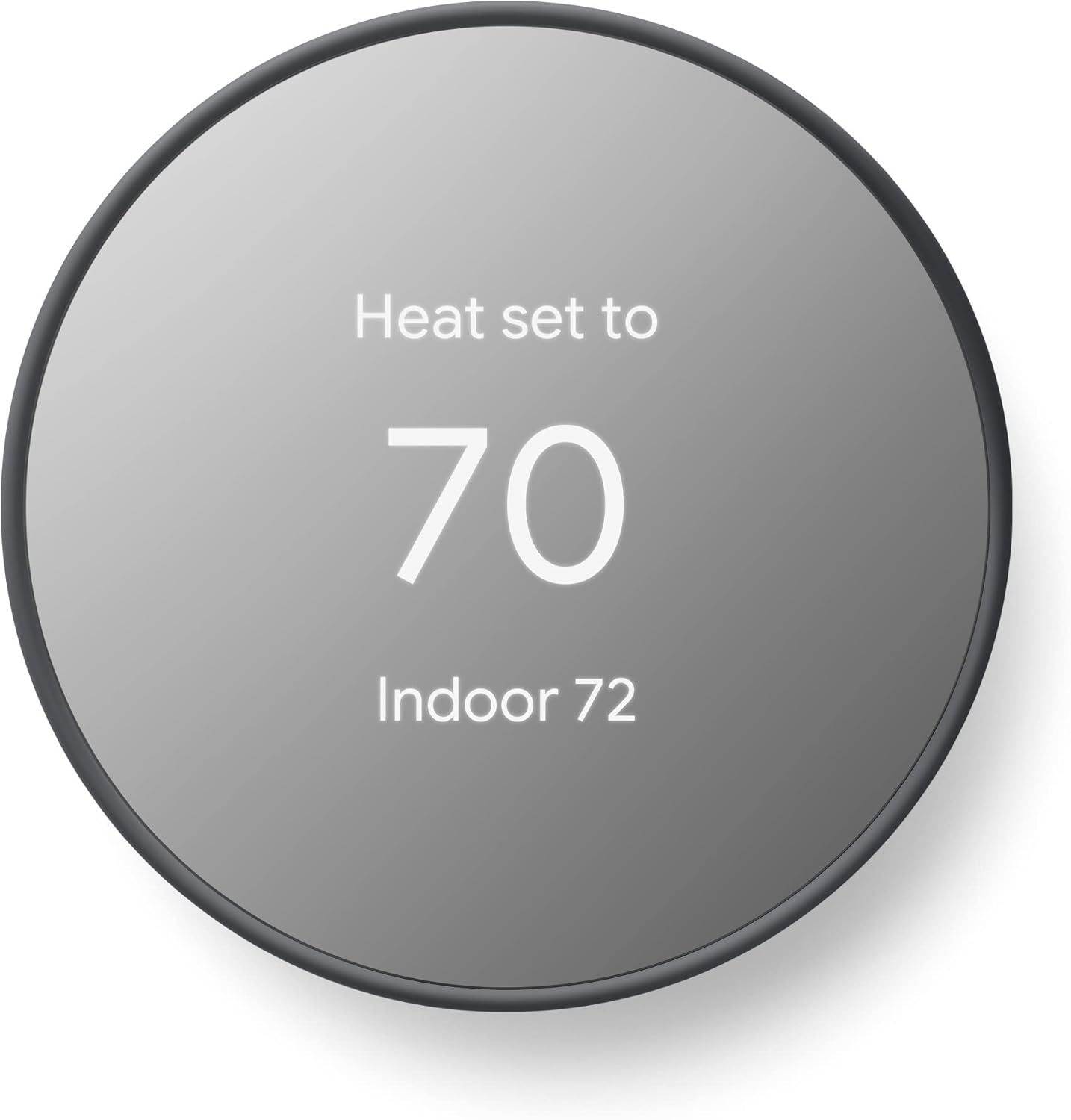
Google Nest Thermostat
| Connectivity Technology | Bluetooth, Wi-Fi |
|---|---|
| Power Source | Battery Powered |
| Display Type | LCD |
| Control Type | Remote Control, Voice Control |
| Number of Batteries | 2 A batteries required. (included) |
The Google Nest Thermostat is a compact smart thermostat designed for everyday temperature control and basic energy savings. It installs on a wall and connects to your home network so you can change settings from the Google Home app or with voice assistants. The unit uses sensors and simple scheduling tools like Quick Schedule and Savings Finder to suggest adjustments and set Eco Temperatures when nobody's home, and it can send alerts if it detects potential HVAC issues. It runs on batteries and is intended to work without a C wire in most homes, though some systems may need a C wire or power accessory. Practical benefits include easy remote control, HVAC monitoring that can flag problems early, and compatibility with common voice platforms. Limitations to note are that advanced learning features and some grid‑integration services require other Nest models, and full functionality depends on working Wi‑Fi and compatible HVAC wiring in boiler or heat pump setups.
Best for: Buyers who prioritize easy remote control, energy-saving suggestions, and clear social-proof from widespread consumer use and want a straightforward smart thermostat that is simple to set up and manage.
Less Ideal for: Homes with complex or uncommon boiler wiring where professional HVAC compatibility checks are needed, or buyers who need the most advanced learning features and grid services available only on higher-end Nest models.
- App and voice control for remote adjustments and scheduling.
- Saves energy with Eco Temperatures and Savings Finder suggestions.
- Alerts and HVAC monitoring that can notify you of potential system issues.
- Designed for straightforward DIY installation in many homes.
- May require a C wire or power accessory for some boiler or specialized systems.
- Some advanced Nest services and integrations require newer or different Nest models.
Verdict: A simple, widely adopted smart thermostat that makes remote control and basic energy savings easy for buyers seeking a proven, low-friction solution.
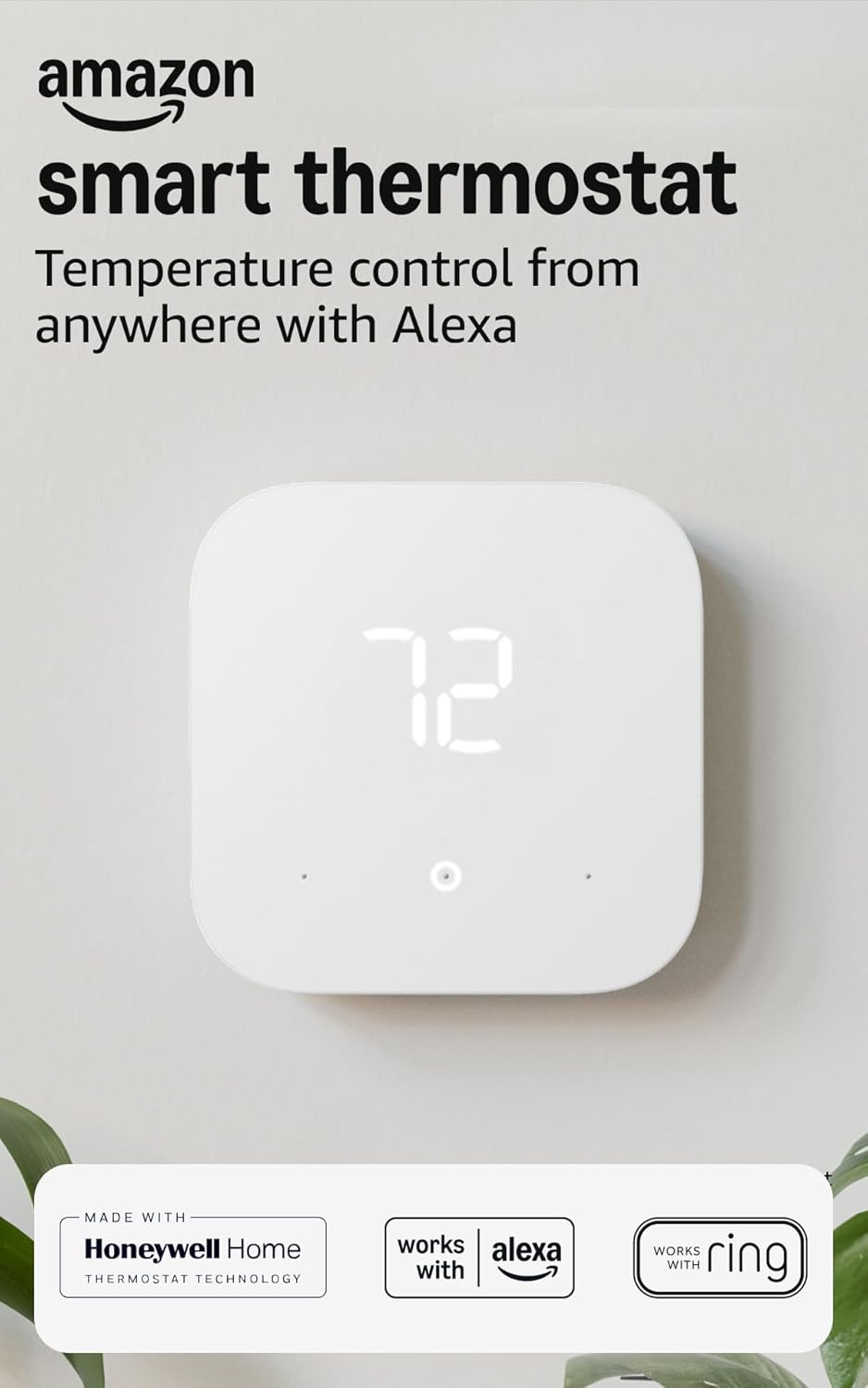
Amazon Smart Thermostat
| ASIN | B08J4C8871 |
|---|---|
| Requires C-wire | Yes |
| Works with | Alexa and Ring |
| Price | 79.99 USD |
The Amazon Smart Thermostat is a simple, Alexa-centric thermostat that replaces a conventional wall unit to control heating and cooling from the Alexa app or voice commands. It is typically installed in place of a standard thermostat and guided through a step-by-step setup in the Alexa app; it supports scheduling, home/away modes, and Alexa routines so you can automate temperature changes based on presence or time. The unit leans on proven Honeywell thermostat technology under the hood and integrates with Alexa devices and Ring for presence-based adjustments and voice control. Practical benefits include on-the-go temperature control, energy-saving schedule options, and access to regional rebate information that can lower ownership cost. Limitations to consider are that it requires a C-wire for power so older systems without one may need an adapter or professional installation, and its tight integration with Alexa means users who prefer other smart ecosystems may find fewer native options. It is a straightforward, cost-conscious choice for households that want easy Alexa integration and basic smart scheduling without advanced HVAC diagnostics.
Best for: Buyers who prioritize simple, reliable smart thermostat features and seamless Alexa voice and app control and prefer a low-friction replacement backed by known thermostat technology.
Less Ideal for: Homes that rely on non-Alexa smart platforms or need advanced boiler-specific diagnostics and controls should look for thermostats with broader ecosystem support and specialized boiler features.
- Works with Alexa for voice control and routines
- Remote control and scheduling via the Alexa app
- Built on Honeywell thermostat technology for established reliability
- Provides ENERGY STAR style energy-saving schedules and rebate guidance
- Requires a C-wire for installation which may need an adapter or pro install
- Limited native integration outside the Alexa ecosystem
Verdict: Choose this thermostat if you want an affordable, Alexa-first replacement that offers reliable basic smart scheduling and voice control backed by established thermostat technology.
Choosing the Right Smart Thermostat for Boiler System: Key Factors to Consider
Wiring and Control Type
Boilers use a range of control approaches, from simple two-wire thermostats that close a contacts to call for heat, to multi-stage systems and relay-driven circuits. Confirm whether your boiler expects a dry contact, a low-voltage switched circuit, or a powered thermostat. Some smart thermostats require a separate relay or isolation module to avoid feeding voltage back into the boiler control board.
Choosing a thermostat that matches the boiler wiring prevents nuisance tripping, false flame detection, and potential control board issues. If you are unsure about the existing wiring, inspect the thermostat junction or consult the boiler manual to identify which wires control the burner, circulator, or zone valves.
Relay and Zone Valve Support
Homes with multiple heating zones often use zone valves or external relays to control separate radiator circuits. A compatible smart thermostat should either drive the zone valve correctly or work through a relay interface designed for boilers. Some thermostats provide dry-contact outputs while others supply a powered signal that can damage zone valve electronics.
Consider whether you need thermostat-to-zone-controller integration or a thermostat with isolated contacts. When in doubt, prioritize models that explicitly document compatibility with zone valves or show recommended wiring diagrams for relay modules.
Anti-Short-Cycling and Minimum Run Time
Boilers do not respond well to rapid on-off cycles. Frequent cycling increases wear, reduces efficiency, and can trigger safety lockouts. Look for thermostats that implement minimum run-time settings, anti-short-cycle delays, or boiler-protection logic that forces a cool-down interval before reissuing a call for heat.
These features help extend boiler lifespan and maintain efficient operation, especially in mild weather when short heat calls are common. Adjustable protection settings are helpful if you have an older boiler or one with long recovery times.
Control Strategy and Schedule Options
Smart thermostats vary in how they handle schedules, setbacks, and adaptive temperature control. For boiler systems, a thermostat that supports gradual setback and anticipatory recovery can avoid aggressive late-stage heating that creates long boiler runs. Look for multi-program scheduling, geo-fencing or sensor-based presence options, and the ability to set different setback behaviors for daytime and nighttime.
Flexible scheduling reduces fuel use without sacrificing comfort. Also consider whether remote temperature sensors are supported to avoid overdriving the boiler based on a single-room reading.
Installation Support and Documentation
Boiler-system installations are more nuanced than forced-air installs. Clear wiring diagrams, installer modes, and step-by-step setup guidance matter a great deal. Good documentation reduces installation errors, avoids calling the boiler into an unsupported state, and speeds troubleshooting.
Also check whether the manufacturer provides wiring diagrams for common boiler configurations and whether firmware or app-based setup includes boiler-specific presets. Accessibility of technical support is another practical factor for homeowners tackling installation themselves.
Connectivity, Integrations, and Local Control
Remote access and integrations with smart-home platforms can enhance convenience but also introduce reliability questions. Thermostats that support local control or robust cloud services help ensure you can change settings when needed. For boiler systems, remote diagnostics that report wiring issues, failed calls for heat, or abnormal cycling are particularly useful.
If you rely on home automation routines or voice control, confirm the thermostat supports the required integrations. Also consider whether the thermostat stores schedules locally so heating continues during internet outages.
How Boiler Systems Differ From Forced-Air Heating
Boilers heat water or steam and use radiators, baseboards, or radiant zones to distribute heat. Unlike forced-air systems, boilers often have slower thermal response and require different control logic to avoid short cycles and excessive run times.
Thermostats designed specifically for boilers address these differences with features like minimum run times, relay isolation options, and compatibility with zone valves. Understanding these distinctions helps you pick a smart thermostat that will not conflict with the boiler's safety or control circuits.
- Slower system response means anticipatory or gradual recovery is useful.
- Boilers may require dry-contact outputs rather than powered thermostat circuits.
- Zone valves and circulator pumps introduce wiring and sequencing needs not present in single-duct systems.
Common Wiring Configurations to Check
Before choosing a smart thermostat, open the existing thermostat box and note the wire colors and terminal labels. Typical boiler wiring includes R (power), W (call for heat), and sometimes additional terminals for circulator or zone control.
If you see only two wires, the thermostat may be a simple switch; many smart thermostats need a C wire for power or a compatible relay accessory. Document the boiler control terminals and any zone controller connections so you can match them to a new thermostat's wiring guide.
- Two-wire systems often use a simple on/off contact.
- Three-wire or more may signal separate circulator or burner controls.
- Zone setups will show connections to a separate zone controller or multiple thermostat wires tied into valve actuators.
When to Use an External Relay or Isolation Module
Some smart thermostats source voltage on their outputs and are unsuitable for direct connection to a boiler control expecting a dry contact. An external relay or isolation module provides the required separation and protects both the thermostat and the boiler control board.
Use an isolation module when wiring documentation or the installer manual indicates a powered output could interfere with system sensors or controls. Many boiler-friendly thermostat instructions include recommended relay wiring diagrams and the type of relay required.
- Isolation helps prevent backfeeding that can confuse flame detection.
- Relays are commonly used when driving circulator pumps or zone valves.
- A professional installer can confirm the correct relay coil voltage and contact rating.
Remote Sensors and Multi-Room Control
Remote temperature sensors let the thermostat measure conditions in the rooms that matter most instead of relying on a single location. For boiler systems, this can reduce overheating while a cold corner remains under-heated.
Some smart thermostats support multiple sensors and averaging logic, or let you select which sensor controls the setpoint. These features improve comfort balance in homes with uneven heat distribution and can reduce the need for aggressive boiler run times.
- Sensor averaging smooths out localized temperature swings.
- Placement matters: avoid mounting sensors near radiators or drafts.
- Wireless sensors are convenient but check battery life and signal reliability.
Maintenance and Troubleshooting Tips
After installing a smart thermostat, monitor the boiler's first few heating cycles to ensure proper behavior. Look for long on/off patterns, unusually short cycles, or failure to start the burner when called. Document any error codes or app notifications.
Keep wiring photos and notes from the original setup in case you need to revert or consult a technician. Regular boiler maintenance combined with correct thermostat configuration reduces the chance of control-related issues.
- Verify minimum run times are enabled and adjusted to your boiler's recovery rate.
- If the thermostat shows a wiring mismatch message, shut power off and recheck connections.
- Schedule a professional boiler inspection if you detect repeated safety lockouts or strange behavior after installation.
How We Chose the Best Smart Thermostat for Boiler System
We prioritized features and specifications that directly affect how a smart thermostat interacts with a boiler. First, compatibility with common boiler control types was required, including support for two- and three-wire systems, call-for-heat relays, and options for external relay or isolation modules when needed. Second, control flexibility mattered: the ability to configure multi-stage heating, adaptive scheduling, and temperature setback behavior that reduces short-cycling was essential. Third, safety and boiler-friendly protections were evaluated, such as minimum run times, anti-short-cycle logic, and flame/relay isolation options. Fourth, connectivity and remote control were considered, including reliable cloud or local access and integration with common home automation platforms. Finally, usability and setup clarity were assessed because boiler systems often require attention to wiring and configuration during installation. We excluded thermostats that are strictly for low-voltage forced-air systems without boiler-compatible wiring options, and we filtered out models that lack basic boiler protections or require bespoke wiring adapters not commonly available. The shortlist favors units that clearly document boiler setup, provide installer or advanced modes, and include options for external relays or dry-contact control when needed.
Our full evaluation process is outlined in our review methodology.
FAQ
Can a smart thermostat control a boiler with zone valves?
Often yes. Many smart thermostats can work with zone valves when wired through the zone controller or when the thermostat provides dry-contact outputs. Confirm the thermostat documents zone valve wiring and whether an isolation relay is needed.
Do I need a C wire to install a smart thermostat on a boiler?
It depends. Some smart thermostats require a C wire for constant power, while others can operate on battery or use power-stealing methods. For boiler systems, a C wire or a compatible power accessory is often more reliable and avoids intermittent behavior.
Will a smart thermostat save energy on a boiler system?
Smart thermostats can reduce energy use by optimizing schedules, implementing setbacks, and avoiding unnecessary operation. Actual savings depend on your heating patterns, insulation, and how the thermostat is configured to prevent short cycling.
What if my boiler uses a unique or proprietary control interface?
If the boiler employs a proprietary or nonstandard control interface, consult the boiler's documentation before replacing the thermostat. You may need an approved interface module or a thermostat that supports dry-contact relays to avoid interfering with built-in safety logic.
Can remote temperature sensors improve comfort in a boiler-heated home?
Yes. Remote sensors help the thermostat measure temperature where people spend time, which can reduce over-heating of other rooms. Using multiple sensors or averaging modes provides a more balanced control strategy for radiators and baseboards.
Final Verdict
For boiler-equipped homes, prioritize a smart thermostat that explicitly supports the wiring and control style of your system. Focus on wiring compatibility, relay or zone-valve support, and boiler-protection features such as minimum run times and anti-short-cycle logic. Also weigh installation documentation and remote-sensor support to match your layout and comfort priorities. Choosing a thermostat that aligns with your boiler's control inputs and provides clear setup guidance reduces the risk of control conflicts and improves day-to-day comfort. With the right match, a smart thermostat will bring better scheduling, remote control, and gentler boiler operation without compromising system safety.