
Note: This article contains affiliate links. If you click on these links and make a purchase, we may earn a small commission at no extra cost to you. This helps support our research and content. Read our full affiliate disclosure here.
If you manage a home with multiple heating and cooling zones, the right smart thermostat can mean steadier room temperatures, lower energy waste, and fewer manual adjustments. You need controls that understand zone dampers, multiple sensors, and how to coordinate with your HVAC equipment. This guide shortlists seven top smart thermostats for zoned systems that fit common zoning setups and priorities. We evaluated connectivity, zone compatibility, sensor support, and automation features so you can pick a unit that works with your existing dampers and thermostat wiring. Read on for decision criteria and practical guidance before the product list.
Top Picks at a Glance
| Best Overall The best all-around choice for most situations | ecobee Smart Thermostat Enhanced |  |
| Best Quality Built to a higher standard if you want something more solid | ecobee Smart Thermostat Premium |  |
| Best Value The sweet spot between price and what you get | Sensi Smart Thermostat ST55 |  |
| Best Budget The cheapest option that still gets the job done reliably | Heagstat Wifi Thermostat STN701W |  |
| Top Rated A top-rated pick with lots of positive feedback | Sensi Touch ST75 |  |
| Most Popular A crowd favorite that many people choose with confidence | Google Nest Thermostat |  |
| Best Seller A high-volume bestseller chosen again and again | Amazon Smart Thermostat |  |
ecobee Smart Thermostat Enhanced

| Connectivity Technology | Wi-Fi |
|---|---|
| Power Source | Corded Electric |
| Voltage | 24 volts |
| Display Type | LCD |
| Control Type | App Control |
The ecobee Smart Thermostat Enhanced is a wall-mounted, hardwired smart thermostat designed to automate temperature control and save energy. It uses built-in radar occupancy sensing plus optional remote SmartSensors to detect which rooms are occupied and shift heating or cooling accordingly, which is useful for zoned systems trying to avoid conditioning unused spaces. Setup is intended for DIY installs and the box includes a power extender kit for systems lacking a C wire. Dual-band Wi-Fi and broad smart-home support let you control the thermostat from the ecobee app, Apple Watch, Siri, Alexa, Google Assistant, or HomeKit. Practical benefits include schedule learning, eco+ energy optimizations, and an LCD touchscreen for local adjustments. Important limitations are that it requires compatibility with 24 VAC HVAC systems and does not support high-voltage or millivolt setups, so you must check system compatibility before buying; advanced zoning still needs proper HVAC zone control hardware rather than the thermostat alone. Overall, it is a feature-rich option for homeowners wanting a reliable, integrated smart thermostat for standard low-voltage systems.
Best for: Homeowners who want a robust, smart thermostat that improves comfort and energy savings across multiple rooms and integrates with existing smart home platforms.
Less Ideal for: Homes with high-voltage, millivolt, or unusual HVAC control systems, or installers who need a thermostat to serve as the sole zoning control without additional zone equipment.
- Built-in radar occupancy sensing and support for SmartSensors to detect room usage
- Includes Power Extender Kit and trim plate for easier DIY installation
- Dual-band Wi-Fi and broad voice assistant/HomeKit integrations for remote control
- Factory-backed Energy Star certified with features to learn schedules and optimize energy use
- Not compatible with line-voltage or millivolt systems so compatibility check is required
- Does not replace zoning hardware; effective zoned control requires separate zone controllers or dampers
Verdict: A full-featured smart thermostat that improves comfort and energy savings for standard 24 VAC HVAC systems and works well as part of a zoned setup when paired with proper zone control hardware.
ecobee Smart Thermostat Premium

| Connectivity Protocol | Wi-Fi |
|---|---|
| Controller Type | Amazon Alexa, Android, Apple HomeKit, Google Assistant, iOS |
| Voltage | 24 volts |
| Power Source | Battery Powered |
| Display Type | LCD |
The ecobee Smart Thermostat Premium is a premium Wi‑Fi thermostat designed to optimize comfort and energy use across multiple rooms. It pairs with the included SmartSensor to detect hot and cold spots and adjust setpoints where it matters, which is especially useful for zoned systems aiming for balanced temperature control. The unit has dual-band Wi‑Fi, built-in Alexa or Siri voice control, a speaker for media, and a built-in air quality monitor that issues alerts and filter reminders. Installation is simplified by the included Power Extender Kit for systems without a C‑wire and the package includes trim and wiring labels for a clean wall mount. Practical benefits include radar occupancy sensing for automatic adjustments, doorbell Live View integration, and compatibility with major smart home platforms for scheduling and remote control via app. Trade-offs are its premium positioning and feature depth, which may be more than necessary if you only need basic scheduling or a minimal, low-cost thermostat for a simple zone controller.
Best for: Buyers who want a high-performance smart thermostat to actively manage multiple rooms and zones, prioritizing precise comfort, automation, and advanced integrations.
Less Ideal for: People who only need a basic schedule-capable thermostat for a single simple zone or who prefer the lowest-cost controller without smart home features.
- Included SmartSensor improves room-by-room temperature control for zoned setups
- Built-in voice assistant and speaker remove the need for a separate smart speaker
- Air quality monitor with alerts and filter reminders helps maintain home health
- Power Extender Kit and wiring accessories included for easier DIY installation
- Works with Siri, Alexa, Google Assistant, HomeKit, SmartThings and app control
- Feature-rich design may be unnecessary for users wanting a simple zone thermostat
- Premium price and advanced features could be overkill for very small or single-zone homes
Verdict: If you need a powerful, zone-capable smart thermostat with sensors and wide smart home integration, the ecobee Smart Thermostat Premium is built to deliver precise, multi-room comfort and automation.
Sensi Smart Thermostat ST55

| Connectivity Technology | Wi-Fi |
|---|---|
| Controller Type | Amazon Alexa, Apple HomeKit, Google Assistant, SmartThings, Vera |
| Temperature Control Type | Programmable, Smart/Remote |
| Power Source | Corded Electric |
| Number of Batteries | 2 AA batteries required. (included) |
The Sensi ST55 is a wall‑mounted Wi‑Fi smart thermostat meant to replace a traditional programmable thermostat and add remote control, scheduling and energy reports. It connects to 2.4 GHz Wi‑Fi and integrates with Alexa, Google Assistant, Apple HomeKit and SmartThings so you can control temperature by app, touch or voice and include the thermostat in automated routines. The unit is ENERGY STAR certified and provides usage reports, smart alerts and filter reminders to help manage HVAC efficiency. Installation is designed for DIY with mounting hardware, wire stickers and an app with step‑by‑step guidance, and it works without a common wire in many setups. The display is a simple LED touchscreen with button control rather than a large color panel, and power comes from 24 VAC with included AA batteries for backup. For zoned systems you get the basics for remote access and scheduling, but advanced multi‑zone management requires compatible zoning controls and controller integration rather than features built into the thermostat itself.
Best for: Buyers who want a straightforward, energy‑focused smart thermostat they can install themselves and control via app or voice for improved HVAC efficiency in each zone.
Less Ideal for: Homeowners seeking an all‑in‑one multi‑zone control hub or advanced graphical touchscreen should consider dedicated zoning controllers or higher‑end thermostats with multi‑zone features.
- Works with major smart platforms including Alexa, Google Assistant and Apple HomeKit for flexible voice and app control
- ENERGY STAR certification with usage reports and scheduling to support energy savings
- Designed for DIY installation with clear app guidance, mounting hardware and wire stickers
- Provides smart alerts and maintenance reminders such as filter replacement
- Includes batteries and supports operation without a common wire in many systems
- Display is a basic LED touchscreen and not a large color or fully graphical interface
- Does not include built‑in multi‑zone controller functions; zoning requires separate hardware integration
Verdict: A practical, ENERGY STAR‑certified smart thermostat that delivers easy DIY setup, remote app and voice control, and energy reports—ideal for optimizing individual zones when paired with proper zoning hardware.
Heagstat Wifi Thermostat STN701W

| Controller Type | App Control |
|---|---|
| Connectivity Technology | Wi‑Fi (2.4 GHz only) |
| Specific Uses For Product | Single‑Stage Heating, Ventilation, and Air Conditioning |
| Temperature Control Type | Programmable |
| Voltage | 24 volts alternating current |
The Heagstat Wifi Thermostat STN701W is a budget-friendly smart thermostat for conventional single-stage heating and cooling systems. It connects to 2.4 GHz Wi‑Fi and a companion app to enable remote temperature control, 7‑day programmable schedules, and real-time HVAC monitoring. The backlit LCD and simple wall-mounted design make daily adjustments straightforward, and the unit claims temperature accuracy within ±2°F to reduce noticeable swings. Installation requires a 24V C common wire and it only supports basic single-stage terminal wiring (RH/RC, W, Y, G, C), so it is a direct replacement for many simple furnaces and central AC setups. Important limits are its incompatibility with multi-stage systems, heat pumps, line-voltage systems, PTACs, mini‑splits, and 5 GHz networks, so it will not work for more complex or zoned HVAC setups that need multi-stage or heat‑pump controls. For buyers who need remote app control and weekly scheduling on a standard single-stage system, this delivers the core features at an affordable level, but it is not suitable when advanced system compatibility is required.
Best for: Buyers who need an inexpensive smart thermostat to add remote control and weekly scheduling to a conventional single‑stage furnace and central AC, and who have a C‑wire available.
Less Ideal for: Homeowners with multi‑stage systems, heat pumps, zoned/multi‑zone controllers, or equipment that uses line‑voltage or 5 GHz Wi‑Fi should look for more compatible models.
- App remote control and 7‑day scheduling enable remote adjustments and weekly routines.
- Works on common single‑stage heating and cooling setups with standard RH/RC, W, Y, G, C terminals.
- Backlit 4.72‑inch screen is easy to read in low light.
- Claims ±2°F temperature accuracy to limit temperature swings.
- Requires a 24V C‑wire and cannot run on batteries.
- Not compatible with multi‑stage systems, heat pumps, line‑voltage systems, mini‑splits, PTACs, or 5 GHz Wi‑Fi.
Verdict: A low-cost way to get app control and 7‑day scheduling on a standard single‑stage HVAC system when a C‑wire is present.
Sensi Touch ST75

| Connectivity Technology | Wi-Fi (2.4 GHz) |
|---|---|
| Control Method | App, Touch, Voice |
| Display Type | LCD color touchscreen |
| Power Source | AC/DC (C‑wire required) |
| Specific Uses For Product | Air Conditioner, Boiler, Furnace, Heat Pump |
The Sensi Touch ST75 is a wall‑mounted smart thermostat that gives homeowners app, touch and voice control of compatible HVAC equipment. It pairs with 2.4 GHz Wi‑Fi and major smart home platforms so you can change schedules, adjust temperature remotely and use voice assistants. The large color touchscreen and illuminated terminals simplify DIY installation for most systems that require a common wire, and the app offers scheduling, usage reports, geofencing and maintenance alerts to help manage energy use. For zoned systems the Sensi provides straightforward programmable control and remote access so each zone can follow a set schedule or be adjusted on demand through the app. Important limitations are the C‑wire requirement and reliance on 2.4 GHz Wi‑Fi only, which may affect installation options in older homes or networks that use only 5 GHz. The unit is Energy Star certified and includes filter reminders and smart alerts, making it a durable, serviceable option for owners who prioritize reliable HVAC control and data privacy.
Best for: Homeowners who want a reliable, DIY‑friendly smart thermostat that integrates with major smart home ecosystems and provides stable remote control and usage reporting for zoned heating and cooling.
Less Ideal for: Homes without an available C‑wire or networks that only use 5 GHz Wi‑Fi should consider other solutions or wiring upgrades before choosing this unit.
- Large color touchscreen with intuitive menus for easy local control
- Works with Alexa, Apple HomeKit, Google Assistant and other smart platforms
- Energy Star certified with scheduling, usage reports and smart alerts to help reduce HVAC energy
- App-based remote access and geofencing for convenient zone adjustments
- Requires a common wire (C‑wire) which may need an electrician for some homes
- Supports only 2.4 GHz Wi‑Fi, not 5 GHz
Verdict: Choose the Sensi Touch ST75 if you need a dependable, smart touchscreen thermostat that gives consistent remote control and energy reporting for a zoned HVAC setup.
Google Nest Thermostat
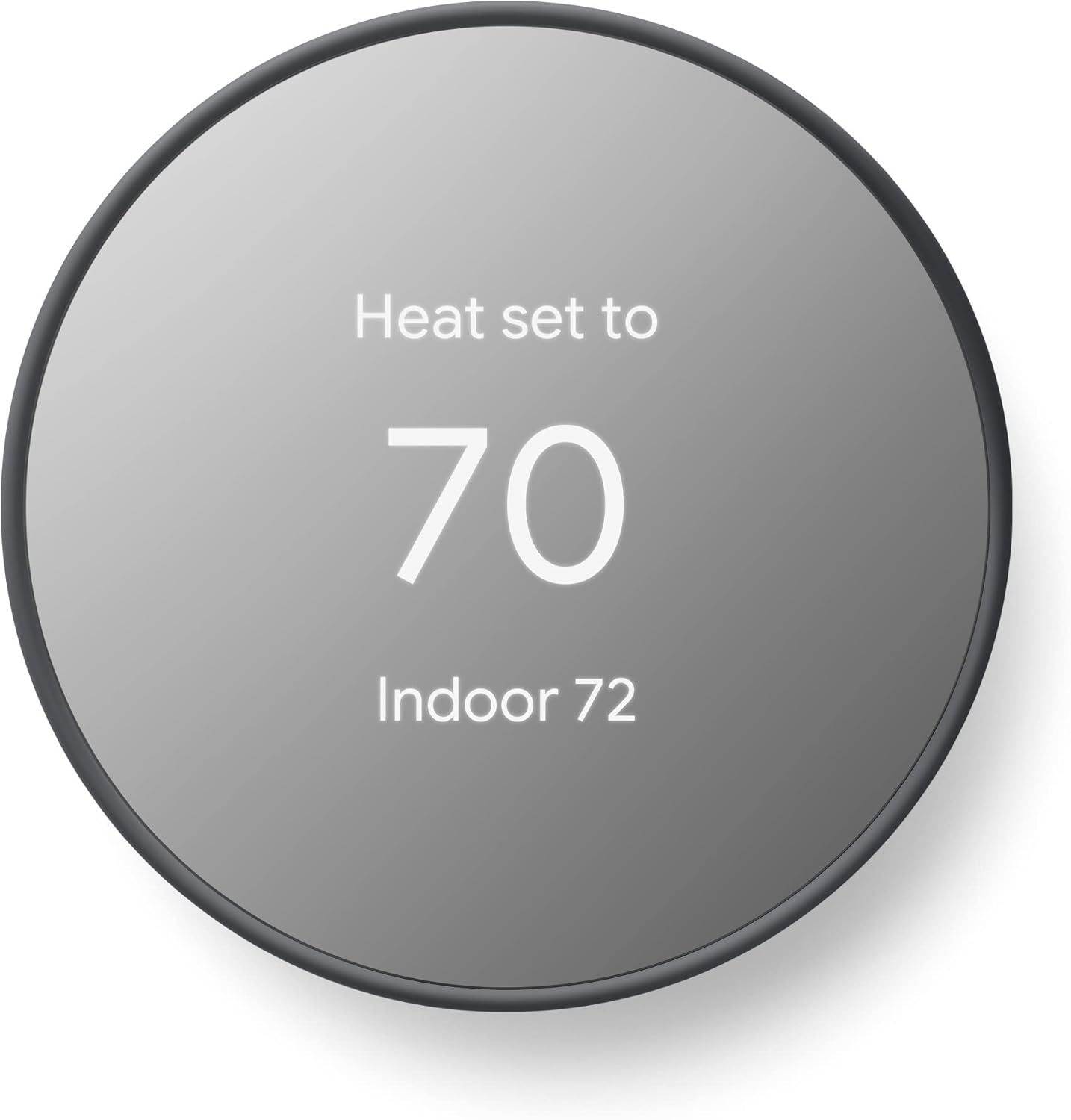
| Connectivity Technology | Bluetooth, Wi-Fi |
|---|---|
| Power Source | Battery Powered |
| Display Type | LCD |
| Control Type | Remote Control, Voice Control |
The Google Nest Thermostat is a budget-friendly smart thermostat designed for straightforward control of home heating and cooling from the Google Home app or by voice. It installs on a wall plate and typically works without a C wire in many homes, though some systems like certain heat pumps or zone setups may need a C wire or power accessory. The thermostat offers Wi-Fi and Bluetooth connectivity, a 2-inch LCD display, and remote/voice control through Google Assistant, Android, and iOS devices. Features such as Savings Finder, Eco Temperatures when you leave, Quick Schedule, and HVAC monitoring help identify energy-saving opportunities and surface potential system issues. Practical benefits include easy app-based scheduling, remote adjustments while away, and simple DIY installation in about 30 minutes. Limitations are that some more advanced zoned-system features and diagnostics are limited compared with higher-end learning thermostats, and voice or remote features require working Wi-Fi and compatible smart home devices.
Best for: Buyers who want a simple, app-driven smart thermostat that reduces energy use and offers remote control without paying for a premium learning model.
Less Ideal for: Homeowners who need deep zoned-system controls, advanced HVAC diagnostics, or enterprise-level integration should consider higher-end thermostats designed specifically for zoning.
- Remote and voice control via Google Home app and compatible assistants
- Energy-saving features like Savings Finder and automatic Eco Temperatures
- Easy DIY installation with common wall-mount setup and included mounting hardware
- Wi-Fi and Bluetooth connectivity for mobile notifications and basic HVAC alerts
- May require a C wire or power accessory for some HVAC or zoned systems
- Limited advanced zoning and diagnostic features compared with premium learning thermostats
Verdict: A cost-conscious smart thermostat that gives reliable remote and voice control plus basic energy-saving features, ideal for buyers prioritizing simplicity and social-proof reliability.
Amazon Smart Thermostat
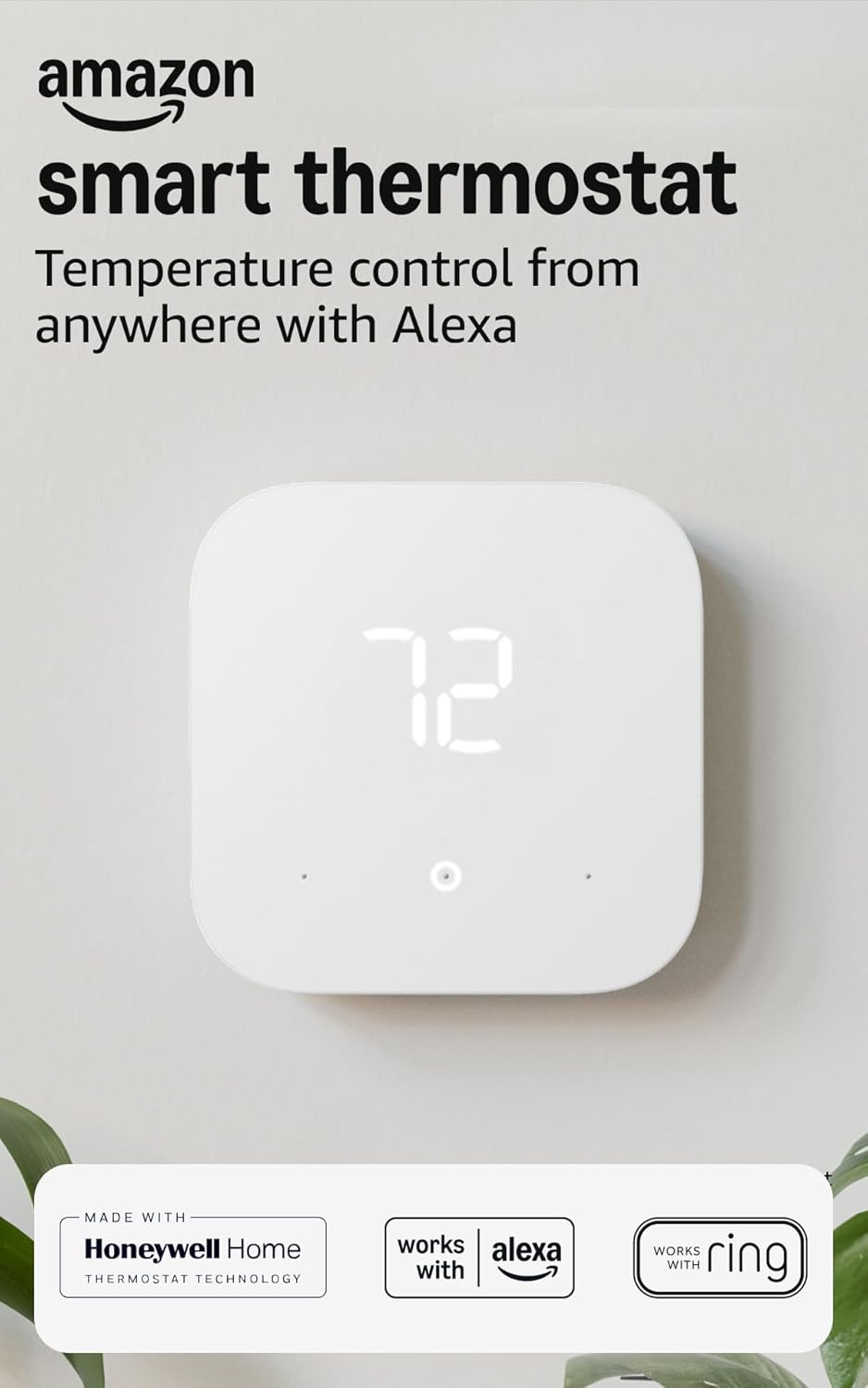
| Works with | Alexa and Ring |
|---|---|
| C-wire | Required |
| Manufacturer technology | Honeywell thermostat technology |
| Control app | Alexa app |
The Amazon Smart Thermostat is a straightforward smart thermostat built around Alexa integration and Honeywell thermostat technology. It replaces a conventional wall thermostat and lets you create schedules (home, away, sleep), control temperature remotely via the Alexa app, and use presence detection or compatible Alexa devices to adjust settings automatically. Installation is intended as a DIY process using the Alexa app installer, and the unit requires a C-wire. Notable features include Alexa+ automations for routines and the ability to link with Ring and other Alexa devices for zoned presence inputs. The design leans toward simplicity rather than advanced HVAC diagnostics, so it is best for homeowners who want reliable voice and app control and energy-saving schedules without professional setup. It also points to potential energy rebates through post-purchase guidance. The main limitations are that it focuses on Alexa ecosystem features and does not advertise deep zoning controls or installer-grade configuration tools for complex multi-zone HVAC systems.
Best for: Homeowners who prioritize simple, reliable smart control within the Alexa ecosystem and want an easy-to-manage replacement for a conventional thermostat.
Less Ideal for: Homes that need advanced multi-zone HVAC management, professional installer features, or users who prefer non-Alexa ecosystems.
- Easy Alexa-first setup and remote control through the Alexa app
- Supports schedules and basic presence-based automation with Alexa devices
- Built with Honeywell thermostat technology for dependable temperature control
- Guidance on possible energy-rebate opportunities after purchase
- Requires a C-wire which may need a professional retrofit in older homes
- Not focused on advanced installer or multi-zone HVAC configuration options
Verdict: Choose this thermostat if you want a dependable, Alexa-centric smart replacement that adds remote scheduling and basic presence-based automation to your heating and cooling.
Choosing the Right Smart Thermostat for Zoned System: Key Factors to Consider
Zone Compatibility
Not all smart thermostats work seamlessly with damper-based or multi-thermostat zoning setups. Confirm whether a thermostat will integrate with your existing zoning controller or if it requires an add-on interface. Compatibility affects whether each zone can be controlled independently, how the system sequences dampers and the HVAC equipment, and whether fail-safe behaviors are supported during power or communication loss.
A compatible thermostat reduces installation surprises and ensures the zoning strategy you want is achievable. For many homeowners, the difference between a unit that recognizes a zoning panel and one that does not can mean the difference between centralized control and the need for additional hardware or wiring changes.
Multi-Sensor Support
Zoned systems benefit from temperature and occupancy sensors placed in different rooms to prevent a single location from dictating comfort for a whole zone. Check how many remote sensors the thermostat supports, whether sensors are wireless or wired, and if the device can average readings or apply room-priority logic.
Sensor accuracy and placement impact comfort and runtime. Systems that allow per-sensor offsets or weighted averages will better handle temperature differences across a zone and reduce short-cycling caused by localized hot or cold spots.
Connectivity and Integrations
A thermostat's connectivity determines how you monitor and control zones remotely and whether it works with home automation platforms. Look for reliable local network operation and optional cloud features that do not break basic scheduling when servers are unavailable. Integration with voice assistants, home automation hubs, and energy-monitoring services can extend the thermostat's usefulness and let you create multi-zone scenes or energy rules.
Open integration and documented APIs or native support for common ecosystems simplify advanced automations, while closed or proprietary systems may limit options and require vendor apps for most tasks.
Automation and Scheduling
Effective zoning relies on schedules and automations that match household patterns and variable occupancy. Evaluate how granular the scheduler is, whether it supports different schedules per zone, and if it offers adaptive features like learning algorithms or geofencing. The ability to create temperature presets and coordinate start/stop commands across multiple zones helps maintain comfort without manual intervention.
Good automation reduces runtime and energy waste by ensuring only occupied zones are conditioned and by staggering HVAC starts to prevent excessive load on equipment.
Installation and Wiring Flexibility
Zoned systems often have legacy wiring or central zone control boards. Assess whether a thermostat supports common wiring configurations, needs a common wire, or requires an external adapter for certain HVAC systems. Some smart thermostats can operate with minimal wiring changes, while others need a C-wire or a compatible interface with the zoning panel.
Consider whether you will DIY or hire a technician. Lower-install complexity units save on labor and reduce the chance of compatibility issues, while more capable controllers might require professional setup but provide superior control and diagnostics.
Energy Management and Reporting
Beyond temperature control, look for features that help measure and reduce energy use in zoned homes. Built-in energy reports, runtime summaries per zone, and setback optimization can show where savings are possible. Some thermostats offer demand response or time-of-use-aware scheduling to lower peak charges if your utility supports that.
Useful reporting helps you tune setpoints and schedules to maximize savings without compromising comfort, and it can reveal zones that need physical adjustments such as insulation or airflow balancing.
Understanding How Zoning Works With Smart Controls
Zoning divides a home into multiple areas controlled independently using dampers or individual zone thermostats. A smart thermostat for a zoned system must coordinate with that zoning hardware so the HVAC equipment runs only when needed and each zone reaches its setpoint without causing conflicts.
Proper integration means the controller can pause calls for heating or cooling from one zone while another zone holds priority, and it can sequence starts to avoid short-cycling. Knowing whether your setup uses damper-based zoning or separate air handlers changes which thermostat features are most important.
- Damper-based zoning uses a central HVAC unit and motorized dampers in ductwork.
- Multi-thermostat zoning uses separate air handlers or mini-splits controlled independently.
- Control coordination prevents simultaneous conflicting calls and reduces equipment wear.
Common Zoning Configurations and What They Mean
Typical zoning arrangements include upstairs/downstairs splits, individual-room zones for frequently used rooms, or multi-family conversions. Each configuration has different demands for sensor placement, control latency, and scheduling granularity.
Homes with large open areas may need multiple sensors in a single zone, while small rooms might be better served by occupancy-triggered conditioning. The number of zones determines how sophisticated your scheduling and sequencing must be to avoid comfort swings.
- Few large zones: favors simple schedules and fewer sensors.
- Many small zones: benefits from per-zone schedules and more sensors.
- Mixed-use zones: may require occupancy-based automations for efficiency.
Installation Tips for Zoned Systems
Before installing a smart thermostat, document your zoning panel, wire labels, and HVAC control board. Verify which wires run to each thermostat location and whether a common wire is present. Labeling wires and taking photos of existing terminals can prevent common wiring errors during replacement.
When integrating with a zoning controller, check the controller's manual for supported thermostat types and any recommended wiring diagrams. If the controller expects dry contacts or a specific signal type, choose a thermostat that can provide that interface or plan for an adapter.
- Turn off HVAC power at the breaker before touching wiring.
- Use the zoning panel manual to confirm terminal functions.
- Consider a professional if your zoning system has complex control logic.
Sensor Placement and Best Practices
Place temperature and occupancy sensors away from direct sunlight, vents, and exterior walls to avoid skewed readings. For large zones, distribute sensors to represent actual living spaces rather than hallways or transitional areas.
If your thermostat supports averaging or weighted sensor input, test different sensor combinations and offsets to find a balance that prevents over-conditioning and keeps the most-used areas comfortable.
- Avoid mounting sensors near windows, doors, or air registers.
- Use wall-mounted sensors at typical living height for best readings.
- Test occupancy sensor locations during typical use to verify trigger behavior.
Troubleshooting Common Zoning Issues
If zones do not reach setpoint or dampers are not responding, start by verifying wiring and power at the zoning controller. Check for error indicators on the control board and confirm that the thermostat's zone calls match what the panel expects.
Short-cycling or frequent on/off cycles can indicate poor sequencing or oversized equipment relative to zone load. Adjust setback schedules, add sensor averaging, or consult an HVAC professional to rebalance ductwork and damper settings.
- Verify thermostat-to-panel communication and correct terminal hookups.
- Look for damper mechanical issues or stuck actuators.
- Adjust automation rules if zones keep fighting for priority.
How We Chose the Best Smart Thermostat for Zoned System
We focused on features and specs that directly affect a smart thermostat's performance in zoned HVAC systems. Our selection prioritized proven compatibility with zoning controllers and damper-based systems, reliable multi-sensor support so temperature can be measured per zone, and flexible scheduling and automation to coordinate multiple zones without manual intervention. Connectivity and integration were weighted heavily, including local network reliability and cloud integration for remote control and voice assistants. We also considered installation complexity and wiring options since many zoned systems have legacy control wiring or require an interface board. Energy management features such as adaptive scheduling and per-zone setback modes were included to assess ongoing operating cost and comfort tradeoffs. We excluded basic single-zone smart thermostats that lack multi-sensor or zoning-controller support and any devices that require extensive proprietary hubs not commonly available to homeowners. The final shortlist balances ease of setup, compatibility with typical damper-based zoning systems, and the control features homeowners need to manage multiple zones efficiently.
Our full evaluation process is outlined in our review methodology.
FAQ
Will a smart thermostat control my zoning dampers directly?
Often the thermostat does not drive dampers directly. Many damper-based systems use a separate zoning controller that accepts simple calls for heat or cool from thermostats. Confirm whether your thermostat can interface with that controller or if it needs an adapter.
How many remote sensors should I use for a single zone?
That depends on zone size and layout. Larger or irregularly shaped zones usually benefit from two or more sensors to avoid localized temperature bias. Smaller rooms typically need only the thermostat plus one sensor if necessary.
Do smart thermostats require a common wire in zoned systems?
Many smart thermostats do need a common wire for reliable power, but some models offer power-stealing or adapter solutions. In zoned systems, confirming power availability at each thermostat location is important to avoid intermittent behavior.
Can I set different schedules for each zone?
Yes. Most smart thermostats that support zoning also allow independent schedules per zone so you can match conditioning to occupancy patterns. Check that the thermostat or its companion app supports per-zone scheduling rather than a single global schedule.
Will zoning save energy with a smart thermostat?
Zoning can reduce energy use when unoccupied areas are set back and the system avoids conditioning the whole house. Actual savings depend on your home's layout, insulation, and how well schedules and sensors are configured.
Final Verdict
Choosing a smart thermostat for a zoned system means prioritizing compatibility with your zoning controller, support for multiple sensors, and robust automation that coordinates zones intelligently. Installation flexibility and clear reporting help you get the system working reliably and reveal where further efficiency gains are possible. Focus on the control features that match your zoning architecture and household routines. Balance ease of installation against advanced capabilities when deciding, and prioritize units that simplify sensor management and scheduling so each zone stays comfortable with minimal fuss.