
Note: This article contains affiliate links. If you click on these links and make a purchase, we may earn a small commission at no extra cost to you. This helps support our research and content. Read our full affiliate disclosure here.
If certain rooms in your house run hot or cold compared with the rest of your home, a smart thermostat with room sensors can make a noticeable difference. These thermostats use small remote sensors to measure temperature and occupancy in specific rooms, helping your HVAC system target comfort where you need it most instead of relying on a single hallway reading. Choosing the right setup affects both daily comfort and how efficiently your system operates. This guide shortlists the top picks for smart thermostats with room sensors and explains how we evaluated sensor accuracy, connectivity, installation, and how well each option integrates into a home's heating and cooling routines. Read on to find options that suit your wiring, thermostat location, and comfort preferences.
Top Picks at a Glance
| Best Overall The best all-around choice for most situations | Honeywell Home X8S Smart Thermostat |  |
| Best Quality Built to a higher standard if you want something more solid | ecobee Smart Thermostat Premium Bundle |  |
| Best Value The sweet spot between price and what you get | LUX TQX Smart Thermostat |  |
| Best Budget The cheapest option that still gets the job done reliably | Honeywell Home T9 Smart Thermostat |  |
| Top Rated A top-rated pick with lots of positive feedback | ecobee Smart Thermostat Premium |  |
| Most Popular A crowd favorite that many people choose with confidence | Google Nest Learning Thermostat (4th Gen) |  |
| Best Seller A high-volume bestseller chosen again and again | Google Nest Thermostat E |  |
Honeywell Home X8S Smart Thermostat

| Controller Type | Touchscreen |
|---|---|
| Connectivity Technology | Wi-Fi |
| Power Source | Hardwired |
| Screen Size | 5 inches |
| Control Type | App Control |
The Honeywell Home X8S is a full-featured smart thermostat designed to give more targeted comfort through its included wireless room sensor and a customizable 5-inch touchscreen. It pairs with your home Wi‑Fi and the First Alert app for remote control, supports Matter, Alexa, Google and Apple Home integrations, and can stream compatible Ring or First Alert VX1 doorbell video directly to the display. The unit handles multiple system types including heat pump and conventional systems and offers humidity and ventilation monitoring for improved indoor air quality when paired with required accessories. Auto-scheduling and occupancy detection help reduce energy use while the sensor lets you prioritize living areas or bedrooms for different times of day. Installation requires a C-wire or the included voucher for a C-wire adapter and the thermostat is hardwired, so it is best for homes with existing HVAC wiring infrastructure. The main limitations are the need for additional HVAC accessories for some IAQ features and potential installation complexity for homes without a C-wire.
Best for: Buyers who want a capable, connected thermostat that uses a dedicated room sensor to improve comfort and energy control and who are comfortable with a hardwired install.
Less Ideal for: Renters or homeowners without existing HVAC wiring or those who want a strictly battery-powered, plug-and-play thermostat.
- Includes wireless room sensor for targeted temperature control and up to 200 ft sensor range
- 5-inch customizable touchscreen that can display video doorbell streams from compatible devices
- Works with Matter, Amazon Alexa, Google Assistant and Apple Home for broad smart home integration
- Built-in humidity and ventilation control options to help manage indoor air quality
- ENERGY STAR certified and includes auto-scheduling and occupancy detection to reduce energy use
- Requires hardwiring and a C-wire or adapter which can complicate installation
- Some IAQ features and video integrations require additional equipment or compatible doorbells
Verdict: Choose the X8S if you want a smart, hardwired thermostat with a room sensor and wide smart-home support to improve targeted comfort and energy savings.
ecobee Smart Thermostat Premium Bundle

| Connectivity Technology | Wi-Fi |
|---|---|
| Power Source | Hardwired |
| Temperature Control Type | Heating, Cooling |
| Display Type | LCD or LED |
| Included Components | Smart Thermostat, SmartSensor for Doors and Windows 2-Pack |
The ecobee Comfort and Security Bundle pairs the Smart Thermostat Premium with multiple SmartSensors to deliver room-level temperature control plus entryway and motion alerts when used with ecobee's security subscription. The thermostat functions as a wall-mounted control hub with built-in Alexa and Siri support, an LCD display, hardwired power and Wi‑Fi connectivity for remote control and scheduling from the phone. Included SmartSensors act as occupancy and door/window sensors so the system can balance temperature across rooms, detect open doors or windows, and notify you or auto-arm when paired with ecobee Smart Security. Practical benefits include improved comfort in trouble spots, energy savings from smarter HVAC cycling and added safety features like smoke alarm sound detection and air quality alerts. Limitations: some security and advanced alert features require a paid ecobee Smart Security subscription, and compatibility should be checked against your specific HVAC system even though the product supports most systems. Setup is aimed at DIY installers and requires a hardwired connection and occasional app interaction for full feature enablement.
Best for: Buyers who prioritize precise room-by-room comfort and want a thermostat that doubles as a smart home security hub will appreciate this bundle.
Less Ideal for: Those who want a fully free security system or a purely plug-in thermostat without wiring, or buyers unwilling to subscribe for advanced security features should look elsewhere.
- Room-level temperature control using SmartSensors to reduce hot or cold spots
- Built-in Alexa and Siri support for voice control without needing a separate speaker
- Includes door/window SmartSensors for entry alerts and motion detection when paired with the security subscription
- Energy Star certified and designed to save on heating and cooling through smarter automation
- Hardwired power with included Power Extender Kit for easier DIY installation on many systems
- Some security and motion-alert features require a paid ecobee Smart Security subscription to unlock
- Requires a hardwired installation which may need professional help for incompatible setups
Verdict: Choose this bundle if you want a performance-focused smart thermostat with room sensors that improves comfort and adds entry/motion alerts when paired with ecobee’s security features.
LUX TQX Smart Thermostat
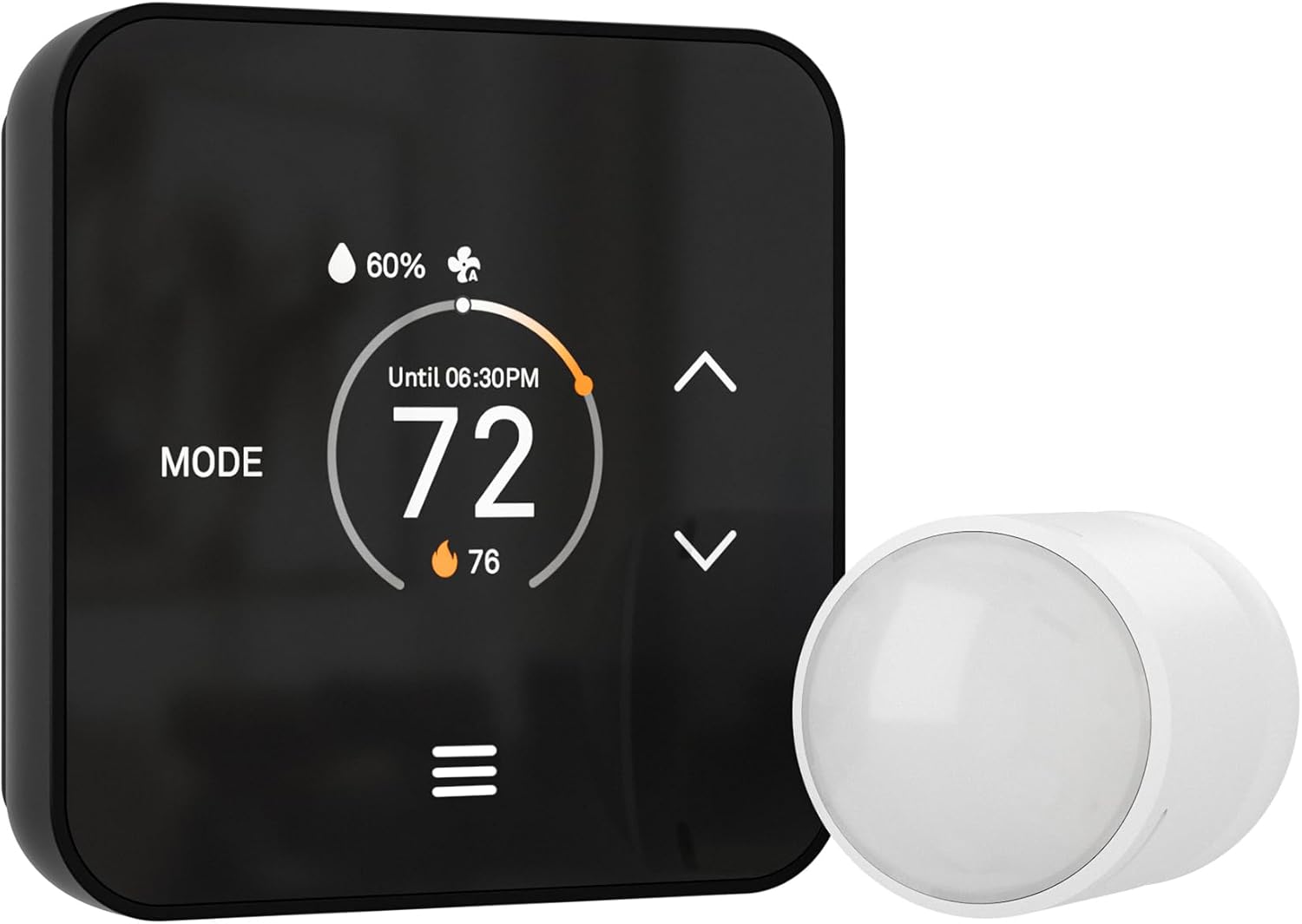
| Connectivity Technology | Bluetooth, Matter, WiFi, Zigbee |
|---|---|
| Power Source | System Power C-Wire |
| Controller Type | Amazon Alexa, Android, Apple HomeKit, Google Assistant, iOS |
| Included Components | 1 Remote sensor, trim plate, Lux Power Bridge (c-wire replacement) |
| Number of Batteries | 2 CR2 batteries required (included) |
The LUX TQX smart thermostat is a wall-mounted, Matter-over-WiFi thermostat designed to manage HVAC systems while using occupancy detection and up to five remote sensors to improve whole-house comfort. It connects through Matter-compatible smart speakers or controllers so you can control temperature, schedules, and sensor data remotely with your existing smart-home app and voice assistants like Alexa, Siri, or Google Assistant. The thermostat learns routines to auto-schedule heating and cooling, adjusts display brightness with a proximity light sensor, and includes a Lux Power Bridge for homes without a C-wire. In practice the occupancy sensor and remote sensors help the system avoid conditioning empty rooms and can shift comfort based on combined sensor inputs, though individual sensors do not control rooms independently. Setup supports common HVAC setups including multi-stage heat and cool and heat pumps, but it is not compatible with line-voltage systems. The TQX is a practical choice if you want integrated sensor-driven comfort and Matter compatibility, with the caveat that whole-house sensor aggregation means you should plan sensor placement for accurate results.
Best for: Buyers who want to optimize home comfort and energy use with sensor-driven, whole-house control and who prefer using their existing smart-home platform rather than a separate thermostat app.
Less Ideal for: Homes that require line-voltage thermostat control or users who need each room to be regulated independently by its own sensor without aggregated system control.
- Matter over Wi-Fi and Zigbee/Bluetooth support for broad smart-home integration
- Built-in millimeter-wave occupancy detection plus support for up to 5 remote sensors
- Auto-scheduling learns routines to reduce wasted heating or cooling
- Includes Lux Power Bridge to provide system power when a C-wire is absent
- Sensor data is aggregated for whole-house adjustments, so single sensors do not control individual rooms independently
- Not compatible with 120V/240V line-voltage heating systems
Verdict: Choose the TQX if you want a Matter-compatible thermostat that uses occupancy sensing and multiple remote sensors to centrally optimize comfort and energy use across your home.
Honeywell Home T9 Smart Thermostat

| Connectivity Technology | Wi‑Fi |
|---|---|
| Control Type | Touch |
| Power Source | Corded Electric |
| Controller Type | Amazon Alexa, Google Assistant, SmartThings, Vera |
| Display Type | LCD |
The Honeywell Home T9 is a touchscreen Wi‑Fi thermostat that uses a bundled Smart Room Sensor to target comfort in specific rooms and track temperature and humidity. It connects to the Honeywell Home (Resideo) app and works with voice assistants so you can adjust settings remotely, set schedules, and use geofencing for automatic home and away behavior. The included sensor reports room conditions up to a claimed 200 feet, and multiple sensors can be added to focus the thermostat on occupied rooms or create an averaged setpoint across zones. Setup is intended for DIY installation and the package includes a low‑voltage power adapter option for homes lacking a C‑wire. Practical benefits are clearer temperature control in bedrooms or living areas, monthly energy reports, and compatibility with common smart platforms. Important limitations are that it requires compatibility with your HVAC wiring (not for electric baseboard heat) and some advanced features need additional room sensors, so you may pay more to cover a whole house.
Best for: Buyers who want a practical smart thermostat that improves comfort in specific rooms while offering app and voice control without requiring professional installation.
Less Ideal for: People with electric baseboard heating or those who need whole‑home room sensing without buying multiple extra sensors.
- Smart Room Sensor included for targeted room temperature and humidity readings
- Works with major smart platforms and voice assistants for remote control
- Geofencing and auto home/away modes help reduce energy use
- DIY guided installation and optional power adapter for homes without a C‑wire
- Monthly energy reports and filter reminders in the app
- Not compatible with electric baseboard heat systems
- Key multi-room features require purchasing additional sensors to cover more rooms
Verdict: A good choice for budget-minded buyers who want reliable smart control plus a room sensor to focus comfort where it matters most.
ecobee Smart Thermostat Premium

| Controller Type | Amazon Alexa, Android, Apple HomeKit, Google Assistant, iOS |
|---|---|
| Connectivity Protocol | Wi-Fi |
| Power Source | Battery Powered |
| Voltage | 24 volts |
| Included Components | SmartSensor, Backplate, Wire labels, Screws, PEK, Trim plate |
The ecobee Smart Thermostat Premium is a feature-rich smart thermostat designed to balance comfort, air quality, and energy savings. It mounts on the wall and connects to your HVAC via 24VAC systems, with a Power Extender Kit included for installs that lack a C-wire. In daily use it combines a large, bright LCD with an included SmartSensor to reduce hot and cold spots and radar occupancy sensing to detect presence for automated adjustments. Built-in air quality monitoring issues alerts and filter reminders, while the integrated speaker supports Siri or Alexa for voice control and basic media playback. Dual-band Wi‑Fi, app control, and broad smart home integrations provide remote scheduling and geofencing. Practical strengths are easy DIY-friendly installation for compatible systems and the bundled sensor that improves room-level comfort. Important limits are that it is not compatible with line-voltage or millivolt systems and full Siri requires an Apple home hub, so some users may need additional hardware to unlock every feature.
Best for: Homeowners who prioritize dependable, sensor-driven comfort and want a single thermostat that also monitors air quality and integrates with major smart home ecosystems.
Less Ideal for: Homes with line-voltage or millivolt heating systems or buyers who need voice assistant functionality without any additional hub or ecosystem devices.
- Includes SmartSensor to manage hot and cold spots for room-level comfort
- Built-in air quality monitor with alerts and filter reminders
- Radar occupancy sensing improves automatic temperature adjustments
- Bundled Power Extender Kit simplifies installation on systems without a C-wire
- Works with Siri, Alexa, Google Assistant, HomeKit and major smart home platforms
- Not compatible with line-voltage or millivolt HVAC systems
- Siri voice control requires an Apple home hub to enable full functionality
Verdict: Choose this thermostat if you want reliable, sensor-based room comfort plus built-in air quality monitoring and broad smart home integration.
Google Nest Learning Thermostat (4th Gen)

| Connectivity Technology | Wi-Fi |
|---|---|
| Power Source | Battery Powered |
| Voltage | 24 volts |
| Display Type | Touchscreen |
| Included Components | Nest Temperature Sensor (2nd gen) |
The Nest Learning Thermostat (4th gen) is a premium smart thermostat designed to learn your preferences and reduce heating and cooling waste while giving you remote control via the Google Home app. It installs on standard 24V systems and includes a Nest Temperature Sensor (2nd gen) so you can manage hot or cold spots from the app rather than relying on a single wall location. Notable features include Adaptive Eco that factors in outdoor conditions, Dynamic Farsight for at-a-glance info across the room, System Health alerts, and compatibility with voice assistants plus Matter for easier smart-home integration. The larger touchscreen and aluminum finish make it visually distinct, and the unit can suggest schedule tweaks that you approve in the app. Limitations to consider are that some advanced energy-saving benefits rely on participation in Nest services and app notifications, and full compatibility should be confirmed for nonstandard HVAC setups; professional installation is available if wiring is unfamiliar.
Best for: Buyers who want a top-tier smart thermostat with room-sensor support and are looking for data-driven energy savings plus easy app and voice control backed by strong user feedback.
Less Ideal for: People who need the simplest manual thermostat without app dependence or those with highly unusual HVAC wiring who prefer a basic non-learning thermostat.
- Includes a Nest Temperature Sensor to control temperature in a different room
- Learns schedule and suggests auto-schedule changes to save energy
- Adaptive Eco and outdoor-aware controls help reduce runtime when natural heating or cooling is sufficient
- Works with Google Home app, voice assistants, and Matter for remote and voice control
- System Health monitoring and alerts help spot HVAC issues early
- Some energy-saving features require app notifications and opt-in services
- May need verification for compatibility with unusual or older HVAC systems
Verdict: Choose this Nest bundle if you want a learning smart thermostat with an included room sensor that prioritizes real-world energy savings and remote control.
Google Nest Thermostat E

| Connectivity Technology | Wi-Fi |
|---|---|
| Power Source | Battery Powered |
| Display Type | LCD |
| Number of Batteries | 1 Lithium Ion (included) |
The Nest Thermostat E is a simple smart thermostat designed to learn schedules and adjust your heating and cooling to save energy while keeping rooms comfortable. It pairs with the included Nest Temperature Sensor so you can prioritize a specific room for temperature control and schedule different setpoints by time of day. Installation is intended to be DIY-friendly with wall mount hardware and a battery power option, and the thermostat integrates with Wi‑Fi, the Nest app, Amazon Alexa, and Google Assistant for remote and voice control. Practical benefits include Auto‑Scheduling, Home/Away Assist that shifts to Eco temperatures when the house is empty, and Energy History feedback in the app to track usage. Limitations to keep in mind are that energy savings vary by home and usage patterns, and the thermostat offers a basic LCD display and button controls rather than a high‑resolution touchscreen, so advanced control and detailed on-device menus are limited compared with higher-end models.
Best for: Buyers who want a straightforward, reliable smart thermostat with a room sensor for more accurate comfort control and who prefer simple setup and mainstream smart assistant support.
Less Ideal for: Users seeking advanced on-device controls, color touchscreen displays, or deeply configurable HVAC integrations should consider higher-end models with more features.
- Includes a Nest Temperature Sensor to control temperature in a specific room
- Wi‑Fi and app control for remote scheduling and adjustments
- Works with Amazon Alexa and Google Assistant for voice commands
- Auto‑Scheduling and Home/Away Assist help automate energy-saving behavior
- Basic LCD and button interface offers less on-device detail than touchscreens
- Energy savings are not guaranteed and depend on household usage and systems
Verdict: Choose the Nest Thermostat E bundle if you want an easy‑to‑install smart thermostat with a room sensor and mainstream app and voice control for reliable, straightforward comfort and energy management.
Choosing the Right Smart Thermostat with Room Sensors: Key Factors to Consider
Sensor Accuracy and Placement
How precisely a room sensor measures temperature and occupancy affects the thermostat's ability to maintain comfort. Sensors should have consistent calibration and minimal drift so that readings represent actual room conditions rather than noisy fluctuations.
Placement matters almost as much as raw accuracy. Sensors placed near windows, direct sunlight, vents, or heat sources will report skewed readings. Plan sensor locations in the rooms you most want to balance, and prefer sensors with at least a few feet of separation from obvious thermal influences.
Connectivity and Range
Remote sensors communicate with the main thermostat over RF protocols or Wi-Fi, and the reliability of that link determines how often the thermostat gets fresh data. Look for systems that support robust protocols, repeaters, or mesh-capable sensors if you have a large or multi-story home.
Consider how thick walls, distance from the thermostat, and sources of interference may affect range. If your home has known dead spots, choose sensors with stronger radios or the option to add more sensors to create overlap and redundancy.
Compatibility With HVAC Wiring
Smart thermostats vary in wiring requirements and in how they interface with heating, cooling, heat pumps, and auxiliary systems. Confirm that the thermostat works with your existing control wiring and whether a common wire is required or included.
Some installations may need a professional adapter or minor HVAC modifications. If you prefer DIY installation, prioritize thermostats with clear wiring guidance, adaptive charging circuits, and good installer resources to avoid system disruptions.
Control Logic and Multi-Sensor Management
Different thermostats handle multiple sensors in different ways: averaging temperatures, prioritizing the warmest or coldest room, or allowing schedule-based room selection. The control strategy you choose affects both comfort and energy use.
For example, averaging can reduce temperature swings across many rooms, but prioritizing an occupied room may be better if you mainly use a few spaces. Check whether the thermostat supports custom rules, per-sensor weightings, or automatic occupancy-based switching.
App Interface and Automation Options
A good mobile app turns sensor data into actionable settings and automations. Look for clear sensor readouts, easy scheduling by room, and simple ways to create rules that respond to occupancy or temperature thresholds.
Integration with third-party automation platforms and voice assistants can extend functionality, enabling temperature-driven scenes or geofencing actions. If you rely on linked devices or routines, ensure the thermostat exposes sensor-level data and triggers to those services.
Battery Life and Maintenance
Many remote sensors run on batteries, so expected battery life and replacement ease are practical concerns. Longer battery life reduces maintenance and the chance that a neglected sensor will drop offline.
Check whether sensors use common battery types, how the system alerts low battery, and whether sensors can operate while reporting intermittent connectivity. Durable housings and easy-to-replace batteries make upkeep straightforward for busy households.
How Room Sensors Improve Everyday Comfort
Room sensors give you more granular temperature information than a single thermostat location. That means the heating and cooling system can respond to the parts of the house that actually need attention, reducing hot or cold spots and improving perceived comfort.
Sensors also enable occupancy-aware control. Many systems can prioritize rooms where people are present, so you are not conditioning an empty hallway while the living room is too warm or cold.
- Reduces temperature variation between rooms
- Enables occupancy-based temperature prioritization
- Helps avoid over-conditioning unoccupied areas
Planning Sensor Locations for Best Results
Choose sensor locations based on where comfort problems occur and where family members spend most time. Common spots include living rooms, home offices, master bedrooms, and frequently used downstairs areas.
Avoid placing sensors immediately above vents, on exterior walls, or in direct sunlight. If a room has uneven temperature zones, consider two sensors placed apart to capture an average.
- Place sensors away from direct heat sources
- Use multiple sensors in large or open-plan rooms
- Mount sensors at typical breathing height for accurate readings
Installing Sensors: DIY Tips and Common Pitfalls
Many sensors are easy to install and mount with adhesive or screws. Before mounting, verify connectivity where you plan to place each sensor by testing signal strength in the thermostat's app or following the manufacturer's pairing steps.
Common pitfalls include relying on a single sensor for multiple rooms, mounting too close to appliances, and neglecting to register each sensor in the app. Label sensors by room in the app to avoid confusion when creating automation rules.
- Test signal before final mounting
- Label each sensor for easier automation setup
- Keep spare batteries on hand for long-term reliability
Using Sensors to Save Energy Without Sacrificing Comfort
Properly configured sensors can reduce wasted conditioning by focusing temperature control on occupied spaces and by avoiding overcorrection from a single hot or cold reading. Use scheduling and occupancy rules so the system relaxes setpoints when rooms are empty.
Avoid overly aggressive setpoint swings that cause frequent on/off cycles in the HVAC. Smoother, moderate adjustments informed by multiple sensors usually yield both comfort and efficiency benefits.
- Use occupancy-based rules to avoid conditioning unused rooms
- Prefer gradual temperature changes to reduce short cycling
- Combine sensor data with time-of-day schedules for best results
When to Call a Pro
Call a professional if your HVAC wiring is nonstandard, if you have a multi-stage or commercial-grade system, or if you are uncomfortable modifying control wiring. Professionals can confirm compatibility and install adapters or a common wire if needed.
Also consider professional help when integrating sensors into complex zoning systems so that the control logic aligns with duct dampers, zone panels, or existing thermostatic controls.
- Professional assist recommended for complex HVAC setups
- Electricians can add or verify common wire connections
- Technicians help with multi-zone or multi-stage control integration
How We Chose the Best Smart Thermostat with Room Sensors
We began by filtering for smart thermostats that explicitly support remote room sensors or ship with sensor bundles. Priority went to systems that report individual sensor temperature and occupancy rather than solutions that only infer conditions from a single device. We evaluated connectivity options and reliability, giving weight to thermostats that use robust local protocols or dual-band Wi-Fi to reduce dropouts in multi-room setups. Sensor performance was assessed based on reported accuracy, response time, and the ability to place sensors away from the main thermostat. Integration with scheduling, zoning features, and multi-sensor averaging or prioritization was a must, because usable control logic matters as much as raw sensor readings. Installation complexity and wiring compatibility were considered to ensure the picks work in a range of homes, including support for common HVAC configurations and existing C-wire setups. We also reviewed mobile app functionality and voice platform compatibility for ease of control, plus the availability of automation rules that use sensor data. Products with limited sensor reporting, proprietary single-room solutions, or poor connectivity histories were excluded. The result is a set of thermostats that balance sensor accuracy, integration flexibility, and everyday reliability.
Our full evaluation process is outlined in our review methodology.
FAQ
Do room sensors always improve thermostat performance?
Often they do, but the benefit depends on placement and control logic. Well-placed sensors that the thermostat uses intelligently will reduce hot or cold spots, while poorly placed sensors can introduce misleading readings.
How many sensors should I buy for a typical home?
It depends on layout and problem areas. Many homes see clear improvement with two to four sensors placed in primary living spaces and bedrooms. Large open plans or multi-level homes often benefit from additional sensors.
Will sensors work if they lose Wi-Fi?
Usually room sensors communicate directly with the thermostat over a dedicated RF link, so temporary Wi-Fi outages do not necessarily stop sensor updates. However, cloud features and remote control may be affected until connectivity is restored.
How often do sensor batteries need replacing?
Battery life varies, but many sensors last months to years depending on reporting frequency and battery type. Systems typically provide low-battery alerts so you can replace batteries before a sensor goes offline.
Can I use sensors to control different temperatures in different rooms?
Many thermostats allow room-based prioritization or scheduling, which can effectively target comfort to specific rooms. True independent temperature control for separate zones requires dedicated zone dampers or separate HVAC zones.
Final Verdict
Room sensors extend a thermostat's awareness beyond a single location, giving you options to balance comfort and energy use across a home. When choosing a smart thermostat with room sensors, prioritize sensor accuracy, reliable connectivity, and flexible multi-sensor control logic that matches how you use rooms. Consider installation complexity and app automation capabilities as deciding factors. With the right balance of sensors and rules, you can reduce temperature disparities and make your HVAC system work more intelligently for daily comfort.