
Note: This article contains affiliate links. If you click on these links and make a purchase, we may earn a small commission at no extra cost to you. This helps support our research and content. Read our full affiliate disclosure here.
Choosing the right thermostat for a central heat and air system changes how comfortable and efficient your home stays. The correct unit improves temperature consistency, reduces wasted runtime, and can simplify daily operation for everyone in the household. This guide shortlists the top thermostat options designed for central systems and explains the technical and practical factors that matter when swapping or upgrading your wall controller. We tested candidates against compatibility, installation complexity, and control features to find reliable picks for typical homes. Read on to see which options match your setup and priorities.
Top Picks at a Glance
| Best Overall The best all-around choice for most situations | Sensi Smart Thermostat ST55 |  |
| Best Quality Built to a higher standard if you want something more solid | Honeywell Home X8S Smart Thermostat |  |
| Best Value The sweet spot between price and what you get | Suuwer S705 Programmable Thermostat |  |
| Best Budget The cheapest option that still gets the job done reliably | Suuwer Non-Programmable Thermostat S701 |  |
| Top Rated A top-rated pick with lots of positive feedback | White‑Rodgers 80 Series 1F83C-11NP |  |
| Most Popular A crowd favorite that many people choose with confidence | Google Nest Thermostat |  |
| Best Seller A high-volume bestseller chosen again and again | Riseem S3001 Nonprogrammable Thermostat |  |
Sensi Smart Thermostat ST55

| Connectivity Technology | Wi-Fi |
|---|---|
| Controller Type | Amazon Alexa, Apple HomeKit, Google Assistant, SmartThings, Vera |
| Temperature Control Type | Programmable, Smart/Remote |
| Power Source | Corded Electric |
The Sensi Smart Thermostat ST55 is a wall‑mounted Wi‑Fi thermostat that replaces a traditional programmable stat and gives remote control via a mobile app and voice assistants. It supports common HVAC systems including furnaces, heat pumps, boilers and central air, and offers scheduling, usage reports and smart alerts to help manage energy use. Installation is pitched as DIY friendly with a built‑in level, wire stickers and clear app guidance, and it can work without a common wire in many homes while also accepting a C‑wire where available. The display is a simple LED panel with button controls rather than a full color touchscreen, and the unit integrates with Alexa, Google, Apple HomeKit and other smart home platforms for voice control and automation. Practical benefits include Energy Star certification and system maintenance reminders, but users who want a large touch display or advanced UI will find the ST55 basic in its physical controls. The product prioritizes ease of use, broad compatibility and energy reporting over flashy hardware features.
Best for: Buyers who want a straightforward, energy‑focused smart thermostat that is easy to install themselves and integrates with voice assistants and common smart home platforms.
Less Ideal for: Users seeking a thermostat with a large color touchscreen, highly customizable on‑device UI, or models tailored to niche HVAC setups should consider other options.
- Works with major voice platforms and smart home ecosystems for flexible control
- ENERGY STAR certification and usage reports help reduce HVAC energy use
- Designed for DIY installation with mounting hardware, wire stickers and app guidance
- Operates without a common wire in many installations and includes battery backup
- LED/button interface is more basic than color touchscreen competitors
- Limited on‑device controls for users who prefer richer local interaction
Verdict: An easy to install, ENERGY STAR certified smart thermostat that delivers reliable remote and voice control to cut HVAC energy use.
Honeywell Home X8S Smart Thermostat

| Controller Type | Touchscreen |
|---|---|
| Connectivity Technology | Wi-Fi |
| Power Source | Hardwired |
| Screen Size | 5 inches |
| Control Type | App Control |
The Honeywell Home X8S is a feature-rich smart thermostat designed for central heat and air systems that need precise control and modern integrations. It uses a 5-inch customizable touchscreen and app control to set schedules, adjust temperature remotely, and prioritize comfort with the included wireless room sensor that can be placed up to about 200 feet away for targeted zoning. The X8S supports multiple system types (up to 3 heat/2 cool heat pump or 2 heat/2 cool conventional), requires hardwired power with a C-wire, and works over 2.4 or 5 GHz Wi‑Fi. Notable extras include humidity and ventilation monitoring, ENERGY STAR qualification, and compatibility with Alexa, Google, Apple Home, Matter, and select video doorbells so you can view visitors from the thermostat. Installation is typical of smart thermostats and may need the included C‑wire adapter voucher for systems without a C‑wire. The thermostat is strong on connectivity and comfort features, though buyers should confirm system compatibility and be prepared for a hands-on install if their HVAC wiring differs from supported setups.
Best for: Buyers who prioritize precise comfort control, smart home interoperability, and energy efficiency for central heat and air systems and who are comfortable with a typical smart-thermostat installation process.
Less Ideal for: People with electric baseboard heating or those who need a simple plug-and-play thermostat without any wiring work or system-compatibility checks.
- Includes wireless room sensor for targeted comfort control
- 5-inch customizable touchscreen plus app control for remote adjustments
- Supports multiple HVAC configurations and offers humidity/ventilation monitoring
- Matter certified and works with Alexa, Google Assistant, and Apple Home for smart home integration
- ENERGY STAR certified to support energy-saving programs and rebates
- Requires hardwired C-wire power and possible adapter voucher for some installs
- Not compatible with electric baseboard heat (120–240V)
Verdict: Choose the X8S when you want advanced, app-driven comfort and smart-home integration to optimize central heating and cooling performance.
Suuwer S705 Programmable Thermostat

| Power Source | 24VAC or 2 AAA batteries |
|---|---|
| System Compatibility | Single-stage 1 Heat/1 Cool conventional systems |
| Display Type | Digital blue backlit LCD |
| Programming | 5-1-1 day, 4 periods per day |
| Protection | 5 minute compressor delay (selectable) |
The Suuwer S705 is a straightforward 5-1-1 day programmable thermostat built for conventional single-stage 1 Heat/1 Cool HVAC systems. It provides separate weekday and weekend schedules with four periods per day, a large 4.5 inch blue backlit LCD for easy reading, and simple push-button controls for programming. The unit supports dual power sources (24VAC or two AAA batteries) so it installs in most homes without a common wire on typical single-stage setups, and it includes selectable 5-minute compressor delay protection, adjustable swing (cycle rate), ambient temperature correction, and reminders for low battery and filter replacement. Practical benefits include clear on-screen information for older eyes, basic energy-saving scheduling, and protection for the compressor. Limitations are that it is not compatible with multistage, heat pump with auxiliary stages, line-voltage baseboard systems, mini-splits, or many RV/PTAC systems, so compatibility must be checked before purchase. For buyers who want a no-frills, programmable wall thermostat for a standard central furnace and AC, the S705 delivers dependable basic control without smart features.
Best for: Buyers who want a reliable, easy-to-program wall thermostat to schedule comfort and save energy on a standard single-stage central furnace and air conditioner.
Less Ideal for: Homeowners with multistage HVAC, heat pump systems with auxiliary stages, mini-split installations, or line-voltage electric baseboard heating should look elsewhere.
- Large backlit 4.5 inch LCD that is easy to read
- 5-1-1 day programming with four periods per day for weekday/weekend scheduling
- Dual power option (24VAC or 2 AAA batteries) so a c-wire is not required on most installs
- Selectable 5-minute compressor delay and adjustable temperature swing for system protection and stable control
- Incompatible with multistage systems, most heat pumps with auxiliary stages, line-voltage baseboard heat, and mini-splits
Verdict: A practical, easy-to-read programmable thermostat that gives dependable scheduling and system protection for single-stage central heat and air systems.
Suuwer Non-Programmable Thermostat S701

| Controller Type | Push Button |
|---|---|
| Specific Uses For Product | Single-Stage Heating (Gas/Oil/Electric Furnace), Ventilation, and Air Conditioning |
| Power Source | Battery Powered or 24VAC |
| Display Type | LCD |
| Additional Features | Non-Programmable, Separate Heating and Cooling Swing, Low Battery Indicator, 5 Minute Compressor Delay Protection |
The Suuwer S701 is a no-frills digital thermostat designed for conventional single-stage HVAC systems (1 heat/1 cool). It uses a large blue backlit LCD and push-button controls to set temperature, heating or cooling mode, and separate swing rates, making it easy to read and operate. Installation supports either 24VAC power or two AAA batteries so a common wire is not required in most homes, and the unit includes selectable 5-minute compressor delay protection and ambient temperature correction for steadier cycling. Practical benefits include straightforward setup, clear display for older users, and basic protections that help avoid short-cycling. Limitations are its lack of programmability or smart features, and explicit incompatibility with multistage systems, heat pumps, line-voltage baseboard heat, mini-splits, and certain RV or PTAC units, so it only fits standard single-stage central systems. If you want a simple, reliable replacement thermostat that prioritizes ease of use and basic controls over scheduling or connectivity, the S701 delivers.
Best for: Buyers who need an inexpensive, easy-to-use replacement thermostat for a standard single-stage central heating and cooling setup and prioritize simple operation over advanced features.
Less Ideal for: Homeowners who need scheduling, Wi-Fi/smart control, or compatibility with multistage or heat-pump systems should look at programmable or smart thermostats instead.
- Large backlit 4.5-inch LCD that is easy to read
- Dual power options (24VAC or 2 AAA batteries) so no common wire is usually required
- Selectable 5-minute compressor delay protection to protect HVAC equipment
- Simple push-button controls for easy operation and setup
- Non-programmable with no smart home or scheduling features
- Incompatible with multistage systems, heat pumps, line-voltage heating, and several specialty HVAC types
Verdict: A straightforward, budget-friendly replacement thermostat for single-stage central heat and air that focuses on clear display and reliable basic controls.
White‑Rodgers 80 Series 1F83C-11NP

| Controller Type | Push Button |
|---|---|
| Power Source | Battery Powered (2 AA included) |
| Display Type | Backlit LCD |
| Voltage | 24 volts |
| Specific Uses For Product | Air Conditioner, Heat Pump |
The White‑Rodgers 80 Series 1F83C-11NP is a straightforward non‑programmable thermostat aimed at reliable temperature control for central heat and air systems. It installs quickly using the universal back plate and built‑in level, runs on two included AA batteries, and shows set and room temperatures on a large backlit LCD that is easy to read in low light. Practical features include a filter change reminder, keypad lockout to prevent tampering, adjustable heat/cool limits, and one‑degree precision for consistent comfort. The unit supports common system types including single‑stage conventional and heat pump setups, and its simple button controls make daily use intuitive. Because it is non‑programmable, it lacks scheduling, smart connectivity, and remote control, so it is best where basic manual control and proven durability matter more than energy‑saving automation. For homeowners wanting a low‑complexity, factory‑quality replacement that focuses on dependable operation, this model delivers exactly that.
Best for: Buyers who prioritize straightforward, dependable temperature control and want a durable factory‑quality replacement without the complexity of smart or programmable features.
Less Ideal for: People who want programmable scheduling, smartphone control, or integrations with smart home systems should consider a programmable or Wi‑Fi thermostat instead.
- Large backlit LCD for easy reading in low light
- Simple, quick DIY installation with universal back plate and built‑in level
- Includes filter change reminder and keypad lockout for basic maintenance and security
- Works with common single‑stage heating, cooling, and heat pump systems
- Non‑programmable so no scheduling or energy‑saving automation
- No Wi‑Fi or remote control capability
Verdict: Choose this thermostat if you need a low‑complexity, reliable wall controller that replaces factory units and keeps central heat and air systems running simply and accurately.
Google Nest Thermostat
| Connectivity Technology | Bluetooth, Wi-Fi |
|---|---|
| Power Source | Battery Powered |
| Display Type | LCD |
| Control Type | Remote Control, Voice Control |
| Number of Batteries | 2 A batteries required (included) |
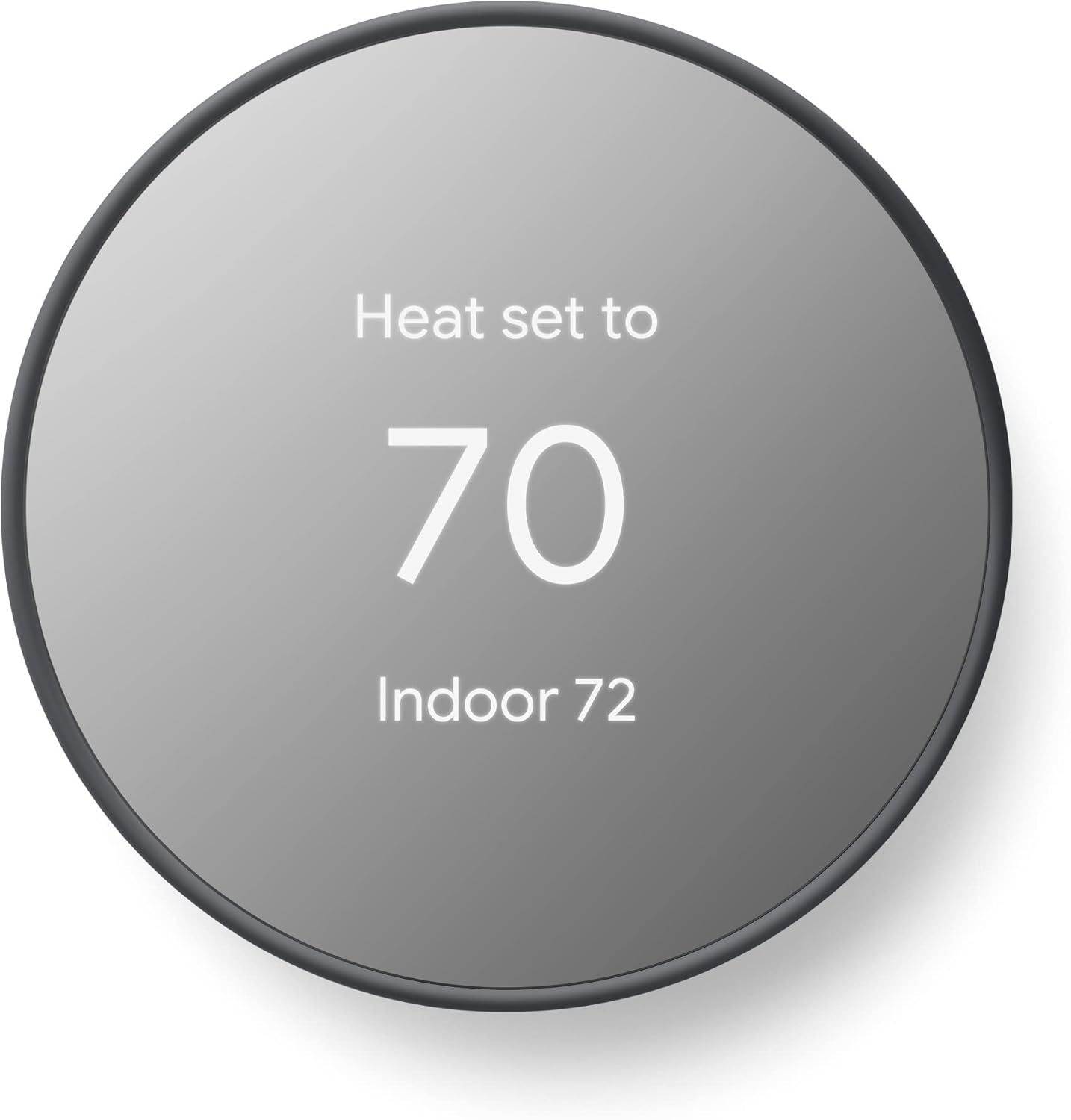
The Google Nest Thermostat is a compact smart thermostat designed for central heating and air systems that brings basic energy-saving automation and remote control to most homes. It mounts to the wall and pairs with the Google Home app so you can set schedules, change temperatures from your phone, or use voice commands with compatible assistants. Key features include Savings Finder suggestions, HVAC monitoring alerts, Quick Schedule editing in-app, and automatic Eco Temperatures when the thermostat detects you are away. It is battery powered and installs quickly for many systems without a C wire, though certain setups like some heat pumps or zone controls may need a C wire or power accessory. The display and touch bar provide simple local control, and the unit supports both 2.4 GHz and 5 GHz Wi‑Fi plus Bluetooth for configuration. For buyers focused on proven performance and energy features, it delivers useful automation and app control, but it does not include advanced learning behavior found in higher-end Nest models and may require professional help for less common HVAC wiring.
Best for: Buyers who want a reliable, easy-to-use smart thermostat for central heating and cooling that provides app control and energy-saving suggestions without the complexity of higher-end models.
Less Ideal for: Homeowners who need advanced learning algorithms, enterprise-level HVAC diagnostics, or who have uncommon wiring setups and prefer a thermostat with built-in power support.
- Remote temperature control and scheduling via Google Home app
- Savings Finder and Eco Temperature features that help reduce energy use
- Quick, user-installable setup for most central HVAC systems
- Works with voice assistants and supports both 2.4 GHz and 5 GHz Wi‑Fi
- May require a C wire or power accessory on some systems
- Lacks the more advanced self-learning routines of Nest Learning Thermostats
Verdict: A straightforward smart thermostat that brings reliable remote control and energy-saving features to central heat and air systems without the complexity of premium learning models.
Riseem S3001 Nonprogrammable Thermostat

| Controller Type | Push Button |
|---|---|
| Temperature Control Type | Conventional Single Stage Systems |
| Power Source | 24VAC or 2 AA batteries |
| Display Type | LCD |
| Connectivity Technology | Wired |
The Riseem S3001 is a straightforward wall-mounted digital thermostat made for single-stage heat/cool central systems. It provides simple temperature control with button operation and a clear backlit LCD, and it can run on 24VAC or two AA batteries so it works without a common wire in most setups. Installation is aimed at DIYers: the universal sub-base and large terminal blocks simplify wiring for up to five wires and the product information highlights compatibility and incompatibility clearly. The unit includes separate heating and cooling swing settings to help stabilize cycles and improve comfort, and a low-battery indicator helps avoid unexpected downtime when on battery power. Practical limits are that it does not support multistage equipment, heat pumps, mini-splits, or line-voltage baseboard systems, and it offers no programming or smart/home integration features, so you must make manual adjustments to change temperature setpoints. For homes with a single-stage furnace and central A/C that need a reliable, no-frills control, this unit delivers dependable basic control with an easy install.
Best for: Buyers who want a reliable, easy-to-install thermostat for a conventional single-stage central HVAC system and prefer simple manual controls over programmable or smart features.
Less Ideal for: Homeowners with multistage systems, heat pumps, mini-splits, or those seeking programmable schedules or smart-home connectivity should look elsewhere.
- Compatible with conventional single-stage heating and cooling systems
- Dual power option: 24VAC or 2 AA batteries so C-wire is not required in most setups
- Backlit LCD and simple button controls for easy everyday use
- Universal sub-base and large terminal blocks intended to make DIY installation straightforward
- Separate heating and cooling swing control to reduce short cycling and improve comfort
- Not compatible with multistage, heat pump, mini-split, or line-voltage systems
- No programming schedules or smart/home integration features
- Base only supports up to about five wires so complex wiring configurations are not supported
Verdict: A dependable, no-frills wired thermostat that is ideal when you need a simple, easy-to-install controller for a single-stage central heating and cooling system.
Choosing the Right Thermostat for Central Heat and Air: Key Factors to Consider
Wiring and System Compatibility
Central heat and air systems use a handful of standard control wires and voltages, but not every thermostat supports every configuration. Confirm which wires your furnace and air handler use for power, fan control, and stages of heating or cooling. Some systems need a common 24V C wire for consistent power, while others can run on batteries or power-stealing designs. Multi-stage systems and heat pumps require thermostats that explicitly support those modes.
Choosing a thermostat that matches your wiring prevents installation headaches and functional limitations. If you are unsure, inspect the existing terminal label cluster and compare it to the thermostat documentation before purchase. An incompatible unit can lead to lost features, frequent battery changes, or intermittent operation.
Installation Effort and Tools Needed
Installation difficulty ranges from simple wall-plate swaps to models that require jumper changes, app setup, or mounting templates. Homeowners with basic DIY skills can often handle a direct replacement when wire labels match, but some units need a common wire hookup or a professional to reconfigure the control board. Consider whether you are comfortable turning off HVAC power, handling low-voltage wiring, and following wiring diagrams.
Also factor in whether the thermostat requires additional hardware like a trim plate to cover wall damage or an adapter for nonstandard wall boxes. Choosing a model with clear instructions and good wiring diagrams reduces the chance of an incorrect install and the need for a service call.
Control Modes and Scheduling Options
Thermostats differ in how they allow you to set temperatures across the day and week. Basic models offer manual or simple programmable schedules, while more advanced controllers provide flexible multi-period schedules, geofencing, or adaptive learning that adjusts based on occupancy patterns. The scheduling approach affects both comfort and energy use because it determines how the system preconditions the house before occupancy and sets setbacks during unoccupied hours.
Decide whether you need complex weekly schedules, temporary holds, or automatic adjustments based on detected presence. For households with predictable routines, detailed scheduling can yield significant runtime savings without sacrificing comfort. For variable schedules, features like remote control and geofencing provide more practical convenience.
Sensor Support and Zoning Capabilities
Central systems deliver conditioned air to multiple rooms, and a single wall thermostat only reads temperature at its mounting location. Thermostats that support remote temperature sensors let you average readings from other rooms or prioritize a particular space. This helps avoid overheating or overcooling due to a thermostat mounted in a naturally warm or cool spot.
If you plan to add passive zoning or multiple sensors, confirm the number and type of sensors supported and whether the thermostat can switch control logic based on sensor input. True mechanical zoning requires dampers and a control board, but sensor-aware thermostats improve comfort in many homes without full zoning upgrades.
Connectivity, App Control, and Integrations
Wi-Fi and mobile app access enable remote temperature adjustments, alerts, and cloud-based scheduling. Integration with voice assistants and home automation platforms adds convenience if you already use those systems. However, wireless features introduce dependencies on network reliability and potentially on cloud services that can change over time.
Look for thermostats with robust local controls and clear statements about backup operation during network outages. Consider whether you want open integrations that use industry-standard protocols or a closed ecosystem that may limit future flexibility.
Energy Reporting and Savings Features
Some thermostats include energy-use estimates, runtime charts, and suggestions to reduce consumption. These features can help you spot inefficient patterns and verify the effect of schedule changes. Others simply provide on/off or setback control without analytics.
If reducing bills is a priority, choose a model that gives clear, actionable feedback and supports setback strategies like temperature hold schedules and eco modes. Keep in mind that long-term savings depend on how consistently you use those features and whether the thermostat accurately controls the HVAC runtime.
Wiring Checklist Before You Buy
Before you select any thermostat, perform a quick wiring audit at the current thermostat and the furnace or air handler control board. Note the labels and colors of wires present and photograph the terminals to cross-check with product documentation. Common terminals include R or Rh (24V power), C (common), W (heat call), Y (cooling compressor), G (fan), and O/B for heat pumps.
If a common wire is missing and the thermostat you want needs one, look for solutions such as a C-wire adapter or alternative models that run on batteries. Also verify multi-stage or heat-pump requirements so the thermostat can manage all system functions correctly.
- Label and photograph existing wiring before disconnecting anything
- Compare terminal labels to the thermostat wiring diagram
- Confirm whether you have single-stage, multi-stage, or heat-pump control
Balancing Ease of Use With Advanced Features
Simplicity matters if multiple people in the home will interact with the thermostat. Large displays, straightforward menus, and clearly labeled buttons reduce confusion. Advanced features are valuable but only if you will use them. For many homes, a model with reliable scheduling and an intuitive app is the best balance.
If you want learning thermostats or complex scene integration, accept a steeper initial setup in exchange for automation over time. Conversely, if you prefer manual control, pick a unit with physical controls and basic scheduling to avoid unnecessary complexity.
- Look for clear on-device controls if multiple household members will adjust settings
- Use app-driven features only if you plan to manage schedules remotely
- Consider learning modes for hands-off energy management
Common Installation Pitfalls and How to Avoid Them
Mismatched wiring, missing common wires, and incorrect jumper placement are frequent causes of installation problems. Always turn off HVAC power at the breaker before disconnecting wires and consult the furnace or air handler control board if terminal labels differ. If your system uses proprietary connectors or unconventional wiring, that is a sign to get professional help.
Another common issue is wall damage or uneven surface mounting after removing an old thermostat. A trim plate or compatible mounting bracket can make the new unit look finished without drywall work. Finally, allow time for any app-based setup and firmware updates before concluding the installation.
- Shut off system power before touching thermostat wiring
- Keep old thermostat terminals as a reference until setup is complete
- Use trim plates to cover patchy wall areas
When to Call an HVAC Pro
If your system uses multi-stage heating and cooling, a proprietary control board, or complex zoning dampers, consult a professional. An HVAC technician can verify control board settings, wire compatibility, and diagnostic codes that affect thermostat operation. Professional installation reduces the risk of incorrect wiring that could damage control components.
Also call a pro if you find unexpected wiring in the wall, if the furnace control board lacks labeled terminals, or if the system behaves unpredictably after install. A trained technician can ensure the thermostat and system are configured safely and operate reliably.
- Complex multi-stage or zoned systems usually need professional setup
- Unexpected or unlabeled wires are a sign to stop and call a technician
- Ask for a control-board check if the system shows error codes
Maximizing Comfort Without Increasing Runtime
Small adjustments to setback schedules and fan settings can improve perceived comfort without substantially increasing HVAC runtime. Use fan circulation settings to even out room temperatures during off-peak hours. Slight preconditioning before occupancy, timed to match system ramp rates, reduces peak runtime while delivering comfortable temperatures when needed.
If you have remote sensors, place them in representative living spaces rather than drafty or sun-exposed locations. Averaging sensor readings or prioritizing the main living area helps avoid unnecessary long cycles to reach a single-room setpoint.
- Use fan settings to even out temperatures between rooms
- Precondition briefly before occupancy instead of long warm-ups
- Place sensors away from direct sun and drafts
How We Chose the Best Thermostat for Central Heat and Air
Our selection focused on units that work well with standard central heating and cooling systems and that deliver reliable temperature control in real-world homes. We prioritized compatibility with common wiring arrangements and control voltages, practical installation demands for a typical homeowner or HVAC tech, and the range of control features that affect daily comfort. Long-term reliability and firmware stability were considered through reviewing documented user experiences and manufacturer update practices. Energy-management features such as scheduling flexibility, setback options, and integration with remote sensors were evaluated because they directly affect runtime and utility usage. Usability was assessed by looking at display clarity, menu simplicity, and remote-access options. Exclusions included specialized commercial controls, thermostats built only for single-stage window units, and units that require proprietary home automation hubs not commonly found in residential setups. The result is a set of thermostats that balance compatibility, ease of installation, control features, energy management, and long-term reliability.
Our full evaluation process is outlined in our review methodology.
FAQ
Do I need a common 24V wire for a thermostat to control central heat and air?
Often a common 24V C wire is recommended for reliable power, especially for Wi-Fi and touchscreen thermostats. Some models can run on batteries or use power-stealing methods, but those approaches may cause intermittent behavior on certain systems.
Can I install a new thermostat myself if I have basic DIY skills?
Usually yes for single-stage central systems when wiring matches and instructions are clear. Turn off power, label wires, and follow the wiring diagram. Call an HVAC technician if wiring is unfamiliar, unlabeled, or your system uses multi-stage or zone controls.
Will a smart thermostat save money on my central heat and air system?
Smart thermostats can reduce energy use by enabling schedules, setbacks, and remote control, but savings depend on how consistently you use those features and on your local climate. The thermostat itself does not alter system efficiency, only how the system is operated.
How do remote sensors improve comfort with a central system?
Remote sensors let the thermostat consider temperatures from multiple rooms, preventing the system from overcooling or overheating based on a single reading. They are helpful when the thermostat is in a spot that does not represent the household's typical living areas.
What should I do if the new thermostat causes the HVAC system to cycle frequently?
Check wiring and configuration settings first, including stage settings and fan control. Ensure the thermostat's temperature differential or cycle rate settings match the system type. If cycling persists, have an HVAC technician inspect system controls and refrigerant or combustion performance.
Final Verdict
Pick a thermostat that matches your central heat and air wiring and supports the control features you will actually use. Prioritize compatibility and installation simplicity first, then choose the level of scheduling, sensor support, and connectivity that fits your household routine. Expect tradeoffs between ease of use and advanced automation; choose the option that offers reliable control and manageable setup for your home. With the right fit, a thermostat will improve comfort and make efficient operation straightforward.