
Note: This article contains affiliate links. If you click on these links and make a purchase, we may earn a small commission at no extra cost to you. This helps support our research and content. Read our full affiliate disclosure here.
Picking the right thermostat affects daily comfort, energy bills, and how your heating and cooling system performs. A well-chosen thermostat keeps rooms at steady temperatures, reduces wasted runtime, and makes scheduling or automation simple. This guide walks through six shortlisted thermostats that meet common home needs, from precise temperature sensing to straightforward setup and useful connectivity. Read on to see the key features we evaluated and which tradeoffs matter for different home situations.
Top Picks at a Glance
| Best Overall The best all-around choice for most situations | Sensi Smart Thermostat ST55 |  |
| Best Quality Built to a higher standard if you want something more solid | ecobee Smart Thermostat Premium |  |
| Best Value The sweet spot between price and what you get | Amazon Smart Thermostat |  |
| Best Budget The cheapest option that still gets the job done reliably | Miuputake STN601 Nonprogrammable Thermostat |  |
| Top Rated A top-rated pick with lots of positive feedback | ecobee Smart Thermostat Enhanced |  |
| Most Popular A crowd favorite that many people choose with confidence | Google Nest Thermostat |  |
Sensi Smart Thermostat ST55

| Connectivity Technology | Wi-Fi (2.4 GHz) |
|---|---|
| Controller Type | Amazon Alexa, Apple HomeKit, Google Assistant, SmartThings, Vera |
| Specific Uses For Product | Air Conditioner, Boiler, Furnace, Heat Pump |
| Display Type | LED |
| Number of Batteries | 2 AA batteries required (included) |
The Sensi ST55 is a wall‑mounted smart thermostat that replaces a traditional programmable thermostat and gives you remote control and scheduling via the Sensi mobile app. It connects over 2.4 GHz Wi‑Fi and works with popular voice assistants and smart home platforms for hands‑free temperature adjustments. The unit is designed for easy DIY installation with included mounting hardware, wire labels, and an integrated level, and it supports most HVAC systems including furnaces, heat pumps, boilers, and air conditioners. Notable features include Energy Star certification with usage reports and smart alerts that help identify maintenance needs and filter changes, plus a simple LED display and button controls if you prefer not to use the app. The main limitations are a modest 5‑inch screen without a full color touchscreen and reliance on 2 AA batteries alongside low‑voltage power, which may not suit every setup; full functionality also requires a compatible Wi‑Fi network and occasional app interaction. For buyers who want a straightforward, privacy‑focused smart thermostat that keeps the wall‑thermostat look, the Sensi ST55 balances smart features with easy installation.
Best for: Buyers who want a simple, privacy‑minded smart thermostat that is easy to install themselves and delivers remote control, scheduling, and energy reports without a steep learning curve.
Less Ideal for: Homes that require advanced touchscreen controls, specialty HVAC configurations, or users who want a thermostat with a large color display and more advanced on‑device controls.
- Easy DIY installation with included mounting hardware and wire stickers
- Works with Alexa, Google Assistant, Apple HomeKit, SmartThings and other platforms
- Energy Star certified with usage reports and smart alerts for maintenance
- Simple app and button control plus remote access over Wi‑Fi
- No full color touchscreen; uses LED display and button controls
- Requires 2 AA batteries in addition to low‑voltage wiring which may not be ideal for all setups
Verdict: Choose the Sensi ST55 if you want an Energy Star certified, easy‑to‑install smart thermostat that provides reliable remote control, voice integration, and energy reports with strong privacy controls.
ecobee Smart Thermostat Premium

| Controller Type | Amazon Alexa, Android, Apple HomeKit, Google Assistant, iOS |
|---|---|
| Connectivity Protocol | Wi-Fi |
| Power Source | Battery Powered |
| Voltage | 24 volts |
| Number of Batteries | 1 Lithium Ion (included) |
The ecobee Smart Thermostat Premium is a performance-focused smart thermostat that aims to improve comfort while cutting HVAC energy use. It installs on compatible 24VAC systems and ships with a SmartSensor and a Power Extender Kit for homes without a C-wire, letting you balance temperature in priority rooms and reduce hot or cold spots. The unit includes a built-in air quality monitor, radar occupancy sensor, and live view integration with ecobee doorbell cameras for extra situational awareness. Dual-band Wi‑Fi, Apple HomeKit, Google Assistant, Alexa and Siri support let you automate schedules and control the system from phones or voice, and the speaker supports music and voice responses. The premium metal finish and large LCD make the interface easy to read. Limitations include the need to verify HVAC compatibility first and reliance on an Apple home hub to enable full Siri functionality, and some advanced features require linking accounts or subcriptions. For buyers who prioritize accurate room-level comfort and smart home integrations, this is a capable top-tier option.
Best for: Buyers who want a high-performance smart thermostat that prioritizes room-level comfort, advanced sensing, and broad smart home integration to optimize HVAC efficiency and lived experience.
Less Ideal for: People with non-24VAC systems such as line-voltage or millivolt setups, or those who need a very basic thermostat without smart integrations.
- Includes SmartSensor for room-level temperature balancing to reduce hot and cold spots
- Built-in air quality monitor provides alerts and filter reminders
- Radar occupancy sensing improves presence detection without wearables
- Works with HomeKit, Google Assistant, and Alexa and has dual-band Wi‑Fi
- Includes Power Extender Kit and trim/backplate for easier DIY installation
- Requires checking system compatibility; not compatible with line-voltage or millivolt systems
- Full Siri features need an Apple home hub to function
Verdict: Choose this thermostat if you want a top-tier, sensor-driven smart thermostat that improves room-by-room comfort and integrates tightly with major smart home ecosystems.
Amazon Smart Thermostat
| Brand | Amazon |
|---|---|
| Requires C-wire | Yes |
| Works with | Alexa and Ring |
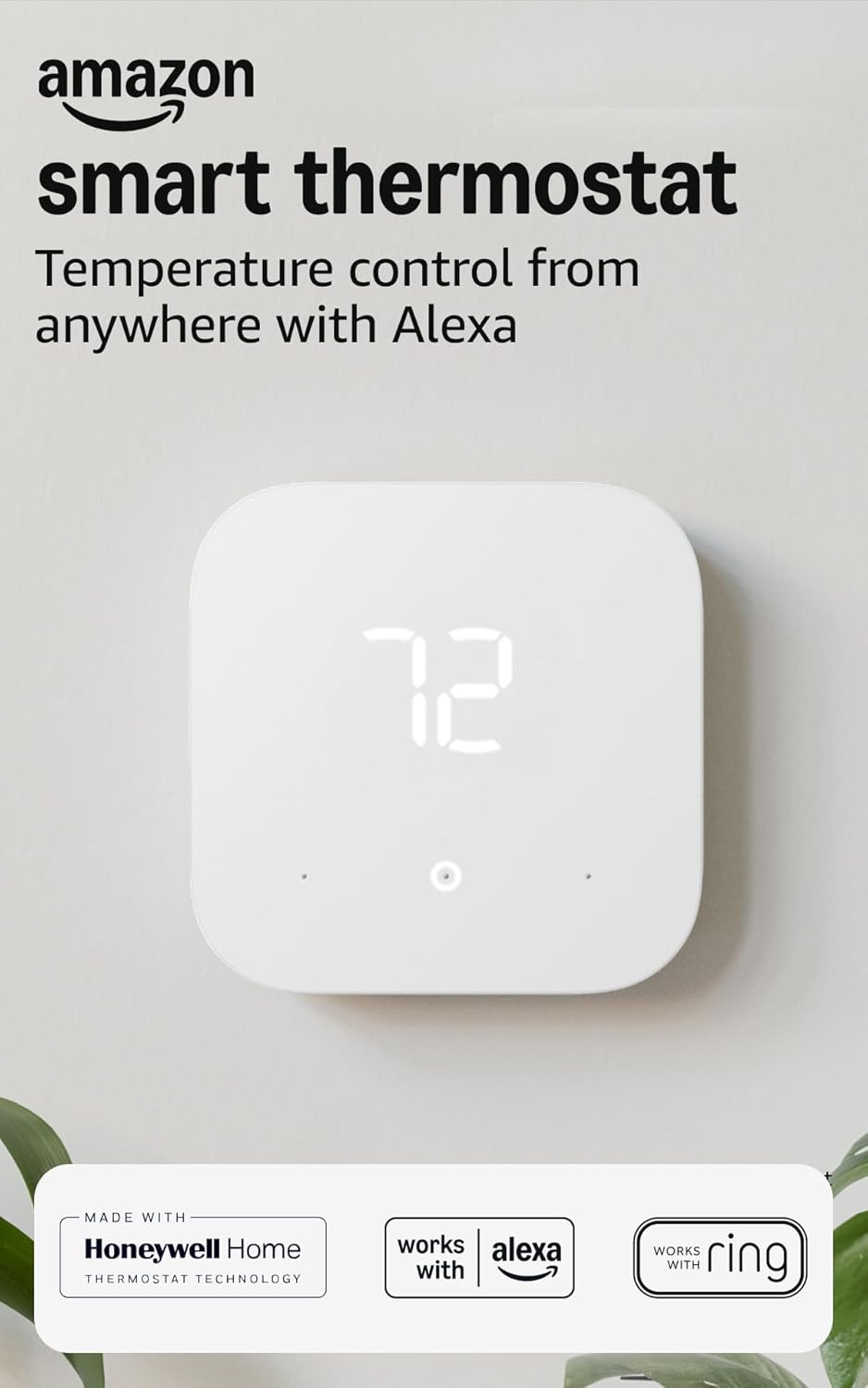
The Amazon Smart Thermostat provides basic smart-home temperature control with easy Alexa integration and DIY installation. It uses proven Honeywell Home thermostat technology to run schedules, let you switch between home, away and sleep modes, and control temperature remotely through the Alexa app. When paired with compatible Alexa devices it can adjust heating and cooling automatically using temperature readings and presence detection, and it supports Alexa+ routines for coordinating multiple devices. The unit is sold as a straightforward, energy-focused upgrade from a conventional thermostat and Amazon points to potential utility rebates and ENERGY STAR savings. Installation requires a C-wire, and advanced users should note it emphasizes Alexa ecosystem features rather than broad third-party platform support. For buyers who want a simple, low-friction smart thermostat that leverages Alexa voice control and schedule automation, this is an efficient choice; if you need extensive cross-platform integrations or advanced HVAC diagnostics, look elsewhere.
Best for: Buyers who want a no-frills, energy-aware smart thermostat that integrates tightly with Alexa and prioritizes easy setup and routine automation.
Less Ideal for: People seeking deep third-party smart home platform compatibility or advanced HVAC diagnostics and controls should consider more feature-rich alternatives.
- Simple Alexa-native setup and voice control
- Programmable schedules and automatic home/away modes
- Remote control via the Alexa app for on-the-go adjustments
- Built on Honeywell Home thermostat technology for reliable basic functionality
- Energy-saving focus with ENERGY STAR related benefits and potential utility rebates
- Requires a C-wire for installation
- Primarily designed for the Alexa ecosystem with limited third-party platform emphasis
Verdict: Choose this thermostat if you want a straightforward, Alexa-first smart thermostat that makes it easy to automate temperature and save energy.
Miuputake STN601 Nonprogrammable Thermostat

| Controller Type | Push Button |
|---|---|
| Temperature Control Type | Manual |
| Power Source | 24VAC or 2 AAA batteries |
| Display Type | LCD |
| Mounting Type | Wall Mount |
The Miuputake STN601 is a no-frills digital thermostat designed for basic single-stage heating and cooling control. It mounts to the wall on a universal sub-base and is typically used to replace older manual thermostats in homes with forced-air, hot water, or heat-only systems. The clear backlit LCD and push-button controls make setpoint changes straightforward, and the unit supports both 24VAC power and two AAA batteries so it can run without a C-wire on most systems. Usability features include adjustable temperature differential (swing), selectable compressor delay protection, and a low-battery indicator, which help protect HVAC equipment and tune comfort. Installation is meant to be quick thanks to large terminal blocks and included screws and anchors, but the thermostat does not offer programming or smart features and is not compatible with systems that require auxiliary/emergency heat, line-voltage baseboard heat, or mini-split setups. For buyers who want an inexpensive, reliable replacement that keeps things simple, this performs well; buyers wanting scheduling, remote control, or multi-stage support should look elsewhere.
Best for: Buyers who need an inexpensive, easy-to-install replacement thermostat for basic single-stage heating and cooling and who prioritize straightforward manual control over scheduling or smart features.
Less Ideal for: People who want programmable schedules, Wi-Fi control, multi-stage system support, or compatibility with auxiliary/emergency heat setups should choose a different model.
- Works with many single-stage forced-air and heat-only systems
- Dual power options (24VAC or 2 AAA batteries) so no C-wire is required in most installs
- Backlit LCD and simple push-button controls make adjustments easy
- Adjustable temperature swing and compressor delay protect equipment and improve comfort
- Nonprogrammable so no schedules or smart connectivity
- Not compatible with systems that need auxiliary/emergency heat or line-voltage baseboard heating
Verdict: A simple, budget-friendly replacement thermostat that delivers reliable manual control for common single-stage HVAC systems.
ecobee Smart Thermostat Enhanced

| Connectivity Technology | Wi‑Fi |
|---|---|
| Power Source | Corded Electric |
| Voltage | 24 volts |
| Display Type | LCD |
| Controller Type | Amazon Alexa, Android, Apple HomeKit, Google Assistant, iOS |
The ecobee Smart Thermostat Enhanced is a hardwired Wi‑Fi thermostat designed to learn your schedule, sense occupancy, and adjust heating and cooling to save energy. It mounts on the wall, connects to your HVAC via 24VAC wiring, and includes a Power Extender Kit for systems without a C‑wire to simplify DIY installation. The thermostat pairs with the ecobee app and integrates with Apple HomeKit, Siri, Alexa, and Google Assistant so you can control temperature remotely or with voice. Built‑in radar occupancy sensing and an included SmartSensor help preheat or precool occupied rooms and avoid conditioning empty spaces, which the company says can cut energy use over time. The LCD screen and app provide clear controls and scheduling, and the unit is Energy Star certified with a three‑year manufacturer backing. Important limits are compatibility—line voltage and certain low‑voltage systems are unsupported—so you should run the ecobee compatibility checker before buying, and advanced features need a functioning smart home ecosystem to get the most benefit.
Best for: Buyers who prioritize a reliable, long‑term thermostat that stays powered and automates energy savings through occupancy sensing and remote control.
Less Ideal for: People with line‑voltage heating systems or unusual control setups should look for a thermostat specifically designed for those systems instead.
- Hardwired design with included Power Extender Kit for stable, continuous operation
- Built‑in radar occupancy sensing and SmartSensor support for room‑aware temperature control
- Works with major smart home platforms and remote app control for convenience
- Energy Star certified and designed to reduce heating and cooling usage
- Not compatible with line voltage or specialized low‑voltage control systems so check compatibility first
- Advanced features are most useful when integrated with a smart home ecosystem
Verdict: Choose this ecobee if you want a factory‑quality, hardwired smart thermostat that reliably automates comfort and energy savings using occupancy sensing and broad smart home integration.
Google Nest Thermostat
| Connectivity Technology | Bluetooth, Wi-Fi |
|---|---|
| Power Source | Battery Powered |
| Display Type | LCD |
| Control Type | Remote Control, Voice Control |
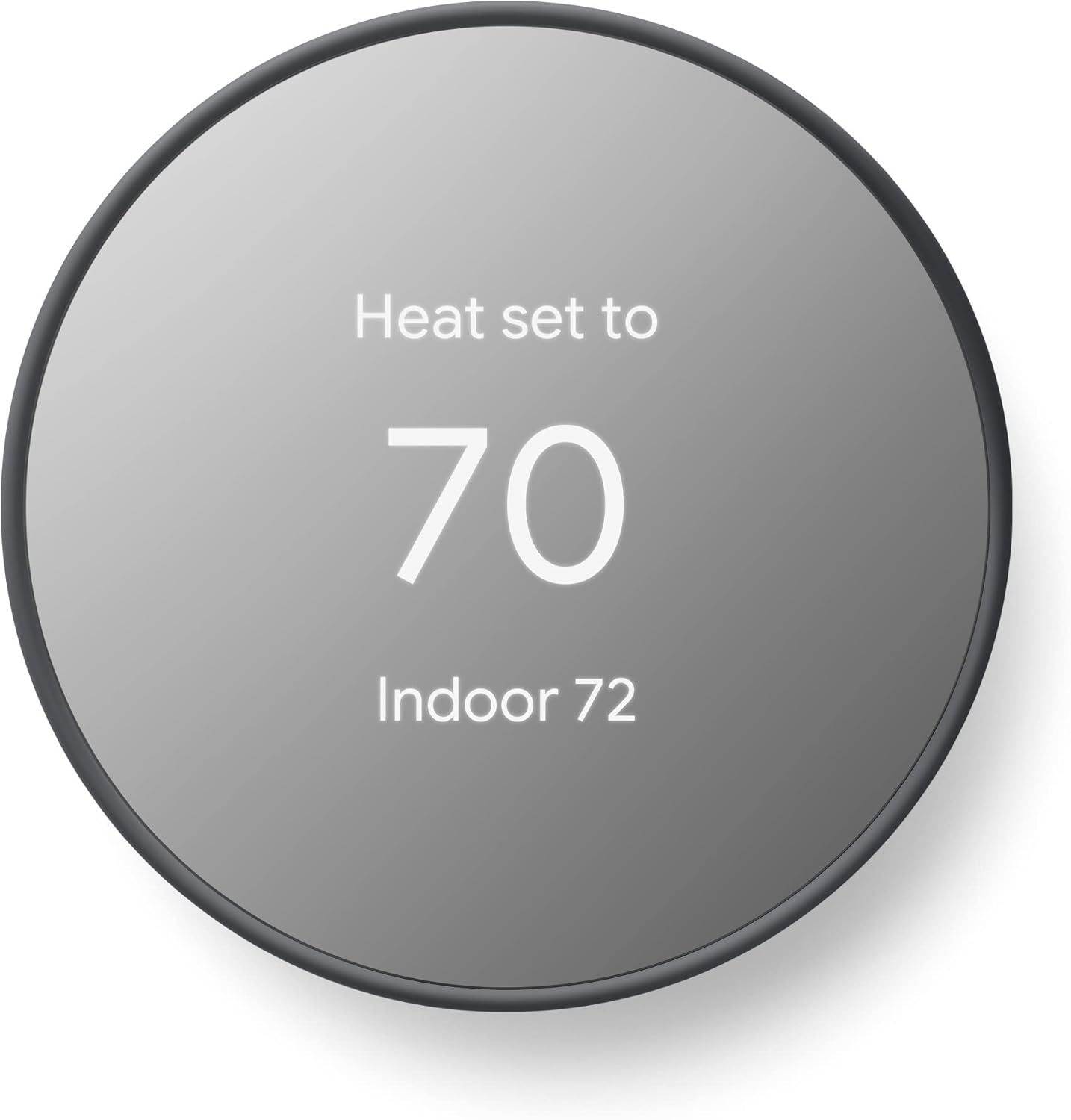
The Google Nest Thermostat is a compact smart thermostat designed to make temperature control simple and energy-aware. It connects to your home Wi‑Fi and pairs with the Google Home app so you can change settings remotely, create schedules with Quick Schedule, and accept energy-saving suggestions from Savings Finder. The unit can run on batteries and is built to install in most homes without a C wire, with guided setup in the app and included mounting hardware. It also monitors your HVAC system and sends alerts if it detects potential issues, and it supports voice control through Google Assistant and other Matter-certified assistants. Practical benefits include easy remote control, automated Eco Temperatures when the house is empty, and potential energy savings through app suggestions. Limitations are that some HVAC setups require a C wire or power accessory and advanced features like Nest Renew or certain alerts depend on services or specific Nest models and regional availability.
Best for: Buyers who prioritize a simple, app-driven smart thermostat with automated energy features and straightforward DIY installation backed by wide user adoption and support.
Less Ideal for: Homes with uncommon HVAC wiring that cannot provide consistent power without a C wire or users who need the most advanced Nest features restricted to newer Nest models and regions.
- Remote control and scheduling via Google Home app for adjusting temperature from anywhere
- Works without a C wire in most homes and includes mounting hardware for DIY installation
- Voice control support with Google Assistant and Matter‑certified assistants
- Energy-saving features like Eco Temperature and Savings Finder that suggest schedule tweaks
- Some HVAC systems require a C wire or additional power accessory to function
- Advanced services and certain alerts depend on regional availability or specific Nest models
Verdict: Choose the Nest Thermostat if you want an affordable, easy-to-install smart thermostat with app control and energy-saving automation.
Choosing the Right Thermostat: Key Factors to Consider
Temperature Accuracy and Sensing
Accurate temperature sensing determines how closely a thermostat can maintain your target comfort level. A thermostat with poor sensing may short-cycle your HVAC, overshoot temperatures, or create persistent hot and cold spots.
Look for devices that offer multi-point sensing, a calibrated internal sensor, or external sensor support if you have rooms that differ from the thermostat location. Accuracy matters more in smaller homes and tightly insulated spaces where even a degree can be noticeable.
Installation Complexity and Wiring Compatibility
Thermostats vary from simple battery-powered drop-in replacements to units that need a common power wire and more advanced HVAC knowledge. Matching a thermostat to your system wiring and control type is essential to avoid installation headaches.
Check for clear wiring diagrams, built-in compatibility checks, and whether professional installation is recommended. Features like auto-detection of wiring, adapter accessories, or support for multiple control stages make a unit easier to fit into existing systems.
Connectivity and Smart Features
Connectivity affects convenience and long-term value. Wi-Fi or Bluetooth enables remote temperature control, scheduling, and integration with smart-home ecosystems. Some thermostats also offer geofencing, learning algorithms, or energy reports that help reduce consumption.
Consider whether you need cloud features, or if local control and privacy are preferable. Verify the platform support for voice control or automation hubs you already use to avoid being locked into an incompatible system.
User Interface and Daily Usability
A thermostat you interact with daily should have a clear physical interface and a responsive app. Simple menus, readable displays, and intuitive program setup reduce frustration and misconfiguration.
Pay attention to how schedules are edited, whether temporary holds are easy to set, and how alerts are presented. Usability also includes access controls for other household members and the ability to override programs without losing the schedule.
Power Options and Reliability
Thermostats need a reliable power source to maintain schedules, connectivity, and timekeeping. Some units rely on batteries, while others require a C-wire or include power-saving circuits to draw from HVAC control lines.
Assess how the thermostat handles power interruptions, whether it preserves settings during outages, and if it provides diagnostics for low-battery or wiring faults. Power strategy influences stability of smart features and long-term maintenance requirements.
Wiring Types and How They Affect Your Choice
Most homes use one of several common wiring configurations, and the thermostat you pick should match the system. Single-stage heat/cool systems need fewer control wires than multi-stage furnaces or heat pumps. If you lack a dedicated common (C) wire, some thermostats will run on batteries or include power-saving modes, while others require an adapter or professional wiring change.
- Identify the number of control wires at your current thermostat before shopping
- For multi-stage systems, verify the thermostat supports the correct stage count and heat pump reversing valve control
- If you do not have a C-wire, look for battery-powered options or C-wire adapters
Scheduling Strategies That Save Energy
Effective scheduling reduces runtime without sacrificing comfort. Rather than rigid, single-week schedules, consider thermostats that support multiple schedule profiles, temporary holds, and weekday/weekend splits. Geofencing or occupancy sensing can automatically adjust setpoints when the house is empty, trimming energy use without manual input.
- Use setback periods during sleep and away times to lower heating and raise cooling setpoints
- Prefer schedules that can be edited easily on the thermostat and in the app
- Combine scheduling with humidity or fan controls for more complete climate management
Integration with Home Automation and Voice Assistants
If you use a home automation hub or voice assistant, check what integrations a thermostat offers. Native integrations simplify scenes and routines, while third-party platform support enables broader automation possibilities. Consider whether integration requires cloud access or allows local control for reliability and privacy.
- Confirm whether the thermostat exposes temperature and mode controls to your automation platform
- Look for automation triggers like temperature thresholds, presence, or time-based events
- Check whether firmware updates can be applied automatically or manually through the local network
Placement and External Sensor Use
Thermostat location affects readings. Placing the thermostat near drafts, direct sunlight, or kitchens can skew temperature sensing and lead to poor comfort. External remote sensors solve this by measuring temperature in different rooms and reporting back to the thermostat. If you have a known hot or cold room, choose a thermostat that supports one or more external sensors and lets you base control on average or prioritized sensor readings.
- Avoid installing a thermostat on an exterior wall or near windows
- Use remote sensors in frequently used rooms or upstairs areas that heat differently
- Ensure the thermostat supports sensor-based control logic you prefer
Security, Updates, and Long-Term Support
Smart thermostats connected to the internet require secure firmware updates and vendor support. Regular updates address security issues and add features, while poor long-term support can leave a device vulnerable or obsolete. Look for clear update policies, the ability to perform manual updates, and straightforward reset procedures. Consider whether the manufacturer provides diagnostic logs or local APIs if you plan deeper automation work.
- Check update frequency and how updates are delivered
- Prefer products that offer rollback or reset options in case of problematic updates
- Ensure account and network security measures are documented and accessible
How We Chose the Best Thermostat
Our selection focused on features and real-world reliability that matter when you replace or upgrade a thermostat. We prioritized precise temperature sensing and control logic because even small accuracy differences affect comfort and system runtime. Installation complexity and compatibility were weighed heavily since many buyers install or retrofit thermostats themselves. Connectivity and app functionality were assessed for homeowners who want scheduling, remote control, or integration with home automation. We examined power options and backup strategies because thermostats must remain operational through short outages or when wiring lacks a dedicated power feed. Usability for everyday adjustments and energy-reporting clarity were included so owners can meaningfully act on data. We excluded devices that require proprietary HVAC equipment or niche commercial systems. Products missing basic safety certifications or lacking essential wiring documentation were not considered. The criteria above guided selection and the score labels used throughout the guide.
Our full evaluation process is outlined in our review methodology.
FAQ
Do I need a C-wire to install a smart thermostat?
It depends. Some smart thermostats require a common wire for continuous power, while others operate on batteries or include a power adapter. If your system lacks a C-wire, look for units that explicitly support battery operation or offer a C-wire adapter.
Can a thermostat work with both heat pumps and conventional furnaces?
Many modern thermostats support both heat pumps and conventional furnaces, but you should confirm support for your specific control scheme, such as whether a reversing valve is required. Verify wiring compatibility and configuration steps before attempting installation.
Will a smart thermostat reduce my energy bills?
A smart thermostat can lower energy use by enabling precise schedules, setbacks, and automation, but savings depend on your habits, the efficiency of your HVAC system, and how aggressively you use setback periods. Learning-based features can improve savings over time in some setups.
How do external sensors change thermostat behavior?
External sensors let the thermostat read temperature from other rooms, which can prevent the thermostat location from dictating whole-house comfort. You can typically choose whether control is based on an average of sensors, a prioritized sensor, or the main device sensor.
What happens to my settings during a power outage?
Many thermostats retain schedules and settings in nonvolatile memory, so basic configuration persists through outages. However, features that rely on cloud services may be unavailable until connectivity returns. Devices with battery backup can maintain the clock and certain smart functions during short outages.
Final Verdict
Prioritize the traits that matter most for your home: accurate sensing and proper wiring support if comfort and stability come first, or robust connectivity and automation if remote control and scheduling are key. Understand the tradeoffs between battery operation and requiring a C-wire, and plan placement or external sensors to avoid misleading readings. With a clear sense of wiring, power, and the daily interface you prefer, you can pick a thermostat that delivers consistent comfort and manageable energy use. Focus on the score dimensions discussed earlier to match the product to your installation and lifestyle needs.