
Note: This article contains affiliate links. If you click on these links and make a purchase, we may earn a small commission at no extra cost to you. This helps support our research and content. Read our full affiliate disclosure here.
If you bake bread regularly, the right stand mixer makes dough prep faster, more consistent, and less tiring. A mixer that can handle high-hydration doughs and long kneads saves your arms and improves crumb structure. This guide covers seven shortlisted stand mixers for bread dough, chosen for their motor strength, bowl capacity, attachment quality, and durability. Below you will find concise notes on what each option does well, plus the evaluation criteria used to select them and the tradeoffs to consider when choosing a machine for home bread baking.
Top Picks at a Glance
| Best Overall The best all-around choice for most situations | Bosch Universal Plus 6.5-Qt Mixer |  |
| Best Quality Built to a higher standard if you want something more solid | Cuisinart Stand Mixer SM-50BC |  |
| Best Value The sweet spot between price and what you get | Aucma 6.5QT Stand Mixer |  |
| Best Budget The cheapest option that still gets the job done reliably | OLIXIS 4.2 Qt Stand Mixer |  |
| Top Rated A top-rated pick with lots of positive feedback | KitchenAid Classic Series K45SS 4.5‑Qt |  |
| Most Popular A crowd favorite that many people choose with confidence | Dash Everyday Stand Mixer |  |
| Best Seller A high-volume bestseller chosen again and again | KitchenAid Artisan 5-Qt Mixer |  |
Bosch Universal Plus 6.5-Qt Mixer

| Wattage | 500 watts |
|---|---|
| Voltage | 230 volts |
| Number of Speeds | 4 |
| Capacity | 6.5 quarts |
The Bosch Universal Plus is built around a powerful bottom-drive 500 W motor and a roomy 6.5-quart bowl that make it well suited to heavy bread dough and large batches. Its belt-driven transmission and high-torque design let the machine knead dense whole-grain doughs and handle long mixing tasks without overheating, and the included dough hook plus dough-hook extender let you work both large and small loaves. Dual wire whips provide a triple-whip action for fast volume when making meringue or whipped cream, and four suction feet keep the unit stable during vigorous kneading. The mixer accepts a wide range of optional attachments so it can act as a more complete kitchen machine beyond basic mixing. Trade-offs include a mostly plastic bowl and body that feel less premium than all-metal alternatives, and the control layout is simple with just four speeds and a pulse rather than fine-grain speed control. Expect a robust performer for regular bread baking, with easy-clean parts and strong accessory support if you want to expand its uses.
Best for: Home bakers who need a durable, high-torque mixer that can handle frequent bread baking and large batches and who value expandability through attachments.
Less Ideal for: Buyers who want a full-metal, professional-heavy construction or who need very precise incremental speed control for delicate tasks.
- High-torque bottom-drive 500 W motor designed to knead heavy bread doughs
- Large 6.5-quart bowl that supports big batches and multiple loaves
- Included dough hook and extender for both small and large dough quantities
- Dual wire whips with triple-whip action for efficient whipping tasks
- Accepts many optional attachments to expand functionality beyond mixing
- Body and mixing bowl are primarily plastic rather than metal, which may feel less durable to some buyers
- Only four speed settings plus pulse limit fine-grained speed control
Verdict: Choose this mixer if you bake bread regularly and want a high-torque bottom-drive machine that kneads large, dense doughs and grows with optional attachments.
Cuisinart Stand Mixer SM-50BC
| Wattage | 500 watts |
|---|---|
| Number of Speeds | 12 |
| Capacity | 5.5 quarts |
| Voltage | 110 volts |
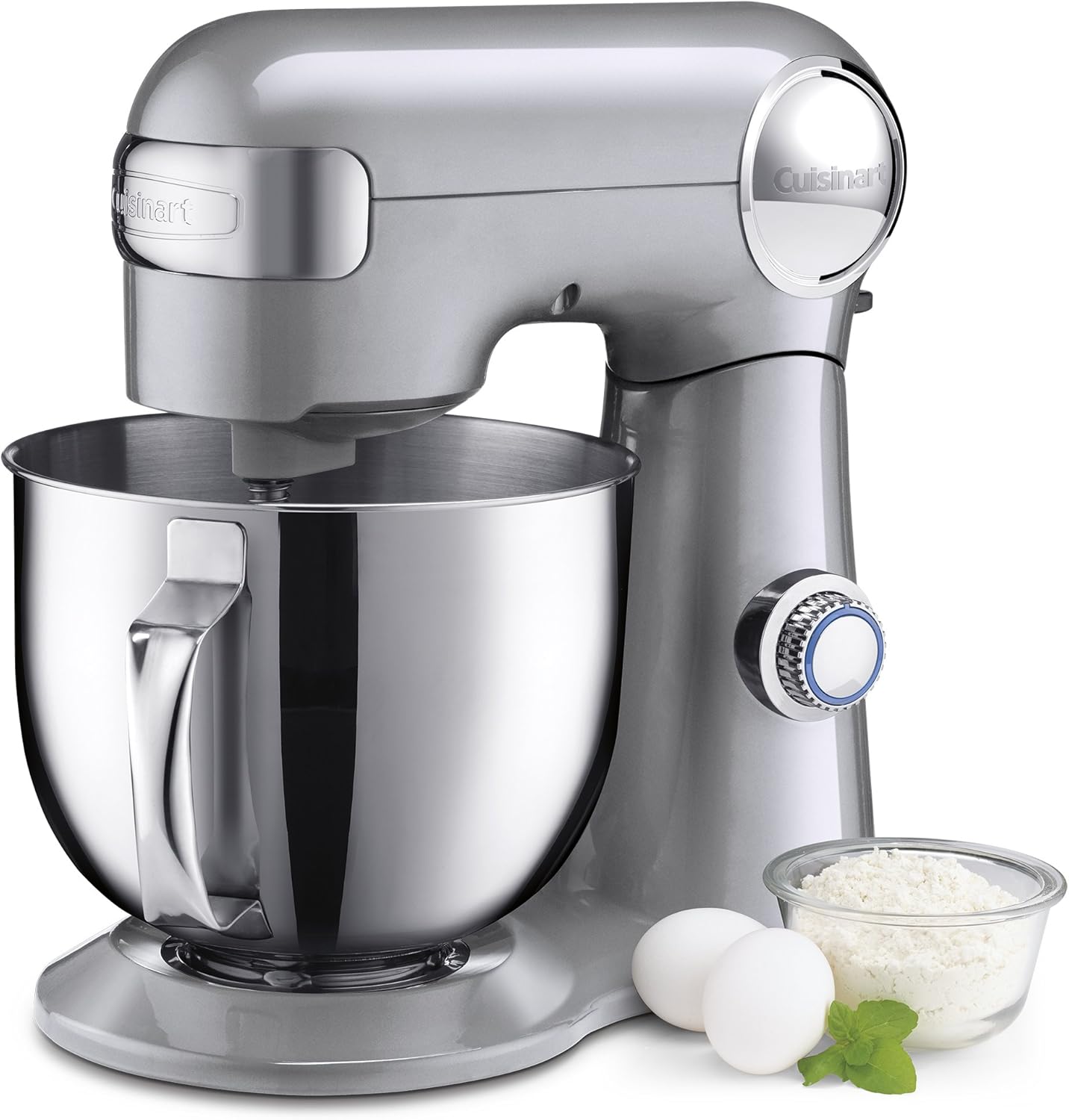
The Cuisinart SM-50BC is a midweight stand mixer built around a 500-watt motor, die-cast metal body, and a 5.5-quart stainless bowl that handles everyday mixing, whipping, and dough work. It ships with a whisk, flat paddle, dough hook, and a splash guard with pour spout, and the tilt-back head makes attachment changes and bowl access simple. Twelve speed settings provide fine control from slow kneading to faster whipping, and the metal construction and dishwasher-safe accessories make cleanup and durability straightforward. For bread bakers the dough hook and the motor power are capable of mixing and kneading most home bread recipes, though very heavy or very large batches may push the motor longer than lighter-capacity, higher-torque models. The mixer also accepts a range of optional attachments for grinding, pasta, and frozen desserts which expands its utility. If you want a solid, versatile machine for regular home baking with reliable controls and a roomy bowl, this Cuisinart is a practical choice, but those who routinely mix very large or dense doughs may prefer a heavier-duty, higher-torque model.
Best for: Home bakers who want a dependable, versatile mixer that can handle regular bread-making and a variety of other kitchen tasks without upgrading to a commercial machine.
Less Ideal for: Commercial bakers or home users who regularly mix very large, high-hydration, or heavy whole-grain doughs that require higher torque and larger capacity.
- 500-watt motor and die-cast metal construction for durable, consistent performance
- 5.5-quart stainless steel bowl roomy enough for most home bread recipes
- Twelve speeds give precise control from slow kneading to high-speed whipping
- Includes dough hook, whisk, paddle, and splash guard so it is ready for common tasks
- Accessories and bowl are dishwasher-safe for easier cleanup
- 500-watt motor may strain with very large or extremely dense dough batches
- Tilt-head design limits bowl capacity compared with some bowl-lift commercial-style mixers
Verdict: A solid, versatile 5.5-quart mixer with enough power and control for most home bread bakers who want consistent, everyday performance.
Aucma 6.5QT Stand Mixer

| Wattage | 660 watts |
|---|---|
| Capacity | 6.5 quarts |
| Number of Speeds | 6 |
| Voltage | 120 volts |
| Noise Level | 76 db |
This Aucma stand mixer is a value-oriented workhorse for home bakers who need a machine that handles everything from whipped egg whites to dense bread dough. The 660W pure copper motor and included dough hook give it the torque to mix stiff doughs, while the 6.5QT stainless bowl holds large batches so you can make multiple loaves or big cookie batches in one run. The tilt-head design and double handles make attaching the bowl and accessories straightforward, and the splash guard with add-through hatch keeps mixing neater. Six speed settings plus pulse give control when starting mixes or finishing delicate batters. Noise is listed under 76 dB, so it is not ultra-quiet but reasonable for a high-power mixer. Attachments are dishwasher safe, which simplifies cleanup, but the housing is ABS plastic rather than metal, so it does not have the same heft or long-term solidity as higher-end metal-bodied machines. For bakers focused on getting reliable dough performance without a premium price, this model covers the essentials well.
Best for: Home bakers who prioritize practical performance and batch capacity for mixing bread dough and other heavy mixtures without paying for a premium metal-bodied mixer.
Less Ideal for: Users seeking a professional-grade, all-metal commercial machine or those who need very quiet operation and extra-fine speed control.
- 660W copper motor delivers enough power to handle thick bread dough
- 6.5 quart stainless steel bowl fits large batches and has dual handles for easy lifting
- Includes whisk, beater, dough hook, and splash guard with add-through hatch
- Dishwasher-safe attachments make cleanup simple
- ABS plastic housing is less sturdy than metal-bodied mixers
- Limited to six speeds which may be less granular than some higher-end models
Verdict: Aucma’s 6.5QT mixer gives practical, high‑torque performance for home bakers who want to mix large batches and handle bread dough affordably.
OLIXIS 4.2 Qt Stand Mixer

| Capacity | 4.2 quarts |
|---|---|
| Wattage | 300 watts |
| Number of Speeds | 10 |
| Noise Level | 60 db |
| Voltage | 120 volts |
The OLIXIS 4.2 Qt Stand Mixer is a budget-friendly countertop mixer aimed at home bakers who need a capable machine for everyday doughs and batters. It uses a 300W motor with ten speed settings and a tilt-head design, letting you mix everything from cake batter to pizza and bread dough. The package includes a stainless steel bowl plus standard attachments: dough hook, flat beater, and whisk, so you can start baking right away. A multifunction bowl cover adds extras like a measuring cup and egg separator to save counter clutter. At about 60 dB reported noise, it runs reasonably quietly for a lightweight mixer. Expect solid performance for small-to-medium dough batches, though the 300W motor and 4.2-quart capacity limit how large or heavy a dough it can handle compared with larger, heavier-duty machines. Build materials combine ABS and aluminum with stainless steel in contact parts, which keeps the unit affordable while remaining serviceable for regular home use.
Best for: Home bakers shopping on a budget who want a compact, ready-to-use mixer that handles everyday bread doughs and baking tasks without a large upfront cost.
Less Ideal for: People who frequently mix large loaves, commercial quantities, or very heavy artisanal doughs should choose a higher-capacity, more powerful floor or heavy-duty mixer instead.
- Includes dough hook, whisk, and flat beater so you can mix, whip, and knead out of the box.
- Ten adjustable speeds let you start slow and increase power without splatter.
- Compact 4.2 quart bowl fits small kitchens and is suitable for most household bread and dessert recipes.
- Tilt-head design makes it easy to access the bowl and swap attachments quickly.
- 300W motor may struggle with very large or very stiff bread doughs.
- 4.2 quart capacity restricts batch size for serious bread bakers.
Verdict: A practical, budget-focused stand mixer that delivers solid performance for home bread baking in small to medium batches.
KitchenAid Classic Series K45SS 4.5‑Qt
| Capacity | 4.5 quarts |
|---|---|
| Wattage | 275 watts |
| Number of Speeds | 10 |
| Voltage | 120 volts |
| Included Components | Flat beater, dough hook, 6‑wire whip, 4.5‑qt bowl |
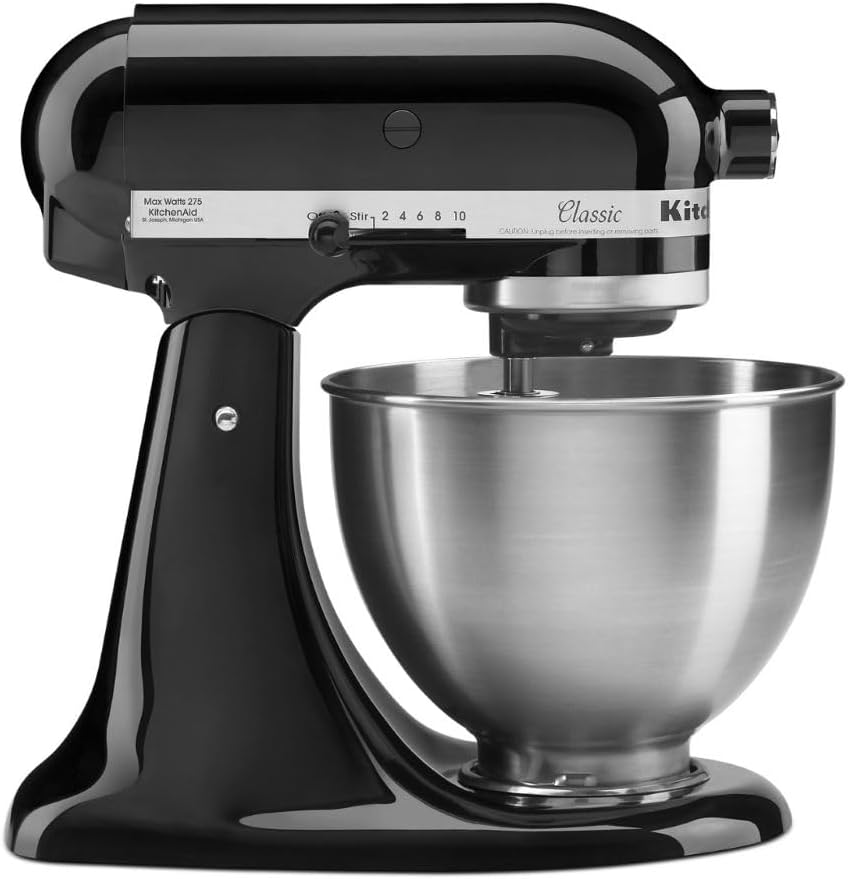
The KitchenAid Classic Series K45SS is a basic, rugged tilt‑head stand mixer built for routine home baking and dough work. It pairs a metal construction and a 4.5‑quart stainless bowl with 10 speed settings so you can mix, whip, and knead common recipes from cookie dough to sandwich loaves. The included coated flat beater, dough hook, and 6‑wire whip cover the usual tasks, and the power hub accepts optional attachments for grinders, pasta makers, and more. The tilt‑head makes adding ingredients and switching tools quick, and the 59 touchpoints around the bowl help keep ingredients moving for consistent results. On the downside the motor is modest at 275 watts, so very heavy, high‑hydration bread doughs may require smaller batches or longer kneading than a heavier duty bowl‑lift commercial unit. For typical home bakers who value a durable, factory‑quality mixer that handles frequent use, the Classic Series is a reliable, no‑frills choice.
Best for: Bakers who prioritize a dependable, built‑to‑last mixer for everyday bread and baking tasks and who prefer straightforward, practical operation.
Less Ideal for: Commercial bakers or home users who regularly mix very large or extremely heavy doughs and need a higher‑power, bowl‑lift machine for big batches.
- Durable metal construction designed for regular home use
- Versatile 10 speeds that cover stirring, whipping, and kneading tasks
- Comes with flat beater, dough hook, and 6‑wire whip for common recipes
- Removable 4.5‑quart stainless steel bowl fits typical home batches
- Power hub enables optional attachments to expand functionality
- Modest 275W motor that can struggle with very heavy or large dough batches
- Tilt‑head design is less stable for extremely heavy loads compared with bowl‑lift mixers
Verdict: A sturdy, straightforward stand mixer that reliably handles everyday bread doughs and general baking for home bakers.
Dash Everyday Stand Mixer

| Wattage | 250 |
|---|---|
| Number of Speeds | 6 |
| Capacity | 3 liters |
| Controls Type | Knob |
| Special Features | Programmable |
The Dash Everyday Stand Mixer is a small, lightweight tilt-head mixer meant for routine kitchen tasks like whipping, beating, and light dough kneading. It packs a 250 watt motor with six speed settings and ships with two dough hooks and two beaters that attach easily for switching between batters, creams, and simple bread doughs. The included 3-quart stainless steel bowl locks in place and is removable for pouring and cleaning, and most of the removable attachments are dishwasher safe which keeps cleanup quick. Because the unit is compact and weighs under 5 pounds it is easy to store or keep on a crowded countertop, and the knob control is straightforward to operate. For heavier doughs or very large loaves the motor and smaller bowl limit continuous heavy kneading, so expect best results with small to medium batches of bread, pizza dough, or roll dough rather than commercial-scale baking. Its affordable, user-friendly design makes it a sensible choice for home bakers who make occasional to moderate amounts of dough.
Best for: Home bakers who want an affordable, easy-to-use mixer for small to medium batches and occasional bread or pizza dough without taking up much counter space.
Less Ideal for: Bakers who routinely mix large loaves, frequent heavy breads, or commercial quantities should choose a more powerful, larger-capacity stand mixer.
- Compact, lightweight design fits small kitchens and stores easily
- Includes dough hooks and beaters for basic kneading and mixing tasks
- Dishwasher-safe bowl and attachments simplify cleanup
- Six speed settings provide control from gentle stirring to higher-speed whipping
- 250W motor and 3-quart bowl are undersized for heavy or large-batch doughs
Verdict: Choose this compact Dash mixer if you need an affordable, space-saving machine for small to moderate batches and occasional bread dough.
KitchenAid Artisan 5-Qt Mixer

| Capacity | 5 quarts |
|---|---|
| Wattage | 325 watts |
| Number of Speeds | 10 |
| Material | Stainless Steel |
The KitchenAid Artisan 5-Quart Tilt-Head Stand Mixer is a heavyweight home mixer built for frequent baking and batch work. It uses a durable metal construction and a powerful 325-watt motor to handle a wide range of tasks from whipping cream to kneading bread dough, and the 5-quart stainless steel bowl with handle fits batches large enough for family baking. The tilt-head design makes it easy to add ingredients and change attachments, while the 10-speed knob gives fine control from gentle stirring to high-speed whipping. Practical benefits include dishwasher-safe bowl cleanup and compatibility with many optional hub-powered attachments for grinding, pasta, and more. For someone focused on reliable, long-term performance the mixer stands out, though the tilt-head form can limit bowl capacity compared with bowl-lift models and heavy doughs may require attention to speed and mixing time. The mixer is available in many colors if you want a model that fits your kitchen styling.
Best for: Home bakers who value a proven, durable mixer that reliably handles everyday and batch baking tasks and who prefer a unit with easy access to the bowl and many accessory options.
Less Ideal for: Professional bakers or high-volume users who need the larger capacity and stability of a bowl-lift commercial-style mixer.
- Sturdy metal construction designed for long-term durability
- 5-quart stainless steel bowl handles large batches, up to around 9 dozen cookies
- 10-speed control knob provides precise mixing from stir to whip
- Tilt-head design makes adding ingredients and swapping attachments simple
- Compatible with hub-powered attachments to expand functionality
- Tilt-head design gives slightly less clearance and capacity than bowl-lift models
- Heavier doughs may need longer kneading and careful speed management
Verdict: A dependable, well-built 5-quart stand mixer that is ideal for home bakers who want a long-lasting machine capable of handling bread dough and large batches.
Choosing the Right Stand Mixer for Bread Dough: Key Factors to Consider
Motor Torque and Heat Management
Strong continuous torque matters because bread dough requires extended kneading and often produces high resistance as gluten develops. A motor rated for higher wattage or designed for torque delivery will maintain kneading speed without bogging down. Heat management is equally important since prolonged operation can overheat motors and shorten lifespan. Look for machines with thermal protection, well-ventilated motor housings, or gearing that reduces motor strain.
If you bake frequently or make dense doughs such as rye or whole-wheat blends, prioritize torque over light-duty features. For occasional white-bread mixing, moderate torque can suffice, but heat control still prevents unexpected shutdowns in the middle of a knead.
Bowl Capacity and Shape
Bowl size affects how much dough you can make in one batch and how thoroughly ingredients are incorporated. For most home bakers, a bowl capacity of at least 4.5 to 5.5 quarts handles standard loaves and lunchbox-sized batches comfortably. Larger bowls are useful for multi-loaf batches or enriched doughs that expand more during mixing.
Bowl shape and depth matter too. A deep bowl reduces splatter with high-hydration doughs and allows the hook to reach all the dough. Wide, shallow bowls can improve surface contact with a hook for some designs, but check that the hook reaches the bottom and sides to prevent unworked pockets of flour.
Dough Hook Design and Attachment Fit
The shape and material of the dough hook determine how efficiently the mixer develops gluten and handles sticky dough. Spiral or C-style hooks are common; spiral hooks tend to fold and stretch dough more aggressively, while C-hooks are simple and effective for many home recipes. Durable materials and robust attachment points prevent bending or wobbling during heavy kneads.
Secure, easy-to-install fittings reduce wasted time and frustration. Some mixers offer proprietary hooks or reinforced metal hooks; if you plan to knead often, favor hooks that are metal rather than plastic and that lock snugly to the mixer head or hub.
Gearing, Transmission, and Build Durability
Internal gearing quality affects longevity and how well the mixer transfers motor torque to the dough hook. Metal gear trains and planetary drives are more durable than cheap plastic gears, especially under repeated heavy loads. A sturdily built head hinge, reliable bowl latch, and robust housing reduce the chance of mechanical failure when kneading dense doughs.
Durability also ties into repairability. Machines with replaceable drive parts, widely available service components, or a reputation for long service life are preferable for frequent bakers who expect years of use rather than occasional hobby mixing.
Speed Range and Control Precision
Bread-making benefits from a mixer that can run very slowly for initial ingredient incorporation and step up to steady kneading speeds without abrupt jumps. Fine-grain speed control helps you manage hydration and dough temperature during mixing. Some mixers offer multiple stepped speeds while others provide a wide, smooth range with variable knobs or electronic controls.
Consistency of speed under load is critical. A mixer that drops rpm when the dough thickens will lengthen kneading time and may yield inconsistent gluten development. Check for machines that hold speed under load or have a low gear ratio to preserve torque.
Cleaning, Maintenance, and Accessories
Ease of cleaning matters because bread dough can get sticky and leave residue in crevices. Removable, dishwasher-safe bowls and hooks simplify cleanup. Fewer nooks where flour collects reduce maintenance time. Regular maintenance tasks such as greasing or checking gear housings are easier when panels or parts are accessible.
Accessory availability is also relevant. Some mixers include extra hooks, splash guards, or pouring shields that help with wet doughs. Consider whether attachments are metal and whether they are easy to remove without bending or stressing the mixer head.
How Mixer Capacity Affects Batch Planning
Decide how many loaves you typically bake in one session and plan bowl capacity around that. If you bake weekly for a family, a larger bowl lets you mix multiple loaves or enriched doughs in one cycle, saving time and oven runs.
For occasional bakers, a mid-size bowl reduces footprint and consumes less counter space while still handling standard recipes. Remember that flour absorbs water, so the finished dough volume can be larger than the ingredient volume suggests.
- Smaller bowls: good for single loaves and limited counter space
- Mid-size bowls: balance capacity and footprint for most home bakers
- Large bowls: best for multiple loaves or high-hydration artisan recipes
Managing Dough Temperature During Mixing
Dough temperature influences yeast activity and final crumb. High-speed mixing or motors that generate heat can raise dough temperature, which changes fermentation schedules. To control temperature, use cooler water and keep mixing times minimal when the dough reaches proper development.
Some bakers intermittently rest the dough during long kneads to let the mixer and dough cool. A machine with good thermal control reduces that need, but monitoring dough temperature with a thermometer is the most reliable way to stay consistent.
- Use cool liquids if motor heat is a concern
- Shorten mixing intervals and rest between cycles for long kneads
- Measure dough temperature for consistent results
Attachments and Versatility Beyond Kneading
While dough hooks are central for bread, many stand mixers accept other attachments that expand their utility. Flat beaters and whisks let you handle batters, frostings, and lighter doughs, turning the machine into a multipurpose kitchen tool. Consider whether you want a mixer dedicated to bread or a multifunction appliance.
If you plan to use additional attachments, check the attachment hub and available accessory ecosystem. A mixer with a sturdy hub will handle pasta rollers, grinders, or slicers if you decide to broaden its role in the kitchen.
- Dough hook for heavy kneading
- Flat beater for heavier batters and mixing
- Wire whisk for aerating and whipping tasks
Noise and Vibration Considerations
Long kneading cycles can produce significant noise and vibration, which matters if you bake early mornings or in open-plan spaces. Heavier, well-balanced motors and solid baseplates reduce vibration transfer to countertops.
If noise is a concern, look for machines with dampening features or rubber feet. Secure bowl locks and tight tolerances also cut down on rattling during heavier loads.
- Rubber feet or anti-vibration pads reduce counter noise
- Tight bowl locks prevent wobble during kneading
- Balanced drive systems minimize rattling
Counter Space, Weight, and Storage Tradeoffs
Stand mixers built for bread tend to be heavier and bulkier. Factor in where you will store the machine and whether you need to move it frequently. A heavier unit stays put during kneading but is harder to tuck away after use.
If countertop real estate is limited, consider the footprint and whether the mixer head tilts back or lifts for easier bowl access. Some users prefer a permanently stationed heavier mixer to avoid the inconvenience of frequent lifting.
- Heavier units are more stable during kneading
- Lift or tilt heads affect access and clearance above the bowl
- Measure cabinet or shelf space before purchase
How We Chose the Best Stand Mixer for Bread Dough
We evaluated every candidate against baking-specific demands to identify stand mixers that actually perform when handling bread dough. Primary filters included sustained motor torque under load, bowl capacity suitable for typical home loaves, and the availability and durability of dough-hook attachments designed for heavy, sticky doughs. We also prioritized machines with robust gear trains and metal construction where possible, since long kneading cycles expose weaker mechanisms to premature wear. Other selection considerations were user-focused features such as speed control range for gradual gluten development, secure bowl-locking systems to prevent wobble during heavy kneading, and ease of access for cleaning flour and dough from crevices. We excluded machines intended only for light mixing, handheld mixers, and compact units with very small bowls that cannot handle standard bread recipes. Reliability, serviceability, and the presence of replaceable mechanical parts informed our editorial judgment along with ergonomic factors for frequent use.
Our full evaluation process is outlined in our review methodology.
FAQ
What bowl size do I need for baking two standard loaves?
Two standard loaves generally require a bowl in the 6 to 7 quart range to allow room for mixing and dough expansion. If you only plan single loaves, a 4.5 to 5.5 quart bowl is usually sufficient.
How long should I knead dough with a stand mixer?
Kneading times vary by recipe and mixer torque but typically range from 5 to 12 minutes. Stop when the dough passes the windowpane test and feels smooth and elastic rather than strictly following a clock-based rule.
Can a stand mixer over-knead bread dough?
Yes, over-kneading is possible, especially on high speeds. It can break down gluten structure and lead to a gummy crumb. Use low to medium speeds and watch texture; pause periodically to check dough development.
Is metal dough hook always better than plastic?
Metal hooks are generally more durable and better suited for heavy or frequent kneading. Plastic hooks may suffice for occasional light doughs but can flex or wear faster under sustained loads.
How do I prevent my mixer from overheating during long kneads?
Use intermittent kneading cycles with short rests to allow the motor to cool, avoid running at the highest speed unnecessarily, and follow the manufacturer's recommended duty cycles. Good ventilation around the mixer also helps dissipate heat.
Do I need special attachments for high-hydration doughs?
High-hydration doughs often benefit from a spiral-style hook that folds and stretches the dough more effectively. A splash guard or bowl scraper can also help contain sticky ingredients during initial mixing.
Final Verdict
When choosing a stand mixer for bread dough, prioritize motor torque, durable gearing, and a bowl size that matches the batches you plan to make. Dough-hook design and secure fitting matter for efficiency and to avoid incomplete mixing or excessive wear. Balance capacity and durability against counter space and noise considerations. Focus on machines that maintain consistent speed under load and offer straightforward maintenance. With those tradeoffs in mind, you can select a mixer that reliably supports your home bread baking for years.