
Note: This article contains affiliate links. If you click on these links and make a purchase, we may earn a small commission at no extra cost to you. This helps support our research and content. Read our full affiliate disclosure here.
Choosing the right thermostat for baseboard heaters matters more than most homeowners realize. Baseboard systems are line-voltage devices with different wiring and control needs than low-voltage HVAC systems, so the wrong thermostat can lead to poor performance, nuisance cycling, or wiring headaches. This guide shortlists the top thermostats for baseboard heaters that deliver consistent temperature control, straightforward installation for typical line-voltage setups, and useful control features for everyday comfort. We evaluated options that suit standard baseboard wiring types and common use cases, including simple manual control, digital programming, and smart connectivity. Below you will find our top picks followed by objective buying guidance and practical FAQs to help you pick the right thermostat for your space.
Top Picks at a Glance
| Best Overall The best all-around choice for most situations | Mysa Smart Thermostat LITE |  |
| Best Quality Built to a higher standard if you want something more solid | meross Matter Smart Thermostat MTS215 |  |
| Best Value The sweet spot between price and what you get | meross Smart Thermostat MTS200 |  |
| Best Budget The cheapest option that still gets the job done reliably | YeloDeer 240V Baseboard Thermostat |  |
| Most Popular A crowd favorite that many people choose with confidence | Honeywell Home RLV3120A Thermostat |  |
| Best Seller A high-volume bestseller chosen again and again | Honeywell TL7235A1003 Digital Thermostat |  |
Mysa Smart Thermostat LITE
| Connectivity Technology | Bluetooth, Wi-Fi |
|---|---|
| Voltage | 240 volts_of_alternating_current |
| Wattage | 3800 watts |
| Control Method | App, Touch, Voice |
| Display Type | LCD |
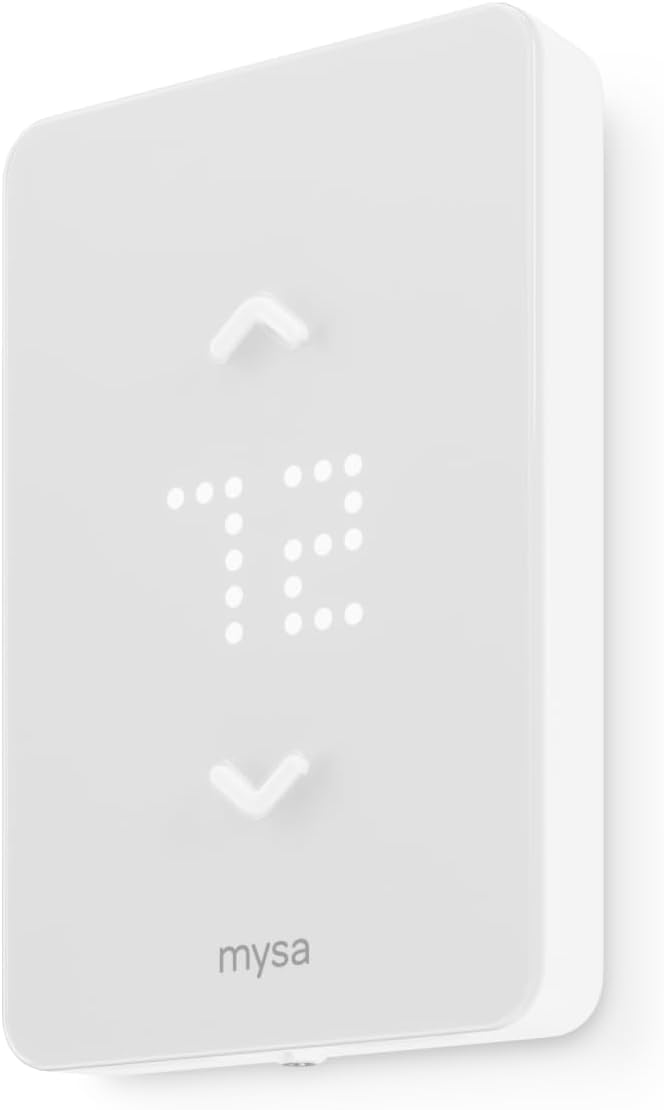
The Mysa Smart Thermostat LITE replaces a standard high-voltage heater control with a Wi‑Fi connected, app-driven thermostat built for electric baseboard, fan-forced, and convector units. It installs on the wall and supports 120V–240V systems and single- or double-pole wiring, and the Mysa app provides 7-day scheduling, geofencing, remote control, monthly runtime reports, and energy-tracking per room. The unit also offers touch control on the device, an LCD readout, and voice integration with HomeKit, Alexa, and Google Assistant for hands-free adjustments. Practical benefits include targeted per-room scheduling to lower electric heating bills, the ability to warm rooms before arrival, and no subscription fees for advanced features. Important limitations are that it requires compatible wiring (neutral or a second live) and most users will need to check wiring before DIY installation, and it is purpose-built for electric heat so it is not suitable for conventional central HVAC systems.
Best for: Buyers who want a room-level smart thermostat to cut electric heating bills and prefer app and voice control for baseboard or fan-forced heater zones.
Less Ideal for: Homeowners seeking a thermostat for a central 24V furnace/AC system or those without the required wiring for a DIY install should look elsewhere.
- Designed specifically for high-voltage electric baseboard and fan-forced heaters
- Wi‑Fi and app control with 7-day scheduling and geofencing for remote temperature management
- Works with HomeKit, Alexa, and Google Assistant for voice control
- Provides monthly runtime reports and per-room energy tracking to help reduce electric heating costs
- No subscription fees and in-app features are included free
- Requires compatible wiring (neutral or second live) so some installs may need an electrician
- Not compatible with central 24V HVAC systems
Verdict: Pick the Mysa LITE if you need a dedicated smart thermostat to remotely schedule and track energy use for electric baseboard or fan-forced heater zones.
meross Matter Smart Thermostat MTS215
| Controller Type | Amazon Alexa, Apple HomeKit, Google Assistant, Matter, SmartThings |
|---|---|
| Connectivity Technology | Matter, Wi‑Fi |
| Voltage | 120 volts |
| Display Type | LCD |
| Additional Features | Auto‑Scheduling, Energy Monitoring, Open Window Detection |
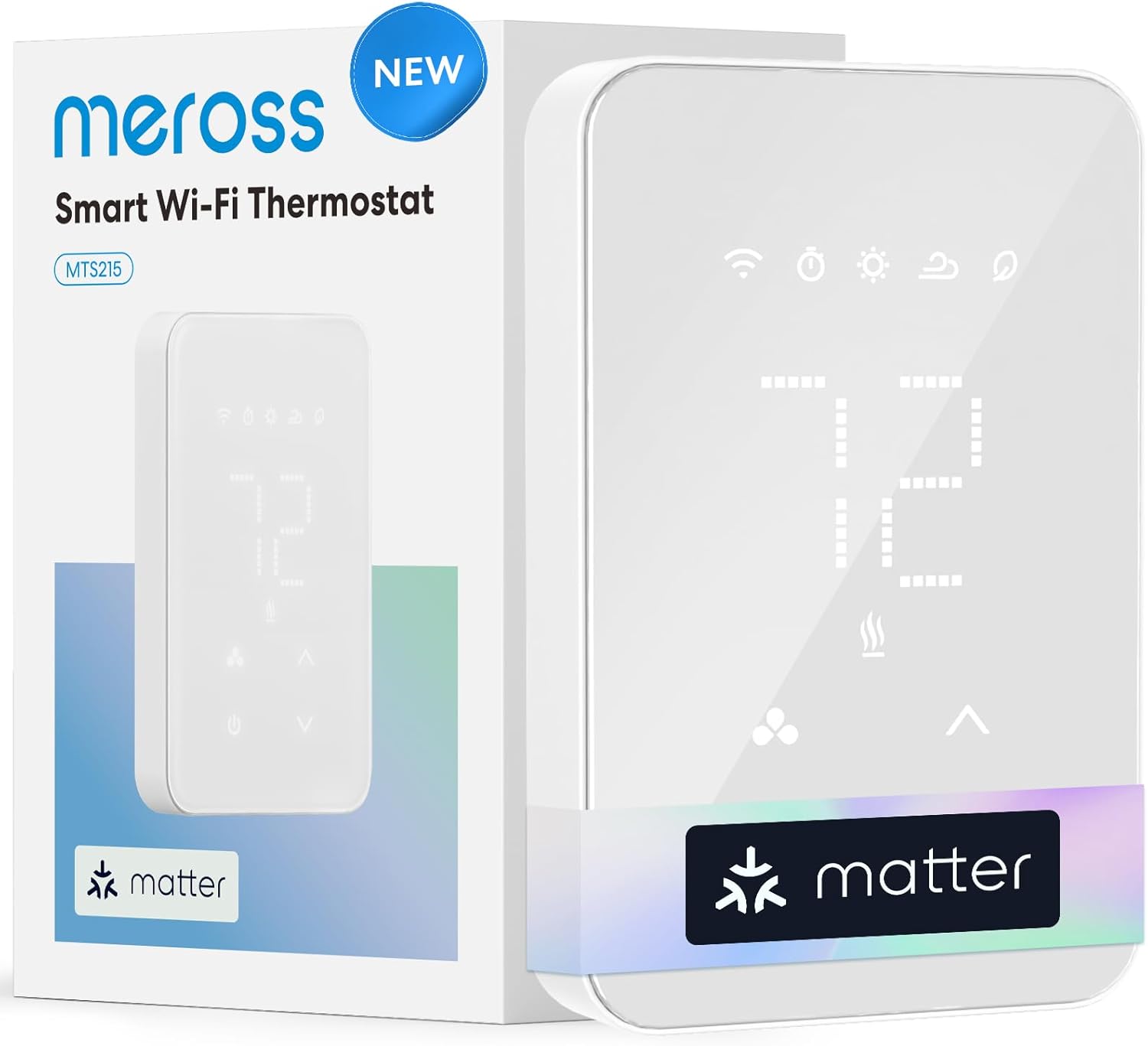
The meross MTS215 is a smart wall thermostat made specifically for 120–240V electric heating systems such as baseboard, convector, and fan‑forced heaters. It connects over Wi‑Fi and supports Matter, HomeKit, Alexa, Google Home, and SmartThings for voice and remote app control, letting you schedule heating, run 24/7 temperature profiles, and adjust settings from anywhere. Notable features include energy monitoring that reports real‑time and historical power usage, open‑window detection that pauses heating to avoid waste, and an LCD for local control. Installation is typical for line‑voltage thermostats and the unit ships with wire nuts and screws. Practical benefits for performance‑minded users include fast response and the ability to integrate with other smart home routines via Matter, plus the power monitoring data to optimize heat cycles and costs. Limitations to watch for are incompatibility with 24V HVAC systems and electric underfloor heating, and the internal temperature sensor sits under the casing so placement or app calibration may be needed for the most accurate readings.
Best for: Buyers who want a high‑performing smart thermostat for electric baseboard or convector heaters and who prioritize responsive control, energy monitoring, and broad smart‑home integration.
Less Ideal for: Homes that use 24V HVAC systems, heat pumps, conventional central AC, or electric underfloor heating should look for a thermostat designed for those systems.
- Matter and Wi‑Fi connectivity for cross‑platform voice and remote control
- Built‑in energy monitoring with real‑time and historical usage data
- Open‑window detection that automatically pauses heating to save energy
- Fast response designed for responsive temperature control on electric heaters
- Not compatible with 24V HVAC systems or electric underfloor heating
- Temperature sensor is inside the casing and may require placement adjustment or app calibration for accuracy
Verdict: Choose this thermostat if you need a performance‑focused, Matter‑compatible controller that delivers responsive control and built‑in energy monitoring for 120–240V electric baseboard heaters.
meross Smart Thermostat MTS200

| Controller Type | Amazon Alexa, Apple HomeKit, Google Assistant, SmartThings |
|---|---|
| Connectivity Technology | Wi-Fi |
| Voltage | 120 volts (supports 120–240V systems) |
| Display Type | LCD |
| Control Method | App, Remote, Voice |
The meross MTS200 replaces a basic baseboard thermostat with a networked, programmable wall unit for 120–240V electric heating systems. It connects to Wi‑Fi and integrates with Apple HomeKit, Alexa, Google Home, and SmartThings so you can change temperature by voice or app and build schedules to cut runtime. The unit supports a 7×24 scheduling graphic, reports energy use through an internal meter, and includes open-window detection and a child lock to avoid wasted heat. Installation targets homes with four or more wires in the electrical box and the company provides wiring guidance; once wired the LCD display and in-app calibrations make temperature control straightforward. Important limits: it is not compatible with 24V HVAC systems, heat pumps, underfloor electric heating, or systems that do not expose the required high-voltage wiring, and the on-device sensor sits under the casing so placement or calibration may be needed for precise readings. For someone replacing a mechanical baseboard stat and wanting smart schedules and energy monitoring, it delivers practical savings and convenience.
Best for: Buyers who want to replace a manual baseboard thermostat with a smart, schedule-driven controller that prioritizes energy visibility and voice/app control for everyday heating optimization.
Less Ideal for: Do not choose this if your heating is a 24V HVAC system, a heat pump, electric underfloor system, or if your wall box lacks the multiple high-voltage conductors required for installation.
- Works with high-voltage baseboard, convector, and fan-forced heaters at 120–240V.
- Integrates with HomeKit, Alexa, Google Home, and SmartThings for voice and app control.
- 7×24 programmable scheduling plus energy monitoring to track and reduce heating costs.
- Open-window detection and child lock add practical safety and energy savings.
- Offline local control available on the home Wi‑Fi network for continued operation without Internet.
- Requires four or more wires in the electrical box and is not compatible with 24V HVAC or underfloor electric heating.
- On-board temperature sensor is under the casing and may need calibration or repositioning for the most accurate readouts.
Verdict: For owners of electric baseboard or convector heaters who want smart scheduling, voice control, and built-in energy monitoring, the meross MTS200 turns a manual thermostat into a practical energy-saving hub.
YeloDeer 240V Baseboard Thermostat

| Voltage | 240 volts |
|---|---|
| Wattage | 4800 watts |
| Temperature Control Type | Manual |
| Mounting Type | Wall Mount |
| Connectivity Technology | Wired |
This YeloDeer thermostat is a simple dial-style controller for 240V 4-wire baseboard and fan-forced electric heaters, designed for straightforward temperature control without programming. Installation is typical for line-voltage wall mounts and the unit includes a temperature sensor and clear indicator lights to show when heat is active. The large rotary knob lets you fine-tune setpoints between roughly 40°F and 80°F rather than being limited to coarse steps, which helps dial in comfort in small rooms. It is wired and corded for line-voltage systems and supports up to 20A/4800W, so it fits most single-zone baseboard circuits of that size. Because it is manual and nonprogrammable there are no scheduling features or remote control, but that simplicity reduces complexity and cost. The display is basic and the unit is intended as a direct replacement or upgrade for basic mechanical thermostats rather than a smart home hub.
Best for: Buyers who need a low-cost, no-frills replacement thermostat for a single 240V baseboard circuit and prioritize ease of installation and simple manual control.
Less Ideal for: People who want scheduling, smartphone control, or multi-zone smart integration should look at programmable or smart thermostats instead.
- Supports 240V line-voltage systems and up to 4800 watts (20A) for common baseboard heaters
- Large rotary knob allows continuous temperature adjustment for finer setpoints
- Wired wall-mount design with included temperature sensor and indicator lights for clear operation
- Simple nonprogrammable control keeps installation and daily use straightforward
- No programmable schedules, remote access, or smart features
- Display and controls are basic compared with digital programmable thermostats
Verdict: A budget-friendly, straightforward manual thermostat that gives precise dial control for a single 240V baseboard heater without extra features.
Honeywell Home RLV3120A Thermostat

| Voltage | 240 volts |
|---|---|
| Wattage | 2000 watts |
| Display Type | Digital |
| Controller Type | Push Button |
The Honeywell RLV3120A is a simple digital, non-programmable thermostat made specifically for line-voltage electric baseboards and convectors. It uses TRIAC switching for 100% silent operation and offers precise temperature control with an on-screen heating power indicator and push-button controls for straightforward daily use. The unit supports 240V or 120V line-voltage systems with a 2000W maximum load and a relatively low 200W minimum load, which makes it suitable for smaller baseboards and slim convectors that other line-voltage thermostats may not handle. Installation is intended to be DIY-friendly thanks to the two-wire non-polarized connection and included mounting hardware. Because it is non-programmable, it is best where simple manual control is preferred over scheduled or smart features, and it does not support fan-forced convectors. The compact, white rectangular design keeps it unobtrusive on the wall and the silent switching removes the clicking common to many line-voltage controls.
Best for: Buyers who want a reliable, easy-to-use wall thermostat for electric baseboard or convector heating that emphasizes quiet, accurate manual control and straightforward installation.
Less Ideal for: People who need programmable schedules, Wi-Fi control, or operation with fan-forced convectors should look at programmable or smart thermostat alternatives.
- TRIAC switching provides completely silent on/off transitions
- Designed for line-voltage baseboard and convector heaters with 2000W maximum load
- Low 200W minimum load allows control of smaller baseboards
- Simple push-button digital interface with on-screen heating power indicator
- Two-wire non-polarized connection and included hardware for straightforward DIY installation
- Non-programmable design lacks scheduling or remote/smart features
- Cannot be used with fan-forced convectors
Verdict: Choose this thermostat when you want quiet, accurate manual temperature control for line-voltage baseboard heaters without the complexity of programming or smart features.
Honeywell TL7235A1003 Digital Thermostat

| Power Source | Hardwired |
|---|---|
| Connectivity Protocol | Wi-Fi |
| Control Type | Button Control |
| Wattage | 3600 watts |
| Control Range | 40 to 86 F |
The Honeywell TL7235A1003 is a line-voltage, non-programmable digital thermostat intended for baseboard heating applications on 240 VAC circuits. It provides basic temperature control via a button interface and an easy-to-read LCD with on-demand backlight and a 1 F differential for straightforward setpoint adjustments. The unit is hardwired and rated to control up to 15 full-load amps at 240 VAC, and includes auto changeover and a heating indicator so you can see when the system is calling for heat. Practical benefits include quiet, soundproof operation compared with mechanical switches and factory safety listings (UL/CSA). Because it is non-programmable, it suits users who want simple manual control rather than scheduling, and the app/connectivity details suggest remote monitoring or control where supported. The main limitations are the lack of programmable schedules and a basic button control scheme that lacks touchscreen refinement, so it is not focused on energy-optimization features found in smart programmable models.
Best for: Buyers who want a reliable, straightforward replacement thermostat for electric baseboard heat and prefer simple manual control with clear on/off heating indication.
Less Ideal for: People looking to save energy with multi-day scheduling, advanced programming, or a modern touchscreen smart thermostat should consider programmable models instead.
- Designed for 240 VAC line-voltage baseboard heating with 15A full-load rating
- Simple digital display with on-demand backlight and visible heating indicator
- Soundproof operation reduces clicking noise common with mechanical thermostats
- UL and CSA listed for basic safety and reliability
- Non-programmable so it cannot automate temperature schedules
- Button-only controls are basic compared with modern touch interfaces
Verdict: Choose this Honeywell if you need a dependable, hardwired digital replacement thermostat for 240V baseboard heating that favors simple, reliable manual control.
Choosing the Right Thermostat for Baseboard Heaters: Key Factors to Consider
Line-voltage Compatibility and Load Rating
Baseboard heaters typically run on line-voltage circuits, often 120V or 240V. Ensuring the thermostat is explicitly rated for the same voltage and for the resistive load of baseboard elements is essential. Mismatched voltage or insufficient amp rating can cause the thermostat to fail prematurely, trip breakers unexpectedly, or create safety hazards.
Look for thermostats that list supported voltages and maximum amperage or wattage for resistive loads. If your installation involves multiple heater runs on a single thermostat, add their wattages to confirm the thermostat can handle the combined load. This factor directly affects safety, longevity, and whether a separate contractor-installed relay or contactor is required.
Wiring Type and Terminal Configuration
Baseboard heater wiring varies: some setups use two-pole 240V feeds, others use single-pole 120V circuits, and some include separate line and load conductors for multi-zone installations. The thermostat you choose must match your wiring scheme or provide compatible terminal configurations.
Check whether the thermostat expects a neutral, whether it uses line-in/line-out terminals, and how many separate circuits it can control. Clear terminal labeling and wiring diagrams reduce installation errors and the need for rework. If your wallbox is shallow or contains multiple conductors, verify the thermostat's physical size and backplate accommodate the wiring.
Temperature Sensing and Control Accuracy
Thermostats differ in how they sense and regulate temperature. Mechanical bimetal thermostats use physical expansion for setpoint control and can be simple and durable, but may have wider differentials. Digital thermostats typically provide finer temperature resolution and programmable differentials that reduce swings and short cycling.
Consider whether a more precise control system is important for comfort in the room you are zoning. Rooms with quick heat loss or tight comfort requirements benefit from thermostats with adjustable differentials or adaptive control features that learn system response and minimize overshoot.
Programmability and Scheduling
Programmable thermostats allow you to set different temperatures by time of day and day of week, which can improve comfort while saving energy. For baseboard heaters, scheduling can prevent unnecessary operation during unoccupied hours, especially for larger or second-floor zones.
Decide whether you need simple weekday/weekend schedules, multiple daily periods, or full seven-day programming. Some users prefer basic manual controls to avoid complex setup, while others benefit from advanced schedules or vacation modes. Ease of programming and clarity of the user interface affect day-to-day satisfaction with the thermostat.
Smart Features and Remote Control
Smart thermostats and Wi-Fi enabled models offer remote temperature control, scheduling via smartphone apps, and integration with home automation platforms. These features can be convenient for monitoring and adjusting comfort from anywhere and for creating energy-saving automations.
However, smart control adds complexity and may require reliable home Wi-Fi. For line-voltage baseboard systems, confirm the smart thermostat is designed to handle the required voltage or uses a compatible relay accessory. Consider whether remote access and data logging are worth the extra setup and potential need for firmware updates.
Safety Features and Build Quality
Because baseboard heaters operate at mains voltage, safety features and reliable construction are important. Thermostats with robust internal relays, adequate spacing between contacts, and built-in protections against overheating or overloads reduce risk. Quality materials, secure mounting hardware, and clear regulatory markings indicate a device designed for durable service.
Also consider certifications and whether the thermostat provides thermal cutouts or other protections. These aspects do not directly affect day-to-day comfort but have a strong impact on long-term reliability and safe operation.
Installation Checklist and Typical Wiring Scenarios
Before you begin, turn off power at the breaker and verify the circuit is de-energized with a meter. Identify whether your baseboard circuit is 120V single-pole or 240V two-pole and how many conductors enter the wallbox. Knowing the voltage and conductor count determines which thermostats are compatible and whether you need a neutral or additional wiring.
Common wiring setups include a single-line in and line out for one heater zone, or a feed-through arrangement for multiple heaters. If you encounter a switched neutral or an unexpected bundle of wires, consult an electrician. Also confirm the wallbox has room for the thermostat and that the thermostat's mounting plate aligns with your wallbox style.
- Turn off power and verify with a meter
- Identify 120V vs 240V and count conductors
- Confirm wallbox depth and mounting compatibility
- Match thermostat amp rating to combined heater wattage
When to Consider a Two-Stage or Relay-Controlled Setup
Standard thermostats directly switch the heater load and are suitable when the combined wattage is within the thermostat's rating. For larger loads or when multiple heaters are tied together, a thermostat that controls a relay or contactor can be safer and extend component life. The thermostat then switches the relay coil while the relay handles the heavy current.
If you plan to centralize control of several baseboard units on a single thermostat, or if you have very high-wattage elements, factor in relay control. This approach keeps the thermostat electronics isolated from large currents and simplifies future replacements.
- Use a relay for loads exceeding thermostat ratings
- Relay setups reduce wear on thermostat contacts
- Account for relay coil voltage compatibility with the thermostat
Balancing Comfort and Energy Use with Schedules
Baseboard heating can be less responsive than forced-air systems, so schedule choices affect both comfort and energy consumption. Longer preheat intervals may be needed to reach comfortable temperatures at the scheduled time. Conversely, aggressive setbacks can save energy but might leave a space cold for longer than expected.
If you are installing thermostats in multiple rooms, pick a consistent scheduling approach that matches occupant routines. For frequently used spaces, tighter control with smaller setbacks provides a better balance of comfort and efficiency.
- Allow longer preheat time for setback recovery
- Use smaller setbacks in main living areas for comfort
- Stagger schedules in multi-zone homes to reduce peak load
Using External Sensors and Remote Sensing Options
Some thermostats support remote temperature sensors to measure conditions away from the thermostat location. This can be useful if the thermostat sits in a drafty hallway or on an exterior wall and does not reflect the room's typical temperature. Remote sensors help avoid overheating or underheating occupied spaces.
When choosing remote sensors, ensure compatibility with the thermostat and consider sensor placement carefully. Sensors should be mounted at typical occupancy height and away from direct sunlight, heat sources, or drafts to provide representative readings.
- Remote sensors correct misleading wallbox readings
- Place sensors away from drafts and direct sun
- Confirm wiring or wireless pairing requirements before purchase
Maintaining Line-Voltage Thermostats Over Time
Regular checks help extend the life of line-voltage thermostats. Periodically inspect the thermostat for signs of discoloration, loose mounting, or unusual odor, which can indicate overheating or failing contacts. Tighten terminals if they become loose and confirm mounting is secure.
If you notice frequent cycling, fluctuating temperatures, or a thermostat that fails to maintain setpoint, investigate wiring connections and the relay or contact mechanism. Replacing older mechanical thermostats with modern digital units can improve reliability and control accuracy.
- Inspect for discoloration or odors indicating overheating
- Tighten terminals and confirm secure mounting
- Consider modern digital replacements if control degrades
How We Chose the Best Thermostat for Baseboard Heaters
We focused on factors that matter specifically for baseboard heater control. First, compatibility with line-voltage systems and common wiring configurations was nonnegotiable. We prioritized thermostats designed for 120V or 240V baseboard circuits and that clearly document supported wire counts and load ratings. Second, control precision and temperature sensing were key. We evaluated whether thermostats offered adjustable differentials, accurate digital sensing, or adaptive control logic that minimizes short cycling. Third, installation and wiring clarity mattered; we favored designs with clear terminal labeling and installation guides suitable for typical DIY or electrician installs. Fourth, user control features were considered, including simple manual dials, multi-program scheduling, and basic smart integration where applicable. Safety features and load protection—such as internal relays rated for resistive loads and overcurrent safeguards—were also essential. We excluded devices intended only for low-voltage HVAC systems, wireless add-on modules that do not control line voltage directly, and thermostats with unclear load or wiring specs. Our shortlist reflects products that meet the technical wiring and safety needs of baseboard heating while offering meaningful user benefits.
Our full evaluation process is outlined in our review methodology.
FAQ
Can I use a low-voltage thermostat on a baseboard heater?
Usually not. Baseboard heaters commonly use line-voltage circuits, and low-voltage thermostats are designed for HVAC control systems. Using a low-voltage device directly on a line-voltage heater can be unsafe unless a compatible relay or interface is used that isolates the low-voltage control from the high-voltage load.
Do I need an electrician to install a baseboard thermostat?
It depends. If you are comfortable and competent with electrical work and the circuit is straightforward, a homeowner experienced with wiring may handle a simple swap after shutting off power. For 240V circuits, multi-conductor wiring, or any uncertainty about terminal connections, hiring a licensed electrician is the safer choice.
Will a smart thermostat work with baseboard heaters?
Some smart thermostats are designed specifically for line-voltage systems or can control a relay that switches the line-voltage load. Verify that the smart device supports your circuit voltage and load requirements. If the smart thermostat is low-voltage only, it will not directly control baseboard heaters without an appropriate relay.
How do I know if my thermostat needs replacing?
Signs include inconsistent temperatures, increased cycling, visible wear or discoloration, or a thermostat that no longer reaches or maintains setpoints. If adjustments no longer affect heater operation or the device feels unusually hot to the touch, replace it and check the wiring and load compatibility.
Are programmable thermostats worth it for baseboard heating?
Often yes. Programmable thermostats let you reduce heating during unoccupied periods and raise it when needed, which can save energy. Because baseboard systems respond more slowly, plan for longer preheat times so scheduled temperature changes occur when you want them.
Final Verdict
Pick a thermostat that matches your baseboard heater's electrical characteristics first. Confirm voltage and load rating, then prioritize temperature sensing accuracy and the level of control you want, whether simple manual adjustment or advanced scheduling and remote access. Balance comfort needs against installation complexity and potential relay requirements to handle higher loads. Focusing on compatibility, clear wiring documentation, and the control features that suit your routine will help you choose confidently. When in doubt about wiring or load handling, consult a licensed electrician to ensure a safe and reliable installation.