
Note: This article contains affiliate links. If you click on these links and make a purchase, we may earn a small commission at no extra cost to you. This helps support our research and content. Read our full affiliate disclosure here.
If you have radiant floor heating, the right thermostat makes a big difference in comfort and energy use. A thermostat designed for radiant systems handles slow thermal response, supports floor- or air-sensor inputs, and lets you set schedules that avoid overheating the slab. Picking the correct model reduces temperature swings and prevents wasted energy while keeping floors comfortably warm. This guide highlights seven shortlisted thermostats optimized for radiant floor heating. We evaluated units for sensor accuracy, installation requirements, programming flexibility, and compatibility with typical radiant installations. Below you will find practical guidance to match a thermostat to your system and installation skill level, followed by factors to consider and answers to common questions.
Top Picks at a Glance
| Best Overall The best all-around choice for most situations | OJ Microline UDG4 Thermostat |  |
| Best Quality Built to a higher standard if you want something more solid | Nuheat nVent AC0056 Thermostat |  |
| Best Value The sweet spot between price and what you get | MAXKOSKO WiFi Smart Floor Thermostat |  |
| Best Budget The cheapest option that still gets the job done reliably | Baomain BM-J01-F Thermostat |  |
| Top Rated A top-rated pick with lots of positive feedback | Schluter Ditra-Heat-E-RT Thermostat |  |
| Most Popular A crowd favorite that many people choose with confidence | Honeywell TH1100DV1000 Thermostat |  |
| Best Seller A high-volume bestseller chosen again and again | BOWSEN Programmable Thermostat |  |
OJ Microline UDG4 Thermostat

| Connectivity Technology | Wi-Fi |
|---|---|
| Controller Type | Touchscreen Programable |
| Additional Features | 7-day, 4-event Program |
| Wattage | 3600 watts |
| Voltage | 240 volts |
The OJ Microline UDG4 is a purpose-built radiant floor thermostat that pairs a 3.5" color touchscreen and Wi‑Fi connectivity with dual sensing (air and floor) and a factory‑quality Class A GFCI for safe electric floor heating control. It is typically wall‑mounted and used to schedule heating across a 7‑day, 4‑event program while the included floor sensor lets the unit limit floor temperature for sensitive surfaces like wood or laminate. The unit supports dual voltage and up to 3600 watts at 240V, and features convenience tools such as child lock, vacation and open‑window modes, temporary overrides, adaptive run‑time, and power logging for energy tracking. Practical benefits include straightforward touchscreen programming, built‑in ground‑fault protection that simplifies installation in wet rooms, and self‑learning runtime that can reduce energy use. Limitations to note are that it is focused on electric radiant floor systems only and requires proper wiring for the GFCI and load capacity, so installation is best handled by someone familiar with electrical or HVAC work.
Best for: Buyers who want a dedicated, safety‑focused thermostat for electric radiant floors that balances easy touchscreen programming with smart features and energy tracking.
Less Ideal for: Those seeking a general HVAC thermostat for forced‑air systems or users who need a simple non‑programmable temperature control.
- Dual sensing (air and floor) with included floor sensor for accurate floor temperature control
- Built‑in Class A GFCI provides integrated ground‑fault protection suitable for wet room installations
- 3.5" touchscreen and intuitive 7‑day, 4‑event programmable interface for easy scheduling
- Wi‑Fi connectivity and power logging enable remote monitoring and energy usage reporting
- Adaptive self‑learning runtime helps maintain comfort while reducing energy consumption
- Designed specifically for electric radiant floor heating and not compatible with other HVAC types
- Requires proper 120/240V wiring and load capacity awareness, which may need professional installation
Verdict: A safety‑minded, feature‑rich thermostat for electric radiant floors that combines touchscreen programming, Wi‑Fi energy logging, and built‑in GFCI protection.
Nuheat nVent AC0056 Thermostat

| Controller Type | Programmable Touchscreen Thermostat |
|---|---|
| Voltage | 120 volts, 240 volts |
| Display Size | 3.5 inches |
| Included Components | Floor Heat Sensor |
| Safety | Class A GFCI protection |
The Nuheat nVent AC0056 is a 7-day programmable touchscreen thermostat made specifically for electric radiant floor systems. It uses a 3.5-inch color touchscreen for direct control, includes a floor heat sensor, and supports both 120 V and 240 V installations, so it fits most heated-floor cable setups. Built-in Class A GFCI protection adds a layer of safety for wet areas like bathrooms, and the unit offers energy-use monitoring plus an early-start feature that stages power based on recent temperature trends to reach target temps on schedule. Installer-friendly diagnostics and a setup wizard simplify commissioning for pros or experienced DIYers. Connectivity options list RF and Wi‑Fi which can aid in remote monitoring, though the interface and network features are not marketed as a full smart-home hub. Limitations include reliance on the supplied floor sensor for accurate control of slab or tile temperatures and the need for proper electrical wiring for dual-voltage feeds; buyers replacing a non-radiant thermostat should verify compatibility and wiring before purchase.
Best for: Buyers who prioritize precise, reliable control of electric radiant floor heating and want a dedicated thermostat with safety features and installer diagnostics.
Less Ideal for: Users looking for a general-purpose smart thermostat with broad third-party integrations or those who need multi-zone Wi‑Fi hub functionality.
- Dual-voltage compatibility for 120 V and 240 V radiant floor systems
- Built-in Class A GFCI for added electrical safety in wet areas
- 7-day programmability with early-start to reach target temps efficiently
- 3.5-inch color touchscreen and setup wizard for easier configuration
- Includes floor heat sensor and diagnostic tests for reliable installation
- Not described as a full smart-home thermostat with broad ecosystem integrations
- Accurate control depends on correct floor sensor placement and wiring
Verdict: Choose the Nuheat nVent AC0056 when you need a purpose-built, safety-minded thermostat that gives precise, programmable control for electric radiant floor heating.
MAXKOSKO WiFi Smart Floor Thermostat

| Connectivity Technology | Wi‑Fi |
|---|---|
| Control Method | App, Remote, Touch, Voice |
| Power Source | Corded Electric |
| Display Type | touchscreen, LED |
| Specific Uses For Product | Floor Heating Thermostat |
The MAXKOSKO WiFi Smart thermostat is a programmable wall controller built for radiant floor heating systems. It connects to your Wi‑Fi and pairs with the Smart Life app so you can set schedules, change setpoints remotely, and use Alexa or Google Assistant voice control. The bright LED touchscreen and included 15 ft floor sensor make it straightforward to monitor floor temperature and keep tile or laminate surfaces comfortable. For everyday use you can program 7‑day schedules to balance comfort and energy savings and switch between manual and app control as needed. Installation is aimed at competent DIYers and installers familiar with line‑voltage thermostats since it is corded electric and wall mounted; wiring and compatibility with specific floor heating kits should be checked before purchase. The product delivers practical remote scheduling and voice control, but you should verify wiring and system compatibility during planning to avoid installation hiccups.
Best for: Buyers who want to optimize radiant floor comfort and energy use with remote scheduling and voice control and who are comfortable confirming wiring and compatibility before installation.
Less Ideal for: People seeking a plug‑and‑play, low‑voltage HVAC thermostat or those unwilling to check wiring details and possibly hire an electrician.
- Wi‑Fi and Smart Life app support for remote temperature control and scheduling
- Works with Alexa and Google Assistant for voice control
- Programmable 7‑day schedules for energy savings and comfort
- LED touchscreen with included floor sensor simplifies floor temperature monitoring
- Requires correct line‑voltage wiring and installation knowledge for radiant floor systems
- Manufacturer lists broad compatibility but buyers should confirm fit with their specific floor heating kit
Verdict: Choose this thermostat if you want remote app control, voice assistant support, and programmable schedules to efficiently manage radiant floor heating.
Baomain BM-J01-F Thermostat

| Voltage | 120 volts |
|---|---|
| Load current | 16 Amp |
| Power consumption | 2 watts |
| Temperature control range | 40°F–104°F (adjustable higher) |
The Baomain BM-J01-F is a simple, wired manual thermostat built for radiant floor systems and heat pumps. It uses push-button controls and an LED display to show ambient temperature and lets you set target temperature within a wide Fahrenheit range; accuracy is listed as ±0.5°C for control and ±0.1°C for display. The unit mounts flush and includes a wall plate for concealed wiring, runs on standard 115–120 VAC and can directly switch loads up to 16 A, making it suitable to control floor heating circuits without an external relay on many installs. Practical benefits are straightforward operation, compact polished plastic housing, and low power draw under 2 W. Limitations are that it is manual only (no scheduling), uses wired BACnet MS/TP protocol support notes that are atypical for simple thermostats, and it does not offer modern conveniences like Wi-Fi or app scheduling despite a control-method field listing app. For budget-focused buyers wanting a basic, accurate controller for radiant floors, it provides the essentials; those wanting programmability or remote control should look elsewhere.
Best for: Buyers who need an inexpensive, straightforward wall thermostat to control a radiant floor heating circuit and value accuracy and direct switching without smart features.
Less Ideal for: Users who want programmable schedules, smartphone control, or integration with modern smart-home systems.
- Designed specifically for radiant floor heating and heat pump use
- Simple push-button operation with an accurate LED temperature display
- Runs on standard 115–120 VAC and can directly switch up to 16 A
- Compact wall-mount design with included wall plate for concealed wiring
- Nonprogrammable with no built-in scheduling or Wi-Fi remote access
- Plastic housing and basic feature set lack advanced smart thermostat conveniences
Verdict: A budget-friendly, accurate wired thermostat that gives reliable manual control for radiant floor heating without smart features.
Schluter Ditra-Heat-E-RT Thermostat

| Display Size | 3.5 inches |
|---|---|
| Voltage | 240 volts |
| Power Source | Corded Electric |
| Connectivity | QR Code |
| Mounting Type | Wall Mount |
The Schluter Ditra-Heat-E-RT is a wall-mounted, programmable thermostat built specifically for Ditra-Heat-E floor heating systems and offers a clear 3.5 inch touchscreen for everyday control and scheduling. It is used to set target floor temperatures, create multi-day programs, and monitor energy usage so homeowners can balance comfort with running costs. Notable features include integrated GFCI protection, support for both 120V and 240V heating cables, and a floor sensor included for accurate temperature feedback. The touchscreen and QR-code connectivity simplify setup and accessing system settings, while the energy tracking/logging helps identify consumption patterns. Because it is purpose-built for Schluter floor heating, installation follows standard wall-mount wiring and the unit replaces separate GFCI devices, consolidating safety and control in one package. Limitations: it is tied to the Ditra-Heat-E line so it is not a universal thermostat replacement and the interface relies on the touchscreen rather than physical buttons, which may be less convenient for some users.
Best for: Homeowners installing or replacing controls for a Ditra-Heat-E radiant floor system who prioritize safety and dependable, purpose-built operation.
Less Ideal for: Someone who needs a universal thermostat for mixed heating systems or who wants a non-touchscreen, simpler control interface.
- Built-in GFCI adds integrated electrical safety for floor heating circuits
- Programmable touchscreen makes daily scheduling and adjustments straightforward
- Supports both 120V and 240V Ditra-Heat-E heating cables for installation flexibility
- Energy tracking/logging helps monitor and optimize power usage
- Includes floor sensor and required cables for a complete control solution
- Compatible only with Ditra-Heat-E systems and not a universal thermostat option
- Touchscreen control may be less tactile for users who prefer physical buttons
Verdict: Choose this thermostat if you want a factory-quality, safety-focused controller made specifically for Ditra-Heat-E radiant floor heating with programmable scheduling and energy tracking.
Honeywell TH1100DV1000 Thermostat

| Specific Uses For Product | Electric Baseboard Heater |
|---|---|
| Voltage | 230 volts |
| Display Type | Digital |
| Number of Batteries | 2 AAA batteries required. |
| Connectivity Protocol | BACnet MS/TP |
The Honeywell TH1100DV1000 is a heat-only, nonprogrammable digital thermostat intended for electric baseboard and similar heating setups. It shows ambient temperature continuously on a backlit 1.5-inch display and offers one-touch setpoint control through push-button operation, making day-to-day adjustments quick and straightforward. The unit is battery powered (2 AAA) and mounts to the wall; it includes basic protections such as built-in compressor safeguards suited to simpler heating systems and BACnet MS/TP connectivity listed for integration in managed environments. Because it is nonprogrammable there are no scheduling options or advanced energy-saving algorithms, so it works best where manual control is acceptable or where a simple, reliable setpoint device is preferred. Installation and operation are uncomplicated, but buyers wanting Wi-Fi scheduling, app control, or multi-stage HVAC management will need a different model. The TH1100DV1000 is practical as a pared-down, readable thermostat for straightforward heat-only radiant or baseboard circuits.
Best for: Buyers who prioritize a straightforward, dependable thermostat for a single-purpose heating circuit and want an easy-to-read, manual control device supported by strong user feedback.
Less Ideal for: People who want programmable schedules, remote app control, or advanced multi-stage HVAC management should consider smart or programmable alternatives.
- Clear backlit digital display that shows ambient temperature continuously
- One-touch push-button control for simple, fast setpoint changes
- Battery powered for easy installation without a dedicated low-voltage transformer
- Designed specifically for heat-only systems such as electric baseboard or radiant heating
- Listed connectivity protocol (BACnet MS/TP) for integration in compatible control setups
- Nonprogrammable so it cannot run schedules or automated setbacks
- No built-in Wi-Fi app control or advanced energy management features
Verdict: Choose the TH1100DV1000 when you need a simple, reliable digital thermostat for heat-only radiant or baseboard systems with no programming complexity.
BOWSEN Programmable Thermostat
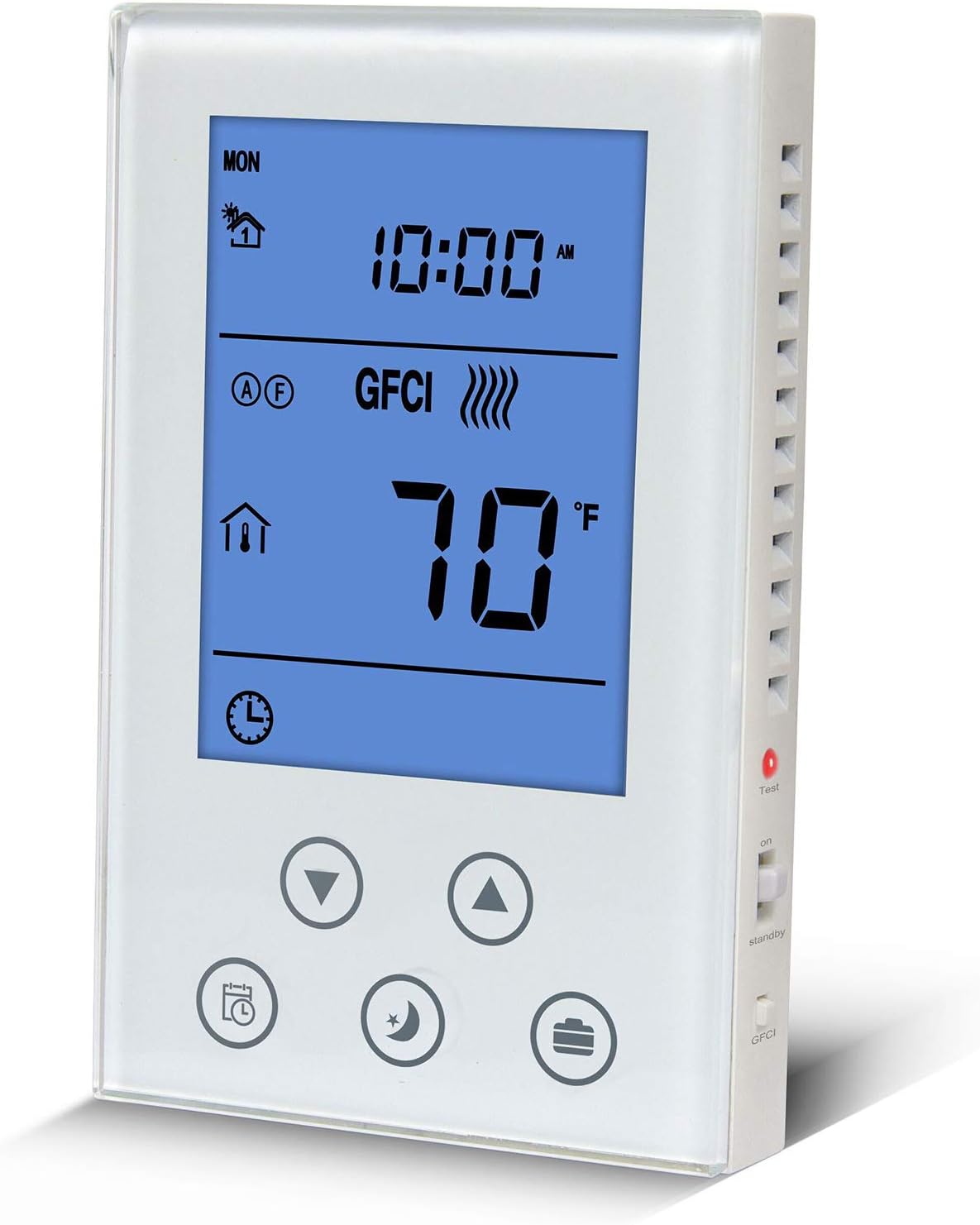
| Voltage | 240 volts_of_alternating_current |
|---|---|
| Wattage | 3600 watts |
| Connectivity Technology | Wired |
| Display Type | LCD |
| Controller Type | Push Button |
This BOWSEN programmable thermostat is built specifically for electric radiant floor heating and supports both 120V and 240V systems with a maximum load of 1,800W at 120V or 3,600W at 240V. It uses dual sensing—floor and air—so you can control surface temperature while monitoring room conditions, and the large backlit LCD makes setpoints and schedules easy to read. The unit offers 7‑day programmable scheduling and an ON/STANDBY switch to disable heating when the season ends. A notable safety feature is the integrated Class A GFCI with a manual test function that protects against ground faults and reduces shock risk. Installation is typical for a hardwired thermostat and the wired connectivity and button controls keep operation simple, but that also means no app or remote control. The thermostat is practical for straightforward radiant floor setups where factory‑quality safety and reliable scheduling matter, though users who want smart home integration or wireless control will need a different model.
Best for: Buyers who prioritize reliable, safety‑focused control for an electric radiant floor installation and prefer a straightforward, programmable wall thermostat over smart features.
Less Ideal for: If you want Wi‑Fi connectivity, voice control, or app‑based scheduling, choose a smart thermostat designed for connected home systems instead.
- Dual sensing with separate floor and air sensors for more accurate floor temperature control
- Built‑in Class A GFCI with test function for improved electrical safety on wet‑area floor systems
- Supports both 120V and 240V installations with up to 3600W load at 240V
- Large backlit LCD and physical button controls make programming and daily use straightforward
- 7‑day programmable schedule and ON/STANDBY switch for seasonal shutdown and energy control
- Wired only with no Wi‑Fi or smart home integration
- Button control interface lacks touchscreen polish and advanced remote features
Verdict: Choose this thermostat when you need a dependable, safety‑minded programmable controller with built‑in GFCI for electric radiant floor heating.
Choosing the Right Thermostat for Radiant Floor Heating: Key Factors to Consider
Floor Sensor Compatibility and Placement
A thermostat that supports a dedicated floor sensor is essential for radiant systems because air temperature alone does not reflect slab temperature. Floor sensors measure the actual surface or embedded slab temperature to prevent overheating and to maintain comfort at foot level.
Sensor placement and type matter. Surface-mounted sensors respond faster but can vary with localized conditions, while embedded sensors in the slab provide steadier readings but can lag. Confirm the thermostat supports the sensor type you plan to use and that sensor cable runs and length limits match your installation.
Control Logic Tuned for Thermal Mass
Radiant slabs warm and cool slowly, so thermostats must use control logic that accounts for thermal inertia. Simple on/off cycling can cause overshoot and inefficient operation because the slab will continue to radiate heat after the call for heat stops.
Look for thermostats with floor-temperature limiting, adaptive or predictive algorithms, PID-style control, or multi-stage setpoint ramping. These features reduce overshoot, maintain consistent comfort, and avoid frequent short cycles that stress components.
Installation Requirements and Wiring Type
Radiant heating systems use a variety of controllers and power types. Some systems are low-voltage, others are line-voltage, and some rely on separate relay or contactor panels. Your thermostat must be compatible with the system voltage and the control method installed.
Consider the wiring access and whether you have a common wire available for smart features. Verify that the thermostat provides clear wiring diagrams and supports the number of zones or circuits you will control. Ease of mounting and sensor terminations also affect DIY feasibility and electrician time.
Programming Options and User Interface
Scheduling capability influences comfort and energy savings. Thermostats with flexible schedules, multiple daily periods, and setback/hold options let you reduce slab temperature when spaces are unoccupied without long recovery penalties.
A clear local interface speeds daily adjustments, while Wi-Fi or app-based controls add remote access and easier schedule configuration. However, remote features must remain secondary to proper floor-sensor control because remote changes can inadvertently create unsafe floor temperatures if the device ignores the floor sensor.
Safety Features and Floor Temperature Limits
Overheating a floor can damage flooring materials or create comfort problems. Safety features such as maximum floor temperature limits, lockout functions, and error reporting are important safeguards for radiant systems.
Ensure the thermostat allows you to set an upper floor temperature limit appropriate for your flooring type and that it provides clear alerts if the sensor fails or reads out-of-range values. These protections reduce risk during commissioning and everyday use.
Durability and Serviceability
Thermostats for radiant systems are long-term fixtures, so build quality and ease of service matter. Durable relays, well-marked terminals, and replaceable sensors extend useful life and simplify repairs.
Look for devices with good documentation, available replacement sensors, and accessible firmware updates or support resources. A thermostat that is easy to troubleshoot reduces future maintenance time and costs.
How Radiant Thermostats Differ From Forced-Air Models
Thermostats designed for radiant floor heating prioritize floor-sensor inputs and slow-response control strategies. Unlike forced-air thermostats that react quickly to air-temperature changes, radiant controllers manage the thermal lag of slabs and often include floor temperature limiting to protect flooring materials.
- Floor-sensor vs air-sensor operation
- Adaptive control logic for thermal mass
- Dedicated safety limits for floor temperature
Matching a Thermostat to Your Radiant System Type
Start by identifying whether your system uses low-voltage actuators, line-voltage heating elements, or hydronic manifolds with zone valves. The thermostat must interface correctly with the control hardware, either by driving relays, providing dry contacts, or communicating with a manifold controller. Verify voltage compatibility and the need for external relays or contactors before selecting a unit.
- Low-voltage control: needs appropriate output type
- Line-voltage elements: require compatible relay or built-in switching
- Hydronic manifolds: often need a thermostat that supports zone valves or pump control
Sensor Installation Best Practices
Correct sensor placement is crucial for accurate control. Embedded slab sensors should be set within the thermal mass near the heated area and routed to minimize exposure to drafts or surface heat sources. Surface sensors must be placed where typical foot traffic and room conditions reflect average use rather than adjacent heat-producing objects.
- Avoid placing sensors near windows or vents
- Keep sensor wire runs away from high-voltage lines
- Label sensor leads clearly at the thermostat
Programming Tips for Consistent Comfort
Because radiant floors heat slowly, program gradual setpoint changes and avoid frequent short setbacks. Use overnight lower setpoints that the slab can reach comfortably without long recovery periods. If the thermostat supports adaptive recovery, enable it so the system starts warming earlier and reaches target temperature at the scheduled time without overshoot.
- Use gradual temperature ramps instead of abrupt changes
- Limit the number of daily schedule periods to reduce cycling
- Enable adaptive recovery if available
When to Call a Professional
If your installation requires line-voltage wiring changes, mounting in inaccessible locations, or integration with a central manifold, consult a licensed electrician or HVAC professional. Professionals can verify wiring, confirm relay sizing, and ensure sensor placement meets code and manufacturer recommendations.
- Complex wiring or panel changes
- Multiple-zone integrations
- Uncertain voltage or controller compatibility
How We Chose the Best Thermostat for Radiant Floor Heating
We selected thermostats based on criteria that matter specifically for radiant floor heating systems. First, sensor accuracy and the ability to use a dedicated floor sensor were required, since floor temperature control prevents overheating and ensures occupant comfort. Second, we prioritized thermostats with appropriate control logic for slow thermal mass systems, such as floor temperature limiting, adaptive schedules, and PID or algorithmic control tuned for radiant loads. Third, we evaluated installation flexibility, including support for common line-voltage and low-voltage radiant controllers, clear wiring diagrams, and straightforward sensor connections. Fourth, programming and interface quality were assessed because intuitive schedules and remote access reduce user error and improve long-term efficiency. Finally, we considered build quality and reliability indicators like solid-state relays or durable mechanical components. We excluded units that lack explicit floor-sensor support, thermostats designed only for forced-air systems without radiant modes, and smart devices that cannot limit floor temperature. The final short list balances precise temperature sensing, control features for thermal mass systems, and practical installation needs.
Our full evaluation process is outlined in our review methodology.
FAQ
Can I use a standard thermostat for radiant floor heating?
Often standard forced-air thermostats lack floor-sensor inputs and radiant-specific control logic, so they are usually not ideal. Use a thermostat that explicitly supports floor sensors and thermal-mass tuning to avoid overheating or poor temperature control.
Do I need a floor sensor for radiant systems?
A floor sensor is strongly recommended because it measures slab temperature directly and prevents surface overheating. Some systems allow air-sensor operation, but that approach can lead to larger temperature swings and less accurate floor comfort.
How should I set temperature schedules for radiant floors?
Use longer, gradual setpoint changes and fewer daily schedule periods. Program setbacks conservatively and enable adaptive recovery if available so the system starts warming earlier and avoids overshoot from aggressive calls for heat.
Will a smart thermostat work with radiant heating?
Smart thermostats can work if they support floor-sensor inputs and the control logic needed for radiant systems. Confirm the device explicitly supports floor temperature limiting and the voltage or relay requirements of your installation.
What happens if a floor sensor fails?
A failed sensor can cause the thermostat to lose accurate readings and may trigger safety lockouts or error notifications if the device has those protections. If a sensor failure is suspected, stop normal operation and replace the sensor or contact a professional to avoid overheating.
Final Verdict
Choose a thermostat that matches your radiant system type and gives you reliable floor-sensor control, thoughtful scheduling, and safety limits. Prioritize units with control logic designed for thermal mass, clear installation documentation, and durable terminals or relays. By focusing on sensor compatibility, correct control strategy, and practical installation considerations, you will achieve steady comfort and avoid common pitfalls associated with radiant floor heating control.