
Note: This article contains affiliate links. If you click on these links and make a purchase, we may earn a small commission at no extra cost to you. This helps support our research and content. Read our full affiliate disclosure here.
If you have a two-stage heating and cooling system, a thermostat that properly handles staging can make a noticeable difference in comfort, efficiency, and equipment wear. Choosing the right thermostat for two-stage HVAC ensures your system runs the correct stage at the right time rather than cycling inefficiently or switching too late. This guide shortlists seven top thermostats designed to manage two-stage systems, with attention to staging logic, installation complexity, and smart control features. Below we identify the most relevant factors that matter for two-stage systems and explain how each shortlisted option performs against those criteria. Use the brief product summaries to match a thermostat to your installation skill level and control preferences.
Top Picks at a Glance
| Best Overall The best all-around choice for most situations | Honeywell Home RTH7600D Thermostat |  |
| Best Quality Built to a higher standard if you want something more solid | Sensi Touch 2 ST76 |  |
| Best Value The sweet spot between price and what you get | Garystat G701-B Thermostat |  |
| Best Budget The cheapest option that still gets the job done reliably | Riseem STN615 Programmable Thermostat |  |
| Top Rated A top-rated pick with lots of positive feedback | Riseem STN621 Thermostat |  |
| Most Popular A crowd favorite that many people choose with confidence | Google Nest Thermostat |  |
| Best Seller A high-volume bestseller chosen again and again | Riseem S3001 Nonprogrammable Thermostat |  |
Honeywell Home RTH7600D Thermostat

| Controller Type | Touch |
|---|---|
| Program Mode | 7-Day |
| Power Source | Battery Powered |
| Voltage | 24 volts |
| Display Type | Digital |
The Honeywell Home RTH7600D is a wall-mounted 7-day programmable thermostat that uses a large backlit touchscreen and menu-driven programming to set four periods per day for each weekday. It learns how long your system takes to reach set temperatures with Smart Response Technology so rooms are comfortable at programmed times, and it supports automatic heat/cool changeover plus compressor protection delays and filter replacement alerts. Installation can be DIY-friendly for compatible low-voltage systems and the unit runs on a single AAA battery or wired 24V power. While it provides straightforward scheduling and practical safety features, the user interface is text-based rather than graphical and the unit lacks Wi-Fi or mobile app control, so remote adjustments and smart-home integration are not available. For homeowners who value reliable scheduled control and adaptive run-time learning without needing connected features, this is a solid, no-frills option.
Best for: Homeowners who want dependable, schedule-focused temperature control with adaptive preheating/cooling and simple on-device programming rather than cloud-connected features.
Less Ideal for: Anyone seeking remote control, voice assistant integration, or advanced energy reports should consider a Wi-Fi smart thermostat instead.
- Large backlit touchscreen with clear, menu-driven programming for 7-day schedules
- Smart Response Technology learns system run times to hit setpoints on schedule
- Auto changeover between heating and cooling simplifies seasonal use
- Compressor delay and filter-replacement alerts help protect HVAC equipment and reduce maintenance
- No Wi-Fi or app connectivity for remote control or smart-home integration
- Text-driven interface is less visual and customizable than modern smart thermostats
Verdict: Choose the RTH7600D if you want reliable, menu-driven 7-day scheduling with adaptive preheating and straightforward on-device control without needing Wi‑Fi.
Sensi Touch 2 ST76
| Connectivity Technology | Wi-Fi |
|---|---|
| Power Source | Common wire |
| Display Type | LCD Touchscreen |
| Control Method | App, Touch, Voice |
| Specific Uses For Product | Air Conditioner, Boiler, Furnace, Heat Pump |
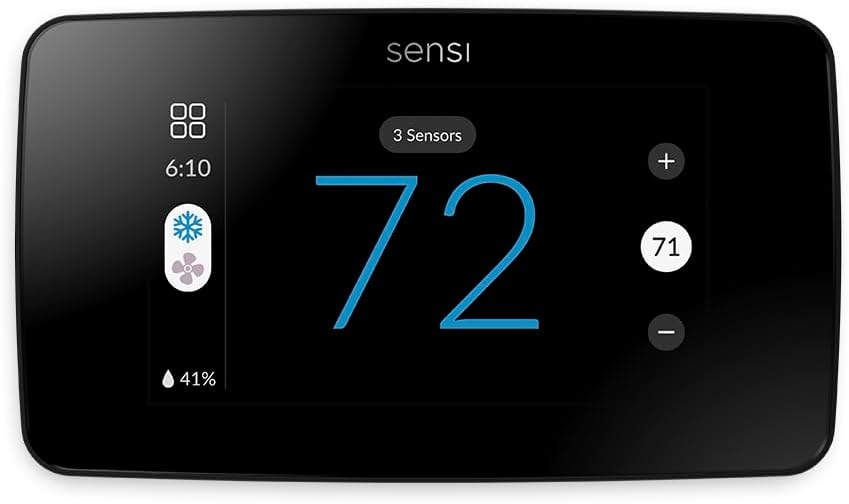
The Sensi Touch 2 ST76 is a Wi‑Fi smart thermostat designed to replace a conventional wall thermostat and give remote control, schedules and basic energy reporting. It installs using a common wire and the Sensi app walks you through setup, after which you can control heating and cooling from the touchscreen, the mobile app or voice assistants. The unit supports multiple system types including furnaces, boilers, heat pumps and air conditioners and pairs with optional Sensi room sensors to reduce hot and cold spots. Practical benefits include Energy Star certified savings features, usage reports and maintenance alerts that help preserve two‑stage HVAC performance, plus an intuitive LCD touch display for in‑home adjustments. Limitations to note are the requirement for a c‑wire, room sensors sold separately, and that advanced multi‑stage or niche commercial HVAC integrations are not described in the product details. For a homeowner with a two‑stage residential system this thermostat focuses on easy DIY setup and consistent remote control rather than deep professional configurability.
Best for: Homeowners who want a reliable, easy‑to‑install smart thermostat that offers remote control, scheduling and energy reporting to keep a two‑stage residential HVAC system running efficiently.
Less Ideal for: Commercial installations or users who need extensive professional multi‑stage programming and custom HVAC integrations should consider contractor-grade controllers instead.
- Energy Star certified with scheduling and usage reports to help reduce HVAC runtime
- Wi‑Fi, app control and voice assistant compatibility for remote adjustments
- LCD touchscreen and clear in‑app guidance for straightforward DIY installation
- Compatible with multiple residential system types including heat pumps and two‑stage equipment
- Requires a common wire (c‑wire) for power which may need an electrician in older homes
- Room sensors for zone balancing are sold separately and add to total cost
Verdict: Choose the Sensi Touch 2 if you want an Energy Star smart thermostat that simplifies DIY setup and gives app, voice and touchscreen control to optimize a two‑stage home HVAC system.
Garystat G701-B Thermostat

| Control Method | App |
|---|---|
| Voltage | 24 |
| Display Type | LCD |
| Controller Type | Push Button |
| Mounting Type | Wall Mount |
The Garystat G701-B is a straightforward, non-programmable wall thermostat designed for single-stage heating and cooling systems. It provides a large blue backlit LCD for easy setpoint changes and shows real-time temperature and humidity (the humidity readout can be turned off). Installation is simplified by color-coded terminals and dual power options—24 VAC or two AAA batteries—so a common wire is not required in many installs. The unit offers fan ON/AUTO control, selectable 3-minute compressor delay protection, separate heating and cooling swing adjustments, and a low-battery indicator for reliable everyday use. Practical features like room temperature calibration and separate B/O terminals help when replacing an older thermostat. Important limits: this model only supports 1 heat/1 cool single-stage systems and is not compatible with multistage systems, heat pumps with aux/emergency heat, mini-splits, or line-voltage baseboard systems, so it will not work on two-stage HVAC setups. For homes with a single-stage conventional furnace or air handler, it delivers simple, accurate control; it is not suitable where multi-stage or heat-pump-specific controls are required.
Best for: Buyers who want a reliable, no-frills replacement thermostat for a conventional single-stage gas, oil, or electric furnace and who prioritize simple installation and clear local readouts.
Less Ideal for: Homes with two-stage or multi-stage HVAC systems, heat pumps with auxiliary/emergency heat, or those seeking programmable or smart thermostat features.
- Large, easy-to-read backlit LCD with temperature and optional humidity display
- Dual power options (24 VAC or 2 AAA batteries) so C-wire is often unnecessary
- Color-coded, easy wire-coded terminal block and universal sub-base simplify installation
- Selectable compressor delay and separate swing adjustments give finer control over cycling
- Supports only single-stage (1 heat/1 cool) systems and is incompatible with multistage or heat-pump systems
- Non-programmable interface lacks scheduling or smart/remote control features
Verdict: Choose the Garystat G701-B when you need a simple, easy-to-install single-stage thermostat with a clear backlit display and humidity monitoring.
Riseem STN615 Programmable Thermostat

| Temperature Control Type | 24V Conventional Multi Stage Thermostat |
|---|---|
| Power Source | Dual Power Supply |
| Display Type | LCD |
| Number of Batteries | 2 AAA batteries required. |
The Riseem STN615 is a straightforward programmable thermostat made to control multi-stage 24V heating and cooling systems. It provides 5-1-1 day scheduling, selectable temperature swing, and a backlit LCD for easy viewing, with button and touch-style controls for daily adjustments. Installation is aimed at DIYers: the universal sub-base and labeled terminals simplify wiring for single- or multi-stage forced-air, heat pump (without auxiliary heat), and many conventional systems, and the unit can run from 24VAC or two AAA batteries when a common wire is not present. Practical benefits include a factory energy program to reduce runtime, compressor delay protection, and an adjustable calibration for more accurate room readings. Limitations include no Wi-Fi or remote app control, a basic interface that lacks advanced automation, and incompatibility with systems like heat pumps that need auxiliary/emergency heat, line-voltage or mini-split systems, and high-voltage electric baseboards. For buyers prioritizing a low-cost, programmable, factory-quality replacement for standard two-stage setups, this covers the essentials without smart features.
Best for: Buyers seeking an affordable, no-frills programmable thermostat to replace or upgrade a conventional two-stage 24V HVAC controller who want reliable scheduling and easy DIY installation.
Less Ideal for: Users who want smart features, app control, or need compatibility with auxiliary-heat heat pumps, mini-splits, or high-voltage electric heating should look elsewhere.
- Supports 24V multi-stage systems including 2 heat/2 cool configurations
- 5-1-1 day programmable schedule with factory energy program for runtime savings
- Dual power supply lets it run without a C-wire using AAA batteries
- Large terminal blocks and labeled sub-base simplify DIY installation
- Adjustable temperature swing and compressor delay protection to protect equipment
- No Wi-Fi, remote control, or smart-home integration
- Not compatible with systems that require auxiliary/emergency heat or line-voltage heat sources
Verdict: A budget-friendly programmable thermostat that gives reliable multi-stage control and easy DIY installation when you do not need Wi-Fi or advanced smart features.
Riseem STN621 Thermostat

| Controller Type | Push Button |
|---|---|
| Additional Features | 24V Heat Pump Thermostat |
| Power Source | Corded Electric |
| Display Type | LCD |
| Number of Batteries | 2 AAA batteries required. |
The Riseem STN621 is a straightforward wall-mounted digital thermostat built for basic heating and cooling control on 24V systems. It installs on a universal sub-base with large terminal blocks, so most DIYers and technicians can wire it quickly, and it can run on 24VAC or two AAA batteries when a common wire is not present. The backlit LCD and push-button controls make temperature changes and viewing easy, and the unit supports heat pump and conventional single-stage systems as well as several specialty heating options listed in the manual. Practical features include an adjustable temperature differential to reduce short-cycling and a front-load battery compartment for fast maintenance. Limitations: it is nonprogrammable, so it lacks scheduling, remote or smart connectivity, and it explicitly excludes multi-transformer, multi-stage, line-voltage, and mini-split systems—so you must verify compatibility before buying. For buyers who want a simple, reliable wall thermostat without smart features, this is a sensible, no-frills option.
Best for: Buyers who prioritize a dependable, simple thermostat for a standard 24V heat pump or single-stage HVAC system and want an easy-to-install, low-maintenance control without scheduling or smart features.
Less Ideal for: Users who need multi-stage control, programmable schedules, remote access, or who have line-voltage or mini‑split systems should look for a different model.
- Easy DIY install with universal sub-base and large terminal blocks
- Dual power option (24VAC or 2 AAA batteries) removes need for a common wire in most installs
- Backlit LCD and button controls are clear and simple to use
- Adjustable temperature differential helps reduce short-cycling and save energy
- Nonprogrammable with no Wi‑Fi or smart features
- Not compatible with multi-stage, line-voltage, or mini‑split systems
Verdict: A simple, reliable nonprogrammable thermostat built for easy installation and dependable 24V heat pump or single-stage HVAC control.
Google Nest Thermostat
| Connectivity Technology | Bluetooth, Wi-Fi |
|---|---|
| Power Source | Battery Powered |
| Display Type | LCD |
| Control Type | Remote Control, Voice Control |
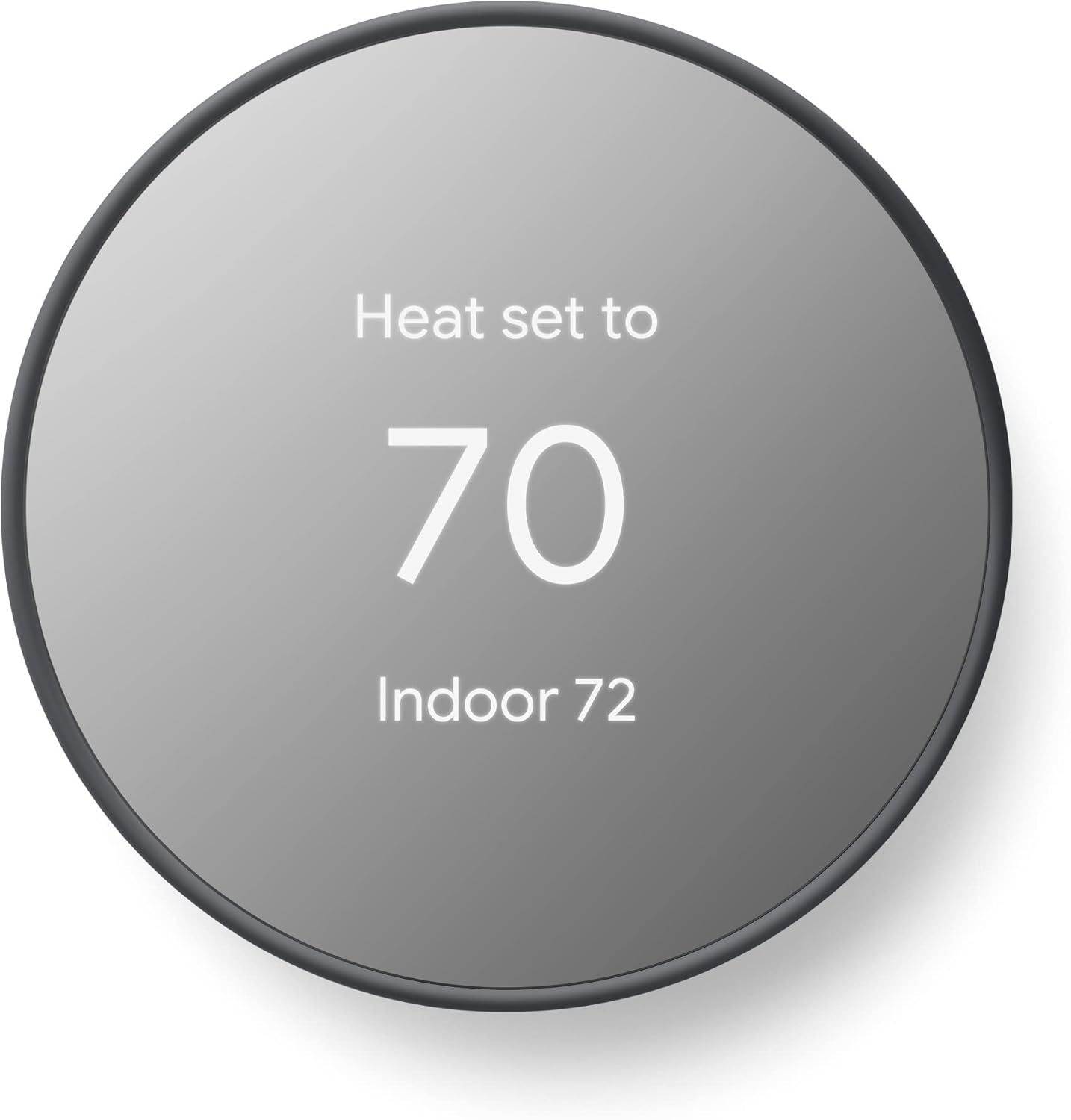
The Google Nest Thermostat is a compact smart thermostat intended to replace a basic wall thermostat and give remote app control, voice commands, and simple scheduling. It connects over 2.4/5 GHz Wi‑Fi and Bluetooth Low Energy so you can change temperature and set schedules from the Google Home app or a compatible voice assistant. Setup is designed for do‑it‑yourself installation in about 30 minutes and the unit runs on two A batteries, which makes it useful where a C wire is not present in many homes. The thermostat includes features like Savings Finder, Eco Temperatures when the house is empty, and HVAC monitoring that can send alerts if it detects potential issues. Practical benefits include easier multiuser control, energy saving suggestions, and integration with other Google Nest devices. Limitations to note are that some HVAC configurations still require a common wire or power accessory, voice features need a compatible assistant and internet, and alert messages are informative but not a substitute for professional HVAC diagnostics.
Best for: Buyers who want a straightforward smart upgrade that adds app and voice control, energy suggestions, and easy installation without needing advanced HVAC knowledge.
Less Ideal for: Homes with complex 110V/120V or unusual HVAC wiring, or buyers who need professional‑grade diagnostics and on‑device advanced controls.
- Easy DIY installation designed for most homes and quick set up via the Google Home app
- Wi‑Fi and Bluetooth connectivity for remote control and voice assistant integration
- Battery powered option works without a C wire in many systems
- Savings Finder and Eco Temperature features that suggest and apply energy-saving changes
- HVAC monitoring that can send alerts about potential system issues
- May require a C wire or power accessory for some HVAC configurations
- Voice control and remote features require working internet and compatible devices
- Alerts are informative but not a replacement for professional HVAC diagnosis
Verdict: Choose this Nest thermostat if you want an affordable, easy‑to‑install smart upgrade that adds app and voice control plus energy‑saving features for a two‑stage HVAC setup.
Riseem S3001 Nonprogrammable Thermostat

| Controller Type | Push Button |
|---|---|
| Connectivity Technology | Wired |
| Power Source | 24 volts AC or 2 AA batteries |
| Display Type | LCD |
| Temperature Control Type | Conventional Single Stage Systems |
The Riseem S3001 is a basic nonprogrammable thermostat intended to control single-stage heating and cooling systems. It mounts to a standard wall plate and uses large terminal blocks and a universal sub-base to simplify DIY wiring, with dual power options of 24VAC or two AA batteries so a C-wire is not required in most setups. The clear backlit LCD, button controls, and separate heating and cooling swing setting make it easy to set and maintain a stable temperature, and the unit advertises +/-1°F accuracy for consistent room comfort. Practical benefits include straightforward installation within about 30 minutes for typical single-stage systems and a low battery indicator so you do not lose control unexpectedly. Important limitations are that this model only supports 1 heat/1 cool single-stage systems and is incompatible with multistage, heat-pump, mini-split, multiwire hydronic, and most 120–240V electric baseboard systems, so it will not work for two-stage HVAC setups or more complex systems.
Best for: Someone who wants a low-risk, easy-to-install replacement thermostat for a standard single-stage furnace or central AC and values simple, reliable manual temperature control.
Less Ideal for: Homes with two-stage HVAC, heat pumps, mini-splits, 120–240V electric baseboard heat, or users who want programmable or smart thermostats with remote control.
- Easy DIY installation with universal sub-base and large terminal blocks
- Dual power options (24VAC or 2 AA batteries) remove need for a C-wire in most systems
- Clear backlit LCD and simple button controls for straightforward operation
- Separate heating and cooling swing control and +/-1°F accuracy for stable temperature control
- Only supports conventional single-stage (1 heat/1 cool) systems and is not compatible with two-stage or heat-pump systems
- No programmable schedules or smart connectivity features
Verdict: Choose this thermostat if you need a straightforward, low‑risk factory‑style replacement for a single-stage heating and cooling system.
Choosing the Right Thermostat for Two-Stage HVAC: Key Factors to Consider
Staging Logic and Accuracy
How a thermostat decides to call the first or second stage of heating or cooling affects comfort and equipment life. Good staging logic considers temperature differential, rate of change, and minimum runtime to avoid rapid cycling. Thermostats vary in whether they use fixed deadbands, adaptive algorithms, or user-adjustable thresholds, and that choice changes daily performance.
For two-stage HVAC systems, look for devices that explicitly list two-stage heat and cool support and provide clear configuration options. Thermostats that offer adaptive staging learn from system behavior and can reduce unnecessary stage changes while maintaining consistent comfort.
Wiring Complexity and Compatibility
Two-stage systems may require additional terminals beyond single-stage setups, including separate O/B/Aux outputs or multiple compressor stages. Confirming that a thermostat supports the specific terminal set used by your equipment will save installation time and avoid functional compromises. Some units provide terminal labeling and wiring diagrams in the app or display to simplify hookups.
Also consider whether the thermostat needs a common power wire, and whether your existing wiring bundle provides it. If your system uses proprietary control modules, you may need a thermostat with flexible wiring modes or external relays to interface cleanly.
User Controls and Scheduling
Programmability affects both comfort and efficiency. Advanced schedules, adaptive recovery, and geo-fencing can help a thermostat balance runtime between stages and avoid unnecessary second-stage calls. Ease of programming on the thermostat and via remote apps matters for day-to-day use, especially if you want different behavior for occupied and unoccupied periods.
Guest and multi-user control, as well as simple overrides, are helpful when multiple people influence temperature. Clear feedback on current stage and setpoints improves confidence that the thermostat is managing the system as intended.
Diagnostics and Monitoring
A thermostat that reports staging activity, run times, and error conditions makes it easier to spot performance problems before they become failures. Diagnostics can include stage call history, compressor runtimes, short-cycle detection, and alerts for unusual behavior. This information supports smarter decisions about timing, filters, or service visits.
Remote monitoring via a companion app or web portal is useful for homeowners and technicians alike. Look for thermostats that expose meaningful system data rather than just basic temperature logs.
Energy Management and Algorithms
Two-stage systems are often more efficient when the thermostat prioritizes first-stage operation for mild loads and only summons second stage when necessary. Energy management features such as adaptive recovery, setback schedules, and stage-balancing logic help minimize on-off cycling and reduce runtime of the higher-capacity stage.
Consider whether the thermostat integrates with broader home energy systems or supports local incentive programs. Energy reporting that breaks out stage runtimes can demonstrate whether your staging strategy is meeting efficiency goals.
Installation Support and Firmware Updates
Because proper configuration is crucial for two-stage control, vendor documentation, wiring guides, and firmware updates matter. Clear step-by-step installation instructions reduce the risk of misconfiguring stage outputs or fan control. Ongoing firmware updates can add staging refinements or security patches over time.
Thermostats backed by accessible customer support and straightforward update mechanisms give you a better chance of long-term reliability and correct staging behavior as your system and needs evolve.
How Two-Stage Systems Differ From Single-Stage
Two-stage HVAC systems have two levels of heating or cooling capacity so they can match output to the current load more precisely. The first stage handles routine temperature control with lower energy use and less wear, while the second stage provides higher capacity for extreme conditions. A thermostat that understands this distinction will call the appropriate stage based on measured conditions and internal logic.
Without proper staging, a system may overuse the second stage, which increases runtime and energy consumption, or underuse it, which can leave the home uncomfortable during peak conditions.
- Stage 1: Lower capacity, energy-efficient operation
- Stage 2: Higher capacity for larger temperature gaps
- Thermostat decides stage based on differential, runtime, and algorithms
Common Wiring Scenarios for Two-Stage Units
Wiring for two-stage systems typically involves separate terminals for each stage of heat and cool and possibly additional outputs for staged compressors or reversing valves. Many modern thermostats include dedicated terminals labeled for stage 1 and stage 2 that simplify hookup. Confirm terminal names and whether a common wire is required before starting.
If your system uses control modules or zone panels, you may need to consult wiring diagrams and set the thermostat to the appropriate control mode. Using inline relays is an option when a thermostat cannot directly switch higher-voltage or high-current circuits.
- Check for terminals labeled W1/W2 and Y1/Y2 for heat and cool stages
- Confirm C-wire availability for power-hungry smart thermostats
- Use relays or control modules when direct switching is not supported
Programming Strategies for Smooth Staging
Set temperature differentials and minimum runtimes deliberately to avoid short cycling. A common approach keeps a moderate deadband around setpoint and requires a minimum continuous runtime for each stage to prevent rapid switching. Adaptive recovery features can warm or cool the home efficiently before occupancy without immediately calling the second stage.
Use setback schedules conservatively in two-stage systems. Large, sudden setpoint changes can trigger the second stage; gradual recovery or staged setpoint changes reduce the need for higher-capacity operation.
- Use minimum runtime to prevent short cycling
- Avoid large instantaneous setpoint jumps to reduce second-stage calls
- Consider adaptive recovery to leverage first-stage operation
Remote Access and Mobile Controls
Thermostats with robust mobile apps let you view current stage, adjust schedules, and receive alerts about unusual staging behavior. Remote access is particularly useful for monitoring stage runtimes when evaluating comfort issues or diagnosing equipment problems.
Look for apps that display staging history and clear notifications for fault conditions. Basic remote control without diagnostic detail is helpful, but visibility into stage calls and runtimes is more valuable for two-stage systems.
- Prefer apps that show stage calls and runtime history
- Push alerts for short cycles or error conditions help catch issues early
- Multi-user access with permission controls keeps settings manageable
When to Call a Technician
If the thermostat repeatedly calls the second stage for very small temperature differences, or if staging seems inconsistent with outdoor conditions, you should consult an HVAC technician. These symptoms can indicate sensor issues, improper wiring, or incorrect configuration of staging thresholds.
A technician can validate system wiring, verify stage sequencing at the equipment, and adjust minimum runtimes or sensitivity settings to align thermostat behavior with equipment capabilities.
- Frequent second-stage calls for minor cooling or heating demands
- Short cycling between stages
- Inconsistent or missing stage indicators on the thermostat or app
How We Chose the Best Thermostat for Two-Stage HVAC
To assemble this list we focused on attributes that directly affect how well a thermostat controls a two-stage heating and cooling system. Our editorial filters prioritized staging capability and accuracy, meaning we looked for clear support for two-stage heat and two-stage cool modes and reliable logic for switching between stages based on temperature differential and runtime. We also evaluated wiring and install complexity, since two-stage systems sometimes require extra terminals or configuration steps. Other important criteria included user controls and programmability, covering both onboard scheduling and remote app access, and diagnostics or system monitoring features that surface staging and equipment operation. Energy-saving algorithms and compatibility with common accessory sensors were factored in because they influence real-world efficiency. Finally, we considered build quality and ongoing firmware support as proxies for long-term reliability. We excluded thermostats that only support single-stage systems or require extensive HVAC control system upgrades. Models that lacked two-stage configuration options or practical diagnostic feedback were not considered. The resulting picks reflect devices that balance staging accuracy, installation practicality, user control, and monitoring capability.
Our full evaluation process is outlined in our review methodology.
FAQ
Does every thermostat support two-stage heating and cooling?
No. Not all thermostats support two-stage systems. Some only handle single-stage heat and cool. Verify that the thermostat explicitly lists support for two-stage heat and two-stage cool before assuming compatibility.
Can I install a two-stage thermostat myself?
Many homeowners can complete the wiring and setup if they are comfortable working with low-voltage HVAC terminals and have clear documentation. However, complex control panels or proprietary wiring may require a technician to avoid misconfiguration.
How does the thermostat decide when to use stage two?
Thermostats use configuration settings such as temperature differential, rate of change, and minimum runtime to decide when to call stage two. Some models use adaptive algorithms that learn system behavior to delay second-stage calls until necessary.
Will a smart thermostat save energy on a two-stage system?
Smart features can reduce run time of the higher-capacity stage by prioritizing first-stage operation, using setback schedules, and optimizing recovery. Actual savings vary based on system design, local climate, and user behavior.
What if my thermostat needs a common wire?
If a thermostat requires a C-wire and your existing bundle lacks one, you can run a new conductor, install a power extender kit where supported, or choose a low-power device that does not need a C-wire. Each option has tradeoffs for installation complexity.
Final Verdict
Selecting a thermostat for a two-stage HVAC system means prioritizing accurate staging logic, clear wiring compatibility, and diagnostic visibility. Focus on devices that provide explicit two-stage configuration, meaningful runtime and stage feedback, and flexible scheduling to reduce unnecessary second-stage operation. Balance installation complexity against desired control features. If you want hands-off optimization, lean toward thermostats with adaptive staging and strong remote monitoring. If wiring or system constraints exist, choose a thermostat that matches your terminal set and provides straightforward setup guidance.