
Note: This article contains affiliate links. If you click on these links and make a purchase, we may earn a small commission at no extra cost to you. This helps support our research and content. Read our full affiliate disclosure here.
If your home lacks a C-wire, you can still upgrade to a modern thermostat without rewiring. A thermostat without a C-wire is designed to operate using batteries or power-stealing methods so you can add programmability and, in many cases, smart features without the cost and hassle of running new wiring. This guide shortlists the best options available for homes without a dedicated common wire and explains the practical tradeoffs you should expect. Below you will find carefully selected picks that prioritize installation simplicity, stable power behavior, and compatibility with common HVAC setups. Read on to see which models match your needs and the specific factors we used to evaluate them.
Top Picks at a Glance
| Best Overall The best all-around choice for most situations | Fabater Smart Knob Thermostat |  |
| Best Quality Built to a higher standard if you want something more solid | Hamwesh Smart Thermostat |  |
| Best Value The sweet spot between price and what you get | SASWELL T18 Smart Thermostat |  |
| Best Budget The cheapest option that still gets the job done reliably | SASWELL T21 Programmable Thermostat |  |
| Top Rated A top-rated pick with lots of positive feedback | Mysa Smart Thermostat LITE |  |
| Most Popular A crowd favorite that many people choose with confidence | MoesGo Wi‑Fi Programmable Thermostat |  |
| Best Seller A high-volume bestseller chosen again and again | Hualans Non-programmable Thermostat |  |
Fabater Smart Knob Thermostat

| Power Supply | 95-240V AC, 50-60Hz |
|---|---|
| Current Load | 3A (water heating) |
| Accuracy | ±1℃ |
| Set Temperature Range | 5-35℃ |
| App | Tuya |
The Fabater Smart Knob Thermostat is a wall-mounted digital thermostat built specifically for water heating equipment and designed to work without a C-wire. It uses a rotary knob and a 1.81-inch TFT screen for direct local control, and pairs with the Tuya app for remote scheduling and voice control. The unit claims ±1°C accuracy and supports weekly programming and set temperatures from 5 to 35°C, which makes it useful for maintaining stable hot water or radiator schedules. Installation fits standard 86×86mm square or 60mm round mounting boxes and accepts common wire sizes for household wiring. Practical benefits include low power consumption, simple user interface for nontechnical users, and app/voice integration for remote adjustments. Important limitations are that it is explicitly intended only for water heating equipment and not compatible with boilers that use water and gas, air conditioners, or underfloor heating systems, so it is not a universal replacement thermostat. Also the current load is limited to 3A, so it is best for control circuits rather than high-current loads.
Best for: Homeowners looking for a no-C-wire smart thermostat to control a water-based heating system who value easy local control plus app and voice convenience for weekly schedules.
Less Ideal for: People who need a universal HVAC or multi-system thermostat, or who plan to control high-current heating elements or systems other than water-based heating.
- Works without a C-wire and integrates with the Tuya app for remote control and scheduling
- Simple rotary knob and clear TFT display make local adjustments quick and intuitive
- Supports voice control for hands-free temperature changes
- High stated accuracy of ±1°C for consistent temperature regulation
- Only suitable for water heating equipment and incompatible with many boiler, gas, HVAC, and floor heating systems
- Maximum current load of 3A limits direct control of high-power devices
Verdict: If you need a simple, no-C-wire smart control for a water-based heating system with app and voice control, this knob thermostat is a practical, accurate option.
Hamwesh Smart Thermostat

| Connectivity Technology | Wi‑Fi |
|---|---|
| Display Type | LCD |
| Control Method | App, Touch, Voice |
| Additional Features | Programmable, Temperature Display |
This Hamwesh smart thermostat is a no‑C‑wire Wi‑Fi unit with a color LCD and app, touch and voice controls aimed at simple remote temperature management. It installs with the supplied cable and hardware and connects to your home network so you can change schedules, set temperature points, and monitor conditions from the mobile app. The bright LCD makes on‑device adjustments easy and the programmable scheduling supports routine energy management for heating and cooling cycles. Practical benefits include remote access for temperature changes away from home and a modern interface that replaces older mechanical thermostats. Limitations to expect are basic ecosystem integration compared with major brand platforms and limited documentation or support details, so advanced HVAC setups or systems requiring professional compatibility checks may need additional verification before purchase.
Best for: Buyers who want a performance‑focused, easy‑to‑install smart thermostat for reliable remote control and programmable schedules without running a C‑wire.
Less Ideal for: Homeowners with complex multi‑stage HVAC systems or those who need deep integration with a specific smart home platform should consider factory‑quality alternatives with documented compatibility.
- No C‑wire required design for easier installs in older homes
- Color LCD for clear on‑device controls and status
- Wi‑Fi and mobile app control for remote temperature adjustments
- Programmable scheduling for routine heating and cooling management
- Limited brand ecosystem and sparse support information compared with established smart thermostat makers
- May require verification for compatibility with complex HVAC systems
Verdict: Choose this unit if you need a performance‑minded, no‑C‑wire smart thermostat that gives clear on‑device controls and reliable app‑based remote management.
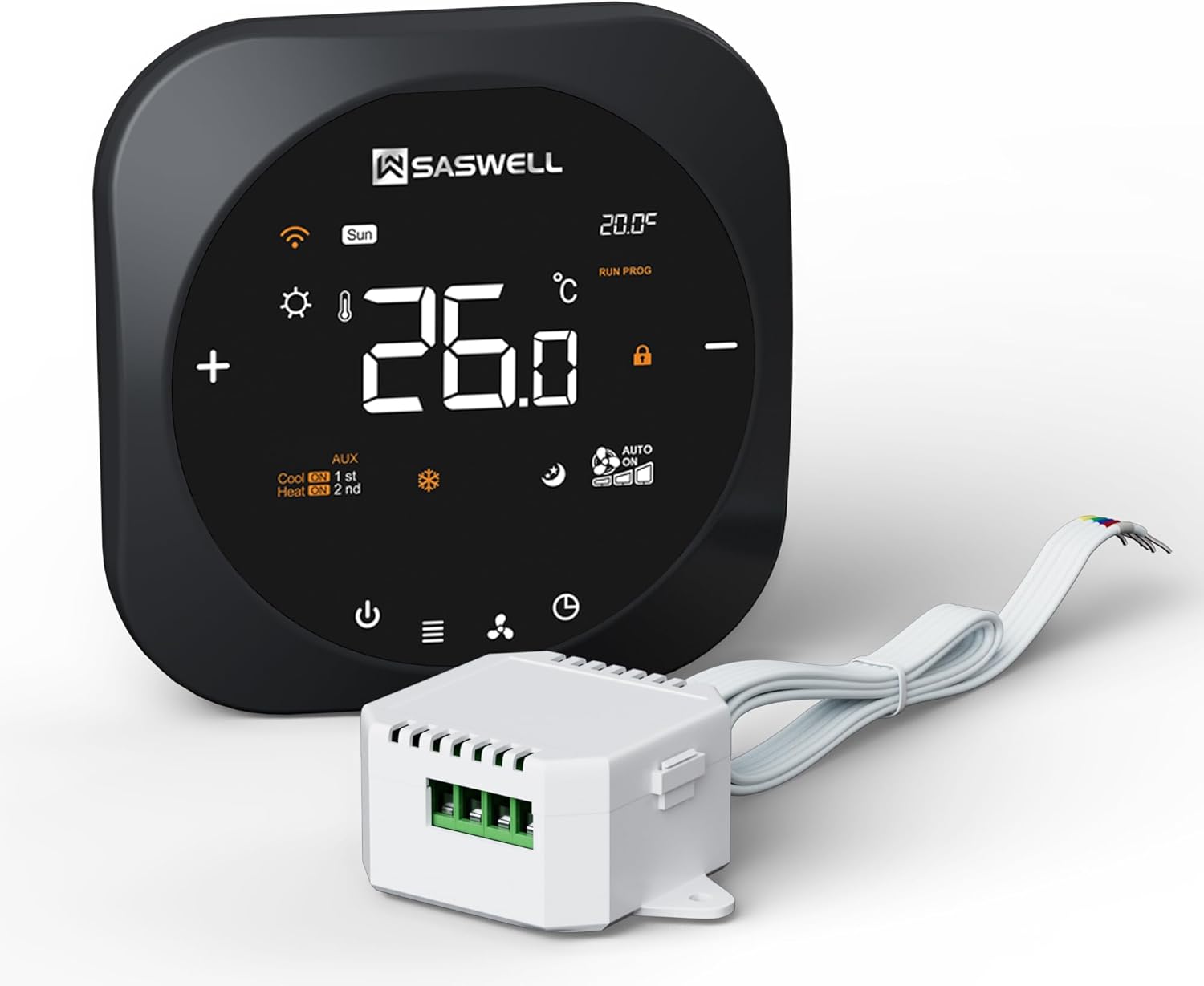
SASWELL T18 Smart Thermostat
| Controller Type | Smart Life, Tuya Smart |
|---|---|
| Specific Uses For Product | 3H/2C Heat Pump, Conventional Multi-stage Heating & Cooling System |
| Connectivity Technology | Wi-Fi |
| Voltage | 24 volts |
| Display Type | LED |
The SASWELL T18 is a smart, app‑controlled thermostat aimed at replacing traditional units on 3H/2C heat pump and conventional multi‑stage systems. It connects over Wi‑Fi and works with Tuya Smart and Smart Life apps plus voice control via Alexa and Google Assistant, letting you adjust temperature remotely or with voice. The unit includes a C‑wire adapter so homes without a dedicated C wire can still get continuous power without rewiring, and its LED touch screen offers straightforward on‑device control. The thermostat is programmable for a 7‑day schedule, supports fan control, and is designed for DIY installation with clear instructions and included components. Practical buyers will appreciate the balance of smart features and compatibility, though setup may still require checking system wiring and verifying multi‑stage support for more complex HVAC configurations. The interface is functional rather than premium, but it delivers the core conveniences most households need for smarter, schedule‑based temperature control.
Best for: Buyers who want a cost‑effective smart thermostat that avoids rewiring by using a C‑wire adapter and who prioritize remote app control and simple weekly scheduling.
Less Ideal for: Homes that need a premium touchscreen interface or users who prefer factory‑level integrations from big OEM smart thermostat ecosystems.
- Includes C‑wire adapter for homes without a C wire
- Wi‑Fi connectivity with Tuya Smart and Smart Life app support
- Works with Alexa and Google Assistant for voice control
- 7‑day programmable schedules and on‑device LED touch screen for local control
- Interface and display are functional but not high‑end
- Requires confirming compatibility with specific multi‑stage HVAC wiring before installation
Verdict: If you need a practical, app‑controlled thermostat that works without a home C‑wire, the SASWELL T18 delivers essential smart features plus a C‑wire adapter for easy DIY upgrades.
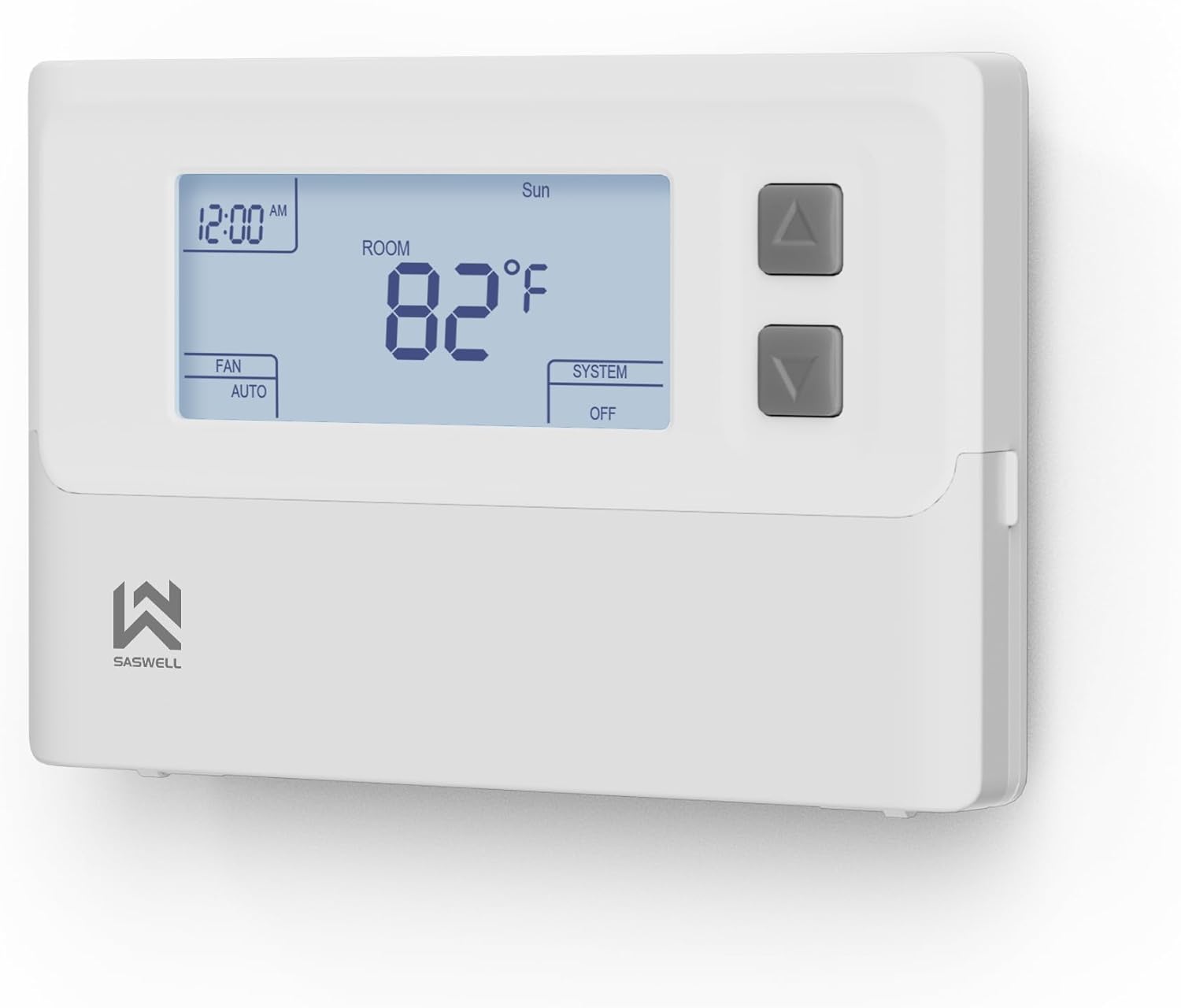
SASWELL T21 Programmable Thermostat
| Controller Type | Push Button |
|---|---|
| Temperature Control Type | programmable |
| Power Source | Battery Powered, Hardwired (24VAC) |
| Display Type | LCD |
| Control Method | App, Touch |
The SASWELL T21 is a straightforward 1 heat/1 cool programmable thermostat intended for homeowners who want a low-cost, no-frills replacement that does not require a C-wire when battery powered. It supports single-stage furnaces, heat pumps without auxiliary heat, boilers, and common 24V systems, and offers 5+2 weekly scheduling to set weekday and weekend temperatures. The unit runs from 24VAC or two AA batteries, includes an easy-to-read backlit LCD, and hides buttons and the battery compartment under a cover to avoid accidental changes. Memory retention preserves settings during power outages and the manual-focused interface makes it an easy DIY install for someone comfortable with basic wiring. Limitations are its lack of Wi-Fi or smart app connectivity and incompatibility with systems that need auxiliary/emergency heat, dual-fuel setups, electric baseboard line-voltage systems, and mini-splits, so it is better as a simple programmable replacement than a smart thermostat upgrade.
Best for: Buyers who want an inexpensive, easy-to-install programmable thermostat that restores scheduling and basic control without adding smart features or requiring a C-wire.
Less Ideal for: Users seeking a Wi‑Fi connected or app-controlled smart thermostat, or those with auxiliary/emergency-heat or line-voltage heating systems should look elsewhere.
- Works without a C-wire when battery powered so you can replace many older thermostats without running new wiring
- Supports common single-stage systems and heat pumps without auxiliary heat for broad basic compatibility
- 5+2 programmable schedule helps save energy by setting weekday and weekend temperatures
- Dual power options (24VAC or AA batteries) and memory retention keep settings stable during outages
- No Wi‑Fi or app control so remote scheduling and smart-home integration are not available
- Not compatible with systems that require auxiliary/emergency heat, dual-fuel setups, or line-voltage/electric baseboard systems
Verdict: A budget-friendly programmable replacement that restores scheduled temperature control for homes without a C-wire, without adding smart features.
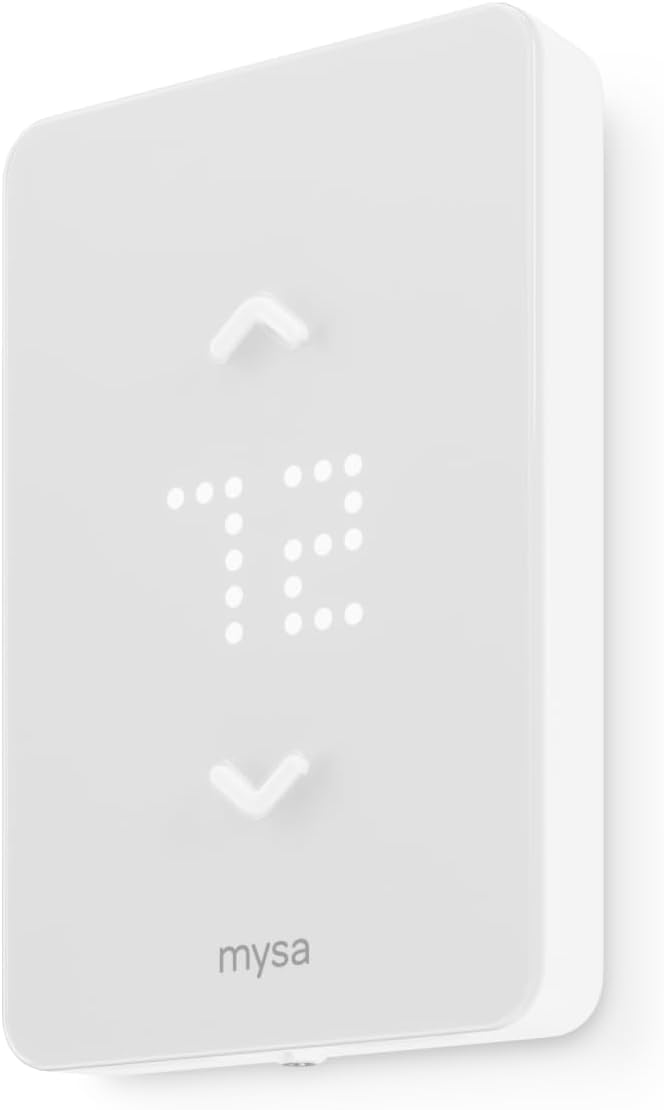
Mysa Smart Thermostat LITE
| Controller Type | Amazon Alexa, Android, Apple HomeKit, Google Assistant, iOS |
|---|---|
| Connectivity Technology | Bluetooth, Wi‑Fi |
| Voltage | 240 volts_of_alternating_current |
| Wattage | 3800 watts |
| Control Method | App, Touch, Voice |
The Mysa Smart Thermostat LITE is built specifically for high‑voltage electric baseboard, convector, and fan‑forced heaters and gives you modern smart control without a separate hub. It connects directly to your home Wi‑Fi and pairs with HomeKit, Alexa, and Google for voice control while the Mysa app provides remote temperature changes, geofencing, and 7‑day scheduling to cut runtime and energy costs. The wall‑mounted unit includes an LCD and touch control for local adjustments and supports 120V through 240V installations including single‑pole and double‑pole setups. Installation is aimed at DIYers and the app walks you through wiring, though the thermostat does require four wires (neutral or a second live) so you should check your existing wiring before starting. Notable strengths are clear energy reporting, monthly runtime emails, and a five‑year hardware warranty backed by North American support, but buyers should be comfortable with electrical work or consult an electrician if wiring is nonstandard.
Best for: Buyers who want a reliable, smart upgrade for electric baseboard or wall heaters that delivers remote control, energy reports, and durable support rather than a generic low‑voltage thermostat.
Less Ideal for: People who lack a compatible four‑wire heater circuit or who need a simple plug‑and‑play low‑voltage thermostat for central HVAC should look elsewhere.
- Direct Wi‑Fi connection with app control and no hub required
- Works with HomeKit, Alexa, and Google for voice control
- Designed for 120V–240V electric baseboard and fan‑forced heaters including single and double pole
- 7‑day scheduling, geofencing, and monthly runtime reports to reduce energy use
- Five‑year hardware warranty and North America based support
- Requires four‑wire hookup (neutral or second live), so some homes need wiring changes
- Installation involves high‑voltage wiring which may require an electrician for nontechnical users
Verdict: A durable, smart thermostat built specifically to replace high‑voltage baseboard and fan‑forced heaters for buyers prioritizing reliable remote control and long‑term support.
MoesGo Wi‑Fi Programmable Thermostat

| Connectivity Technology | Wi‑Fi |
|---|---|
| Control Method | Voice |
| Power Source | Hardwired |
| Display Type | digital |
| Included Components | C‑wire adapter, temperature sensor |
The MoesGo Wi‑Fi Programmable Thermostat is a smart, wall‑mounted thermostat designed for conventional and heat‑pump HVAC systems and ships with a C‑wire adapter and a remote temperature sensor. You set 7‑day schedules with four modes (wake, away, home, sleep), control it remotely through the Tuya/Smart Life app, and use voice commands with Alexa or Google Assistant. The included sensor can average readings with the main unit when it detects presence, which helps keep the temperature more representative of occupied rooms. Installation is intended for DIY users but requires at least R, Y and G wires (or R, Y, G with the adapter) and it does not support high voltage or heating‑only systems. Practical benefits include remote scheduling, presence‑aware sensing for better comfort, and broad HVAC compatibility for 2H/2C and 4H/2C systems, but buyers should note it only supports 2.4 GHz Wi‑Fi and some older or unusual wiring setups will still be incompatible. The digital display and programmable options make it a capable budget smart thermostat if your system meets the wiring requirements.
Best for: Buyers who want a budget smart thermostat that offers remote control, voice integration, and a companion sensor but need a solution that avoids running a new C‑wire.
Less Ideal for: Homes with high‑voltage HVAC, heating‑only systems, or setups lacking the R/Y/G wiring should avoid this model and look for a compatible alternative.
- Includes C‑wire adapter to support systems without a dedicated C‑wire
- Remote temperature sensor with presence detection for more accurate room readings
- 7‑day programmable schedule with four customizable modes
- Works with Tuya/Smart Life app and voice assistants for remote and hands‑free control
- Requires specific wire combinations (R, Y and G) so truly minimal‑wire systems may still be incompatible
- Only supports 2.4 GHz Wi‑Fi, not 5 GHz
Verdict: A practical budget smart thermostat for homes without a C‑wire that want remote app control and room sensing without rewiring.
Hualans Non-programmable Thermostat

| Controller Type | Digital, Non-programmable |
|---|---|
| Power Source | 2 AA batteries or 24VAC hardwire |
| Compatibility | 1H/1C and heat pump systems |
| Display | Backlit LCD |
| Temperature Accuracy | ±1°F |
The Hualans HY817 is a straightforward, non-programmable thermostat designed for buyers who want reliable temperature control with minimal fuss. It runs on two AA batteries or can be hardwired to 24VAC with batteries as a backup, and supports single-stage conventional systems and heat pumps via a full 9-terminal hookup. The large backlit LCD and ±1°F NTC sensor make temperature readouts clear and accurate, and control is limited to intuitive slide switches and push buttons so there is no app, schedule setup, or learning curve. Installation is aimed at DIYers: clearly labeled terminals, wire labels, and included mounting hardware should let most homeowners finish in under 30 minutes without calling an electrician. Because it is non-programmable and lacks smart connectivity, it will not provide remote control, schedules, or energy reports, but that simplicity also means fewer points of failure and no subscription or network setup to manage.
Best for: Buyers who prioritize a fail-safe, low-maintenance thermostat that just controls temperature reliably without Wi‑Fi or complicated setup and who prefer a quick DIY install.
Less Ideal for: Anyone who wants smart features, remote control, automated schedules, or energy usage tracking should choose a programmable or Wi‑Fi thermostat instead.
- Works without Wi‑Fi or an app, so no network setup or subscriptions are required
- Runs on 2 AA batteries or can be hardwired to 24VAC with battery backup
- Compatible with 1H/1C systems and heat pumps via full 9-terminal connections
- Large backlit LCD and ±1°F sensor deliver clear, accurate temperature readouts
- Simple controls and labeled terminals support typical DIY installation under 30 minutes
- Non-programmable design offers no scheduling, remote access, or energy-reporting features
- Lacks C-wire charging features that some newer thermostats use for advanced functions
Verdict: Choose this thermostat if you want a dependable, no‑Wi‑Fi, battery-powered unit that installs easily and delivers accurate basic temperature control without fuss.
Choosing the Right Thermostat Without a C-Wire: Key Factors to Consider
Power Source and Battery Life
How the thermostat is powered is the single most important practical concern when you do not have a C-wire. Some thermostats run on AA or AAA batteries while others rely on power stealing from the HVAC wiring. Battery-powered models require occasional replacement and you should check expected run time under typical usage.
Power-stealing designs draw small amounts of current through the control circuit to keep internal electronics alive. While this avoids battery swaps, it can cause compatibility issues with certain HVAC control boards or lead to system short-cycling if the unit is not well matched. Ask how the thermostat reports low power and whether it supports emergency battery mode to maintain basic operation during power issues.
Installation Method and Instructions
A thermostat that advertises no C-wire support should also make installation straightforward. Look for clear, illustrated wiring guides, an easy wall-plate design that hides extra wires, and step-by-step mobile setup. Some thermostats include an optional C-wire adapter or power accessory; others require none.
Consider whether the device offers professional installation support or remote guidance. Even if you plan to DIY, clear documentation reduces the risk of wiring mistakes that can damage the thermostat or the HVAC control board. If your system has nonstandard wiring labels, check that the manual covers alternate terminal names and common legacy setups.
HVAC System Compatibility
Not all no-C-wire thermostats work with every heating and cooling system. Confirm compatibility with your specific control type, whether single-stage heat/cool, multi-stage systems, heat pumps with auxiliary or emergency heat, or systems with millivolt or proprietary controls.
A thermostat that handles a broad range of control signals will be easier to install and less likely to cause unexpected behavior. Check for explicit support of your system's control signals and review whether features like fan control, auxiliary output, or separate humidifier/dehumidifier terminals are required for your setup.
Smart Features and Scheduling
The value of upgrading often comes from smarter scheduling and energy-saving features. Consider whether the thermostat provides flexible scheduling, geofencing, adaptive recovery, or usage reports. Some devices offer cloud-based learning that adapts to your habits, while others keep settings local for privacy.
Decide which smart features you will actually use. If you only want basic programmable schedules, a simpler model with long battery life may be preferable. If you plan to integrate the thermostat into a home automation platform, confirm available integrations and whether the device requires an account to enable core features.
User Interface and Remote Control
A clear display and intuitive controls make daily use less frustrating. Consider whether you prefer a touchscreen with a large, readable interface or a simpler display with physical buttons. Remote control via an app is essential for many buyers; check app usability, reliability of remote access, and whether local control is available when the internet is down.
Also evaluate notification behavior. Thermostats that proactively alert you to low batteries, HVAC faults, or connection issues reduce maintenance surprises. Accessibility features such as high-contrast screens or voice control compatibility may also matter for some households.
Understanding No-C-Wire Operation
Thermostats designed for homes without a C-wire either run on batteries or extract a trickle of power from the HVAC control circuit. Battery models are simple and predictable but need periodic replacement. Power-stealing models can avoid batteries but require careful matching to the HVAC control board to prevent erratic behavior.
Knowing which method a thermostat uses helps you anticipate maintenance and compatibility. If your system already has intermittent communication issues or an older control board, a battery-powered option may be the safer choice. Conversely, if you want to minimize upkeep, pick a model that is explicitly engineered to work reliably with power stealing.
- Battery operation: predictable, requires occasional replacement
- Power stealing: no batteries, potential compatibility tradeoffs
- Some devices include optional adapters to emulate a C-wire
When to Use a C-Wire Adapter
A C-wire adapter can be an effective compromise when a thermostat's no-C-wire behavior is unreliable on your system. Adapters provide a stable common reference by drawing power from the furnace control board and creating a pseudo C connection for the thermostat. They are typically installed at the furnace or air handler.
Use an adapter when you see frequent battery drain, HVAC short-cycling, or if the thermostat reports unstable power. Installation requires access to the control board and basic wiring skills, so factor that into your decision if you plan to DIY.
- Adapters stabilize power for smart features
- They require furnace access and basic electrical comfort
- Adapters can resolve compatibility problems without full rewiring
Practical Tips for DIY Installation
Turn off power to the HVAC system at the breaker before touching control wiring. Label every wire you remove from the old thermostat and take a photo of the existing hookup to reference during installation. Use the new thermostat's wiring checklist and confirm terminal labels match your system.
If the thermostat offers an in-app wiring diagnostic, run it before restoring power. After installation, monitor the system for a few days to ensure there are no frequent cycles, unexpected heat or cool calls, or rapid battery drain. If you notice issues, revert power and consult the manual or a professional.
- Kill power at the breaker before starting
- Label and photograph existing wiring
- Use diagnostics and watch the system for the first week
Integrating With Smart Home Systems
If you plan to connect the thermostat to a broader home automation setup, verify which integrations are supported. Some thermostats communicate via Wi-Fi and cloud services, while others use local protocols or third-party hubs. Confirm whether the thermostat allows local control so core functions work if your internet or cloud service is unavailable.
Consider the ecosystem you already use. Voice assistants, energy-monitoring platforms, and third-party scheduling tools often differ in the level of control they provide. A simple thermostat that exposes basic setpoint controls may be sufficient for most integrations without the overhead of advanced cloud features.
- Check for Wi-Fi and local control options
- Confirm compatibility with your automation platform
- Verify what happens during internet outages
Maintenance and Long-Term Reliability
Track battery status regularly if you choose a battery-powered thermostat. Some devices provide clear battery life estimates and advance warnings. For power-stealing models, watch for signs of system instability and verify the unit does not cause rapid HVAC cycling over time.
Plan a yearly check of wiring connections at the air handler to ensure terminals remain secure. Keep firmware up to date for devices with networked features to address any stability or security fixes released by the manufacturer.
- Monitor battery alerts and change batteries on schedule
- Watch for HVAC short-cycling with power-stealing units
- Keep networked devices updated with firmware patches
How We Chose the Best Thermostat Without a C-Wire
We evaluated thermostats for homes without a C-wire using criteria that reflect real installation conditions and day-to-day reliability. Our primary filters focused on installation method and power behavior, favoring thermostats that can operate reliably on batteries or by safe power-stealing from typical heating and cooling control circuits. We assessed compatibility with common HVAC control types such as single-stage heating and cooling, heat pump setups with auxiliary heat, and conventional systems that lack a dedicated common terminal. Usability and setup were tested conceptually: how clear the wiring instructions are, whether the device needs a C-wire adapter, and how straightforward the initial configuration and app pairing are. Energy management features and scheduling flexibility were also scored because these determine how useful a thermostat will be once installed. Finally, we considered long-term operation issues such as battery life, power-stealing stability, and whether the thermostat avoids frequent HVAC cycling. We excluded units that explicitly require a C-wire or that only work with proprietary HVAC modules not suitable for general replacement. We also filtered out thermostats with unclear documentation about no-C-wire operation. The result is a list that emphasizes dependable power handling, broad compatibility, easy installation, clear setup flows, and sensible energy-management features.
Our full evaluation process is outlined in our review methodology.
FAQ
Can a smart thermostat work without a C-wire?
Often yes. Many smart thermostats are designed to operate on batteries or use power-stealing methods to run without a C-wire. Check the manufacturer's compatibility guidelines and expected battery life or power behavior for your HVAC type.
How long do batteries usually last in no-C-wire thermostats?
Battery life varies by model and usage but commonly ranges from several months to a year. Models with frequent Wi-Fi activity or large displays tend to use batteries faster, while simpler displays and conservative polling intervals extend life.
What problems indicate a thermostat needs a C-wire or adapter?
Frequent low-battery warnings, erratic thermostat reboots, unexpected HVAC short-cycling, or failure to maintain Wi-Fi connectivity can indicate inadequate power. In those cases, a C-wire adapter or running a dedicated common wire may resolve issues.
Is installing a C-wire adapter difficult?
Installing an adapter typically requires accessing the furnace or air handler control board and making a few wiring connections. A homeowner with basic wiring skills can often do it, but if you are uncomfortable working near the control board, professional help is reasonable.
Will a no-C-wire thermostat support heat pumps and auxiliary heat?
Some no-C-wire models support heat pumps and auxiliary heat, but compatibility is not universal. Verify that the thermostat explicitly lists support for heat pump configurations and associated terminals before attempting installation.
Final Verdict
For homes without a C-wire, prioritize how the thermostat is powered and how it interacts with your specific HVAC control board. Battery-powered units offer predictable behavior and easier installation, while power-stealing designs eliminate battery maintenance but may require careful matching to your system. Also weigh installation simplicity, the smart features you will actually use, and how the thermostat reports power or system faults. Choose a model that balances reliable power handling with the level of connectivity and scheduling you need. If reliability is paramount, favor clear documentation and proven power stability or plan for a simple adapter or wiring upgrade to ensure consistent long-term operation.