
Note: This article contains affiliate links. If you click on these links and make a purchase, we may earn a small commission at no extra cost to you. This helps support our research and content. Read our full affiliate disclosure here.
Picking the right Automatic Thermostat can cut energy waste, reduce temperature swings, and make daily comfort effortless. Whether you want hands-off scheduling, better temperature accuracy, or simpler integration with your existing heating and cooling system, the correct thermostat changes how your home feels and how much energy it uses. This guide shortlists seven top Automatic Thermostats that represent reliable design and useful features. We evaluated controls, accuracy, installation considerations, and smart-home compatibility to help you decide which unit fits your living situation. Read on for a clear breakdown of what matters and which features match different needs.
Top Picks at a Glance
| Best Overall The best all-around choice for most situations | ecobee Smart Thermostat Enhanced |  |
| Best Quality Built to a higher standard if you want something more solid | ecobee Smart Thermostat Premium |  |
| Best Value The sweet spot between price and what you get | Honeywell Home X2P Programmable Thermostat RTH20B |  |
| Best Budget The cheapest option that still gets the job done reliably | Heagstat H705 Programmable Thermostat |  |
| Top Rated A top-rated pick with lots of positive feedback | Coiiwsei STN7205 Thermostat |  |
| Most Popular A crowd favorite that many people choose with confidence | Google Nest Thermostat |  |
| Best Seller A high-volume bestseller chosen again and again | Amazon Smart Thermostat |  |
ecobee Smart Thermostat Enhanced

| Connectivity Technology | Wi-Fi |
|---|---|
| Controller Type | Amazon Alexa, Android, Apple HomeKit, Google Assistant, iOS |
| Power Source | Corded Electric |
| Voltage | 24 volts |
| Display Type | LCD |
The ecobee Smart Thermostat Enhanced is a wall‑mounted smart thermostat that automates temperature control using built‑in radar occupancy sensing, schedule learning, and app-based control. It connects to dual‑band Wi‑Fi and integrates with Alexa, Google Assistant, and Apple HomeKit so you can adjust settings from your phone or with voice commands. The unit includes a Power Extender Kit and trim plate for easier DIY installation on systems without a C‑wire, and the included SmartSensor support lets you factor room occupancy into temperature decisions. In practice the radar sensor and eco+ software mean the thermostat preheats or precools when you return and suggests schedule changes to save energy. Key practical limits are that it is designed for 24 VAC HVAC systems only and requires a wired connection, so it is not compatible with line‑voltage or millivolt systems. The interface is clear and the LCD screen is responsive, but advanced features require spending a little time in the app to tune to your home's patterns.
Best for: Buyers who want a feature‑rich, hands‑off thermostat that learns occupancy and schedules to cut energy use while integrating with modern smart home platforms.
Less Ideal for: Homes with line‑voltage, millivolt, or other non‑24VAC systems or users who need a battery‑operated, non‑hardwired thermostat.
- Built‑in radar occupancy sensing for room‑aware temperature control
- Dual‑band Wi‑Fi with app and voice assistant integrations (Alexa, Google, HomeKit)
- Includes Power Extender Kit and trim plate for easier DIY install on systems lacking a C‑wire
- Learns schedules and uses eco+ features to reduce heating and cooling energy use
- Compatible only with 24 VAC HVAC systems and incompatible with line‑voltage or millivolt setups
- Requires hardwiring to the HVAC system rather than battery operation
Verdict: Choose this model if you want a connected, occupancy‑aware thermostat that automates comfort and energy savings while fitting most 24VAC HVAC systems.
ecobee Smart Thermostat Premium

| Connectivity Protocol | Wi-Fi |
|---|---|
| Controller Type | Amazon Alexa, Android, Apple HomeKit, Google Assistant, iOS |
| Power Source | Battery Powered |
| Voltage | 24 volts |
| Number of Batteries | 1 Lithium Ion (included) |
The ecobee Smart Thermostat Premium is a high‑end smart thermostat that controls heating and cooling while adding air quality monitoring and built‑in voice control. It installs on a wall and pairs with the ecobee app to schedule, geofence, and remotely adjust temperature; the included SmartSensor helps balance hot and cold spots. Notable features include an integrated air quality monitor with alerts, radar occupancy sensing for presence detection, dual‑band Wi‑Fi, and a built‑in speaker with Siri or Alexa for voice commands and media playback. The package also includes a Power Extender Kit for homes without a C‑wire and a trim/backplate set for a clean install. For performance‑focused users the thermostat offers advanced occupancy detection and room sensing to prioritize comfort where it matters and software features aimed at energy savings. On the downside, full Siri functionality requires an Apple home hub and some advanced integrations require time to fine tune, and buyers should check system compatibility before buying.
Best for: Buyers who prioritize precise, automated comfort and energy savings and want advanced occupancy and air‑quality features built into a single, premium thermostat.
Less Ideal for: People who need a very simple, no‑frills thermostat or who do not use smart home platforms and prefer a basic programmable unit.
- Built‑in air quality monitoring with alerts and filter reminders
- Included SmartSensor improves room‑level comfort and reduces hot/cold spots
- Radar occupancy sensing provides better presence detection for automatic control
- Dual‑band Wi‑Fi and app control enable remote scheduling, geofencing, and energy reports
- Includes Power Extender Kit and trim kit for easier DIY installation
- Siri voice features require an Apple home hub to enable full functionality
- Advanced setup and integrations can take time to configure optimally
Verdict: Choose the ecobee Smart Thermostat Premium if you want a top‑tier, automatic thermostat that pairs radar occupancy and room sensors with built‑in air quality monitoring and voice control to maximize comfort and savings.
Honeywell Home X2P Programmable Thermostat RTH20B

| Controller Type | Push Button |
|---|---|
| Temperature Control Type | Programmable |
| Power Source | 2 AA batteries |
| Display Type | LCD |
| Mounting Type | Wall Mount |
The Honeywell Home X2P (RTH20B) is a straightforward programmable thermostat for homes with single‑stage heating and cooling systems. It is typically installed on a wall and powered by two AA batteries, and it provides a large backlit LCD and touchpad control for daily adjustments. The unit supports 5‑2 day scheduling (with other schedule options or a non‑programmable mode) so you can set separate weekday and weekend temperature routines, plus it can remind you when to change your air filter and display indoor humidity. Installation is simplified with a compatible wall plate and the interface is clear for users who prefer tactile buttons and simple menus rather than app‑centric control. Limitations include lack of smart home integration or advanced remote control features and no support for electric baseboard heat; it is built as a reliable, no‑frills replacement for older Honeywell models rather than a connected smart thermostat.
Best for: Buyers who want a dependable, low‑complexity programmable thermostat to reduce manual adjustment and set weekday/weekend schedules without needing smart‑home features.
Less Ideal for: People who need remote app control, voice assistant integration, or support for electric baseboard heating should consider a smart or specialty thermostat instead.
- Clear, backlit LCD and touch controls make daily use simple
- 5‑2 day scheduling with additional schedule options for personalized routines
- Filter change reminders and basic humidity monitoring help with maintenance
- Battery powered with an easy install process and compatible wall plate for replacements
- No Wi‑Fi app control or smart home integration for remote scheduling
- Not compatible with electric baseboard heat systems
Verdict: Choose the X2P RTH20B if you want a dependable, easy‑to‑use programmable thermostat to automate weekday/weekend temperature schedules without smart‑home complexity.
Heagstat H705 Programmable Thermostat

| Temperature Control Type | 1 Heating and 1 Cooling |
|---|---|
| Power Source | 24VAC, Battery Powered |
| Display Type | LCD |
| Connectivity Technology | Wired |
| Programming | 5-1-1 day |
The Heagstat H705 is a straightforward 1 heat/1 cool programmable thermostat designed for conventional single-stage HVAC systems. It provides 5-1-1 day programming with four periods per day so you can set weekday and weekend schedules for wake, leave, return, and sleep. The large backlit LCD and one-button wake light make it easy to read, and the unit runs on 24VAC or two AAA batteries for installations without a common wire. Practical features include selectable compressor delay protection, adjustable temperature swing and calibration, an optional air filter reminder, and simple labeled terminal blocks that simplify DIY wiring. Limitations are that it is not compatible with multi-stage systems, heat pumps, line-voltage systems, mini-splits, or certain hydronic and RV applications, so it only fits basic single-stage setups. For buyers who want a no-frills, programmable replacement that is easy to install and read, the H705 covers the essentials without extra smart-home complexity.
Best for: Buyers who need an affordable, easy-to-install programmable thermostat for a basic single-stage heating and cooling system and prefer a clear, no-frills interface.
Less Ideal for: Homes with multi-stage HVAC, heat pumps, mini-split systems, line-voltage heaters, or specialized heating setups should look for a model built for those system types.
- Simple 5-1-1 day programming with four periods per day for weekday/weekend schedules
- Dual power design runs on 24VAC hardwire or two AAA batteries so no C-wire is required
- Large backlit LCD and one-button wake light improve readability for all ages
- Selectable compressor delay and adjustable temperature calibration for better system protection
- Not compatible with multi-stage systems, heat pumps, line-voltage systems, mini-splits, or certain hydronic and RV systems
Verdict: A budget-friendly, easy-to-read programmable thermostat that delivers basic scheduling and simple DIY installation for single-stage HVAC systems.
Coiiwsei STN7205 Thermostat

| Temperature Control Type | Single-Stage Systems |
|---|---|
| Power Source | Corded Electric (24 VAC) |
| Display Type | LCD with backlight |
| Number of Batteries | 2 AA batteries required |
The Coiiwsei STN7205 is a wall-mounted programmable thermostat designed for single-stage heating and cooling systems and common forced-air setups. It provides 7-day and 5/1/1-day programming modes with an easy-to-read, large backlit LCD and simple button controls, which makes daily scheduling and setpoint changes straightforward. Installation is intended to be quick thanks to a universal sub-base and large terminal blocks, and the unit runs on 24VAC power with two AA batteries for memory backup. Notable features include separate heating and cooling cycle rate control and a low-battery indicator, and the factory preset energy-efficiency program helps users adopt a schedule without extensive setup. It is not compatible with line-voltage systems, multi-stage heat pumps with auxiliary heat, baseboard electric heat, or mini-split systems, so confirming system compatibility before purchase is essential. For routine home climate control on supported systems this thermostat offers reliable, no-frills programming and a clear display for everyday use.
Best for: Buyers who value a straightforward, dependable programmable thermostat for standard single-stage forced-air or heat-only systems and want a large, easy-to-read display and simple scheduling.
Less Ideal for: Homes that use line-voltage heating, multi-stage heat pumps with auxiliary/emergency heat, mini-splits, or electric baseboard systems should look for a thermostat designed specifically for those systems.
- Clear, large backlit LCD for easy temperature reading and programming
- Flexible scheduling with 7-day and 5/1/1-day programmable modes
- Universal sub-base and large terminal blocks for straightforward installation
- Factory preset energy-efficiency program to simplify setup
- Not compatible with line-voltage, electric baseboard, or heat pump systems with auxiliary/emergency heat
Verdict: A simple, reliable programmable thermostat that delivers clear display and dependable scheduling for standard single-stage home HVAC systems.
Google Nest Thermostat
| Connectivity Technology | Bluetooth, Wi-Fi |
|---|---|
| Power Source | Battery Powered |
| Display Type | LCD |
| Control Type | Remote Control, Voice Control |
| Number of Batteries | 2 A batteries required (included) |
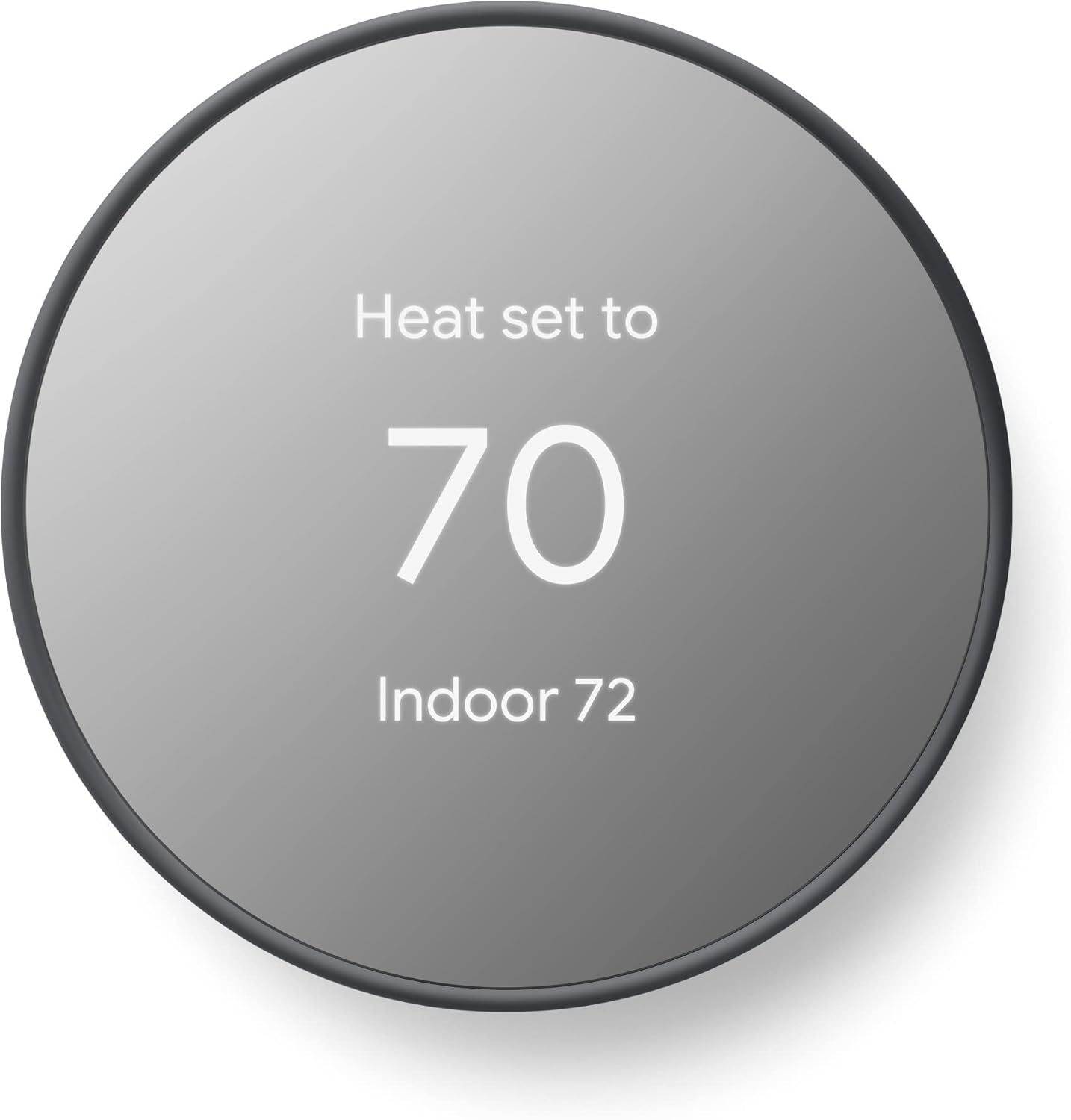
The Google Nest Thermostat is a compact smart thermostat designed to make temperature control simpler and more efficient. It connects to your home Wi‑Fi and pairs with the Google Home app so you can set schedules, change temperature remotely, and use voice commands with compatible assistants. The unit includes features like Savings Finder, which suggests schedule tweaks to reduce energy use, Eco Temperatures that lower heating or cooling when the home is empty, and HVAC monitoring that can alert you to potential system issues. Installation is intended to be DIY-friendly and the thermostat can work without a C wire in many homes, though some systems may require a C wire or power accessory. Practical benefits include easy mobile control, energy-saving automation, and integration into a broader Google smart home setup. Limitations are that advanced features depend on reliable Wi‑Fi and a linked Google account, voice control needs a compatible device, and some HVAC configurations may need extra wiring or professional help.
Best for: Buyers who want an easy-to-use, app-driven smart thermostat that prioritizes energy savings and integrates with a Google-centered smart home.
Less Ideal for: People who need a thermostat that operates fully offline or whose priority is platform-agnostic operation without any dependence on a specific smart home ecosystem.
- Remote control and scheduling via Google Home app for on-the-go adjustments
- Savings Finder and Eco Temperature features help reduce energy use automatically
- Works with voice assistants and Matter-certified devices for hands-free control
- Designed for straightforward DIY installation in many homes
- Some HVAC systems require a C wire or power accessory to function
- Full feature set depends on consistent internet, Wi‑Fi, and a linked Google account
Verdict: Choose the Nest Thermostat if you want a compact, app-first smart thermostat that automates savings and fits smoothly into a Google smart home.
Amazon Smart Thermostat
| Requires C‑wire | Yes |
|---|---|
| Works with | Alexa and Ring |
| Manufacturer technology | Honeywell Home |
| Price starting | $79.99 |
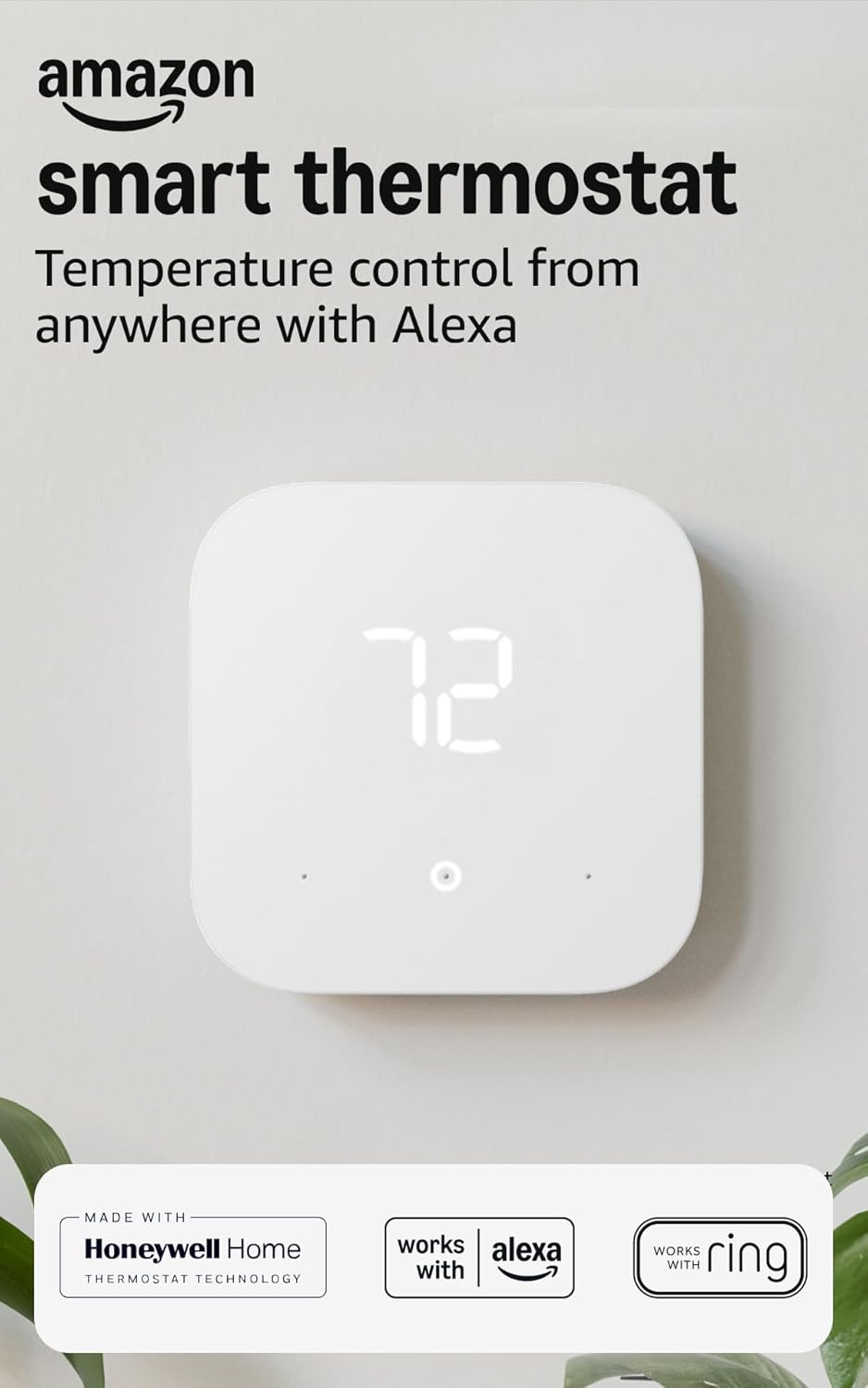
The Amazon Smart Thermostat is a basic smart HVAC controller designed to replace a conventional thermostat and give Alexa-based remote and automated control. It connects to Wi‑Fi and the Alexa app so you can set schedules, change temperatures from your phone, and use presence or compatible Alexa devices to trigger temperature adjustments. The unit uses Honeywell Home thermostat technology, offers guided DIY installation (requires a C‑wire), and includes Alexa+ features for routines and multi-device commands. Its strengths are straightforward setup, clear app control, and energy-saving scheduling that ties into utility rebate information. Limitations include dependency on the Alexa ecosystem for advanced automation and the need for a C‑wire or adapter in some homes, so it is not a zero‑wiring replacement for every older system. For buyers who want a simple, voice-first smart thermostat that prioritizes easy integration with Alexa, this is a practical choice; power users seeking deeper third-party integrations or advanced HVAC diagnostics may need a more feature-rich model.
Best for: Buyers who want a simple, reliable smart thermostat that prioritizes voice control and easy Alexa-based scheduling and remote access without a steep learning curve.
Less Ideal for: Users who need deep third-party integrations, detailed HVAC diagnostics, or a thermostat that works independently of the Alexa ecosystem should consider alternatives.
- Easy Alexa integration for voice control and routines
- Guided DIY installation with app instructions
- Remote control and scheduling via the Alexa app
- Built on Honeywell Home thermostat technology for reliable temperature control
- Requires a C‑wire in many installations or an adapter
- Relies mainly on the Alexa ecosystem for advanced automations
Verdict: A straightforward, Alexa-first smart thermostat that delivers reliable remote control and scheduling for buyers who prefer simple voice-driven automation.
Choosing the Right Automatic Thermostat: Key Factors to Consider
Temperature Accuracy and Sensor Placement
How accurately a thermostat measures room temperature directly affects comfort and energy use. A unit with precise sensors and sensible calibration will avoid overshooting or undershooting setpoints, reducing frequent HVAC cycling and wasted energy.
Sensor placement matters too. If the thermostat is installed near drafts, direct sunlight, or heat-generating appliances it may report misleading readings. Some thermostats support remote or multiple sensors to average temperatures across rooms, which helps maintain consistent comfort in larger or oddly shaped homes.
Automation and Scheduling Flexibility
Automatic features determine how hands-off your heating and cooling can become. Look for thermostats that offer multiple scheduling modes, hold and vacation settings, and learning-based routines if you want the device to adapt to occupant behavior.
Flexible scheduling helps you reduce runtime during predictable away periods while ensuring the house is comfortable when people return. Advanced automation can include geofencing, event-based triggers, and temperature presets for different times of day, which together reduce manual adjustments.
Compatibility With HVAC Systems
Not every thermostat works with every heating and cooling setup. Compatibility depends on system type, number of heat/cool stages, and whether a common power wire is available. Choosing a thermostat that matches your system ensures full feature support and avoids control issues.
Confirming compatibility before purchase can prevent installation headaches. Some thermostats also support common accessories such as humidifiers, dehumidifiers, or zone controls, which is important for homes that rely on those features for indoor comfort.
Smart Home Integration and Remote Access
If you plan to control climate from a phone, voice assistant, or home automation system, confirm the thermostat offers secure remote access and integration with the platforms you use. Native support for common smart ecosystems simplifies setup and enables convenient voice commands or routines.
Consider whether cloud-based features are required, and review privacy or data-sharing settings. Local control options can be beneficial for resilience if internet access is interrupted.
Installation Requirements and Wiring
Installation complexity influences both cost and whether you can do the swap yourself. Some thermostats need a dedicated common wire for power or expect certain terminal labels. If you lack the right wiring, you may need an adapter or professional installation.
Review mounting options, wall compatibility, and whether the thermostat can reuse existing wiring and backplates. Clear wiring diagrams and good documentation reduce installation time and errors.
User Interface and Daily Usability
An intuitive interface makes daily temperature adjustments and schedule tweaks quick and painless. Large, readable displays, physical buttons or responsive touch controls, and straightforward menus reduce frustration for all household members.
Consider how easy it is to change setpoints, view current mode, or temporarily override a schedule. Visual feedback and clear icons are useful features that improve everyday interactions with the thermostat.
Wiring Checks Before You Buy
Before selecting an Automatic Thermostat, inspect the wiring at your current thermostat. Note terminal labels and whether a common power wire is present. Taking a clear photo of the wiring can help when confirming compatibility with a new unit.
If your HVAC system uses multiple stages, heat pump configuration, or additional accessories, document those connections. Some modern thermostats need a constant 24V supply while older mechanical systems may not provide it. Planning ahead avoids surprises at installation time.
- Turn power off at the breaker before removing the existing thermostat.
- Label wires and keep a wiring photo for reference.
- Check for a C-wire or plan for an adapter if the new thermostat requires power.
How Remote Sensors Change Comfort
Remote or room sensors help thermostats read temperature and occupancy in multiple locations. This is especially useful in homes with uneven heating or multi-story layouts where a single wall-mounted thermostat cannot represent the whole living area.
When choosing a thermostat that supports sensors, consider how many you need and where to place them. Sensors that detect motion can also factor occupancy into automatic setback behavior, preventing the thermostat from lowering heat when someone is actually home.
- Use sensors in bedrooms or living rooms rather than hallways.
- Avoid placing sensors near windows or heat sources.
- Combine temperature and occupancy sensors for smarter setbacks.
Balancing Energy Savings and Comfort
Energy-saving features like aggressive setback schedules or learning algorithms can reduce runtime but may cause longer recovery times when restoring comfort. Decide whether you prefer steady temperature control or deeper savings during away periods.
Programmable holds and short-term overrides allow you to prioritize comfort when needed without abandoning long-term savings. Look for thermostats that offer simple temporary overrides rather than forcing schedule edits for short changes.
- Use moderate setbacks for occupied homes with pets or variable schedules.
- Combine setbacks with smart recovery settings to warm up or cool down before occupancy.
- Review historical runtime to understand actual savings versus perceived comfort loss.
Security and Privacy for Connected Thermostats
Connected thermostats exchange data with cloud services for remote control and analytics. Check what data is collected, how it is stored, and whether local control is available if you prefer not to use cloud features.
Secure account setup, two-factor authentication, and the ability to change passwords are important protections. If the thermostat integrates with other home systems, ensure those connections use secure methods and limit unnecessary data sharing.
- Prefer devices that allow local control where possible.
- Enable strong passwords and two-factor authentication when available.
- Review app permissions and linked accounts for minimal data sharing.
Maintaining Your Thermostat for Reliable Operation
Regular maintenance keeps thermostats accurate and responsive. Replace batteries promptly when low warnings appear, clean dust from vents and the unit, and periodically check for firmware updates to maintain feature support.
Verify schedule settings after seasonal changes and confirm sensor placement if you rearrange furniture. Simple upkeep prevents comfort issues and maintains the savings promised by automated controls.
- Check battery levels annually or when prompted by the unit.
- Keep the area around the thermostat free from obstructions.
- Install firmware updates during low-use hours to avoid interruptions.
How We Chose the Best Automatic Thermostat
We focused on criteria that matter for long-term comfort, energy efficiency, and practical installation. Accuracy and sensor performance were prioritized because a thermostat that reads temperature reliably drives real savings and steady comfort. Scheduling flexibility and automation options were included to reflect how users typically program setpoints for weekdays, weekends, and away modes. Compatibility and installation complexity were assessed so buyers can estimate whether they need professional help or a simple DIY swap. Smart integration and remote control capabilities were evaluated for users who want voice control or smartphone access. Build quality and display clarity were considered for daily usability and longevity. We excluded units that require uncommon wiring or proprietary HVAC interfaces that limit broad home use. Also excluded were units lacking essential scheduling or sensor features for automated operation. The resulting shortlist favors thermostats that balance accurate temperature control, reliable automation, reasonable installation demands, and clear user interfaces.
Our full evaluation process is outlined in our review methodology.
FAQ
Do automatic thermostats save energy compared with manual controls?
Often they do, because automated schedules and setbacks reduce runtime during predictable away or sleep periods. Actual savings depend on behavior, system efficiency, and how aggressively schedules are set.
Will I need a C-wire to install an automatic thermostat?
It depends on the model and your HVAC system. Many modern units prefer a constant 24V supply, but some work with adapters or batteries. Check wiring requirements before purchasing.
Can automatic thermostats control multi-stage systems and heat pumps?
Some units support multiple heat and cool stages and specific heat pump configurations. Verify that the thermostat lists support for the number of stages and accessories your system uses.
Are remote sensors necessary for a small house?
Not always. In compact homes where one location represents overall temperature well, the built-in sensor may suffice. Remote sensors become more useful in larger or multi-level homes with temperature variation.
How secure are connected thermostats from unauthorized access?
Security varies. Choosing devices with strong account protections, encrypted communications, and regular firmware updates reduces risk. Disabling unnecessary cloud features and using strong passwords further improves security.
Final Verdict
Prioritize temperature accuracy, compatibility with your HVAC wiring, and the level of automation you want when choosing an Automatic Thermostat. Think about whether you need remote sensors, cloud-based integrations, or simple local control and weigh the tradeoffs between deeper energy savings and recovery time for comfort. Focus on a thermostat that matches your system wiring and provides the scheduling and integration features you will actually use. With the right selection and proper installation, an Automatic Thermostat can simplify daily temperature management and reduce energy waste while keeping your home comfortable.