
Note: This article contains affiliate links. If you click on these links and make a purchase, we may earn a small commission at no extra cost to you. This helps support our research and content. Read our full affiliate disclosure here.
If you are worried about microplastics in your tap water, choosing the right under-sink water filter matters for daily use and long-term health precautions. Under-sink systems offer higher capacity and better filtration stages than simple faucet attachments, so they are a common choice for kitchens where reducing microscopic plastic particles is a priority. This guide covers seven shortlisted under-sink options specifically evaluated for microplastic capture, ease of installation, and real-world flow performance. Read on to understand the tradeoffs between pore size, filter media, and maintenance frequency before selecting the system that fits your home and water habits.
Top Picks at a Glance
| Best Overall The best all-around choice for most situations | Aquasana Claryum 3-Stage AQ-6300 |  |
| Best Quality Built to a higher standard if you want something more solid | APEC Water ROES-50 |  |
| Best Value The sweet spot between price and what you get | Waterdrop WD-15UA Under Sink Filter |  |
| Best Budget The cheapest option that still gets the job done reliably | Dreamwills DS10 Under Sink Filter | 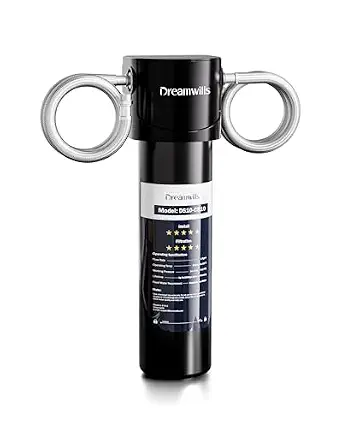 |
| Top Rated A top-rated pick with lots of positive feedback | iSpring CU-A4 Under-Sink Filter |  |
| Most Popular A crowd favorite that many people choose with confidence | Waterdrop WD-10UA Under-Sink Filter | 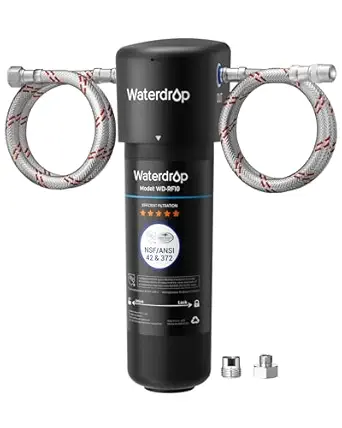 |
| Best Seller A high-volume bestseller chosen again and again | CuZn UC-200 Under Sink Filter |  |
Aquasana Claryum 3-Stage AQ-6300

| Capacity | 600 gallons |
|---|---|
| Maximum Flow Rate | 0.5 gpm |
| Purification Method | Carbon Block, Ultra Filtration |
| Operating Pressure Range | 20 to 80 psi |
| Filter Life Cycle | 6 months |
The Aquasana Claryum 3-Stage AQ-6300 is an under-sink filtration system designed to deliver fast, high-quality drinking water for everyday use. It installs under the counter and includes a dedicated metal faucet, a 5-micron pre-filter plus two Claryum filters that combine activated and catalytic carbon, ion exchange, and sub-micron filtration. That configuration targets lead, PFAS, microplastics, chlorine, chloramines, and many other contaminants while retaining beneficial minerals for better taste. Flow rate is about 0.5 gallons per minute, so it fills bottles and pots quickly compared with pitcher filters. Filters are rated for roughly 600 gallons or six months and twist off for tool-free replacement, and the system is WQA tested and certified to reduce a wide range of contaminants. Expect minimal disposable plastic in the replaceable parts and an included installation kit for DIY setup, but be prepared to allow about 12 inches of vertical space under the sink and to replace cartridges every six months if your household uses a lot of filtered water.
Best for: Buyers who want a balanced under-sink filter that removes microplastics and a broad list of contaminants while keeping reasonable flow and easy DIY installation for everyday kitchen use.
Less Ideal for: Homes that need whole-house filtration, much higher flow for multiple fixtures, or much longer cartridge life between changes should consider other system types.
- WQA tested and certified to reduce a wide list of contaminants including microplastics, lead, and PFAS.
- Three-stage Claryum filtration (pre-filter plus dual carbon/ion-exchange/sub-micron stages) preserves minerals while removing toxins.
- 0.5 gpm flow rate provides faster fill times than pitcher or many countertop filters.
- Includes metal dedicated faucet and full installation kit for under-sink DIY setup.
- Minimal disposable plastic in filter design reduces environmental waste compared with bottled water.
- Filter life is limited to about 600 gallons or six months, requiring semi-annual replacement.
- Flow rate of 0.5 gpm may be slower than whole-house systems for multiple simultaneous uses.
Verdict: A well-rounded under-sink system that reliably removes microplastics and many contaminants while delivering fast, great-tasting water for everyday kitchen use.
APEC Water ROES-50

| Filtration Stages | 5-Stage |
|---|---|
| Daily Output (GPD) | 50 GPD |
| Operating Pressure Range | 40-85 psi |
| Supported Water TDS Level Maximum (PPM) | 2000 |
| Filter Life Cycle | 6 months |
The APEC ROES-50 is a 5-stage under-sink reverse osmosis system built to remove a wide range of contaminants and deliver very low-TDS water for drinking and cooking. It uses large-capacity prefilters, an RO membrane, and a postfilter to reduce chlorine, heavy metals, fluoride, PFAs, and microplastics, and it includes a storage tank and a dedicated faucet for steady delivery. Installation is designed for DIY with quick-connect fittings and color-coded tubing, and routine maintenance involves swapping the filter set roughly every 6 to 24 months depending on your feed water. Practical benefits include consistent, near-bottled quality water at the tap and WQA/NSF-level performance expectations for contaminant rejection. Trade-offs are a footprint under the sink and the need for periodic filter and membrane replacements, plus the system wastes some water during RO rejection and requires sufficient feed pressure and temperature to meet rated output. For buyers focused on high contaminant removal and microplastic reduction, this system delivers reliable, long-term performance when installed and maintained correctly.
Best for: Buyers who prioritize maximum contaminant removal and want near-zero TDS drinking water at the tap for cooking and drinking, and who are willing to install and maintain an under-sink system.
Less Ideal for: People who lack under-sink space, low feed water pressure, or who prefer a no-install countertop option or a zero-waste filtration approach.
- Five-stage RO filtration that targets a broad range of contaminants including PFAs and microplastics
- Rated 50 gallons per day for steady household drinking-water needs
- Includes storage tank and dedicated faucet for consistent flow and convenience
- DIY-friendly quick-connect fittings and color-coded tubing simplify installation and service
- Requires under-sink space and a separate storage tank that may limit cabinet room
- Produces wastewater as part of the RO process and needs adequate feed pressure and temperature
Verdict: If you want robust, certified under-sink filtration that removes PFAs and microplastics and produces near-zero TDS water, the APEC ROES-50 is a reliable choice.
Waterdrop WD-15UA Under Sink Filter
| Purification Method | Activated Carbon |
|---|---|
| Capacity | 19000 gallons |
| Filter Life Cycle | 24 months |
| Maximum Flow Rate | 0.75 gpm |
| Supported Water TDS Level Maximum (PPM) | 700 |
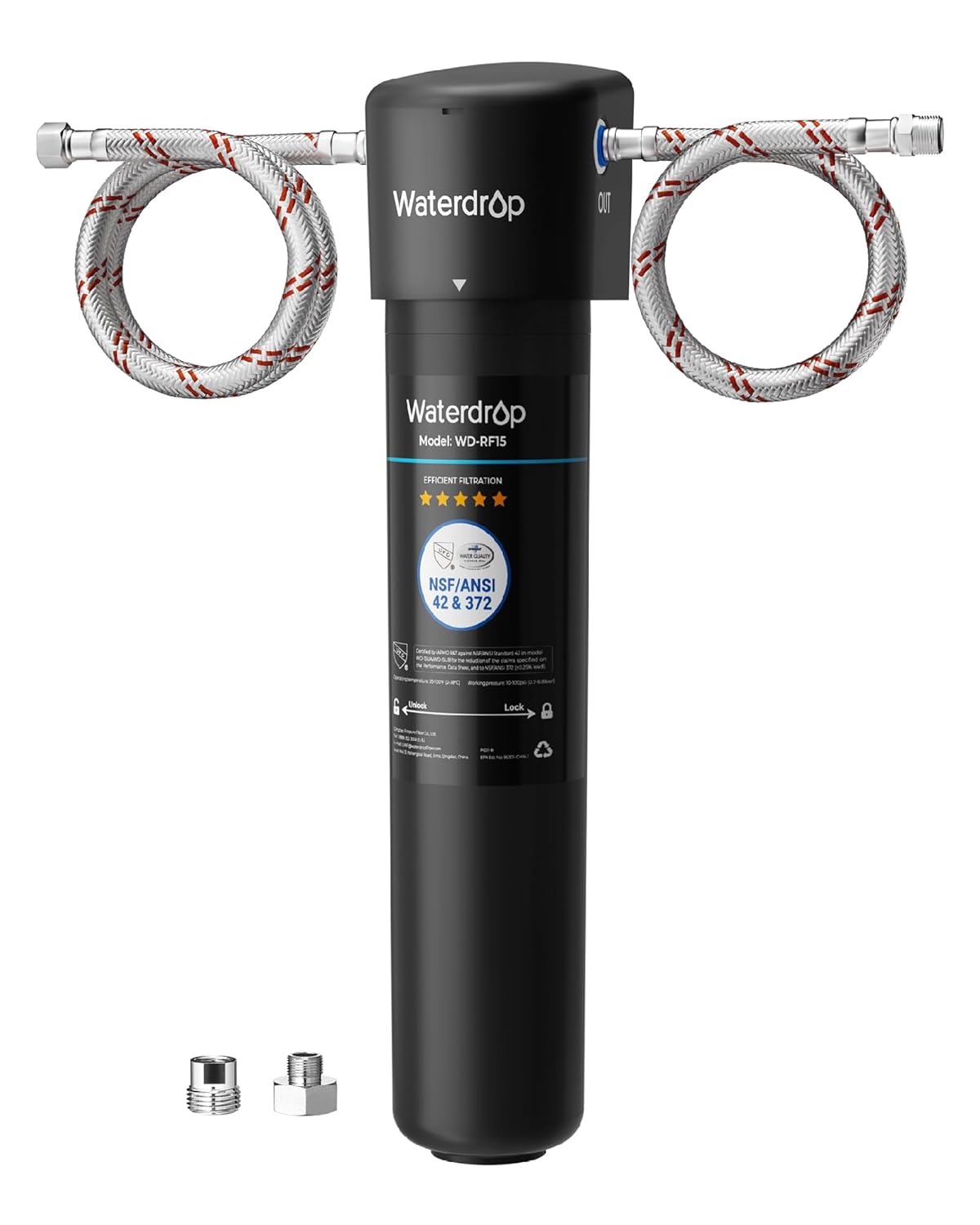
The Waterdrop WD-15UA is an under-sink activated carbon filter designed for direct cold-water connection and long service life. It installs with push-to-connect fittings and includes a 3/8" direct-connect hose plus a 3/8"–1/2" adapter, so most standard kitchen cold-water lines hook up without drilling or a plumber. The unit is optimized for municipal tap water and claims a 24-month or 19,000-gallon life span, using a larger filtration area to cut clogging and extend runtime. Rated to reduce chlorine, bad taste and odor, lead, PFAS/PFOA/PFOS, and other common contaminants, it delivers a steady flow (tested at 0.75 gpm at 60 psi) suitable for drinking, cooking, and ice makers. Because it retains beneficial minerals, it will not dramatically lower TDS readings even when contaminants fall. Limitations: it is intended for cold municipal water only and is not recommended for well water or hot lines, and it does not list a micron rating for microplastic removal specifically, so buyers focused on microplastics should verify third-party test data for that particle size.
Best for: Buyers who want a low-maintenance under-sink filter that minimizes replacement hassle and preserves everyday water flow while cutting common municipal contaminants.
Less Ideal for: People who need certified microplastic filtration to a specific micron size or who treat well water should look for systems with confirmed particulate ratings or appropriate prefiltration.
- Long advertised service life of 24 months or 19,000 gallons reduces replacement frequency
- Push-to-connect fittings and included adapter simplify DIY installation without a plumber
- IAPMO/NSF-related certifications for chlorine and lead reduction support basic contaminant removal claims
- Maintains a steady flow rate (0.75 gpm at 60 psi) suitable for everyday kitchen use
- Designed for municipal cold water only and not intended for well water or hot water use
- No explicit micron rating for microplastic capture listed in the product details
Verdict: Choose the WD-15UA if you want a long-life, easy-to-install under-sink filter that reliably reduces lead, chlorine, PFAS and improves taste while keeping steady kitchen flow.
Dreamwills DS10 Under Sink Filter

| Maximum Flow Rate | 1.3 gpm |
|---|---|
| Purification Method | Carbon Block |
| Supported Water TDS Level Maximum (PPM) | 600 |
| Filter Life Cycle | 2 years |
| Capacity | 8000 gallons |
The Dreamwills DS10 is an under-sink carbon block filter that installs without tools and is sized for kitchen faucet use. It uses a coconut shell carbon block tested to NSF/ANSI 42 for chlorine and taste reduction, and the manufacturer calibrated the unit for a 1.3 gpm flow so water fills a glass quickly while spending enough time in contact with the media for aesthetic contaminant reduction. The system is intended for cold water only, fits in tight cabinets, and includes the fittings and tape for a straightforward hose connection. Dreamwills sets the replacement interval at one year or about 8,000 gallons to prioritize fresh carbon performance rather than longest possible life. That shorter, sanitary service cycle plus the tool-free swap makes maintenance simple, but the filter is focused on chlorine, taste, and odors rather than certified removal of microplastics or dissolved solids, so buyers seeking specific microplastic reduction should confirm media ratings. Good for households that want an inexpensive, easy-to-install under-sink carbon filter that improves flavor and odor with predictable annual replacement.
Best for: Buyers on a budget who want an easy, low-effort under-sink filter to improve tap taste and odor with simple annual replacements.
Less Ideal for: Homes that require verified microplastic or broad-spectrum contaminant removal should consider specialty filters with specific certifications or multi-stage systems.
- Tool-free installation with included fittings for quick DIY setup
- Hydraulically calibrated 1.3 gpm flow balances speed and contact time
- Uses natural coconut shell carbon for reliable chlorine and taste reduction
- Compact design fits in crowded under-sink cabinets
- Rated and tested mainly for chlorine and aesthetic contaminants, not explicitly certified for microplastic removal
- One-year / 8,000-gallon lifespan is shorter than some long-life cartridges
Verdict: A budget-friendly, compact under-sink carbon filter that delivers easy tool-free installation and consistent taste and odor improvement with annual cartridge swaps.
iSpring CU-A4 Under-Sink Filter

| Purification Method | Mechanical Filtration, Chemical Absorption, Redox, and Ultrafiltration |
|---|---|
| Filter Life Cycle | 6 months |
| Capacity | 8000 gallons |
| Installation Type | Under Sink |
The iSpring CU-A4 is a tankless under-sink filtration system built around a 0.01 micron ultrafiltration membrane paired with sediment, KDF/GAC, and activated carbon polishing stages. It installs under a sink and supplies filtered water directly through the included brushed nickel faucet, with push-to-connect fittings and twist-on/twist-off cartridges intended to simplify replacement. Because it is ultrafiltration rather than reverse osmosis, it removes very small particles including bacteria and many particulates while retaining dissolved minerals and producing no wastewater or storage-tank concerns. The KDF/GAC stage helps control chlorine, chloramine, and some heavy metals, and the carbon final stage improves taste and odor. Filter life is listed at roughly 6 to 12 months depending on water quality, and the system is rated for about 8,000 gallons capacity. Limitations include that it does not lower TDS like RO systems and replacement filters are required on a regular schedule, so long-term maintenance costs and periodic cartridge swaps should be expected.
Best for: Buyers who prioritize dependable, low-maintenance filtration for drinking water and want a system that removes very small particulates and microbes without using electricity or producing wastewater.
Less Ideal for: Users who need major TDS reduction or mineral removal for specific appliances or who prefer a system that stores filtered water under pressure for high-flow simultaneous use.
- Ultrafiltration membrane with 0.01μm pores captures ultra-fine particles and many microorganisms
- Multi-stage design (sediment, KDF/GAC, carbon) targets chlorine, heavy metals, odors, and particulates
- Tankless operation produces no wastewater and avoids storage-tank maintenance
- Push-to-connect fittings and twist-on cartridges simplify installation and filter changes
- Does not reduce total dissolved solids (TDS) like reverse osmosis systems
- Filters require replacement every 6–12 months, adding ongoing maintenance cost
Verdict: Choose the CU-A4 if you want reliable, tankless ultrafiltration that captures ultra-fine particles and improves taste without wastewater or electricity.
Waterdrop WD-10UA Under-Sink Filter

| Purification Method | Activated Carbon |
|---|---|
| Maximum Flow Rate | 2.5 gpm |
| Filter Life Cycle | 1 years |
| Supported Water TDS Level Maximum (PPM) | 700 |
| Capacity | 11000 gallons |
The Waterdrop WD-10UA is a compact under-sink filter that installs directly on standard 3/8" or 1/2" cold-water lines and uses an activated carbon cartridge to remove chlorine, lead, PFAS/PFOA/PFOS and common taste and odor contaminants. It is intended for municipal tap water and fits tight spaces under a sink or in an RV; the twist-and-lock housing plus push-to-connect fittings make installation fast and tool-light for most homeowners. The filter is rated for roughly 11,000 gallons or about 12 months of typical household use and supports a tested flow of up to 1.33 gpm from the 3/8" outlet. Because it is an activated carbon system, it excels at chemical and organics reduction and improving flavor, but it does not claim sub-micron mechanical filtration like 0.01 micron UF models that capture bacteria or most microplastics. Practical benefits include easy cartridge swaps, compact footprint, and NSF/ANSI 42 and 372 component approvals for material safety. Important limitations are the cold-water only restriction and the fact that its primary reduction mechanism is adsorption rather than fine mechanical sieving, so it may not remove the smallest microplastic particles or microbiological contaminants.
Best for: Buyers who prioritize verified contaminant reduction for municipal tap water and want a compact, easy-to-install under-sink system with strong user reviews and safety certifications.
Less Ideal for: Homes that need microbiological protection, very fine particle or microplastic removal at sub-micron scale, or systems for well water and hot-water lines should consider different filter types.
- Compact single-canister design fits small under-sink spaces and RVs.
- Fast, tool-light installation with twist-and-lock and push-to-connect fittings.
- NSF/ANSI 42 and 372 approved components for material safety and taste/odor reduction.
- Long rated life of about 11,000 gallons or up to 12 months under municipal water conditions.
- Activated carbon focus means it does not provide ultra-fine mechanical filtration for sub-micron particles or bacteria.
- Cold-water only use; not suitable for well water or hot-water lines.
Verdict: For municipal-tap households wanting a compact, NSF‑verified under-sink filter that improves taste and reduces chemical contaminants, the WD-10UA is an easy, proven choice.
CuZn UC-200 Under Sink Filter

| Model Number | UC-200 |
|---|---|
| Included Components | Stainless Steel Connection Hose |
| Material Type | NSF Approved Material Components |
The CuZn UC-200 is an inline under-sink filter built for low-maintenance household use and long service life. It uses a three-stage combination of micro sediment membrane, KDF-55 media, and coconut shell carbon to reduce chlorine, lead, PFAS/PFOS, microplastics and other common tap-water contaminants while leaving healthy minerals intact. Installation is straightforward: the unit connects to a cold water feed with the included stainless steel hose and does not require drilling, so most DIYers can fit it under a kitchen or bathroom sink in minutes. Its standout practical benefit is endurance — rated for up to 50,000 gallons or about five years depending on water quality — which cuts replacement frequency and plastic waste compared with short-life cartridges. Limitations include no reduction of dissolved solids (TDS), so it is not a substitute for a reverse osmosis system when you need hardness or TDS removal, and treated flow rate can be slower than a direct faucet feed depending on plumbing. For buyers who prioritize simple, long-lasting filtration of chlorine, lead and microplastics, the UC-200 is a low-hassle option.
Best for: Risk-averse buyers who want dependable, low-maintenance reduction of chlorine, lead and microplastics without removing beneficial minerals and who prefer a longer-lasting cartridge to minimize replacements.
Less Ideal for: Homes that require removal of dissolved solids, heavy mineral hardness, or where users specifically need RO-level purification for laboratory or medical uses.
- Long rated filter life up to 50,000 gallons or 5 years, reducing replacement frequency
- 3-stage filtration (micro sediment membrane, KDF-55, coconut shell carbon) targets chlorine, lead, PFAS and microplastics
- Simple inline installation with included stainless steel connection hose and no drilling required
- Does not reduce total dissolved solids (TDS) or replace a reverse osmosis system
- Flow rate may be lower than unfiltered faucet water depending on household plumbing
Verdict: Choose the UC-200 if you want a low-maintenance under-sink filter that reliably reduces chlorine, lead and microplastics for years between replacements.
Choosing the Right Under-Sink Water Filter for Microplastics: Key Factors to Consider
Micron Rating and Filtration Media
Micron rating determines the smallest particle size a filter can reliably remove. To capture microplastics, look for pre-filters or sediment stages rated at one micron or smaller, and consider depth filtration media that traps particles throughout the element rather than just on the surface.
Media composition matters because some materials combine physical sieving with adsorption or electrostatic attraction. A multi-stage approach that pairs a fine sediment filter with a carbon or specialty post-filter helps address both particles and any taste or odor issues that can accompany sediment removal.
Flow Rate and Household Demand
Under-sink systems must supply enough water for cooking, rinsing, and filling pitchers without causing long waits. Flow rate, usually measured in gallons per minute, is affected by filter pore size and the number of parallel filtration paths. Smaller micron ratings often reduce flow, so choose a system whose rated output matches your typical kitchen usage.
Consider peak demand moments. If you frequently run the dishwasher or fill large pots at the same time as needing filtered water, a system with higher flow capacity or a dedicated storage tank will reduce interruptions and user frustration.
Filter Life and Replacement Frequency
Filter longevity affects both convenience and total cost of ownership. Fine-pore sediment filters trap more microplastics but may clog faster in water with heavy particulate loads. Check manufacturer-stated life in gallons and typical months of use, then compare that to your household consumption.
Also evaluate replacement complexity and whether replacement elements are readily available. Frequent or difficult replacements can create lapses in protection if homeowners delay maintenance.
Installation Requirements and Plumbing Compatibility
Under-sink systems vary from simple single-valve installs to multi-component assemblies requiring drill holes or additional fittings. Confirm compatibility with your existing cold-water supply line, under-sink space constraints, and whether you need extra hardware such as mounting brackets or a dedicated faucet hole.
Homes with narrow cabinets, garbage disposals, or complex shutoff valves may need a more compact or flexible solution. Ease of installation reduces the need for professional plumbing, lowering initial setup time and cost.
Certifications and Test Data
Certifications from recognized third-party labs provide independent validation of particulate reduction claims. Look for particulate or micron-specific test results and any certifications relevant to sediment or microplastic reduction. While not every system will have a specific microplastic certification, documented performance against small particulate sizes is a useful proxy.
Independent lab data or third-party test reports help verify manufacturer claims and give you greater confidence in expected field performance.
Maintenance Accessibility and User Experience
How easy it is to change filters affects whether maintenance actually happens on schedule. Systems with tool-free housings or twist-off cartridges significantly reduce the time and effort required. Also consider how clearly the system indicates when a change is needed, whether via pressure gauges or drop-off in flow.
Good documentation and widely available replacement parts make ongoing ownership less frustrating. Consider how spare filters are packaged and whether the system allows partial changes if only one stage is exhausted.
How Microplastics Are Captured Under Sink
Microplastics are solid particles that must be stopped by physical filtration. Under-sink systems capture them using a combination of graded sediment stages and fine absolute or nominal micron-rated elements. Filtration works either by sieving particles at the surface or by trapping them throughout a depth media.
In practice, a coarse pre-filter extends the life of the fine element by removing larger debris, while a dedicated submicron sediment stage handles the smallest fragments. Follow-up carbon or polishing stages do not remove particles as effectively but improve taste and odor after particulate removal.
- Pre-filter reduces load on fine stage
- Fine sediment stage captures submillimeter particles
- Polishing stages address taste and residual contaminants
Installing an Under-Sink System: Practical Tips
Before installation, measure cabinet space and note the location of existing shutoff valves. Turn off the cold-water supply and relieve line pressure by opening a faucet. Choose a mounting location that leaves room for filter removal and replacement.
Use the correct fittings and follow torque recommendations to prevent leaks. If the system includes a dedicated faucet, plan the hole location or verify an available knockout. When in doubt, consult a plumber for tasks that require modifying supply lines.
- Leave at least 6 inches clearance below filters for cartridge removal
- Label shutoffs and document plumbing connections for future maintenance
Balancing Filtration Fineness and Usable Flow
The tradeoff between filtration fineness and usable flow is central to selecting an under-sink solution. Extremely low micron ratings increase particle capture but can substantially reduce flow and increase pressure drop. Systems with parallel filtration paths or larger housings can mitigate flow losses without sacrificing particle removal.
If steady kitchen flow is critical, look for systems that publish both micron ratings and flow rates under realistic pressure conditions to understand how they will perform in your home.
- Check flow at rated household pressure
- Consider a small storage tank for consistent immediate delivery
Maintaining Peak Performance
Regular element changes and periodic flushing keep performance consistent. Replace filters according to the manufacturer's life recommendations or sooner if you notice reduced flow. For sediment-prone supplies, add a visible pre-sediment stage to make clogging obvious before it affects downstream elements.
Sanitize housings when you change cartridges if the system design allows. Keep spare cartridges on hand if lead times or sourcing are unpredictable.
- Monitor flow and taste as simple performance indicators
- Record replacement dates to maintain schedule
When to Consider a Dedicated Storage or Booster
Homes with low incoming pressure or heavy simultaneous demand benefit from a small pressurized storage tank paired with the under-sink filter. Tanks provide immediate filtered water at faucet draw without waiting for the filter throughput to catch up.
A booster pump can restore flow but adds complexity and a power dependency. Choose tanks or pumps only when necessary, and evaluate their maintenance implications alongside the basic filter system.
- Storage tanks reduce wait time for pitchers and large volumes
- Pumps increase complexity but can solve low-pressure issues
How We Chose the Best Under-Sink Water Filter for Microplastics
We focused on features that directly affect microplastic removal and everyday usability. Core evaluation criteria included filter micron rating and media type, because smaller pore sizes and depth filtration are the primary mechanisms for capturing microplastic particles. We assessed certified particulate reduction claims and independent test data where available to gauge likely effectiveness. Flow rate and pressure drop were measured or reported to ensure selected systems can supply kitchen demand without excessive throttling. Filter life expectancy and element replacement cost were included to reflect ongoing maintenance burden. Installation complexity and available fittings were considered because under-sink accessibility varies widely between homes. We excluded systems that rely solely on carbon block polishing without a rated particulate barrier or those intended only for whole-house installations. The result is a list of products that balance demonstrable microplastic capture capability with practical plumbing compatibility and manageable upkeep.
Our full evaluation process is outlined in our review methodology.
FAQ
What micron rating should I look for to remove microplastics?
Aim for filters rated at one micron or smaller for the best chance to capture most microplastic fragments. Also consider depth-filtration media because absolute micron ratings behave differently depending on media design.
Will a carbon filter remove microplastics on its own?
Carbon filters primarily address taste, odor, and chemical contaminants and are not designed to reliably remove fine microplastic particles. Pairing carbon with a dedicated sediment or submicron stage is necessary for particle removal.
How often will I need to change the filters?
Replacement frequency depends on household water usage and incoming particulate load but typically ranges from three to twelve months. Heavy sediment conditions shorten life, while pre-filters and larger housings can extend the interval.
Can I install an under-sink filter for microplastics myself?
Many systems are designed for DIY installation using standard fittings and tool-free cartridges, but some require drilling or modifying supply lines. Assess your comfort with basic plumbing and consider professional help if the installation looks complex.
Does removing microplastics affect water taste?
Particle removal can improve perceived clarity and sometimes reduce gritty mouthfeel, but taste changes are most often addressed by carbon or polishing stages. A system that combines particulate removal with a finishing filter gives the most complete sensory improvement.
Final Verdict
Prioritize a system that provides a documented fine-particle stage and a flow rating that matches your kitchen habits. Expect tradeoffs between micron fineness and flow, and factor in replacement frequency and installation needs when choosing. By focusing on micron rating, realistic flow performance, and maintenance simplicity, you can select an under-sink water filter for microplastics that delivers consistent, usable filtered water.