
Note: This article contains affiliate links. If you click on these links and make a purchase, we may earn a small commission at no extra cost to you. This helps support our research and content. Read our full affiliate disclosure here.
If you are concerned about arsenic in your household water, choosing the right water filter can make a real difference for health and daily use. Water filters targeted at arsenic removal vary in how effectively they lower contaminant levels, how much treated water they produce each day, and how much maintenance they require. This guide lists seven shortlisted water filters for arsenic that represent the strongest options in this category. We evaluated each option for contaminant removal performance, flow and capacity, installation needs, and maintenance demands to help you pick the system that fits your home and usage habits. Read on for the factors that matter and the practical pros and cons of different system types.
Top Picks at a Glance
| Best Overall The best all-around choice for most situations | Waterdrop G3P600 Tankless RO System |  |
| Best Quality Built to a higher standard if you want something more solid | Clearly Filtered Water Pitcher P-V3 |  |
| Best Value The sweet spot between price and what you get | iSpring RCC7-BN 5-Stage RO |  |
| Best Budget The cheapest option that still gets the job done reliably | Culligan ZeroWater 10-Cup Pitcher |  |
| Top Rated A top-rated pick with lots of positive feedback | iSpring WGB21B-CPB Whole House Filter |  |
| Most Popular A crowd favorite that many people choose with confidence | BRITA Large Water Filter Pitcher |  |
| Best Seller A high-volume bestseller chosen again and again | GE XWFE Refrigerator Water Filter |  |
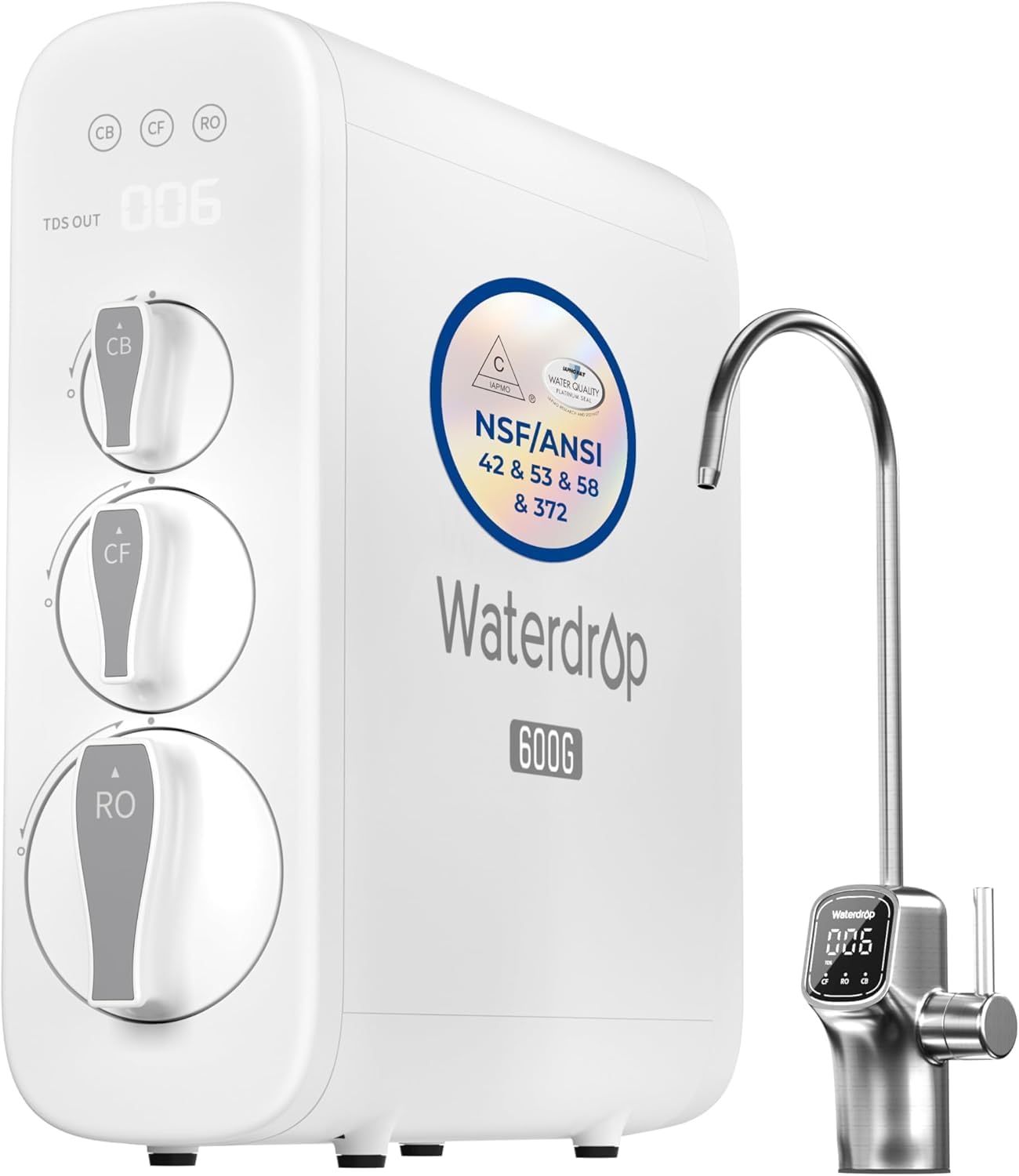
Waterdrop G3P600 Tankless RO System
| Filtration stages | 8-stage Filtration |
|---|---|
| Flow rate | 600 GPD |
| Pure to drain ratio | 2:1 |
| Maximum flow rate (faucet) | 0.42 gpm |
| Installation type | Under Sink |
The Waterdrop G3P600 is a tankless under-sink reverse osmosis system built to remove a wide range of contaminants, including heavy metals such as arsenic, using an 8-stage filtration train and an RO membrane. It installs under the sink and requires a power connection to run its electronics and automatic flushing. The tankless design saves under-sink space and produces water quickly — the manufacturer rates an 8 oz cup in about 8 seconds — while a low 2:1 pure-to-drain ratio reduces wastewater compared with many RO units. The included smart faucet shows TDS and filter life so you can monitor water quality and replacement timing at a glance. Filters are user-replaceable with a twist motion for fast service. Important limitations are the need for an electrical outlet under the sink and the requirement to confirm cabinet clearance for the unit dimensions; as a high-capacity RO it also produces some wastewater and periodic filter/membrane changes are required to maintain performance.
Best for: Buyers who want a high-capacity, certified RO system that actively reduces arsenic and other heavy metals while offering fast dispensing and a built-in quality monitor.
Less Ideal for: Households without a convenient under-sink electrical outlet or very small cabinets that cannot accommodate the unit should consider alternatives.
- Certified to NSF/ANSI 58 and 42 for TDS reduction and chlorine/taste removal
- 8-stage filtration and RO membrane target heavy metals including arsenic and PFAS
- High rated output up to 600 gallons per day for fast dispensing
- Smart faucet with TDS monitor and filter life display for easy water-quality checks
- Tankless design saves under-sink space and allows quick filter swaps
- Requires under-sink electricity which may limit installation locations
- 2:1 pure-to-drain is low for RO but still generates wastewater
- Unit dimensions should be checked; it may not fit very small cabinets
Verdict: Choose the G3P600 if you want a certified, high-capacity tankless RO that specifically targets arsenic and other heavy contaminants while giving quick, monitored dispensing.
Clearly Filtered Water Pitcher P-V3

| Purification Method | Affinity Filtration |
|---|---|
| Capacity | 80 fluid ounces |
| Filter Life Cycle | 100 gallons (about 4 months) |
| Supported Water TDS Level Maximum (PPM) | 500 |
| Material Type | Medical-Grade Tritan |
The Clearly Filtered Water Pitcher P-V3 is a family-sized countertop pitcher that filters tap water using the brand's Affinity Filtration technology and a replaceable cartridge. You fill the 80 fl oz reservoir through the hinged lid and filtered water collects in the pitcher for pouring; the filter is rated for about 100 gallons or roughly 3–4 months of typical household use. Notable features include medical-grade Tritan construction, an ergonomic handle and spill-resistant dam for easy pouring, and independent lab testing plus NSF certification for chlorine taste and lead-free materials. Practically, the pitcher is meant for people worried about drinking-water contaminants: it targets hundreds of substances including fluoride, arsenic, PFAS, microplastics and heavy metals while leaving beneficial minerals intact. Limitations to expect are the manual fill workflow and the slower flow rate that can occur with high-contaminant or aging filters, and replacement cartridges are required every few months to maintain peak performance.
Best for: Buyers who prioritize contaminant removal and certified performance for drinking water, especially those concerned about arsenic and other heavy metals, and who want a simple countertop solution for family use.
Less Ideal for: People who need a hands-off, plumbed-in system or very high flow rates for large households should consider whole-home or under-sink filtration instead.
- Targets a very broad list of contaminants including arsenic, fluoride, lead and PFAS according to independent testing
- Long filter life rated at about 100 gallons, approximately 3–4 months for average household use
- Made from medical-grade Tritan material that is BPA/BPS-free and designed not to leach
- 80 fl oz capacity reduces refill frequency for families and fits standard refrigerator shelves
- Manual fill design and cartridge flow rate can be slow with heavily contaminated water or near end of filter life
- Replacement filters are required every few months which adds ongoing cost
Verdict: Choose this pitcher if you want a countertop filter that is independently tested and designed to remove arsenic and a very wide range of contaminants while preserving beneficial minerals.
iSpring RCC7-BN 5-Stage RO

| Purification Method | Reverse Osmosis, Activated Carbon, Carbon block |
|---|---|
| Capacity | 75 gallons |
| Maximum Flow Rate | 3.4 liters per minute |
| Supported Water TDS Level Maximum (PPM) | 750 |
| Power Source | No Power Needed |
The iSpring RCC7-BN is a 5-stage under-sink reverse osmosis system designed to deliver bottled-quality drinking water at the tap. It combines three prefilters (sediment, GAC, carbon block), a high-rejection RO membrane and a final polishing GAC filter to remove sediments, chlorine, PFAS, heavy metals and many dissolved solids down to 0.0001 microns. Installation is intended for municipal tap water and uses push-to-connect fittings, a top-mounted designer faucet and a storage tank so you have on-demand purified water without electricity. The clear first-stage housing makes visual checks simple and the system is NSF/ANSI 58 certified, which supports its contaminant-removal claims including high arsenic reduction. Maintenance requires periodic filter and membrane replacement and the system is not recommended for untreated well water without prefiltration. The unit is compact enough for most kitchen cabinets but does include a separate tank that needs space under the sink.
Best for: Buyers who prioritize proven contaminant removal and want a reliable under-sink system to reduce arsenic and other dissolved contaminants from municipal tap water while keeping maintenance manageable.
Less Ideal for: Homes sourcing water from untreated wells or users seeking a zero-maintenance countertop pitcher-style purifier should consider other solutions.
- Five-stage filtration including RO membrane for very small-particle and dissolved contaminant removal
- NSF/ANSI 58 certification supports performance claims for drinking water safety
- Transparent first-stage housing allows quick visual inspection of sediment filter
- Includes storage tank and lead-free designer faucet for convenient access at the sink
- Push-to-connect fittings and online install resources make DIY installation feasible
- Not designed for untreated well water without additional prefiltration
- Requires regular filter and membrane replacements to maintain performance
- Separate storage tank requires dedicated under-sink space
Verdict: Choose the iSpring RCC7-BN if you need a certified, high-capacity under-sink RO system that effectively reduces arsenic and other dissolved contaminants for municipal tap water.
Culligan ZeroWater 10-Cup Pitcher

| Purification Method | Activated Carbon, Ion Exchange |
|---|---|
| Power Source | Manual |
| Maximum Flow Rate | 0.18 liters per minute |
| Capacity | 80 fluid ounces |
The Culligan ZeroWater 10-Cup Pitcher is a countertop pour-through pitcher that uses a 5-stage filtration cartridge combining activated carbon and ion exchange to reduce dissolved solids and common contaminants. It is typically used to make drinking and cooking water taste cleaner and to lower contaminants such as lead, chlorine, mercury and Total PFAS; the included TDS meter shows dissolved solids levels and helps you know when the filter needs changing. The pitcher holds about 80 fluid ounces and is designed to fit in small refrigerators or sit on a counter, with a pour spout and ergonomic handle for everyday use. Practical benefits include certified reduction of total PFAS and a filter that aims to remove far more contaminants than standard single-stage cartridges. Limitations are the manual refill process and a modest flow rate of 0.18 liters per minute, so filling can be slower than simpler pitchers, and filters will need periodic replacement to maintain performance.
Best for: Buyers wanting an affordable countertop pitcher that prioritizes measurable contaminant reduction and clear drinking water for everyday use.
Less Ideal for: People who need instant large-volume filtration for gatherings or want a hands-off, plumbed-in whole-house solution should look at larger or plumbed systems instead.
- 5-stage filtration certified to reduce Total PFAS and lead
- Built-in TDS meter provides instant feedback on dissolved solids
- 80 fl oz capacity suitable for small households and fridge storage
- Compact pour-through design with ergonomic handle for easy daily use
- Slow maximum flow rate means refilling takes time
- Requires periodic filter replacements to retain contaminant removal performance
Verdict: Choose this pitcher if you want a budget-friendly countertop filter with certified PFAS and lead reduction plus a TDS meter to verify water quality.
iSpring WGB21B-CPB Whole House Filter

| Capacity | 50000 gallons |
|---|---|
| Purification Method | Carbon Block, Sedimentation |
| Inlet / Outlet | 1 inch Female NPT |
| Supported Water TDS Level Maximum (PPM) | 300 |
| Operating Temperature | 40-100 ºF |
The iSpring WGB21B-CPB is a two-stage point-of-entry system designed to improve whole-house water quality by removing sediment, chlorine and heavy metals such as lead and cadmium. It pairs a 5-micron polypropylene sediment stage with an FC15B-PB carbon/lead-reduction cartridge rated for up to 50,000 gallons, and ships preassembled on a mounting bracket to simplify DIY installation. Typical use is at the main water inlet to protect plumbing, appliances and faucets rather than to lower TDS or perform reverse osmosis. The system accepts 1" inlet/outlet connections and operates across common household pressures and temperatures, and includes a wrench and pressure-relief valve to make filter changes easier. Strengths are its high-capacity lead-reduction cartridge and heavy-duty housings built for long service life, but it will not reduce dissolved solids so homes needing TDS reduction will still need an RO stage. Expect occasional filter replacements and the usual maintenance for any POE setup, and consider a pressure regulator if your supply pressure is high to extend housing life.
Best for: Buyers who prioritize dependable, long-life whole-house protection against sediment, chlorine and heavy metals and want a system they can install themselves or with minimal pro help.
Less Ideal for: Homes that need to significantly lower TDS or produce bottled-water-level purity should look to an RO-based system instead.
- Dedicated lead-reduction carbon block cartridge rated up to 50,000 gallons
- Preassembled mounting bracket and included wrench speed up DIY installation
- 1" inlet/outlet and 15 GPM flow capability keep pressure loss low for whole-house use
- Heavy-duty housings and materials designed for long service life
- Includes pressure-relief valve and clear maintenance guidance
- Does not reduce total dissolved solids so it is not a substitute for reverse osmosis
- Installation near main shutoff may require basic plumbing skills or a plumber for best results
Verdict: Choose this system if you want a reliable, high-capacity whole-house filter focused on reducing sediments, chlorine and heavy metals like lead.
BRITA Large Water Filter Pitcher

| Capacity | 10 cups |
|---|---|
| Purification Method | Granular Activated Carbon |
| Filter Life Cycle | 2 months / 40 gallons |
| Power Source | Manual |
The BRITA Large Water Filter Pitcher is a simple countertop pitcher that reduces chlorine taste and select heavy metals using a granular activated carbon filter with ion exchange resin. You fill the flip-top lid reservoir and filtered water collects in the 10-cup carafe for easy pouring and fridge storage. The included filter is certified to reduce chlorine, copper, cadmium and mercury and is designed for household use where improving taste and removing common contaminants is the priority. Setup and filter replacement are straightforward and the pitcher is freestanding and fridge-friendly for everyday use. Important limitations for this article topic: the pitcher and its standard filter are not designed or certified to remove arsenic, and Brita notes the system is not intended for microbiologically unsafe water, so it is best for treated municipal tap water where taste and certain metals are the concern. For buyers wanting an easy, well-supported option to improve flavor and cut several impurities, this delivers a low-effort solution, but it should not be relied on for arsenic removal.
Best for: Buyers who prioritize proven, widely used taste improvement and reduction of common metals in treated tap water and who value an easy, low-maintenance pitcher-based solution supported by plenty of user feedback.
Less Ideal for: Households dealing with elevated arsenic levels, untreated well water, or anyone needing certified arsenic removal should choose a treatment system specifically rated for arsenic reduction instead.
- 10-cup capacity fits in most refrigerator shelves and fills multiple bottles at once
- Filter certified to reduce chlorine taste and odors plus mercury, copper and cadmium
- Easy-fill flip-top lid and simple filter replacement process
- BPA-free plastic construction and widely available replacement filters
- Not designed or certified to remove arsenic or to make microbiologically unsafe water safe
Verdict: This pitcher is a reliable, easy-to-use choice for improving taste and reducing common metals in treated tap water but it is not a solution for arsenic removal.
GE XWFE Refrigerator Water Filter

| Model Number | XWFE |
|---|---|
| Compatible Refrigerator Models | GE GNE27JGMWW |
| External Testing Certification | NSF 42, NSF 53, NSF 401 |
| Unit Count | 1 Count |
| Included Components | Water Filter |
The GE XWFE is a factory replacement refrigerator water filter designed to drop into compatible GE French-door and side-by-side models without tools or turning off the water. It is certified to NSF 42, 53, and 401, which means it targets aesthetic issues like chlorine taste and odor plus health-related contaminants such as lead and certain pharmaceuticals, and it lists reductions for more than 50 impurities. Install and replacement are straightforward — the maker recommends changing the cartridge every six months or after about 170 gallons — so maintenance is predictable for households wanting steady performance. The filter's certification and GE branding reduce the risk of poor fit or broken seals that can occur with generic cartridges, but buyers should confirm compatibility with their exact refrigerator model. If your primary concern is arsenic specifically, the listing highlights many contaminants but does not call out arsenic reduction as a primary spec, so check local water test results or supplemental treatment if arsenic is present above guideline levels.
Best for: Buyers who prioritize certified, factory-quality filtration and low-risk, easy maintenance for everyday drinking water in GE refrigerators.
Less Ideal for: Homes with documented arsenic in the water source that need a targeted arsenic removal system should consider specialized point-of-use or whole-house treatments instead.
- NSF 42/53/401 certified for aesthetic and health-related contaminants
- Factory replacement from GE for reliable fit in supported GE refrigerators
- Reduces lead, chlorine, select pharmaceuticals and 50+ listed impurities
- Tool-free installation and a clear six-month replacement interval
- Product description does not specifically guarantee arsenic removal
- Compatibility limited to refrigerators that accept XWFE/XWF style cartridges
Verdict: Choose the GE XWFE if you want a certified, factory replacement filter that fits supported GE refrigerators and simplifies maintenance with predictable six-month service intervals.
Choosing the Right Water Filter for Arsenic: Key Factors to Consider
Arsenic Removal Method
Different technologies remove arsenic by different mechanisms, and the method you choose affects performance and operating requirements. Reverse osmosis and iron-based adsorption media are among the most common approaches for point-of-use removal; each has distinct removal efficiencies at various arsenic species and water chemistries.
Knowing the method matters because some treatments are sensitive to pH, competing ions, or require prefiltration to prevent rapid fouling. If your source water has high iron, manganese, or sediment, you may need staged treatment to preserve arsenic media life and maintain consistent performance.
System Type and Coverage
Decide whether you need a point-of-use filter for a single tap or a point-of-entry system that treats all water entering the home. Under-sink or countertop filters are common when arsenic concern is limited to drinking and cooking water. Whole-house systems make sense when you want treated water for showers and laundry as well, but they typically cost more and require larger media vessels.
System type affects installation complexity and ongoing operating costs. Whole-house systems require larger media volumes and may need professional installation and occasional backwashing, while under-sink systems tend to be simpler to install and maintain but only treat one fixture.
Flow Rate and Daily Capacity
A filter can remove arsenic effectively but still be a poor match if it cannot supply enough treated water when you need it. Check rated flow in gallons per minute for tap-mounted and under-sink systems, and daily throughput or residence time for larger adsorptive media systems. Household size and peak demand patterns determine the capacity you need.
Low-flow point-of-use units may be fine for an individual or small household but will struggle in a busy kitchen. Systems with higher flow capacity often use larger filters or multiple stages to keep contact time sufficient for arsenic removal without restricting water delivery.
Maintenance and Replacement Intervals
Arsenic-specific media and reverse osmosis membranes have finite lifespans and require scheduled replacement to maintain safety. Consider both the frequency of changes and the ease of swapping parts. Systems that need frequent cartridge swaps may increase long-term costs and the likelihood of lapses in protection if replacements are delayed.
Also factor in whether the system requires routine cleaning or backwashing, whether replacement parts are easy to source, and whether a simple indicator or meter notifies you when service is due. These practical details influence long-term reliability and total cost of ownership.
Compatibility With Water Chemistry
Arsenic exists in different chemical species that respond differently to treatment. Some technologies are more effective against arsenate than arsenite unless the system includes an oxidation or pre-treatment stage. Likewise, dissolved solids, hardness, or high iron can reduce media life and lower removal rates.
Before choosing a filter, test your water so you know total dissolved solids, iron, and arsenic species if possible. Matching system capabilities to your water chemistry avoids underperformance and prevents wasted expense on the wrong treatment.
Certifications and Testing Documentation
Look for third-party test results or certifications that document arsenic reduction under defined test conditions. Independent verification provides confidence that a system will perform close to advertised levels when installed correctly.
Pay attention to the conditions of the test reports, such as inlet concentrations, pH, and flow rates, since real-world water can differ. Systems with transparent performance data and clear replacement schedules are easier to evaluate and maintain over time.
Types of Arsenic Treatment Systems
Arsenic treatment for homes typically falls into a few categories: reverse osmosis, adsorptive media (iron-based or specialty resins), coagulation/filtration for whole-house systems, and combined staged systems. Each type brings tradeoffs between removal efficiency, waste stream volume, installation footprint, and maintenance frequency.
Reverse osmosis is reliable for many dissolved contaminants but produces reject water and often works best as a point-of-use solution. Adsorptive media can be scaled for whole-house service but requires periodic media replacement or regeneration. Your choice depends on whether you prioritize low waste, high throughput, or broad coverage of multiple taps.
- Point-of-use RO: high removal, lower throughput, needs pressure and storage tank
- Adsorptive media: scalable, minimal reject water, media life depends on influent chemistry
- Whole-house coagulation/filtration: treats all water but needs larger footprint and more maintenance
How to Test Your Water Before Buying
Start with a certified water test that reports arsenic concentration and, if available, the arsenic species. Local health departments or certified labs can provide detailed reports. Basic home test kits exist but can be less reliable for low-concentration readings.
Include tests for iron, manganese, pH, and hardness because these parameters affect which systems will work best. Bring the results when consulting with a water-treatment professional or when evaluating product specifications so you can match treatment capabilities to your actual water chemistry.
- Order a lab test that includes arsenic speciation when possible
- Test for iron, manganese, pH, and total dissolved solids alongside arsenic
- Keep a recent test report on hand when discussing options with a pro
Installation Considerations and DIY Vs Professional
Under-sink and countertop filters are often designed for DIY installation with basic tools and clear instructions. Whole-house systems and systems requiring hard plumbing changes typically need a plumber or water-treatment technician to ensure proper flow, pressure, and leak-free connections.
If you choose a system that requires electricity, pressure tanks, or localized drainage for reject water, factor in the additional installation time and possible electrical or drainage work. Professional installation can add upfront cost but reduces the risk of improper setup that can reduce arsenic removal performance.
- DIY-friendly units: under-sink cartridges, faucet-mounted filters, simple tank connections
- Professional installs recommended for whole-house systems, pressurized tanks, or electrical components
- Confirm warranty terms related to who performs installation
Daily Use and Household Impact
Consider how a chosen system will affect your daily routine. Point-of-use systems may require you to switch to treated water at a specific tap or fill a storage tank. Whole-house systems provide treated water everywhere but increase system complexity and footprint.
Also consider waste streams and wastewater handling. Systems that generate reject water, like reverse osmosis, need a drain connection and will increase household wastewater volume. Adsorptive media systems usually do not generate significant reject water but do need periodic media replacement.
- Check whether treated water is available at all household taps or only select fixtures
- Verify drain access for systems that produce reject water
- Plan for where spent filters or media will be disposed or recycled
Monitoring Performance Over Time
Regular testing after installation confirms the system continues to meet arsenic reduction targets. Install simple monitoring where possible, such as water quality test strips for interim checks or professional testing at intervals based on media life and local regulations.
Follow the manufacturer or installer schedule for filter replacements and service. Keep records of maintenance and test results to spot trends that might indicate media exhaustion or system issues before water quality slips below safe levels.
- Schedule periodic lab testing to confirm arsenic remains below target thresholds
- Use system indicators or timers to remind you of maintenance tasks
- Retest after any major plumbing work or noticeable changes in water taste or clarity
How We Chose the Best Water Filter for Arsenic
We selected systems that demonstrate a clear track record or specification for arsenic reduction and that suit a range of household needs. Our editorial filters prioritized peer-reviewed treatment methods, certified contaminant reduction claims or comparable independent test data, and designs that support everyday household use. We also considered system capacity and flow rates to ensure the picks work for single fixtures through whole-home setups. Concrete evaluation criteria included measured arsenic reduction or verified treatment mechanism, daily throughput or flow capacity, ease of installation and compatibility with common household plumbing, long-term maintenance frequency and filter replacement costs, and build quality and materials that resist contaminant breakthrough. We excluded systems that lacked verifiable arsenic performance, had unclear replacement-part sourcing, or were designed only for emergency or occasional use rather than continuous household treatment. The result is a mix of point-of-use and point-of-entry systems that address different budgets and plumbing situations while meeting a baseline for arsenic control.
Our full evaluation process is outlined in our review methodology.
FAQ
How often should I test my water for arsenic after installing a filter?
Test at least once a year to verify ongoing removal. If your system has a specified media life or you notice taste or clarity changes, test more frequently, such as every six months.
Can a standard water filter pitcher remove arsenic?
Most basic pitcher filters are not designed for reliable arsenic removal. Look for systems specifically rated or tested for arsenic reduction or consider point-of-use reverse osmosis or certified adsorptive media instead.
Will installing an arsenic filter affect water pressure at my taps?
Point-of-use filters with small flow rates can reduce available tap flow, especially without a storage tank. Whole-house systems sized properly should maintain normal household pressure, but undersized units can cause noticeable drops.
Do arsenic filters require special disposal?
Spent arsenic media can contain concentrated contaminants and may need to be disposed of according to local regulations. Check the replacement part guidance for recommended disposal or recycling options.
Is a professional water test necessary before choosing a system?
A professional or certified lab test is strongly recommended because arsenic species and other water chemistry factors influence which treatment will be effective. Basic tests can miss critical details that affect long-term performance.
Final Verdict
Focus first on verified arsenic removal performance and how the system fits your household flow needs. Balance removal method, capacity, and maintenance demands against whether you need point-of-use treatment or whole-house coverage. Prioritize systems with documented test data for arsenic reduction, straightforward maintenance, and compatibility with your water chemistry. That approach helps you select a reliable treatment that keeps drinking water safe without unexpected upkeep or performance surprises.