
Note: This article contains affiliate links. If you click on these links and make a purchase, we may earn a small commission at no extra cost to you. This helps support our research and content. Read our full affiliate disclosure here.
If you are worried about coliform bacteria in your household water, the right filtration system can significantly reduce microbial risk and improve water safety. You need a solution that removes or inactivates bacteria reliably while fitting your household water usage and installation constraints. This guide shortlists the top water filters for coliform bacteria, focusing on systems that balance proven microbial reduction, flow rate, and maintenance needs. Below you will find our top picks and the criteria we used to evaluate them, so you can choose a filter that meets both safety and daily-use requirements.
Top Picks at a Glance
| Best Overall The best all-around choice for most situations | iSpring CU-A4 Ultra-Filtration |  |
| Best Quality Built to a higher standard if you want something more solid | Aquasana Rhino WH-1000-CS-UVS-B |  |
| Best Value The sweet spot between price and what you get | Express Water RO5DX 5-Stage RO |  |
| Best Budget The cheapest option that still gets the job done reliably | AQUALTRA USF01-BK Under Sink Filter |  |
| Top Rated A top-rated pick with lots of positive feedback | iSpring RCC7-BN 5-Stage RO |  |
| Most Popular A crowd favorite that many people choose with confidence | Waterdrop 10UAW UF |  |
| Best Seller A high-volume bestseller chosen again and again | CuZn UC-200 Under Sink Filter |  |
iSpring CU-A4 Ultra-Filtration

| Purification Method | Mechanical Filtration, Chemical Absorption, Redox, and Ultrafiltration |
|---|---|
| Filter Life Cycle | 6 months |
| Capacity | 8000 gallons |
| Installation Type | Under Sink |
The iSpring CU-A4 is a compact under-sink water filter that combines a 0.01μm hollow-fiber ultrafiltration membrane with sediment, KDF/GAC, and activated carbon stages to deliver very fine mechanical and chemical filtration without a storage tank. It installs under the sink with push-to-connect fittings and includes a brushed nickel faucet for dedicated drinking water; the system requires no electricity and produces no wastewater since it is not reverse osmosis. In use it provides clear, low-particulate water suitable for drinking, coffee, and filling pitchers, and the ultrafiltration membrane should capture bacteria and larger pathogens while the KDF/GAC stage helps control chlorine, chloramines, and some heavy metals. Filter cartridges are twist-on/twist-off for relatively painless replacement, though filter life depends on source water and usage and the manufacturer notes 6 to 12 months. This is not an RO system and does not lower total dissolved solids, so it focuses on biological and chemical contaminant reduction rather than desalination or mineral removal.
Best for: Buyers seeking a balanced, all-purpose under-sink purifier that prioritizes bacterial and chemical contaminant removal without the complexity of RO systems.
Less Ideal for: People who need significant TDS reduction, demineralization, or desalination should choose an RO or specialized treatment instead.
- 0.01μm ultrafiltration membrane capable of blocking bacteria and fine particulates
- Four-stage design (sediment, ultrafiltration, KDF/GAC, activated carbon) for broad contaminant control
- Tankless flow-through design with no wastewater and no electrical requirement
- Easy twist-on/twist-off filter changes and push-to-connect fittings simplify maintenance
- Does not reduce total dissolved solids or perform reverse osmosis-level purification
- Filter life varies and cartridges may need replacement as often as every 6 months
Verdict: Choose the iSpring CU-A4 if you want a compact, tankless under-sink system that effectively removes bacteria and common chemical contaminants without RO complexity.
Aquasana Rhino WH-1000-CS-UVS-B

| Maximum Flow Rate | 14.6 gpm |
|---|---|
| Operating Pressure Range | 20-100 psi |
| Supported Water TDS Maximum | 500 ppm |
| Filter Life Cycle | 10 years |
| Power Source | Corded Electric |
The Aquasana Rhino WH-1000-CS-UVS-B is a whole-home water treatment system designed to sit at the main line and deliver filtered water to every tap. Its sequenced setup uses a 20" pre-filter, activated carbon, copper-zinc KDF media, a salt-free scale conditioner, a post-filter, and an NSF-tested UV stage to reduce chlorine, sediment, organic contaminants, scale, and microbial threats such as bacteria and viruses. In practice it provides continuous high flow for household use and is built for long-life service—rated for 1,000,000 gallons or up to 10 years under rated conditions—so it reduces the frequency of cartridge changes and service interruptions. The included UV module brings certified disinfection capability to address coliform and other microbes, while the salt-free conditioner prevents scale without softening. Trade-offs are typical for a whole-house system: it requires professional-style installation at the main line and periodic replacement of pre/post filters and the UV bulb to maintain effectiveness, and it does not remove dissolved minerals the way a water softener would. For buyers focused on reducing microbial contamination and chlorine across the house, this is a robust, long-duration option.
Best for: Homeowners who prioritize strong, performance-oriented microbial protection and whole-house chlorine reduction and want a long-life system that treats water for every tap.
Less Ideal for: Users who need a dedicated water softener to remove hardness minerals or those who prefer a countertop/under-sink point-of-use unit instead of a whole-house installation.
- Multi-stage filtration including carbon and KDF for broad contaminant reduction
- NSF-tested UV disinfection certified to reduce bacteria and viruses
- Long rated service life of up to 1,000,000 gallons or 10 years reducing frequent replacements
- Salt-free scale control to limit scale buildup without salt or backwashing
- Designed for whole-house continuous flow with a high maximum flow rate (14.6 gpm)
- Requires main-line installation and periodic professional maintenance for UV and filter replacement
- Does not soften water or remove dissolved minerals such as hardness ions
Verdict: Choose this system if you want a high-flow, whole-house setup with certified UV disinfection and long service life to reduce coliform and other microbial risks across every tap.
Express Water RO5DX 5-Stage RO

| Purification Method | Reverse Osmosis |
|---|---|
| Maximum Flow Rate | 0.8 gpm |
| Gallons Per Day | 50 GPD |
| Capacity | 4 gallons |
| Supported Water TDS Level Maximum (PPM) | 300 |
The Express Water RO5DX is a 5-stage under-sink reverse osmosis system designed to deliver very high-purity drinking water for a household. It installs beneath the sink and uses sediment, granular activated carbon, activated carbon block, an RO membrane, and a post-carbon stage to remove a broad range of contaminants; the manufacturer cites >99% reductions for many heavy metals, fluoride, pharmaceuticals, VOCs, and TDS. The system needs no electricity, produces up to 50 GPD, and feeds a 4 gallon storage tank so purified water is available on demand through the included chrome faucet with brass waterway. Practical features include quick-connect fittings, a leak stop valve with a floor sensor, and labeled housings for straightforward filter swaps; pre/post filters are changed roughly twice a year and the membrane annually. Limitations to consider are the reject water output (roughly 1–3 gallons discharged per gallon produced) and the need for adequate incoming water pressure or a booster pump for low-pressure supplies, plus possible extra tubing for remote installs or fridge hookups.
Best for: Buyers who prioritize practical, proven contaminant removal and want a durable under-sink system that delivers bottled-water quality at the tap while minimizing maintenance hassle.
Less Ideal for: Those with very low household water pressure who cannot or will not add a booster pump, or buyers who need a zero-waste or point-of-use system with minimal wastewater.
- Comprehensive five-stage filtration including RO membrane for broad contaminant reduction
- NSF-tested performance claims for heavy metals, fluoride, pharmaceuticals, and VOCs
- Produces up to 50 gallons per day with a 4 gallon storage tank for ready access to purified water
- Quick-connect fittings, labeled housings, and included adapters simplify installation and filter replacement
- Built-in leak stop valve and included floor sensor add a layer of leak protection
- Reject water ratio can be high, discharging up to three gallons for each gallon produced
- Requires 40–80 psi inlet pressure or an added booster pump for low-pressure situations
Verdict: Choose the RO5DX when you want a proven, low-maintenance under-sink RO setup that reliably removes a wide spectrum of contaminants and supplies ready drinking water for a household.
AQUALTRA USF01-BK Under Sink Filter
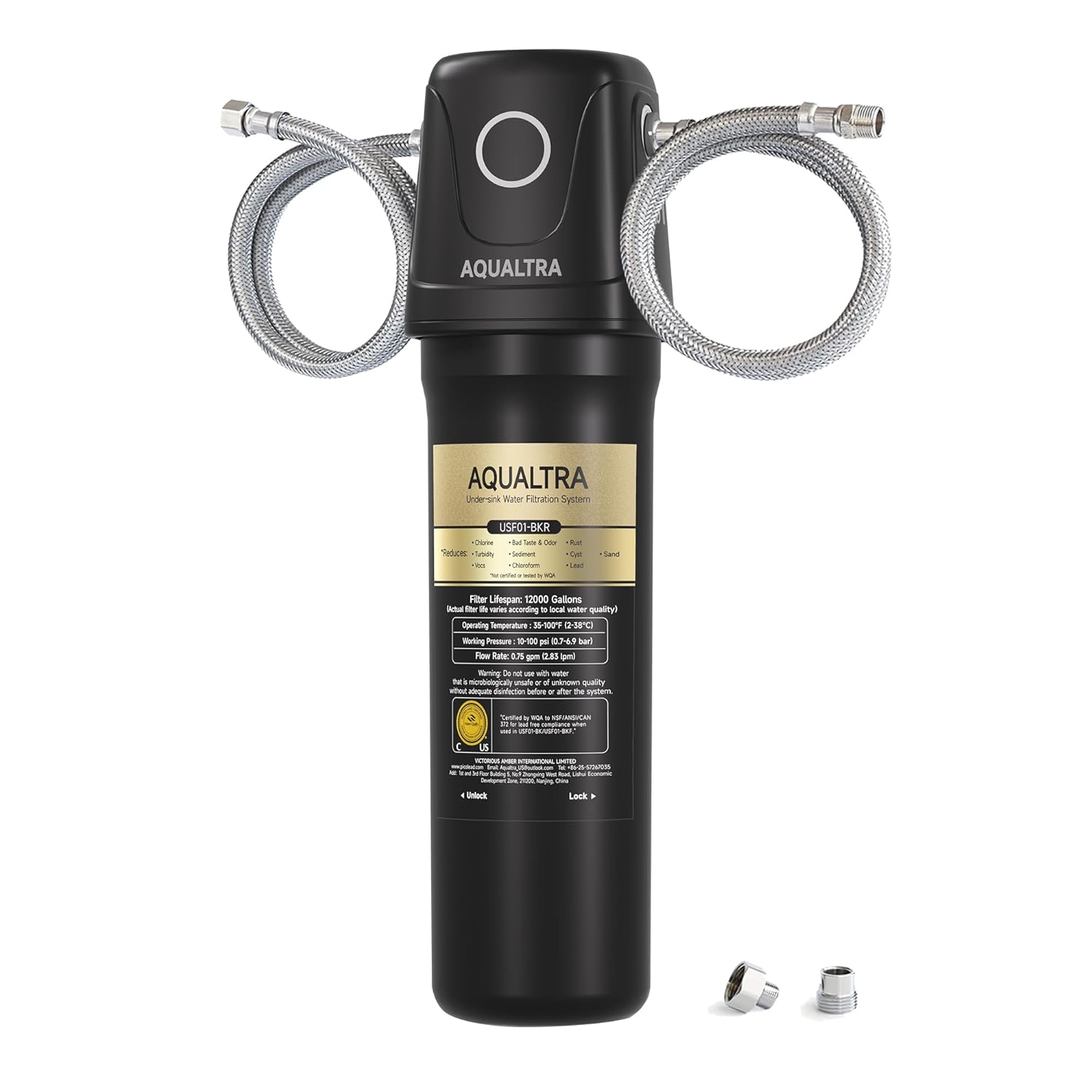
| Purification Method | Activated Carbon |
|---|---|
| Filter Fineness | 0.5 micron |
| Capacity | 12000 gallons |
| Maximum Flow Rate | 0.75 gpm |
| Filter Life Cycle | 12 months |
The AQUALTRA USF01-BK is a compact under-sink filter that uses a 0.5 micron activated carbon element to reduce chlorine, chloramine, PFAS (PFOA/PFOS), lead, mercury, fluoride, microplastic particles, and taste and odor from municipal cold water. It installs with push-to-connect hoses and a quick-twist cartridge so setup is straightforward for DIYers and replacement is fast. The unit delivers a steady 0.75 gpm flow that is sufficient for everyday kitchen tasks like filling a glass or rinsing produce without a noticeable slowdown. The filter is advertised to last up to 12 months or about 12,000 gallons, which keeps ongoing costs predictable. Important limitations: it is not intended for well water, it does not reduce total dissolved solids, and it must be used on cold water only. For buyers focused on removing bacteria like coliforms, this is not an antibacterial or RO system and will not provide the same level of microbial protection as dedicated microbiological treatments or certified bacteriostatic solutions.
Best for: A cost-conscious homeowner or renter who wants an affordable under-sink filter that improves taste and removes common chemical contaminants from municipal cold water with minimal installation hassle.
Less Ideal for: People who need certified bacterial/coliform protection, well-water treatment, or TDS reduction should choose a dedicated microbiological or RO system instead.
- Targets a broad list of chemical contaminants including PFAS, lead, mercury, chlorine, and microplastics
- Compact single-cartridge design fits easily under most sinks and works where space is limited
- Push-to-connect hoses and quick-twist cartridge make installation and filter changes fast
- Rated for up to 12,000 gallons or 12 months for predictable replacement intervals
- Not suitable for well water or hot water applications
- Does not reduce total dissolved solids or provide specific antibacterial/coliform removal
Verdict: AQUALTRA USF01-BK is a budget-friendly under-sink carbon filter that reliably improves taste and removes many chemical contaminants from municipal cold water with easy DIY installation.
iSpring RCC7-BN 5-Stage RO

| Purification Method | Reverse Osmosis, Activated Carbon, Carbon block |
|---|---|
| Power Source | No Power Needed |
| Maximum Flow Rate | 3.4 liters per minute |
| Supported Water TDS Level Maximum (PPM) | 750 |
| Capacity | 75 gallons |
The iSpring RCC7-BN is a five-stage under-sink reverse osmosis system designed to deliver high-quality drinking water for household use. It uses three pre-filters (sediment, GAC, carbon block), a thin-film RO membrane that removes contaminants down to 0.0001 microns, and a final GAC polishing filter, feeding a pressurized tank and dedicated faucet. Typical use is kitchen drinking and cooking water where municipal tap water is the feed; installation is DIY-friendly with push-to-connect fittings and clear first-stage housing for visual inspection. Notable features include NSF/ANSI 58 certification, a lead-free designer faucet, and no electrical power requirement. Practically, the system cuts TDS substantially and removes bacteria-sized particles and many chemical contaminants, improving taste and reducing scale in kettles and appliances. Limitations are that it is intended for municipal water rather than untreated well water and requires periodic filter and membrane replacements and tank space under the sink. Expect routine maintenance and occasional filter purchases to keep performance at NSF levels.
Best for: Homeowners who prioritize reliable, certified contaminant removal and want a durable under-sink system that delivers noticeably cleaner, better-tasting drinking water for daily kitchen use.
Less Ideal for: Homes with untreated well water or very high TDS sources that need whole-house or pre-treatment solutions should consider systems designed for well-water conditions instead.
- Five-stage filtration including an RO membrane that removes very small contaminants
- NSF/ANSI 58 certified for quality and performance
- Transparent first-stage housing for easy visual inspection
- Push-to-connect fittings and comprehensive installation parts make DIY setup straightforward
- Not designed for untreated well water without pre-treatment
- Requires periodic replacement of filters and RO membrane and uses under-sink storage tank space
Verdict: Choose the RCC7-BN when you want a certified, high-capacity under-sink RO system that consistently removes bacteria-sized particles and a broad range of contaminants for reliable drinking water.
Waterdrop 10UAW UF

| Filtration accuracy | 0.01 μm |
|---|---|
| Purification Method | Ultra Filtration |
| Maximum Flow Rate | 1.33 gpm |
| Filter Life Cycle | 12 months / 11,000 gallons |
| Supported Water TDS Level Maximum (PPM) | 700 |
The Waterdrop 10UAW-UF is a compact under-sink ultrafiltration unit designed to attach directly to standard 3/8" or 1/2" cold-water feed lines. It uses a 0.01 μm ultrafiltration membrane plus activated carbon media to reduce chlorine, bad taste and odor, and heavy metals such as lead, while retaining beneficial minerals. Installation is straightforward: push-to-connect fittings and a 3/8" direct-connection hose let you fit the system under most sinks without drilling, and the twist-and-lock cartridge replacement is quick. The unit is mechanical—no electricity required—and is rated for up to 1.33 gpm flow and a filter life of about 12 months or 11,000 gallons on municipal water. Practical benefits include noticeably improved drinking water taste, low maintenance compared with pitcher filters, and certified component materials. Limitations are that it is intended for cold water only, the flow rate can be lower than an unfiltered tap, and ultrafiltration reduces bacteria and particulates but does not replicate high-pressure reverse osmosis for dissolved solids reduction. Buyers should also confirm faucet thread compatibility before purchase.
Best for: Buyers who want a low-maintenance under-sink filter that reliably improves taste and reduces bacteria and heavy metals using a compact, easy-to-install system with proven user feedback.
Less Ideal for: People who need hot-water filtration, aggressive dissolved-solids reduction, or whole-house treatment should look at other system types.
- Very fine 0.01 μm ultrafiltration membrane for bacterial and particulate reduction
- Quick push-to-connect installation and twist-and-lock cartridge replacement
- Includes fittings for 3/8" and 1/2" connections and direct-connect hose for standard under-sink feed valves
- Long single-filter service life rated at 12 months or 11,000 gallons on municipal water
- Mechanical operation requires no electricity
- Rated for cold water only, not for hot-water lines
- Does not reduce total dissolved solids like an RO system
Verdict: Choose this Waterdrop if you want a compact, easy-to-install under-sink ultrafiltration unit that improves taste and reduces bacteria and lead with minimal upkeep.
CuZn UC-200 Under Sink Filter

| Model Number | UC-200 |
|---|---|
| Included Components | Stainless Steel Connection Hose |
| Material Type | NSF Approved Material Components |
| Unit Count | 1 Count |
The CuZn UC-200 is an inline under-sink filter designed for simple DIY installation and long service life. It uses a three-stage combination of micro sediment membrane, KDF-55 media and coconut shell carbon to reduce chlorine, lead, PFAS/PFOA, sediment and tastes or odors without stripping beneficial minerals. The unit connects directly to a cold water supply and includes a stainless steel connection hose so you can have filtered water at a dedicated faucet or line; setup is straightforward and the manufacturer provides video instructions. Its standout feature is longevity — the UC-200 is rated up to five years or 50,000 gallons depending on water quality, which lowers replacement frequency and ongoing cost compared with short-life cartridges. The filter does not reduce total dissolved solids so it will not perform like an RO system, and its performance depends on incoming water conditions, so heavily contaminated supplies may require pre-treatment or a different technology for complete microbial removal. For users seeking a low-maintenance, taste-improving under-sink filter, the UC-200 delivers strong value and practical performance.
Best for: Buyers who prioritize low maintenance and long service life and want reliable reduction of chlorine, lead and common chemical contaminants without frequent cartridge changes.
Less Ideal for: Homes with known severe microbial contamination or needs for near-zero TDS should consider RO systems or certified microbial-treatment solutions instead.
- Long rated service life up to 5 years or 50,000 gallons reduces replacement frequency
- 3-stage media (micro sediment, KDF-55, coconut shell carbon) targets chlorine, lead, PFAS and sediment
- Retains beneficial minerals because it is not a reverse osmosis system
- Includes stainless steel connection hose and is designed for easy direct-connect installation
- Does not reduce total dissolved solids so it will not remove dissolved salts or minerals
- Not designed as a dedicated microbial/coliform removal system; heavily contaminated water may need additional treatment
Verdict: Choose the UC-200 if you want a low-maintenance under-sink filter that lowers common chemical contaminants and needs infrequent cartridge changes.
Choosing the Right Water Filter for Coliform Bacteria: Key Factors to Consider
Microbial Reduction Method
Different filters use different approaches to address coliform bacteria. Membrane technologies, such as absolute-rated ultrafiltration or microfiltration, physically remove bacteria by pore size. Other systems use validated disinfection methods like UV light or chemical disinfection to inactivate organisms.
Understanding the method matters because mechanical removal and inactivation have different operational limits. Membrane filters can be highly effective but may clog when water has high turbidity. Disinfection systems require reliable power or chemical replenishment and may not address particulate matter unless paired with prefiltration.
Pore Size and Certification
Pore size directly affects a filter's ability to block bacteria. Filters rated with absolute pore sizes (for example, sub-micron ratings) give a clearer expectation for bacterial exclusion than vague nominal ratings. Look for explicit pore-size specifications that match the size range of target organisms.
Certifications and third-party test reports provide objective evidence of performance. Independent lab verification or recognized standards testing shows whether a product achieves claimed bacterial log reductions under controlled conditions.
Flow Rate and Household Demand
A filter that removes bacteria but delivers water at a trickle will frustrate daily use. Consider the system's typical flow rate under normal household pressure and how that matches your peak demands for drinking, cooking, or multiple simultaneous outlets.
Systems designed for point-of-entry whole-house treatment need higher capacity and flow handling than point-of-use units. Some effective microbial filters reduce flow as they load with particulates, so planned maintenance and appropriate sizing are important to maintain acceptable delivery rates.
Maintenance Frequency and Consumables
Filters that require frequent cartridge replacements or UV lamp changes add recurring effort and cost. Evaluate replacement intervals and whether consumables are easy to source locally. Also check how straightforward the replacement process is and whether routine maintenance requires tools or professional service.
Longer-lasting filter elements or modular designs that simplify swaps reduce the likelihood of lapses in protection due to delayed maintenance.
Prefiltration and Water Quality
Raw water quality has a major effect on microbial filtration performance. High levels of turbidity, sediment, or organic matter can clog mechanical filters and reduce disinfection efficacy by shielding bacteria from UV or chemicals.
Including a sediment or carbon prefilter can protect the microbial-stage component and preserve flow and lifespan. Assess your source water and consider systems that provide or accept staged prefiltration when needed.
Installation and System Compatibility
Installation complexity ranges from under-sink point-of-use units to whole-house systems that require plumbing modifications. Confirm whether your chosen location has the necessary space, water pressure, and electrical access if the system uses powered disinfection.
Compatibility with existing plumbing and whether you are comfortable performing installation or need professional help will influence both upfront costs and how quickly you can deploy a protection solution.
Point-of-Use Versus Point-of-Entry Options
Decide whether you need protection at a single tap or across the entire home. Point-of-use systems focus treatment on one outlet, typically the kitchen sink, and are less expensive and easier to install. They are useful when contamination is localized or water is only used for drinking and cooking from that tap.
Point-of-entry systems protect all water entering the house and are better when the source water has systemic contamination or when you want whole-house assurance. These systems require more space, higher flow capacity, and often professional installation, but they remove the need for multiple point-of-use units.
- Point-of-use: lower cost, simpler installation, limited to one outlet
- Point-of-entry: whole-house protection, higher capacity needs, more complex installation
Combining Prefiltration and Disinfection
Many effective strategies pair a sediment or carbon prefilter with a microbial-stage treatment. Prefilters remove particulates and chlorine or organics that can interfere with downstream microbial removal methods. This staged approach preserves the performance and lifespan of the microbial component.
For example, a sediment filter ahead of a membrane will reduce clogging, while a carbon stage can reduce tastes and odors and protect certain disinfection technologies from organics that absorb UV or react with chemical agents.
- Prefiltration reduces load on microbial-stage components
- Staged systems deliver more consistent flow and longer lifespans
Sizing Systems for Flow and Capacity
Match the system capacity and flow rating to your household's peak usage. Underestimating demand results in slow delivery or frequent bypass. Manufacturers typically list gallons per minute or daily capacity; use those figures to compare against your typical usage patterns.
If you have intermittent high demands such as multiple simultaneous showers or appliance cycles, consider a higher-capacity point-of-entry system or multiple point-of-use units to avoid flow constraints.
- Check rated gallons per minute and peak flow specifications
- Allow margin above typical peak demand to avoid performance drop-off
Maintaining Effective Protection Over Time
Regular maintenance keeps bacterial protection reliable. Follow recommended replacement intervals for cartridges, membranes, or UV lamps. Keep a maintenance schedule and check for pressure drops or changes in taste and clarity that can signal component loading.
Also inspect seals and housings for damage and ensure that any disinfecting lamps reach end-of-life replacement promptly. Neglecting maintenance can reduce microbial removal and compromise safety.
- Track replacement intervals and monitor flow and water clarity
- Replace consumables before end-of-life to avoid lapses in protection
Testing and Verifying System Performance
After installation, verify that the system performs as expected. Periodic water testing for coliforms and total bacterial counts provides objective confirmation that treatment remains effective. Testing frequency depends on source risk and system type but is a sensible step after any major maintenance or water-quality event.
Maintain records of test results and component changes to identify trends. If test results show recurring bacterial presence, investigate prefilter condition, installation integrity, and whether the system is properly sized for the water quality.
- Use certified labs or validated test kits for periodic verification
- Test after installation, repairs, or source-water changes
How We Chose the Best Water Filter for Coliform Bacteria
We prioritized products and systems that are explicitly designed for microbial reduction and that include certified or independently verified performance data against bacteria and coliform organisms. Our selection filters included only units with credible laboratory test results, third-party certifications, or clear technical specifications for bacterial removal or inactivation mechanisms such as absolute-rated membrane filtration or validated disinfection technologies. Key evaluation criteria were microbial reduction efficacy, filter pore size or disinfection method, flow rate and capacity for typical household demand, ease of installation and maintenance, and long-term consumable availability. We excluded products that only claim general "improved water" or that lack verifiable test data for bacterial removal. We also filtered out devices unsuitable for household potable supply, such as units intended only for graywater or non-potable uses. The final shortlist favors systems that balance measurable bacterial control with realistic household performance: adequate flow under load, manageable replacement intervals, and accessible replacement parts. We also considered clarity of manufacturer documentation and whether maintenance tasks are feasible for a typical homeowner.
Our full evaluation process is outlined in our review methodology.
FAQ
How do I know if my water has coliform bacteria?
The only reliable way is to have a water sample tested by a certified lab or with an approved test kit. Visible changes in water are not a dependable indicator of coliform presence.
Will a standard carbon filter remove coliform bacteria?
Standard carbon filters primarily address taste, odor, and chemicals and usually do not reliably remove bacteria unless paired with a dedicated microbial-stage component or an appropriate pore-size membrane.
Do I need a professional to install a whole-house bacterial filter?
Many whole-house systems benefit from professional installation because of plumbing modifications and flow balancing. Some point-of-use units are user-installable with basic tools, but complex systems or those requiring electrical hookups may need a qualified installer.
How often should I test water after installing a bacterial filter?
Test after initial installation to confirm performance, then periodically based on source risk—commonly every 6 to 12 months. Test sooner after any maintenance, source-water change, or if water quality changes.
Can UV disinfection replace mechanical filtration?
UV inactivates bacteria effectively but does not remove particulates. For turbid water, prefiltration is important to ensure UV penetration. Combining UV with mechanical filtration often gives more reliable protection for drinking water.
Final Verdict
Prioritize systems that include documented bacterial reduction methods and that match your household flow and maintenance capacity. Choose a solution with appropriate pore size or validated disinfection, paired with prefiltration when source water is turbid. Plan for regular maintenance, regular testing, and accessible replacement parts to preserve protection over time. By balancing microbial efficacy, flow needs, and upkeep requirements, you can select a water filter that delivers reliable reduction of coliform bacteria while fitting into daily household use and maintenance practices.