
Note: This article contains affiliate links. If you click on these links and make a purchase, we may earn a small commission at no extra cost to you. This helps support our research and content. Read our full affiliate disclosure here.
If your home draws water from a private well, choosing the right water filter matters for health, plumbing longevity, and daily convenience. Well water can contain sediment, bacteria, iron, hardness minerals, and other contaminants that affect taste, appliance performance, and safety. Picking the right filter system helps you treat the specific issues in your supply without creating new problems like low pressure or frequent maintenance. This guide shortlists the top water filter options for home well water across common use cases and household sizes. We evaluated each type for contaminant removal, flow-rate impact, maintenance burden, and installation needs so you can narrow choices based on how your well actually performs. Read on for practical buying guidance and clear criteria to match a system to your well's conditions.
Top Picks at a Glance
| Best Overall The best all-around choice for most situations | XINSHUO Whole House Water Filter 125 |  |
| Best Value The sweet spot between price and what you get | Membrane Solutions String Wound 10"x2.5" |  |
| Best Budget The cheapest option that still gets the job done reliably | Whirlpool Whole Home Sediment Filter WHKF-GD05 |  |
| Top Rated A top-rated pick with lots of positive feedback | iSpring RCC7AK-BN RO System |  |
| Most Popular A crowd favorite that many people choose with confidence | iSpring WGB21B 2-Stage Whole House Filter |  |
| Best Seller A high-volume bestseller chosen again and again | SimPure DB10P 10" Housing |  |
XINSHUO Whole House Water Filter 125

| Purification Method | Activated Carbon, Sedimentation |
|---|---|
| Maximum Flow Rate | 15 gpm |
| Supported Water TDS Level Maximum (PPM) | 1000 |
| Filter Life Cycle | 6 months |
| Power Source | Water Pressure |
This XINSHUO whole-house system uses a three-stage sequence (sediment, GAC, and carbon block) to trap 0.5-micron particles and reduce chlorine, rust, sediment, and odors across every tap. It is typically installed at the main line or under a sink and delivers up to 15 gallons per minute, so pressure holds up even with multiple fixtures running. The clear housings make it easy to visually monitor trapped debris and know when to service filters, and the kit includes a wrench, plumbing tape, valves, and three full sets of replacement cartridges for roughly 1.5 to 2 years of use. The unit relies on water pressure only, so no electricity is required, and the dual-valve design lets you swap cartridges without shutting off the whole supply. Important limits: it preserves dissolved minerals and will not lower TDS, and the included filters are rated to about six months between changes depending on water quality, so heavy iron or very high sediment well water may need pre-treatment or more frequent replacement.
Best for: Homeowners with mixed well or city water who want a balanced, whole-house solution that improves taste, smell, and sediment protection without electrical components and with easy visual maintenance.
Less Ideal for: Homes that require water softening, heavy iron removal, or advanced contaminant reduction beyond chlorine and sediment should consider dedicated softeners or specialized treatment before or instead of this system.
- Three-stage filtration (PP sediment, GAC carbon, CTO carbon block) that targets sediment, chlorine, rust, and odors
- Clear housings provide visual monitoring of debris so you can see when filters need replacing
- High flow capacity up to 15 gpm maintains pressure with multiple taps in use
- Includes three full filter sets plus installation hardware for about 1.5–2 years of service out of the box
- Does not reduce TDS or dissolved minerals, so it will not soften water
- Filters are rated for around six months and may need more frequent replacement on very dirty well water
Verdict: A practical, no-electricity whole-house filter that delivers visible, balanced sediment and chlorine reduction with high flow for typical well or city households.
Membrane Solutions String Wound 10"x2.5"

| Micron Rating | 5 Micron |
|---|---|
| Material Type | Polypropylene (PP) |
| Recommended Service Temp. | 40-113°F / 5-45°C |
| Max. Operating Pressure | 75PSI @ 68°F |
| Set Name | 6-Pack |
This 5-micron string-wound cartridge is a straightforward sediment prefilter for whole-house or under-sink systems, sold in a six-pack for regular maintenance cycles. Made from food-grade polypropylene, the deep graded winding traps larger particles on the outer layers and finer sediment nearer the core, which increases dirt-holding capacity and extends service life compared with simple melt-blown cartridges. It fits most 10"x2.5" housings and is commonly used ahead of carbon or RO stages to protect downstream filters and plumbing from sand, rust, and silt. The filter is rated for a wide temperature range and up to 75 PSI operating pressure, and NSF testing covers material requirements. Expect long life in low-to-moderate sediment wells — the listing cites up to 15,000 gallons depending on water quality — but heavy-sediment supplies will shorten that. Installation is the typical drop-in swap for standard housings, and buying a 6-pack simplifies scheduled changes for whole-house setups.
Best for: Homeowners with well water or sediment-prone supplies who want an affordable, high-capacity prefilter to protect downstream filters and plumbing and reduce replacement frequency.
Less Ideal for: People who need chemical, taste, or microbial reduction should choose a carbon, catalytic, or specialized filter instead.
- Deep graded string-wound design increases dirt-holding capacity
- Food-grade polypropylene construction that is lead- and BPA-free
- Fits most standard 10"x2.5" filter housings for easy replacement
- Sold as a 6-pack to simplify routine filter changes for whole-house systems
- Sediment-only cartridge does not remove chlorine, taste, or dissolved contaminants
Verdict: Buy this 6-pack if you want a durable, high-capacity sediment prefilter that extends service life and protects downstream systems in well-water or high-sediment homes.
Whirlpool Whole Home Sediment Filter WHKF-GD05

| Filtration micron | 5 Micron |
|---|---|
| Material Type | Polypropylene (PP) |
| Filter life | 6 months (recommended) |
| Compatible models | Whirlpool WHKF-DWH, WHKF-DWHV |
The Whirlpool WHKF-GD05 is a 10" x 2.5" whole-house sediment cartridge sold in a two-pack for routine replacement. It is a grooved polypropylene sediment filter rated at 5 microns and certified to NSF/ANSI 42 for particulate reduction, so it removes visible particulates like sand, silt and rust before water reaches plumbing and appliances. Typical use is as a primary sediment stage in a whole-home filter housing such as Whirlpool WHKF-DWH/DWHV or compatible 10" housings, with a recommended replacement interval of about six months under standard conditions. The rigid, grooved design gives extra surface area to hold debris and helps extend life compared with plain pleated cartridges. The filter is straightforward to swap during regular maintenance and comes in a value-oriented two-pack. Limitations: it is a sediment-only cartridge and does not address chlorine taste, odors, or dissolved contaminants, so homeowners who need chemical or microbial treatment will need an additional carbon or specialized stage.
Best for: Homeowners on a tight budget who need a reliable, certified sediment stage for well or municipal water and prefer a simple, replace-as-needed cartridge to protect plumbing and appliances.
Less Ideal for: Homes needing chemical, taste, or microbial treatment or filtration beyond particulate removal should choose a carbon block or multi-stage system instead.
- NSF/ANSI 42 certificaton for particulate/material safety
- 5-micron rating effective for sand, silt and rust removal
- Grooved polypropylene construction increases sediment-holding capacity
- Sold as a two-pack for regular scheduled replacements
- Sediment-only cartridge does not reduce chlorine, taste, or dissolved contaminants
- Replacement interval depends on water quality so heavily sedimented wells may require more frequent changes
Verdict: A budget-friendly, NSF-certified 5-micron sediment cartridge sold as a two-pack that reliably protects plumbing and appliances from sand and silt.
iSpring RCC7AK-BN RO System

| Purification Method | Reverse Osmosis, Alkaline, Activated Carbon, Carbon block |
|---|---|
| Power Source | No Power Needed |
| Maximum Flow Rate | 284 liters_per_day |
| Supported Water TDS Level Maximum (PPM) | 750 |
| Filter Life Cycle | 6 months |
The iSpring RCC7AK-BN is an under-sink reverse osmosis system designed to deliver low-TDS, mineral-balanced drinking water without electricity. It uses six stages of filtration including sediment, carbon, RO membrane, and a patent-pending alkaline remineralization stage to restore healthy minerals and pH after RO treatment. The top-mounted faucet fastener and push-to-connect fittings simplify DIY installation and the clear first-stage housing helps you visually monitor sediment buildup. Rated to reduce a wide range of contaminants and certified to NSF/ANSI 58 for the complete system, it suits homes on well water where heavy particulates, hardness byproducts, and dissolved contaminants are concerns. The system requires periodic filter changes (main filters on a roughly 6-month cycle and RO membrane maintenance) and needs space under the sink for the tank and housings, so plan for routine upkeep and storage room. Its no-electric design keeps operating costs low while providing consistent, tested contaminant reduction for long-term reliability.
Best for: Buyers who prioritize a reliable, tested under-sink system for well water that removes a broad range of contaminants and restores drinkable minerals, and who are comfortable with scheduled maintenance.
Less Ideal for: People who need instant hot water dispensing, have extremely tight under-sink space, or prefer zero-maintenance countertop filters.
- Full-system NSF/ANSI 58 certification for verified RO performance
- Six-stage filtration with alkaline remineralization for improved taste and balanced pH
- Top-mounted faucet fastener and push-to-connect fittings simplify installation
- Transparent first-stage housing for easy visual checks of sediment buildup
- Requires regular filter and membrane replacements and under-sink storage space
- Not suitable for systems that need hot water dispensing or electric boosting pumps
Verdict: Choose the iSpring RCC7AK-BN when you need a certified, no-electric RO system that reliably cleans well water and returns balanced minerals for better drinking water.
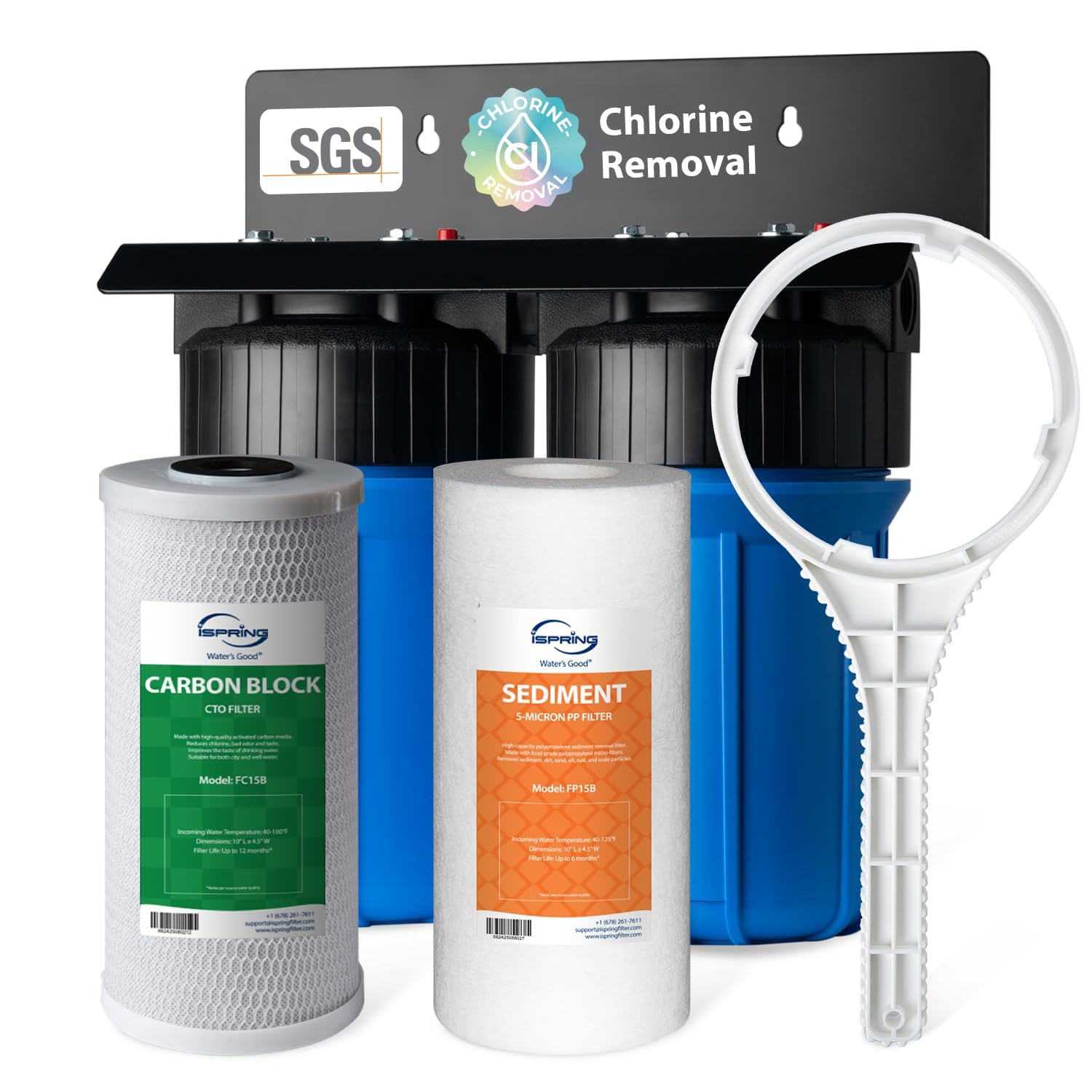
iSpring WGB21B 2-Stage Whole House Filter
| Maximum Flow Rate | 15 gpm |
|---|---|
| Operating Pressure Range | 25–80 psi |
| Operating Temperature | 40–100 °F |
| Filter Life Cycle | Up to 50,000 gallons / 12 months |
| Inlet / Outlet | 1 inch Female NPT |
The iSpring WGB21B is a point-of-entry two-stage system built to remove sediment and chlorine-related contaminants from all the water entering a home. It pairs a 5-micron polypropylene sediment cartridge with a coconut-shell carbon CTO block to capture dirt, rust, and scale while knocking out over 90% of chlorine and many VOCs that cause bad taste and odor. The unit ships pre-assembled on a mounting bracket and includes a filter wrench and installation kit, making DIY installation straightforward for someone comfortable with basic plumbing; a pressure release valve speeds filter changes. With 1-inch inlet/outlet ports and a claimed capacity of up to 50,000 gallons or roughly 12 months of service for a typical household, it supports high flow without heavy pressure loss. The system does not lower TDS, so it retains beneficial minerals but will not soften water or remove dissolved salts. For well-water homes that need sediment control plus chlorine and organic reduction, this model is a practical, serviceable whole-house option, though homes needing iron, bacteria, or TDS reduction will need additional treatment stages.
Best for: Buyers who want a proven, no-frills whole-house filter that removes sediment and chlorine to improve taste and protect plumbing and appliances, and who prefer a system with clear user feedback and installation resources.
Less Ideal for: Homes that need TDS reduction, disinfection, heavy iron or manganese removal, or integrated water softening should consider additional or different treatment options.
- Two-stage design targets both sediment and chlorine/organics for clearer, better-tasting water
- Pre-assembled mounting bracket, included wrench, and how-to videos simplify DIY installation and filter changes
- 1" inlet/outlet and high flow rating preserve household water pressure
- Long advertised filter life up to 50,000 gallons or about 12 months for average families
- Made with heavy-duty housings suitable for continuous whole-house service
- Does not reduce total dissolved solids or function as a water softener
- Not designed to remove bacteria or high levels of dissolved iron without additional stages
Verdict: A straightforward two-stage whole-house system that reliably removes sediment and chlorine to deliver cleaner-tasting water and protect home plumbing.
SimPure DB10P 10" Housing

| Maximum Flow Rate | 20 gpm |
|---|---|
| Inlet/Outlet | 1" NPT Brass Port |
| Compatible Filter Dimensions | 10" x 4.5" |
| Working Water Pressure Range | 15-90 PSI |
| Applicable Water Temperature | 5-38 ℃ (41-100 ℉) |
The SimPure DB10P is a single-stage whole-house filter housing that accepts standard 10" x 4.5" cartridges to pre-filter well or municipal water. It mounts on a bracket and uses 1" NPT brass inlet and outlet ports to support high flow rates and durable connections, while the food-grade reinforced polypropylene body resists corrosion and impact. Installation is straightforward with the included wrench, bracket, screws, and a built-in red pressure-relief button that makes cartridge changes easier and safer. The housing supports sediment, granular activated carbon, and pleated cartridges, so it can remove sand, dirt, chlorine, and improve taste before water reaches appliances or a downstream purifier. It is rated for up to 20 gpm and works across typical household pressures, but cartridges are sold separately and you should leave clearance for filter changes. For well-water use it serves well as a pre-filter, though buyers will want to pick the right cartridge micron rating for heavy sediment loads and monitor pressure drop over time.
Best for: Buyers who want a simple, durable pre-filter housing to protect home plumbing and appliances from sediment and chlorine while retaining flexibility to choose cartridge types.
Less Ideal for: Those seeking a complete multi-stage filtration system or an all-in-one softening and treatment solution should look at assembled systems rather than a single-stage housing.
- Universal 10" x 4.5" cartridge compatibility simplifies replacement and upgrades
- 1" NPT brass inlet/outlet for secure, higher-flow plumbing connections
- Reinforced food-grade polypropylene body resists corrosion and impact
- Includes mounting bracket, wrench, screws and a pressure-relief button for easier maintenance
- Supports sediment and carbon cartridges for effective pre-filtration of well or municipal water
- Filter cartridges are not included so total system cost requires separate purchases
- Large housing needs adequate clearance for cartridge removal and replacement
Verdict: A rugged, 1" NPT whole-house housing that provides reliable pre-filtration for well water using widely available 10" x 4.5" cartridges.
Choosing the Right Water Filter for Home Well Water: Key Factors to Consider
What Contaminants Are Present
Knowing the specific contaminants in your well water is the single most important factor. A well-water test identifies sediment levels, iron and manganese, hardness minerals, pH, bacteria, and trace organics. Each contaminant class requires different media and technology: sediment needs mechanical filtration, iron may need oxidation or specialized media, hardness is treated with softening or template-assisted crystallization, and bacteria require disinfection or certified microbiological barriers.
Without a water test you risk over- or under-specifying a system. Over-specifying can add unnecessary cost and complexity; under-specifying can leave health or nuisance problems unresolved. Start with a certified lab test or a reputable kit, then match filter types to the detected issues.
System Type and Placement
Decide whether you need a whole-house system, a point-of-entry sediment prefilter, or point-of-use devices. Whole-house filters protect plumbing and appliances and treat all taps but usually cost more and require more space. Point-of-use filters are useful when only drinking water needs polishing or when you want a low-cost first step.
Placement matters for performance. Installing a sediment filter as the first stage protects downstream media and extends cartridge life. If disinfection is needed, position that stage where contact time and backwashing options are feasible. Consider space in the utility area and access for cartridge changes when choosing a system location.
Flow Rate and Household Demand
Filter sizing must match your peak household demand. Filters reduce flow to some degree; undersized systems cause pressure drops during showers or when multiple fixtures run. Check the system's rated flow in gallons per minute and compare to your household peak demand. Larger homes or those with irrigation needs require higher-throughput systems or parallel installations.
Also account for head pressure in homes with well pumps. Some filter housings add resistance that can cause pump cycling or reduced delivery at peak times. Choose systems specified for your expected flow and pump configuration to avoid performance problems.
Maintenance Needs and Consumables
Understand the frequency and cost of replacing cartridges, media, or salt if a softener is involved. Some media beds require periodic regeneration, backwashing, or chemical treatment. Cartridge lifespans vary widely depending on contaminant load; heavily sediment-laden wells may need frequent prefilter changes.
Maintenance accessibility is crucial. Systems with tool-free housings or clear service intervals reduce the chance of lapse. Factor in local availability of replacement media and whether you can handle routine tasks yourself or will hire a technician.
Material Compatibility and Corrosion Resistance
Well water chemistry can be hard or acidic, both of which accelerate corrosion of metal parts. Choose filter housings, valves, and fittings made from corrosion-resistant materials compatible with your water's pH and mineral content. Plastics, stainless steel, and coated components are common choices depending on system type.
Incorrect material choices can shorten system life or introduce contamination. Confirm the manufacturer's specifications for temperature and pH range to ensure long-term reliability in your well environment.
Certification and Performance Data
Look for independent testing or certifications relevant to the contaminants you need removed. Certifications to NSF/ANSI standards or third-party test data show that a system meets specific reduction claims for sediment, chlorine, lead, cysts, or other targets. For microbiological issues, ensure the system has appropriate validation or that a separate disinfection approach is used.
Certification does not replace a water test, but it does help validate that a technology can achieve the advertised reductions under defined conditions. Review the tested influent concentrations and flow rates to make sure they match your needs.
Common Well Water Problems and How Filters Address Them
Well water can present a mix of visible and invisible issues. Fine sand and silt cause abrasion and clogging, iron and manganese stain fixtures and create metallic taste, hardness minerals form scale, and coliform bacteria present health risks. Understanding how different filter technologies target these problems helps you choose the right configuration.
Mechanical sediment filters trap particulate matter and protect downstream components. Oxidation media and catalytic carbon can convert dissolved iron and manganese to removable solids. Water softeners exchange hardness ions for sodium or potassium to prevent scale. Disinfection options include UV sterilizers or chlorination when bacterial contamination is a concern.
- Sediment filters: remove sand, rust, and silt to protect equipment
- Oxidation/iron media: transform dissolved iron and manganese for filtration
- Softening: reduces scale using ion exchange
- Carbon filtration: improves taste and removes some organics
- UV or disinfection: inactivates bacteria and viruses without chemicals
Testing Your Well and Interpreting Results
Start with a comprehensive test that includes bacteria, nitrate, iron, hardness, pH, and any local contaminants of concern. Results usually arrive with numeric concentrations and suggested limits. Use those numbers to prioritize treatment steps rather than guessing based on taste or appearance.
If bacteria are detected, take immediate action to disinfect and consult local health guidance. For nuisance issues like odor or staining, focus first on targeted media or carbon polishing. For multiple problems, staged systems that address sediment first, then specific soluble contaminants, work best.
- Bacteria present: consider immediate disinfection and a validated microbiological barrier
- High iron/manganese: test both dissolved and total concentrations
- High hardness: measure grains per gallon to size softeners correctly
- Low pH: consider corrosion control before installing metal components
Installation Options and When to Use a Pro
Some whole-house filter housings and under-sink point-of-use units are straightforward to install for an experienced DIYer. However, systems that require bypass valves, electrical hookups for UV, or integration with a well pump and pressure tank are good candidates for professional installation.
Hiring a professional is advisable when local codes require permits, when you are replacing a primary service line component, or when you want warranty-backed work. A qualified installer can also verify flow rates, set up regeneration timers, and ensure airtight seals for microbiological safety.
- DIY-friendly: cartridge swaps and simple housings with shutoff valves
- Pro recommended: UV systems, backwashing media tanks, and softeners
- Check local plumbing codes and permit requirements before major work
Routine Care to Keep a Well Water Filter Performing
Regular maintenance keeps filtration effective and prevents unplanned failures. Replace prefilters on a schedule driven by sediment load, monitor pressure differential to detect clogging, and follow manufacturer guidance for media regeneration or replacement. Keep records of service actions and replacement dates.
Visually inspect housings and fittings for leaks or corrosion, and test water periodically after installation to confirm reductions. For systems with UV, replace lamps on the recommended schedule and keep quartz sleeves clean to maintain output.
- Monitor pressure drop to know when prefilters need replacing
- Keep replacement cartridges and media on hand for quick swaps
- Maintain service logs and annual water testing after major changes
Balancing Performance with Operating Cost
High-performance media and multi-stage systems can solve complex well-water problems but carry higher ongoing costs for media replacement and service. Simpler cartridge-based systems have lower upfront costs but may require frequent replacement in dirty wells. Match expected consumable costs to your budget and willingness to perform maintenance.
Consider lifecycle cost, not just initial purchase price. Factor in replacement media frequency, electricity for pumps or UV, and any water use for regeneration cycles. A properly sized system often reduces long-term costs by protecting appliances and reducing plumbing repairs caused by scale or sediment.
- Estimate annual consumable and service costs before buying
- Prioritize systems that reduce damage to appliances and plumbing
- Factor in time and skill required for routine maintenance
How We Chose the Best Water Filter for Home Well Water
We selected systems that address the most common and consequential problems found in private wells. Our evaluation emphasized measurable filtration performance for contaminants typical in well water, such as sediment, iron, manganese, hardness minerals, chlorine byproducts when present, and bacterial indicators where appropriate. We also prioritized flow-rate retention so systems do not throttle household water pressure, because many homeowners need whole-house flow for showers and irrigation. Practical maintenance and operating costs were part of the filter selection. We looked for units with clear cartridge life expectations, accessible replacement parts, and straightforward routine servicing. Installation complexity and compatibility with typical home plumbing were assessed, favoring systems that a competent DIYer or local plumber can integrate without extensive rework. Durability and corrosion resistance for well environments also guided choices. Exclusions: we excluded niche laboratory-grade units, single-use consumer pitchers, and systems that only address bottled-water style point-of-use filtration without whole-house options. The final list focuses on installable solutions that provide reliable contaminant reduction, manageable upkeep, and retained household water performance.
Our full evaluation process is outlined in our review methodology.
FAQ
How often should I test my well water after installing a filter?
Test annually for bacteria and nitrates and more frequently if you notice changes in taste, odor, or appearance. After installing a new treatment, retest within a few weeks to confirm the system is working as intended.
Can a whole-house filter remove bacteria from well water?
Not all whole-house filters remove bacteria. Mechanical and carbon filters remove particulates and some organics but do not reliably inactivate microbes. For bacterial concerns, use a validated disinfectant stage such as UV or a chemical treatment designed for microbiological control.
Will filtration reduce my water pressure?
Some systems cause a measurable pressure drop, especially if undersized or when cartridges are clogged. Choose a system rated for your household peak flow and monitor pressure differential to avoid impaired performance.
What maintenance do water softeners need if used with well water?
Softeners require periodic salt or potassium replenishment and occasional resin cleaning. Regeneration cycles use water and should be sized to your hardness level to avoid excessive salt use. Hard, sediment-heavy wells may require prefiltration to protect the softener resin.
Do I need a sediment prefilter for my well?
If your well shows sand, silt, or high turbidity, a sediment prefilter is recommended. It protects downstream media and cartridges, extends service life, and can prevent clogging that leads to pressure loss and more frequent maintenance.
Final Verdict
Choose a system that addresses the contaminants indicated by your well test while matching household flow needs and maintenance expectations. Prioritize a staged approach: remove sediment first, treat specific dissolved contaminants second, and add disinfection only when bacterial issues are present. Balance upfront complexity with ongoing consumable and service costs to find a durable, low-friction solution. Focus on fit and maintenance capability when deciding. A properly sized and installed system will protect plumbing, improve water quality, and minimize surprises, so prioritize contaminant removal, flow retention, and accessible servicing when making your final choice.