
Note: This article contains affiliate links. If you click on these links and make a purchase, we may earn a small commission at no extra cost to you. This helps support our research and content. Read our full affiliate disclosure here.
If you rely on a deep well as your household water source, the right water filter makes a big difference in taste, safety, and plumbing longevity. Deep wells commonly present unique challenges such as high sediment loads, iron, manganese, sulfur odors, and variable flow rates. Choosing an appropriate filter setup helps protect fixtures and appliances, improves drinking water quality, and reduces time spent on maintenance. This guide presents seven shortlisted water filters for deep well water that suit different homes and well conditions. We evaluated systems by filtration effectiveness, flow capacity, installation needs, and upkeep, so you can find a durable solution that fits your well and household routine. Read on for practical buying guidance and answers to common owner questions.
Top Picks at a Glance
| Best Overall The best all-around choice for most situations | iSpring WGB32BM 3-Stage Whole House Filter |  |
| Best Quality Built to a higher standard if you want something more solid | Aquasana Rhino Well with UV WH-WELL-CT-UVS |  |
| Best Value The sweet spot between price and what you get | iSpring WGB21B 2-Stage Whole House Filter |  |
| Best Budget The cheapest option that still gets the job done reliably | EcoPure EPW2P Pleated Filter 2-Pack |  |
| Top Rated A top-rated pick with lots of positive feedback | Membrane Solutions String Wound 5-Micron |  |
| Most Popular A crowd favorite that many people choose with confidence | PUREPLUS 5 Micron 10" x 4.5" Filter |  |
| Best Seller A high-volume bestseller chosen again and again | SimPure DB10P 10" Filter Housing |  |
iSpring WGB32BM 3-Stage Whole House Filter
| Maximum Flow Rate | 15 gpm |
|---|---|
| Operating Pressure Range | 25 – 80 psi |
| Operating Temperature | 40 – 100 °F |
| Inlet / Outlet | 1 inch NPT |
| Filter Life Cycle | 1 years |
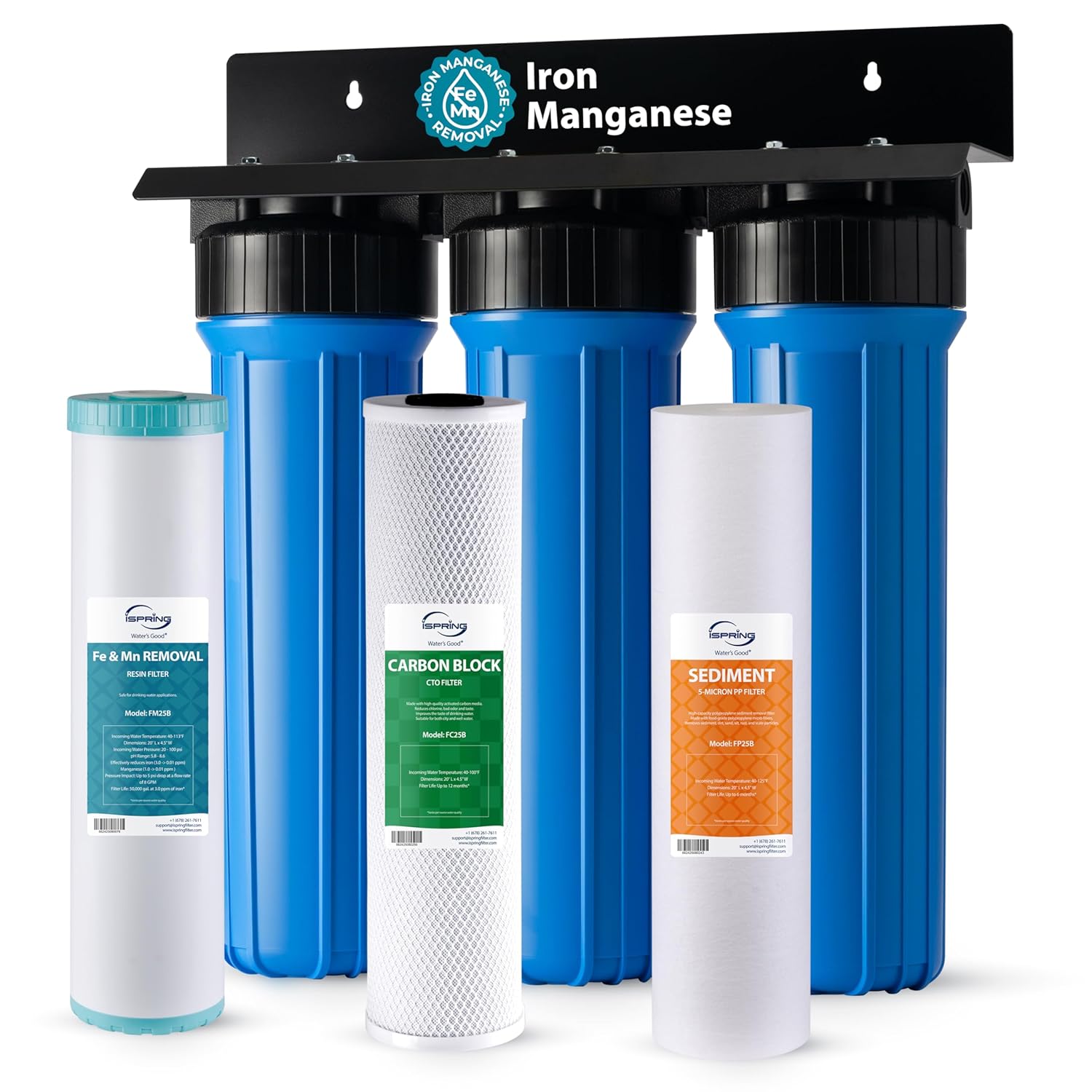
The iSpring WGB32BM is a tankless, 3-stage whole house filtration system built to handle well and municipal water with heavy sediments and low-to-moderate iron and manganese. It uses a 20-inch polypropylene sediment cartridge as the first stage to capture sand, rust, and large particles, a coconut-shell carbon block in stage two to remove chlorine, color, odor and improve taste, and a catalytic iron and manganese stage designed to reduce iron (up to 3.0 ppm) and manganese (up to 1.0 ppm). The system supports up to 15 gpm flow and installs on a 1-inch NPT main line for point-of-entry protection for showers, laundry and fixtures. Filters are rated to last up to 100,000 gallons or about 12 months under typical use, which reduces maintenance frequency compared with smaller housings. Important limits: it will not soften water or remove dissolved solids, and it is not recommended where iron or manganese exceed the listed maxima. The unit is intended for indoor installation and benefits households that want a high-capacity, low-pressure-loss whole-house filter without the complexity of chemical feed systems.
Best for: Homeowners with well or municipal water seeking an all-around, high-capacity point-of-entry filter that reduces sediment, chlorine, and moderate iron/manganese while keeping installation and maintenance straightforward.
Less Ideal for: Homes with very hard water or exceptionally high iron/manganese levels should consider adding a dedicated softener or a heavy-duty iron removal system instead.
- Three-stage design targets sediment, chlorine/taste/odor, and iron/manganese specifically
- High capacity rated up to 100,000 gallons or 12 months between replacements
- Supports up to 15 gpm with minimal pressure loss for whole-house flow
- Uses coconut shell carbon block for effective chlorine and taste reduction
- Includes three filters and a wrench for DIY installation
- Does not reduce water hardness or remove dissolved solids
- Not suitable where iron exceeds 3.0 ppm or manganese exceeds 1.0 ppm
Verdict: Choose this system if you want a high-capacity, easy-to-install whole-house filter that removes sediment, chlorine, and moderate iron and manganese for deep well or municipal water.
Aquasana Rhino Well with UV WH-WELL-CT-UVS

| Maximum Flow Rate | 14.7 gpm |
|---|---|
| Operating Pressure Range | 20-100 psi |
| Supported Water TDS Level Maximum (PPM) | 1000 |
| Filter Life Cycle | 5 years |
| Capacity | 500000 gallons |
The Aquasana Rhino Well with UV is a whole-home filtration package built for well water: it pairs pre- and post-filters, carbon and copper-zinc (KDF) media, a salt-free conditioner, and an integrated UV lamp to reduce chlorine, bacteria, viruses, and scale. It is installed on the main line and is intended to deliver treated water to every tap, improving drinking water taste and reducing contaminants that can damage plumbing and appliances. Notable features include a high maximum flow rate (14.7 gpm), a 5-year / 500,000-gallon filter life cycle, and an installation kit for 3/4
Best for: Buyers who need a high-capacity, performance-focused whole-house system for well water and prioritize broad contaminant reduction plus UV disinfection for a family home.
Less Ideal for: Homes that require true water softening or those unwilling to schedule professional installation should consider alternative systems.
- Multi-stage filtration combining carbon and KDF for broad contaminant reduction
- Integrated UV purification for bacteria and virus control
- Salt-free scale control to reduce mineral buildup without softening
- Long rated service life: 500,000 gallons or 5 years
- Installation kit includes tank connections, drain valve, and pre/post filters
- Requires professional or experienced DIY plumbing for correct installation
- Does not soften water or remove dissolved minerals like a softener
- Performance depends on incoming water quality and may need pretesting
Verdict: Choose this system if you want a durable, high-flow whole-house well filter that pairs broad chemical filtration with UV disinfection for long-lasting, homewide protection.
iSpring WGB21B 2-Stage Whole House Filter
| Inlet / Outlet | 1 inch Female NPT |
|---|---|
| Maximum Flow Rate | 15 gpm |
| Operating Temperature | 40-100 ºF |
| Supported Water TDS Level Maximum (PPM) | 2500 |
| Filter Life Cycle | 12 months |
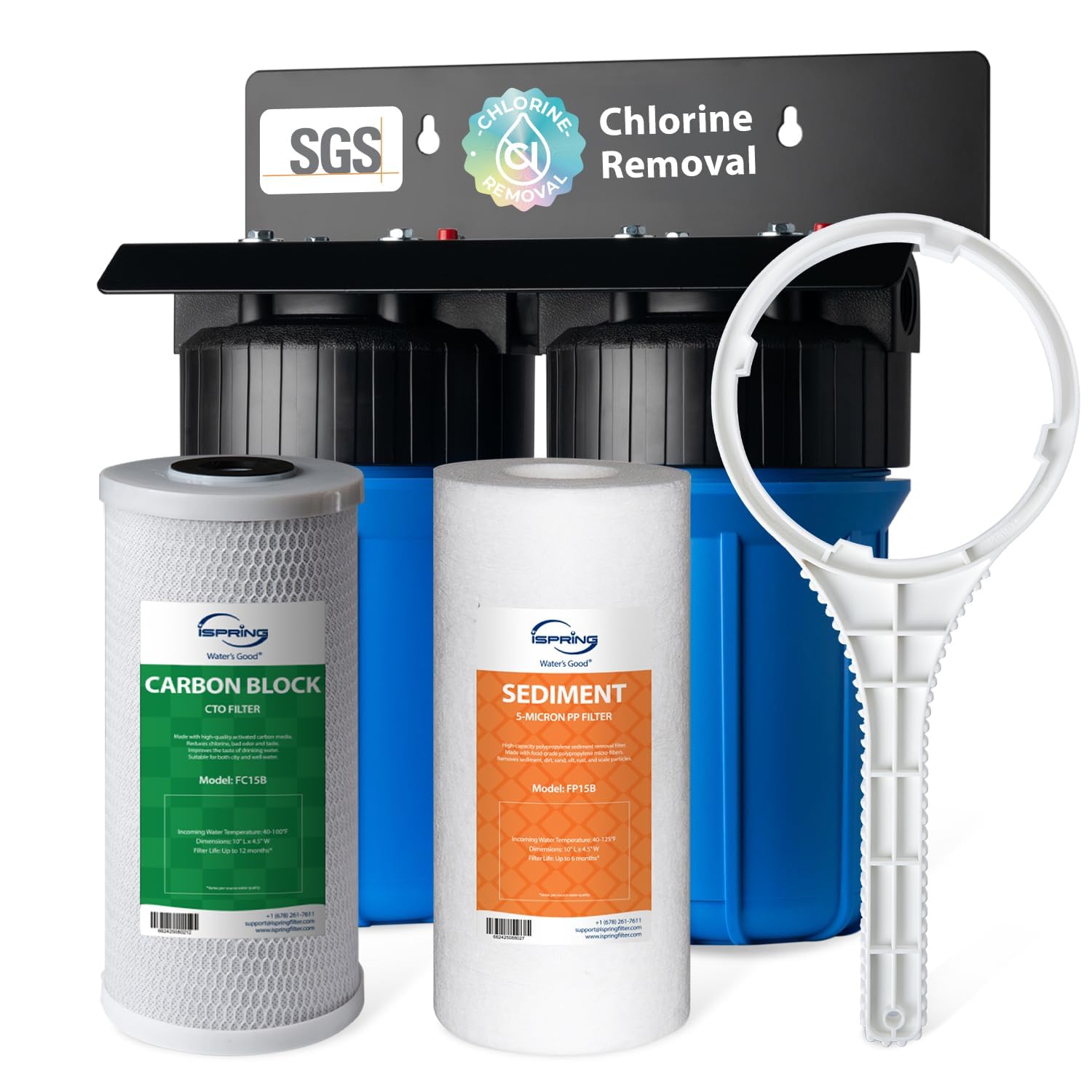
The iSpring WGB21B is a two-stage point-of-entry filtration system built to protect plumbing and improve water taste across an entire house. It pairs a 5-micron polypropylene sediment filter with a coconut-shell carbon CTO cartridge to capture sand, rust, silt and remove over 90% of chlorine and many VOCs, which helps extend appliance life and reduces odors at every faucet. The system is pre-assembled on a mounting bracket and includes a filter wrench and installation kit, so many homeowners can do a DIY install at the main supply using standard 1" female NPT fittings; a pressure relief valve eases cartridge changes. Rated for up to 50,000 gallons and roughly a year of service for a typical family, it maintains minerals since it is not RO-based and supports up to 15 gpm flow. Limitations to note are that it does not reduce TDS or dissolved salts, and it is focused on sediment and chlorine-type contaminants rather than deep well-specific issues like iron, hydrogen sulfide, or bacteria without adding targeted media or a separate treatment stage.
Best for: Homeowners who want a practical, easy-to-install point-of-entry filter that reduces sediment and chlorine for better-tasting water and to protect appliances without removing beneficial minerals.
Less Ideal for: Homes with deep well issues such as high iron, sulfur smell, or bacterial contamination that require specialized media, iron filters, or disinfection systems.
- Two-stage design removes sediment and over 90% of chlorine to improve taste and protect plumbing
- High capacity filters rated up to 50,000 gallons or about 12 months for typical household use
- Pre-assembled mounting bracket, included installation kit, and filter wrench simplify DIY installation
- 1" inlet/outlet and up to 15 gpm flow preserve household water pressure and supply
- Does not reduce total dissolved solids so it will not soften water or remove dissolved minerals
- Not configured to address some common deep well contaminants like iron, hydrogen sulfide, or bacteria without additional stages
Verdict: Choose this system if you need a high-capacity, easy-to-install whole-house filter to remove sediment and chlorine and improve water taste without stripping minerals.
EcoPure EPW2P Pleated Filter 2-Pack

| Set Name | 2-pack |
|---|---|
| External Testing Certification | NSF |
| Unit Count | 2 Count |
| Item Type Name | Pleated Whole Home Replacement Water Filter – Universal Fit |
The EcoPure EPW2P is a two-pack of pleated whole-house replacement filters meant to be installed at the main water line to protect plumbing and appliances from coarse particles. Each pleated cartridge is NSF certified to remove sediment down to roughly 30 microns, making these useful first-stage filters for homes on well water that need to block sand, rust and visible dirt. They are universally sized to fit EcoPure housings and many standard-capacity whole-house systems, and the cartridges are simple to swap every three months without specialty tools. The pleated media gives a larger surface area than simple string-wound filters, so they tend to maintain flow while trapping more debris between changes. Limitations are that they are aimed at sediment removal only and will not reduce dissolved contaminants, taste, or bacteria, so they work best as a prefilter or sediment stage in a multi-stage well-water setup rather than a standalone treatment solution.
Best for: Homeowners on a budget who need an affordable, easy-to-install sediment prefilter for deep well water to protect plumbing and appliances from sand and rust.
Less Ideal for: People seeking chemical, taste, or microbial removal from well water should choose a dedicated adsorption, softening, or disinfection stage instead of this sediment-only filter.
- NSF certified to capture sediment and visible particles down to 30 microns
- Pleated design offers greater surface area to trap debris while preserving flow
- Universal fit for EcoPure housings and most standard-capacity whole-house systems
- Two-pack provides up to six months of continuous sediment protection
- Only targets sediment and particulate matter, not dissolved chemicals or microbiological contaminants
- Three-month service life means regular replacement to maintain protection
Verdict: A cost-conscious sediment prefilter that reliably blocks sand and rust for deep well systems and is easy to install and replace.
Membrane Solutions String Wound 5-Micron

| Material Type | Polypropylene (PP) |
|---|---|
| Micron Rating | 5 Micron |
| Set Name | 6-Pack |
| Compatible Water Purifier Models | GE GNSV70R, Whirlpool WHKF-GD05 |
| External Testing Certification | NSF |
These Membrane Solutions string-wound cartridges are designed as sediment prefilters for well or heavily particulated water. Buyers install them in standard 10" x 2.5" housings ahead of downstream filters or RO systems to capture sand, rust, silt and larger particulates and help prevent clogging of valves and finer cartridges. The deep, graded string-wound structure traps coarse particles on the outside and finer debris toward the core, which increases dirt-holding capacity and extends service life compared with simple spun filters. The pack of six makes routine maintenance straightforward for households that see heavy sediment loads. Limits to note are that this is a mechanical sediment filter only—it does not remove dissolved contaminants, chlorine taste, or microbes—so it should be paired with appropriate carbon, media, or disinfecting stages for complete treatment. The polypropylene construction is NSF-tested for material safety, and the cartridges fit most common 10" housings used on well supply lines.
Best for: Homeowners with deep well or high-sediment feed water who prioritize reliable, heavy-duty prefiltration to protect downstream equipment and reduce clogging frequency.
Less Ideal for: Buyers seeking chemical removal, taste and odor improvement, or microbial disinfection should choose carbon, specialty media, or UV stages instead of relying on this cartridge alone.
- High dirt-holding design extends time between changeouts compared with basic spun filters
- Universal 10" x 2.5" size fits most standard housings used on well systems
- Rated 5 micron for reliable sediment capture without overly restricting flow
- Sold as a 6-pack so you can complete several scheduled replacements without resupply
- Only a sediment filter so it does not address dissolved contaminants, chlorine, or microbiological risks
Verdict: A practical, heavy-duty 5-micron string-wound prefilter pack built to keep well water sediment from fouling downstream filters and plumbing.
PUREPLUS 5 Micron 10" x 4.5" Filter

| Micron rating | 5 Micron |
|---|---|
| Material type | Coconut Shell Carbon, Polypropylene (PP) |
| Certification | NSF 42 |
| Unit count | 2 Count |
This PUREPLUS cartridge pairs a three-layer polypropylene sediment structure with a coconut-shell activated carbon layer to capture particulates, reduce chlorine and VOCs, and improve taste and odor in municipal tap water. It installs like a standard 10" x 4.5" replacement and is intended for whole-house pre-filtration use where you want basic contaminant reduction ahead of downstream equipment. The filter is NSF 42 tested for aesthetic impurities and the listing suggests up to 30,000 gallons of service life depending on water quality, with a recommended 3–6 month change interval for typical households. Practical benefits are straightforward: reliable removal of sediment and chlorine that protects plumbing and improves tap water flavor, a soft end-cap design that seals without extra gaskets, and broad compatibility with common housings. Important limitations for this article's scope: the cartridge is optimized for treated municipal tap water and explicitly notes it may not meet expectations for deep well water where iron, heavy metals, and high sediment loads require specialized media or pre-treatment; buyers with well supplies should choose filters rated for iron, hydrogen sulfide, or very fine sediment capture instead.
Best for: Buyers who prioritize reliable, tested replacement cartridges for municipal or treated tap-water whole-house systems and who value clear customer feedback and certifications when choosing parts.
Less Ideal for: Homes fed by deep wells with high iron, sulfur, heavy metals, or very high sediment loads should opt for filters specifically formulated for well-water contaminants or a staged pre-filtering approach.
- Combination PP sediment layers plus coconut-shell activated carbon for chlorine, VOC and particulate reduction
- Fits standard 10" x 4.5" housings for easy replacement and installation
- NSF 42 certification for reduction of aesthetic impurities
- Higher stated capacity (up to 30,000 gallons) and recommended 3–6 month replacement cadence
- Not formulated for heavy well-water contaminants like high iron or hydrogen sulfide
- Performance depends on incoming water quality so lifespan varies
Verdict: A dependable 5-micron sediment plus carbon replacement for standard 10" x 4.5" whole-house housings that works well for municipal tap water but is not intended as a deep-well specialist.
SimPure DB10P 10" Filter Housing

| Maximum Flow Rate | 20 gpm |
|---|---|
| Installation Type | Mounted/Fixed |
| Applicable Water Quality | Municipal Tap Water & Well Water |
| Compatible Filter Dimensions | 10" x 4.5" |
| Working Water Pressure Range | 15-90 PSI |
The SimPure DB10P is a single-stage whole-house filter housing built to accept 10" x 4.5" sediment or carbon cartridges for pre-filtration of deep well or municipal water. It mounts in-line using 1" NPT brass inlet and outlet ports and is intended to keep sand, silt, chlorine, and larger particulates out of downstream appliances and plumbing. The housing is molded from reinforced, food-grade polypropylene and ships with a heavy-duty mounting bracket, screws, and a wrench for installation. A built-in red pressure-relief button simplifies cartridge changes, and the brass threads aim to reduce leaks when installed correctly. Rated for up to 20 gpm and tested against NSF standards, it suits a first-stage or pre-filter role ahead of finer treatment for deep well water. Limitations include reliance on separately purchased cartridges and push fittings, and the single-stage design does not address dissolved minerals, iron, or bacteria without additional treatment stages or specialized media.
Best for: Buyers who want a dependable, factory-quality pre-filter to protect appliances and plumbing ahead of deeper treatment for well water and who prioritize leak-resistant fittings and straightforward maintenance.
Less Ideal for: Those looking for multi-stage treatment to remove dissolved iron, hardness, or microbiological contaminants should consider multi-stage systems or specialized filters instead.
- Fits standard 10" x 4.5" cartridges so you can choose sediment or carbon media
- 1" NPT brass inlet/outlet supports higher flow and robust plumbing connections
- Reinforced food-grade polypropylene construction resists corrosion and impact
- Includes mounting bracket, wrench, screws and a pressure-relief button for easier maintenance
- Single-stage housing only removes particulates and chlorine when paired with appropriate cartridge
- Requires separately purchased filter cartridges and push fittings to function
Verdict: A sturdy, easy-to-service 10" housing that provides reliable pre-filtration for well water systems when paired with the right cartridge.
Choosing the Right Water Filter for Deep Well Water: Key Factors to Consider
Contaminant Profile
Know what is in your well water before choosing a filter. A general sediment-only filter will not address dissolved iron, manganese, or sulfur gas. Start with a recent water test that reports sediment levels, dissolved iron and manganese concentrations, hardness, and any bacterial indicators.
Matching a filter to contaminants reduces wasted expense and prevents improper systems from clogging or failing prematurely. For example, oxidizing media target dissolved iron and manganese after they convert to particulate form, while activated carbon targets tastes and odors but does not remove most dissolved metals.
Flow Rate and Household Demand
Deep well supplies often feed multiple faucets, showers, and appliances simultaneously. Choose a whole-house filter rated for the peak flow your household needs, typically expressed in gallons per minute. Undersized systems create pressure drops and poor performance at fixtures.
Consider simultaneous use scenarios such as showering while the dishwasher runs. If peak flow is high or variable, look for systems with higher GPM ratings or multi-tank setups that maintain steady pressure.
Filter Type and Stages
Different filter types address different problems. Sediment pre-filters trap sand and silt and protect downstream media. Catalytic carbon and activated carbon are effective for chlorine, organics, and odors. Oxidizing filters and greensand-style media target iron, manganese, and hydrogen sulfide when paired with the correct oxidant or aeration stage.
Multi-stage systems allow a tailored approach: heavy sediment removal first, then specialized media for metals or carbon for taste. This arrangement extends media life and improves overall reliability.
Maintenance Frequency and Cost
Maintenance affects long-term ownership cost and convenience. Filters with replaceable cartridges or media beds will need scheduled service. Understand expected replacement intervals in gallons or months and whether you can service the system yourself.
Backwashing systems may reduce cartridge waste but require drain access and occasional media replenishment. Factor in filter element cost, frequency, and whether routine maintenance requires a licensed plumber.
Installation Requirements
Assess whether the system requires professional installation, electrical power, or additional components such as pressure tanks or pumps. Some whole-house systems mount on existing piping and are straightforward for a competent DIYer. Others need bypass valves, space for media tanks, and access for drains.
Planning installation ahead avoids surprises and ensures proper placement relative to the well pump and pressure tank to prevent cycling or pump short-cycling.
Durability and Materials
Well water can be corrosive depending on chemistry. Choose systems constructed from corrosion-resistant materials such as stainless steel or NSF-rated plastics. Valves, fittings, and tank linings should tolerate expected water conditions to avoid premature failure.
Long-lasting components reduce downtime and maintenance frequency. Confirm warranty terms and whether routine wear parts are readily available.
Whole-House Vs Point-of-Use Solutions
Whole-house filtration protects plumbing, appliances, and every water outlet by treating water at the main supply. For deep well systems, whole-house setups are usually preferable because they prevent sediment and contaminants from damaging fixtures and reduce staining and odors throughout the home.
Point-of-use filters, such as under-sink or countertop units, can complement a whole-house system when extra polishing of drinking water is desired. Use point-of-use filtration for dedicated drinking and cooking water if your whole-house system does not include a dedicated polishing stage.
- Whole-house: protects all fixtures, requires higher flow capacity
- Point-of-use: targets drinking water, lower flow but finer polishing
- Combining both can yield the best balance of protection and taste
Testing and Monitoring Your Well
Regular testing defines what your filter needs to remove and helps catch changes in water quality over time. Test annually for basic parameters and more frequently if you notice taste, odor, or staining issues.
Monitoring can be as simple as visual checks for sediment and staining, or as involved as periodic lab testing for dissolved metals and bacteria. Track any trends so you can adjust filter media or maintenance schedules before problems escalate.
- Test at least once per year for key contaminants
- Retest after heavy rains or well maintenance
- Keep a log of test results and filter service dates
Common Filter Media and How They Work
Sediment filters use graded depth or pleated cartridges to trap sand, silt, and large particulates. They are the first line of defense and protect downstream media from rapid fouling.
Oxidizing media convert dissolved iron and manganese into particulate form that can be trapped by sediment filters. Activated carbon adsorbs organic compounds and improves taste and odor but does not remove most dissolved metals.
Some systems use aeration or chemical oxidation ahead of media beds to improve iron and hydrogen sulfide removal. Understanding the chemistry and sequence of these stages helps you choose a system that will work reliably with your specific well water.
- Sediment filter: protects downstream components
- Oxidizing media: treats dissolved metals
- Activated carbon: improves taste and odor
Installation Placement and Plumbing Considerations
Place whole-house filters after the pressure tank and main shutoff so the system treats household water with minimal pump cycling. Ensure there is adequate space for media tanks, service access, and any required drain lines for backwashing systems.
Install a bypass valve to allow service without shutting off household water completely. Consider soft starts for pumps or additional surge protection if the system includes electrical components.
- Locate filters where they are accessible for service
- Provide proper drainage for backwash systems
- Include bypass valves for quick maintenance
Signs Your Filter Needs Service
Watch for reduced flow, new or worsening odors, staining on fixtures, or a change in water taste. These are common indicators that media are spent, cartridges are clogged, or biological growth is present.
Routine checks of pre-filter pressure drop and scheduled replacement intervals prevent unexpected failures. Address issues promptly to protect plumbing and water quality.
- Lowered flow suggests clogged media or undersized system
- Odors and taste changes often point to spent carbon or biological activity
- Staining typically indicates iron or manganese breakthrough
How We Chose the Best Water Filter for Deep Well Water
We prioritized products and system types that address the problems most homeowners face with deep well water: heavy particulates, iron and manganese staining, sulfur odor, and inconsistent flow. Selection began with systems designed specifically for municipal or private well applications rather than generic point-of-use filters. We looked for multi-stage filtration options that include sediment removal plus targeted media or cartridges for iron, manganese, and hydrogen sulfide where applicable. Key evaluation criteria included filtration stages and contaminant removal capability, measured by rated micron size and media type; system flow capacity, expressed as gallons per minute and suitability for typical household plumbing; maintenance needs, including filter life, ease of cartridge or media replacement, and serviceability; and installation complexity and compatibility with typical well plumbing and pressure tanks. We also considered materials durability, corrosion resistance, and whether systems require electricity or backwashing. We excluded single-use pitchers and low-capacity point-of-use devices that cannot reliably protect whole-house plumbing or sustain household demand. Systems lacking clear specifications on micron ratings, flow capacity, or maintenance intervals were not considered. The result is a list focused on practical, serviceable solutions for homes served by deep wells.
Our full evaluation process is outlined in our review methodology.
FAQ
How often should I test deep well water?
Test at least once a year for basic chemistry and bacteria. Test more frequently if you notice changes in taste, odor, or staining, and retest after any well repairs or heavy storms.
Can a single filter handle sediment and dissolved iron?
Often not. Sediment removal and dissolved iron treatment usually require a staged approach: heavy sediment pre-filtration followed by media or oxidation designed for dissolved metals.
Will filtration affect my household water pressure?
A properly sized whole-house system should maintain normal pressure. Undersized or clogged filters can reduce flow, so match GPM ratings to peak household demand and monitor pressure drop across pre-filters.
Are backwashing systems better for wells?
Backwashing systems can extend media life and reduce cartridge replacements, but they need a drain and occasional media maintenance. They are a good option when sediment loads are high and drain access is available.
Do I need chemical additives for iron removal?
Some iron systems use air or oxidants to convert dissolved iron before filtration. Whether additives are necessary depends on iron form and concentration. Water testing and system design determine the appropriate approach.
Final Verdict
Choosing the right water filter for deep well water depends on your well's contaminant profile, household flow needs, and willingness to perform maintenance. Prioritize a system that combines robust sediment protection with targeted media for iron, manganese, or odor control as indicated by testing. Balance flow capacity and maintenance demands against installation complexity. With the right match between your well conditions and a properly sized system, you will protect plumbing, improve water quality, and reduce long-term workload and repairs.