
Note: This article contains affiliate links. If you click on these links and make a purchase, we may earn a small commission at no extra cost to you. This helps support our research and content. Read our full affiliate disclosure here.
When disaster disrupts municipal systems or power, having a dependable water filter for emergency preparedness can be the difference between a short inconvenience and a serious health risk. You need equipment that reliably reduces pathogens and chemical contaminants, is simple to operate under stress, and stores well without frequent maintenance. This guide covers seven shortlisted water filters that meet common emergency needs, from small household caches to multi-person sheltering. We evaluated options for flow rate, contaminant removal capability, durability, storage and portability, and ease of use, so you can pick a system that matches your household size and storage plans. Read on to see which types and configurations suit different emergency scenarios.
Top Picks at a Glance
| Best Overall The best all-around choice for most situations | Sawyer MINI Water Filter SP128 |  |
| Best Quality Built to a higher standard if you want something more solid | MSR Guardian Purifier |  |
| Best Value The sweet spot between price and what you get | Waterdrop Gravity Water Filter Straw |  |
| Best Budget The cheapest option that still gets the job done reliably | Potable Aqua Water Purification Tablets (50ct) |  |
| Top Rated A top-rated pick with lots of positive feedback | LifeStraw Personal Water Filter |  |
| Most Popular A crowd favorite that many people choose with confidence | Sawyer Squeeze Filter SP129 |  |
| Best Seller A high-volume bestseller chosen again and again | Aquatabs Water Purification Tablets 397mg |  |
Sawyer MINI Water Filter SP128

| Purification Method | Hollow Fiber Membrane |
|---|---|
| Filter Rating | 0.1 micron absolute |
| Capacity | 100000 gallons |
| Included Components | Mini filter, 16-oz pouch, straw, cleaning plunger |
| Power Source | Manual Operation |
The Sawyer MINI is a palm-sized, manual filtration system intended to deliver safe drinking water from natural sources or uncertain taps. It works as a squeeze filter (uses the included 16-ounce pouch), a straw to sip directly from a source, or by screwing onto standard 28mm disposable bottles and connecting to hydration pack tubing, which makes it useful for hiking, travel, and emergency kits. The hollow fiber membrane provides 0.1 micron absolute filtration that independently tests to remove very high percentages of bacteria and protozoa and blocks microplastics, and the filter is rated by the manufacturer for up to 100,000 gallons of use. Its tiny weight and multiple connection options make it highly portable and versatile, while the included cleaning plunger helps restore flow after heavy use. Limitations are its manual operation and slower flow compared with pump or gravity systems, and the small included pouch is fine for short refills but not for large-group water processing without additional bladders or bottles.
Best for: Buyers who want a highly portable, proven point-of-use filter to include in emergency kits or take on short trips where lightweight, reliable protection from bacteria and protozoa is the priority.
Less Ideal for: People who need to quickly process large volumes of water for groups or who prefer hands-free high-flow systems should consider larger pump or gravity filters instead.
- Very small and lightweight for easy carry in emergency kits or packs
- 0.1 micron hollow fiber membrane removes bacteria, protozoa and microplastics
- Multiple use modes: squeeze pouch, straw, bottle attachment, or hydration-pack inline
- Rated up to 100,000 gallons with an included cleaning plunger to extend service life
- Manual squeeze/straw operation yields slower flow than pump or gravity filters
- Included 16-ounce pouch is limited for processing larger volumes
Verdict: A tiny, proven manual filter that delivers lab-grade bacterial and protozoa protection and is ideal for lightweight emergency kits and solo outdoor use.
MSR Guardian Purifier
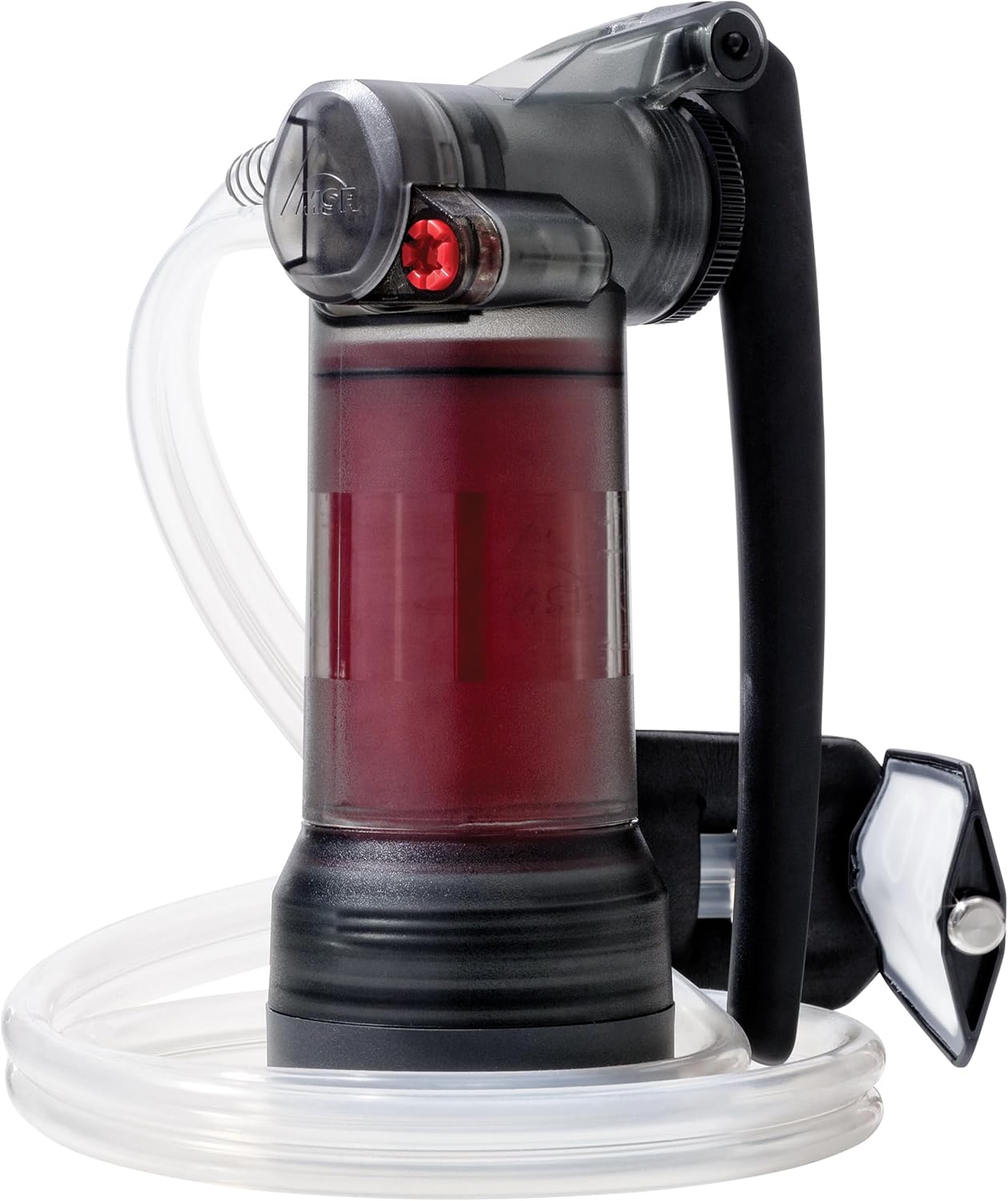
| Purification Method | Activated Carbon, Hollow Fiber Membrane |
|---|---|
| Maximum Flow Rate | 2.5 liters per minute |
| Capacity | 10000 liters |
| Supported Water TDS Level Maximum (PPM) | 1000 |
| Power Source | Manual |
The MSR Guardian is a heavy‑duty manual pump purifier intended for high-risk water sources and emergency preparedness. It uses hollow fiber membranes and activated carbon in a pump that meets NSF P248 military testing, so it treats viruses, bacteria, protozoa, and particulates while delivering a fast flow of up to 2.5 liters per minute. The unit is built to withstand freezing, drops, and heavy use and the pump self-cleans on every stroke, which keeps flow rates high without manual backflushing. It treats up to 10,000 liters before replacement and ships with a storage bag that has a PFAS-free DWR coating. The purifier is relatively lightweight for its capability, but it is a purpose‑built, single‑unit solution so you should expect higher upfront cost and a learning curve for priming and field maintenance compared with simple gravity filters. For users needing a proven, high‑capacity purifier that handles the worst water and keeps treating at speed, the Guardian is a practical choice.
Best for: Buyers who prioritize proven, high‑performance purification for emergency kits, international travel, or backcountry use and want a durable, fast purifier that handles the worst water.
Less Ideal for: People seeking the cheapest or simplest emergency filter, ultralight day hikers who avoid heavy gear, or users who prefer fully passive gravity systems over a manual pump.
- Meets NSF P248 military testing for virus, bacteria, protozoa, and sediment removal
- High flow rate up to 2.5 liters per minute for fast treatment in the field
- Long service life rated to treat up to 10,000 liters before replacement
- Rugged, field‑ready construction that tolerates freezing, drops, and heavy use
- Self‑cleaning pump design that maintains consistent flow without backflushing
- Manual pumping requires physical effort and is less convenient than passive gravity systems
- Higher upfront cost and complexity compared with simple microfilters
Verdict: Choose the MSR Guardian when you need a rugged, military‑grade purifier that delivers fast, reliable removal of viruses, bacteria, and protozoa for emergency and backcountry use.
Waterdrop Gravity Water Filter Straw

| Purification Method | Hollow Fiber Ultrafiltration Membrane |
|---|---|
| Maximum Flow Rate | 700 milliliters_per_minute |
| Supported Water TDS Level Maximum (PPM) | 500 |
| Capacity | 1.5 gallons |
The Waterdrop Gravity Water Filter Straw kit pairs two hollow-fiber ultrafiltration straws with a 1.5 gallon gravity bag and two 16 oz pouches to deliver filtered drinking water for camping or emergencies. You fill the included bag or a compatible bottle, hang or prop it up, and let gravity pull water through the 0.1 micron membrane into a clean container; the listed flow rate can reach about 700 ml per minute so it fills quickly for group use. The straws are rated to treat roughly 1,400 gallons each and include a backwashable mouthpiece to flush sediment and help restore flow in the field. Because it is non-electric and packaged as a freestanding gravity system, it works without pumps or chemicals and is simple to set up in a shelter or campsite. Limitations are that it does not list viral removal or chemical adsorption media like activated carbon for heavy metals, so very high-TDS or chemically contaminated sources may need additional treatment. The kit is compact and practical for emergency kits, day hikes, and group water resupply where microfiltration of particulates and bacteria is the priority.
Best for: Buyers building a compact, no-power emergency water kit or practical campers who want fast, hands-free filtration of bacterial and particulate contaminants for groups.
Less Ideal for: People who need guaranteed viral removal or filtration for chemical-heavy or industrially contaminated water should choose systems with certified viral/chemical treatment or additional adsorption stages.
- 0.1 micron hollow fiber membrane reduces particulates, sediment, and bacteria-level contaminants
- Gravity-fed 1.5 gallon bag allows hands-free filtration and relatively fast flow up to 700 ml/min
- Backwashable straw mouthpiece for field cleaning and extended usable life
- High stated lifespan of about 1,400 gallons per straw for long-term emergency use
- Does not specify viral removal or heavy chemical adsorption capabilities
- Included components may not address very high-TDS or chemically contaminated water
Verdict: A simple, gravity-powered filtration kit that delivers fast, backwashable microfiltration ideal for emergency kits and group camping without power.
Potable Aqua Water Purification Tablets (50ct)

| Unit Count | 50 Count |
|---|---|
| Number of Items | 2 |
| Product Benefits | Disinfects contaminated drinking water and improves taste and color |
| Manufacturer | Wisconsin Pharmacal |
Potable Aqua pairs a standard chlorine-based purification tablet with a PA Plus neutralizer in two 50-count bottles to treat questionable water in emergency or backcountry situations. You add the tablet to a container of water, wait the recommended contact time for disinfection, then use the PA Plus tablet to reduce residual taste and color. The product is compact and lightweight, so it fits easily into a backpack, bug-out bag, or home emergency kit. It targets bacteria and Giardia lamblia and is widely used by military and relief organizations, which speaks to its reliability in low-resource settings. The main limitations are that chemical tablets do not remove particulates or chemical contaminants and require correct dosing and wait times to be effective, so you may still want a pre-filter for turbid water and a different solution for industrial pollutants. For basic biological purification in an emergency where portability and shelf life matter, this is a practical, no-frills option.
Best for: Buyers assembling an affordable emergency or camping water kit who prioritize lightweight, long-shelf-life biological disinfection over filtration of sediments or chemicals.
Less Ideal for: People needing removal of sediment, heavy turbidity, or chemical pollutants should choose mechanical filters or specialized purifiers instead.
- Two-step system includes treatment and taste/color neutralizer
- Compact, lightweight packaging suitable for backpacks and emergency kits
- Effective against bacteria and Giardia lamblia when used as directed
- Used by military and emergency organizations, indicating field reliability
- Does not remove particulates or chemical contaminants
- Requires correct contact time and dosing to be effective
Verdict: A compact, budget-friendly chemical two-step treatment that reliably disinfects emergency drinking water and reduces aftertaste.
LifeStraw Personal Water Filter

| Material Type | Plastic |
|---|---|
| External Testing Certification | NSF |
| Product Benefits | Reduce Parasites, Removes Bacteria |
| Unit Count | 1 Count |
The LifeStraw Personal Water Filter is a simple, ultralight straw you can drink through to make water from lakes, streams or other untreated sources much safer. It uses a microfiltration membrane tested to NSF and EPA-related protocols that blocks bacteria, parasites, microplastics and visible turbidity, and it is rated to treat up to 4,000 liters (about 1,000 gallons) with routine use. In practice you either sip directly from a water source or draw water into a container and sip through the straw; no batteries, pumps or chemicals are required. The product is compact and durable plastic construction makes it ideal for packing in a bug-out bag or glovebox, and LifeStraw's long service life and independent testing give confidence in emergency scenarios. Limitations are that it does not remove viruses or chemical contaminants, and because it is a single-user straw you will need additional tools to share water, treat cloudy or heavily sedimented water beforehand, or replace it after heavy use.
Best for: Buyers who prioritize a proven, low-maintenance water treatment for emergency kits, shelters, or solo outdoor trips and want a durable, no-power solution they can rely on.
Less Ideal for: People who need chemical or viral removal, want to treat water for groups frequently, or prefer a system that fills bottles quickly should consider more comprehensive filtration or purification systems.
- Ultralight and compact for easy storage in emergency kits or backpacks
- Microfiltration membrane certified to remove bacteria, parasites and microplastics
- Long rated lifetime of up to 4,000 liters under proper use
- Requires no power, pumps, or consumable chemicals to operate
- Does not remove viruses or chemical pollutants
- Designed for single-person direct drinking rather than filling multiple containers
Verdict: A proven, ultralight filtration straw that delivers reliable bacterial and parasite protection for emergency survival kits and solo use.
Sawyer Squeeze Filter SP129

| Purification Method | Hollow Fiber Membrane |
|---|---|
| Maximum Flow Rate | 1.7 liters per minute |
| Upper Temperature Rating | 40 °C |
| Supported Water TDS Level Maximum (PPM) | 1000 |
| Capacity | 100000 gallons |
The Sawyer Squeeze SP129 is a compact, high-performance 0.1 micron hollow-fiber filtration system designed for backpacking, travel, and emergency preparedness. It ships with two 32‑oz collapsible pouches, adapters for 28 mm bottles and hydration packs, and a mesh storage bag so you can squeeze or drink directly from a treated pouch, fit the filter inline with a hydration hose, or use it on standard bottles. The filter is rated to protect against bacteria and protozoa and to remove 100% of microplastics, and Sawyer reports a very large service life capacity which makes it suitable for repeated use in long-term emergency scenarios. Flow is respectable for a small filter at up to about 1.7 liters per minute, though squeezing or gravity setups are required rather than powered pumping. Maintenance is straightforward with backflushing recommended to preserve flow, and the included pouches save weight and packing space. The main trade-offs are manual operation and the need to keep the filter clean in turbid water, but for a compact, proven emergency filter the Squeeze balances reliability, portability, and long service life.
Best for: Buyers who want a proven, lightweight, long-life filter for emergency kits or outdoor travel and who prioritize reliable microbial protection backed by many user reviews.
Less Ideal for: Users who need automatic or high-volume motorized filtration for group basecamps or who expect to treat very muddy water frequently without prefiltration.
- 0.1 micron hollow-fiber filter blocks bacteria, protozoa, and microplastics
- Includes two reusable 32‑oz collapsible pouches and bottle/hydration pack adapters
- High advertised capacity suitable for long-term use
- Lightweight and highly packable for emergency kits and backpacks
- Requires manual squeezing, gravity feed, or backflushing to maintain flow
- Performance can be reduced by very turbid water without prefiltering
Verdict: A compact, field-proven filter that delivers strong microbial and microplastic protection while staying lightweight and easy to pack for emergency preparedness.
Aquatabs Water Purification Tablets 397mg

| Tablet strength | 397mg |
|---|---|
| Pack count | 100 |
| Treatment time | 30 Minutes |
| Treated volume per tablet | 4 gallons |
Aquatabs 397mg tablets are a compact chemical water disinfectant intended for emergency preparedness and outdoor use. Each tablet treats up to 4 gallons and claims full microbial kill (bacteria, viruses, cysts) after a 30‑minute contact time, so you drop a tablet into a container or bag of water and wait for safe-to-drink results. The bulk 100‑count bag is lightweight and easy to store in a survival kit, RV, or backpack, and the tablets have minimal taste compared with iodine-based treatments. Because they rely on a soluble chemical rather than mechanical filtration, they handle microbiological contamination well and work on cloudy water when paired with a sediment filter or settling step. Limitations: they do not remove sediment, heavy metals, or chemicals, and treated water requires the full contact time before consumption, so they are not instantaneous like some pump filters. Users should also follow dosing instructions closely and be mindful of the stated volume per tablet.
Best for: Buyers who prioritize reliable pathogen disinfection and want a compact, long‑shelf emergency treatment to keep in a preparedness kit or for outdoor trips.
Less Ideal for: People needing immediate filtration of particulates, chemical removal, or repeated daily drinking without waiting periods should choose a mechanical or multi-stage filter instead.
- Treats up to 4 gallons per 397mg tablet for large‑volume emergency use
- Proven broad-spectrum disinfection against bacteria, viruses, and cysts
- Lightweight, compact 100‑count pack easy to store in emergency kits
- Minimal unpleasant taste compared with iodine alternatives
- Does not remove sediment, particulates, heavy metals, or chemical contaminants
- Requires a 30 minute contact time before water is safe to drink
Verdict: Choose Aquatabs 397mg tablets if you want a compact, proven chemical treatment that reliably disinfects large volumes of emergency water.
Choosing the Right Water Filter for Emergency Preparedness: Key Factors to Consider
Contaminant Removal Capability
Verify what contaminants a filter actually removes and how that aligns with likely emergency hazards. Biological threats such as bacteria and protozoa require mechanical filtration or disinfection technologies rated for microbial reduction. Chemical contaminants like heavy metals, pesticides, and volatile organic compounds need activated carbon, ion exchange, or specialized media.
Understanding the specific removal claims and the applicable certifications or test data matters because different emergencies pose different risks. In flood zones, sediment and microbial contamination are most common. In scenarios involving industrial incidents, chemical adsorption performance becomes critical. Selecting a unit with the right blend of technologies ensures you are prepared for the most likely contaminants in your area.
Flow Rate and Daily Throughput
Consider how much water your household will need per day and whether the filter can meet that demand without excessive time or effort. Small inline or straw-style filters are excellent for one person or short hikes, but they may not provide enough volume for multiple people or extended sheltering.
Throughput also affects logistics during an emergency. Filters with higher flow rates reduce the time spent processing water, freeing you to focus on other priorities. Check rated liters or gallons per minute and the total service life of the filter media to estimate how often elements must be replaced when treating large volumes.
Durability and Construction
Emergency gear is often exposed to rough handling, temperature swings, and debris. Choose filters built from robust materials that resist cracking, clogging, and corrosion. Metal fittings, reinforced housings, and quality seals increase a unit's lifespan in field conditions.
Durability also ties to repairability. Units with modular parts and widely available spare elements allow on-the-fly repairs and extended service life. Less durable plastic housings or fragile connectors may fail when you most need them, so factor construction quality into procurement decisions.
Storage Life and Shelf Stability
For emergency preparedness, it is important that filters and their consumables remain ready over months or years. Some filter media are shelf-stable and retain performance when stored dry, while others degrade or require periodic replacement. Consider how the filter should be stored, whether it needs periodic flushing, and how long replacement cartridges remain effective on the shelf.
Long shelf life reduces maintenance chores and ongoing costs. Also account for packaged water storage compatibility and whether the filter can be connected quickly to common containers like barrels, jerry cans, or gravity bags.
Ease of Use Under Stress
In emergencies you may have limited light, shaky hands, or little time to configure complex systems. Filters that require few steps, clear connections, and minimal tools are preferable. Intuitive indicators for flow, a straightforward prime procedure, and easy-to-follow instructions reduce user error when treating water.
Look for systems that can be operated without electricity, with one or two people, and that offer visible guidance on when elements need replacing or backflushing. Simplicity speeds deployment and reduces the chance of accidental contamination.
Maintenance Requirements and Consumables
Understand what ongoing maintenance a filter needs and how easy it is to source replacement parts. High-maintenance systems with rare consumables are a liability during prolonged emergencies. Filters that allow cleaning, backflushing, or that use common replacement cartridges are easier to keep operational.
Also consider whether the design permits regeneration in the field or requires factory servicing. Plans for stocking spare cartridges and knowing expected lifespans under heavy use are essential parts of a preparedness strategy.
Types of Emergency Water Filtration Systems
Emergency water filters fall into several broad categories: point-of-use mechanical filters, gravity-fed systems, pump filters, and chemical or combined treatment kits. Mechanical filters use fine pores or hollow fibers to block bacteria and protozoa. Gravity systems are convenient for treating larger volumes without power. Pump filters let you draw water from a source and push it through media, useful when sources are distant or turbid.
Chemical disinfection and combined systems add layers of protection by targeting viruses or chemical contaminants that mechanical filters may not remove. Choosing the right type depends on expected hazards, how much water you need, and whether you can rely on manual effort during the emergency.
- Point-of-use filters are compact and fast to deploy for individual use.
- Gravity systems are suitable for households and group sheltering due to higher throughput.
- Pump filters provide flexibility to access moving or shallow sources.
- Chemical treatments are lightweight and effective against viruses when used correctly.
Preparing a Water Storage and Filtration Plan
A robust plan pairs stored water with filtration capability. Store a baseline amount of water per person, then have filtration ready to treat additional sources if stored supplies run low. Keep filter spare parts and consumables with your storage cache so you can treat water reliably.
Label containers with fill dates and arrange supplies so that the easiest-to-use systems are accessible first. Practice assembling and using each filter type before an emergency so you can operate quickly and confidently under stress.
- Match filter capacity to household daily needs before deciding how many units to stock.
- Include spare cartridges, tubing, and connection adapters in your cache.
- Plan for both stagnant and turbid water sources; pre-filtration or settling may be necessary.
Maintaining and Testing Filters in Long-Term Storage
Maintenance routines for stored filters should include periodic inspection, drying, and replacing seals or cartridges per manufacturer guidance. Some filter elements should be stored dry to prevent microbial growth; others are shipped wet and require a different protocol. Keep a log of when you rotated or tested elements.
Regularly exercise pump seals and valves to prevent them from seizing. Conduct annual flow tests to confirm filters still perform to expectations and replace any element approaching its shelf life. Training household members on these maintenance steps reduces the risk of unexpected failure.
- Perform annual flow checks and visual inspections.
- Dry and repack filters that require dry storage conditions.
- Rotate cartridges based on shelf-life guidance or after heavy use.
Using Filters with Different Water Sources
Not all sources present the same challenges. Clear spring water primarily needs microbial treatment, while floodwater often brings heavy sediment and chemical runoff. For turbid sources, use settling, pre-filters, or cloth sieves to remove large particles before running water through a fine filter to avoid rapid clogging.
When treating unknown sources, use a multi-step approach: coarse sediment removal, mechanical filtration for microbes, and an activated carbon or chemical stage if chemical contamination is suspected. This layered strategy balances throughput and safety.
- Pre-filter turbid water to extend the life of fine filter elements.
- Use conservative assumptions for unknown contamination and include a chemical treatment when chemistry is uncertain.
- Test small batches first when using a new source to gauge turbidity and taste.
Packing and Transport Considerations
If you need to evacuate, choose filters that are compact and lightweight yet still meet your minimum daily water needs. Look for systems that collapse or nest for efficient packing and those that can attach to common containers without special adapters. Durable carrying cases protect equipment from damage during transport.
Balance weight against capacity. A small pump filter is lighter but requires manual operation. Gravity bags and collapsible bladders hold more but take up space when full. Decide what you will carry versus what you will leave with a fixed cache.
- Prioritize compact, multifunction systems for evacuation kits.
- Store heavier, higher-capacity units at fixed locations.
- Include clear instructions and a basic maintenance kit in each packed filter.
How We Chose the Best Water Filter for Emergency Preparedness
We focused on features that matter in true emergency contexts where water quality, reliability, and low-maintenance operation are priorities. Selection favored filters and systems with validated contaminant-reduction capabilities for bacteria, protozoa, and common chemical hazards, plus options that include or support long-term storage. We prioritized designs that operate without grid power, require minimal consumables, and are easy to use under stress. Concrete evaluation criteria included certified removal performance for biological and chemical contaminants, realistic flow rate and throughput for household needs, construction durability and materials suited to repeated use or long-term storage, and logistical factors like portability, spare-part availability, and shelf life of filter elements. We also considered simplicity of operation, setup time in low-light or chaotic conditions, and compatibility with common storage containers. Excluded from consideration were devices that rely on continuous electricity, complex multi-step laboratory processes, or single-use disposables that cannot be replenished in austere situations. We also filtered out units with unclear performance claims or lacking verifiable testing data. The result is a curated set of reliable, practical water filtration solutions for emergency preparedness.
Our full evaluation process is outlined in our review methodology.
FAQ
How much water should I plan to treat per person per day during an emergency?
Plan on at least one to three gallons per person per day for drinking and basic hygiene, depending on climate and activity level. Match your filter capacity and spare parts to this expected daily throughput to ensure sustained access.
Can mechanical filters remove viruses as well as bacteria?
Many mechanical filters effectively remove bacteria and protozoa but not all viruses because viruses are smaller. For viral protection you may need a combined approach such as chemical disinfection, ultrafiltration rated for virus removal, or a treatment step specifically designed for viruses.
How long can filter cartridges be stored before they degrade?
Shelf life varies by media type. Some cartridges remain stable for several years if stored dry and sealed, while others require periodic replacement or conditioning. Check the manufacturer's storage guidance and keep a rotation schedule to avoid expired consumables.
Is it safe to use filtered water from a visibly contaminated source?
You can often make turbid or contaminated water safer by pre-filtering sediment, then applying a validated microbial treatment. However, if chemical contamination is suspected or visible pollution is extensive, avoid using that source unless your filtration system is rated for chemical removal.
Do gravity filters work better for households than pump filters?
Gravity filters are convenient for treating larger volumes with minimal effort, which often makes them well suited to household use. Pump filters are more versatile for fetching water from distant or moving sources but require more manual labor to deliver the same volume.
Final Verdict
Choosing the right water filter for emergency preparedness means balancing contaminant removal, throughput, durability, and ease of operation. Prioritize systems with verified microbial and chemical removal appropriate to your anticipated hazards, enough throughput to meet daily needs, and a maintenance plan that keeps consumables ready. Tradeoffs are inevitable: lighter portable options sacrifice throughput, while higher-capacity units may require more storage space. Decide based on household size, likely water sources, and whether you will shelter in place or evacuate. With the right mix of storage and filtration, you can ensure reliable access to safe drinking water when it matters most.