
Note: This article contains affiliate links. If you click on these links and make a purchase, we may earn a small commission at no extra cost to you. This helps support our research and content. Read our full affiliate disclosure here.
If your home draws from a private well, hard water and dissolved contaminants can affect taste, plumbing, and appliances. Choosing the right water filter for hard well water matters because well chemistry varies and a one-size-fits-all approach often fails. You need a system that targets the specific minerals and common well contaminants in your area while also managing scale to protect fixtures. This guide shortlists the top options for well owners and explains how we evaluated them across filtration performance, scale control, flow rate, and maintenance needs. Read on to see the types of systems that made the list and which features to prioritize for reliable well-water treatment.
Top Picks at a Glance
| Best Overall The best all-around choice for most situations | iSpring WGB32BM 3-Stage Whole House Filter |  |
| Best Quality Built to a higher standard if you want something more solid | Aquasana WH-WELL-CT-UVS |  |
| Best Value The sweet spot between price and what you get | Waterdrop WD-WHF21-FG Whole House Filter |  |
| Best Budget The cheapest option that still gets the job done reliably | Amazon Basics Under-Sink Water Filter |  |
| Top Rated A top-rated pick with lots of positive feedback | PUREPLUS 5 Micron 10×4.5 Filter |  |
| Most Popular A crowd favorite that many people choose with confidence | Camco TastePURE RV Water Filter 40043 |  |
| Best Seller A high-volume bestseller chosen again and again | SimPure DB10P Filter Housing |  |
iSpring WGB32BM 3-Stage Whole House Filter
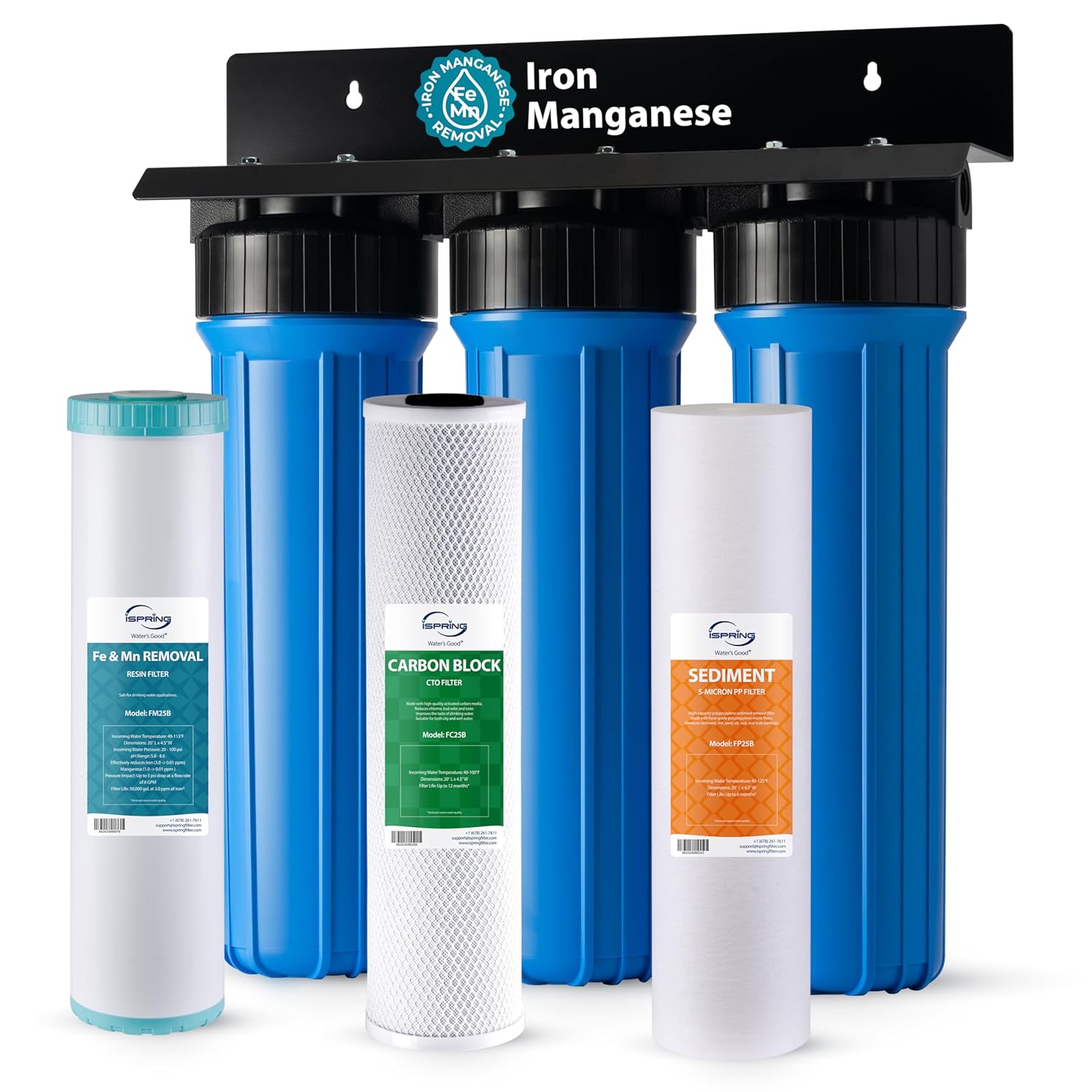
| Maximum Flow Rate | 15 gpm |
|---|---|
| Operating Pressure Range | 25 – 80 psi |
| Operating Temperature | 40 – 100 °F |
| Filter Life Cycle | 1 years |
| Inlet / Outlet | 1 inch NPT |
The iSpring WGB32BM is a tankless, 1-inch inlet whole-house filter that combines a multi-layer sediment stage, a coconut-shell carbon block, and an iron and manganese catalytic media to protect plumbing and improve water quality. It is installed at the main supply line and is intended for DIY or professional plumbing hookup, delivering up to 15 gpm with minimal pressure loss when operating within the 25 to 80 psi range. The sediment cartridge traps sand, rust and large particles to protect downstream cartridges, the carbon block removes chlorine, taste and odor, and the third-stage catalytic media substantially reduces iron and manganese within the stated limits. Cartridges are sized for high capacity use and the manufacturer rates filter life up to 100,000 gallons or 12 months for many stages, which keeps annual maintenance predictable for most households. Important limitations are that it will not soften water or remove dissolved solids and it is not specified for iron or manganese levels above the listed maxima, so very high iron well water may need a different solution or a pretreatment softener. The system ships with three filters and a wrench and iSpring provides a one-year warranty and lifetime tech support.
Best for: Homeowners who want an all-round whole-house filter to improve water taste, reduce chlorine and remove moderate iron and sediment from well water while keeping annual maintenance simple.
Less Ideal for: Homes with very hard water or very high iron/manganese concentrations that require dedicated softening or specialized iron removal solutions.
- Three-stage filtration targeting sediment, chlorine/taste/odor, and iron/manganese
- High flow capacity up to 15 gallons per minute with low pressure loss
- Long-rated cartridge life up to 100,000 gallons or 12 months for key stages
- Includes three filters and a wrench for straightforward initial setup
- Does not remove water hardness or lower total dissolved solids
- Not intended for iron levels above 3.0 ppm or manganese above 1.0 ppm
Verdict: A high-capacity, easy-to-maintain three-stage whole-house filter that improves taste and removes moderate iron and sediment for most well-water households.
Aquasana WH-WELL-CT-UVS

| Maximum Flow Rate | 14.7 gpm |
|---|---|
| Filter Life Cycle | 5 years |
| Capacity | 500000 gallons |
| Operating Pressure Range | 20-100 psi |
| Supported Water TDS Level Maximum (PPM) | 1000 |
The Aquasana WH-WELL-CT-UVS is a multi-stage whole-house system built for well water: a 20" pre-filter, large filter tank with carbon and copper-zinc (KDF) media, a salt-free scale conditioner, 10" post-filter, and an integrated UV purifier. It installs on the main line and is intended to reduce chlorine, organic contaminants, bacteria and viruses while limiting scale without salt or regeneration. With a rated flow up to 14.7 gpm and a 500,000-gallon / 5-year filter life, it can support typical family demand and lower maintenance frequency compared with cartridge-only setups. Practical benefits include improved drinking water taste, gentler water for skin and hair, and protection for appliances from scale. The system does need space for its tall tanks and a corded UV power source, and its contaminant reduction depends on flow rate and incoming water chemistry so heavily iron-rich or extremely hard supplies may require pretreatment or testing. Installation kit components are included for 3/4" or 1" lines, but professional plumbing installation is advisable for best performance and warranty compliance.
Best for: Buyers who prioritize robust contaminant reduction and continuous whole-house performance for family-sized homes with moderate well water hardness and want a low-frequency maintenance system.
Less Ideal for: Homes with extremely high iron, very hard water, or unusual contaminants that need targeted pretreatment or softening should consider specialized pretreatment before this system or alternative solutions.
- Multi-stage filtration combining carbon and KDF media plus UV for chemical and microbial reduction
- Salt-free scale control protects pipes and appliances without salt or backwashing
- High flow capacity (up to 14.7 gpm) suitable for whole-house demand
- Long rated service life—up to 500,000 gallons or about 5 years between major replacements
- Includes pre- and post-filters and an installation kit for 3/4" or 1" lines
- Performance depends on incoming water quality and flow rates so additional pretreatment may be needed for very hard or high-iron well water
- Physically large footprint requires dedicated space and plumbing access
Verdict: Choose this system if you want a high-capacity, multi-stage whole-house solution that combines carbon/KDF filtration, UV disinfection, and salt-free scale control for reliable performance on moderate well water.
Waterdrop WD-WHF21-FG Whole House Filter

| Purification Method | Granular Activated Carbon |
|---|---|
| Maximum Flow Rate | 15 gpm |
| Filter Life Cycle | 6 months |
| Supported Water TDS Level Maximum (PPM) | 1000 |
| Capacity | 50000 gallons |
The Waterdrop WD-WHF21-FG is a 2-stage whole-house system designed to reduce iron, manganese, chlorine, heavy metals and particles down to 5 microns while preserving household water pressure. It pairs an iron/manganese reduction cartridge with a coconut-shell granular activated carbon cartridge to target hardness-related ions plus taste and odor contaminants. The unit supports up to 15 gallons per minute and uses 1" NPT plumbing connections so showers and multiple fixtures can run without noticeable pressure loss. Filters are rated for roughly 50,000 gallons or about six months of typical use, and the housing includes brass threads and dual O-rings intended to minimize leaks. Installation is aimed at DIYers with a mounting bracket, preinstalled parts, and an included wrench, though proper Teflon tape and careful tightening are still required. Limits include the fixed 5-micron rating, which does not remove dissolved salts or reduce very fine TDS, and the need to replace cartridges biannually under heavier well-water conditions. For homes looking to cut iron staining, chlorine taste, and sediment before appliances and fixtures, this is a practical, high-flow option.
Best for: Homeowners with hard or well-influenced water who prioritize reducing iron staining, chlorine taste, and sediment across the whole house while keeping water pressure steady and maintenance straightforward.
Less Ideal for: People needing softening or reduction of dissolved hardness minerals like calcium and magnesium or those who require sub-micron or reverse-osmosis level purification at point-of-use.
- Targets iron and manganese specifically alongside chlorine and sediment
- High flow rate up to 15 GPM preserves water pressure for multiple fixtures
- Long advertised service life of ~50,000 gallons or about six months per set
- Reinforced brass threads and dual O-rings designed to reduce leakage risk
- Includes mounting bracket, wrench and pre-installed parts for easier DIY installation
- 5-micron filtration does not remove dissolved minerals or very fine suspended solids
- Filter replacement every ~6 months may be more frequent for heavily contaminated well water
Verdict: A practical whole-house choice for well-water homes that need reliable iron, manganese, chlorine and sediment reduction while maintaining high flow.
Amazon Basics Under-Sink Water Filter

| Purification Method | Activated Carbon |
|---|---|
| Installation Type | Under Sink |
| Capacity | 11000 gallons |
| Supported Water TDS Level Maximum (PPM) | 500 |
This Amazon Basics under-sink water filter is a simple, manual activated-carbon cartridge designed to reduce chlorine, taste, and odor for household cold water. It mounts under the counter and connects directly to standard 3/8" or 1/2" cold-water lines using the included fittings and hoses, so installation is straightforward for anyone comfortable with basic plumbing. The twist-and-lock cartridge and push-to-connect fittings make replacements quick and the manufacturer rates the cartridge life at 11,000 gallons or 12 months on municipal water. The system is NSF/ANSI 42 and 372 certified, which confirms basic contaminant reduction and lead-free materials. Expect good basic taste and odor improvement but not specialized softening or iron/manganese removal needed for hard well water; this unit targets aesthetic contaminants rather than heavy mineral reduction. Its manual, non-powered design keeps maintenance and running costs low, but buyers needing dissolved solids or hardness control will require additional equipment.
Best for: A buyer seeking an inexpensive, no-frills under-sink filter to improve tap taste and remove chlorine in a household on a budget who wants an easy install and low running costs.
Less Ideal for: Homes on hard well water that need hardness reduction, iron removal, or broader contaminant treatment should choose a specialized well-water system instead.
- NSF/ANSI 42 and 372 certification for chlorine reduction and lead-free materials
- Twist-and-lock cartridge with push-to-connect fittings for fast replacements
- Direct-connect hoses and 3/8"–1/2" converter for easy hookup to standard cold-water lines
- High quoted service life of 11,000 gallons or 12 months on municipal water
- Manual, no-power design keeps operation simple and low-cost
- Does not address hardness, iron, or other dissolved minerals common in well water
- Designed for cold-water only and limited to the contaminants covered by NSF/ANSI 42
Verdict: Choose this unit if you want an affordable, easy-to-install under-sink filter that reliably improves taste and reduces chlorine without adding complexity.
PUREPLUS 5 Micron 10×4.5 Filter

| Micron rating | 5 Micron |
|---|---|
| Material Type | Polypropylene (PP) |
| Unit Count | 2 Count |
| Compatible Models | GE GNWH38F, GXWH30C, GXWH35F, GXWH40L |
| External Testing Certification | ANSI |
This PUREPLUS replacement cartridge is a string-wound polypropylene sediment filter rated at 5 microns and sized for standard 10 x 4.5 inch housings, sold in a two-pack. It is designed for whole-house and well water service where sediment, sand, rust, and color need removal. Installation is straightforward in compatible housings and the soft end caps are intended to seal without extra gaskets; the brand recommends flushing a new cartridge for five minutes before use. PUREPLUS advertises a dense inner structure for deeper filtration, an advertised life up to 30,000 gallons depending on water quality, and tested certifications such as ANSI and various manufacturing quality checks. In practice this filter gives reliable particulate capture and maintains decent flow for routine household use, but like all 5-micron sediment cartridges it will not remove dissolved contaminants such as iron in solution or chemical contaminants. Replace intervals depend on local water conditions and flow demands, typically every 3 to 6 months for many households. For anyone using a standard 10 x 4.5 housing on a hard well, this offers a durable, easy-to-install sediment option that balances dirt-holding capacity with reasonable flow.
Best for: Buyers who prioritize dependable particulate removal on hard well water and want a straightforward, factory-quality sediment cartridge that installs in standard 10 x 4.5 housings.
Less Ideal for: Homes needing reduction of dissolved iron, hardness, or chemical contaminants should consider iron filters, water softeners, or carbon/oxidation stages instead.
- 5-micron string-wound polypropylene construction captures sediment, sand, and rust effectively
- Sold as a two-pack for straightforward scheduled replacements
- Fits standard 10 x 4.5 inch heavy-duty filter housings for wide compatibility
- Soft end caps provide sealing without requiring extra gaskets according to the manufacturer
- Advertised high dirt-holding capacity and tested manufacturing quality (ANSI, ISO processes)
- Does not remove dissolved iron, hardness minerals, or chemical contaminants
- Lifespan and flow rate vary with water quality and may require frequent replacement in very dirty wells
Verdict: A reliable 5-micron string-wound sediment cartridge for well water that fits standard 10 x 4.5 housings and simplifies scheduled replacement.
Camco TastePURE RV Water Filter 40043

| Model Number | 40043 |
|---|---|
| Included Components | Adapter |
| Material Type | Polypropylene (PP) |
| External Testing Certification | NSF/ANSI 42, NSF/ANSI 53, NSF/ANSI 372 |
The Camco TastePURE RV Water Filter is an inline hose filter designed to deliver better-tasting, lower-odor water for RVs, boats, and other outdoor uses. It attaches between a standard water supply and your hose and uses a 6-step Hex-Flow filtration stack combining granular activated carbon, KDF media and a 20-micron sediment layer to cut chlorine, bad taste, odor and larger particles while helping control bacteria and mold growth when idle. The wide-body, high-flow design keeps water pressure usable for drinking, washing and routine campsite tasks, and the included flexible hose protector prevents kinks and strain at the connection. It carries NSF/ANSI 42, 53 and 372 listings and is made in the USA, which supports claims about performance and lead-free construction. Important limits: it is not a point-of-use purifier for microbe-contaminated well water and its 20-micron sediment rating will not remove very fine particulates or dissolved minerals that cause hard water scaling. For standard campground hookups and improving municipal-tasting water, it is effective; for heavy mineral removal or microbiological disinfection, additional treatment is needed.
Best for: Buyers who prioritize verified performance and want a rugged, American-made inline filter to improve taste and odor from campground or municipal hookups, with a preference for products backed by strong social proof and certifications.
Less Ideal for: People seeking a dedicated hard-water treatment or microbiological disinfection solution for well water should look for water softeners, reverse osmosis, or point-of-use UV/chemical disinfection systems instead.
- Multi-stage filtration (GAC + KDF + 20-micron sediment) reduces taste, odor, chlorine and larger particulates
- High-flow wide-body design maintains usable water pressure for drinking and campsite tasks
- NSF/ANSI 42, 53 and 372 listings and made in the USA support verified performance and lead-free claims
- Includes flexible hose protector to prevent kinks and reduce strain at the connection
- Does not remove dissolved minerals that cause hard water hardness or heavy scaling
- 20-micron sediment rating will not filter very fine particulates or provide microbe-level purification
Verdict: Choose the Camco TastePURE when you want an NSF-tested, high-flow inline filter that reliably improves taste and odor at RV and campsite hookups.
SimPure DB10P Filter Housing

| Maximum Flow Rate | 20 gpm |
|---|---|
| Installation Type | Mounted/Fixed |
| Purification Method | Granular Activated Carbon, Sedimentation |
| Supported Water TDS Level Maximum (PPM) | 500 |
| Upper Temperature Rating | 40 °C |
The SimPure DB10P is a single 10" x 4.5" whole-house filter housing designed as a pre-filter for well or municipal water systems. It accepts standard 10" cartridges for sediment, granular activated carbon, or pleated filters and installs on a mounted bracket using 1" NPT brass inlet and outlet ports to support higher flow needs. The polypropylene housing is reinforced for strength and the molded brass threads improve sealing compared with plastic-only fittings, while the included wrench, mounting bracket, and built-in red pressure-relief button make cartridge changes straightforward. Rated up to 20 gpm and tested against NSF standards, it is useful for keeping sand, silt, and chlorine out of downstream appliances and for reducing maintenance on water heaters and washers. Limitations are that cartridges and push fittings are sold separately, and the 10" size provides only one filter stage per housing so deeper contaminant removal will require an additional stage or different media. For buyers who want a reliable, serviceable pre-filter for hard well water, this is a practical, factory-quality housing.
Best for: Homeowners who prioritize reliability and easy maintenance for pre-filtering well or municipal water and want a factory-quality housing that accepts standard cartridges.
Less Ideal for: Buyers seeking a complete multi-stage treatment system or who want cartridges, fittings, or advanced contaminant removal included out of the box.
- Fits universal 10" x 4.5" cartridges so you can choose sediment or carbon media
- 1" NPT brass inlet/outlet for robust connections and better sealing
- Built-in red pressure relief button and included wrench simplify cartridge changes
- Reinforced food-grade polypropylene body rated for up to 20 gpm and NSF tested
- Filter cartridges and push fittings are not included
- Single-stage 10" housing cannot provide deep multi-media filtration alone
Verdict: Choose the DB10P when you want a sturdy, easy-to-service factory-quality housing to protect downstream equipment from sediment and chlorine in hard well water.
Choosing the Right Water Filter for Hard Well Water: Key Factors to Consider
Type of Contaminants Present
Well water chemistry varies widely. A lab test or municipal report will tell you whether iron, manganese, hydrogen sulfide, nitrate, bacteria indicators, or sediment are primary concerns.
Choosing a filter that specifically targets the contaminants you have is crucial. Some systems are optimized for particulate removal, others for dissolved metals, and some combine media or stages to address multiple issues. Buying a system without matching it to actual water data can leave significant problems untreated.
Hardness Level and Scale Management
Hardness is measured in grains per gallon or milligrams per liter and directly affects scale formation in pipes and appliances. Systems that only filter particulates will not reduce hardness.
Decide whether you need a dedicated water softening approach, a template-assisted crystallization media, or a combination system that reduces scale while also addressing other contaminants. The right choice prevents frequent descaling and extends appliance life.
Flow Rate and Household Demand
Whole-house systems must support peak household flow without causing a noticeable drop in water pressure. Consider the system's rated flow in gallons per minute relative to your home's simultaneous use patterns, such as showers plus laundry.
Undersized filters create frustration and may indicate false problems with the well pump. Oversized systems can be costlier and require more maintenance. Choose capacity to match typical and peak demand.
Maintenance Needs and Ongoing Costs
Different media and cartridge types require varying maintenance. Some media are reusable or regenerable, while others need frequent replacement. Factor replacement frequency, media disposal requirements, and any needed chemicals into lifecycle costs.
A system that is easy to service and has accessible replacement parts will be less likely to fall into disrepair. If you have limited DIY skills, prioritize simpler maintenance or professional service options.
Installation and Plumbing Compatibility
Well systems often have specific plumbing configurations, pressure tanks, and pump locations. Choose a filter that fits the available space and can be installed without complex rerouting.
Consider whether you will DIY or hire a plumber. Some systems require bypass valves, drain access for backwash, or electrical connections. Confirming compatibility ahead of purchase reduces installation delays and surprises.
Certifications and Performance Data
Look for documented performance claims and independent test data for the contaminants you care about. Certifications from recognized labs or standards bodies provide assurance that the system does what it claims.
Systems lacking transparent testing make comparing options difficult and increase the risk of unmet expectations. Prioritize units with clear measurable reductions for specific contaminants and hardness-related metrics when available.
Common Well Water Problems and How Filters Address Them
Well water issues range from visible sediment and rust staining to dissolved metals and hard minerals that cause scale. Understanding the symptom helps identify the appropriate treatment. For example, cloudy water and sand-like particles point to sediment filtration, while staining and metallic taste suggest iron or manganese.
Different technologies address different problems. Sediment filters trap particulates, catalytic carbon and oxidizing media can reduce iron and hydrogen sulfide, and specific ion-exchange media or template-assisted crystallization can reduce scale. Some multi-stage systems combine these approaches to create a single solution for several common well issues.
- Sediment filtration for particulate removal
- Oxidizing or catalytic media for iron and hydrogen sulfide
- Ion exchange or salt-free scale control for hardness
- Activated carbon for taste and odor
Salt-Based Softeners Versus Salt-Free Options
Salt-based ion-exchange softeners are effective at removing calcium and magnesium ions that cause hardness, producing softened water that prevents scale. They require periodic regeneration with salt and can increase sodium levels in effluent, which some homeowners consider when discharging to septic systems.
Salt-free systems use different approaches, such as physical crystal modification or sequestration, to reduce scale formation without removing hardness ions. These are lower-maintenance and do not add sodium, but their effectiveness varies with water chemistry and may not be as dramatic as ion exchange for very hard water.
- Salt-based: proven hardness removal, requires salt and regeneration
- Salt-free: lower maintenance, variable results depending on hardness
- Consider plumbing and local discharge rules when choosing
Sizing Your System for a Whole House
Sizing is about both flow rate and capacity. Match the system's peak flow rating to the expected simultaneous demand from showers, appliances, and outdoor use. Also verify the contaminant load and choose media capacity that avoids premature exhaustion under your household's usage.
Factor in seasonal variations, such as higher outdoor water use in summer. For well owners, pump cycle behavior and pressure tank size affect how a system performs; a too-large system that sits idle may still be appropriate if its media life and regeneration schedule fit your maintenance plan.
- Check rated gallons per minute against household peak demand
- Compare media capacity to your well's contaminant levels
- Account for seasonal and occasional high-demand events
Installation Considerations for Well Systems
Plan for physical space, access to an electrical outlet if the system uses timed or demand-based regeneration, and proximity to a drain for backwash systems. A bypass valve provides uninterrupted water during service and makes maintenance easier.
If you rely on a well pump, consult pump specifications to ensure the additional headloss from filtration does not exceed safe operating limits. Some installations benefit from a prefilter ahead of the main system to extend service intervals and protect more expensive media.
- Allow space for service and replacement media
- Ensure drain and electrical access for backwash or powered units
- Use bypass valves to simplify maintenance
Maintenance Tasks to Expect
Routine tasks vary by system but commonly include changing cartridges, adding or replenishing regeneration media, cleaning or backwashing media beds, and occasional sanitizing of the system and plumbing. Keep a schedule based on manufacturer recommendations and actual water conditions to avoid surprises.
Some systems indicate service needs via pressure gauges or flow monitors. Track changes in taste, odor, or pressure as early warning signs of filter exhaustion. Budget time and minor supplies into your regular home maintenance routine to keep the system performing reliably.
- Regular cartridge or media replacement
- Backwashing or regenerating media as required
- Monitoring pressure and water quality for service signs
How We Chose the Best Water Filter for Hard Well Water
We evaluated candidate systems using criteria that matter to homeowners on private wells. Primary filters were judged on measured contaminant removal for common well issues such as iron, manganese, sediment, and bacterial risk indicators where applicable. Scale-control performance and hardness handling were assessed to determine whether a system reduces mineral buildup on fixtures and inside appliances. Flow capacity and pressure retention were considered because well pumps and household demand require dependable flow without excessive pressure drop. Maintenance burden and operating costs were measured by filter change frequency, media longevity, and complexity of routine tasks. Installation options and compatibility with typical well setups were reviewed to ensure systems fit common plumbing configurations. We excluded single-use, point-of-use pitchers or untested DIY fixes and any systems that lack clear specifications for hardness or contaminant reduction. Final selections focus on solutions that balance measurable filtration, scalable capacity for whole-house use, and realistic maintenance expectations.
Our full evaluation process is outlined in our review methodology.
FAQ
How do I test my well water to know which filter I need?
Start with a comprehensive water test from a certified laboratory or a reliable DIY kit that measures hardness, iron, manganese, nitrate, and bacterial indicators. The test results tell you which contaminants are present and at what concentrations, guiding your choice of filtration technologies.
Can a single system handle both hardness and iron?
Some multi-stage systems combine scale-control media with oxidizing or catalytic stages that reduce iron and manganese. Effectiveness depends on concentrations and water chemistry, so confirm the system specifications match your test results and consider prefiltration if sediment loads are high.
How often will I need to service or replace filters?
Service intervals depend on contaminant load and system type. Sediment cartridges may need replacement every few months, while media beds in larger systems can last several years with proper backwashing. Monitor flow and water quality to determine when maintenance is necessary.
Will a water filter for hard well water remove bacteria?
Not all systems address microbiological contamination. Some filters reduce bacterial indicators through ultrafiltration or UV disinfection modules, but many mechanical or media filters do not. If bacteria are a concern, choose a system specifically rated for microbiological reduction.
Do salt-based softeners affect septic systems?
Salt-based systems discharge brine during regeneration, which can impact septic biology depending on drain field design and local regulations. Check local guidance and consider salt-free alternatives if septic compatibility is a priority.
Final Verdict
For well owners dealing with hard water, prioritize systems that match documented water problems and balance scale control with contaminant removal. Choose capacity and flow ratings that fit household peak demand, and select media types that target iron, sediment, or other site-specific issues. Tradeoffs include maintenance frequency, space and drain needs, and whether you prefer salt-based softening or lower-maintenance salt-free options. Focus on measured performance data and realistic servicing expectations to pick a reliable system that protects plumbing and improves water quality over time.