
Note: This article contains affiliate links. If you click on these links and make a purchase, we may earn a small commission at no extra cost to you. This helps support our research and content. Read our full affiliate disclosure here.
If you are concerned about lead, mercury, or other heavy metals in your tap water, selecting the right water filter matters for health and convenience. A good filter removes specific heavy-metal contaminants without overly restricting flow or requiring frequent cartridge swaps. This guide shortlists the top-performing options for heavy-metal removal, focusing on real-world factors like contaminant reduction ratings, filter life, and installation style. Below you will find concise evaluations of each shortlisted system and the criteria we used to compare them. Read on to match a heavy-metal filtration solution to your household needs.
Top Picks at a Glance
| Best Overall The best all-around choice for most situations | APEC Water ROES-PH75 |  |
| Best Quality Built to a higher standard if you want something more solid | Waterdrop G3P600 Tankless RO |  |
| Best Value The sweet spot between price and what you get | ICEPURE Under Sink Water Filter WFS5300A |  |
| Best Budget The cheapest option that still gets the job done reliably | CaoXiong 360° Faucet Filter | 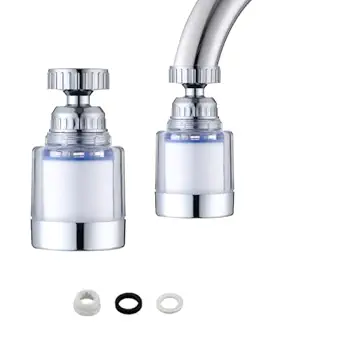 |
| Top Rated A top-rated pick with lots of positive feedback | Brita Large 10-Cup Pitcher |  |
| Most Popular A crowd favorite that many people choose with confidence | ZeroWater 10-Cup Ready-Pour Pitcher |  |
| Best Seller A high-volume bestseller chosen again and again | DREO RO Countertop WF112 | 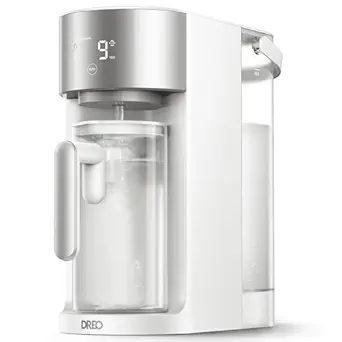 |
APEC Water ROES-PH75

| Purification Method | Reverse Osmosis |
|---|---|
| Capacity | 75 gallons_per_day |
| Operating Pressure Range | 40-85 psi |
| Supported Water TDS Level Maximum (PPM) | 2000 |
The APEC ROES-PH75 is a 6-stage under-sink reverse osmosis system designed to remove a wide range of contaminants while restoring pH with a calcium mineral stage. Installed under a sink and paired with the included faucet and tank, it uses water pressure to push feed water through prefilters, an RO membrane, and a post-mineral cartridge to yield up to 75 gallons per day of filtered water. Notable features include WQA certification, a high TDS tolerance (up to 2000 ppm), and a dedicated alkaline stage that improves taste and raises pH slightly. The system is built from polypropylene components and comes with the hoses, fittings, tank, and wrenches needed for typical DIY installation. Limitations include the usual RO drawbacks: it requires adequate feed pressure, produces wastewater during filtration, and needs periodic filter and membrane replacement on a schedule tied to incoming water quality. For households focused on reducing heavy metals and a broad set of dissolved contaminants, this model delivers robust, factory-quality RO performance with the benefit of a mineralized finish.
Best for: Buyers who want a comprehensive under-sink system that prioritizes removal of heavy metals and other dissolved contaminants while retaining the option for mineralized, better-tasting water.
Less Ideal for: People who cannot accommodate a drain line, have very low incoming water pressure, or who prefer a no-waste countertop purifier should consider other options.
- Six-stage filtration including RO membrane for broad contaminant removal
- WQA certification indicating tested materials and performance
- High daily output (75 GPD) suitable for most households' drinking and cooking needs
- Includes tank, faucet, tubing, and basic installation tools for DIY setup
- Alkaline mineral stage adds calcium to improve taste and raise pH slightly
- Produces wastewater as part of the RO process which needs a drain connection
- Requires adequate feed water pressure and periodic filter/membrane replacements
Verdict: Choose the ROES-PH75 if you need a certified, high-capacity under-sink RO that removes heavy metals and returns drinkable water with added minerals.
Waterdrop G3P600 Tankless RO
| Filtration stages | 8-stage |
|---|---|
| Capacity | 600 GPD |
| Pure to drain ratio | 2:1 |
| Maximum flow rate | 0.42 gpm |
| Power source | Corded Electric |
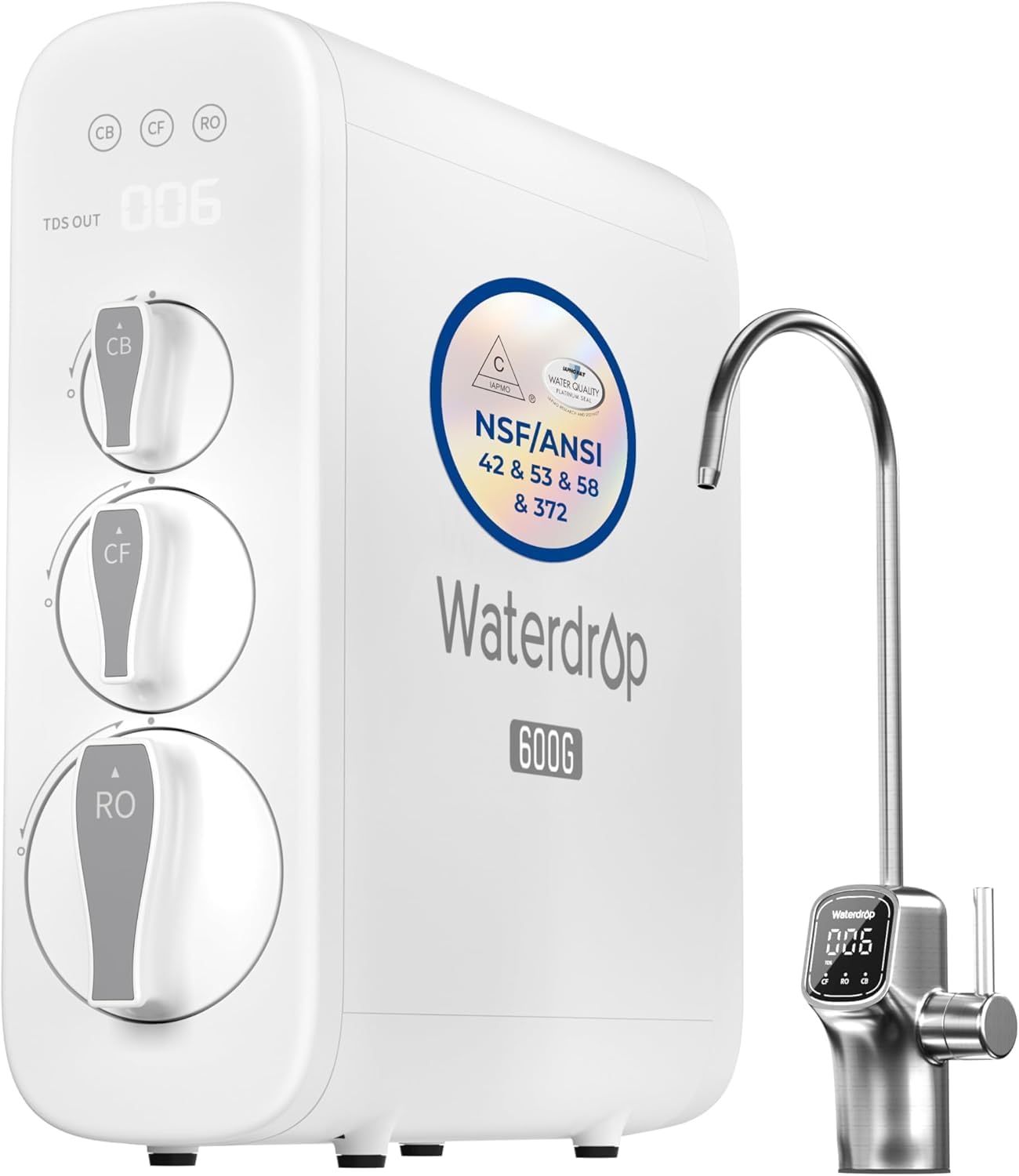
The Waterdrop G3P600 is a tankless under-sink reverse osmosis system designed to deliver high volumes of purified water while minimizing under-sink footprint. It uses an 8-stage filtration train including RO membrane and carbon block stages to reduce heavy metals, PFAS, chlorine, fluoride, and other contaminants, and the system is certified to NSF/ANSI 42, 53, 58, and 372. The tankless design produces filtered water on demand—about one 8 oz cup in roughly 8 seconds—and the unit reports TDS and filter life through a smart-display faucet so you can monitor performance in real time. The G3P600 advertises a low 2:1 pure-to-drain ratio and requires a plug-in power source and a drilled faucet hole and drain connection. Installation and filter changes are user-friendly with twist-in cartridges, but it does require under-sink space that fits the unit and an electrical outlet. For buyers focused on removing heavy metals and industrial contaminants, this system balances high output with continuous monitoring and compact, tankless operation.
Best for: Buyers who prioritize high contaminant removal and fast on-demand output for heavy-metal reduction and want continuous TDS visibility to track system performance.
Less Ideal for: People who need a non-electric or countertop solution, have no space or willingness to drill for installation, or who prefer a simple pitcher-style filter.
- Certified to NSF/ANSI 42, 53, 58 and 372 for contaminant reduction and lead-free materials
- 8-stage filtration including RO membrane and carbon block targeting heavy metals, PFAS, chlorine, fluoride and TDS
- High 600 GPD capacity with a fast dispense speed for on-demand use
- Smart faucet display shows TDS and filter life for real-time monitoring
- Tankless design frees under-sink storage and allows tool-free quick filter replacement
- Requires under-sink electricity and drilling for faucet and drain connections
- Not truly portable; must fit cabinet space and plumbing layout
Verdict: If you need a high-capacity, certified RO system that targets heavy metals and gives live TDS feedback, the G3P600 delivers tankless, on-demand purified water with strong contaminant removal.
ICEPURE Under Sink Water Filter WFS5300A

| Purification Method | Activated Carbon |
|---|---|
| Maximum Flow Rate | 2.5 gpm |
| Filter Life Cycle | 3 years |
| Capacity | 22000 gallons |
| Other Special Features of the Product | Chlorine Reduction, NSF certified |
The ICEPURE WFS5300A is an under-sink activated carbon cartridge system designed to deliver filtered cold drinking water without changing your faucet or cutting countertop holes. It installs with a direct-connect adapter to standard 1/2" or 3/8" female NPT cold water lines and promises a high tested flow rate of 2.5 gallons per minute, so it can keep up with typical kitchen demands for drinking, cooking, and coffee. The cartridge uses coconut shell carbon with an outer 0.5 micron layer and carries NSF/ANSI 42 and 372 listings for chlorine, taste, odor reduction and lead-free materials, which makes it a practical choice for improving water taste while preserving beneficial minerals. ICEPURE highlights a long service life of about 22,000 gallons (roughly three years under normal municipal use) and a quick tool-free filter change. Limitations include that it is for cold water only and the filtration is focused on chlorine/taste and heavy metals testing rather than multi-stage reverse osmosis level contaminant removal, so it may not address all heavy metal scenarios that require higher-end or targeted technologies.
Best for: Buyers who want a low-maintenance, high-capacity under-sink filter to improve taste and reduce chlorine and common heavy metal exposure in municipal cold water without frequent cartridge changes.
Less Ideal for: Households that need full-spectrum contaminant removal, including very high concentrations of specific heavy metals or total dissolved solids, should consider multi-stage or RO systems instead.
- NSF/ANSI 42 and 372 certified for chlorine reduction and lead-free materials
- High advertised capacity of 22,000 gallons (about 3 years) for lower replacement frequency
- Tested flow rate up to 2.5 GPM supports normal kitchen use without noticeable slowdown
- Quick plug-and-play installation and tool-free 2-second filter replacement
- Filters cold water only and requires compatible 1/2" or 3/8" female NPT connection
- Activated carbon cartridge targets chlorine, taste, and some heavy metals but is not a multi-stage RO system for comprehensive contaminant removal
Verdict: Choose this high-capacity under-sink carbon filter if you want long-lasting, NSF-certified chlorine and lead-free performance with minimal maintenance.
CaoXiong 360° Faucet Filter
| Purification Method | Activated Carbon, Ion Exchange |
|---|---|
| Upper Temperature Rating | 120 °F |
| Supported Water TDS Level Maximum (PPM) | 300 |
| Material Type | Plastic |
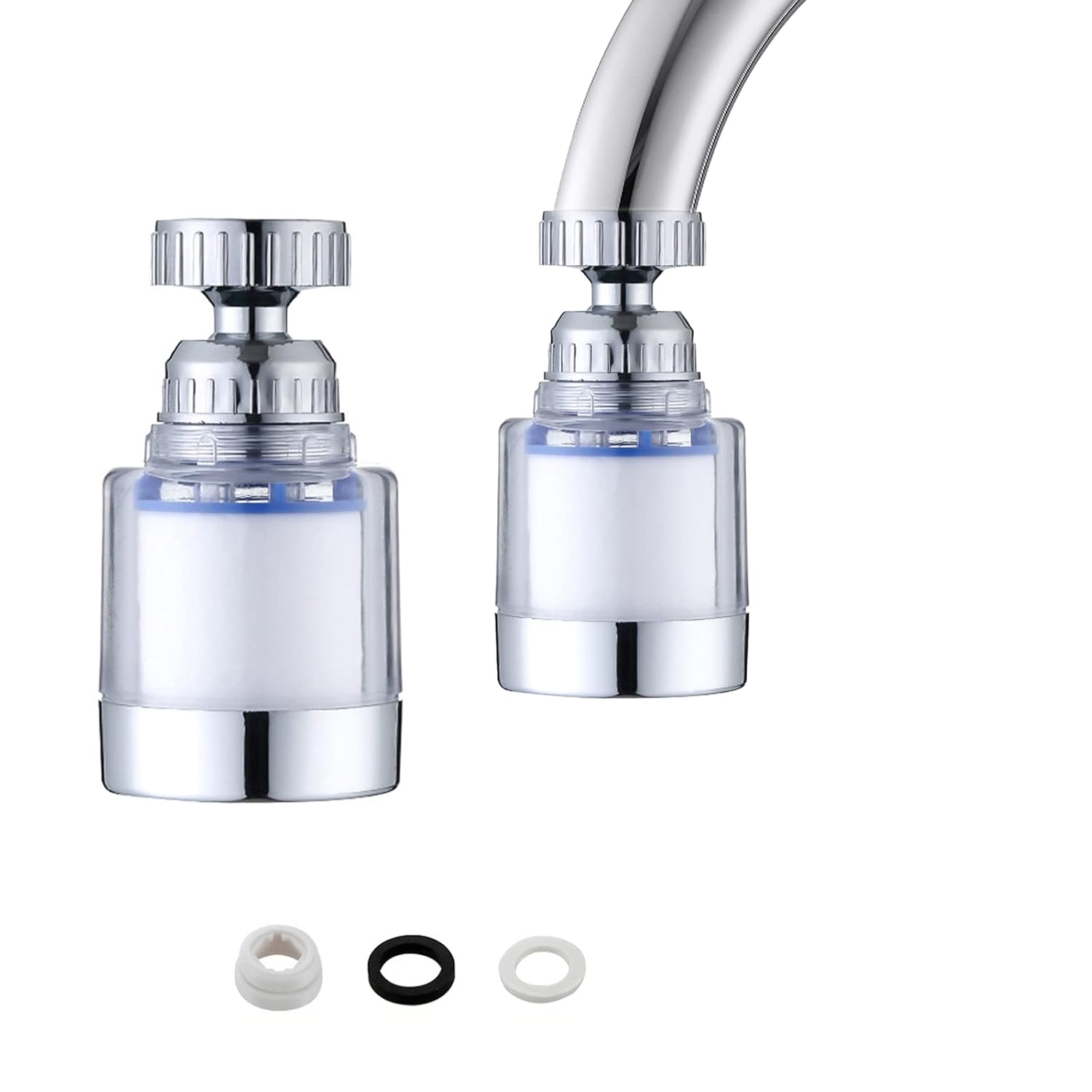
This small 360-degree rotating faucet filter attaches to most round faucet outlets and combines activated carbon, ion exchange resin, PP cotton, and mineralized balls to reduce lead, iron, rust, chlorine, chloramine, and some fluoride while softening hard water. Installation is straightforward: remove the existing aerator or use the included adapter for internal-thread faucets, then tighten the unit in place. The transparent housing makes it easy to see when the replaceable cartridge is clogging and affecting flow, and the low-profile plastic body tolerates typical tap temperatures up to 120°F. Because it is a simple faucet-mount adapter, it delivers point-of-use filtration for drinking and cooking without plumbing changes, but flow rate will drop as the cartridge loads and it only fits faucets with the specified outlet diameter. Expect routine filter replacements and limited capacity compared with under-sink or whole-house systems, though for a low-cost, tool-free solution it effectively targets common heavy-metal and sediment concerns at the tap.
Best for: Buyers looking for an inexpensive, no-plumbing point-of-use filter to cut heavy metals and sediment at a single tap and who prioritize low upfront cost and simple installation.
Less Ideal for: Households that need whole-home treatment, high flow for multiple users, or a filter with long service life and large capacity should consider under-sink or whole-house systems instead.
- Reduces heavy metals, rust, chlorine, chloramine and some fluoride using activated carbon and ion exchange
- 360-degree rotating design lets you position the filtered flow for sink or basin use
- Transparent housing lets you visually monitor cartridge condition
- Tool-free faucet-mount installation with included adapter for internal-thread faucets
- Flow rate decreases as the cartridge loads and requires timely replacement
- Only fits most round faucets with an outlet diameter around 0.86 in, so not universal
Verdict: An affordable, easy-to-install faucet filter that effectively reduces heavy metals and chlorine at a single tap for budget-conscious buyers.
Brita Large 10-Cup Pitcher

| Purification Method | Granular Activated Carbon |
|---|---|
| Capacity | 10 ounces |
| Filter Life Cycle | 2 months |
| Supported Water TDS Level Maximum (PPM) | 500 |
| Power Source | Manual |
The Brita Large 10-Cup Pitcher is a manual, freestanding water filter pitcher meant for everyday use in the kitchen or fridge. You fill the flip-top reservoir, water passes through a Granular Activated Carbon filter and a small ion-exchange component that Brita certifies to reduce chlorine taste and odor plus select heavy metals like copper, mercury and cadmium. It ships with one filter that lasts about 40 gallons or roughly two months for average family use and is compatible with Brita Longlast and standard replacement filters for longer life if desired. The pitcher is compact enough to fit refrigerator shelves and is simple to operate without power or plumbing, making it convenient for households that want cleaner-tasting tap water and to avoid bottled water waste. Limitations are that it does not disinfect microbiologically unsafe water and filter life requires regular replacement to maintain performance, so reliability depends on timely filter changes.
Best for: Buyers who prioritize consistent contaminant reduction in everyday tap water and want a low-effort, fridge-ready solution that reliably cuts chlorine and select heavy metals without plumbing changes.
Less Ideal for: People who need a point-of-use system to treat microbiologically unsafe water or who require high-capacity filtration for large groups or whole-home treatment.
- Certified to reduce chlorine taste and odor and select heavy metals including copper, mercury and cadmium
- Simple manual design that fits refrigerator shelves and requires no plumbing or electricity
- Compatible with Brita Longlast and standard replacement filters for flexibility in filter life
- Includes one filter and uses a replaceable cartridge system for predictable maintenance
- Filter must be replaced roughly every 40 gallons or two months which adds ongoing cost and maintenance
- Not intended to make microbiologically unsafe water safe to drink
Verdict: Choose this pitcher if you want a simple, fridge-friendly filter that reliably reduces chlorine and common heavy metals without plumbing or power.
ZeroWater 10-Cup Ready-Pour Pitcher

| Capacity | 10 cup |
|---|---|
| Filtration Method | 5-stage ion exchange |
| Included Components | Pitcher, 5-stage filter, TDS meter |
| Certification | IAPMO certified to reduce lead, PFOA/PFOS, chromium, mercury |
The ZeroWater 10-Cup Ready-Pour pitcher is a freestanding filtration pitcher that uses a five-stage ion exchange filter to remove virtually all total dissolved solids and reduce contaminants such as lead, chromium, PFOA/PFOS, and mercury. It is used like a standard pitcher: fill from the top, the filter processes water through five stages, and you can check remaining dissolved solids with the included TDS meter before pouring from the spout. Notable features include the IAPMO-certified filtration, a change-filter indicator, an ergonomic handle, and a quick-fill spigot for easy pouring. In practice the five-stage system gives noticeably lower TDS readings compared with basic carbon pitchers, and the TDS meter helps you know when to replace the cartridge. Trade-offs are typical for high-reduction pitchers: flow rate is slower than simple filters and replacement cartridges are required regularly to maintain performance, so ongoing filter costs and refill time should be expected.
Best for: Buyers who prioritize demonstrable contaminant reduction and want a pitcher that verifies performance with measurable TDS readings for safer drinking water.
Less Ideal for: Anyone who needs very fast refills, wants a maintenance-free option, or prefers a long-term whole-house solution rather than a countertop pitcher.
- IAPMO certified to reduce lead, PFOA/PFOS, chromium, and mercury
- Five-stage ion exchange filtration that removes virtually all TDS for cleaner taste
- Includes TDS meter to verify water quality and know when to change the filter
- Ergonomic handle and ready-pour spigot make filling and pouring easy
- Slower filtration and pour speed compared with single-stage pitchers
- Requires periodic replacement filters which adds ongoing cost
Verdict: Choose this pitcher when you want certified, measurable reduction of heavy metals and dissolved solids in an easy-to-use countertop system.
DREO RO Countertop WF112

| Purification Method | Reverse Osmosis |
|---|---|
| Capacity | 3 liters |
| Pure to Drain Rate | 3:1 |
| Included Components | RO body, RO filter, autofill pitcher |
The DREO WF112 countertop RO system brings multi-stage reverse osmosis performance into small kitchens or offices without permanent installation. It uses a 7-in-1 RO filter and a 3:1 pure-to-drain ratio to remove a broad range of contaminants and includes a built-in TDS meter that shows raw and purified water readings and a filter-life indicator for straightforward maintenance. The unit ships with a 1.1 L autofill pitcher and an auto-fill sensor so you can collect filtered water hands-free, while a self-cleaning flush cycles internal tubing to limit sediment buildup between changes. Setup is installation-free and the replaceable RO cartridge twists in for quick swaps; DREO rates the filter for roughly 265 gallons (about 1000 L) of service. The system is compact and engineered to cut waste compared with many RO designs, but like any countertop RO it produces limited daily output compared with plumbed under-sink RO units and requires periodic cartridge replacement and occasional descaling in hard-water areas.
Best for: Buyers who prioritize reliable contaminant removal and want a no-plumbing countertop RO solution that provides clear TDS readouts and easy maintenance.
Less Ideal for: Large families or users who need continuous, high-volume filtered water from a plumbed source should consider an under-sink or whole-house system instead.
- 7-stage reverse osmosis filtration removes a wide range of impurities including heavy metals
- Built-in TDS meter and change-filter indicator for clear, real-time water quality and maintenance cues
- Auto-fill pitcher and self-cleaning flush reduce manual refilling and help keep internal tubing cleaner
- Installation-free countertop design makes it easy to move and set up without plumbing modifications
- Lower daily output compared with permanently plumbed under-sink RO systems, so not ideal for high household demand
- Filter lifespan (about 265 gallons) means periodic replacements and ongoing consumable cost
Verdict: If you want proven RO-level removal of heavy metals and easy, installation-free operation with built-in TDS monitoring, this compact countertop system is a practical choice.
Choosing the Right Water Filter for Heavy Metals: Key Factors to Consider
Contaminant Reduction Profile
Different filters are engineered to remove different substances. For heavy-metal concerns you should look for explicit reduction data for lead, mercury, cadmium, and arsenic rather than broad "contaminant" claims. Certification or third-party lab reports that quantify percent reduction at specific concentrations provide confidence that the filter will address the metals you worry about.
Pay attention to the conditions under which reduction is measured. Performance can vary with water temperature, pH, and initial contaminant concentration, so confirm the reduction claims match your typical supply conditions when possible.
Filter Lifespan and Replacement Cost
A filter's rated lifespan determines how often you will swap cartridges and therefore the ongoing cost of ownership. Lifespan is often stated in gallons or months; compare that to your household usage to estimate annual replacement frequency. Longer-life cartridges reduce maintenance intervals but may cost more upfront.
Also consider availability and pricing of replacement elements. Some proprietary or uncommon cartridge formats are harder to source and cost more over time. Balance advertised lifespan with realistic replacement costs to choose the most economical option for continuous heavy-metal protection.
Flow Rate and Daily Output
Filtration media that removes heavy metals can restrict flow more than simple carbon filters. Check the unit's flow rate and daily output to ensure it meets your needs for drinking, cooking, and filling containers. Under-sink or direct-connect systems often deliver near-instant filtered water, while gravity or small countertop units may be slower.
If you regularly need larger volumes—such as for meal prep or multiple users—prioritize systems with higher flow and greater throughput ratings so filtration does not become a bottleneck in daily routines.
Installation Type and Space Requirements
Where the filter will live affects ease of use and whether you can install it yourself. Under-sink systems offer concealed installation and steady on-demand flow but require cabinet space and basic plumbing work. Countertop and pitcher-style options are simpler to set up and move but may sacrifice output or capacity.
Consider cabinet depth, proximity to a cold water shutoff valve, and whether you need a dedicated faucet. If renter limitations or limited tools are a concern, choose a model that avoids permanent modifications.
Maintenance and User-Friendly Design
Frequent cartridge changes, tricky seals, or hard-to-access filter housings make upkeep more burdensome. Look for clear service intervals, tool-free replacement, and visible indicators for when a filter needs changing. Materials that resist biofilm buildup and straightforward flushing instructions reduce user error and keep performance consistent.
Also check how easily replacement parts and instructions are provided. Good documentation and simple component access lower the likelihood of installation mistakes and lessen long-term headaches.
Materials and Build Quality
Materials in contact with water should be durable and inert so they do not introduce contaminants of their own. Robust housings and reliable seals reduce leak risk and prolong system life. Metal fittings and certified plastics are preferable for long-term service.
Consider whether the design allows routine cleaning of housings and whether connections use standard thread sizes. Better construction reduces maintenance surprises and supports consistent heavy-metal reduction over time.
Types of Water Filters That Remove Heavy Metals
Several filtration technologies can reduce heavy metals, each with tradeoffs. Activated carbon with targeted adsorption can capture certain metal ions when specifically formulated or combined with other media. Ion-exchange resins swap harmless ions for contaminant ions and are effective for some metals but can require regeneration or replacement more frequently.
Reverse osmosis delivers high removal rates across a broad range of dissolved metals but typically requires under-sink installation, produces wastewater, and may need a storage tank. Specialized filtration media such as KDF or media blends are often used in multi-stage systems to target metals while controlling bacterial growth.
- Activated carbon variants: good for taste and some metal adsorption when specified
- Ion-exchange: effective for certain dissolved metal ions, shorter service life
- Reverse osmosis: highest broad-spectrum removal, lower throughput and higher complexity
- Specialty media blends: tuned to heavy-metal adsorption while maintaining flow
Testing and Certification to Trust
Look for independent testing or certification that lists percent reduction for specific heavy metals. Certifications or lab reports that include test conditions, flow rates, and initial contaminant concentrations let you compare real-world expected performance. Without objective data, heavy-metal claims are harder to evaluate.
Pay attention to which contaminants were actually tested. A filter certified to reduce chlorine does not imply lead removal. Ideally, the documentation will include results for the specific metals of concern and describe whether performance is stable across the rated service life.
- Seek lab-verified reduction figures for lead, mercury, cadmium, arsenic as applicable
- Check test conditions so you can judge how results map to your water supply
Installation Tips for Smooth Start-Up
Before installing, measure available space and confirm necessary fittings match your supply lines. Turn off the cold-water supply and relieve pressure before connecting or changing plumbing. If you are not comfortable with small plumbing tasks, choose a model with a simpler installation or consult a professional.
Flush new cartridges according to manufacturer instructions to remove packing dust and prime the media. Record the installation date to track replacement intervals. Proper initial flushing also helps the filter reach optimal reduction performance faster.
- Verify cold-water shutoff accessibility and clearance under the sink
- Flush new filters thoroughly and log replacement dates
- Use fittings and adapters suitable for your existing plumbing to avoid leaks
Keeping Filters Performing Over Time
Regular maintenance preserves heavy-metal reduction performance. Replace cartridges on the stated schedule and follow any recommended sanitizing or housing-cleaning steps. If your water has high sediment load, pre-filters can extend the life of metal-targeting cartridges by removing particulates that would otherwise clog media.
Monitor output quality and flow rate. A sudden taste change or major drop in flow can indicate exhausted media or a blocked pre-filter. Addressing these issues early prevents lapses in contaminant protection.
- Use sediment pre-filters where water has visible particulates
- Watch for gradual flow decline and replace cartridges proactively
- Follow sanitizing steps if a unit sits unused for long periods
Matching System Choice to Household Needs
Single-user households may prefer compact countertop or pitcher-style filters with convenient replacements. Families or households with higher throughput needs should prioritize under-sink or point-of-entry solutions that sustain higher flow and larger daily output.
Consider where you need filtered water most. A point-of-use under-sink unit dedicated to a kitchen faucet may be enough for drinking and cooking, while whole-house options are a different class of solution reserved for comprehensive distribution of filtered water.
- Small households: compact systems with affordable replacements
- High-demand homes: higher-flow under-sink units or multi-stage systems
- Specific fixtures: choose dedicated point-of-use systems for kitchen use
How We Chose the Best Water Filter for Heavy Metals
We evaluated systems that specifically target heavy-metal contaminants and prioritized measurable reduction performance, practical service life, and ease of use. Our selection criteria emphasized independently verified contaminant removal certifications or lab-rated reductions for lead, mercury, cadmium, and similar metals. We also considered filter lifespan and replacement cadence so buyers can estimate running costs and maintenance frequency. Installation type and compatibility were important because under-sink or countertop placement affects flow, footprint, and accessibility. Flow rate and everyday usability were included to ensure filtered water remains practical for cooking and drinking. Finally, build quality and warranty terms informed our editorial judgment to favor durable designs. We excluded systems that only address taste and odor without demonstrable heavy-metal reduction, and we avoided filters that rely solely on unverified proprietary claims. Units with unclear certification or inadequate service information were not considered. The result is a curated set of options that balance verified heavy-metal removal, reasonable upkeep, and practical household performance.
Our full evaluation process is outlined in our review methodology.
FAQ
Can a home water filter remove lead and mercury effectively?
Many home filters can significantly reduce lead and mercury when the media and system are designed for those contaminants. Look for documented reduction figures or lab certification for the specific metals you are concerned about.
How often do filters for heavy metals need to be replaced?
Replacement intervals vary by system and usage, typically ranging from a few months to a year or more. Lifespan is usually given in gallons or months, so estimate based on your daily consumption and follow the manufacturer's guidance.
Is reverse osmosis necessary to remove all heavy metals?
Reverse osmosis offers broad-spectrum removal and is very effective for many dissolved metals, but other technologies with verified reduction data can also work well. RO involves tradeoffs such as wastewater and lower flow, so assess whether its benefits match your priorities.
Will filtration affect water taste and mineral content?
Filters that target heavy metals may also change taste by removing associated compounds. Some systems retain beneficial minerals while others remove a wider range of dissolved solids. If mineral retention matters, check the technology and test results before deciding.
Can I install a heavy-metal filter myself?
Many point-of-use filters are designed for DIY installation, especially countertop and inline under-sink models. More complex systems like under-sink RO units may require moderate plumbing work. If you are unsure, consult installation guides or a professional.
Final Verdict
When selecting a water filter for heavy metals, prioritize verified reduction performance, realistic filter life, and a system that fits your daily water needs. Balance high removal capability against practical considerations like flow rate, replacement ease, and installation constraints. If you value the highest broad-spectrum removal, be prepared for more complex installation and regular maintenance. For simpler everyday use, choose a certified point-of-use system with clear replacement intervals and easy servicing so you maintain consistent protection without excessive upkeep.