
Note: This article contains affiliate links. If you click on these links and make a purchase, we may earn a small commission at no extra cost to you. This helps support our research and content. Read our full affiliate disclosure here.
If your water leaves reddish stains, metallic taste, or causes frequent plumbing buildup, a targeted water filter for iron removal can restore household water quality. Choosing the right system matters because iron affects laundry, fixtures, appliances, and drinking water aesthetics. This guide covers seven shortlisted water filters for iron removal that suit a range of home needs and installation types. We focus on measurable performance like iron reduction capacity, continued flow rate, and maintenance burden so you can pick a solution that fits your water profile and home plumbing. Read on for clear, practical evaluation criteria and what to expect from each top pick.
Top Picks at a Glance
| Best Overall The best all-around choice for most situations | AFWFilters Filox 10 1 cu ft |  |
| Best Quality Built to a higher standard if you want something more solid | AFWFilters Iron Pro 2 64k |  |
| Best Value The sweet spot between price and what you get | Waterdrop WHF21-FG Whole House Filter |  |
| Best Budget The cheapest option that still gets the job done reliably | Waterdrop WF10FG Whole House Filter |  |
| Top Rated A top-rated pick with lots of positive feedback | iSpring WGB21BM Whole House Filter | 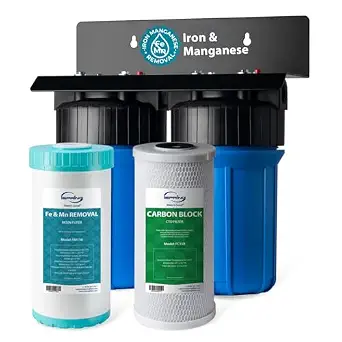 |
| Most Popular A crowd favorite that many people choose with confidence | CuZn UC-200 Under Sink Filter |  |
| Best Seller A high-volume bestseller chosen again and again | iSpring FM25B Iron Filter |  |
AFWFilters Filox 10 1 cu ft

| Media volume | 1 cu. ft. |
|---|---|
| Service flow | 6 GPM |
| Backwash flow required | 5.3 GPM |
| Maximum iron removal | 15 ppm |
| Control valve | Fleck 2510SXT digital |
The AFWFilters Filox 10 is a whole-house backwashing iron, sulfur, and manganese removal system built around 1.0 cubic foot of high-density Filox media and a Fleck 2510SXT digital control head. It is installed on the main water line to oxidize and trap ferrous and ferric iron, hydrogen sulfide odor, manganese, and some sediment so treated water throughout the home is clearer and free of rust stains and rotten-egg smell. The system runs automatically and backwashes when needed, eliminating the need for chemicals, salt, or air injectors, and includes a stainless steel 1" bypass for easy service. Practical benefits include high removal capacities (up to 15 ppm iron, 7 ppm hydrogen sulfide, 3 ppm manganese), a gravel underbed for even flow, and do-it-yourself installation guidance. Important limitations are the minimum pH requirement (around 6.3) for effective removal and the need for sufficient backwash flow (about 5.3 GPM), so homes with low well pump output or very acidic water may require pretreatment or a different configuration. The unit is substantial and intended for whole-home installation rather than point-of-use applications.
Best for: Buyers who want a low-maintenance whole-house solution to eliminate rust stains, rotten-egg odor, and visible iron or manganese in household water and who value automatic backwashing and proven media performance.
Less Ideal for: Homes with very low service flow or acidic water without prior pH adjustment should consider alternative systems or pretreatment before choosing this unit.
- Removes iron, hydrogen sulfide, and manganese without chemicals or air injection
- Automatic digital Fleck 2510SXT backwash control reduces manual maintenance
- Rated removal capacities up to 15 ppm iron, 7 ppm hydrogen sulfide, and 3 ppm manganese
- Includes 1" stainless steel bypass and installation instructions for DIY setup
- Requires minimum feedwater pH near 6.3 for optimal performance
- Needs about 5.3 GPM for backwash which may exceed low-flow well systems
Verdict: Choose the Filox 10 if you need a durable, chemical-free whole-house system that automatically removes high levels of iron, sulfur odor, and manganese.
AFWFilters Iron Pro 2 64k

| Capacity | 64,000 grain |
|---|---|
| Control valve | Fleck 5600SXT digital metered |
| Removes up to | Iron 6 ppm, Manganese 6 ppm |
| Includes | Brine tank and bypass valve |
The Iron Pro 2 is an all-in-one whole-house softener and iron filter built for homes that need reliable, high-flow treatment. It pairs a 64,000-grain softener with fine-mesh resin and media tuned to remove up to about 6 ppm of ferrous and low levels of ferric iron plus manganese, rust, sediment, and hardness. The Fleck 5600SXT digital metered valve provides demand-initiated regeneration so the unit only cycles when needed, which saves salt and water compared with time-based systems. The package includes a brine tank, bypass valve, and DIY instructions, and Pentair-style tanks carry long-term warranty coverage for durability. Expect straightforward installation for someone comfortable with basic plumbing, and practical benefits include steady high flow for whole-house use and reduced staining and scale. Important limitations are the system size and weight that typically require a basement or utility area and the need to size and configure the unit to your household water profile to get the claimed iron and manganese removal performance.
Best for: Buyers who prioritize strong iron removal and high-flow whole-house performance and are willing to install a robust, serviceable system that minimizes regeneration cycles.
Less Ideal for: Renters, small apartments, or users seeking a compact under-sink iron solution should consider smaller point-of-use filters instead.
- Combined softener and iron filter removes hardness, iron, manganese, sediment, and rust
- High 64,000-grain capacity supports larger households and longer service intervals
- Fleck 5600SXT metered valve provides demand-based regeneration to conserve salt and water
- Designed for high flow suitable for whole-house supply without noticeable pressure loss
- Large, heavy unit that requires a dedicated installation space and likely professional help
- Performance depends on correct sizing and water chemistry; may need pre-treatment for high ferric iron or elevated contaminants
Verdict: Choose the Iron Pro 2 when you need a high-capacity, high-flow whole-house system that combines softening and effective iron removal with demand-driven regeneration.
Waterdrop WHF21-FG Whole House Filter

| Purification Method | Granular Activated Carbon |
|---|---|
| Maximum Flow Rate | 15 gpm |
| Filter Life Cycle | 6 months |
| Capacity | 50000 gallons |
| Supported Water TDS Level Maximum (PPM) | 1000 |
The Waterdrop WHF21-FG is a 2-stage whole-house system designed to tackle well and municipal water issues by combining an iron and manganese reduction cartridge with granular activated carbon. It installs on a 1" inlet/outlet and supports up to 15 gallons per minute, so household fixtures and appliances can run simultaneously with minimal pressure loss. The twin cartridges are rated to remove iron, manganese, chlorine, rust and particles larger than 5 microns and are third-party tested for high removal percentages. The unit ships with mounting hardware, a wrench, and pre-installed parts to simplify a DIY setup, and reinforced brass threads plus dual O-rings aim to reduce leaks. Filters are sized to treat roughly 50,000 gallons or about six months of service before replacement, which keeps routine maintenance infrequent. Expect a straightforward mechanical system without electronic monitoring or softening capability, so very hard water minerals beyond soluble iron and manganese may still require a dedicated water softener or additional treatment stage.
Best for: Buyers who want a practical, low-maintenance whole-house filter that prioritizes removing iron, manganese and chlorine while preserving household water flow and minimizing frequent service.
Less Ideal for: Homes that need full-scale hardness removal or advanced multi-stage treatment beyond iron and chlorine reduction should consider a system with a softener or additional filtration stages.
- Targets iron and manganese reduction with a specialized first-stage cartridge
- Granular activated carbon reduces chlorine, odor and improves taste
- High flow rate up to 15 gpm supports multiple fixtures without noticeable pressure drop
- Long service life rated to 50,000 gallons or about six months between changes
- Includes mounting bracket, wrench and pre-installed parts for easier DIY installation
- Does not include a salt-based water softener or ion-exchange stage for hardness removal
- No built-in electronic indicators for filter life remaining
- Replacement filters may require periodic purchase and disposal every six months
Verdict: Choose this Waterdrop system if you need an effective, high-flow whole-house filter that specifically reduces iron and manganese while keeping maintenance infrequent.
Waterdrop WF10FG Whole House Filter
| Material Type | NSF/ANSI Approved Components |
|---|---|
| Set Name | Iron&Manganese&Chlorine Reduction Filter |
| Unit Count | 2 Count |
| Compatible Water Purifier Models | Culligan WH-HD200-C; GE GNQH38S; GE GNWH38S; GE GXWH30C; GE GXWH35F; GE GXWH40L; Waterdrop WD-WHF21-FG; WD-WHF21-PG; iSpring WGB21B |
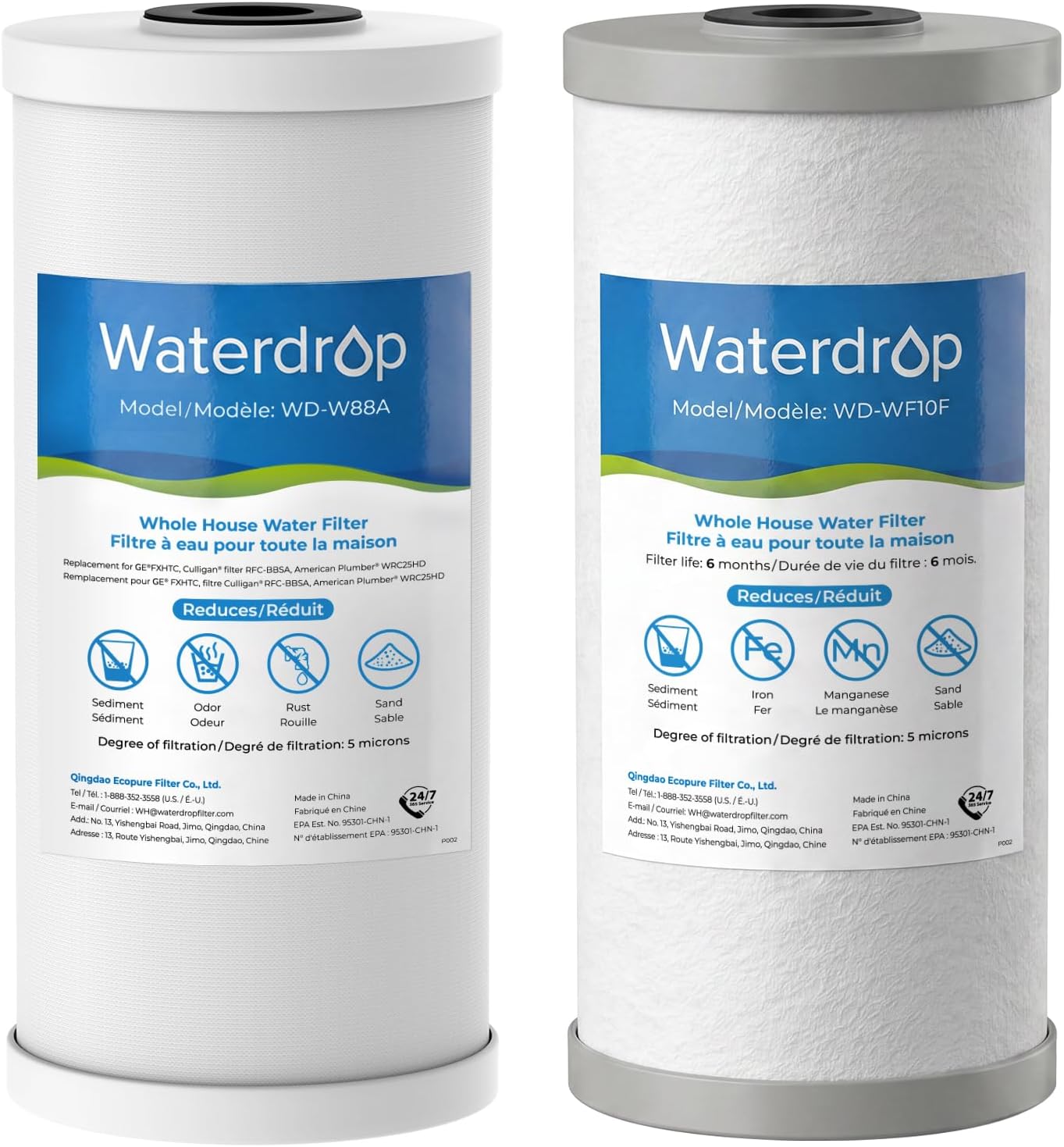
The Waterdrop WF10FG is a 10" x 4.5" replacement cartridge built for whole-house and under-sink systems that focuses on iron, manganese, and chlorine reduction using a five-stage approach that includes a GAC stage made from coconut shell. In typical use you install it in compatible housings and let it treat incoming water to remove particles larger than about 5 microns, reduce rust and improve taste and odor, and help protect downstream appliances. The filter claims high removal rates for iron and manganese and an expected service life of roughly six months under normal conditions, which keeps maintenance predictable. Its NSF/ANSI approved components and broad compatibility with many common housings make it a straightforward swap for older factory cartridges. The main limits are that lifespan and performance depend on feed-water quality and flow rate, and heavy iron or well water with very high sediment may need pre-filtration or more frequent changes to maintain flow and capacity.
Best for: Buyers who need an inexpensive, easy-to-install replacement cartridge to reduce iron, manganese, and chlorine across a whole-house or under-sink 10" x 4.5" system and want predictable maintenance cycles.
Less Ideal for: Homes with extremely high dissolved iron, microbial contamination, or very fine particulate that require specialized iron-removal systems or multi-stage pretreatment should look at more heavy-duty solutions.
- Targets iron, manganese, chlorine, rust, and large sediment with a 5-stage design
- GAC stage made from coconut shell improves taste and reduces odor
- NSF/ANSI approved components for material safety
- Broad compatibility with many 10" x 4.5" housings and common OEM models
- Rated life of about six months can be shorter with very dirty or high-iron water
- Not a standalone solution for very fine particulate or dissolved iron without additional treatment
Verdict: Choose this cartridge if you want a budget-friendly, drop-in replacement that reduces iron, manganese, and chlorine for 10" x 4.5" whole-house or under-sink systems.
iSpring WGB21BM Whole House Filter

| Maximum Flow Rate | 15 gpm |
|---|---|
| Filter Life Cycle | 1 years |
| Inlet / Outlet | 1 inch Female NPT |
| Capacity | 50000 gallons |
| Purification Method | Mechanical filtration, Chemical Absorption, Ion Exchange |
The iSpring WGB21BM is a preassembled two-stage whole-house filter built to reduce chlorine, improve taste, and target iron and manganese in residential water supplies. It pairs a 10" x 4.5" coconut shell carbon CTO cartridge to remove chlorine, VOCs, and turbidity with a catalytic iron and manganese reducing second-stage cartridge rated to drop iron and manganese to very low levels. The unit mounts at the main inlet with 1" female NPT ports and supports household flow up to 15 gpm so it has minimal impact on water pressure for most homes. Installation is DIY-friendly with a mounting bracket, wrench, manual, and video guides, though a plumber can speed the process. Filters are serviceable and the iron/manganese media is long-lived compared with greensand, giving a quoted service life up to 50,000 gallons for the set. Limitations: it does not lower TDS and outdoor installs need frost and sun protection, so it is not a replacement for reverse osmosis when mineral reduction is required.
Best for: Homeowners who want a reliable point-of-entry system that prioritizes robust iron and manganese reduction and low-maintenance, long-life filters to protect plumbing and appliances.
Less Ideal for: People seeking water softening or significant TDS reduction, or those who need an unprotected outdoor installation without weatherproofing measures.
- Two-stage design specifically reduces iron and manganese down to trace levels
- Coconut shell carbon CTO removes chlorine, tastes, odors, and many VOCs
- Supports up to 15 gpm flow so it treats whole-house supply with minimal pressure loss
- Preassembled on a mounting bracket with wrench and video/manual for easier DIY installation
- Iron/manganese catalytic media lasts significantly longer than greensand alternatives
- Does not reduce total dissolved solids so it will not soften water or remove dissolved salts
- Requires indoor or protected outdoor installation to avoid weather damage
Verdict: Choose the WGB21BM if you need a durable, whole-house point-of-entry system focused on dependable iron and manganese removal with easy DIY service.
CuZn UC-200 Under Sink Filter

| Model Number | UC-200 |
|---|---|
| Included Components | Stainless Steel Connection Hose |
| Material Type | NSF Approved Material Components |
| Unit Count | 1 Count |
The CuZn UC-200 is an inline under-sink filter designed for straightforward DIY installation and multi-year service. It uses a three-stage combination of micro sediment membrane, KDF-55 and coconut shell carbon to cut chlorine, lead, PFAs/PFOS and common taste and odor problems while leaving healthy minerals in the water. Installation is simple using the included stainless steel connection hose and requires no drilling, so it fits easily under a kitchen or bathroom sink and connects directly to the cold water feed. The headline benefit is durability: the company rates the unit for up to five years or 50,000 gallons depending on input water, which reduces replacement frequency and plastic waste versus short-life cartridges. Practical limits are that it does not lower total dissolved solids or perform full reverse osmosis-level purification, and actual lifespan depends on local water quality and contaminant load. For buyers focused on improving taste and removing specific contaminants like lead and PFAs while minimizing maintenance, the UC-200 is a low-hassle option with long service life.
Best for: Buyers who want a low-maintenance under-sink filter that reliably improves taste and reduces contaminants like lead and PFAs while minimizing cartridge changes and plastic waste.
Less Ideal for: Homes that need heavy-duty iron removal, complete TDS reduction, or RO-level purification should consider specialized iron filters or reverse osmosis systems instead.
- Very long rated filter life (up to 5 years or 50,000 gallons) reduces replacement frequency.
- Three-stage media (micro sediment membrane, KDF-55, coconut shell carbon) targets chlorine, lead, PFAs and taste/odor issues.
- Simple direct-connect installation with included stainless steel hose, no drilling required.
- Retains beneficial minerals by not using RO, so water tastes natural.
- Not designed to reduce total dissolved solids (TDS) or replace reverse osmosis systems.
- Actual filter life varies with incoming water quality and heavy iron or sediment may shorten lifespan.
Verdict: Choose the UC-200 if you want a simple, long-lasting under-sink filter that improves taste and cuts lead and PFAs with very infrequent cartridge changes.
iSpring FM25B Iron Filter

| Filtration target | Iron and Manganese reducing |
|---|---|
| Filter size | 4.5" x 20" |
| Capacity | 50,000 gallons at 3.0 ppm iron |
| Flow rate | Up to 15 gallons per minute |
| Feed pressure | 20 – 100 psi |
The iSpring FM25B is a catalytic-media whole-house replacement cartridge built to cut iron and manganese from well or municipal water before it reaches fixtures and appliances. It installs in standard 4.5" x 20" housings such as the iSpring WGB32B/WGB22B series and is used inline as part of a whole-home filtration train to protect plumbing and improve water clarity. The filter uses a nonconsumable catalytic media that the manufacturer says lasts up to three times longer than greensand and delivers a high flow rate with minimal pressure drop, making it suitable for typical household flow demands. It is rated to reduce iron from up to 3.0 ppm down to about 0.01 ppm and is stable across common pH and temperature ranges. Practical benefits include long life (about 50,000 gallons at specified iron levels), no wastewater production, and U.S.-based tech support. Important limits: it does not remove dissolved solids or soften hard water, and performance depends on preconditioning (a water softener is recommended if TDS is high) and accurate water testing for iron levels before purchase.
Best for: Buyers who prioritize dependable, low-maintenance iron removal for a whole-house system and want a long-lived, factory-compatible replacement cartridge backed by local support.
Less Ideal for: Homes needing TDS reduction or active water softening should consider reverse osmosis or a dedicated water softener instead.
- Specifically formulated to reduce iron and manganese to very low levels
- Catalytic media designed for long life—up to three times longer than greensand
- High flow rate with low pressure drop suitable for whole-house use
- Designed for standard 4.5" x 20" housings including iSpring WGB32B and WGB22B
- Does not remove total dissolved solids or act as a water softener
- Effectiveness depends on water chemistry; well water should be tested before purchase
Verdict: Choose the iSpring FM25B when you need a reliable, long-life whole-house cartridge specifically tuned to remove iron and manganese with minimal pressure loss.
Choosing the Right Water Filter for Iron Removal: Key Factors to Consider
Type of Iron Present
Iron appears in water mainly as dissolved (ferrous) iron or particulate (ferric) iron. Dissolved iron is typically clear in the glass and oxidizes to a reddish color when exposed to air, while particulate iron shows up as visible rust particles. Knowing which form dominates in your supply determines the treatment method you need.
Dissolved iron often requires oxidation followed by filtration or ion-exchange media that can capture the oxidized particles. Particulate iron can sometimes be handled with sediment filtration alone if the particles are large, but fine particulate iron and iron combined with organic matter usually need specialized media or backwashing systems. Test results or visual inspection before buying will guide whether a simple cartridge filter will work or if you need a media tank or oxidizing system.
Iron Concentration and Capacity
Lab or home test results should report iron concentration in parts per million or milligrams per liter, which helps size the system. Higher iron concentrations require larger media beds or more frequent regeneration to avoid premature breakthrough and staining.
Capacity ratings like pounds of iron removed or gallons per cycle matter because they translate test numbers into service intervals. A system with higher rated capacity will run longer between maintenance cycles and media changes, so plan for both typical daily usage and seasonal peaks in demand when evaluating capacity figures.
Flow Rate and Household Demand
Flow rate specifications determine how well a filter will support showers, washing machines, dishwashers, and simultaneous taps. Whole-house filters must maintain sufficient peak flow without causing a noticeable drop in water pressure. Point-of-use filters may accept lower flows but should still meet faucet or appliance needs.
Flow rate sustainability also depends on how the media performs as it loads with iron. Some systems maintain near-rated flow until a scheduled backwash, while others experience gradual pressure loss. Consider both the stated flow rate and any manufacturer guidance about real-world flow under loaded conditions.
Maintenance and Regeneration
Iron-removal systems range from near-maintenance-free cartridge filters to media tanks requiring periodic backwashing or chemical regeneration. Maintenance frequency affects operating cost and convenience. Backwashing systems need municipal water pressure and a drain, while ion-exchange or oxidation-media systems might require salt or periodic replacement of media.
Evaluate how easy it is to perform routine tasks like replacing cartridges, starting a regeneration cycle, or changing media. Also consider availability and cost of replacement parts or media, and whether a professional service call is required for typical upkeep.
Installation and Plumbing Compatibility
Some systems are designed for simple under-sink or inline installation, while whole-house media tanks need space, proper connections, and a drain for backwash. Check inlet and outlet sizing, mounting options, and whether additional pre-filters or softening equipment are recommended for optimal performance.
Also factor in the disruption and cost of installation: hard-plumbed tanks and control valves often require a plumber for correct setup, whereas cartridge housings and point-of-use filters can be DIY-friendly. Make sure the system you choose matches the intended installation location and the existing plumbing layout.
Water Chemistry Interactions
Iron removal does not happen in isolation. pH, dissolved oxygen, manganese, and hardness all influence how well a treatment method works and how quickly media will foul. For example, low oxygen levels can make oxidizing systems less effective, and high manganese can require additional media or specialized treatment.
A comprehensive water test allows you to anticipate interactions and select pre-treatment steps if needed, such as aeration, oxidation additives, or a water softener to reduce hardness that otherwise would shorten media life.
Common Iron-Removal Methods Explained
Residential iron-removal relies on a few repeatable methods: oxidation followed by filtration, catalytic media that converts dissolved iron to particulate form, ion-exchange systems, and physical sediment filtration for particulate iron. Each approach has strengths and typical use cases.
Oxidation converts dissolved iron into solid particles that can be trapped in a media bed or cartridge. Catalytic media accelerates that conversion without chemical additives and is common in whole-house tanks. Ion-exchange removes dissolved iron but often requires regeneration and is sensitive to competing minerals.
- Oxidation plus filtration: Effective for ferrous iron when aeration or oxidants are present.
- Catalytic media: Low-chemical option that traps oxidized iron and is backwashed regularly.
- Ion-exchange: Works for dissolved iron but may need salt or regenerant and is impacted by hardness.
- Sediment filters: Useful for visible rust particles but not reliable for dissolved iron.
Testing Your Water Before You Buy
Start with a water test that quantifies iron, manganese, hardness, pH, and oxidant levels. Many municipal reports do not show private well chemistry, so well owners should use lab testing or reliable home test kits. Bring sample results to any purchase decision because they determine method effectiveness and system sizing.
If you detect intermittent or seasonal spikes, document when those occur and how they coincide with usage patterns. That helps determine whether increased capacity or an automatic regeneration schedule is necessary.
- Test for both dissolved and particulate iron when possible.
- Check pH and manganese levels to anticipate treatment interactions.
- Record peak household flow needs to match system flow ratings.
Where to Install Different System Types
Point-of-use cartridges are best for single fixtures like kitchen taps or under-sink drinking water, offering targeted iron and taste improvement without the cost of whole-house plumbing changes. They are user-friendly but generally have lower capacity.
Whole-house media tanks are installed at the main line and protect plumbing, appliances, and laundry from staining. These systems require space for the tank and a drain for backwash. Some hybrid setups pair a whole-house tank with point-of-use polishing filters for drinking water.
- Under-sink filters: Easy install, limited coverage.
- Inline housings at the entry: Protects specific appliances.
- Main-line media tanks: Comprehensive protection for the whole home.
Signs a System Needs Service or Replacement
Monitor water appearance, taste, and appliance performance. A resurgence of staining, metallic taste, or discoloration often signals exhausted media, clogged cartridges, or a failed regeneration cycle. Decreasing water pressure at taps can indicate media loading or an obstructed filter.
Track maintenance intervals recommended by the manufacturer and adjust based on your measured iron load and water use. Systems that allow easy inspection or have a visible usage counter make it simpler to stay on schedule.
- Reddish stains reappearing on fixtures and laundry
- Talk or metallic taste returns in drinking water
- Noticeable drop in household water pressure
Coordinating Iron Removal with Other Treatments
Iron removal often pairs with softening, sediment pre-filtration, or chlorine-based treatments depending on water chemistry. For example, a sediment pre-filter can protect higher-performance media from being prematurely fouled by sand or rust flakes. Softening may be recommended if hardness would shorten media life or interfere with ion-exchange processes.
Plan treatment order carefully: sediment removal first, then iron-specific media or oxidation, followed by softening or polishing steps as needed. A staged approach provides the most reliable long-term results.
- Use sediment pre-filters to extend media life
- Place iron-specific tanks before softeners in most cases
- Consider a final carbon or polishing filter for taste and odor
How We Chose the Best Water Filter for Iron Removal
We shortlisted systems that address dissolved and particulate iron with methods proven in residential settings. Selection prioritized verified iron-reduction mechanisms such as oxidation and filtration media, backwash or regeneration options for sustained capacity, and clear rated removal capacities tied to iron concentration. We favored models with adequate flow rates for whole-house use or point-of-use needs, straightforward maintenance procedures, and accessible replacement media. Durability of pressure vessels and the availability of serviceable parts were also considered because iron management can strain components over time. We excluded products designed only for temporary or experimental use, devices without documented iron-removal claims, and filters intended solely for sediment or chlorine removal. Editorial filters focused on real-world metrics buyers can compare: rated iron capacity, service interval, flow performance, ease of maintenance, and installation flexibility.
Our full evaluation process is outlined in our review methodology.
FAQ
Can a simple cartridge filter remove iron from my water?
A cartridge can capture particulate iron and improve aesthetics if the particles are visible and large. Cartridges are usually inadequate for dissolved iron unless they contain specialized oxidizing or catalytic media, and they will need frequent changes with higher iron loads.
How often will I need to service an iron-removal system?
Service intervals vary widely based on iron concentration, household water use, and system capacity. Expect anything from monthly cartridge changes in high-iron situations to backwash cycles on media tanks that run automatically every few days. Use test results and observed performance to set a maintenance schedule.
Will an iron filter also fix a metallic taste or odor?
Removing iron often reduces metallic taste associated with iron itself, but taste and odor can stem from other contaminants. A polishing carbon filter or point-of-use treatment may be needed to address residual tastes or odors after iron removal.
Is professional installation required for whole-house iron systems?
Whole-house media tanks and backwash systems generally need a professional plumber for reliable installation, drain hookup, and control valve setup. Simpler under-sink or inline filters are frequently suitable for DIY installation.
Can water softeners remove iron?
Water softeners can remove small amounts of dissolved iron but are not primarily designed for iron removal. High iron concentrations can foul resin beds and reduce softener effectiveness, so an iron-specific pre-treatment is often recommended.
Final Verdict
Focus first on understanding your water: test for iron type and concentration, then match the treatment method to that profile. Prioritize systems with the right removal capacity and flow ratings for your household, and factor in maintenance needs and plumbing compatibility. Choosing a system that balances sustained flow, manageable upkeep, and robust construction will give the most reliable stain and rust control. With a clear picture of your water chemistry and usage, you can select an iron-removal solution that keeps water looking and tasting better over the long term.