
Note: This article contains affiliate links. If you click on these links and make a purchase, we may earn a small commission at no extra cost to you. This helps support our research and content. Read our full affiliate disclosure here.
If your tap water shows iron staining, metallic taste, or reddish-brown buildup around fixtures, selecting the right water filter for iron water matters. Iron in water is common in older plumbing and well systems, and untreated iron can stain laundry, cloud glassware, and shorten the life of appliances. This guide covers seven shortlisted water filters chosen for their ability to treat dissolved and particulate iron while preserving household water pressure and flow. Below we summarize how each filter addresses iron removal, service life, and installation, and we flag the practical tradeoffs buyers face. Read on for the evaluation criteria and product-type breakdowns that will help you pick the best option for your home.
Top Picks at a Glance
| Best Overall The best all-around choice for most situations | Waterdrop WHF3T-FG Whole House Filter |  |
| Best Quality Built to a higher standard if you want something more solid | DuraWater Air Injection Iron Eater 1.0 cu ft |  |
| Best Value The sweet spot between price and what you get | Waterdrop WF10FG Whole House Filter |  |
| Best Budget The cheapest option that still gets the job done reliably | PUREPLUS 5 Micron 10" x 4.5" Sediment Filter |  |
| Top Rated A top-rated pick with lots of positive feedback | A. O. Smith Whole House Filter AO-WH-Filter |  |
| Most Popular A crowd favorite that many people choose with confidence | Camco TastePure RV Water Filter |  |
| Best Seller A high-volume bestseller chosen again and again | iSpring F3WGB32BM 3-Stage Pack |  |
Waterdrop WHF3T-FG Whole House Filter

| Filtration Precision | 5 Micron |
|---|---|
| Maximum Flow Rate | 15 gpm |
| Supported Water TDS Level Maximum (PPM) | 300 |
| Filter Life Cycle | 6 months |
| Material Type | NSF/ANSI Approved Components |
The Waterdrop WHF3T-FG is a point-of-entry, 3-stage whole-house filtration system designed to tackle iron- and manganese-heavy well water while also reducing chlorine, sediment, rust and odors. It uses a double iron and manganese removal cartridge plus a granular activated carbon stage to provide seven stages of filtration in practice, and supports a steady 15 gpm flow for normal household use. Installation is intended at the main inlet with 1" ports and the kit includes three cartridges, a wrench and mounting hardware; the manufacturer notes the iron/manganese cartridge should be replaced every 6–12 months and the GAC cartridge about every 12 months depending on water quality. The system is built with NSF/ANSI approved components and is tested for durability, but it is not a water softener and will not reduce TDS. For buyers with well water concerns, it offers stronger iron and manganese reduction than typical single-stage filters, though periodic cartridge replacement and space for the housings are practical considerations.
Best for: Homeowners with well water who need reliable reduction of iron, manganese and common municipal contaminants and who want a whole-house, point-of-entry solution rather than a single tap filter.
Less Ideal for: Homes seeking water softening or TDS reduction or very high-demand households that may exceed typical single-system flow and simultaneous fixture usage.
- Engineered specifically to reduce iron and manganese with a double removal cartridge
- Includes multi-stage filtration with granular activated carbon to cut chlorine, taste and odor
- Supports up to 15 gpm for steady whole-house supply
- NSF/ANSI approved components and durability testing for reliable operation
- Does not soften water or reduce total dissolved solids
- Requires regular cartridge replacements (iron/manganese 6–12 months, GAC ~12 months)
Verdict: Choose this system if you need a whole-house filter built for well water that prioritizes strong iron and manganese reduction while maintaining steady household flow.
DuraWater Air Injection Iron Eater 1.0 cu ft

| Size | 10X54" |
|---|---|
| Filter media volume | 1.0 cu ft |
| Included components | complete system |
| Bypass size | 1 inch plastic bypass |
This DuraWater Air Injection Iron Eater is a bundled, performance-focused media filtration system designed to remove iron, manganese, and H2S from well water. The kit includes 1.0 cubic foot of filter media, a 10×54 inch mineral tank, a 1-inch plastic bypass, and a digital control valve; air injection oxidizes dissolved iron and sulfur so the media can capture the precipitated particles. In practice it is installed in the main water line and works continuously with the control valve managing backwash cycles and air pocket formation, so maintenance is mostly limited to occasional media replacement and periodic valve checks. The system is built for serious iron issues and provides stronger contaminant removal than simple carbon or sediment filters, but it requires basic plumbing skills for DIY installation and sufficient tank space. The plastic bypass and non-specified valve specs mean buyers should confirm flow needs for large households before installing. For homes with iron-stained fixtures or rotten-egg odor, this system delivers a factory-quality, whole-house treatment option that focuses on performance rather than compact convenience.
Best for: Buyers who need a high-performance, whole-house solution for iron, manganese, or hydrogen sulfide issues and are willing to install and maintain a tank-based filtration system.
Less Ideal for: Those seeking a compact countertop or point-of-use filter, or renters and users unwilling to perform plumbing installation should consider alternatives.
- Complete kit that includes media, mineral tank, bypass and digital control valve for whole-house installation
- Air injection oxidation improves removal of dissolved iron, manganese and H2S compared with passive media alone
- 1.0 cubic foot of media provides substantial contact volume for better contaminant capture
- Digital control valve automates backwash and air-pocket management to reduce hands-on maintenance
- Requires space for a 10×54 inch tank and basic plumbing know-how for installation
- Plastic bypass and limited published flow specs may constrain high-flow household applications
Verdict: Choose this system when you need a robust, whole-house air-injection solution to aggressively remove iron, manganese, and H2S.
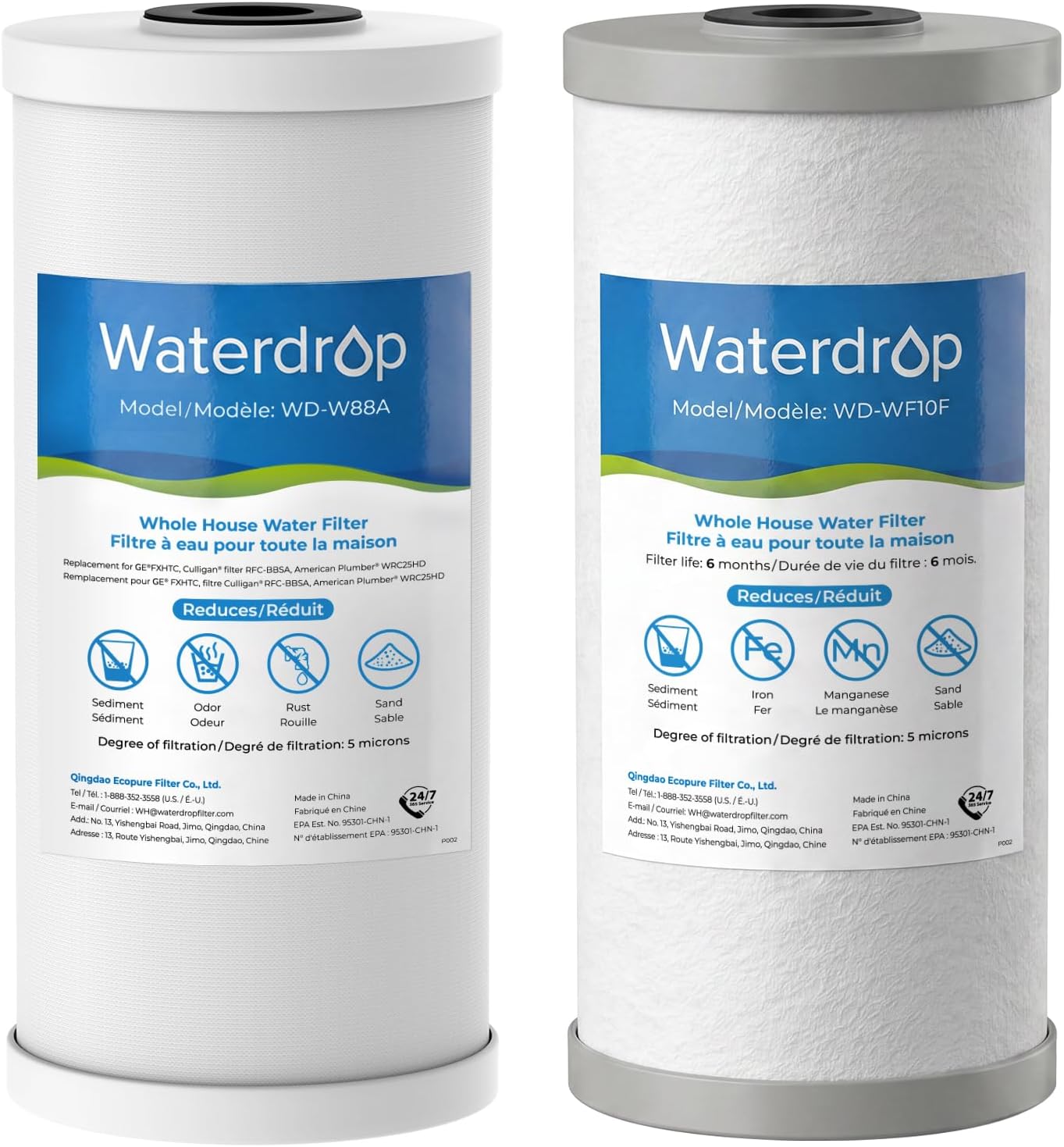
Waterdrop WF10FG Whole House Filter
| Material Type | NSF/ANSI Approved Components |
|---|---|
| Compatible Water Purifier Models | Culligan WH-HD200-C; GE GXWH40L; Waterdrop WD-WHF21-FG; iSpring WGB21B |
| Product Benefits | Reduces iron, manganese and chlorine; 5-stage filtration |
| Unit Count | 2 Count |
This Waterdrop WF10FG replacement filter is built for whole-house 10" x 4.5" systems and targets iron, manganese and chlorine with a 5-stage filtration that includes granular activated carbon from coconut shell for better taste and odor. It is typically used as a direct replacement in compatible under-sink and whole-house housings to cut rust, sediment and the metallic taste common in iron-heavy water. The manufacturer claims high reduction rates for iron and manganese and a service life of roughly six months under normal use, which makes it a straightforward scheduled-maintenance part for homeowners treating well water or municipal supplies with iron issues. The filter uses NSF/ANSI approved components and fits many common housings from GE, Culligan, iSpring and Waterdrop, so installation is usually a simple swap when plumbing sizes match. Limitations include the need for periodic replacement every few months and dependence on pre-filtration for very sandy or high-sediment feeds, since very coarse particulate can shorten life and performance.
Best for: Homeowners dealing with detectable iron or manganese in their water who want a practical, swap-in filter that improves taste and protects plumbing and appliances with predictable maintenance.
Less Ideal for: People seeking a one-time permanent solution or filters that remove a wider range of contaminants beyond iron, manganese and chlorine should consider multi-stage systems with targeted media or professional water treatment.
- Specifically formulated 5-stage filtration to reduce iron, manganese and chlorine
- Uses coconut-shell GAC to improve taste and reduce odor
- NSF/ANSI approved components for material safety
- Direct compatibility with many common 10" x 4.5" housings for easy replacement
- Requires replacement about every six months, adding recurring maintenance
- May need upstream sediment pre-filtration in very dirty or sandy water to maintain lifespan
Verdict: Choose this filter if you need a reliable, easy-to-install replacement that specifically reduces iron and manganese and improves water taste in 10" x 4.5" whole-house systems.
PUREPLUS 5 Micron 10" x 4.5" Sediment Filter

| Micron rating | 5 Micron |
|---|---|
| Material Type | Polypropylene (PP) |
| Unit Count | 2 Count |
| Compatible Water Purifier Models | GE GNWH38F, GXWH30C, GXWH35F, GXWH40L |
The PUREPLUS 5-micron 10" x 4.5" string-wound sediment filter is a basic replacement cartridge designed to remove sand, rust, and visible particulates from well or municipal water before it reaches downstream filters or appliances. You install it in a standard 10" x 4.5" heavy-duty housing and flush a new cartridge for about five minutes to condition it. The polypropylene string-wound construction offers layered density that traps particles while maintaining decent flow rates reported up to about 2.5 GPM, and the manufacturer claims higher dirt-holding capacity and a long service life depending on water quality. It comes as a two-pack and is ANSI tested, which is useful for routine whole-house sediment control and to protect carbon or iron-removal stages that follow. Limitations are that it is a sediment-only cartridge and will not remove dissolved iron, iron bacteria, or chlorine, so it must be paired with a proper iron-specific media or oxidation/filtration system when iron removal is the goal.
Best for: Buyers on a budget who need an inexpensive, reliable sediment prefilter to protect downstream iron-removal or carbon systems and extend appliance life.
Less Ideal for: If your primary goal is to remove dissolved iron, iron bacteria, or change water chemistry, choose a dedicated iron removal or oxidation/filtration solution instead.
- Effective at removing visible sediment, rust, and sand from well water.
- String-wound polypropylene design offers good dirt-holding capacity and multilayer filtration.
- Sold as a two-pack for straightforward replacement scheduling.
- Fits standard 10" x 4.5" heavy-duty housings for broad compatibility.
- ANSI external testing noted, supporting basic quality verification.
- Does not remove dissolved iron, iron bacteria, or chemical contaminants.
- Replacement interval varies with water quality and may be as often as every 3 months in heavy sediment conditions.
Verdict: A budget-friendly, ANSI-tested sediment cartridge that protects downstream iron-removal systems by capturing sand and rust before they clog specialty media.
A. O. Smith Whole House Filter AO-WH-Filter

| Purification Method | Activated Carbon |
|---|---|
| Other Special Features | Chlorine Reduction, NSF/ANSI 42 Certified |
| Maximum Flow Rate | 7 gpm |
| Operating Pressure Range | 20-100 psi |
| Filter Life Cycle | 6 years |
The A. O. Smith AO-WH-Filter is a whole-house activated carbon system that conditions city or well water by removing chlorine taste and odor for use at every tap. It installs inline with 3/4" connections and ships with a shut-off valve, flushing nipple, and hose adapter to support DIY installation without a drain or backwash. The cartridge is rated for up to 600,000 gallons or about six years of service, and the unit is NSF/ANSI 42 certified for chlorine reduction, helping improve shower air and water taste. Flow capacity is up to 7 gpm and it tolerates common household pressures. Important limitations: this is not a water softener and will not remove dissolved iron, heavy sediment, or sulfur long term, so homes with iron water should pair it with an iron-specific prefilter or treatment. The fiberglass tank and long life cycle make it a low-maintenance option for buyers who prioritize steady, long-term chlorine control rather than multi-contaminant removal.
Best for: Homeowners who prioritize a reliable, low-maintenance whole-house solution for consistent chlorine taste and odor control and want a long-lasting factory-quality filter they can install themselves.
Less Ideal for: Homes where iron, high sediment loads, or water hardness are primary concerns should look for an iron-specific treatment or a multi-stage system instead.
- Long service life rated to 600,000 gallons or six years which reduces replacement frequency
- NSF/ANSI 42 certification for chlorine taste and odor reduction
- Includes basic installation parts (shut-off valve, nipple, hose adapter) for DIY setup
- Activated carbon media improves water taste and reduces chlorine off-gassing into home air
- Does not remove hardness, dissolved iron, or sulfur so it is not a standalone solution for iron-rich water
- No backwash or drain function so heavy sediment may require a separate prefilter
Verdict: Choose this durable AO Smith whole-house carbon filter if you want a long-life, low-maintenance factory-quality system to reliably remove chlorine taste and odor across every tap.
Camco TastePure RV Water Filter

| Material Type | Polypropylene (PP) |
|---|---|
| Certifications | NSF/ANSI 42, NSF/ANSI 53, NSF/ANSI 372 |
| Included Components | Adapter |
| Model Number | 40043 |
The Camco TastePure RV Water Filter is an inline hose filter meant for campers, boats, and other outdoor water connections where you want better tasting, safer water. It combines granular activated carbon (GAC) with KDF media and a 20-micron sediment layer to reduce chlorine, bad tastes and odors while blocking visible sediment, and the KDF stage helps inhibit bacterial and mold growth when the line is idle. Its wide-body, high-flow design keeps water pressure reasonable for drinking, cooking and filling tanks, and the included flexible hose protector prevents kinks and strain at the connection. The unit is made in the USA and carries NSF/ANSI 42, 53 and 372 listings, which supports its claims for contaminant reduction and lead-free construction. Limitations to note: it is an inline disposable filter rather than a cartridge you can service, and it is not described as a specialized iron removal system, so heavy iron staining or very high iron concentrations may require a dedicated iron filter or pre-treatment.
Best for: Campers, boaters, and RV owners who prioritize proven, certified filtration for better-tasting potable water and want a simple inline solution that is easy to attach and use at the spigot.
Less Ideal for: Homes or properties with high dissolved iron levels, rust stains, or groundwater iron problems that require a specialized iron removal system or whole-house treatment.
- Multi-stage filtration (GAC + KDF + 20-micron sediment) reduces taste, odor, chlorine and visible sediment
- High-flow wide-body design maintains usable water pressure for drinking and filling tanks
- NSF/ANSI 42, 53 and 372 listings verify certified performance and lead-free content
- Includes flexible hose protector to prevent kinks and reduce stress at connections
- Made in the USA with a patented design and factory-quality construction
- Not a dedicated iron removal filter and may be insufficient for heavy iron or severe iron staining
- Disposable inline design offers no user-serviceable cartridges for long-term maintenance
Verdict: Choose this TastePure inline filter when you want a certified, easy-to-install RV hose filter that noticeably improves taste and reduces common contaminants on the road.
iSpring F3WGB32BM 3-Stage Pack

| Included components | Sediment filter x1; carbon block filter x1; iron & manganese reducing filter x1 |
|---|---|
| Compatible models | iSpring WGB32BM |
| Material Type | Sediment + Carbon + Iron & Manganese Removal |
| Capacity (per carbon/sediment) | 100,000 gal |
This three-stage replacement pack is designed for whole-house housings that accept 20" x 4.5" cartridges and combines a sediment prefilter, a coconut-shell carbon block, and an iron & manganese reducing cartridge. In everyday use the sediment stage captures sand and rust down to about 5 microns, the carbon block reduces chlorine and organic tastes while protecting the iron-media, and the catalytic iron cartridge specifically targets dissolved iron and manganese at the claimed limits. The set is sized for long service life and iSpring says the carbon and sediment cartridges are independently tested to NSF/ANSI standards and rated for large capacities, which means less frequent changes for a typical family. Because these are direct replacement cartridges for iSpring WGB32BM housings, installation is straightforward and they maintain normal whole-home flow when installed correctly. Limitations: they do not remove dissolved salts or lower TDS like an RO system, and very high iron/manganese well water may require a specialized iron filter solution rather than this cartridge set.
Best for: Buyers who want a low-risk, factory-compatible replacement pack to reduce visible sediment, chlorine taste, and moderate iron/manganese in whole-house water without complicated installation.
Less Ideal for: Homes needing removal of dissolved salts, very high iron/manganese concentrations, or point-of-use drinking-water demineralization should consider purpose-built iron filters or reverse osmosis systems instead.
- Three-stage approach addresses sediment, chlorine/organics, and iron/manganese specifically
- Fits industry-standard 20" x 4.5" whole-house housings including iSpring WGB32BM
- High-capacity cartridges designed for long service life and lower maintenance frequency
- Independent third-party testing cited for the sediment and carbon stages
- Not designed to reduce total dissolved solids or act as a replacement for RO systems
- May be insufficient for very high iron or manganese levels without a specialized iron treatment
Verdict: A straightforward, factory-compatible three-stage replacement pack that reduces sediment, chlorine taste, and moderate iron/manganese for worry-free whole-house filtration.
Choosing the Right Water Filter for Iron Water: Key Factors to Consider
Type of Iron Present
Iron can appear in water as particulate (visible rust particles) or dissolved (clear water with a metallic taste). Particulate iron is usually trapped by sediment filters, while dissolved iron often needs oxidizing media or chemical treatment before filtration.
Knowing which form of iron you have matters because it determines the filtration approach. A simple sediment filter may be sufficient for particulate iron, but dissolved iron typically requires oxidation followed by granular media or ion-exchange, and sometimes aeration. Testing your water for iron concentration and speciation will guide whether you need a basic cartridge or a more complex treatment train.
Iron Concentration and Capacity Needs
The concentration of iron in parts per million or parts per billion affects how often media will exhaust and need replacement. Higher iron levels shorten service life for filter cartridges and packed media, increasing operating attention and cost.
Estimate your household daily water usage and match it to a filter's rated capacity. Systems with higher capacity or backwashable media reduce frequency of maintenance but may require more space and plumbing access. Poorly matched capacity leads to premature clogging and reduced performance when you need iron removal most.
Flow Rate and Household Demand
A filter that removes iron but restricts flow can cause low pressure at faucets and appliances. Consider peak demand periods like morning showers or simultaneous dishwasher and laundry use when evaluating flow rate retention.
Whole-house systems and inline filters list maximum flow rates. Choose a system whose flow specification covers your household peak flow, or consider parallel filtration or larger media vessels for homes with high simultaneous demand to avoid compromising daily comfort.
Installation Location and Plumbing Access
Decide whether you need a point-of-use unit for drinking and cooking water or a point-of-entry/whole-house system to protect plumbing and appliances. Whole-house installations typically require more space near the main water line and may be more complex to install.
Check for clearance around the unit for service, and whether the unit requires hard plumbing changes or can use existing fittings. Some systems are designed for DIY installation, while others are better handled by a professional. Accessibility affects how easy routine media changes or backwashes will be.
Type of Filtration Media
Different media target iron in different ways: oxidizing media convert dissolved iron to particulates for filtration, chelating resins perform ion-exchange, and manganese greensand or catalytic carbon have specific affinities. Each media type has specific operating needs such as pH range, pre-oxidation, or regeneration chemicals.
Choose media compatible with your water chemistry. For example, systems requiring periodic regeneration need access to regenerant chemicals and appropriate drainage. Media selection influences long-term performance and the complexity of routine upkeep.
Maintenance and Upkeep
Routine tasks include cartridge replacement, media backwashing, and periodic system checks. Ease of accessing cartridges or media vessels, the availability of replacement parts, and whether backwash can be automated are practical considerations for long-term ownership.
Consider how comfortable you are with DIY maintenance and whether you prefer low-touch systems that regenerate automatically. Factor in the time between required service events and whether the device warns when performance drops, since these aspects affect real-world reliability.
How Iron Affects Home Fixtures and Appliances
Iron in water can cause visible staining on sinks, toilets, and laundry, and lead to build-up inside appliances that heat or circulate water. Over time, iron deposits reduce efficiency in water heaters and can shorten the service life of washing machines and dishwashers.
Addressing iron at the point of entry protects the entire plumbing system and prevents recurring cosmetic damage. Point-of-use treatments for drinking water focus on taste and clarity, while whole-house solutions protect fixtures and appliances from long-term harm.
- Rust stains on porcelain and fixtures are common signs of particulate iron.
- Metallic taste or odor often indicates dissolved iron.
- Appliance heat exchange surfaces can accumulate iron deposits, reducing efficiency.
Testing Your Water Before Choosing a System
Start with a basic water test that measures iron concentration and reports whether iron is dissolved or particulate. Local health departments, private labs, or home test kits can provide these metrics. Also check pH, manganese, and hardness, as these affect filter choice and media compatibility.
- Test for total iron, dissolved iron, pH, manganese, and hardness.
- Compare results to the filter manufacturer's recommended operating ranges.
- Retest after installation to confirm the system is functioning as expected.
Common Filtration Approaches for Iron
There are several proven methods for treating iron. Sediment filtration captures visible particles. Oxidation with air, chlorine, or permanganate converts dissolved iron to particles that can be filtered. Ion-exchange resins can remove low levels of dissolved iron in drinking water systems.
Each approach has tradeoffs. Oxidation-based systems often require backwashing and may need chemical feed control. Ion-exchange systems may require periodic regeneration and are typically used in point-of-use setups or for low concentrations of iron.
- Sediment filters: simple, low cost for particulate iron.
- Oxidizing media: convert dissolved iron for filtration.
- Ion-exchange: effective for low-level dissolved iron in drinking water.
Sizing the Right System for Your Home
Match system flow rate and capacity to household peak demand and iron concentration. For whole-house systems, choose media volume and vessel size that will provide acceptable service intervals and maintain pressure across multiple fixtures.
For smaller point-of-use filters, check certified flow rate and expected cartridge life based on your daily use. Oversizing leads to unnecessary expense, while undersizing causes frequent maintenance and poor performance during peak use.
- Calculate peak simultaneous flow in gallons per minute before choosing a system.
- Factor in higher usage during mornings and evenings when sizing.
- Select a system with a buffer between rated capacity and expected use.
Maintenance Best Practices
Follow manufacturer guidance for cartridge replacement intervals, backwash frequency, and any chemical regeneration steps. Keep a log of service dates and changes in water quality so you can detect media exhaustion before it affects fixtures or taste.
Inspect pre-filters and housings regularly for sediment buildup and replace worn seals. If a system includes a backwash cycle, confirm drainage remains unobstructed and the backwash is washing clear within the expected time frame.
- Schedule cartridge checks and replacements based on actual water usage.
- Flush new media according to instructions to avoid early fouling.
- Keep spare O-rings and basic tools handy for quick service.
How We Chose the Best Water Filter for Iron Water
We focused on performance characteristics that directly affect how well a water filter removes iron and fits into a household plumbing system. Core evaluation criteria included iron removal efficiency measured across dissolved and particulate iron types; flow rate retention, because systems that choke household pressure are impractical; filter service life and maintenance complexity; and total capacity before media exhaustion for whole-house or under-sink systems. We also assessed installation flexibility, including compatibility with common plumbing connections and whether professional hookup is typically required. Materials and corrosion resistance were considered to ensure the filtration media and housings stand up to iron-rich water without rapid degradation. Water quality certification or third-party test data was used when available to corroborate claims. We excluded devices that only address taste with carbon alone and systems designed solely for sediment without demonstrated iron reduction. Units requiring proprietary consumables with unclear availability were deprioritized. The final shortlist balances measurable iron removal, realistic maintenance intervals, and practical installation for typical homes.
Our full evaluation process is outlined in our review methodology.
FAQ
How do I know if my iron problem is dissolved or particulate?
A lab test that reports dissolved versus total iron will tell you whether iron is in solution or present as particles. Particulate iron usually causes visible rust flakes and staining, while dissolved iron often makes water taste metallic but looks clear.
Can a simple carbon filter remove iron from water?
Carbon filters improve taste and reduce some contaminants but are not reliable for removing significant levels of iron, especially dissolved iron. Systems designed for iron reduction use oxidizing media or specialized resins.
Will treating iron also handle manganese and sulfur issues?
Some oxidizing media and catalytic materials can reduce manganese and certain sulfur compounds, but effectiveness depends on concentration and system design. Test for those contaminants and choose a system with documented performance for multiple targets if present.
How often will I need to service an iron removal system?
Service intervals vary with iron concentration and household use. Cartridge systems may need replacement every few months under high iron loads, while backwashable media in larger vessels can go much longer between service events. Monitor water quality and follow the system's maintenance schedule.
Is professional installation necessary for whole-house iron filters?
Whole-house systems often require hard plumbing, adequate space, and proper bypass plumbing for service, so professional installation is commonly recommended. Simpler point-of-use units are often DIY-friendly if you have basic plumbing skills.
Final Verdict
When choosing a water filter for iron water, prioritize matching the treatment method to the type and concentration of iron in your supply. Balance iron removal efficiency and filter capacity against required flow rates so household comfort is not compromised. Also factor in installation constraints and how much maintenance you are willing to perform. Pick a system that fits your household demand and water chemistry, and plan for routine testing and maintenance. That approach helps ensure reliable iron control, clearer water, and fewer stains without unexpected drops in water pressure.